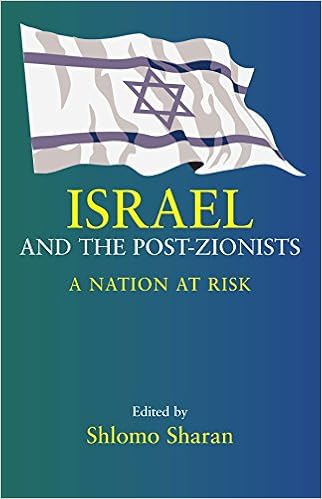
Israel exists in order to protect the rights of the Jews. That includes rights to life, liberty, property, and, of course, immigration to Israel as a place of refuge. The "post-Zionists" claim that this function of Israel is no longer necessary. That would be a dubious claim in peacetime. It is absurd in wartime. That means that the "post-Zionists" are wrong, and that are failing to defend human rights.
Shlomo Sharan begins this book by explaining that in every generation, some Jews sought freedom from Exile, and that the flow of Jews into the Levant never completely ceased. And that the Arab armies have far more soldiers than does Israel's army. And that the idea that peace can be achieved, rather than precluded, by setting up a new Arab country next to Israel, although promoted by Europe and America, is an illusion.
Following Sharan's introduction are twelve articles that comprise the rest of the book.
Yoav Gelber's article shows that the goal of the Levantine Arabs has been neither coexistence nor compromise.
Sharan follows with an article about Myth. He points out that post-Zionist publications are aimed at vilifying Zionism, not at telling the truth. And he wonders why the statement that the Arab armies have a numerical superiority over Israel's army is called a "myth" (with the implication of being a falsehood) when it is actually a fact. He says that "the ingathering of exiles" (another fact) is not included in the list of Zionist "myths." I suspect it will be, though! And he says that the deconstructionist approach to history is extremely nihilistic.
Now, is post-Zionism antisemitic? Sharan says it is. After all, the salient characteristics of antisemitism are:
1) Fabrication (false accusations, such as blood libel)
2) Generalization (holding all Jews responsible for an act of an individual)
3) Judaization (asserting that only Jews commit a set of crimes that are regularly committed by people in all societies)
4) Discriminatory harshness (if Gentiles do it, it's cool, if Jews do it, it's tacky)
Post-Zionism certainly meets the first, third, and fourth of these characteristics.
Edward Alexander's fine article discusses politics and Israeli intellectuals. One book he discusses is David Grossman's "The Yellow Wind," which he points out has occasional patches of honesty. But he explains that Grossman is more upset by the potential of Jewish terrorism than the reality of Arab terrorism.
Hanan Alexander shows the danger of dismissing Jewish rights on the grounds that Israel is "hegemonic" and the Arabs are "oppressed." Any crimes could be justified by such an argument, and acceptance of this would preclude the rule of law.
David Bukay tries to explain the identification of many Jews with their mortal enemies. He says it is part of the heritage of Exile, where there was a desire to flatter and tattle to win approval from Gentiles. And he points out that this runs counter to the behavior of most of the people in other nations.
Raya Epstein shows the religious nature of anti-Zionism, which is basically a "new world church" that pits an alliance of Europe and the Muslim world against the right of Israel (and of Jews) to exist. And John Fonte has a fine article about the powerful antidemocratic forces that remain in Western society.
Norman Doidge shows the seriousness of the failure to bring Arafat to justice for his horrendous crimes. This has had the effect of implying that some of his crimes may be justified.
Arieh Stav discusses Jewish self-hatred. And he explains that Israel's status in the UN ought not be overlooked. In 1997, 131 states, representing 95% of the people in the world, denounced Israel "for daring to prepare land for housing construction within the municipal boundaries of its capital."
Articles by Yosef Oren, Hillel Weiss, and Shlomo Sharan conclude this interesting book. I recommend it.

No comments:
Post a Comment