Jews Praying In The Synagogue on the Day of Atonement by Maurycy Gottlieb (Tel Aviv Museum of Art)
The Israel Book Review has been edited by Stephen Darori since 1985. It actively promotes English Literacy in Israel .#israelbookreview is sponsored by Foundations including the Darori Foundation and Israeli Government Ministries and has won many accolades .
Email contact: israelbookreview@gmail.com
Office Address: Israel Book Review ,Rechov Chana Senesh 16 Suite 2, Bat Yam 5930838 Israel
Arthur Szyk: Style, Subjects, and Work that changed After Holocaust
Arthur Szyk was one of the more extraordinary Jewish artists to come out of the 20th century. Both in his life and in his art he reflected the world-changing events of the century, the century that transformed the Jewish people and ushered in the world we know today.
There once was a debate among critics as to what extent Szyk can be called an artist. The Times of London once said his art was “among the most beautiful ever produced by the hand of man.” Others saw him as a commercialist who cheapened art by using it in “lowbrow” ways. The reason is that he put his art in the service of different causes and, therefore, was seen by some as little more than a propagandist.
We will not enter here into the discussion, other than to say that for those who see it as legitimate and perhaps important that artists are engaged with the world in which they live, Szyk represents a classic example of that tendency. The artist engaged. As he himself said: An artist, and especially a Jewish artist, cannot be neutral in these times. He cannot escape to still lifes, abstractions and experiments. Art that is purely cerebral is dead. Our life is involved in a terrible tragedy and I am resolved to serve my people with all my art, with all my talent, with all my knowledge. Szyk said that in 1934, outraged at the rise of Nazism, but it was the motto that characterized him for the next 20 years. Haman hangs as Szyk watches (from Megillat Esther by Arthur Szyk) Courtesy of Szyk Society, California
In technical terms, it might be more accurate to see Szyk, first and foremost as an illustrator. He took ideas or texts and created a visual representation of them. He was also a first-rate illuminator of texts in the manner of the classic medieval scribes who laboured endlessly to illustrate their manuscripts.
Pogroms mobilized him
Szyk, was born in 1894 in Lodz, Poland (then part of Russia). It was on his return to Poland after studying art in Paris that he started to be drawn increasingly into Jewish themes and Jewish causes. The sufferings and pogroms experienced by the Jews of Poland at the end of World War One clearly moved him and helped mobilize him, consciously, to put his art in the service of the Jewish people.
For the rest of his life, until his death in 1951, he was always working for the people and for those causes and values he identified with the best of his heritage. He fought with his pen for freedom and equality among the world’s different races as a whole. He fought against fascism, for Zionism, for the right of the Jews to leave Europe before the war and their right to leave the displaced persons camps and to go to Palestine after the war.
He fought for American engagement in the war (he became a celebrated and much loved cartoonist and propagandist – in the best sense of the word) - and against British mandate policies that restricted immigration to Palestine. As such he is both a Jewish artist and a universal one.
In the course of his work as a consciously Jewish artist, he illustrated many of the greatest stories of the Bible. Among these was Megillat Esther which he illustrated twice, both in the classic manuscript style mentioned above. The first time was in 1925, when he produced a French version of the Megillah; the second time was in 1950, when he produced a Hebrew version.
Both versions were consciously produced out of a sense of Jewish suffering and out of a wish to react in some way to that suffering. They are both remarkable works, but the events of the 25 years that separated the two versions left their mark on his treatment of the subject in no uncertain terms.
It is this that we wish to examine here. In the 1925 book, we see Ahashverosh conferring with Haman. The king is on the left and Haman stands before him, in a deferential posture. They are dressed in gorgeous robes full of the color that marked so much of Szyk’s work when he was illustrating the classic Hebrew texts. Both men are imposing, and they wear the Assyrian beard associated with the period.
They look like leaders of the time and place as they have come down to us in some of the statuary of the time. Their images adorned many of the pages of the Haggadah, casting an imposing and dignified presence over the proceedings, even as the text undermined much of that dignity as the story unfolded. Earlier dignity, later diminution
One of the last pictures in the book shows Haman on the gallows viewed from a distance. In the foreground sits Ahashverosh on his throne, and next to him sits Esther with a serious-faced Mordechai standing on the left in the foreground.
Right up to the end, both Ahashverosh and Haman – even in this gallows picture – retain great dignity. Haman hangs, but he cuts a grave and imposing figure, even on the gallows. The picture is perhaps hopeful. There is a sense that in the aftermath of the danger, there is a possibility of rapprochement, between Jews and Persians.
The latter are a serious people, who have proved themselves capable of turning on the Jews, but that can be put behind both peoples. With determination, the two peoples can go forward to their mutual benefit. Jews, for all that they have gone through, can create for themselves, with the benevolence of the king, a better future in the land.
This was not a false hope for Szyk in these years. Just a year after publishing his first Megillah, a coup in Poland brought Jozef Klemens Pilsudski to power. Szyk supported Pilsudski, believing that there was a possibility of Jews and Poles continuing positively their long common history. It was now that he embarked on a large and ambitious project.
Over four years he worked on an illuminated manuscript, which he wrote and published in several languages, the text of which was the Jewish charter of Boleslav of Kalisz, the first Polish ruler to give the Jews a bill of rights.
Szyk illustrated the charter predominantly with scenes of Jewish-Polish cooperation over hundreds of years, showing how Jews had contributed to the development of Poland. Despite the terrible treatment of the Jews during the previous decade, Szyk believed they could go forward and continue productive roles in Poland under a benevolent ruler. As in ancient Persia, the people could go forward as long as death and its would-be perpetrators were swinging on the gallows in the background and a strong and benevolent ruler was in charge.
However, by the time he produced his second Megillah, in 1950, in the aftermath of the Holocaust, things had changed. In contrast to a 1925 picture, in which Haman swings on distant gallows, Esther and Mordechai are sitting in state. Ahashverosh is nowhere to be seen, and the symbols of state are present in and around the figure of Esther.
She holds the royal scepter and to the right of her head there is a tapestry that displays all the symbols of Jewish sovereignty. In Hebrew are written the words Queen Esther underneath a royal crown, and next to them there are two lions with crowns on their heads, the symbol of Jewish sovereignty. Mordechai has one hand vaguely gesturing in the direction of the gallows.
Create own land
The meaning here is inescapable. This is not a call for Jewish life among the nations among benevolent rulers. It is a call for the Jews to seize and create their own sovereignty. The non-Jews have no place in the sovereign Jewish future.
Pilsudski had long gone, his place taken by anti-Semites and fascists who brought Poland to the brink of Nazism before the Germans invaded. The Jews themselves, those Jews whom Szyk had hoped would be the participants in a new relationship with the inhabitants of Poland, were dead. The experiment had failed. Now was the time for a new experiment, one in Jewish rule.
The differences between the two versions of the Megillah were more pronounced than that however. Let us look at the depictions of Ahashverosh and Haman in the 1950 Megillah. We recall that in the earlier version they had been elegant and dignified figures, serious and imposing. In 1950 he portrayed Ahashverosh and Haman as fat, greasy, decadent and indolent.
In addition, a careful inspection of Haman’s clothing will reveal two sorts of swastikas, one on a badge on his hat and the other as part of the design of the fabric of his coat. Nothing could be further from the picture of the two men in 1925. If we examine two other portrayals of Haman in the 1950 work we see the same consistent pattern.
In one picture we see Haman leading Mordechai, and in the other we see Haman on the gallows, this time from close up with the artist, Szyk staring at him while he eats a hamantashen cookie. In both cases the Nazi symbolism is clear, replete with death’s head belt, as well as swastikas.
Both of these pictures show Jewish victory, but perhaps the clearest depiction of victory over the Hamanic foes is in the wonderful picture from 1948 of Mordechai (he is identified as such by the title that Szyk gave to his picture) reading the final words of the Megillah in the land of Israel surrounded by halutzim, working the land and with the weapons to defend their labor and their lives.
By the time the Jewish state was declared, Szyk’s interpretation of the Megillah was crystal clear. Haman and Hitler were part of a chain, a chain thousands of years long, of enemies of the Jewish people and the only way to break that chain, or at least to respond to it, was to see the enemies for what they were and to create a situation of sovereignty where those enemies could no longer hurt the Jews. It is interesting, and perhaps not surprising, that Szyk’s brand of Zionism was Jabotinsky’s Revisionism, which emphasized military strength above all else as the key to the Jewish future.
Thus for Szyk in 1950 – not necessarily in 1925 – it is clear: The ultimate victory will be that of the Jews, but only when they and the world learn the lessons of the Megillah and the Jews are enabled to have their own sovereign state in their own land.
Ferdinand Schmutzer/Austrian National Library/Anzenberger/Redux
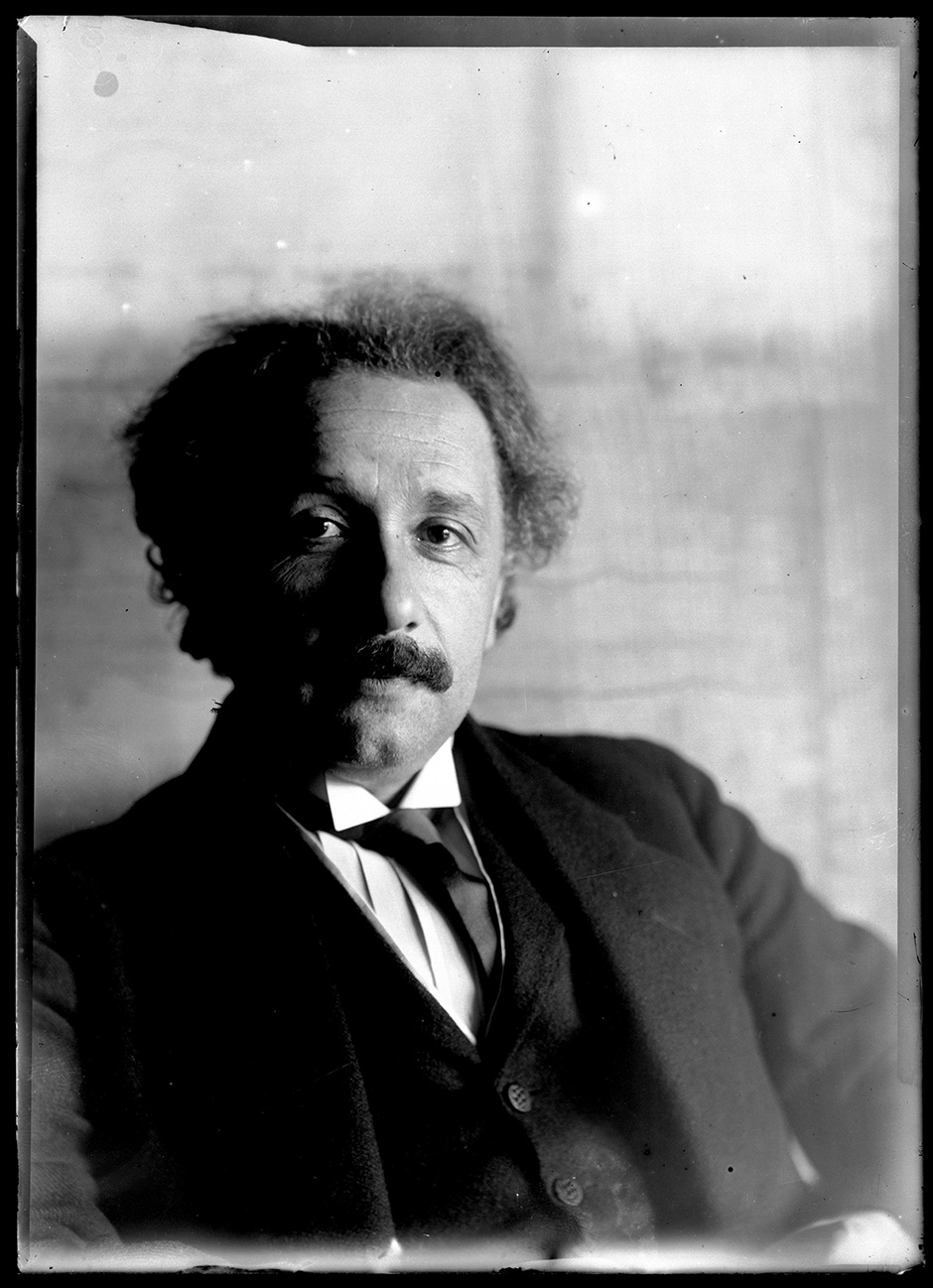
Albert Einstein, Vienna, 1921
Why would anybody want to write another book about Albert Einstein? Why would anybody want to read it? These are two separate questions, but both of them have satisfactory answers. In spite of the large number of books already written about Einstein, there is still room for one more.
There were several good reasons for writing this book. Yale University Press is publishing a big series of short biographies under the heading “Jewish Lives.” Among the twenty already published are Sigmund Freud, Franz Kafka, Sarah Bernhardt, Mark Rothko, and Leon Trotsky. Among the twenty-five announced as forthcoming are Benjamin Disraeli, Bob Dylan, Jesus, and Moses. Einstein obviously belongs on this list.
John Reed in his eyewitness report, Ten Days That Shook the World, describing the Bolshevik Revolution in Petrograd in 1917, proclaimed Leon Trotsky to be “the greatest Jew since Jesus.” Over the last hundred years, Einstein has displaced Trotsky as the second-brightest star of the Jewish pantheon. It would be absurd to display a gallery of famous Jews without putting Einstein in a prominent place. Another reason this Einstein book is welcome is that it is short. Most of the earlier books are much longer, with detailed and lengthy accounts of Einstein’s personal life and scientific thinking. The time is now ripe for a short book, summarizing briefly the well-known facts about Einstein’s rocky road as a husband and father and scientist, and emphasizing his lasting importance as a politician and a philosopher. This book is accurate and well balanced. It presents Einstein’s Jewish heritage as he saw it himself, not as the core of his being, but as a historical accident bringing inescapable responsibilities.
The reasons for reading this book are also simple. The majority of famous scientists have books written about them that are of interest to historians and specialists. The scientists remain famous for a few decades and then gradually fade. The books contain almost all the information about them that is worth preserving. But there are a few scientists whose lives and thoughts are of perennial interest, because they permanently changed our way of thinking. To the few belong Galileo and Newton and Darwin, and now Einstein. For the select few, there will be no end to the writing of books. New books will need to be written and read, because these people had enduring ideas that throw light on new problems as the centuries go by.
Albert Einstein, seen here with his wife Elsa Einstein and Zionist leaders, including future President of Israel Chaim Weizmann, his wife Dr. Vera Weizmann, ...
The later chapters of Steven Gimbel’s book describe Einstein’s deep involvement with the Zionist movement, promoting the settlement of Jews in Palestine. Einstein saw these settlements as a benefit both to Jews and to Arabs, giving Jews a place to live and prosper, and giving Arabs a chance to share the blessings of progress and prosperity. In 1929, when some Palestinian Arabs organized a violent opposition to Jewish settlement and killed some Jews, the British colonial government suppressed the rebellion and enforced a peaceful coexistence of Jews and Arabs. But Einstein understood that this enforced coexistence could not last. He wrote an article with the title “Jew and Arab” from which Gimbel quotes:
The first and most important necessity is the creation of a modus vivendi with the Arab people. Friction is perhaps inevitable, but its evil consequences must be overcome by organized cooperation, so that the inflammable material may not be piled up to the point of danger. The absence of contact in every-day life is bound to produce an atmosphere of mutual fear and distrust, which is favorable to such lamentable outbursts of passion as we have witnessed. We Jews must show above all that our own history of suffering has given us sufficient understanding and psychological insight to know how to cope with this problem of psychology and organization: the more so as no irreconcilable differences stand in the way of peace between Jews and Arabs in Palestine. Let us therefore above all be on our guard against blind chauvinism of any kind, and let us not imagine that reason and common-sense can be replaced with British bayonets.
Einstein worked with Chaim Weizmann, the leader of the Zionist organization, to raise money for the settlements and for the foundation of the Hebrew University of Jerusalem. But while he worked with Weizmann as a fund-raiser, he disagreed fundamentally with Weizmann’s aims for the future. In the early days, before Israel existed, Einstein was opposed to the idea of a Jewish state. Weizmann aimed from the beginning to establish a Jewish state in Palestine, and he lived long enough to see his dreams come true, serving as the first president of the State of Israel. After the State of Israel was established, Einstein gave it his full support. But he said that a peaceful and permanent presence of Jews in Palestine could only be possible if they worked side by side with Arabs under conditions of social and political equality.
Einstein felt a deep personal responsibility for the actions of the Jewish community to which he never wholeheartedly belonged. He tried with all his strength to stop the Jewish people from becoming another nationalistic culture glorifying military strength, like the militaristic German culture that he had hated as a child and repudiated as a teenager when he renounced his German citizenship. He continued to support Israel while severely criticizing it. At the end of his life, when he had become an American citizen, he felt an equally deep responsibility for the actions of the American community to which he never wholeheartedly belonged. He had gone through the ritual of naturalization, but he remained an alien spirit in America.
He saw the American people, after their victory over Germany and Japan, sliding into the same militaristic arrogance that overcame the German people after their victory over France in 1871. He had experienced in Berlin in 1914 the insane enthusiasm with which the German people, including his scientist friends and colleagues, welcomed the outbreak of World War I. He saw the same insanity taking root in America, with patriotic citizens imagining that the possession of nuclear weapons would give America the power to rule the world. Just as he spoke out against the militarization of Israel, he spoke out against the militarization of America. He spoke with particular clarity against the delusion that staying ahead in the race to develop nuclear weapons could give America a permanent national security.
Gimbel quotes an excerpt from Einstein’s statement reacting to President Truman’s announcement in 1950 that the United States was developing a hydrogen bomb:
The arms race between the United States and the Soviet Union, initiated originally as a preventive measure, assumes hysterical proportions. On both sides, means of mass destruction are being perfected with feverish haste and behind walls of secrecy. And now the public has been advised that the production of the hydrogen bomb is the new goal which will probably be accomplished. An accelerated development toward this end has been solemnly proclaimed by the President. If these efforts should prove successful, radioactive poisoning of the atmosphere and, hence, annihilation of all life on earth will have been brought within the range of what is technically possible. The weird aspect of this development lies in its apparently inexorable character. Each step appears as the inevitable consequence of the one that went before. And at the end, looming ever clearer, lies general annihilation.
These words have had a lasting impact. Many world leaders, civilian and military, have made similar statements during the subsequent sixty years. More importantly, the governments of powerful countries have behaved cautiously, showing by their actions that they do not consider victory in a major war to be a meaningful objective. Wars continue to be fought, but they are mostly local in scale and extended in time, as different as possible from a nuclear holocaust that could destroy half the world in a few hours. Military leaders in all countries have learned that nuclear weapons are not very useful. They are effective for murdering huge numbers of people in a short time, but not for winning real battles in real wars. For almost all situations in local wars, nuclear weapons are too big and the targets are too small.
From 1945 until the end of his life in 1955, Einstein saw the abolition of nuclear weapons as a necessary objective. Abolition was for him the only way to save mankind from the threat of nuclear destruction. He was not sure how abolition could be achieved. Sometimes he spoke of a world government with power to stop nuclear activities in every country. Sometimes he spoke of formal agreements between existing governments. Sometimes he spoke about abolishing war as well as abolishing nuclear weapons. He understood that any abolition of war or of weapons would require a radical change in our way of thinking.
The essential first step, before any abolition agreement could be effective, was to educate the public. The public and the political leaders must understand that nuclear weapons were not only intolerably dangerous but also militarily useless. Once these facts of life were clearly understood, there would be a fighting chance that an abolition agreement could work. Einstein did whatever he could in his final years to educate the public.
In the last month of his life, he joined with Bertrand Russell to make a public statement that he did not live to see published. Here are its concluding words:
In view of the fact that in any future world war nuclear weapons will certainly be employed, and that such weapons threaten the continued existence of mankind, we urge the Governments of the world to realize, and to acknowledge publicly, that their purposes cannot be furthered by a world war, and we urge them, consequently, to find peaceful means for the settlement of all matters of dispute between them.
After the Russell-Einstein manifesto was published, there grew out of it an organization called the Pugwash movement, bringing together scientists from East and West to discuss the problems of war and weapons. The name Pugwash came from the small town in eastern Canada where the first meeting was held in 1957. Since that time, meetings have been held in many countries, continuing up to the present day. The basic idea of the meetings is that science gives to scientists of all countries a common language, so that they can understand one another even when talking about political and human problems having little to do with science.
Politicians and diplomats have much greater difficulty in understanding one another. Scientists have long experience of working together in an international enterprise that pays no attention to national or ideological differences. At the beginning, Bertrand Russell himself presided over the Pugwash meetings. After Russell retired, the leadership was taken over by Joseph Rotblat, a Polish nuclear physicist who worked at Los Alamos and became famous as the only scientist who walked out of Los Alamos for reasons of conscience in 1944, when it became known that Germany did not have a serious nuclear weapons project. General Leslie Groves let him go after he promised not to tell his friends the reason for his departure. Rotblat ran the Pugwash meetings for forty years. He won the respect of all the participants and many of their governments.
I attended several of the early Pugwash meetings under the auspices of Russell and Rotblat. At that time they were acting as a valuable back channel for exchanging views between the American and Soviet governments, when the official diplomatic channel was blocked by ideological disagreements. The two dominant personalities were Leó Szilárd on the American side and Vladimir Pavlichenko on the Soviet side. Szilárd was an old friend of Einstein from Einstein’s Berlin days. He wrote the letter that Einstein signed in 1939, warning President Roosevelt that nuclear weapons were a possibility, that uranium was the crucial material for their manufacture, and that it was important to keep the rich uranium ores of the Belgian Congo out of the hands of Hitler.
Szilárd had also tried in vain to deliver an appeal to President Truman in 1945, urging him to give Japan warning and an opportunity to surrender before dropping nuclear bombs on Japanese cities. Pavlichenko was the KGB man on the Soviet side, sent to Pugwash conferences along with the scientists to make sure that they did not deviate from the Soviet line. He was highly intelligent and well informed about technical and political questions. He knew far more than the scientists about the actions and intentions of his own government.
Szilárd immediately recognized Pavlichenko as the man to talk to when serious issues were discussed. Any proposal made to Pavlichenko would reach high levels in the Soviet government. Szilárd had friends at high levels in the American government, and so this unlikely pair, the Hungarian rebel and the KGB apparatchik, worked fruitfully together to carry messages in both directions. Now, fifty years later, Pugwash meetings are carrying messages between Israel and hostile Arab states in the Middle East, and between India and Pakistan in Asia. The hope expressed by Einstein is still alive, that our way of thinking could one day change, and abolition of war and weapons could become possible.
Less than half of Gimbel’s book is about Einstein’s politics. The rest of it is about his science and his philosophy. In this review I reverse the proportions, giving more space to politics and less to philosophy. Einstein’s philosophy grew directly out of his science. During the ten years from 1905 to 1915, he created a new view of the physical universe, including atoms and light-quanta, space and time, electromagnetism and gravitation, with all their motions and interactions governed by precise mathematical laws. His theories were tested by observation and experiment and found to be correct. On the basis of this dazzling success, he built a philosophy.
A philosophy for Einstein meant a general view of nature into which the scientific details can fit. His philosophy describes nature as a single layer of observable objects with strict causality governing their movements. If the state of affairs at the present time is precisely known, then the laws of nature allow the state at a future time to be precisely predicted. The uncertainty of our knowledge of the future arises only from the uncertainty of our knowledge of the past and present. I call this view of nature the classical philosophy, since all objects obey the laws of classical physics.
Ten years after Einstein completed his theories, Werner Heisenberg and Erwin Schrödinger invented quantum mechanics, describing the behavior of atoms and light-quanta in a radically different way. Experiments confirmed that quantum mechanics gives a true picture of atomic processes that Einstein’s theories could not explain. Niels Bohr worked out a philosophy, generally known as the Copenhagen interpretation, to explain quantum mechanics. I prefer to call it the dualistic philosophy, since it describes the universe as consisting of two layers. The first layer is the classical world of Einstein, with objects that are directly observable but no longer predictable. They have become unpredictable because they are driven by events in the second layer that we cannot see. The second layer is the quantum world, with states that are not directly observable but obey simple laws. For example, the laws of the second layer decree that every particle travels along every possible path with a probability that depends in a simple way on the path.
The two layers are connected by probabilistic rules, so that the quantum state of an object tells us only the probabilities that it will do various things. The dualistic philosophy allows us to divide our knowledge of nature into facts and probabilities. Observation of the first layer gives us facts about what happened in the past, but only gives us probabilities about what may happen in the future. The future is uncertain because the processes in the second layer are unobservable. The power and the beauty of quantum mechanics arise from the fact that the physical laws in the second layer are precisely linear.
All points in a linear theory are equal, and a linear space has perfect symmetry about any of its points. As a result of the linearity of the laws, the second layer possesses a wealth of marvelous symmetries that are only partially visible in the first layer. For example, in the first layer, symmetries between space and time are only partly visible. In daily life, we do not mix up inches with seconds or miles with days. In the second layer, as the result of Paul Dirac’s elegant equation describing the quantum behavior of the electron, the mixing of space with time in the electron’s movements would be clearly visible. But we do not live in the second layer, and so the mixing is hidden from us.
The dualistic philosophy gives a natural frame for the new sciences of particle physics and relativistic cosmology that emerged in the twentieth century after Einstein and Bohr were dead. The new sciences are dominated by mathematical symmetries that are exact in the second layer and approximate in the first layer. The dualistic philosophy seems to me to represent accurately our present state of knowledge. It says that the classical world and the quantum world are both real, but the way they fit together is not yet completely understood. The dualistic philosophy is flexible enough to accept unexpected discoveries and conceptual revolutions.
Now, eighty years after the dualistic philosophy was invented by Bohr, it is generally regarded by the younger generation of physicists as obsolete. The younger generation mostly rejects duality and accepts what I call the quantum-only philosophy. The quantum-only philosophy says that the classical world is an illusion and only the quantum world exists. The concept of a classical world arose because the effects of quantum mechanics are rapidly erased by a phenomenon known as decoherence. Decoherence hides the quantum world by destroying rapidly the waves arising from quantum effects. After the waves have disappeared, whatever is left obeys classical laws and looks like a classical world. According to the quantum-only philosophy, the marvelous harmony of Einstein’s classical universe is only an approximation, valid when quantum waves happen to be small enough to be neglected.
To summarize the present situation, there are three ways to understand philosophically our observations of the physical universe. The classical philosophy of Einstein has everything in a single layer obeying classical laws, with quantum processes unexplained. The quantum-only philosophy has included everything in a single layer obeying quantum laws, with the astonishing solidity and uniqueness of the classical illusion unexplained. The dualistic philosophy gives reality impartially to the classical vision of Einstein and to the quantum vision of Bohr, with the details of the connection between the two layers unexplained. All three philosophies are tenable, and all three are incomplete. I prefer the dualistic philosophy because I give equal weight to the insights of Einstein and Bohr. I do not believe that the celestial harmonies discovered by Einstein are an accidental illusion.
Einstein in real life was not only a great politician and a great philosopher. He was also a great observer of the human comedy, with a robust sense of humor. The third side of Einstein’s personality is not emphasized by Gimbel, but was an important cause of his immense popularity. He came as an observer to my boarding school in England in 1931, a few years before I arrived there. He was in England as the guest of Frederick Lindemann, an Oxford physicist who was also a friend and adviser to Winston Churchill.
Lindemann took him to the school to meet one of the boys who was a family friend. The boy was living in Second Chamber, in an ancient building where the walls are ornamented with marble memorials to boys who occupied the rooms in past centuries. Einstein and Lindemann wandered by mistake into the adjoining First Chamber, which had been converted from a living room to a bathroom. In First Chamber, the marble memorials were preserved, but underneath them on the walls were hooks where boys had hung their smelly football clothes. Einstein surveyed the scene for a while in silence, and then said: “Now I understand: the spirits of the departed pass over into the trousers of the living.”
by Caroline Fourest New York: Encounter Books, 2008. 257 pp. $23.95 Fourest, a French journalist, has revealed the real nature of Tariq Ramadan, one of the most effective and threatening Islamist activists in the West. Some Europeans embrace him as a Muslim version of Martin Luther but Fourest shows how Ramadan intends to help make Europe a majority Muslim continent.
Fourest has waded through the complex record of his preaching—particularly off-the-record and impromptu speeches to fellow Muslims—and found a sometimes refined and sometimes puerile contempt for the West and an abiding faith in the supremacy and eventual triumph of Islam. This is the "doublespeak" to which the title of the book refers. Among the themes are Islamo-feminism, itself worth a book; integration and national allegiance; and Zionism.
Then-interior minister Nicolas Sarkozy brought to French national attention Ramadan's refusal to state categorically that there is no place in any society under any circumstances for the stoning of women; Ramadan would only call for a "moratorium," allowing him to appear moderate to Europeans but protecting his fundamentalist credentials among Muslims. Ramadan has used this rhetorical device in other circumstances, and Fourest points out how typical this is of Ramadan's rhetoric. If Israeli children are murdered in a car bombing, Ramadan can say, "It is condemnable," but he is able to avoid having to say "I condemn it."
Ramadan is likewise Janus-faced on the matter of European Muslims integrating themselves into European civilization. He says that Muslims should obey the laws of the countries in which they reside but also that they should resist the contaminants of Western civilization. He supports the laws of countries as long as they do not conflict with Islam. It is not surprising, then, that he advises Muslims not to serve in the army of a European country if it is at war with an Islamic state. And what would serve as a model for Ramadan's new Europe? He sees in Sudan an example of a country that successfully has resisted globalization.
College students, often so eager to learn about the suffering of women, would do well to read this book. Their professors would do well to find space on their reading lists between Edward Said and Howard Zinn to place this highly readable and most relevant book in the assigned reading.
The Birth of the Palestinian Refugee Problem, 1947–1949,[1.1] Israel’s Border Wars, 1949–1956: Arab infiltration, Israeli retaliation, and the countdown to the Suez war,[1.2] Righteous Victims: A history of the Zionist-Arab conflict, 1881–1999,[1.3] The Road to Jerusalem: Glubb Pasha, Palestine and the Jews[1.4]
Israeli historian Benny Morris played a pivotal role in molding the current scholarly consensus on the Israel-Palestine conflict. Until his generation of scholars came along (the so-called new historians), the dominant depiction of the conflict, even in academia, amounted to little more than a footnoted version of Leon Uris’s potboiler,Exodus. The current consensus casts Israel since its founding in a much darker light. During the past 15 years, however, Morris has been given to lashing out at, and defending the old orthodoxy against, critics of Israel.
An unorthodox new historian not too long ago, Benny Morris in effect reinvented himself in recent times as an orthodox old historian. The process has been incremental, the quantitative degeneration becoming at a certain point qualitative. Although disfigured in ways small and large by ideological bias, Morris’s earlier works, such as The Birth of the Palestinian Refugee Problem, 1947–1949,[1.1]Israel’s Border Wars, 1949–1956: Arab infiltration, Israeli retaliation, and the countdown to the Suez war,[1.2]Righteous Victims: A history of the Zionist-Arab conflict, 1881–1999,[1.3] and The Road to Jerusalem: Glubb Pasha, Palestine and the Jews[1.4] brought to light a wealth of novel information. The body of his subsequent major work, 1948: The first Arab-Israeli war,[1.5] preserves a standard of scholarly rigor, but his conclusion crosses the threshold to crude distortion. His last major work, One State, Two States: Resolving the Israel/Palestine conflict[1.6]lacks any redeeming value and reeks of rancid propaganda.
Whereas he did not break new conceptual ground, Morris did roam the archives and cull revealing documents on the Israel-Palestine conflict that he then collated into a fresh, compelling narrative of the past. Once an industrious clerk, Morris has metamorphosed into a raging kook. In all fairness to him, it is of course arguable that Morris has honestly come to reconsider his former conclusions on the basis of new evidence; to discover that, however deficient their scholarship, the conclusions of the old historians were right after all. The problem is that Morris does not adduce new evidence to support his return to the old orthodoxy, but rather whites out the findings of his own pioneering research. This genre might be called doing history not by accretion but by subtraction.
The conclusion of Righteous Victims, Benny Morris’s sweeping “history of the Zionist-Arab conflict,” opened with a quote from Zionist leader (and Israel’s future first prime minister) David Ben-Gurion. The “conflict”with the Arabs, Ben-Gurion said in 1938, “is in its essence a political one. And politically we are the aggressors and they defend themselves.” Morris then observed: “Ben-Gurion, of course, was right. Zionism was a colonizing and expansionist ideology and movement. . . . Zionist ideology and practice were necessarily and elementally expansionist.” Insofar as “from the start its aim was to turn all of Palestine . . . into a Jewish state,” he went on to elaborate, Zionism could not but be “intent on . . . dispossessing and supplanting the Arabs.” Or, as Morris formulated it earlier on in his book, “Jewish colonization meant expropriation and displacement” of the indigenous population.[2.1] These consequences of Zionism, and the Arab resistance they inexorably generated, would figure as signature themes in Morris’s scholarly corpus.
A fundamental challenge for Zionism was how to create a Jewish state, which meant minimally a state whose population was overwhelmingly Jewish, in an area whose population was overwhelmingly not Jewish. One novelty of Morris’s original scholarship was to point up the centrality of “transfer”—a euphemism, as Revisionist Zionist leader Zeev Jabotinsky put it, for “brutal expulsion”[2.2]—to resolving this dilemma. Insofar as orthodox Israeli historians had treated it, they consigned the idea of transfer to a footnote, downplaying it as incidental to the Zionist enterprise.Thus, Shabtai Teveth purported that the Zionist movement only “here and there” and “briefly” contemplated transfer, while, according to Anita Shapira, the Zionist movement conceived transfer merely as a “good thing”that it could just as well “do without.”[2.3] But Morris contended in his groundbreaking study, Birth of the Palestinian Refugee Problem, that, on the contrary, from the mid-1930's “the idea of transferring the Arabs out . . . was seen as the chief means of assuring the stability of the ‘Jewishness’ of the proposed Jewish State,”[2.4] while in Righteous Victims he wrote that “the transfer idea . . . was one of the main currents in Zionist ideology from the movement’s inception.”[5] In another seminal essay, Morris documented that “thinking about the transfer of all or part of Palestine’s Arabs out of the prospective Jewish state was pervasive among Zionist leadership circles long before 1937.”[6]In a greatly expanded version ofBirth, [2.7] Morris gave over fully 25 densely argued pages to documenting the depth and breadth of “the idea of ‘transfer’in Zionist thinking.” His conclusion merits full quotation:
“[T]ransfer was inevitable and inbuilt into Zionism—because it sought to transform a land which was ‘Arab’ into a ‘Jewish’ state and a Jewish state could not have arisen without a major displacement of Arab population; and because this aim automatically produced resistance among the Arabs which, in turn, persuaded the Yishuv’s leaders that a hostile Arab majority or large minority could not remain in place if a Jewish state was to arise or safely endure.”[2.8]
Thus, in Morris’s temporal-logical sequence of the conflict’s genesis, Zionist transfer was cause and Arab resistance effect in an ever-expanding spiral. He put forth a sequence of succinct and copiously documented formulations on this crucial point in Righteous Victims: “The fear of territorial displacement and dispossession was to be the chief motor of Arab antagonism to Zionism down to 1948 (and indeed after 1967 as well)”; “In the 1880's there were already Arabs who understood that the threat from Zionism was not merely a local matter or a by-product of cultural estrangement.‘The natives are hostile towards us, saying that we have come to drive them out of the country,’ recorded one Zionist settler”; “[T]he major cause of tension and violence . . . was . . . the conflicting interests and goals of the two populations. The Arabs sought instinctively to . . . maintain their position as [Palestine’s] rightful inhabitants; the Zionists sought radically to change the status quo . . . and eventually turn an Arab-populated country into a Jewish homeland. . . . The Arabs, both urban and rural, came to feel anxiety and fear.”[9]In the conclusion of Righteous Victims, Morris reiterated that the Arabs’trepidation and ensuing opposition were “solidly anchored in a perception that [Zionist] expansion . . . would be at the expense of their people, principally and initially those living in Palestine itself.”[2.10] As Morris originally reckoned it, Arab fear was rational—because transfer was “inevitable and inbuilt into Zionism”—and Arab resistance natural—because it sprang“automatically” from the Zionist goal of transfer. He located the root of the conflict in a historical clash between Zionism and the indigenous Arab population of Palestine and the historical (if not moral) onus for engendering the conflict was placed squarely by Morris on the shoulders of the Zionist movement.[2.11]
When Benny Morris was still a historian (the “old” Morris), he anchored the resistance of Palestine’s indigenous population in its rational fear that Zionist settlers intended to “transfer”—i.e., ethnically cleanse—it (see Part 2). The “new” Morris, however, has a very different story to tell. He drastically reduces the salience of transfer in Zionism; locates the genesis of the conflict in “Islamic Judeophobia”; and reckons transfer as a Zionist reaction to this Islamic Judeophobia and the “expulsionist” tendency inherent in it. Cause and effect have magically been reversed: expulsionist Judeophobia—which is inevitable and inbuilt into Islam—is the cause, Zionist transfer—which automatically springs from Islamic Judeophobia—the effect. The onus for engendering the conflict is now placed by Morris squarely on the shoulders of the Arabs, while Zionists are depicted as the innocent victims of a lethal Muslim intolerance towards Jews.
According to this new Morris, transfer initially figured as but a “minor and secondary element” in Zionism; “it had not been part of the original Zionist ideology”; key Zionist leaders only “occasionally” supported transfer “between 1881 and the mid-1940s”; and “its thrust was never adopted by the Zionist movement . . . as ideology or policy” until the late 1940s.[3.1] Whereas the old Morris asserted that “the logic of a transfer solution to the ‘Arab problem’ remained ineluctable” for the Zionist movement, and “without some sort of massive displacement of Arabs from the area of the Jewish state-to-be, there could be no viable ‘Jewish’ state,”[3.2] the new Morris alleges that “the Zionist leaders generally said, and believed, that a Jewish majority would be achieved in Palestine, or in whatever part of it became a Jewish state, by means of massive Jewish immigration, and that this immigration would also materially benefit the Arab population.”3.[3]
If Zionists eventually came to embrace transfer, according to the new Morris, it was only in reaction to “expulsionist or terroristic violence by the Arabs,”[3.4] “expulsionist Arab thinking and murderous Arab behavior,”[3.5] which were “indirectly contributing to the murder of their [the Zionists’] European kinfolk by helping to deny them a safe haven in Palestine and by threatening the lives of the Jews who already lived in the country.”[3.6] Transfer has inexplicably metamorphosed from an “inevitable and inbuilt” component of Zionism—which is what Morris had written when he was still a historian—into a response “triggered”[3.7] by expulsionist Arab threats and assaults, not to mention Arab complicity in the Nazi holocaust. Indeed, in the narrative frame crafted by the new Morris, the indigenous population of a country has metamorphosed into expulsionists. Many cruel and unforgivable things have been said by American historians about our native population, but it took a peculiarly fecund Israeli mind to pin the label “starkly expulsionist”[3.8] on an indigenous population resisting expulsion. To document this “expulsionist mindset,”.[3.9] Morris cites the testimony of a Palestinian delegation before a foreign commission of inquiry: “We will push the Zionists into the sea—or they will send us back into the desert.”[3.10] Insofar as the Zionists were intent on “transferring the Arabs out,” it is unclear how this statement manifests malevolence. Doesn’t an indigenous population have the right to resist expulsion?
The new Morris alleges that “Arab expressions in the early years of the twentieth century of fear of eventual displacement and expulsion by the Zionists were largely propagandistic.”[3.11] He seems to have forgotten that he himself pointed up this fear as the “chief motor of Arab antagonism to Zionism” and that he rationally grounded this fear in Zionist transfer policy. Morris now purports that the Arabs’ resistance to Zionism sprang from their thralldom to the notion of “sacred Islamic soil”; was “anchored in centuries of Islamic Judeophobia”; and reached into “every fiber of their Islamic, exclusivist being.”[3.12] After Israel’s establishment, Prime Minister David Ben-Gurion conceded, “If I was [sic] an Arab leader, I would never make [peace?] terms with Israel. That is natural: We have taken their country.” The new Morris alleges, however, that, because of his ignorance of the Arab world, Ben-Gurion failed to grasp that this rejection of Israel was not “natural” but rather rooted in Islamic “abhorrence” of Jews.[3.13] Insofar as Morris is not known for his expertise on Islam, and insofar as he used to be known for not speculating a hair’s breadth beyond what his sources showed, it might be expected that he would copiously substantiate such gross generalizations. But Morris’s elucidation of 14 centuries of an allegedly hate-filled “Muslim Arab mindset” and “Muslim Arab mentality” consists of all of one half paragraph of boilerplate.[3.14]
[1.1]New York: 1987.
[1.2]New York: 1993.
[1.3]New York: 1999.
[1.4]London: 2003.
[1.5]New York: 2008.
[1.6]New Haven: 2009.
[2.1] Benny Morris, Righteous Victims: A history of the Zionist-Arab conflict, 1881-2001(New York: 2001), pp. 652-54, 61.
[2.2]Shabtai Teveth, The Evolution of “Transfer” in Zionist Thinking (Tel Aviv: 1989), p. 17.
[2.3]Ibid., pp. 2, 6. Anita Shapira, Land and Power: The Zionist resort to force, 1881-1948
(Oxford: 1992), pp. 285-86.
[2.4]Benny Morris, The Birth of the Palestinian Refugee Problem, 1947-1949(Cambridge: 1987), p. 25.
[2.5]Morris, Righteous Victims, p. 139.
[2.6]Benny Morris, “Revisiting the Palestinian Exodus of 1948,” in Eugene L. Rogan and Avi Shlaim, eds.,The War for Palestine: Rewriting the history of 1948(Cambridge: 2001), p. 40. The British proposed in 1937, and the Zionists seconded, transfer alongside partition to resolve the Palestine conflict.
[2.7]Benny Morris, The Birth of the Palestinian Refugee Problem Revisited (Cambridge:
2004).
[2.8] Ibid., p. 60.
[2.9]Morris, Righteous Victims, pp. 37, 46, 49.
[2.10] Ibid., p. 653.
[2.11]It could still be argued, and it is Morris’s contention, that although creating a Jewish state necessarily entailed the ethnic cleansing of Palestine, the establishment of a Jewishstate was nonetheless a greater moral good. Even in his original, liberal phase, Morrisput both moral and historical culpability for the creation of the Palestinian refugeeproblem on the Arabs because, inter alia, they rejected the UN Partition Resolution
[3.1] Benny Morris, 1948: The first Arab-Israeli war (New York: 2008), p. 407; Benny Morris, “Fallible Memory,” New Republic (3 February 2011).
[3.2] Benny Morris, The Birth of the Palestinian Refugee Problem Revisited(Cambridge: 2004), p. 43.
[3.3] Benny Morris, “And Now for Some Facts,” New Republic (28 April 2006).
[3.4] Morris, 1948, p. 407.
3.[5] Morris, “Fallible Memory.”
[3.6] Benny Morris, One State, Two States: Resolving the Israel/Palestine conflict (New Haven: 2009),p. 68.
[3.7] Ibid., p. 67.
[3.8] Ibid., p. 105.
[3.9] Morris, 1948, p. 409.
[3.10] Ibid., p. 408.
[3.11] Morris, One State, p. 179.
[3.12] Morris, 1948, pp. 393, 394; Morris, One State, p. 90. In one place he does grant albeit grudgingly that Arab opposition to Zionist settlers resulted not only from the “threat to the ‘Arab-ness’ of their country” but “perhaps, down the road, to their very presence in the land” (ibid., p. 37).