Showing posts with label Albert Einstein. Show all posts

Monday, April 18, 2016

Einstein: His Space and Times by Steven Gimbel Yale University Press, 191 pp., $25.00


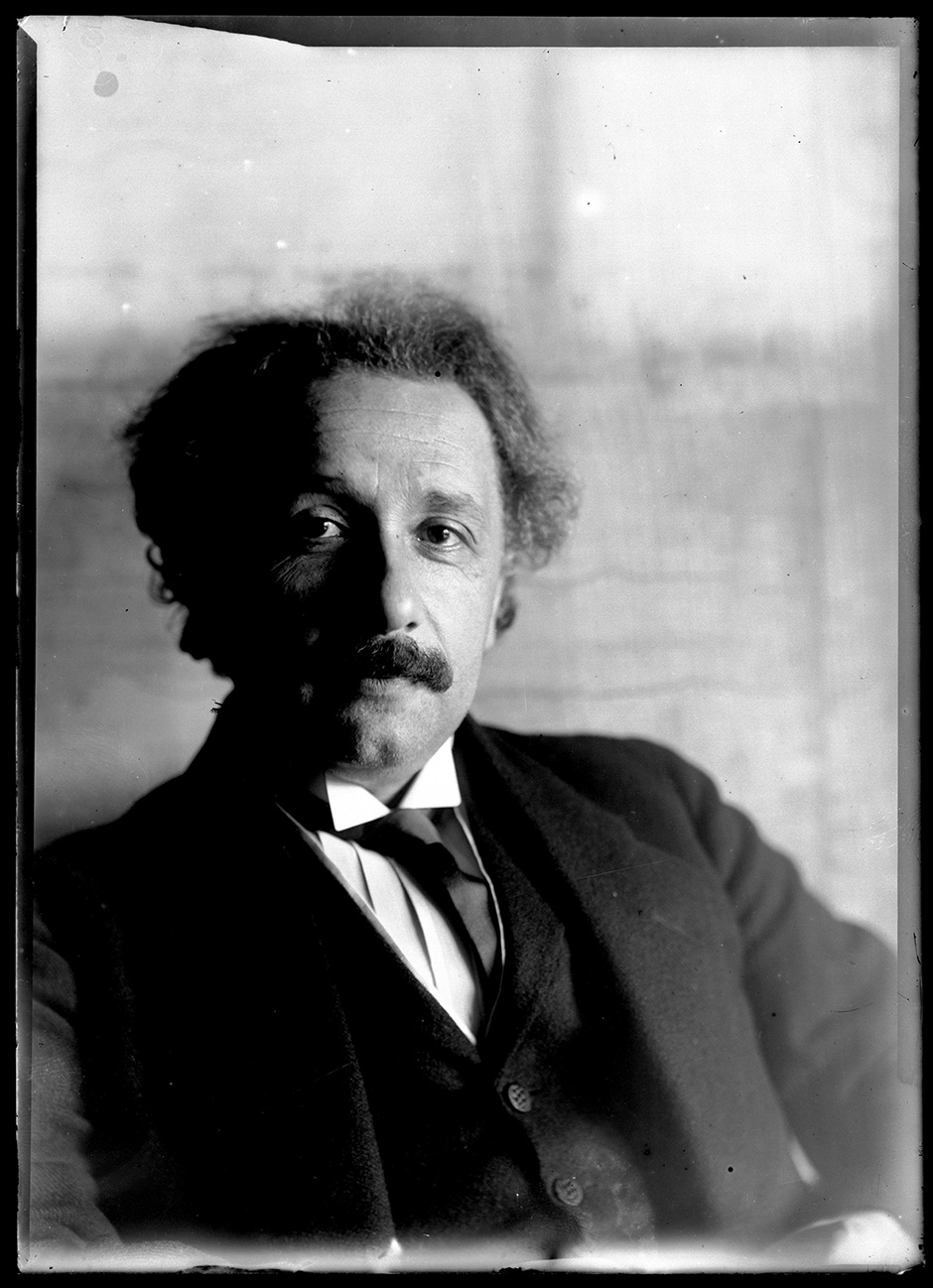
dyson_1-050715.jpg


Ferdinand Schmutzer/Austrian National Library/Anzenberger/Redux

Albert Einstein, Vienna, 1921
Why would anybody want to write another book about Albert Einstein? Why would anybody want to read it? These are two separate questions, but both of them have satisfactory answers. In spite of the large number of books already written about Einstein, there is still room for one more.
There were several good reasons for writing this book. Yale University Press is publishing a big series of short biographies under the heading “Jewish Lives.” Among the twenty already published are Sigmund Freud, Franz Kafka, Sarah Bernhardt, Mark Rothko, and Leon Trotsky. Among the twenty-five announced as forthcoming are Benjamin Disraeli, Bob Dylan, Jesus, and Moses. Einstein obviously belongs on this list.
John Reed in his eyewitness report, Ten Days That Shook the World, describing the Bolshevik Revolution in Petrograd in 1917, proclaimed Leon Trotsky to be “the greatest Jew since Jesus.” Over the last hundred years, Einstein has displaced Trotsky as the second-brightest star of the Jewish pantheon. It would be absurd to display a gallery of famous Jews without putting Einstein in a prominent place. Another reason this Einstein book is welcome is that it is short. Most of the earlier books are much longer, with detailed and lengthy accounts of Einstein’s personal life and scientific thinking. The time is now ripe for a short book, summarizing briefly the well-known facts about Einstein’s rocky road as a husband and father and scientist, and emphasizing his lasting importance as a politician and a philosopher. This book is accurate and well balanced. It presents Einstein’s Jewish heritage as he saw it himself, not as the core of his being, but as a historical accident bringing inescapable responsibilities.
The reasons for reading this book are also simple. The majority of famous scientists have books written about them that are of interest to historians and specialists. The scientists remain famous for a few decades and then gradually fade. The books contain almost all the information about them that is worth preserving. But there are a few scientists whose lives and thoughts are of perennial interest, because they permanently changed our way of thinking. To the few belong Galileo and Newton and Darwin, and now Einstein. For the select few, there will be no end to the writing of books. New books will need to be written and read, because these people had enduring ideas that throw light on new problems as the centuries go by.


Albert Einstein, seen here with his wife Elsa Einstein and Zionist leaders, including future President of Israel Chaim Weizmann, his wife Dr. Vera Weizmann, ...
The later chapters of Steven Gimbel’s book describe Einstein’s deep involvement with the Zionist movement, promoting the settlement of Jews in Palestine. Einstein saw these settlements as a benefit both to Jews and to Arabs, giving Jews a place to live and prosper, and giving Arabs a chance to share the blessings of progress and prosperity. In 1929, when some Palestinian Arabs organized a violent opposition to Jewish settlement and killed some Jews, the British colonial government suppressed the rebellion and enforced a peaceful coexistence of Jews and Arabs. But Einstein understood that this enforced coexistence could not last. He wrote an article with the title “Jew and Arab” from which Gimbel quotes:
The first and most important necessity is the creation of a modus vivendi with the Arab people. Friction is perhaps inevitable, but its evil consequences must be overcome by organized cooperation, so that the inflammable material may not be piled up to the point of danger. The absence of contact in every-day life is bound to produce an atmosphere of mutual fear and distrust, which is favorable to such lamentable outbursts of passion as we have witnessed. We Jews must show above all that our own history of suffering has given us sufficient understanding and psychological insight to know how to cope with this problem of psychology and organization: the more so as no irreconcilable differences stand in the way of peace between Jews and Arabs in Palestine. Let us therefore above all be on our guard against blind chauvinism of any kind, and let us not imagine that reason and common-sense can be replaced with British bayonets.
 

Einstein worked with Chaim Weizmann, the leader of the Zionist organization, to raise money for the settlements and for the foundation of the Hebrew University of Jerusalem. But while he worked with Weizmann as a fund-raiser, he disagreed fundamentally with Weizmann’s aims for the future. In the early days, before Israel existed, Einstein was opposed to the idea of a Jewish state. Weizmann aimed from the beginning to establish a Jewish state in Palestine, and he lived long enough to see his dreams come true, serving as the first president of the State of Israel. After the State of Israel was established, Einstein gave it his full support. But he said that a peaceful and permanent presence of Jews in Palestine could only be possible if they worked side by side with Arabs under conditions of social and political equality.
Einstein felt a deep personal responsibility for the actions of the Jewish community to which he never wholeheartedly belonged. He tried with all his strength to stop the Jewish people from becoming another nationalistic culture glorifying military strength, like the militaristic German culture that he had hated as a child and repudiated as a teenager when he renounced his German citizenship. He continued to support Israel while severely criticizing it. At the end of his life, when he had become an American citizen, he felt an equally deep responsibility for the actions of the American community to which he never wholeheartedly belonged. He had gone through the ritual of naturalization, but he remained an alien spirit in America.
He saw the American people, after their victory over Germany and Japan, sliding into the same militaristic arrogance that overcame the German people after their victory over France in 1871. He had experienced in Berlin in 1914 the insane enthusiasm with which the German people, including his scientist friends and colleagues, welcomed the outbreak of World War I. He saw the same insanity taking root in America, with patriotic citizens imagining that the possession of nuclear weapons would give America the power to rule the world. Just as he spoke out against the militarization of Israel, he spoke out against the militarization of America. He spoke with particular clarity against the delusion that staying ahead in the race to develop nuclear weapons could give America a permanent national security.
Gimbel quotes an excerpt from Einstein’s statement reacting to President Truman’s announcement in 1950 that the United States was developing a hydrogen bomb:
The arms race between the United States and the Soviet Union, initiated originally as a preventive measure, assumes hysterical proportions. On both sides, means of mass destruction are being perfected with feverish haste and behind walls of secrecy. And now the public has been advised that the production of the hydrogen bomb is the new goal which will probably be accomplished. An accelerated development toward this end has been solemnly proclaimed by the President. If these efforts should prove successful, radioactive poisoning of the atmosphere and, hence, annihilation of all life on earth will have been brought within the range of what is technically possible. The weird aspect of this development lies in its apparently inexorable character. Each step appears as the inevitable consequence of the one that went before. And at the end, looming ever clearer, lies general annihilation.
These words have had a lasting impact. Many world leaders, civilian and military, have made similar statements during the subsequent sixty years. More importantly, the governments of powerful countries have behaved cautiously, showing by their actions that they do not consider victory in a major war to be a meaningful objective. Wars continue to be fought, but they are mostly local in scale and extended in time, as different as possible from a nuclear holocaust that could destroy half the world in a few hours. Military leaders in all countries have learned that nuclear weapons are not very useful. They are effective for murdering huge numbers of people in a short time, but not for winning real battles in real wars. For almost all situations in local wars, nuclear weapons are too big and the targets are too small.
From 1945 until the end of his life in 1955, Einstein saw the abolition of nuclear weapons as a necessary objective. Abolition was for him the only way to save mankind from the threat of nuclear destruction. He was not sure how abolition could be achieved. Sometimes he spoke of a world government with power to stop nuclear activities in every country. Sometimes he spoke of formal agreements between existing governments. Sometimes he spoke about abolishing war as well as abolishing nuclear weapons. He understood that any abolition of war or of weapons would require a radical change in our way of thinking.
The essential first step, before any abolition agreement could be effective, was to educate the public. The public and the political leaders must understand that nuclear weapons were not only intolerably dangerous but also militarily useless. Once these facts of life were clearly understood, there would be a fighting chance that an abolition agreement could work. Einstein did whatever he could in his final years to educate the public.
In the last month of his life, he joined with Bertrand Russell to make a public statement that he did not live to see published. Here are its concluding words:
In view of the fact that in any future world war nuclear weapons will certainly be employed, and that such weapons threaten the continued existence of mankind, we urge the Governments of the world to realize, and to acknowledge publicly, that their purposes cannot be furthered by a world war, and we urge them, consequently, to find peaceful means for the settlement of all matters of dispute between them.
After the Russell-Einstein manifesto was published, there grew out of it an organization called the Pugwash movement, bringing together scientists from East and West to discuss the problems of war and weapons. The name Pugwash came from the small town in eastern Canada where the first meeting was held in 1957. Since that time, meetings have been held in many countries, continuing up to the present day. The basic idea of the meetings is that science gives to scientists of all countries a common language, so that they can understand one another even when talking about political and human problems having little to do with science.
Politicians and diplomats have much greater difficulty in understanding one another. Scientists have long experience of working together in an international enterprise that pays no attention to national or ideological differences. At the beginning, Bertrand Russell himself presided over the Pugwash meetings. After Russell retired, the leadership was taken over by Joseph Rotblat, a Polish nuclear physicist who worked at Los Alamos and became famous as the only scientist who walked out of Los Alamos for reasons of conscience in 1944, when it became known that Germany did not have a serious nuclear weapons project. General Leslie Groves let him go after he promised not to tell his friends the reason for his departure. Rotblat ran the Pugwash meetings for forty years. He won the respect of all the participants and many of their governments.
I attended several of the early Pugwash meetings under the auspices of Russell and Rotblat. At that time they were acting as a valuable back channel for exchanging views between the American and Soviet governments, when the official diplomatic channel was blocked by ideological disagreements. The two dominant personalities were Leó Szilárd on the American side and Vladimir Pavlichenko on the Soviet side. Szilárd was an old friend of Einstein from Einstein’s Berlin days. He wrote the letter that Einstein signed in 1939, warning President Roosevelt that nuclear weapons were a possibility, that uranium was the crucial material for their manufacture, and that it was important to keep the rich uranium ores of the Belgian Congo out of the hands of Hitler.
Szilárd had also tried in vain to deliver an appeal to President Truman in 1945, urging him to give Japan warning and an opportunity to surrender before dropping nuclear bombs on Japanese cities. Pavlichenko was the KGB man on the Soviet side, sent to Pugwash conferences along with the scientists to make sure that they did not deviate from the Soviet line. He was highly intelligent and well informed about technical and political questions. He knew far more than the scientists about the actions and intentions of his own government.
Szilárd immediately recognized Pavlichenko as the man to talk to when serious issues were discussed. Any proposal made to Pavlichenko would reach high levels in the Soviet government. Szilárd had friends at high levels in the American government, and so this unlikely pair, the Hungarian rebel and the KGB apparatchik, worked fruitfully together to carry messages in both directions. Now, fifty years later, Pugwash meetings are carrying messages between Israel and hostile Arab states in the Middle East, and between India and Pakistan in Asia. The hope expressed by Einstein is still alive, that our way of thinking could one day change, and abolition of war and weapons could become possible.
Less than half of Gimbel’s book is about Einstein’s politics. The rest of it is about his science and his philosophy. In this review I reverse the proportions, giving more space to politics and less to philosophy. Einstein’s philosophy grew directly out of his science. During the ten years from 1905 to 1915, he created a new view of the physical universe, including atoms and light-quanta, space and time, electromagnetism and gravitation, with all their motions and interactions governed by precise mathematical laws. His theories were tested by observation and experiment and found to be correct. On the basis of this dazzling success, he built a philosophy.
A philosophy for Einstein meant a general view of nature into which the scientific details can fit. His philosophy describes nature as a single layer of observable objects with strict causality governing their movements. If the state of affairs at the present time is precisely known, then the laws of nature allow the state at a future time to be precisely predicted. The uncertainty of our knowledge of the future arises only from the uncertainty of our knowledge of the past and present. I call this view of nature the classical philosophy, since all objects obey the laws of classical physics.
Ten years after Einstein completed his theories, Werner Heisenberg and Erwin Schrödinger invented quantum mechanics, describing the behavior of atoms and light-quanta in a radically different way. Experiments confirmed that quantum mechanics gives a true picture of atomic processes that Einstein’s theories could not explain. Niels Bohr worked out a philosophy, generally known as the Copenhagen interpretation, to explain quantum mechanics. I prefer to call it the dualistic philosophy, since it describes the universe as consisting of two layers. The first layer is the classical world of Einstein, with objects that are directly observable but no longer predictable. They have become unpredictable because they are driven by events in the second layer that we cannot see. The second layer is the quantum world, with states that are not directly observable but obey simple laws. For example, the laws of the second layer decree that every particle travels along every possible path with a probability that depends in a simple way on the path.
The two layers are connected by probabilistic rules, so that the quantum state of an object tells us only the probabilities that it will do various things. The dualistic philosophy allows us to divide our knowledge of nature into facts and probabilities. Observation of the first layer gives us facts about what happened in the past, but only gives us probabilities about what may happen in the future. The future is uncertain because the processes in the second layer are unobservable. The power and the beauty of quantum mechanics arise from the fact that the physical laws in the second layer are precisely linear.
All points in a linear theory are equal, and a linear space has perfect symmetry about any of its points. As a result of the linearity of the laws, the second layer possesses a wealth of marvelous symmetries that are only partially visible in the first layer. For example, in the first layer, symmetries between space and time are only partly visible. In daily life, we do not mix up inches with seconds or miles with days. In the second layer, as the result of Paul Dirac’s elegant equation describing the quantum behavior of the electron, the mixing of space with time in the electron’s movements would be clearly visible. But we do not live in the second layer, and so the mixing is hidden from us.
The dualistic philosophy gives a natural frame for the new sciences of particle physics and relativistic cosmology that emerged in the twentieth century after Einstein and Bohr were dead. The new sciences are dominated by mathematical symmetries that are exact in the second layer and approximate in the first layer. The dualistic philosophy seems to me to represent accurately our present state of knowledge. It says that the classical world and the quantum world are both real, but the way they fit together is not yet completely understood. The dualistic philosophy is flexible enough to accept unexpected discoveries and conceptual revolutions.
Now, eighty years after the dualistic philosophy was invented by Bohr, it is generally regarded by the younger generation of physicists as obsolete. The younger generation mostly rejects duality and accepts what I call the quantum-only philosophy. The quantum-only philosophy says that the classical world is an illusion and only the quantum world exists. The concept of a classical world arose because the effects of quantum mechanics are rapidly erased by a phenomenon known as decoherence. Decoherence hides the quantum world by destroying rapidly the waves arising from quantum effects. After the waves have disappeared, whatever is left obeys classical laws and looks like a classical world. According to the quantum-only philosophy, the marvelous harmony of Einstein’s classical universe is only an approximation, valid when quantum waves happen to be small enough to be neglected.
To summarize the present situation, there are three ways to understand philosophically our observations of the physical universe. The classical philosophy of Einstein has everything in a single layer obeying classical laws, with quantum processes unexplained. The quantum-only philosophy has included everything in a single layer obeying quantum laws, with the astonishing solidity and uniqueness of the classical illusion unexplained. The dualistic philosophy gives reality impartially to the classical vision of Einstein and to the quantum vision of Bohr, with the details of the connection between the two layers unexplained. All three philosophies are tenable, and all three are incomplete. I prefer the dualistic philosophy because I give equal weight to the insights of Einstein and Bohr. I do not believe that the celestial harmonies discovered by Einstein are an accidental illusion.
Einstein in real life was not only a great politician and a great philosopher. He was also a great observer of the human comedy, with a robust sense of humor. The third side of Einstein’s personality is not emphasized by Gimbel, but was an important cause of his immense popularity. He came as an observer to my boarding school in England in 1931, a few years before I arrived there. He was in England as the guest of Frederick Lindemann, an Oxford physicist who was also a friend and adviser to Winston Churchill.
Lindemann took him to the school to meet one of the boys who was a family friend. The boy was living in Second Chamber, in an ancient building where the walls are ornamented with marble memorials to boys who occupied the rooms in past centuries. Einstein and Lindemann wandered by mistake into the adjoining First Chamber, which had been converted from a living room to a bathroom. In First Chamber, the marble memorials were preserved, but underneath them on the walls were hooks where boys had hung their smelly football clothes. Einstein surveyed the scene for a while in silence, and then said: “Now I understand: the spirits of the departed pass over into the trousers of the living.”

Monday, March 14, 2016

The Other Uncle Albert... I barely knew. Einstein: His Life and Universe by Walter Isaacson Simon and Schuster, 675 pp., $32.00 Einstein: A Biography by Jürgen Neffe, translated from the German by Shelley Frisch Farrar, Straus and Giroux, 461 pp., $30.00 'Subtle Is the Lord': The Science and the Life of Albert Einstein by Abraham Pais Oxford University Press,552 pp., $22.00 (paper) The Private Lives of Albert Einstein by Roger Highfield andPaul Carter St. Martin's,376 pp., $18.95 (paper) Einstein in Love: A Scientific Romance by Dennis Overbye Penguin, 416 pp., $15.00 (paper) Einstein's Clocks, Poincaré's Maps: Empires of Time by Peter Galison Norton, 389 pp., $14.95 (paper) Einstein on Politics edited by David Rowe and Robert Schulmann Princeton University Press, 560 pp., $29.95 Einstein on Race and Racism by Fred Jerome and Rodger Taylor Rutgers University Press, 206 pp., $17.95 The Collected Papers of Albert Einstein by Albert Einstein Princeton University Press, ten volumes, 4,252 pp., $50.00 each


1.

Why more books on Albert Einstein? Two years ago we marked the Year of Physics, celebrating the centenary of his great 1905 papers, including those on special relativity and the particle theory of light. There is already a definitive scientific biography, published by Abraham Pais in 1982. That Einstein had an interesting personal life, with many entanglements with women and at least one extramarital child, has not been news since Roger Highfield and Paul Carter’s The Private Lives of Albert Einstein and Dennis Overbye’s Einstein in Love, published in 1994 and 2000, respectively. His private letters continue to come to light, but do they really add anything to the portrait of Einstein’s character drawn so perceptively by Overbye?
In his new book, Einstein: His Life and Universe, Walter Isaacson explains that
studying Einstein can be worthwhile [because] it helps us remain in touch with that childlike capacity for wonder…as the sagas of [science’s] heroes reminds us…. These traits are…vital for this new century of globalization, in which our success will depend on our creativity….
As he elaborates in a recent interview with Thomas Friedman, “If we are going to have any advantage over China, it is because we nurture rebellious, imaginative free thinkers, rather than try to control expression.”1
Noble sentiments, and certainly sufficient justification for continuing to promulgate uplifting myths about science and its heroes. But what does this have to do with the actual character and life of the real person who happened to be the most important physicist of the last two hundred years? There is no doubt that any attempt to understand who Einstein actually was and what he actually did is hampered by a smokescreen that was created by his executors, his colleagues, his biographers, and perhaps even Einstein himself. The myth of Einstein presents us with an elderly sage, a clownish proto-hippy with long hair, no socks, and a bumbling, otherworldly manner. As Isaacson writes it:
Adding to his aura was his simple humanity. His inner security was tempered by the humility that comes from being awed by nature. He could be detached and aloof from those close to him, but toward mankind in general he exuded a true kindness and gentle compassion.
This certainly describes a role that the older Einstein might plausibly have chosen to play as a defense against the onslaught of fame and responsibility. But what Isaacson is describing is a role, not a human being. Who was the person behind that role, and what were his reasons for playing the endearing sage?
Of the new books, Jürgen Neffe’s Einstein: A Biography is the liveliest. It was a big success in Germany and one can see why. His prose is lively and the unconventional organization of his book, by theme rather than chronology, with asides about current science, tells an engaging version of Einstein’s story. Neffe is not afraid to speculate on the personality of the man behind the myth, even if not all his hypotheses are convincing. At the same time Neffe also tells the heroic story of the scholars hired by the Einstein Papers Project to catalog and publish Einstein’s collected papers as they struggled with, sued, and cajoled the executors and family to get the access to the letters and documents they needed to do their job.
The project was launched in 1986 under the joint sponsorship of Princeton University Press and the Hebrew University of Jerusalem. As Neffe explains, the executors, Otto Nathan and Helen Dukas,
made life difficult for anyone who tried to gain access to the approximately 42,000 items in the archives…. Hence it was not surprising that important papers vanished…. It is uncertain how many documents were removed from Einstein’s estate after his death. There is no doubt, however, that documents casting Einstein in an unfavorable light, at least in the opinion of his trustees, were eliminated.
As a result, the efforts of the scholars associated with the Einstein Papers Project—which is now based at the California Institute of Technology—have only recently begun to yield a mature understanding of Einstein’s character and his work. Anyone who really wants to get to know Einstein can do no better than immerse themselves in the books and papers coming out of the Einstein Papers Project, which has so far published ten volumes of correspondence and writings spanning the period from Einstein’s youth up to 1920.
Less ambitious readers who want an introduction to Einstein’s story, taking into account all the latest discoveries of letters and organized in a conventional chronological format, will find Isaacson’s workmanlike biography well worth reading. But I found his clearly written account marred by unconvincing attempts to reassure us that we need not be overly concerned by Einstein’s rough edges. For example, Isaacson takes pains to assure us that Einstein’s criticisms of quantum mechanics, which led to his dissenting from the theory that most of his colleagues thought was the greatest advance of the period, have since been resolved, an assertion that will surprise many scientists who continue to debate and study the issues.
Isaacson also assures us that Einstein’s worries about McCarthyism were “overstated” because “as it turned out, American democracy righted itself, as it always has…. Einstein was not used to self-righting systems…and did not fully appreciate how resilient America’s democracy and its nurturing of individual liberty could be.” Why does Isaacson feel he has to assure us that we don’t need to take his subject’s political views too seriously?

2.

The problem any biographer faces is that Einstein scholarship is still digging itself out of decades of mythmaking. While it is possible to extract a picture of a real person from the recent books, it takes some work, as the writers themselves still seem too much in awe and accept too easily the sanitized and domesticated version of the fierce and unruly spirit who was the greatest scientist in living memory. To untangle the person from the myth we can begin with the parts of the myth—both personal and scientific—that are inconsistent and incredible.
First the young Einstein, the one who actually made the great discoveries we associate with his name, is nothing like the mellow sage described during his Princeton years. He was seen by his contemporaries as arrogant, intolerant of authority, charismatic, good-looking, manipulative, and avidly engaged in his relationships with women, his children, his friendships, his music. One of his classmates described him as follows:
Sure of himself, his gray felt hat pushed back on his thick, black hair, he strode energetically up and down in a rapid, I might almost say, crazy, tempo of a restless spirit which carries a whole world in itself. Nothing escaped the sharp gaze of his bright brown eyes. Whoever approached him immediately came under the spell of his superior personality. A sarcastic curl of his rather full mouth with the protruding lower lip did not encourage philistines to fraternize with him. Unhampered by convention, his attitude towards the world was that of the laughing philosopher, and his witty mockery pitilessly lashed any conceit or pose.
David Reichinstein, a young physical chemist who knew Einstein in Zurich, wrote that “Einstein can express a strong dislike, and can fly into a passion, becoming intolerant and even unjust.” Einstein, in a rare written attempt at introspection, referred to his “hypersensitivity masquerading as indifference.”
The young Einstein’s contempt toward anyone in authority was strongly expressed and likely hurt his career. After an exchange with Paul Drude in which the unknown student tried, unsuccessfully, to point out an error in the professor’s work, he wrote,
It is such manifest proof of the wretchedness of its author that no further comment by me is necessary. From now on I’ll no longer turn to such people, and will instead attack them mercilessly in the journals, as they deserve.
The question that needs to be answered, although none of the biographers do so, is how this arrogant, charismatic revolutionary turned into the otherworldly sage who was said to be an “emblem…of the mature and reflective human being.” The man who was once seen as childish became admired for being childlike. How did this happen? Had Einstein become resigned after facing political and personal tragedies, or was his new character, as Overbye and Neffe both suspect, at least partly an act? “Einstein the lonely genius,” as Neffe writes, “was partly a creation of his own making.”
Peter Bergmann, a physicist who collaborated with Einstein at Princeton, used to recount Einstein’s reaction to their walk being interrupted once more by a stranger wanting to meet the great man. Einstein chatted amiably but when the person left he remarked, “Well, the elephant has gone through his paces again.”
Evidence that Einstein’s otherworldliness was at least partly a conscious strategy is to be found in a letter of spring 1915 to his good friend Heinrich Zangger, a doctor he had met in Bern, in which he explained how he kept his cool when his colleagues and friends in 1915 Berlin became fervid about pursuing war:
I always fare the best with my innocuousness, which is up to 20 percent conscious. This is easily attained when you’re indifferent to the feelings of your dear fellow humans—but you are never as indifferent to them as they deserve.
Then he explained what was really important to him: “I live completely withdrawn and yet I’m not lonely, thanks to the kind care of a cousin [his lover Elsa] who was the one who drew me to Berlin.”
Einstein’s letters show that in fact he was capable of considerable sensitivity to the feelings of other people. Here, in a letter quoted by Isaacson, is how he resolved a difficult conflict with the great mathematician David Hilbert over who should get credit for the equations of general relativity in December 1915:
There has been a certain ill-feeling between us, the cause of which I do not want to analyze. I have struggled against the feeling of bitterness attached to it, with complete success. I think of you again with unmixed geniality and ask you to try to do the same with me. It is a shame when two real fellows who have extricated themselves somewhat from this shabby world do not afford each other mutual pleasure.
And here he is in 1911, again in letters quoted by Isaacson, writing to Marie Curie to express support for her during a scandal caused by disclosures of a relationship with a married man:
Do not laugh at me for writing you without having anything sensible to say. But I am so enraged by the base manner in which the public is presently daring to concern itself with you that I absolutely must give vent to this feeling. I am impelled to tell you how much I have come to admire your intellect, your drive, and your honesty, and that I consider myself lucky to have made your personal acquaintance in Brussels. Anyone who does not number himself among these reptiles is certainly happy, now as before, that we have such personages among us as you….
A possible clue to Einstein’s character is an evident gulf between how women saw him and how men saw him. The men in his life, his friends and his sons, complained of his detachment. “For all his kindness, sociability and love of humanity,” the physicist Max Born wrote, “he was nevertheless totally detached from his environment and the human beings included in it.” But women saw in him “masculine good looks of the type that played havoc at the turn of the Century…. The lower half of his face might have belonged to a sensualist who found plenty of reasons to love life.” And there is plenty of evidence, from the stories of affairs lasting into old age and the letters between him and his women, that women continued to find him attractive.
Throughout his life, in fact, we see how important women were to him. His first marriage in 1903 to Mileva Maric�, a Serbian mathematician, began as a partnership between fellow students and soulmates. He risked a great deal for it, including his relationship with his parents. When it went bad, he might have stayed for the benefit of their children, but he gave it all up for a new love, that of his cousin Elsa Einstein. This cost him dearly in his relationships with his sons, as he wrote to Elsa:
I have carried these children around innumerable times day and night, taken them out in their pram, played with them, romped around and joked with them. They used to shout with joy when I came; the little one cheered even now, because he was still too small to grasp the situation. Now they will be gone forever, and their image of their father is being spoiled.
What he gained by this sacrifice was not just a life with Elsa, but a household of women, starting with Elsa’s two grown daughters—one of whom he apparently also proposed to. A decade later he added Helen Dukas, who became not only his personal assistant but a member of his household. In later years this circle of women came to include also his beloved sister Maja who, along with one of Elsa’s daughters, left her husband to live out her life with Einstein. But this household of women was not enough for him, for it seems Elsa did not interfere with his having many friendships—erotic or not—with women in Berlin.
Perhaps the stories of Einstein and others point to a kind of man who is most comfortable and engaged when in the company of women. Reading about his relations with them, we can ask whether there is an erotic component to some kinds of scientific and mathematical creativity.
This possibility challenges the stereotype that scientists and mathematicians tend to be nerds, out of touch with their bodies. Perhaps the notion that scientists are people of unworldly detachment is accepted uncritically because it supports the ancient idea that the mind and body are distinct entities. Some would prefer the myth of Stephen Hawking, who may seem to be a man with no body to speak of, in touch with only the universe (with his necessary support from a team of nurses and students hardly mentioned), than to think too much about Einstein seducing Berlin socialites in his sailboat, or Erwin Schrödinger inventing quantum mechanics during an erotic weekend with a lover and later showing up in Stockholm to receive the Nobel Prize with both his wife and his mistress.

3.

The discrepancies in the myth of Einstein are important, not so much for their own sake but because they point to contradictions in the perception of his scientific legacy held by laypeople and scientists alike. Corresponding to the apparent contradictions between the character of the young and the old Einstein, and between the detached sage and the man deeply involved with women, we can find in much of the recent writing two scientists called Einstein. The early Einstein, according to legend, was brash and revolutionary. His thinking was closely tied to experimental science and engineering practice. It was intuitive, centered on a search for general principles, and done with a light hand that employed the bare minimum of mathematics.
Moreover, as Peter Galison convincingly shows in his 2003 book, Einstein’s Clocks, Poincaré’s Maps: Empires of Time, the young Einstein developed his science while being closely involved with the technology of his time. Einstein’s father and uncle were high-tech entrepreneurs, which in those days meant they took part in the electrification of cities. In the patent office he dealt every day with cutting-edge technology, and some of it had to do with the issue of defining time and establishing simultaneity. The problem of synchronizing clocks in distant places, leading to a definition of simultaneous time, is central to Einstein’s 1905 special theory of relativity. From Galison we learn that the same problem was crucial for coordinating railway timetables and more generally for the establishment of national and global systems of time, and that Einstein likely examined patents relevant to this problem in his work in the Swiss patent office.
Einstein’s later work, beginning in the early 1920s, was very different. It was an almost random search through catalogs of inelegant mathematical formulas, in the vain hope of discovering a unification of the different physical forces, including both gravity and the fundamental particles. I agree with Neffe that this work was “lacking something that had previously served him well on two occasions: a principle…. It also lacked any empirical foundation.” According to Banesh Hoffman, one of his assistants, “The search was not so much a search as a groping in the gloom of a mathematical jungle inadequately lit by physical intuition.” The ever-acerbic physicist Wolfgang Pauli wrote to him in 1929: “All that is left…is to congratulate you (or had I better say ‘express… condolences’?) on your having gone over to the pure mathematicians.”
It is true that many mathematicians and physicists do their best work when young. But in Einstein’s later work we see something much more extreme than the usual falling off. It is as if Thelonious Monk or John Coltrane turned into an obscure twelve-tone composer. How did the greatest physicist since Newton turn into a failed player of mathematical games? All the biographers ask this question; none gives an answer that seems remotely plausible to me as a working scientist.
The key issue in the assessment of Einstein’s later years is his conviction that quantum mechanics could not be correct. Although in 1905 he had been the first to identify the need for a new quantum physics, he dissented strongly from the view that our understanding of quantum phenomena was put in final form by the invention of quantum mechanics in 1926 and 1927. In particular, he argued that quantum mechanics, while making predictions that agreed with experiments, could only provide an incomplete and approximate description of phenomena at the level of the atom. His objection was partly based on the fact that quantum mechanics gives only statistical predictions for many experiments, and partly on the fact that it gives no physical picture of precisely what occurs in individual atomic processes. For him then, quantum mechanics was at best a provisional step on the way to the right theory of atomic physics. A major motivation for his search for a unified field theory was his belief that it might lead to that correct theory. He was not alone; among the inventors of quantum physics, Louis de Broglie, Erwin Schrödinger, and others shared his skepticism about the theory.
As Freeman Dyson has described in these pages, Einstein was a leader of a generation of revolutionaries, every one of whom “had a crazy theory that he thought would be the key to understanding everything.”2 Like some of his fellow European refugees, such as Kurt Gödel, Einstein represented an older, philosophical approach to science that was based on attempts to think radically about the foundations of reality such as the nature of space, time, and causality. In America, however, he found a new generation of conservatives, among whom Dyson numbers himself. As Dyson saw it,
The old revolutionaries…believed that physics needed another revolution as profound as the quantum revolution…. Young people like me saw all these famous old men making fools of themselves, and so we became conservatives.
They were conservative because they thought the revolution was over and their task was to develop the applications of quantum physics, which they took to be the prime legacy of the revolution. “The physical ideas were basically correct,” Dyson wrote. His contemporaries
did not need to start another revolution. They only needed to take the existing physical theories and clean up the details. I helped them with the later stages of the cleanup. The result of our efforts was the modern theory of quantum electrodynamics, the theory that accurately describes the way atoms and radiation behave.
But for Einstein and others, who did not accept quantum mechanics, the revolution was not yet over. By the time Einstein moved to Princeton in 1933, he had already parted ways with most of his colleagues. As a result, although all the subsequent developments of twentieth-century physics were entirely based on Einstein’s early work, it can also be said that Einstein left very little legacy from his work at Princeton within the scientific community. His later views were for the most part not taken seriously, and those who followed him and worked with him during that period did not flourish. Indeed, his most important contribution of all, general relativity—which he had developed between 1909 and 1915, following his early work on special relativity—was mostly ignored from the 1930s to the 1960s as physics focused on the rapidly expanding sphere of applications of the quantum theory.
By the time Newton died the Royal Society was filled with Newtonians. But after Einstein’s death in 1955, to be an Einsteinian was to be in a decidedly marginalized position in the physics world, if by Einsteinian one meant someone who agreed with Einstein’s strongest convictions and consequently approached physics in the same style he did. The big question that any assessment of Einstein’s later period then hinges on is whether Einstein’s later views were correct or not. The least that can be said is that there is an entire field now devoted to questions raised by the counterintuitive aspects of quantum mechanics called the foundations of quantum mechanics. Most experts agree that the questions raised by Einstein have not been resolved, and a fair fraction of them suspect that in the end Einstein’s view that quantum mechanics is just a step on the way to the right theory will turn out to have been correct.
Nonetheless, for most of Einstein’s biographers, who have been either nonphysicists or, like Pais, particle physicists firmly in the dominant quantum theory camp, the question is closed. To them one of very greatest scientists in history was completely wrong about the truth of a theory whose development he initiated. Isaacson asks, “So what made Einstein cede the revolutionary road to younger radicals and spin into a defensive crouch?” The simple truth is that Einstein ceded nothing because he had well-thought-out and principled objections to the quantum theory.

4.

Paradoxically, it appears that the myth of Einstein may have diminished the influence he might have had. To understand how and why this happened, we should ask who benefited by the diminishment of Einstein’s legacy from that of the greatest scientist of the last two centuries to the gentle and wise clown of popular imagination.
First of all, his executors stood to benefit. They saw their role as establishing the legacy of one of history’s greatest scientists. But the man himself was an embarrassment. Politically he had supported causes such as socialism, pacifism, and racial justice that were considered—in the America of 1955, when he died—on the fringe or worse. He was well known and admired as a Zionist, but the truth was more complicated. He was in favor of a homeland for Jewish refugees, but, in a statement many Zionists would have opposed, he also wrote to Chaim Weizmann in 1929 that “should we be unable to find a way to honest cooperation and honest pacts with the Arabs, then we have learned absolutely nothing from our 20,000 years of suffering.” When he turned down the offer of the presidency of Israel in 1953 he said, “My relationship with the Jewish people has become my strongest human tie.” But he also told his step-daughter Margot, “Were I to be president I would have to say to the Israeli people things they would not like to hear.”
Einstein’s political engagements were an embarrassment even for the director of the Institute for Advanced Study, who had taken great pains to recruit the famous scientist to Princeton. He took to opening Einstein’s mail and turning down invitations—including an invitation to visit the Roosevelts in the White House—without even consulting the man to whom they were addressed. Einstein had to threaten to resign from the institute to get access to his mail.
Einstein’s unruly Bohemian personal life was also an embarrassment, to which the executors, as Neffe notes, responded by destroying documents and restricting access. The executors even went to court to block Einstein’s son from publishing letters between his parents that had been passed down to him from his mother. The result was that key facts about Einstein’s messy personal life were hidden from view before those letters finally came into the hands of scholars in the last few years.
In fact, what is in these letters is far from producing the scandal that the executors may have feared. What stands out instead is banal; his two marriages were not very different from those of many creative people today. How many marry their college soulmates only to have the relationship collapse in the face of diverging careers and the pressures of raising children? How many have weathered a difficult divorce without writing some angry letters that they would not want to see published?
Einstein’s scientific colleagues had even more to gain by the establishment of a myth that left him honored but unheeded. During his years as a professor and director of the Kaiser Wilhelm Physical Institute at the University of Berlin up to 1933, Einstein was a formidable obstacle to those who sought to establish quantum mechanics as the unquestioned paradigm for the new physics. This was so because his arguments were the hardest to answer and because of his unquestioned status as the dominant intellectual figure of twentieth-century science, holder of a prestigious chair in what was at the time the capital of science.
But once Einstein moved to the Institute for Advanced Study at Princeton he was no longer seen as a leading figure among scientists. His dissent from quantum mechanics and his entire philosophical approach to scientific research was an embarrassment to his younger American colleagues. While they may have been happy to have the old master as a trophy of America’s and their own dominance, they were not very interested in what Einstein might have to teach them about how to do science. And indeed, Einstein showed little interest in the discoveries they were most excited about, perhaps because they were expressed in the language of quantum mechanics, which he did not believe. The solution was to elevate Einstein to the status of a sage, a Yoda of Princeton, after which it would not be necessary to take him seriously. Indeed, apart from two or three assistants and some fellow refugees, few others in Princeton—even those who worked on relativity or quantum theory—ever had serious talks with him.
Einstein knew what was going on. In 1949 he wrote to Max Born,
I am generally regarded as a sort of petrified object. I find this role not too distasteful, as it corresponds very well with my temperament…. I…do not take myself nor the doings of the masses seriously, am not ashamed of my weaknesses and vices, and naturally take things as they come with equanimity and humor.
Indeed, Einstein also had something to gain by the propagation of a myth. Knowing that he had done the greatest science of the last two centuries, and aware of being the lifelong European Bohemian rebel that he was, can we imagine him descending into the pit of American academic politics and contending for a legacy measured in chairs held by students and collaborators? This indifference, however, infuriated some of the followers of relativity theory. The great astrophysicist Subrahmanyan Chandrasekhar told me that he held a lifelong grudge against Einstein for having, in his view, abandoned relativity theory and those who studied it, resulting in the subject and its followers being pushed to the fringes of physics for decades. Einstein was mainly interested in being left alone, to live his own kind of life, have his affairs and entanglements, and pursue his lifelong search for truth—a search that began and ended outside the academic establishment and indeed never fit comfortably within it.
But Einstein was famous, as no scientist has been before or since, so his every move was under scrutiny. And, in view of the tragedies that had driven him to give up his European home and move to America, we can imagine he felt compelled to continue to use his fame to speak out for principles and causes he believed in. But he was in a new country where his socialism and pacifism were widely seen as un-American. Perhaps playing the part of the lovable sage was a conscious solution to these problems; it is even possible to imagine that he borrowed something from his friend Charlie Chaplin, who also hid unpopular leftist views behind the famous image of a clown. This not only protected his privacy and excused his apparent irresponsibility, it gave him an unassailable position from which to continue to support causes then unpopular in America.
The myth describes Einstein as politically naive, but there is little evidence for that in two recent books on his political activities: Einstein on Politics, a collection of his writings, and Einstein on Race and Racism, an account of his friendships with Paul Robeson and members of Princeton’s African-American community. He was always as anti-Communist as he was socialist, and did not fall into the common trap of letting his support for good causes be exploited. He was flexible and engaged. He understood the Nazi threat earlier than many and as soon as he did he stopped supporting pacifists. His writings show that in politics as in science he had the ability to speak directly to the heart of the matter. In 1946 Einstein visited Lincoln University, a historically black institution in Pennsylvania, and was quoted as saying:
There is a separation of colored people from white people in this country. This separation is not a disease of colored people. It is a disease of white people. I do not intend to be quiet about it.

5.

In politics, it seems that Einstein was called naive for thoughts that we now understand to have been ahead of his time. Could the same have been true of his later science?
For science, the question to be answered is the paradox of Einstein’s failed last years. I would suggest that the resolution of the paradox is that Einstein’s dissent from quantum mechanics and immersion in the search for a unified field theory were not failures but anticipations. After all, even if many string theorists would disagree with Einstein about the incompleteness of quantum mechanics, much of what goes on in string theory these days looks a lot like what Einstein was doing in his Princeton years, which was trying to find new mathematics that might extend general relativity to a unification of all the forces and particles in nature.
Many of the avenues Einstein and his collaborators explored between the 1920s and the 1950s, for instance, such as the possibility of a higher number of dimensions, are now integral parts of string theory. Perhaps Einstein’s turn from analysis of physical principles to mathematical speculations was not just a foible; perhaps, in the absence of any relevant physical experiments, it was the only way forward. Or perhaps Einstein’s goal of complete unification can only be achieved by someone with the audacity and courage to disdain the mainstream and return to the physical, intuitive, and mathematically unsophisticated methodology of the young Einstein. The answers to such questions are still to come.
It is also disappointing that none of the biographers mention the writings that lead John Stachel, the founding editor of the Einstein Papers project, to speak of “the other Einstein.” These writings look beyond his struggles with the unified field theory to “the other possibility [which] leads in my opinion to a renunciation of the space-time continuum, and to a purely algebraic physics.” What Einstein is saying is that the smoothness of space is an illusion and the fundamental description of space will be in terms of algebra and not geometry. As Einstein wrote in a letter to the physicist H.S. Joachim:
An algebraic theory of physics is affected with just the inverted advantages and weaknesses [of prevailing ideas], aside from the fact that no one has been able to propose a possible logical schema for such a theory. It would be especially difficult to derive something like a spatio-temporal quasi-order from such a schema. I cannot imagine how the axiomatic framework of such a physics would appear, and I don’t like it when one talks about it in dark apostrophies. But I hold it entirely possible that the development will lead there….
Remarkably, this is precisely where most current work on unifying quantum mechanics with general relativity, apart from string theory, has led. Non-commutative geometry, spin foam models, loop quantum gravity, quantum causal histories, and others are each based on such an algebraic framework for spacetime. Between string theory and such approaches, the later Einstein appears to have anticipated much of contemporary research aiming to bring together and close the great revolutions he began.
But it also must be admitted that none of these approaches have, after great effort, succeeded in leading to either physical experiments or to complete theories that have the ring of truth that Einstein’s early theories have. A growing number of us engaged in this work believe that Dyson and his contemporaries declared the revolution over too soon, and that to finish the job Einstein started we will have to return to his preoccupations with the foundations of our understanding of space, time, matter, and the quantum.
As for Einstein’s dissent from quantum mechanics, there remains the stubborn fact that a significant proportion of those who have thought the matter through find themselves in agreement with Einstein that quantum mechanics must be understood as an incomplete approximation to a very different theory. Here also, no final judgment can be made until the scientific problems are resolved. But it is remarkable that Einstein’s last significant paper on quantum mechanics, written with Boris Podolsky and Nathan Rosen in 1935—well into his alleged deterioration—is more and more central for our understanding of quantum mechanics. This paper is built around a critical argument for the incompleteness of quantum mechanics; but its lasting significance is that it is the first paper to clearly identify a feature of quantum physics we now call entanglement.
According to quantum mechanics, once two systems have interacted they must from that point on be considered a single system, with joint properties, even if they fly far apart from each other and remain widely separated. This remarkable aspect of quantum physics—unappreciated before that paper—has become the basis of a quest for new technologies, called quantum communication, quantum computing, and quantum cryptography, which, during the next decades, may transform our world as much as the electrical technologies Einstein’s father and uncle pioneered.3 Should this happen, one can imagine that Einstein—whose revolution in science went hand in hand with his work in the patent office, observing the transformation of science into technology—would have been proud.