Showing posts with label Bard of Bat Yam. Show all posts

Friday, April 27, 2018

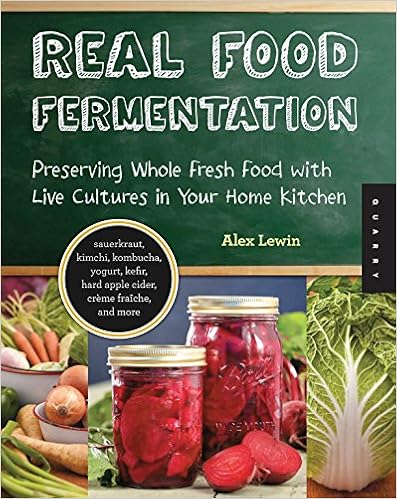
Real Food Fermentation: Preserving Whole Fresh Food with Live Cultures in Your Home Kitchen Flexibound by Alex Lewin (Quarry Books ) (IBRCookBooks), a review by the Bard of Bat Yam (#BArdOfBatYam), Poet Laureate Of Zion ( #PoetLaureateOfZion) and Stephen Darori (@stephendarori, #stephendarori)


I had not heard of this author before, so I did a bit of background research to find out more about him.

Alex Lewin is a software engineer, health coach, and 'real food' advocate who lives in Boston and San Francisco. He has a degree from Harvard in mathematics, has completed the Professional Chef Program at the Cambridge School of Culinary Arts, and has received training as a health coach at the Institute for Integrative Nutrition. He's currently working for the crowdsourced video broadcasting startups Justin.tv and Twitch.tv and serving as vice president of the 501(c)(3) nonprofit Boston Public Market Association. Since 2009, he has run a 'real food' blog (feedmelikeyoumeanit dot com) and led workshops on food preservation. In addition to his blog, he is active on LinkedIn, Twitter, and Facebook; a Google search turns up advertisements for his workshops, articles highlighting his volunteer activities and food advocacy, and a few mentions of his sustainable technology hedge fund, Atlas Capital Investments, in which he is a partner along with Solar Revolution author Travis Bradford. In his blog bio, he lists Vandana Shiva, Kurt Vonnegut, Anthony Bourdain, Andrew Weil, Barry Sears, Dr. Weston A. Price, Sally Fallon, and Sandor Katz as important influences. He blacked out his blog in protest of SOPA and professes a preference for free and open-source software, so he's obviously got his priorities in order.

Granted, you're buying a copy of Lewin's book and not a copy of Lewin himself. Hopefully, though, this information will help you understand this book - Lewin's first - a little better.

The Introduction and Chapter 1 cover the basic concepts of food preservation and fermentation, ending with a reasonably detailed overview of the kitchen equipment you will most likely need to create this book's recipes.

Lewin cares deeply where the food he's fermenting has come from. Chapter 2 ("Know Your Ingredients," 20 pages) is entirely devoted to the issue of Real Food, covering topics including food freshness and buying local. Instead of making a blanket declaration that organic produce is always superior, Lewin advocates that consumers open a dialog with food producers to really understand where their food comes from. While this might be possible in a farmer's market, he concedes that it is not always practical. I like the vision he has for a better world, but I also appreciate that he is realistic.

The recipes themselves fill out the remaining 110 pages. Chapters are devoted to sauerkraut, vegetables, dairy, fruits, beverages, and meat. Unlike Sandor Katz, Lewin makes no attempt to be comprehensive: beer, wine, soy (soy sauce, tempeh, natto, and miso), and even bread receive only a few short words of description and do not include recipes. Strategically, I think this makes sense - Wild Fermentation and The Art of Fermentation already exist, and there is no point in duplicating them. Instead, Lewin has presented a small number of very well tested recipes in such a way that even the most inexperienced and conservative in the kitchen might be enticed to try them out.

Covered in detail: sauerkraut; root and other vegetables; Caroline-style slaw; cucumber pickles; kimchi, yogurt; strained yogurt and whey; kefir; creme fraiche; butter and buttermilk; preserved lemons and limes; peach and plum chutney; pico de gallo; hard apple cider; mead; kombucha; vinegar; ginger ale; corned beef.

In contrast to the often rather vague 'recipes' in Katz' seminal works, these are laid out much more like they would be in a traditional cookbook: each recipe includes a quantitative ingredient list followed by very explicit instructions and many, many photographs.

Ahhh, the photographs! - they are rather gratuitous. In the sauerkraut recipe, for instance, an entire page is devoted to six full-color photographs and 100 words illustrating how to chop a bell pepper. One half of the surface area of pages 70-71 are images of, variously: water being poured into a Mason jar; a root vegetable being coined; salt pouring from a bowl into some water; and a food processor. While some of these images - for instance, an illustration on page 60 entitled 'The Evolution of Sauerkraut' that shows how the colors change as fermentation progresses - are quite helpful, nine out of every ten serve more to titillate than to educate. This is food porn, and in his blog Lewin is unapologetic:

"There are other fermentation books out there, including some new ones, but to be honest, mine is the prettiest by far..."

While 'The Art of Fermentation' is laid out more like a textbook, 'Real Food Fermentation' has a very modern (love it or hate it) layout. The margins and line spacing are broad, and large full-color photographs fill about one out of every three pages. While it has about the same number of pages as 'Wild Fermentation', the open layout fits significantly less text per page - I received the book this morning and read it straight through in a day. Those experimenting with fermentation for the first time, however, may find the pictures to be worth a thousand words.

I will update this review with more information about the recipes once I have had an opportunity to try them. The Carolina slaw, pico de gallo, and plum chutney look especially good, so I'm setting up this weekend to ferment them exactly as written.

If you're brand new to fermentation, consider purchasing this book and Wild Fermentation: The Flavor, Nutrition, and Craft of Live-Culture Foods to complement eachother.

If you want an encyclopedic account of food fermentation's history around the world and aren't as interested in recipes, The Art of Fermentation: An In-Depth Exploration of Essential Concepts and Processes from Around the World is your book.

If you dislike Katz' work for its frequent philosphical wanderings and lack of explicit instructions, try this book instead.

If you already have, use, and love Wild Fermentation and Art of Fermentation, you will probably not find much new information in this book. It will, however, be a useful coffee table trap for luring sometimes-reticent friends and family into your art.


Amazon.com Review



Cucumber Pickles


Cucumber Pickles


Pickled cucumbers, or simply “pickles,” are a quintessential fermented food. The first record of pickles comes from ancient Mesopotamia. Such diverse historical figures as Aristotle, Julius Caesar, Shakespeare, Amerigo Vespucci, and Thomas Jefferson are reported to have been fond of pickles. Indeed, Amerigo Vespucci, after whom America was named, was a pickle vendor before he became a world explorer. Pickles play a significant role in the food culture of many countries, from North America through Europe and into the Middle East.
Preparation:


1. ) If your cucumbers are at all soft, if you bought them at the store, and/or if you suspect that they might have been picked a while ago, you can perk them up by soaking them in ice water. 2. ) Trim the blossom ends off your cucumbers. These ends contain enzymes that can contribute to “hollow pickle syndrome. ” 3. ) Combine the chlorine-free water and salt in the pitcher, and add any starter or vinegar, if using. 4. ) Place the seasonings and tannin providers at the bottom of the jar or crock, followed by the cucumbers. 5. ) Pour the brine into the crock. 6. ) Weight everything down in such a way that it stays submerged. 7. ) If needed, cover the top of the jar or crock with the cloth, and affix the cloth with the rubber band. 8. ) Store at cool room temperature. Every day after the second or third, pull out a pickle, cut off a piece with a clean knife, and taste it. When the pickles are pleasantly sour but still crunchy, they are done. Move them to a cool place (like the refrigerator) immediately. Yield: 3–4 pounds (1.5–2 kg), Prep time: 10 minutes, Total time: 3 days–2 weeks

Equipment:


Knife; Cutting board (wood is ideal); 1-gallon (4-L) pitcher; ½-gallon (2-L) mason jar, a Pickl-It, a Harsch crock, or a plain glazed (lead-free) ceramic crock; Something to hold the cucumbers under the brine, like a small clean plate or saucer that fits inside the jar or crock (if needed); Clean dishtowel or cloth to cover the top of the jar or crock along with a rubber band (if needed).


Ingredients:

3 or 4 pounds (1.5 or 2 kg) small, thick-skinned cucumbers
2 quarts (2 L) chlorine-free water
1⁄2 cup (115 g) sea salt
Up to 1 cup (250 ml) whey or 1 pint (475 ml) sauerkraut juice, or starter powder from an envelope (optional)
Seasonings: generous amounts of whole garlic, bay leaf, etc. (optional)
A few fresh grape or oak leaves, or a couple of black tea bags, for their tannins (optional)
Red wine vinegar or apple cider vinegar, boiled and cooled to replace up to half of the water (optional)

Saturday, March 24, 2018

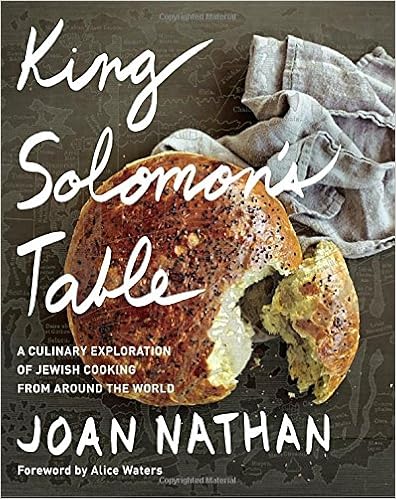
King Solomon's Table: A Culinary Exploration of Jewish Cooking from Around the World Hardcover – April 4, 2017 by Joan Nathan (Knopf) (IBRCookBooks) , a review by the Bard Of Bat Yam (#BardOfBatYam) ,(PoetLaureate Of Zion(#PoetLaureateOf Zion) and Stephen Darori (#Stephendarori, @stephendarori)


The cover tells the story: a variation of a challah roll lying atop an embossed map of the nations of the world. Joan Nathan, a tireless, curious, multilingual cookbook goddess, was in the Paradesi Synagogue in Kochi, Kerala, India, researching a book when she noted a sign that said Jewish people had been in India since the time of King Solomon. Whether it is myth, legend, or fact, she pondered how so many Jewish merchant seamen and traders traveled from the Middle East to other ports for business, spices, and spouses; and they created relationships and families, and “mashed-up” their Jewish food traditions with local customs, foodways and ingredients. She changed her plans and wrote this cookbook, her eleventh, instead.

In it, Ms. Nathan travels – like these ancient mariners - from country to country, and finds she Jewish mash-ups, whether it is Jewish foods from Europe that ended up in Dayton, or Turkish staples in Cuba, or the foods of Babylonia in FSU Georgia. As she once said, “When I lived in Israel, I saw not a clash but a coming together of civilizations. You know, for me, Jewish food was my mother’s matzoh ball soup. Then I went there and I saw stuffed vegetables and all kinds of salads that were different… I realized then that food was culture, and it was not restaurant culture. It was ethnic culture.”

The title? It is said that Solomon had 700 wives and half as many girlfriends, and they had many food traditions. He learned from them, they learned from him, and there was a sharing of recipes and other things. It was "tabletop Judaism." In this spirit, Nathan shares over 170 uniquely Jewish recipes from El Salvador to Israel, from Morocco to Cuba, Siberia to Canada, and Sri Lanka (you know the Rambam’s brother lived there...) to Romania.

The book opens with a quote from Genesis: When woman ate of the tree of wisdom, she took of its fruit and ate, and shared some with her husband, and he ate. This is followed by a 16 page introduction to Solomon, Babylon, Judea, and the roots of Jewish foods; and 11 pages on pantry spices. There are sections for Morning (16 recipes); Starters (21 recipes), Salads (16 recipes), Soups and Their Dumplings (13 recipes), Breads (7 Sabbath breads, 4 Weekday breads), Grains and Such (10 recipes), Vegetables (15), Fish (15), Poultry (10), Meat (14), and Sweets (23).

The aleph recipe is an Azerbaijani Kukusa with Swiss Chard and Herbs, which is easy and herb-infused and a living vestige of Jewish life in Babylonia and Persia and an example of how a Jewish dish traveled from southern France to North Africa and back to France, morphed to Azerbaijan and then to Brooklyn. The Tof "closing recipe" is a Libyan Saefra, King Solomon Cake (how often have you used Cream of Wheat and Orange zest in a recipe?).

One of the fascinating aspects of this book is that each recipe has a priceless shared story and an amazing photo. To me, it is a keepsake. Smoky Shakshuka with Tomatoes, Peppers, and Eggplant comes with a story of colonial Williamsburg and its first Jewish resident, Dr. de Sequeyra, who introduced tomato-eating to his neighbors and patients. A Matzo Brei recipe comes with a cook-off story than ranges from Zamosc Poland to DC to the residence of the late Sheila Lukins (author of Silver Palate Cookbook). A recipe for Chilaquiles (Mexican Matzo Brei) is delivered with a story from LA's Jonathan Gold. Her “New Old Fashioned Bagel” recipe is akin to Montreal style ones of Mark Furstenberg’s "Bread Furst." Speaking of Canada, there is a recipe for Toronto-style Shtritzlach, as well as Siberian Chremsel. The Socca (chickpea pancake) recipe may change your life, as will Caponata Siciliana di Melanzane alla Giudia (many say that the Jews introduced eggplants to Sicily). Her Hummus with Preserved Lemon and Cumin recipe is matched with a Hebrew translation story on whether it was ‘vinegar’ or ‘hummus’ that Boaz served his workers in The Book of Ruth.

Other highlights (just mentioning a few) include: Corfu/Italian Huevos Haminados con Spinaci (Long-Cooked Eggs with Spinach) from Daisy Dente Modigliani; Halleq (Persian Haroset); Ferrara Haroset (using banana, pear, and apple); Bene Israel Fish Curry with Fresh Ginger, Tamarind, and Cilantro (from Babu of Ernakulam, India); Matbucha; Curried Beet Borscht with Apples and Ginger; Yemenite Chicken Soup with Dill, Cilantro and Parsley, Persian Cucumber and Radish Salad with Hungarian Paprika; Salonikan MelitzanoSalata; Tchav; Honduran/CrownHeights mashup Winter Squash Soup with Hot Pepper and Coconut Milk; Perugia-style Cod with Tomatoes, Dried Plums, Onions, and Pine Nuts; Abgoosht with Gundi; Suellen Lazarus’ Vegetarian Matzo Ball Soup with Ghee; Concia; T’beet (Baghdadi Sabbath Overight Spiced Chicken with Rice and Coconut Chutney); Karaite-style Spiced Fried Matzo with Celery Seed and Tumeric; Kosher-Brined Roast Turkey with Challah-Chestnut-Cranberry Stuffing; Bulgarian Pashtida (from Spain Greece, the Balkans); Kubbanah, Ka’ak; Pletzel; Parpikas Krumpli (Hungarian Roasted Potatoes with Onions); Fideos Tostados with Cinnamon-Spiked Tomato Sauce (coupled with an essay on Rabbi Mussana and his concordance to the 1140 CE HeAruch); Slightly Sweet and Sour Cabbage (via Cuba by way of Ladino speakers of Turkey); Hand Cured Corned Beef; Indian Chicken with Cardamom, Cumin and Cilantro; David Tanis’ Dayton, Ohio-inspired Poached Salmon with Ginger-Cilantro Butter and Spinach; Macedonian Leek and Meat Patties; Roman Ricotta Cheese Crostata with Cherries or Chocolate; and El Salvador Schokoladenwurst.

Saturday, March 3, 2018

Hard Times by Charles Dickens (Author),‎ Kate Flint (Editor, Introduction) (Penguin Classics)


I suspect that Charles Dickens was in a pretty foul mood when he wrote “Hard Times” in 1854.

He draws stark differences between the “good” people and the “bad” people in this story, and assigns bleak fates to nearly all of them.

As usual in Dickens, the “bad” people are those that the society of his day saw as good — the upholders of civilization, the ambitious businessmen who made the British Empire hum, the refined, the educated, the proper, the gentry and the would-be gentry.

The “good” characters for him are those that civilized society looked down on — the workers, the domestics, the vagabonds, the entertainers. The salt of the earth.

In “Hard Times,” the “bad” people are especially ignoble. They are blowhards and snoops. They manipulate others out of boredom. They bully. They lack self-knowledge. They are self-satisfied, unctuous. Supercilious. Insipid.

Throughout the book, they cause constant havoc in the lives of other people, particularly the “good” characters.

Those “good” characters, with the exception of clear-headed Sissy Jupe, are victims. One is victimized by her father and her own stubbornness. The father is victimized by his belief in “Facts!” An honest laborer has four separate persecutors, including his own labor union leader.

A hard world

This world of “Hard Times” truly is hard. I’m not just talking about the setting here although the setting, Coketown, an industrial city where factory stacks belch smoke all day and settle soot in thick layers across the landscape, is terribly dreary.

I’m talking in addition about how it is a hard-edge life that is lived in this novel.

Life is bliss for the better sort — i.e., the “bad” people — until they get their comeuppance. And they do.

For the lower classes, their lot is abuse and suppression and betrayal. And for almost no one is there a happy ending.

By the conclusion of “Hard Times,” most of the characters — whether “good” or “bad” — are dead or damaged. One is killed in an accident. One is exposed as a fraud. Another, as a thief. Another, as a cad. Another, as a conniving busybody.

This is a much darker Dickens novel than, say, “David Copperfield” or “Oliver Twist” or “A Christmas Carol.” No dawn awakening for these humbugs, no chance to turn their lives around.

“Don’t!”

Throughout the book, I found myself wanting to scream to the characters: “Don’t!” Almost always, when they had a chance to do something that would harm them, either now or later, they did it.

Louisa, for instance, when asked by her father if she would like to marry a bullying braggart as he has arranged, goes along with it. Not because she likes or loves the man. But because, when it comes to her emotions, “What does it matter.”

He is surprised at her flat response, even though he has trained her to measure everything by the facts and leave emotions out of the equation.

Does she have some other boyfriend?

“Why, father, what a strange question to ask me! The baby-preference that even I have heard of as common among children, has never had its innocent resting-place in my breast. You have been so careful of me, that I never had a child’s heart. You have trained me so well, that I never dreamed a child’s dream. You have dealt so wisely with me, father, from my cradle to this hour, that I never had a child’s belief or a child’s fear.”

Tamping down the spirit


The tamping down of Louisa’s spirit is emblematic of the tamping down of the spirits of just about all of the novel’s characters, either by self-deception or by societal oppression.

Wondering about life is bad; following the lines, following the rules, is good. Reason is the guide. Faith, hope and charity are chimeras. No wonder so many people lose their way.

“There was a library in Coketown, to which general access was easy. Mr. Gradgrind [Louisa’s father] greatly tormented his mind about what the people read in this library: a point whereon little rivers of tabular statements periodically flowed into the howling ocean of tabular statements, which no diver ever got to any depth in and came up sane. It was a disheartening circumstance, but a melancholy fact, that even these readers persisted in wondering. They wondered about human nature, human passions, human hopes and fears, the struggles, triumphs and defeats, the cares and joys and sorrows, the lives and deaths of common men and women! They sometimes, after fifteen hours’ work, sat down to read mere fables about men and women, more or less like themselves, and about children, more or less like their own. They took Defoe to their bosoms, instead of Euclid….”

Feeling affection — and anger

We live in a time when many writers, such as Jonathan Franzen, look down on every one of their characters.

That’s why I take Dickens to my bosom. He may, in this novel, see the world as a harsh place. But instead of making him feel superior, it leads Dickens to feel affection for the common folk — and anger at what they are forced to endure.

Early in the novel, Gradgrind watches dismissively as a young Sissy says goodbye to the circus folk who have been her extended family. We see the scene through Gradgrind’s eyes — but we feel the emotions that Dickens feels.

“The basket packed in silence; they brought her bonnet to her, and smoothed her disordered hair, and put it on. Then they pressed about her, and bent over her in very natural attitudes, kissing and embracing her, and brought the children to take leave of her; and were a tender-hearted, simple, foolish set of women altogether.”

He likes the “good” people of this book, even if he is unable to find full happiness for most of them.

He likes them with their tender hearts, their simplicity and their foolish emotions.

And I do, too.

About the Author


Charles Dickens was born on February 7, 1812, in Landport, Portsea, England. He died in Kent on June 9, 1870. The second of eight children of a family continually plagued by debt, the young Dickens came to know not only hunger and privation,but also the horror of the infamous debtors’ prison and the evils of child labor. A turn of fortune in the shape of a legacy brought release from the nightmare of prison and “slave” factories and afforded Dickens the opportunity of two years’ formal schooling at Wellington House Academy. He worked as an attorney’s clerk and newspaper reporter until his Sketches by Boz (1836) and The Pickwick Papers (1837) brought him the amazing and instant success that was to be his for the remainder of his life. In later years, the pressure of serial writing, editorial duties, lectures, and social commitments led to his separation from Catherine Hogarth after twenty-three years of marriage. It also hastened his death at the age of fifty-eight, when he was characteristically engaged in a multitude of work.


Excerpt. © Reprinted by permission. All rights reserved.

CHAPTER I
The One Thing Needful


“Now, what I want is, Facts. Teach these boys and girls nothing but Facts. Facts alone are wanted in life. Plant nothing else, and root out everything else. You can only form the minds of reasoning animals upon Facts: nothing else will ever be of any service to them. This is the principle on which I bring up my own children, and this is the principle on which I bring up these children. Stick to Facts, Sir!”

The scene was a plain, bare, monotonous vault of a schoolroom, and the speaker’s square forefinger emphasized his observations by underscoring every sentence with a line on the schoolmaster’s sleeve. The emphasis was helped by the speaker’s square wall of a forehead, which had his eyebrows for its base, while his eyes found commodious cellerage in two dark caves, overshadowed by the wall. The emphasis was helped by the speaker’s mouth, which was wide, thin, and hard set. The emphasis was helped by the speaker’s voice, which was inflexible, dry, and dictatorial. The emphasis was helped by the speaker’s hair, which bristled on the skirts of his bald head, a plantation of firs to keep the wind from its shining surface, all covered with knobs, like the crust of a plum pie, as if the head had scarcely warehouse-room for the hard facts stored inside. The speaker’s obstinate carriage, square coat, square legs, square shoulders,—nay, his very neckcloth, trained to take him by the throat with an unaccommodating grasp, like a stubborn fact, as it was,—all helped the emphasis.

“In this life, we want nothing but Facts, Sir; nothing but Facts!”

The speaker, and the schoolmaster, and the third grown person present, all backed a little, and swept with their eyes the inclined plane of little vessels then and there arranged in order, ready to have imperial gallons of facts poured into them until they were full to the brim.

CHAPTER II
Murdering the Innocents


Thomas Gradgrind, Sir. A man of realities. A man of facts and calculations. A man who proceeds upon the principle that two and two are four, and nothing over, and who is not to be talked into allowing for anything over. Thomas Gradgrind, Sir—peremptorily Thomas—Thomas Gradgrind. With a rule and a pair of scales, and the multiplication table always in his pocket, Sir, ready to weigh and measure any parcel of human nature, and tell you exactly what it comes to. It is a mere question of figures, a case of simple arithmetic. You might hope to get some other nonsensical belief into the head of George Gradgrind, or Augustus Gradgrind, or John Gradgrind, or Joseph Gradgrind (all supposititious, non-existent persons), but into the head of Thomas Gradgrind—no, Sir!

In such terms Mr. Gradgrind always mentally introduced himself, whether to his private circle of acquaintance, or to the public in general. In such terms, no doubt, substituting the words “boys and girls,” for “Sir,” Thomas Gradgrind now presented Thomas Gradgrind to the little pitchers before him, who were to be filled so full of facts.

Indeed, as he eagerly sparkled at them from the cellarage before mentioned, he seemed a kind of cannon loaded to the muzzle with facts, and prepared to blow them clean out of the regions of childhood at one discharge. He seemed a galvanizing apparatus, too, charged with a grim mechanical substitute for the tender young imaginations that were to be stormed away.

“Girl number twenty,” said Mr. Gradgrind, squarely pointing with his square forefinger, “I don’t know that girl. Who is that girl?”

“Sissy Jupe, sir,” explained number twenty, blushing, standing up, and curtseying.

“Sissy is not a name,” said Mr. Gradgrind. “Don’t call yourself Sissy. Call yourself Cecilia.”

“It’s father as calls me Sissy, sir,” returned the young girl in a trembling voice, and with another curtsey.

“Then he has no business to do it,” said Mr. Gradgrind. “Tell him he mustn’t. Cecilia Jupe. Let me see. What is your father?”

“He belongs to the horse-riding, if you please, sir.”

Mr. Gradgrind frowned, and waved off the objectionable calling with his hand.

“We don’t want to know anything about that, here. You mustn’t tell us about that, here. Your father breaks horses, don’t he?”

“If you please, sir, when they can get any to break, they do break horses in the ring, sir.”

“You mustn’t tell us about the ring, here. Very well, then. Describe your father as a horsebreaker. He doctors sick horses, I dare say?”

“Oh yes, sir.”

“Very well, then. He is a veterinary surgeon, a farrier and horsebreaker. Give me your definition of a horse.”

(Sissy Jupe thrown into the greatest alarm by this demand.)

“Girl number twenty unable to define a horse!” said Mr. Gradgrind, for the general behoof of all the little pitchers. “Girl number twenty possessed of no facts, in reference to one of the commonest of animals! Some boy’s definition of a horse. Bitzer, yours.”

The square finger, moving here and there, lighted suddenly on Bitzer, perhaps because he chanced to sit in the same ray of sunlight which, darting in at one of the bare windows of the intensely whitewashed room, irradiated Sissy. For, the boys and girls sat on the face of the inclined plane in two compact bodies, divided up the centre by a narrow interval; and Sissy, being at the corner of a row on the sunny side, came in for the beginning of a sunbeam, of which Bitzer, being at the corner of a row on the other side, a few rows in advance, caught the end. But, whereas the girl was so dark-eyed and dark-haired, that she seemed to receive a deeper and more lustrous colour from the sun, when it shone upon her, the boy was so light-eyed and light-haired that the self-same rays appeared to draw out of him what little colour he ever possessed. His cold eyes would hardly have been eyes, but for the short ends of lashes which, by bringing them into immediate contrast with something paler than themselves, expressed their form. His short-cropped hair might have been a mere continuation of the sandy freckles on his forehead and face. His skin was so unwholesomely deficient in the natural tinge, that he looked as though, if he were cut, he would bleed white.

“Bitzer,” said Thomas Gradgrind. “Your definition of a horse.”

“Quadruped. Graminivorous. Forty teeth, namely twenty-four grinders, four eye-teeth, and twelve incisive. Sheds coat in the spring; in marshy countries, sheds hoofs, too. Hoofs hard, but requiring to be shod with iron. Age known by marks in mouth.” Thus (and much more) Bitzer.

“Now girl number twenty,” said Mr. Gradgrind. “You know what a horse is.”

She curtseyed again, and would have blushed deeper, if she could have blushed deeper than she had blushed all this time. Bitzer, after rapidly blinking at Thomas Gradgrind with both eyes at once, and so catching the light upon his quivering ends of lashes that they looked like the antennæ of busy insects, put his knuckles to his freckled forehead, and sat down again.

The third gentleman now stepped forth. A mighty man at cutting and drying, he was; a government officer; in his way (and in most other people’s too), a professed pugilist; always in training, always with a system to force down the general throat like a bolus, always to be heard of at the bar of his little Public-office, ready to fight all England. To continue in fistic phraseology, he had a genius for coming up to the scratch,2 wherever and whatever it was, and proving himself an ugly customer. He would go in and damage any subject whatever with his right, follow up with his left, stop, exchange, counter, bore his opponent (he always fought All England)3 to the ropes, and fall upon him neatly. He was certain to knock the wind out of common sense, and render that unlucky adversary deaf to the call of time. And he had it in charge from high authority to bring about the great public- office Millennium, when Commissioners should reign upon earth.

“Very well,” said this gentleman, briskly smiling, and folding his arms. “That’s a horse. Now, let me ask you girls and boys, Would you paper a room with representations of horses?”

After a pause, one half of the children cried in chorus, “Yes, Sir!” Upon which the other half, seeing in the gentleman’s face that Yes was wrong, cried out in chorus, “No, Sir!”—as the custom is, in these examinations.

“Of course, No. Why wouldn’t you?”

A pause. One corpulent slow boy, with a wheezy manner of breathing, ventured the answer, Because he wouldn’t paper a room at all, but would paint it.

“You must paper it,” said the gentleman, rather warmly.

“You must paper it,” said Thomas Gradgrind, “whether you like it or not. Don’t tell us you wouldn’t paper it. What do you mean, boy?”

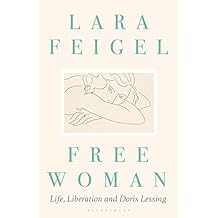
Free Woman: Life, Liberation and Doris LessingMar 8, 2018 by Lara Feigel Hardcover (Bloomsbury Publishing)

Free Woman: Life, Liberation and Doris Lessing

What it means to be an intelligent, political woman two generations after Lessing. Doris Lessing’s work united mind, body and feeling. The Children of Violence series featuring Martha Quest, and above all the novel The Golden Notebook, had a revolutionary impact on a generation of women. Lessing asserted that it was possible to live an intellectual life while attached to a human body: she wrote of emotion, how hormonal changes around mood, pregnancy or menstruation might affect the life of the mind without necessarily diminishing it. Instead of needing to be separated, each aspect of existence became part of a complete whole. In a liberating form of autobiographical fiction, Lessing discounted the prevailing idea of the 1950s that an intelligent, political woman must be unwomanly, un homme manqué. She wrote with great perception on the complications of sex, and how it will tie you more closely to a particular person, which in turn risks altering your personal freedom.

As with many writers, the books she produced can be seen in hindsight as an almost inevitable product of circumstance. Before she had reached the age of 30, she had married, had two children, divorced, married again, had another child, divorced again, and sailed to London with one child. She was escaping the constriction of poor, rural white Rhodesian life, her creative revolt against which had led to her being spied on as a communist by the colonial police. Her education was almost entirely self-generated, done from reading and conversation. When she reached London she had not yet published a book; ahead of her lay achievement and fame: more than 60 books, and the Nobel prize for literature.


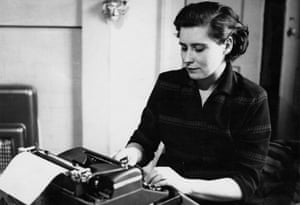
Revolutionary … Doris Lessing circa 1950. Photograph: Popperfoto/Getty Images

For Lara Feigel, at a time of her own frustration with social and biological expectation, Lessing offered a model of feminism “in which it was more important to live fully than to live contentedly”. She writes movingly of her maternal ambivalence, loving her son even while not wanting him to distract her from her necessary thinking and writing, and yearning for another child even while her marriage is falling apart. A reader in modern literature and culture at King’s College London, Feigel has something of Lessing’s diligent energy on the page, and in Free Woman she succeeds in making an extraordinary meditation on what it means to be a clever, engaged woman two generations after Lessing.

The ostensible starting point for her book is a sense of resentment against being coopted into the conventions surrounding a series of friends’ weddings. Wondering about the choices made by herself and her contemporaries, she tunes in to the powerful voice of Lessing. “I could hear her sentences in my ears as I sat below a hundred metres of tasteful Liberty print bunting that the bride, her sister and their mother (three intelligent and expensively educated women) had sewn by hand.” Like Anna Wulf in The Golden Notebook, she wants to be free and to exist independently of others in a way that now seems to be falling out of fashion, as the sacrifices of an earlier generation are taken for granted. “It seemed to me that Anna’s refusal to define herself primarily as a wife, mother or lover was a significant part of the audacity of The Golden Notebook.”

Feigel’s account of her sexual awakening is endearingly bookish, with crushes on Mr Rochester and Ralph Fiennes

Feigel acknowledges that the freedom she desires and expects is less about freedom from servitude or want than about freedom to do as you please and exist outside categories of attachment, and hence is predicated on advantages of class, race and money. The reason this privilege does not sink the book is because she approaches her reordering of life around the precepts of Lessing and her protagonists with such focused earnestness, and with a classical, precise use of language. An account of her teenage sexual awakening is endearingly bookish, with crushes on Mr Rochester and “the Ralph Fiennes of The English Patient”.

Free Woman is structured on themes found in Lessing’s writing, and involves close reading of her books as well as a measure of biography, combined with journeys to places and people of importance in her life. Although this is always interesting and mainly accurate (she mistakes the composer Philip Glass for the object of desire in Lessing’s 1996 novel Love, Again), it is perhaps the autobiographical representation that is in the end most compelling. Her technique is scrupulous, sparing neither herself nor others in a chronicle that is physically and intellectually intimate, in the manner of Jean-Jacques Rousseau in The Confessions, who had “resolved upon an enterprise which has no precedent … My purpose is to display to my fellow mortals a portrait in every way true to nature.”

In contemporary terms, her model may be Rachel Cusk, who displays a similar lack of interest in the feelings of people around her in favour of fidelity to her art. Feigel journeys to Zimbabwe to examine the sunset at the farm where the child Lessing lived, and goes to Los Angeles to meet her lover and chronicler, Clancy Sigal. Smaller than she had anticipated, “He was wearing a baseball cap labelled ‘Secret Agent’ and a T-shirt and shorts that were not the costume of an ageing Lothario.”


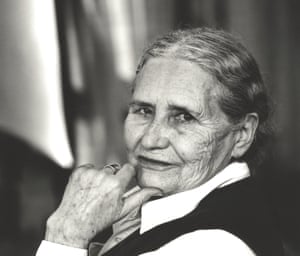
Doris Lessing in 2007 Photograph: Eamonn McCabe for the Guardian

It is in the analysis of Sigal and his relationship with Lessing that I felt most strongly the difference in the way men and women may react to the same story. Feigel is outraged on Lessing’s behalf that he claims not to have been attracted to her, and was “dismissing her aged 37 as a kind of ageing witch”. But Sigal, seven years her junior, was mentally ill, a wandering, faithless wannabe novelist who had been raised in a Chicago slum by a single mother. Living with Lessing in London, he felt hard done by, complaining bitterly that she was a “Stakhanovite” with “a furious and almost cosmic creative energy”. She treated him maternally in return, cooking him fine meals and continuing as she always did with her work. As a successful writer, Lessing used her pain from the relationship as a learning experience, examining the ways in which men and women react to situations of extreme emotional stress. In a reversal of the usual literary man-woman relationship, Sigal was crushed by the industry and stability of the established novelist, and in years to come would seek to create many Lessing-like characters and caricatures in his books, while always asserting his indifference to her work. He does not come out well.

Feigel has thought seriously about the meaning of freedom at different points in history, and about possible social mechanisms to escape “the limits of admissible thought”. Her quest in Free Woman to do things differently is too sincere to be self-indulgent. Unlike Lessing and Sigal in postwar London, she is part of a contemporary world that maintains rules that are nominally liberal but utterly constricting in their peer-pressured mental boundaries. “Now that we had fewer restrictions than their generation had done, there was less possibility to enjoy the feeling of moving beyond constraint, which itself constituted an experience of freedom,” she concludes.


Thursday, March 1, 2018

The Complete Works of Edgar Allan Poe (Classic Reprint) Paperback – September 17, 2017 by Edgar Allan Poe (Forgotton Works)

It is nearly fifty years since the death of Edgar Allan Poe, and his writings are now for the first time gathered together with an attempt at accuracy and completeness. The alleged reason for this indifference to the claims of a writer who has received almost universal recognition is that the literary executors of Dr. Rufus B. Griswold, Poe's first editor, held until recently the copyright to his works. But in reading the various memoirs of which, at one time or another, Poe has been the subject, it appears that other causes have been at work. One and all, even the most flattering estimates of Poe's genius, are pervaded by a curious antipathy to him as a man, and this prejudice, no doubt, has been largely responsible for the absence of any serious demand on the part of the public for a fair representation of the author in his works. A part of the disfavor with which Poe is regarded is due to Dr. Griswold's biography; for of all men Poe had best reason to pray that he might be delivered from the hands of his friends. But still more is chargeable to the extraordinary confusion of the man with his work--of the ethical with the purely literary aspect--which is so characteristic of literary judgments in this country.


This puritanical tang is to be detected even in a study so conscientious as the Memoir by Professor Woodberry, which occupies the opening pages of the first volume of the new edition. However, unlike his predecessor, Professor Woodberry has not allowed his lack of sympathy with his subject to interfere with the precision of his editing. Every care has been given to the preparation of the text and the notes. Whenever obtainable, the exact date of publication of the various papers has been ascertained, as well as other facts of interest regarding them, although no new light is thrown upon the source of Poe's inspiration.

Besides the Memoir by Professor Woodberry, the Tales, Criticisms, and Poems are severally preceded by a critical introduction by Mr. E.C. Stedman. These essays are distinguished by a very just appreciation of the merits and demerits of Poe as a writer. In effect, Mr. Stedman pronounces him a critic of exceptional ability, and agrees with the opinion of Mr. James Russell Lowell that Poe's more dispassionate judgments have all been justified by time. As a story-writer, Mr. Stedman considers that Poe's achievement fell short of his possibilities; he lacked the faculty of observation of real life, a defect for which his unique imaginative power in part compensated, but which will prevent his being classed among the greatest writers of fiction of his century. These qualities, however, appear in their proper aspect when he is regarded as a poet; they then fall into their right relation to his work, and are seen to have made him what he was, a master in his chosen field.

The imaginative illustrations have scarcely the quality of Poe's own creative genius, but the edition is well supplied with portraits of Poe, his wife, and his mother, as well as interesting views of places with which Poe's name is associated.
This edition is supposed to include all of Poe's writings which are of value. The Elk is here reprinted for the first time, while The Landscape Garden and The Pinakidia, a collection of quotations which struck Poe as important or suggestive, are omitted. Whatever may be thought of the omission of the first paper, that of the second is surely an error. It is conceded that not more than a half dozen of the tales, less than that number of the critical essays, and not all of the poems are of interest to the public at large. The sole reason, therefore, for publishing a complete edition of the works of Poe, as of any other writer, must be to increase the facilities for the student of the particular period in which he lived. To exclude writings in which an author has recorded the influences, however slight, which have moulded his thought is plainly to eliminate the chief reason for the compilation of such an edition. In this case, it amounts to an assumption on the part of editors and publishers alike that the last word in regard to Poe has been said. But as yet we have had no critical history of the intellectual development in this country during the past century. There remains, therefore, for the student of Poe's life and times, a field of research practically unexplored; and as long as this is the case it is impossible to form any conclusions in regard to him which can be considered final.

For Poe was essentially the product of his time. The intellectual activity which characterized the educated class in this country before 1860 was no sporadic instance, but the logical result of influences which belong to universal history. For example, when Goethe made his discovery of the unity of structure in organic life, it gave to the philosophers a physiological argument for the suppression of tyrants, and put the whole of creation on an equal footing. The French Revolution pointed the moral most effectually, and to the dullest mind brought a host of new deductions. These deductions necessarily involved a realization of the dignity and value of the individual, whether man or beast, and presented life in an entirely new aspect.

To us Americans these ideas came filtered through the mind of Coleridge, vivified by his enthusiasm. They found a fertile soil, and resulted in a growth of new ideas so vigorous and rapid that a kind of explosion of righteousness took place, which effectually and permanently upset some ancient and picturesque notions of might and right.
The so-called Transcendentalists of New England were the most conspicuous result of this new enthusiasm for the individual. In spite of his scorn for their pretensions, Edgar Allan Poe, in his way, was as deeply affected by the enthusiasm as the most radical among them. He was not, indeed, a reformer in the ordinary sense; he remained always, so to speak, just within the outer fringe of this new humanist movement. Its effect upon him was purely psychologic and the human mind became, in his estimation, a treasure-house of undreamed-of possibilities, which was but the poet's version of the value of the individual. Yet he was no more conscious of this than he was that Goethe's researches in natural history actuated him when, in imitation of Coleridge, he humanized his redoubtable raven. His mind was like a mirror in the precision with which it reflected the prevailing tendencies of his time, and with no more intention. The effect of Coleridge's influence on Poe has never been properly estimated. Professor Woodberry, it is true, accuses him of "parroting Coleridge," while Mr. James Russell Lowell also pointed out Poe's great indebtedness to him. Both critics, however, failed to appreciate the extent of this indebtedness. Not only did Coleridge exert a general influence, which Poe shared with every other man of letters in this country, but he transmitted a special and unique influence to him alone. This had already made of Coleridge a great poet, while to it Poe owes the tardy measure of fame which has been accorded him.

One aspect of the general influence which Coleridge exerted upon Poe is curiously exemplified in his poems from the time that he began to write. Coleridge was among the first to humanize nature. It was a fashion of the day, and a part of those tendencies of thought already briefly indicated. It arose, probably, from a haziness as to the limitations of self-consciousness. But whatever its cause, the idea strongly affected the poets, and animals, birds, plants, and insects were given human attributes, or were made to symbolize all kinds of abstractions. Christabel, The Rime of the Ancient Mariner, and many of the political poems, such as The Destiny of Nations and The Raven, are evidence of the attraction this notion possessed for Coleridge.

It apparently suited as well Poe's mystical turn of mind. The Raven is, of course, the most conspicuous instance, and in the Philosophy of Composition Poe assumes that a talking bird is the most natural thing in the world. In his so-called Juvenile Poems, printed about 1831, thirteen years before The Raven was published, he already makes use of birds as symbols of Nemesis or Destiny, and many of the passages are nearly identical in thought with some of Coleridge's lines. That Poe was familiar with the writings of Coleridge at that time is shown by his eulogistic reference to him in the preface to this early edition of his poems. The special influence which Coleridge had upon Poe relates to the development of his own poetical genius, and, to be understood, requires a short digression from the main subject.

About 1773, Gottfried August Bürger, a poor student at Göttingen, wrote a ballad under the title of Lenore. The composition of this ballad was due to Herder's famous appeal to the poets of Germany for the development of a national spirit in poetry. Lenore was modeled upon the ancient ballad forms as Bürger found them in the collections of Bishop Percy, Motherwell, and Ossian. From these and other relics of folk-songs, as well as from the study of Shakespeare, he evolved a theory as to the requirements of a poem which should endure,--a poem, in short, which should possess a universal, and therefore a national interest. The ballad was written in strict accord with the theory, and its success justified its author's conclusions. It was sung and recited by all classes throughout Germany, and its author, according to Madame de Staël, was more famous than Goethe. The poem was translated into nearly every language. In England it had seven different translators, among them Sir Walter Scott and Pye the poet laureate. It was set to music in many forms, and is said to have inspired The Erl King of Schubert. To the artists it was equally suggestive. Ary Scheffer and Horace Vernet both painted pictures which had for their subjects some episode in the poem, while two of the greatest illustrators of the day, Maclise and Bartolozzi, found it worthy of their best efforts.

Nor did the poets escape its influence. In England, Keats, Shelley, Southey, Coleridge, and Wordsworth either imitated or were inspired by it. Coleridge and Wordsworth were of all most deeply affected by its influence. From the evidence at hand it is apparent that the two poets based their famous new departure in poetry upon Bürger's poetic theory, which had been formulated in the preface to the second edition of his volume containing Lenore; also, that Coleridge's greatest poems, including The Rime of the Ancient Mariner and Christabel, were its direct result. It is this theory which is the foundation of Poe's Philosophy of Composition, and Poe was the third poet to be made famous by the careful application of it to his work. It is a striking confirmation of these facts that the productions in which Poe most faithfully conformed to the rules laid down by Burger are of all his writings those which have been considered by the critics as best worth preserving.

The famous theory whose effects have been so far-reaching is extremely simple. It is based upon a fundamental principle of aesthetics, that art, to endure, must deal with experiences common to all men. Simplicity of phrase, the narrative form, the refrain, and particularly the use of the supernatural are the ancient and essential means for the accomplishment of this end.

Bürger's poems were well known in this country before 1840, but Poe undoubtedly received his knowledge of the theory from Madame de Staël and from The Lyrical Ballads. This, it will be remembered, is the volume of poems whose publication in 1798 marked the apostasy of Wordsworth and Coleridge from the classic models. In the appendix to the second edition their reasons are set forth at length, and Bürger's ideas are referred to with enthusiasm. It is this explanation which Poe quotes in the introduction to his Juvenile Poems. The succession therefore, is uninterrupted: Bürger formulated his theory in the essay prefixed to the edition of his poems published in 1778; Coleridge and Wordsworth applied it and quoted it in The Lyrical Ballads in 1800; while Poe, in his turn quoted it, as adopted by Wordsworth and Coleridge, in the preface to the edition of his poems in 1831, and finally by its complete application made the chief success of his life.

It is clear from this that Poe was far from being the literary mountebank he is generally pictured. From his earliest youth he seems to have been actuated by a unity of purpose, an unswerving application of proven means to a desired end, which indicates in him the possession of qualities that are even Philistine, so respectable are they. As for Poe's weaknesses, some day, perhaps, they may find a critic such as François Villon found in Stevenson, and Coleridge in Walter Pater, who will judge them together with his genius as alike the expression of a nature too keenly responsive to the exigencies of life.

In the mean time, satisfactory as the new edition of Poe's works undoubtedly is to the general reader, we shall hope it may some day be supplemented by the republication of the papers now omitted, with the suggestion of new light to be thrown upon the tendencies of the period in which Poe lived.

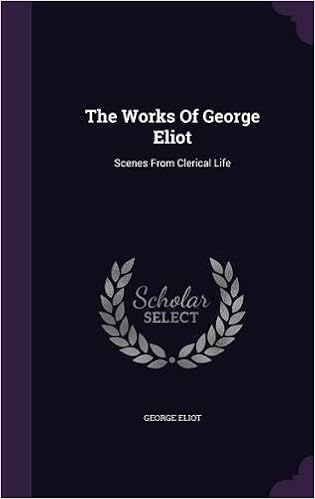
Scenes From Clerical Life, by George Eliot (Palala Press)

Fiction represents the character of the age to which it belongs, not merely by actual delineations of its times, like those of Tom Jones and The Newcomes, but also in an indirect, though scarcely less positive manner, by its exhibition of the influence of the times upon its own form and general direction, whatever the scene or period it may have chosen for itself. The story of "Hypatia" is laid in Alexandria almost two thousand years ago, but the book reflects the crudities of modern English thought; and even Mr. Thackeray, the greatest living master of costume, succeeds in making his Esmond only a joint-production of the Addisonian age and our own. Thus the novels of the last few years exhibit very clearly the spirit that characterizes the period of regard for men and women as men and women, without reference to rank, beauty, fortune, or privilege. Novelists recognize that Nature is a better romance-maker than the fancy, and the public is learning that men and women are better than heroes and heroines, not only to live with, but also to read of. Now and then, therefore, we get a novel, like these Scenes of Clerical Life, in which the fictitious element is securely based upon a broad groundwork of actual truth, truth as well in detail as in general.

It is not often, however, even yet, that we find a writer wholly unembarrassed by and in revolt against the old theory of the necessity of perfection in some one at least of the characters of his story. "Neither Luther nor John Bunyan," says the author of this book, "would have satisfied the modern demand for an ideal hero, who believes nothing but what is true, feels nothing but what is excellent, and does nothing but what is graceful."

Sometimes, indeed, a daring romance-writer ventures, during the earlier chapters of his story, to represent a heroine without beauty and without wealth, or a hero with some mortal blemish. But after a time his resolution fails;--each new chapter gives a new charm to the ordinary face; the eyes grow "liquid" and "lustrous," always having been "large"; the nose, "naturally delicate," exhibits its "fine-cut lines"; the mouth acquires an indescribable expression of loveliness; and the reader's hoped-for Fright is transformed by Folly or Miss Pickering into a commonplace, tiresome, novelesque Beauty. Even Miss Bronte relented toward Jane Eyre; and weaker novelists are continually repeating, but with the ommision of the moral, the story of the "Ugly Duck." Unquestionably, there is the excuse to be made for this great error, that it betrays the seeking after an Ideal. Dangerous word! The ideal standard of excellence is, to be sure, fortunately changing, and the unreal ideal will soon be confined to the second-rate writers for second-rate readers. But all the great novelists of the two last generations indulged themselves and their readers in these unrealities. It is vastly easier to invent a consistent character than to represent an inconsistent one;--a hero is easier to make (so all historians have found) than a man.

Suppose, however, novelists could be placed in a society made up of their favorite characters,--forced into real, lifelike intercourse with them;--Richardson, for instance, with his Harriet Byron or Clarissa, attended by Sir Charles; Miss Burney with Lord Orville and Evelina; Miss Edgeworth with Caroline Percy, and that marvellous hero, Count Altenburg; Scott with the automatons that he called Waverly and Flora McIvor. Suppose they were brought together to share the comforts (cold comforts they would be) of life, to pass days together, to meet every morning at breakfast; with what a ludicrous sense of relief, at the close of this purgatorial period, would not the unhappy novelists have fled from these deserted heroes and heroines, and the precious proprieties of their romance, to the very driest and mustiest of human bores,--gratefully rejoicing that the world was not filled with such creatures as they themselves had set before it as ideals!

To copy Nature faithfully and heartily is certainly not less needful when stories are presented in words than when they are told on canvas or in marble. In the Scenes from Clerical Life we have a happy example of such copying. The three stories embraced under this title are written vigorously, with a just appreciation of the romance of reality, and with honest adherence to truth of representation in the sombre as well as the brighter portions of life. It demands not only a large intellect, but a large heart, to gain such a candid and inclusive appreciation of life and character as they display. The greater part of each story reads like a reminiscence of real life, and the personages introduced show little sign of being "rubbed down" or "touched up and varnished" for effect. The narrative is easy and direct, full of humor and pathos; and the descriptions of simple life in a country village are often charming from their freshness, vivacity, and sweetness. More than this, these stories give proof of that wide range of experience which does not so much depend on an extended or varied acquaintance with the world, as upon an intelligent and comprehensive sympathy, which makes each new person with whom one is connected a new illustration of the unsolved problems of life and a new link in the unending chain of human development.

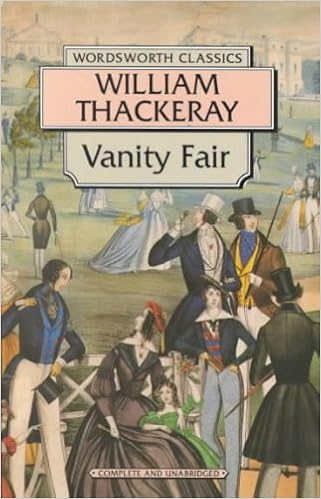
Vanity Fair (Wordsworth Classics) (Wordsworth Collection)Dec 5, 1999 by William Makepeace Thackeray ( Wordsworth Classics)

In the novels of Thackeray, essay is so much mixed up with narrative, and comment with characterization, that they can hardly be thoroughly appreciated in poor editions. The temptation to skip is almost irresistible, when wisdom can be purchased only at the expense of eyesight. We are therefore glad to welcome the commencement of a new edition of his writings, over whose pages the reader can linger at his pleasure, and quietly enjoy the subtleties of humor and observation which in previous perusals he overlooked. The present volumes, published by the Harpers, are among the most tasteful and comely products of the Cambridge University Press. Printed in large type of tinted paper, elegantly bound in green cloth and with a fac-simile of the author's autograph on the cover, every copy has the appearance of being a presentation copy. No English edition of Vanity Fair is equal to this American one in respect either to convenience of form or beauty of mechanical execution. The illustrations are numerous, well engraved, and embody the writer's own conceptions of his scenes and characters, and are often deliciously humorous.


Vanity Fair, though it does not include the whole extent of Thackeray's genius, is the most vigorous exhibition of its leading characteristics. In freshness of feeling, elasticity of movement, and unity of aim, it is favorably distinguished from its successors, which too often give the impression of being composed of successive accumulations of incidents and persons, that drift into the story on no principle of artistic selection and combination. The style, while it has the raciness of individual peculiarity and the careless case of familiar gossip, is as clear, pure, and flexible as if its sentences had been subjected to repeated revision, and every pebble which obstructed its lucid and limpid flow had been laboriously removed. The characterization is almost perfect of its kind. Becky Sharp, the Marquis of Steyne, Sir Pitt Crawley and the whole Crawley family, Amelia, the Osbornes, Major Dobbin, not to mention others, are as well known to most cultivated people as their most intimate acquaintances in the Vanity Fair of the actual world. It has always seemed to us that Mr. Osborne, the father of George, a representation of the most hateful phase of English character, is one of the most vividly true and life-like of all the delineations in the book, and more of a typical personage than even Becky or the Marquis of Steyne. Thackeray's theory of characterization proceeds generally on the assumption that the acts of men and women are directed not by principle, but by instincts, selfish or amiable--that toleration of human weakness is possible only by lowering the standard of human capacity and obligation--and that the preliminary condition of an accurate knowledge of human character is distrust of ideals and repudiation of patterns. This view is narrow, and by no means covers all the facts of history and human life, but what relative truth it has is splendidly illustrated in Vanity Fair. There is not a person in the book who excites the reader's respect, and not one who fails to excite his interest. The morbid quickness of the author's perceptions of the selfish element, even in his few amiable characters, is a constant source of surprise. The novel not only has no hero, but implies the non-existence of heroism. Yet the fascination of the book is indisputable, and it is due to a variety of causes besides its mere exhibition of the worldly side of life. Among these, the perfect intellectual honesty of the writer, the sad or satirical sincerity with which he gives in his evidence against human nature, is the most prominent. 

With all his lightness of manner, he is essentially a witness under oath, and testifies only to what he is confident he knows. Perhaps this quality, rare not only in novel writing, but in all writing, would not compensate for the limitation of his perceptions and the repulsiveness of much that he perceives, were it not for the peculiar charm of his representation. It is here that the individuality of the man appears, and it presents a combination of sentiments and powers more original perhaps than the matter of his works. Take from Vanity Fair that special element of interest which comes from Thackeray's own nature, and it would lose the greater portion of its fascination. It is not so much what is done, as the way in which is is done, that surprises and delights; and the manner is always inimitable, even when the matter is common.

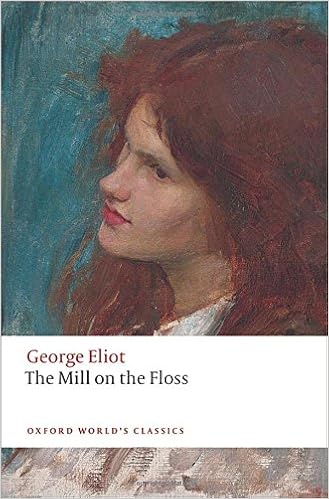
The Mill on the Floss (Oxford World's Classics) 3rd Edition by George Eliot (with introductions from Gordon S. Haightand ‎ Juliette Atkinson and Adam Bede (Wordsworth Classics) Paperback by George Eliot


It is not difficult to understand how the reader's attention may be attracted and his interest retained by a romance of the old chivalrous days whose very name and dim memory fill the mind with fascinating images, or by a novel whose high-born characters claim sympathy for their dignified sorrows and refined delights, or whose story is illuminated by the light of artistic culture and adorned with gems of rhetoric and fine fancy; but it is sometimes surprising to observe the favor which attends a simple tale of humble, unobtrusive, we might almost say insignificant people, whose plane of life appears nowhere to coincide with our own, and to whom romance and passion seem entirely foreign. Such a tale was "Adam Bede," whose great success as a literary venture hardly yet belongs to the chronicle of the past; such a tale is also "The Mill on the Floss," by the author of "Adam Bede," and such, we are confident, will also be its success.

Both books have many elements in common, but the second is the greater work of art, and indicates more fairly the scope and vigor of the author's mind. It is written in the same pure, hardy style, strong with Saxon words that admit of no equivocation or misunderstanding; it is illustrated with sketches of outward Nature and tranquil rural beauty, none the less vivid or truthful that they are drawn with the pen rather than the brush; and it is instinct with an honest, high-souled purpose. In these respects it resembles "Adam Bede," but in others it surpasses its predecessor. It displays a far keener insight into human passion, a subtler analysis of motives and principles, and it suggests a mental and a moral philosophy nobler in themselves and truer to humanity and religion. The pathos, too, is more genuine; for it is not based upon the mere utterance of grief or of entreaty, -- which the eloquent and the artful may, indeed, feign, -- but it is found in that skilful combination of material circumstance and spiritual influence which impresses upon the feeling, more than it proves to the reason, that the hour of heart-break is at hand, and which depends less for its effect upon the dramatic power of the imagination than upon the instant sympathy of the soul.

The principal fault which will be found with "The Mill on the Floss," and probably the only one, is, that the action moves too slowly and tamely in the first three or four books, and that the author shows an undue inclination to reflection and metaphysical digression. This will indeed, be a great objection to the superficial reader, who will impatiently regret that the tedious growth of a miller's boy and girl should usurp so many pages which might better have been filled with exciting incidents. But this very elaboration, tardy and idle though it may seem, was necessary to the completion of the author's plan, and -- in our eyes -- instead of being a blemish upon a fair story, is one of its principal charms. On this very account, however, the book will be less popular, and fewer persons will admire it wholly; but, as thoughtful readers draw near to the end of the narrative, and anxiously hasten on past trial, temptation, and conflict to the dreaded and yet inevitable downfall, muse mournfully over the agony and remorse that follow, and slowly close the volume upon tender forgiveness and final joy, they will be thankful for the far-seeing genius which, by this gradual process of education, enabled them to understand clearly the fateful scroll at last unfolded to them, and which, if they have read in the true spirit, has made them wiser and better.

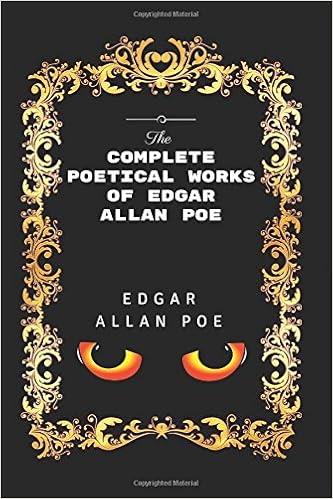
The Complete Poetical Works Of Edgar Allan Poe: By Edgar Allan Poe - Illustrated Paperback – March 22, 2017 by Edgar Allan Poe

This pocket edition of the Poetical Works of Edgar A. Poe is illustrated with a very much idealized portrait of the author. The poems are introduced by an original memoir, which, without eulogy or anathema, gives a clear and succinct account of that singular and wayward genius. The copies of verses are many in number, and most of them are chiefly remarkable for their art, rather than for their power of awakening either pleasing or profound emotion. It is one poem alone which makes an edition of these works emphatically called for. That poem, it is nearly superfluous to mention, is "The Raven," and truly it is unforgetable. In this weird and wonderful creation, art holds equal dominion with feeling. The form not only never yields to the sweep of the thought, but that thought, touching and fearful as is its tone, is made to turn and double fantastically, almost playfully, in many of the lines. The croak of the raven is taken up and moulded into rhyme by a nimble, if not a mocking spirit; and, fascinating as is the rhythmic movement of the verse, it appears like the dancing of the daughter of Herodias. This looks incongruous; and so do the words of the fool which Shakespeare has intermingled with the agonies and imprecations of Lear. In the tragedy, this is held to be a consummate stroke of art, and certainly the reader is grateful for the relief. Had Poe a similar design? Closely analyzed, this song seems the very ecstasy of fancy; as if the haunting apparition inspired the poet more than it appalled the man. We can call to mind no one who had ever played with an inexplicable horror more daintily or more impressively; and, whether premeditated or spontaneous, it is an epitome of the life of the writer, for the marked traits of his character are there, and almost the prevailing expression of his countenance.

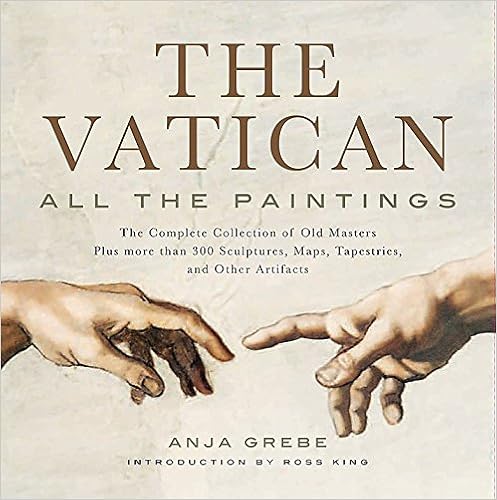
Vatican: All the Paintings: The Complete Collection of Old Masters, Plus More than 300 Sculptures, Maps, Tapestries, and other Artifacts Hardcover by Anja Grebe (Author),‎ Ross King (Foreword)Black Dog & Leventhal


In the same style, manner, and format as The Louvre: All the Paintings (Black Dog & Leventhal, 2011), every Old Master painting on display in the Vatican, as well as hundreds of additional masterpieces and treasures in the papal collection, is included in this deluxe slipcased volume with companion DVD.
The Vatican is one of the most visited sites in the world and houses many museums and palaces, as well as one of the finest art collections known to man. Works of interest include Michelangelo's Sistine Chapel and his Pieta; the Raphael frescoes; the works of Giotto, Fra Angelico, Titian, and Caravaggio; and some of the world's finest statues, manuscripts, architecture, and gardens, as well as the world's most precious Christian relics.
The Vatican: All the Paintings is an unprecedented celebration of this great collection. The book is organized into 22 sections representing the museums and areas of the Vatican, including the Pinacoteca, the Sistine Chapel, the Raphael Rooms, the Borgia Apartments, the Vatican Palaces, and St. Peter's Basilica. 
Each one of the 976 works of art represented in the book?including 661 classical paintings on display in the permanent painting collection and 315 other masterpieces?is annotated with the name of the painting and artist, the date of the work, the birth and death dates of the artist, the medium that was used, the size of the work, and the catalog number (if applicable). In addition, 180 of the most iconic and significant paintings and other pieces of art are highlighted with 300-word essays by art historian Anja Grebe on such topics as the key attributes of the work, what to look for when viewing the work, the artist's inspirations and techniques, biographical information on the artist, and the artist's impact on art history.
The design of the book enables the reader to carefully examine and enjoy the 180 full- and half-page featured paintings as well as the rest of the collection of paintings, which appear four or six to a page. Larger works of art, like ceilings and frescoes, include overall views and details of the masterpieces. Also includes three gatefolds to view the most iconic works of art at a larger size.
An enclosed DVD-ROM contains every image from the book and allows readers to view many at a slightly larger size and to search and sort the paintings by type, artist, era, and date, or by location in the Vatican museums. 
As with The Louvre: All the Paintings, The Vatican: All the Paintings is a complete treasure trove of one of the most exquisite and important art collections in the world. The book itself is a beautiful object.

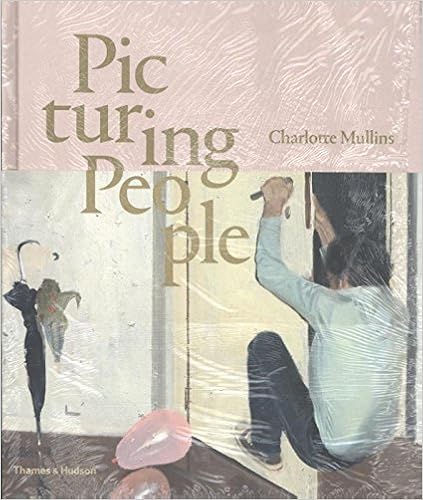
Picturing People: The New State of the Art By Charlotte Mullins. (Thames & Hudson, 192 pages, 200 illus., $40.)


What drives artists to represent people as they do? This question, at the heart of figurative art, and how we represent ourselves as a society, is especially relevant today. Author Charlotte Mullins picks up the conversation at a time when the art world is influenced by the proliferation of images of all kinds, across all mediums, as well as a growing interest in figurative art.

Profiles of nearly sixty artists―from Kara Walker and Grayson Perry to Cindy Sherman and Kehinde Wiley―showcase significant works and are accompanied by the artists’ commentary, illustrating the range of motivations, mediums, and techniques driving one of the most potent genres of art today. The book is organized into five thematic sections that reflect artists’ motivations, which range from investigating the history of art itself to exploring interpersonal relationships. Mullins’s keen curatorial eye picks out informed, sometimes unexpected juxtapositions of artists that reveal new affinities and distinctions between them, making Picturing People an important contribution to the study of figurative art. 200+ illustrations
Focusing on 70 contemporary painters from at least 24 countries, this excellent and highly readable survey argues that these new, sometimes unsettling pictures of people are a reaction to the political unrest, economic turbulence, culture clashes and confusion of the postwar era. Images range from cartoonish sketches to complex family scenes.

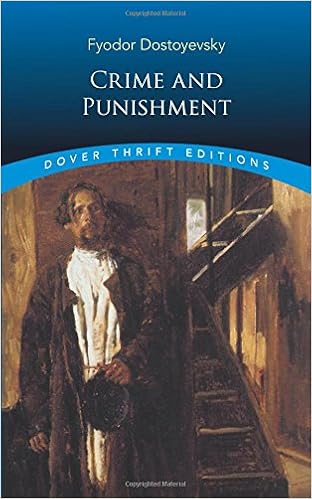
Crime and Punishment Paperback – August 22, 2001 by Fyodor Dostoyevsky (Author),‎ Constance Garnett (Translator)( Dover Publications)


The two popular translations of ‘Crime and Punishment’ before the 1993 translation by Richard Pevear and Larissa Volokhonsky, were by Constance Garnett and David McDuff. The Pevear/Volokhonsky translation became my favourite – until Oliver Ready’s translation came along. Not knowing a word of Russian, I declare my favourite only by the enjoyment I derived from reading the book in English.

Many things may indeed be lost in translation, and many others get misrepresented but we may not know. The result of reading only the English versions is that one’s choice is largely subjective. Compared to the Garnett version, the Pevear/Volokhonsky translation seems very modern – until Ready’s came along. Little things like changing ‘had not’ to ‘hadn’t’ renders Ready’s version not only a little more modern but also more informal. That is not to say that the atmosphere of old Russia is lost. Ready uses ‘fibs’ for ‘lies’ (Pevear/Volokhonsky) in one passage.

Ultimately, the reader has to decide for himself which style he enjoys more. Here is a comparison from one of my favourite passages (there are many) from the book. I set out first the Pevear/Volokhonsky version then the Ready version:

“What do you think?” Razmumikhin shouted, raising his voice even more. “You think it’s because they’re lying? Nonsense! I like it when people lie! Lying is man’s only privilege over all other organisms. If you lie- you get to the truth! Lying is what makes me a man. Not one truth has ever been reached without lying fourteen times or so, maybe a hundred and fourteen, and that’s honourable in its way; well, but we can’t even lie with our minds! Lie to me, but in your own way, and I’ll kiss you for it. Lying in one’s own way is almost better than telling the truth in someone else’s way; in the first case you’re a man, and in the second – no better than a bird. The truth won’t go away, but life can be nailed shut; there are examples. (Pevear/Volokhonsky)

‘Now what are you thinking?’ cried Razumikhin, raising even more. ‘That it’s their lies I can’t stand? Nonsense! I like it when people lie. Telling lies is humanity’s sole privilege over other organism. Keep fibbing and you’ll end up with the truth! I’m only human because I lie. No truth’s ever been discovered without fourteen fibs along the way, if not one hundred and fourteen, and there’s honour in that. But our lies aren’t even our own! Lie to me by all means, but make sure it’s your own, and then I’ll kiss you. After all, lies of your own are almost better than someone else’s truth: in the first case you’re human; in the second you’re just a bird! The truth won’t run away, but life just might – wouldn’t be the first time.

Ready’s version has a table of chronological events and a fresh, inspiring introduction that will help the first-time reader understand and appreciate the context of ‘Crime and Punishment’

The two years before he wrote Crime and Punishment (1866) had been bad ones for Dostoyevsky. His wife and brother had died; the magazine he and his brother had started, Epoch, collapsed under its load of debt; and he was threatened with debtor's prison. With an advance that he managed to wangle for an unwritten novel, he fled to Wiesbaden, hoping to win enough at the roulette table to get himself out of debt. Instead, he lost all his money; he had to pawn his clothes and beg friends for loans to pay his hotel bill and get back to Russia. One of his begging letters went to a magazine editor, asking for an advance on yet another unwritten novel — which he described as Crime and Punishment.

One of the supreme masterpieces of world literature, Crime and Punishment catapulted Dostoyevsky to the forefront of Russian writers and into the ranks of the world's greatest novelists. Drawing upon experiences from his own prison days, the author recounts in feverish, compelling tones the story of Raskolnikov, an impoverished student tormented by his own nihilism, and the struggle between good and evil. Believing that he is above the law, and convinced that humanitarian ends justify vile means, he brutally murders an old woman — a pawnbroker whom he regards as "stupid, ailing, greedy…good for nothing." Overwhelmed afterwards by feelings of guilt and terror, Raskolnikov confesses to the crime and goes to prison. There he realizes that happiness and redemption can only be achieved through suffering. Infused with forceful religious, social, and philosophical elements, the novel was an immediate success. This extraordinary, unforgettable work is reprinted here in the authoritative Constance Garnett translation.

War and Peace (Wordsworth Classics) Paperback by Leo Tolstoy (Wordsworth Editions Ltd)


With an Introduction and Notes by Henry and Olga Claridge, University of Kent at Canterbury. War and Peace is a vast epic centred on Napoleons war with Russia. While it expresses Tolstoys view that history is an inexorable process which man cannot influence, he peoples his great novel with a cast of over five hundred characters. Three of these, the artless and delightful Natasha Rostov, the world-weary Prince Andrew Bolkonsky and the idealistic Pierre Bezukhov illustrate Tolstoys philosophy in this novel of unquestioned mastery. This translation is the one which received Tolstoys approval.

Approaching War and Peace feels like a monumental task. Sitting down and reading it is not for the faint of heart. The story is engrossing and will consume you. It took me about four weeks to finish it because it's not the kind of book that one can read straight through. One puts it down to think about it, coming back after one has digested what has one read.

Set against the backdrop of Napoleonic Europe, the story follows three main Russian families as they navigate the early years of the nineteenth century. Plot? Is there one? Perhaps. Perhaps not. The background history of the Napoleon Wars are what set in motion a lot of the action, especially for the male protagonists who fight in the wars. For the females it seems that love and falling in love and out of love and the passage to adulthood are what drives their stories. Our main protagonist is Pierre Bezukhov, a mirror for Tolstoy himself. The ideas Bezukhov spouts are usually the ideas Tolstoy believes in and wants you to believe in too. Pierre is the illegitimate son of a rich aristocrat.

The other families are the Bolkonskys and the Rostovs. The Bolkonskys are right and proper with an autocratic father from one of the lower levels of Hell. The Rostovs are more homely and not so rich but full of love. There are also a couple of other families that play parts such as the Kuragins, who play the part of the somewhat "evil" characters. The cast of characters is indeed large as many say. But honestly the main characters that the book follows number about 5 to 10. So it's manageable. Aside from Pierre Bezukhov, there is Prince Andrei Bolkonsky, Princess Marya Bolkonskaya, Countess Natalya Rostova, Count Nicholas Rostov, and Helene Kuragina. The rest of the characters are secondary and even Helene is not that important.

The book itself is hard to describe. Is it a novel? Tolstoy didn't think so. Is it history? Though there are huge stretches on the philosophy of history, this is not a history book. Nor is it philosophy. At leas not necessarily good philosophy. It is something unique. Perhaps that is why War and Peace has attained the status of classic. It is a book that attempts to give one a complete (at least complete aristocratic) view of Russian society between the years 1805 and 1812. Perhaps the German word, 'Gesamtkunstwerk' - total work of art - should be applied to literature.

I read the eBook Pevear-Volokhonsky transalation that goes for $12.99. It was a good translation that captured the spirit of the times. The notes and translations of the French were all hyperlinked which made things easy enough to read and follow. Though I would rather have seen the notes on the bottom of each page rather than the end of each book. Having finished War and Peace, I am glad that I read it. Though I am still not quite certain if it should be regarded as such as a classic. Is it truly that great? I'm still not sure.