Showing posts with label #BardofBatYam. Show all posts

Tuesday, September 25, 2018

Extermination of the Jews under Operation Reinhard .....The Operation Reinhard Death Camps, Revised and Expanded Edition: Belzec, Sobibor, Treblinka Hardcover – June 20, 2018 by Yitzhak Arad (Indiana University Press),Eyewitness to Genocide: The Operation Reinhard Death Camp Trials, 1955-1966 (Legacies of War) Paperback – August 26, 2016 by Michael Bryant ( University Tennessee Press;),The Commandant of Lubizec: A Novel of the Holocaust and Operation Reinhard Audible Audiobook – Unabridged Patrick Hicks (Author), Steven Jay Cohen (Narrator), Steerforth Press LLC (Publisher)(Steerforth Press LLC),Heydrich: Dark Shadow of the SS Hardcover – October 5, 2018 by Max Williams (Fonthill Media),Reinhard Heydrich: The Ideal National Socialist Paperback – April 7, 2016 by Reinhard Heydrich (Author), Adolf Hitler (Author), Heinrich Himmler (Author), Martin Bormann (Author),Hitler's Hangman: The Life of Heydrich Audible Audiobook – Unabridged Robert Gerwarth (Author), Napoleon Ryan (Narrator), Tantor Audio (Publisher) (TAntor Audio) Hunting the Hangman Paperback – April 1, 2018 by Howard Linskey (OLdcastle Books),SS Einsatzgruppen: Nazi Death Squads, 1939–1945 (History of Terror Series) Paperback – June 1, 2018 by Gerry van Tonder ( Pen & Sword)

Related image

Operation Reinhard or Operation Reinhardt (German: Aktion Reinhard or Aktion Reinhardt; also Einsatz Reinhard or Einsatz Reinhardt) was the codename of the secretive World War II German plan to exterminate Poland's Jews in the General Government district of German-occupied Poland. This deadliest phase of the Holocaust was marked by the introduction of extermination camps.

As many as two million Jews were sent to Bełżec, Sobibór, and Treblinka to be put to death in purpose-built gas chambers. In addition, mass-killing facilities, using Zyklon B, were developed at about the same time at the Majdanek concentration camp and at Auschwitz II-Birkenau, near the earlier-established Auschwitz I camp for ethnically Polish prisoners.

The first concentration camps in Nazi Germany were established in 1933 as soon as the National Socialist regime developed. They were used for coercion, forced labour, and imprisonment, not for mass murder. The camp system expanded dramatically with the Nazi-Soviet invasion of Poland at the onset of the World War II in September 1939. The new network of Nazi concentration camps built by SS in Germany (including Austria), Poland, and elsewhere in Europe began exploiting foreign captives in the war industry. The prisoners locked into forced labour began dying by the tens of thousands from starvation and untreated disease, or summary executions meant to inflict terror. The Soldau concentration camp opened in September 1939. Also in September, the Stutthof concentration camp was built, with 40 sub-camps set up contingently for maximum profit. Some of the most notorious slave labour camps included Mauthausen, Dachau, Bergen-Belsen, Gross-Rosen (with 100 subcamps), Ravensbrück (70 subcamps), and Auschwitz (with 44 subcamps eventually),among other places.

After the German-Soviet war began, the Nazis decided to undertake the European-wide Final Solution to the Jewish Question. In January 1942, during a secret meeting of German leaders chaired by Reinhard Heydrich, Operation Reinhard was drafted; soon to become a major step in the systematic murder of the Jews in occupied Europe, beginning in the General Government district of German-occupied Poland. Within months, three top-secret camps (at Bełżec, Sobibór, and Treblinka) were built to efficiently kill tens of thousands of Jews every day. These camps differed from Auschwitz and Majdanek, because the latter operated as forced-labour camps initially, before they became death camps fitted with crematoria. Unlike "mixed" extermination camps, the extermination camps of Operation Reinhard kept no prisoners, except as a means of furthering the camps' sole purpose of industrial scale murder. The very few Jews who successfully escaped death (notably, only two at Bełżec), were members of the Sonderkommando. All other victims were killed on arrival.

The organizational apparatus behind the new extermination plan had been put to the test already during the euthanasia Aktion T4programme ending in August 1941, which resulted in the murders of more than 70,000 Polish and German disabled men, women, and children. The SS officers responsible for the Aktion T4, including Christian Wirth, Franz Stangl, and Irmfried Eberl, were all given key roles in the implementation of the "Final Solution" in 1942.


Reinhard Heydrich shown as the SS-Gruppenführer and General of the Police

The origin of the operation's name is debated by Holocaust researchers. Various German documents spell the name differently, some with "t" after "d" (as in "Aktion Reinhardt"), others without it. Yet another spelling (Einsatz Reinhart) was used in the Höfle Telegram. It is generally believed that Aktion Reinhardt, outlined at Wannsee on 20 January 1942, was named after Reinhard Heydrich, the coordinator of the Endlösung der Judenfrage (the Final Solution of the Jewish Question), which entailed the extermination of the Jews living in the European countries occupied by Nazi Germany. Heydrich was attacked by British-trained Czechoslovakian agents on 27 May 1942 and died of his injuries eight days later. The earliest memo spelling out Einsatz Reinhard was relayed two months later.

In November 1946, Rudolf Höss, the former commandant of Auschwitz, suggested in a report while in Polish custody in Kraków, that Operation Reinhardt might have been named after the German State Secretary of Finance Fritz Reinhardt, who was in charge of the collection, sorting, and utilisation of personal belongings acquired from Jews killed at the extermination camps. However, Höss' claim is not proven by surviving documents. Heydrich himself had spelled his first name both Reinhard and Reinhardt throughout the 1930s according to Reichsführer-SS Heinrich Himmler. Meanwhile, Fritz Reinhardt and his ministry became involved with the operation well after it had received its name, according to historians Peter Witte and Stephen Tyas, thus confirming that the operation was indeed named after Reinhard Heydrich.


SS and Police Leader Odilo Globocnik in charge of Operation Reinhard

On 13 October 1941, SS and Police Leader Odilo Globocnik headquartered in Lublin received an oral order from Himmler – anticipating the fall of Moscow – to start immediate construction work on the first killing centre at Bełżec in the General Government territory of occupied Poland. Notably, the order preceded the Wannsee Conference by three months.[20] The new camp was operational by March 1942, with leadership brought in from Germany under the guise of Organisation Todt (OT).

Globocnik was given control over the entire programme. All highly secretive orders he received came directly from Himmler and not from SS-GruppenführerRichard Glücks, head of the greater Nazi concentration camp system, which was run by the SS-Totenkopfverbände and engaged in slave labour for the war effort. Each death camp was managed by between 20 and 35 officers from the Totenkopfverbände (Death's Head Units) sworn to absolute secrecy, and augmented by the Aktion T4 personnel selected by Globocnik. The extermination program was designed by them based on prior experience from the forced euthanasia centres. The bulk of the actual labour at each "final solution" camp was performed by up to 100 mostly Ukrainian Trawniki guards, recruited by SS-Hauptsturmführer Karl Streibel from among the Soviet prisoners of war, and by up to a thousand Sonderkommando prisoners whom the Trawniki guards used to terrorise. The SS called their volunteer guards "Hiwis", an abbreviation of Hilfswillige (lit. "willing to help"). According to the testimony of SS-Oberführer Arpad Wigand during his 1981 war crimes trial in Hamburg, only 25 percent of recruited collaborators could speak German.

By mid-1942, two more death camps had been built on Polish lands: Sobibór (operational by May 1942) under the leadership of SS-Hauptsturmführer Franz Stangl, and Treblinka (operational by July 1942) under SS-Obersturmführer Irmfried Eberl


The 1944 aerial photo of Treblinka II. The new farmhouse for a guard and a livestock building are visible to the lower left. The photograph is overlaid with already-dismantled structures (marked in red/orange). On the left-hand side are the SS and the Trawnikis living quarters (1) with barracks defined by the surrounding walkways. At the bottom (2) are the railway ramp and unloading platform (centre), marked with the red arrow. The "road to heaven" is marked with a dashed line. The undressing barracks for men and women, surrounded by a solid fence with no view of the outside, are marked with two rectangles. The location of the new, big gas chambers (3) is marked with a cross. The burial pits, dug with a crawler excavator, are in light yellow.


Protest! against killing Jews in Poland of Kossak-Szczucka printed in occupied Poland - August 1942.

The killing mechanism consisted of a large internal-combustion engine pumping exhaust fumes into homicidal gas chambers through long pipes. Starting in February–March 1943 the bodies of the dead were exhumed and cremated in pits. Treblinka, the last camp to become operational, utilised knowledge learned by the SS previously. With two powerful engines,[a] run by SS-Scharführer Erich Fuchs, and the gas chambers soon rebuilt of bricks and mortar, this death factory had killed between 800,000 and 1,200,000 people within 15 months, disposed of their bodies, and sorted their belongings for shipment to Germany.

The techniques used to deceive victims and the camps' overall layout were based on a pilot project of mobile killing conducted at the Chełmno extermination camp (Kulmhof), which began operating in late 1941 and used gas vans. Chełmno was not a part of Reinhard. It came under the direct control of SS-Standartenführer Ernst Damzog, commander of the SD in Reichsgau Wartheland. It was set up around a manor house similar to Sonnenstein. The use of gas vans had been previously tried and tested in the mass killing of Polish prisoners at Soldau, and in the extermination of Jews on the Russian Front by the Einsatzgruppen. Between early December 1941 and mid-April 1943, 160,000 Jews were sent to Chełmno from the General Government via the Ghetto in Łódź. Chełmno did not have crematoria; only the mass graves in the woods. It was a testing ground for the establishment of faster methods of killing and incinerating people, marked by the construction of stationary facilities for the mass murder a few months later. The Reinhard death camps adapted progressively as each new site was built.

Taken as a whole, Globocnik's camps at Bełżec, Sobibór, and Treblinka had almost identical design, including staff members transferring between locations. The camps were situated within wooded areas well away from population centres. All were constructed near branch lines that linked to the Ostbahn. Each camp had an unloading ramp at a fake railway station, as well as a reception area that contained undressing barracks, barber shops, and money depositories. Beyond the receiving zone, at each camp was a narrow, camouflaged path known as the Road to Heaven (called Himmelfahrtsstraße or der Schlauch by the SS), which led to the extermination zone consisting of gas chambers, and the burial pits, up to 10 metres (33 ft) deep, later replaced by cremation pyres with rails laid across the pits on concrete blocks; refuelled continuously by the Totenjuden. Both Treblinka and Bełżec were equipped with powerful crawler excavators from Polish construction sites in the vicinity, capable of most digging tasks without disrupting surfaces. At each camp, the SS guards and Ukrainian Trawnikis lived in a separate area from the Jewish work units. Wooden watchtowers and barbed-wire fences camouflaged with pine branches surrounded all camps.

The killing centres had no electric fences, as the size of the prisoner Sonderkommandos (work units) remained relatively easy to control – unlike in camps such as Dachau and Auschwitz. To assist with the arriving transports only specialised squads were kept alive, removing and disposing of bodies, and sorting property and valuables from the dead victims. The Totenjuden forced to work inside death zones were kept in isolation from those who worked in the reception and sorting area. Periodically, those who worked in the death zones would be killed and replaced with new arrivals to remove any potential witnesses to the scale of the mass murder.

During Operation Reinhard, Globocnik oversaw the systematic killing of more than 2,000,000 Jews from Poland, Czechoslovakia, France, the Reich(Germany and Austria), the Netherlands, Greece, Hungary, Italy and the Soviet Union. An undetermined number of Roma were also killed in these death camps, many of them children.


Deportation of Jews to Treblinka during liquidation of the Biała Podlaskaghetto, perpetrated by the Reserve Police Battalion 101 in October 1942

In order to achieve their purposes, all death camps used subterfuge and misdirection to conceal the truth and trick their victims into cooperating. This element had been developed in Aktion T4, when disabled and handicapped people were taken away for "special treatment" by the SS from "Gekrat"wearing white laboratory coats, thus giving the process an air of medical authenticity. After supposedly being assessed, the unsuspecting T4 patients were transported to killing centres. The same euphemism "special treatment" (Sonderbehandlung) was used in the Holocaust.

The SS used a variety of ruses to move thousands of new arrivals travelling in Holocaust trains to the disguised killing sites without unleashing panic. Mass deportations were called "resettlement actions"; they were organised by special Commissioners, and conducted by uniformed police battalions from Orpo and Schupo in an atmosphere of terror. Usually, the deception was absolute. For example, in August 1942, people of the Warsaw Ghetto lined up for several days to be "deported" in order to obtain bread allocated for travel. Jews unable to move or attempting to flee were shot on the spot. Even though death in the cattle cars from suffocation and thirst was rampant, affecting up to 20 percent of trainloads,[53]most victims were willing to believe that the German intentions were different. Once alighted, the prisoners were ordered to leave their luggage behind and march directly to the "cleaning area" where they were asked to hand over their valuables for "safekeeping". Common tricks included the presence of a railway station with awaiting "medical personnel" and signs directing people to disinfection facilities. Treblinka also had a booking office with boards naming the connections for other camps further East.


The railway schedule (or Fahrplananordnung) outlining all transports being sent to Treblinka on 25 August 1942

The Jews most apprehensive of danger were brutally beaten in order to speed up the process. At times, the new arrivals who had suitable skills were selected to join the Sonderkommando. Once in the changing area, the men and boys were separated from the women and children, and everyone was ordered to disrobe for a communal bath: "quickly – they were told – or the water will get cold." The old and sick, or slow, prisoners were taken to a fake infirmary named the Lazarett, that had a large mass grave behind it. They were killed by a bullet in the neck, while the rest were being forced into the gas chambers.

To drive the naked people into the execution barracks housing the gas chambers, the guards used whips, clubs, and rifle butts. Panic was instrumental in filling the gas chambers, because the need to evade blows on their naked bodies forced the victims rapidly forward. Once packed tightly inside (to minimize available air), the steel air-tight doors with portholes were closed. The doors, according to Treblinka Museum research, originated from the Soviet military bunkers around Białystok. Although other methods of extermination, such as the cyanic poison Zyklon B, were already being used at other Nazi killing centres such as Auschwitz, the Aktion Reinhard camps used lethal exhaust gases from captured Soviet tank engines. Fumes would be discharged directly into the gas chambers for a given period, then the engines would be switched off. SS guards would determine when to reopen the gas doors based on how long it took for the screaming to stop from within (usually 25 to 30 minutes). Special teams of camp inmates (Sonderkommando) would then remove the corpses on flatbed carts. Before the corpses were thrown into grave pits, gold teeth were removed from mouths, and orifices were searched for jewellery, currency, and other valuables. All acquired goods were managed by the Main SS Economic and Administrative Department.
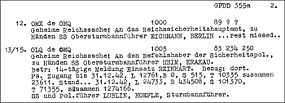


The Höfle Telegram, which was an intercepted SS Enigma message, records the total number of people sent to KL Lublin/Majdanek, Bełżec, Sobibór and Treblinka as 1,274,166 in 1942.

During the early phases of Operation Reinhard, victims were simply thrown into mass graves and covered with lime. However, from 1943 onwards, to hide the evidence of this war crime, all bodies were burned in open air pits. Special Leichenkommando (corpse units) had to exhume bodies from the mass graves around these death camps for incineration.

Nevertheless, Reinhard still left a paper trail. In January 1943, Bletchley Park intercepted an SS telegram by SS-SturmbannführerHermann Höfle, Globocnik's deputy in Lublin, to SS-Obersturmbannführer Adolf Eichmann in Berlin. The decoded Enigma messagecontained statistics showing a total of 1,274,166 arrivals at the four Aktion Reinhard camps until the end of 1942, but the British code-breakers did not understand the meaning of the message, which amounted to material evidence of how many people the Germans themselves confirmed they had murdered.


Extermination campCommandantPeriodEstimated deaths


Bełżec SS-Sturmbannführer Christian Wirth December 1941 – 31 July 1942 600,000
SS-Hauptsturmführer Gottlieb Hering 1 August 1942 – December 1942
Sobibór SS-Hauptsturmführer Richard Thomalla March 1942 – April 1942 Camp construction
SS-Hauptsturmführer Franz Stangl May 1942 – September 1942 250,000
SS-Hauptsturmführer Franz Reichleitner September 1942 – October 1943
Treblinka SS-Hauptsturmführer Richard Thomalla May 1942 – June 1942 Camp construction
SS-Obersturmführer Irmfried Eberl July 1942 – September 1942 800,000–900,000
SS-Hauptsturmführer Franz Stangl September 1942 – August 1943
SS-Untersturmführer Kurt Franz August 1943 – November 1943
Lublin/Majdanek ] SS-Standartenführer Karl-Otto Koch October 1941 – August 1942 130,000
(78,000 confirmed)
SS-Sturmbannführer Max Koegel August 1942 – November 1942
SS-Obersturmführer Hermann Florstedt November 1942 – October 1943
SS-Obersturmbannführer Martin Gottfried Weiss November 1, 1943 – May 5, 1944
SS-Obersturmbannführer Arthur Liebehenschel May 5, 1944 – July 22, 1944

In the winter of 1941, before the Wannsee Conference but after the commencement of Operation Barbarossa, the Nazi demands for forced labor greatly intensified. Therefore, Himmler and Heydrich approved the Jewish substitution policy in Upper Silesia and in Galicia under the "destruction through labor" doctrine. The masses of ethnic Poles had already been sent to the Reich, creating a labour shortage in the General Government. Around March 1942, while the first extermination camp (Bełżec) only began gassing, the deportation trains arriving in the Lublin reservation from the Third Reich and Slovakia were searched for the Jewish skilled workers. After selection, they were delivered to Majdan Tatarski instead of for "special treatment" at Bełżec. For a short time these Jewish laborers were temporarily spared death, while their families and all others perished. Some were relegated to work at a nearby airplane factory or as forced labor in the SS-controlled Strafkompanies and other work camps. Hermann Höfle was one of the chief supporters and implementers of this policy.

However, the problems were the food they required and the ensuing logistical challenges. Globocnik and Friedrich-Wilhelm Krüger complained, and the mass transfer had stopped even before the three extermination camps were working at full throttle

Approximately 178 million German Reichsmarks' worth of Jewish property (current approximate value: around US$700 million or 550 million Euro) was taken from the victims, with vast transfers of gold and valuables to the Reichsbank's "Melmer" account, Gold Pool, and monetary reserve. But this wealth did not only go to the German authorities, because corruption was rife within the death camps. Many of the individual SS members and policemen involved in the killings took cash, property, and valuables for themselves. The higher-ranking SS men stole on an enormous scale. It was a common practice among the top echelon. Two Majdanek commandants, Karl-Otto Koch and Hermann Florstedt, were tried by the SS for it in April 1945. SS-Sturmbannführer Georg Konrad Morgen, an SS judge from the SS Courts Office, prosecuted so many Nazi officers for individual violations that Himmler personally ordered him to restrain his cases by April 1944.

Operation Reinhard ended in November 1943. Most of the staff and guards were then sent to northern Italy for further Aktion against Jews and local partisans. Globocnik went to the San Sabba concentration camp, where he supervised the detention, torture, and killing of political prisoners.

At the same time, to cover up the mass murder of more than two million people in Poland during Operation Reinhard, the Nazis implemented the secret Sonderaktion 1005, also called Aktion 1005 or Enterdungsaktion ("exhumation action"). The operation, which began in 1942 and continued until the end of 1943, was designed to remove all traces that mass murder had been carried out. Leichenkommando ("corpse units") comprising camp prisoners were created to exhume mass graves and cremate the buried bodies, using giant grills made from wood and railway tracks. Afterwards, bone fragments were ground up in special milling machines, and all remains were then re-buried in freshly dug pits. The Aktion was overseen by squads of the Trawniki guards.

After the war, some of the SS officers and guards were tried and sentenced at the Nuremberg trials for their role in Operation Reinhard and Sonderaktion 1005; however, many others escaped conviction, such as Ernst Lerch, Globocnik's deputy and chief of his Main Office, whose case was dropped for lack of witness testimony.

Sunday, September 23, 2018

A New History of Animation 1st Edition by Maureen Furniss (Thames & Hudson)


The history of animation started long before the development of cinematography. Humans have probably attempted to depict motion as far back as the paleolithic period. Shadow play and the magic lantern offered popular shows with projected images on a screen, moving as the result of manipulation by hand and/or some minor mechanics. In 1833 the phenakistiscopeintroduced the stroboscopic principle of modern animation, and would also provide the basis for cinematography.

A New History of Animation guides readers through the history animation from around the world. Topics covered include: optical toys and magic lanterns; early cinema, magic, and the foundations of the animation industry; the relationship of comics to early animation; animation as a modern art in 1920s Europe; the emergence of the major US studios; animation style at Disney, Fleischer, and Warner Bros., types of comedy; animation during wartime; stop-motion; working directly on film; youth audiences and animation in the 1960s; early television animation; advertising; games; animation from Eastern Europe; the Disney renaissance; creator driven television series; the development of college programs; short films and festivals; the rise of computer-generated animation; franchising; Hayao Miyazaki and others in the Japanese animation industry; international development in the UK, Brazil, and numerous other countries; and animation in the art world, including installations and projection mapping.

This book is written for all readers, from those who are fans of animation to college students and researchers looking for a comprehensive historical account of the field. The author's writing style is easy to read, with clear explanations of each studio, film, and artist included in this broad-based book, suitable for casual reading or as a college textbook. It contains 460 color illustrations, ranging from studio productions to independently produces shorts, visual effects, paintings, studio documentation, and more. Various side articles provide details that explain how animation developed within social, industrial, historical, and cultu

Early approaches to motion in art

There are several examples of early sequential images that may seem similar to series of animation drawings. Most of these examples would only allow an extremely low frame rate when they are animated, resulting in short and crude animations that are not very lifelike. However, it's very unlikely that these images were intended to be somehow viewed as an animation. It is possible to imagine technology that could have been used in the periods of their creation, but no conclusive evidence in artifacts or descriptions have been found. It is sometimes argued that these early sequential images are too easily interpreted as "pre-cinema" by minds accustomed to film, comic books and other modern sequential images, while it is uncertain that the creators of these images envisioned anything like it. The notion of instances smaller than a second that are necessary to break down an action into sufficient phases for fluent animation would not really develop before the 19th century.

Early examples of attempts to capture the phenomenon of motion into a still drawing can be found in paleolithic cave paintings, where animals are often depicted with multiple legs in superimposed positions. It has been claimed that these superimposed figures were intended for a form of animation with the flickering light of the flames of a fire or a passing torch illuminating different parts of the painted rock wall, revealing different parts of the motion.

Archaeological finds of small paleolithic discs with a hole in the middle and drawings on both sides have been claimed to be a kind of prehistoric thaumatropes that show motion when spun on a string.


Sequence of images that minimally differ from each other - from the site of the Burnt City in Iran, late half of 3rd millennium B.C.


A 5,200-year old pottery bowl discovered in Shahr-e Sukhteh, Iran has five sequential images painted around it that seem to show phases of a goat leaping up to nip at a tree.


An Egyptian burial chamber mural, approximately 4000 years old, showing wrestlers in action.


An Egyptian mural approximately 4000 years old, found in the tomb of Khnumhotep at the Beni Hassan cemetery, features a very long series of images that apparently depict the sequence of events in a wrestling match.

The Roman poet and philosopher Lucretius (c. 99 BC – c. 55 BC) wrote in his poem De rerum natura a few lines that come close to the basic principles of animation: "...when the first image perishes and a second is then produced in another position, the former seems to have altered its pose. Of course this must be supposed to take place very swiftly: so great is their velocity, so great the store of particles in any single moment of sensation, to enable the supply to come up." It must be noted that this was in the context of dream images, rather than images produced by an actual or imagined technology.

The medieval codex Sigenot (circa 1470) has sequential illuminations with relatively short intervals between different phases of action. Each page has a picture inside a frame above the text, with great consistency in size and position throughout the book (with a consistent difference in size for the recto and verso sides of each page).


Seven drawings by Leonardo da Vinci (c. 1510) extending over two folios in the Windsor Collection, Anatomical Studies of the Muscles of the Neck, Shoulder, Chest, and Arm, have detailed renderings of the upper body and less-detailed facial features. The sequence shows multiple angles of the figure as it rotates and the arm extends. Because the drawings show only small changes from one image to the next, together they imply the movement of a single figure.

Ancient Chinese records contain several mentions of devices, including one made by the inventor Ding Huan, that were said to "give an impression of movement" to a series of human or animal figures on them but these accounts are unclear and may only refer to the actual movement of the figures through space.

Since before 1000 CE the Chinese had a rotating lantern which had silhouettes projected on its thin paper sides that appeared to chase each other. This was called the "trotting horse lamp" [走馬燈] as it would typically depict horses and horse-riders. The cut-out silhouettes were attached inside the lantern to a shaft with a paper vane impeller on top, rotated by heated air rising from a lamp. Some versions added extra motion with jointed heads, feet or hands of figures triggered by a transversely connected iron wire.

Volvelles have moving parts, but these and other paper materials that can be manipulated into motion are usually not regarded as animation.

Shadow play


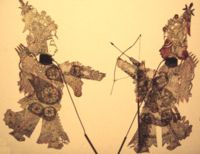
Shadow play figures, circa 1780.

Shadow play has much in common with animation: people watching moving figures on a screen as a very popular form of entertainment, usually a story with dialogue, sounds and music. The figures could be very detailed and very articulated.

The earliest projection of images was most likely done in primitive shadowgraphy dating back to prehistory. It evolved into more refined forms of shadow puppetry, mostly with flat jointed cut-out figures which are held between a source of light and a translucent screen. The shapes of the puppets sometimes include translucent color or other types of detailing. The history of shadow puppetry is uncertain, but seems to have originated in Asia, possibly in the 1st millennium BCE. Clearer records seem to go back to around 900 CE. It later spread to the Ottoman empire and seems not to have reached Europe before the 17th century. It became very popular in France at the end of the 18th century. François Dominique Séraphin started his elaborate shadow shows in 1771 and performed them until his death in 1800. His heirs continued until their theatre closed in 1870. Séraphin developed the use of clockwork mechanisms to automate the show.

Around the time cinematography was developed several theaters in Montmartre showed elaborate "Ombres Chinoises" shows that were very successful. The famous Le Chat noir produced 45 different shows between 1885 and 1896.

The Magic Lantern


Christiaan Huygens' 1659 sketches for a projection of Death taking off his head


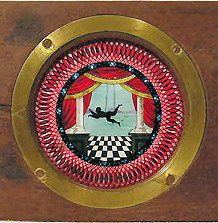
Slide with a fantoccini trapeze artist and a chromatrope border design (circa 1880)

Moving images were possibly projected with the magic lantern since its invention by Christiaan Huygens in 1659. His sketches for magic lantern slides have been dated to that year and are the oldest known document concerning the magic lantern. One encircled sketch depicts Death raising his arm from his toes to his head, another shows him moving his right arm up and down from his elbow and yet another taking his skull off his neck and placing it back. Dotted lines indicate the intended movements.

Techniques to add motion to painted glass slides for the magic lantern were described since circa 1700. These usually involved parts (for instance limbs) painted on one or more extra pieces of glass moved by hand or small mechanisms across a stationary slide which showed the rest of the picture. Popular subjects for mechanical slides included the sails of a windmill turning, a procession of figures, a drinking man lowering and raising his glass to his mouth, a head with moving eyes, a nose growing very long, rats jumping in the mouth of a sleeping man. A more complex 19th century rackwork slide showed the then known eight planets and their satellites orbiting around the sun. Two layers of painted waves on glass could create a convincing illusion of a calm sea turning into a very stormy sea tossing some boats about by increasing the speed of the manipulation of the different parts.

In 1770 Edmé-Gilles Guyot detailed how to project a magic lantern image on smoke to create a transparent, shimmering image of a hovering ghost. This technique was used in the phantasmagoria shows that became very popular in several parts of Europe between 1790 and the 1830s. Other techniques were developed to produce convincing ghost experiences. The lantern was handheld to move the projection across the screen (which was usually an almost invisible transparent screen behind which the lanternist operated hidden in the dark). A ghost could seem to approach the audience or grow larger by moving the lantern away from the screen, sometimes with the lantern on a trolley on rails. Multiple lanterns made ghosts move independently and were occasionally used for superimposition in the composition of complicated scenes.

Dissolving views became a popular magic lantern show, especially in England in the 1830s and 1840s. These typically had a landscape changing from a winter version to a spring or summer variation by slowly diminishing the light from one version while introducing the aligned projection of the other slide. Another use showed the gradual change of for instance groves into cathedrals.

Between the 1840s and 1870s several abstract magic lantern effects were developed. This included the chromatrope which projected dazzling colorful geometrical patterns by rotating two painted glass discs in opposite directions.

Occasionally small shadow puppets had been used in phantasmagoria shows.[20] Magic lantern slides with jointed figures set in motion by levers, thin rods, or cams and worm wheels were also produced commercially and patented in 1891. A popular version of these "Fantoccini slides" had a somersaulting monkey with arms attached to mechanism that made it tumble with dangling feet. Fantoccini slides are named after the Italian word for puppets like marionettes or jumping jacks.

Animation before film


Numerous devices that successfully displayed animated images were introduced well before the advent of the motion picture. These devices were used to entertain, amaze, and sometimes even frighten people. The majority of these devices didn't project their images, and could only be viewed by a one or a few persons at a time. They were considered optical toys rather than devices for a large scale entertainment industry like later animation.Many of these devices are still built by and for film students learning the basic principles of animation.

Prelude


An article in the Quarterly Journal of Science, Literature, and The Arts (1821) raised some interest in optical illusions of curved spokes in rotating wheels seen through vertical apertures. In 1824 Peter Mark Roget provided mathematical details about the appearing curvatures and added the observation that the spokes appeared motionless. Roget claimed that the illusion is due to the fact “that an impression made by a pencil of rays on the retina, if sufficiently vivid, will remain for a certain time after the cause has ceased.”  This was later seen as the basis for the theory of "persistence of vision" as the principle of how we see film as motion rather than the successive stream of still images actually presented to the eye. This theory has been discarded as the (sole) principle of the effect since 1912, but remains in many film history explanations. However, Roget's experiments and explanation did inspire some further research by Michael Faraday and also by Joseph Plateau that would eventually bring about the invention of animation.

Main article: Persistence of vision

Thaumatrope (1825)

Main article: Thaumatrope


In April 1825 the first Thaumatrope was published by W. Phillips (in anonymous association with John Ayrton Paris) and became a very popular toy. The pictures on either side of a small cardboard disc seem to blend into one combined image when it is twirled quickly by the attached strings. This is often used as an illustration of what has often been called "persistence of vision" (scientifically better known as positive afterimages). Although a thaumatrope can also be used for two-phase animation, no examples are known to have been produced with this effect until long after the phénakisticope had established the principle of animation.

Phénakisticope (1833)


Nr. 10 in the reworked second series of Stampfer's stroboscopic discs published by Trentsensky & Vieweg in 1833.

The phénakisticope (better known by the misspelling phenakistiscope or phenakistoscope) was the first animation device using rapid successive substitution of sequential pictures. The pictures are evenly spaced radially around a disc, with small rectangular apertures at the rim of the disc. The animation could be viewed through the slits of the spinning disc in front of a mirror. It was invented in November or December 1832 by the Belgian Joseph Plateau and almost simultaneously by the Austrian Simon von Stampfer. Plateau first published about his invention in January 1833. The publication included an illustration plate of a fantascope with 16 frames depicting a pirouetting dancer.

The phénakisticopees was very successful as a novelty toy and within a year very many sets of stroboscopic discs were published across Europe, with almost as many different names for the device - including Fantascope (Plateau), The Stroboscope (Stampfer) and Phénakisticope (Parisian publisher Giroux & Cie).

Zoetrope (1866)

In July 1833 Simon Stampfer described the possibility of using the stroboscope principle in a cylinder (as well as on looped strips) in a pamphlet accompanying the second edition of his version of the phénakisticope.[28] British mathematician William George Horner suggested a cylindrical variation of Plateau's phénakisticope in January 1834. Horner planned to publish this Dædaleum with optician King, Jr in Bristol but it "met with some impediment probably in the sketching of the figures".

In 1865 William Ensign Lincoln invented the definitive zoetrope with easily replaceable strips of images. It also had an illustrated paper disc on the base, which was not always exploited on the commercially produced versions. Lincoln licensed his invention to Milton Bradley and Co. who first advertised it on December 15, 1866.

Flip book (1868)


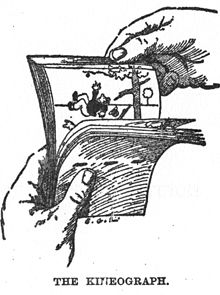
An 1886 illustration of the kineograph.

John Barnes Linnett patented the first flip book in 1868 as the kineograph. A flip book is a small book with relatively springy pages, each having one in a series of animation images located near its unbound edge. The user bends all of the pages back, normally with the thumb, then by a gradual motion of the hand allows them to spring free one at a time. As with the phenakistoscope, zoetrope and praxinoscope, the illusion of motion is created by the apparent sudden replacement of each image by the next in the series, but unlike those other inventions no view-interrupting shutter or assembly of mirrors is required and no viewing device other than the user's hand is absolutely necessary. Early film animators cited flip books as their inspiration more often than the earlier devices, which did not reach as wide an audience.

The older devices by their nature severely limit the number of images that can be included in a sequence without making the device very large or the images impractically small. The book format still imposes a physical limit, but many dozens of images of ample size can easily be accommodated. Inventors stretched even that limit with the mutoscope, patented in 1894 and sometimes still found in amusement arcades. It consists of a large circularly-bound flip book in a housing, with a viewing lens and a crank handle that drives a mechanism that slowly rotates the assembly of images past a catch, sized to match the running time of an entire reel of film.

Praxinoscope (1877)


French inventor Charles-Émile Reynaud developed the Praxinoscope in 1876 and patented it in 1877.[34] It is similar to the zoetrope but instead of the slits in the cylinder it has twelve rectangular mirrors placed evenly around the center of the cylinder. Each mirror reflects another image of the picture strip placed opposite on the inner wall of the cylinder. When rotating the praxinoscope shows the sequential images one by one, resulting in a fluent animation. The praxinoscope allowed a much clearer view of the moving image compared to the zoetrope, since the zoetrope's images were actually mostly obscured by the spaces in between its slits. In 1879 Reynaude registered a modification to the praxinoscope patent to include the Praxinoscope Théâtre, which utilized the Pepper's ghost effect to present the animated figures in an exchangeable background. Later improvements included the "Praxinoscope à projection" (marketed since 1882) which used a double magic lantern to project the animated figures over a till projection of a background.

Zoopraxiscope (1879)


Eadweard Muybridge had circa 70 of his famous chronophotographic sequences painted on glass discs for the zoopraxiscope projector that he used in his popular lectures between 1880 and 1895. In the 1880s the images were painted onto the glass in dark contours. Later discs made between 1892 and 1894 had outlines drawn by Erwin F. Faber that were photographically printed on the disc and then coloured by hand, but these were probably never used in the lectures. The painted figures were largely transposed from the photographs, but many fanciful combinations were made and sometimes imaginary elements were added.

1888-1908: Earliest animations on film

Théâtre Optique


Part of the restored Pauvre Pierrotfilm


Charles-Émile Reynaud further developed his projection praxinoscope into the Théâtre Optique with transparent hand-painted colorful pictures in a long perforated strip wound between two spools, patented in December 1888. From 28 October 1892 to March 1900 Reynaud gave over 12,800 shows to a total of over 500.000 visitors at the Musée Grévin in Paris. His Pantomimes Lumineuses series of animated films each contained 300 to 700 frames that were manipulated back and forth to last 10 to 15 minutes per film. A background scene was projected separately. Piano music, song and some dialogue were performed live, while some sound effects were synchronized with an electromagnet. The first program included three cartoons: Pauvre Pierrot (created in 1891), Un bon bock (created in 1888, now lost), and Le Clown et ses chiens (created in 1890, now lost). Later on the titles Autour d'une cabine (created in 1893) and A rêve au coin du feu would be part of the performances.

Standard picture film[


Despite the success of Reynaud's films it took some time before animation was adapted in the film industry that came about after the introduction of Lumiere's Cinematograph in 1895. Georges Méliès' early fantasy and trick films (released between 1896 and 1913) occasionally came close to including animation with substitution splice effects, painted props or painted creatures that were moved in front of painted backgrounds (mostly using wires), and film colorization by hand. Méliès also popularized the stop trick, with a single change made to the scene in between shots, that had already been used in Edison's The Execution of Mary Stuart in 1895 and probably led to the development of stop-motion animation some years later. It seems to have lasted until 1906 before proper animated films started to appear in cinemas. The dating of earlier films with animation is contested, while other films that may have used stop motion or other animation techniques are lost and can't be checked.

Printed animation film]


In 1897 German toy manufacturer Gebrüder Bing had a first prototype of their Kinematograph. In November 1898 they presented this toy film projector, possibly the first of its kind, at a toy festival in Leipzig. Soon other toy manufacturers, including Ernst Plank and Georges Carette, sold similar devices. Around the same time the French company Lapierre marketed a similar projector. The toy cinematographs were basically magic lanterns with one or two small spools that used standard "Edison perforation" 35mm film. These projectors were intended for the same type of "home entertainment" toy market that most of these manufacturers already provided with praxinoscopes and toy magic lanterns. Apart from relatively expensive live-action films, the manufacturers produced many cheaper films by printing lithographed drawings. These animations were probably made in black-and-white from around 1898 or 1899, but at the latest by 1902 they were made in color. The pictures were often traced from live-action films (much like the later rotoscoping technique). These very short films depicted a simple repetitive action and were created to be projected as a loop - playing endlessly with the film ends put together. The lithograph process and the loop format follow the tradition that was set by the zoetrope and praxinoscope.


Katsudō Shashin

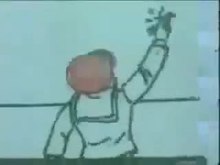
Katsudō Shashin, from an unknown creator, was discovered in 2005 and is speculated to be the oldest work of animation in Japan, with Natsuki Matsumoto,] an expert in iconography at the Osaka University of Arts[and animation historian Nobuyuki Tsugata determining the film was most likely made between 1907 and 1911. The film consists of a series of cartoon images on fifty frames of a celluloid strip and lasts three seconds at sixteen frames per second. It depicts a young boy in a sailor suit who writes the kanji characters "活動写真" (katsudō shashin, or "moving picture"), then turns towards the viewer, removes his hat, and offers a salute. Evidence suggests it was mass-produced to be sold to wealthy owners of home projectors. To Matsumoto, the relatively poor quality and low-tech printing technique indicate it was likely from a smaller film company.

J. Stuart Blackton

J. Stuart Blackton was an Anglo-American filmmaker, co-founder of the Vitagraph Studios and one of the first to use animation in his films.The Enchanted Drawing (1900) by is considered to be the first film recorded on standard picture film that included some sequences that are sometimes regarded as animation. It shows Blackton doing some "lightning sketches" of a face, cigars, a bottle of wine and a glass. The face changes expression when Blackton pours some wine into the face's mouth and takes his cigar. The technique used in this film was basically the substitution splice: the single change to scenes was that a drawing was replaced by a similar drawing with a different facial expression (or a drawn bottle and glass were replaced by real objects). Blackton had possibly used the same technique in a lost 1896 lightning sketch film. The effect can hardly be considered animation.


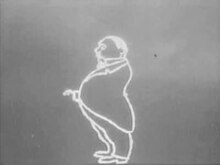
The 1906 cartoon Humorous Phases of Funny Faces by J. Stuart Blackton, considered the first animated film

Blackton's 1906 film Humorous Phases of Funny Faces is often regarded as the oldest known drawn animation on standard film. It features a sequence made with blackboard drawings that are changed between frames to show two faces changing expressions and some billowing cigar smoke, as well as two sequences that feature cutout animation.

Blackton's The Haunted Hotel (1907) featured a combination of live-action with practical special effects and stop-motion animation of objects, a puppet and a model of the haunted hotel. It was the first stop-motion film to receive wide scale appreciation. Especially a large close-up view of a table being set by itself baffled viewers; there were no visible wires or other noticeable well-known tricks. [48] This inspired other filmmakers, including French animator Émile Cohl[38] and Segundo de Chomón, to work with the new technique. De Chomón would release the similar The House of Ghosts and El hotel eléctrico in 1908.

Edwin S. Porter


In 1905 American film pioneer Edwin S. Porter used animated letters and a very simple cutout animation of two hands in the intertitles in How Jones lost his roll. He experimented with a small bit of crude stop-motion animation in his trick film Dream of a Rarebit Fiend (1906). His 1907 film The "Teddy" Bears mainly shows people in bear costumes, but also features a short stop-motion segment with small teddy bears.
]
Segundo de Chomón

Spanish filmmaker Segundo de Chomón made many trick films and has often been compared to Georges Méliès. De Chomón frequently used stop-motion in his films, even before the release of J. Stuart Blackton's groundbreaking The Haunted Hotel. Le théâtre de Bob (1906) features over three minutes of stop-motion animation with dolls and some objects. El hotel eléctrico (1908) features much stop motion with objects, a bit of pixilation and one effect done with drawn animation (a few lines probably drawn on the negative that represent electric sparks).

Arthur Melbourne-Cooper


Arthur Melbourne-Cooper was a British filmmaker who did much pioneering work in stop motion animation. He produced over 300 films between 1896 and 1915, of which an estimated 36 were all or in part animated.

Based on later reports by Cooper and by his daughter Audrey Wadowska some believe that his Matches: an Appeal was produced in 1899 and therefore the very first stop-motion animation. The black-and-white film shows a matchstick figure writing an appeal to donate a Guinea for which Bryant and May would supply soldiers with sufficient matches. No extant archival records show that the film was indeed created in 1899 during the beginning of the Second Boer War. Others place it at 1914, during the beginning of World War I.Cooper created more Animated Matches scenes in the same setting. These are believed to also have been produced in 1899, while a release date of 1908 has also been given. There is also an Animated Matches film by Émile Cohl that was released by Gaumont in 1908, which may have caused more confusion about the release dates of Cooper's matchstick men animations.

The lost films Dolly's Toys (1901) and The Enchanted Toymaker (1904) may have included stop-motion animation. Dreams of Toyland (1908) features a scene with many animated toys that lasts circa three and a half minutes.

Traditional animation

The silent era


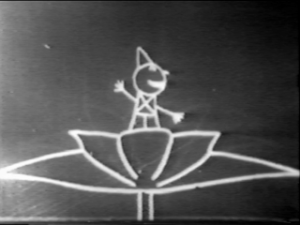
The first animated film created by using what came to be known as traditional (hand-drawn) animation—the 1908 Fantasmagorie by Émile Cohl


Émile Cohl's Fantasmagorie

The French artist Émile Cohl created the first animated film using what came to be known as traditional animation methods: the 1908 Fantasmagorie.[58] The film largely consisted of a stick figure moving about and encountering all manner of morphing objects, such as a wine bottle that transforms into a flower. There were also sections of live action where the animator’s hands would enter the scene. The film was created by drawing each frame on paper and then shooting each frame onto negative film, which gave the picture a blackboard look. Cohl later went to Fort Lee, New Jersey near New York City in 1912, where he worked for French studio Éclair and spread its animation technique to the US.

Influenced by Émile Cohl, the author of the first puppet-animated film (i.e., The Beautiful Lukanida (1912)), Russian-born (ethnically Polish) director Wladyslaw Starewicz, known as Ladislas Starevich, started to create stop motion films using dead insects with wire limbs and later, in France, with complex and really expressive puppets. In 1912, he created The Cameraman's Revenge, a complex tale of treason and violence between several different insects. It is a pioneer work of puppet animation, and the oldest animated film of such dramatic complexity, with characters filled with motivation, desire and feelings.


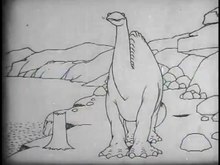
Gertie the Dinosaur (1914)

More detailed hand-drawn animations with detailed backgrounds and characters, were those directed by Winsor McCay, a successful newspaper cartoonist, including the 1911 Little Nemo, the 1914 Gertie the Dinosaur, and the 1918 The Sinking of the Lusitania.Gertie the Dinosaur featured an early example of character development in drawn animation.The film was made for McCay's vaudeville act and as it played McCay would speak to Gertie who would respond with a series of gestures. There was a scene at the end of the film where McCay walked behind the projection screen and a view of him appears on the screen showing him getting on the cartoon dinosaur's back and riding out of frame. This scene made Gertie the Dinosaur the first film to combine live-action footage with hand-drawn animation. McCay hand-drew almost every one of the 10,000 drawings he used for the film.

Also in 1914, John Bray opened John Bray Studios, which revolutionized the way animation was created.Earl Hurd, one of Bray's employees patented the cel technique.[64] This involved animating moving objects on transparent celluloid sheets. Animators photographed the sheets over a stationary background image to generate the sequence of images. This, as well as Bray's innovative use of the assembly line method, allowed John Bray Studios to create Colonel Heeza Liar, the first animated series.

During the 1910s, the production of animated short films, typically referred to as "cartoons", became an industry of its own and cartoon shorts were produced for showing in movie theaters. The most successful producer at the time was John Randolph Bray, who, along with animator Earl Hurd, patented the cel animation process that dominated the animation industry for the rest of the decade.

In 1915, Max and Dave Fleischer invented rotoscoping, the process of using film as a reference point for animation and their studios went on to later release such animated classics as Ko-Ko the Clown, Betty Boop, Popeye the Sailor Man, and Superman. In 1918 McCay released The Sinking of the Lusitania, a wartime propaganda film. McCay did use some of the newer animation techniques, such as cels over paintings—but because he did all of his animation by himself, the project wasn't actually released until just shortly before the end of the war. At this point the larger scale animation studios were becoming the industrial norm and artists such as McCay faded from the public eye.


The 1919 Feline Follies by Pat Sullivan

The first known animated feature film was El Apóstol, made in 1917 by Quirino Cristiani from Argentina. He also directed two other animated feature films, including 1931's Peludópolis, the first feature length animation to use synchronized sound. None of these, however, survived.

In 1920, Otto Messmer of Pat Sullivan Studios created Felix the Cat. Pat Sullivan, the studio head took all of the credit for Felix, a common practice in the early days of studio animation. Felix the Cat was distributed by Paramount Studios, and it attracted a large audience. Felix was the first cartoon to be merchandised. He soon became a household name.

In Germany, during the 1920s the abstract animation was invented by Walter Ruttman, Hans Richter, and Oskar Fischinger, however, the Naziscensorship against so-called "degenerate art" prevented the abstract animation from developing after 1933.

The earliest surviving animated feature film is the 1926 silhouette-animated Adventures of Prince Achmed, which used colour-tinted film.] It was directed by German Lotte Reiniger and French/Hungarian Berthold Bartosch.

Walt Disney & Warner Bros.


In 1923, a studio called Laugh-O-Grams went bankrupt and its owner, Walt Disney, opened a new studio in Los Angeles. Disney's first project was the Alice Comedies series, which featured a live action girl interacting with numerous cartoon characters. Disney's first notable breakthrough was 1928's Steamboat Willie, the third of the Mickey Mouse series. The short film showed an anthropomorphic mouse named Mickey neglecting his work on a steamboat to instead make music using the animals aboard the boat. Even though many wrongly believe Steamboat Willie was the first cartoon with synchronized sound, since May 1924 and continuing through September 1926, Dave and Max Fleischer's Inkwell Studios produced 19 sound cartoons, part of the Song Car-Tunes series, using the Phonofilm "sound-on-film" process.[80][better source needed]

In 1933, Warner Brothers Cartoons was founded. While Disney's studio was known for its releases being strictly controlled by Walt Disney himself, Warner brothers allowed its animators more freedom, which allowed for their animators to develop more recognizable personal styles.

The first animation to use the full, three-color Technicolor method was Flowers and Trees, made in 1932 by Disney Studios, which won an Academy Award for the work Color animation soon became the industry standard, and in 1934, Warner Brothers released Honeymoon Hotel of the Merrie Melodies series, their first color films Meanwhile, Disney had realized that the success of animated films depended upon telling emotionally gripping stories; he developed an innovation called a "story department" where storyboard artists separate from the animators would focus on story development alone, which proved its worth when the Disney studio released in 1933 the first-ever animated short to feature well-developed characters, Three Little Pigs. In 1935, Tex Avery released his first film with Warner Brothers. Avery's style was notably fast-paced, violent, and satirical, with a slapstick sensibility.

Snow White and the Seven Dwarfs

Many consider Walt Disney's 1937 Snow White and the Seven Dwarfs the first animated feature film, though at least seven films were released earlier. However, Disney's film was the first one completely made using hand-drawn animation. The previous seven films, of which only four survive, were made using cutout, silhouette or stop motion, except for one—also made by Disney seven months prior to Snow White's release—Academy Award Review of Walt Disney Cartoons. This was an anthology film to promote the upcoming release of Snow White. However, many do not consider this a genuine feature film because it is a package film. In addition, at approximately 41 minutes, the film does not seem to fulfill today's expectations for a feature film. However, the official BFI, AMPAS and AFI definitions of a feature film require that it be over 40 minutes long, which, in theory, should make it the first animated feature film using traditional animation.

But as Snow White was also the first one to become successful and well-known within the English-speaking world, people tend to disregard the seven films. Following Snow White's release, Disney began to focus much of its productive force on feature-length films. Though Disney did continue to produce shorts throughout the century, Warner Brothers continued to focus on features.

The television era


Color television was introduced to the US Market in 1951. In 1958, Hanna-Barbera released The Huckleberry Hound Show, the first half-hour television program to feature only animation.[88]Terrytoons released Tom Terrific the same year.[89][90] In 1960, Hanna-Barbera released another monumental animated television show, The Flintstones, which was the first animated series on prime time television. Television significantly decreased public attention to the animated shorts being shown in theatres.

Animation techniques


Innumerable approaches to creating animation have arisen throughout the years. Here is a brief account of some of the non traditional techniques commonly incorporated.

Stop motion


This process is used for many productions, for example, the most common types of puppets are clay puppets, as used in The California Raisins, Wallace and Gromit and Shaun the Sheepby Aardman, and figures made of various rubbers, cloths and plastic resins, such as The Nightmare Before Christmas and James and the Giant Peach. Sometimes even objects are used, such as with the films of Jan Švankmajer.

Stop motion animation was also commonly used for special effects work in many live-action films, such as the 1914 Italian cult epic film Cabiria, the 1933 version of King Kong and The 7th Voyage of Sinbad.

CGI animation

The first fully computer-animated feature film was Pixar's Toy Story (1995). The process of CGI animation is still very tedious and similar in that sense to traditional animation, and it still adheres to many of the same principles.

A principal difference of CGI animation compared to traditional animation is that drawing is replaced by 3D modeling, almost like a virtual version of stop-motion. A form of animation that combines the two and uses 2D computer drawing can be considered computer aided animation.

Most CGI created films are based on animal characters, monsters, machines, or cartoon-like humans. Animation studios are now trying to develop ways to create realistic-looking humans. Films that have attempted this include Final Fantasy: The Spirits Within in 2001, Final Fantasy: Advent Children in 2005, The Polar Express in 2004, Beowulf in 2007 and Resident Evil: Degeneration in 2009. However, due to the complexity of human body functions, emotions and interactions, this method of animation is rarely used. The more realistic a CG character becomes, the more difficult it is to create the nuances and details of a living person, and the greater the likelihood of the character falling into the uncanny valley. The creation of hair and clothing that move convincingly with the animated human character is another area of difficulty. The Incredibles and Up both have humans as protagonists, while films like Avatar combine animation with live action to create humanoid creatures.

Friday, April 27, 2018

Real Food Fermentation: Preserving Whole Fresh Food with Live Cultures in Your Home Kitchen Flexibound by Alex Lewin (Quarry Books ) (IBRCookBooks), a review by the Bard of Bat Yam (#BArdOfBatYam), Poet Laureate Of Zion ( #PoetLaureateOfZion) and Stephen Darori (@stephendarori, #stephendarori)


I had not heard of this author before, so I did a bit of background research to find out more about him.

Alex Lewin is a software engineer, health coach, and 'real food' advocate who lives in Boston and San Francisco. He has a degree from Harvard in mathematics, has completed the Professional Chef Program at the Cambridge School of Culinary Arts, and has received training as a health coach at the Institute for Integrative Nutrition. He's currently working for the crowdsourced video broadcasting startups Justin.tv and Twitch.tv and serving as vice president of the 501(c)(3) nonprofit Boston Public Market Association. Since 2009, he has run a 'real food' blog (feedmelikeyoumeanit dot com) and led workshops on food preservation. In addition to his blog, he is active on LinkedIn, Twitter, and Facebook; a Google search turns up advertisements for his workshops, articles highlighting his volunteer activities and food advocacy, and a few mentions of his sustainable technology hedge fund, Atlas Capital Investments, in which he is a partner along with Solar Revolution author Travis Bradford. In his blog bio, he lists Vandana Shiva, Kurt Vonnegut, Anthony Bourdain, Andrew Weil, Barry Sears, Dr. Weston A. Price, Sally Fallon, and Sandor Katz as important influences. He blacked out his blog in protest of SOPA and professes a preference for free and open-source software, so he's obviously got his priorities in order.

Granted, you're buying a copy of Lewin's book and not a copy of Lewin himself. Hopefully, though, this information will help you understand this book - Lewin's first - a little better.

The Introduction and Chapter 1 cover the basic concepts of food preservation and fermentation, ending with a reasonably detailed overview of the kitchen equipment you will most likely need to create this book's recipes.

Lewin cares deeply where the food he's fermenting has come from. Chapter 2 ("Know Your Ingredients," 20 pages) is entirely devoted to the issue of Real Food, covering topics including food freshness and buying local. Instead of making a blanket declaration that organic produce is always superior, Lewin advocates that consumers open a dialog with food producers to really understand where their food comes from. While this might be possible in a farmer's market, he concedes that it is not always practical. I like the vision he has for a better world, but I also appreciate that he is realistic.

The recipes themselves fill out the remaining 110 pages. Chapters are devoted to sauerkraut, vegetables, dairy, fruits, beverages, and meat. Unlike Sandor Katz, Lewin makes no attempt to be comprehensive: beer, wine, soy (soy sauce, tempeh, natto, and miso), and even bread receive only a few short words of description and do not include recipes. Strategically, I think this makes sense - Wild Fermentation and The Art of Fermentation already exist, and there is no point in duplicating them. Instead, Lewin has presented a small number of very well tested recipes in such a way that even the most inexperienced and conservative in the kitchen might be enticed to try them out.

Covered in detail: sauerkraut; root and other vegetables; Caroline-style slaw; cucumber pickles; kimchi, yogurt; strained yogurt and whey; kefir; creme fraiche; butter and buttermilk; preserved lemons and limes; peach and plum chutney; pico de gallo; hard apple cider; mead; kombucha; vinegar; ginger ale; corned beef.

In contrast to the often rather vague 'recipes' in Katz' seminal works, these are laid out much more like they would be in a traditional cookbook: each recipe includes a quantitative ingredient list followed by very explicit instructions and many, many photographs.

Ahhh, the photographs! - they are rather gratuitous. In the sauerkraut recipe, for instance, an entire page is devoted to six full-color photographs and 100 words illustrating how to chop a bell pepper. One half of the surface area of pages 70-71 are images of, variously: water being poured into a Mason jar; a root vegetable being coined; salt pouring from a bowl into some water; and a food processor. While some of these images - for instance, an illustration on page 60 entitled 'The Evolution of Sauerkraut' that shows how the colors change as fermentation progresses - are quite helpful, nine out of every ten serve more to titillate than to educate. This is food porn, and in his blog Lewin is unapologetic:

"There are other fermentation books out there, including some new ones, but to be honest, mine is the prettiest by far..."

While 'The Art of Fermentation' is laid out more like a textbook, 'Real Food Fermentation' has a very modern (love it or hate it) layout. The margins and line spacing are broad, and large full-color photographs fill about one out of every three pages. While it has about the same number of pages as 'Wild Fermentation', the open layout fits significantly less text per page - I received the book this morning and read it straight through in a day. Those experimenting with fermentation for the first time, however, may find the pictures to be worth a thousand words.

I will update this review with more information about the recipes once I have had an opportunity to try them. The Carolina slaw, pico de gallo, and plum chutney look especially good, so I'm setting up this weekend to ferment them exactly as written.

If you're brand new to fermentation, consider purchasing this book and Wild Fermentation: The Flavor, Nutrition, and Craft of Live-Culture Foods to complement eachother.

If you want an encyclopedic account of food fermentation's history around the world and aren't as interested in recipes, The Art of Fermentation: An In-Depth Exploration of Essential Concepts and Processes from Around the World is your book.

If you dislike Katz' work for its frequent philosphical wanderings and lack of explicit instructions, try this book instead.

If you already have, use, and love Wild Fermentation and Art of Fermentation, you will probably not find much new information in this book. It will, however, be a useful coffee table trap for luring sometimes-reticent friends and family into your art.


Amazon.com Review


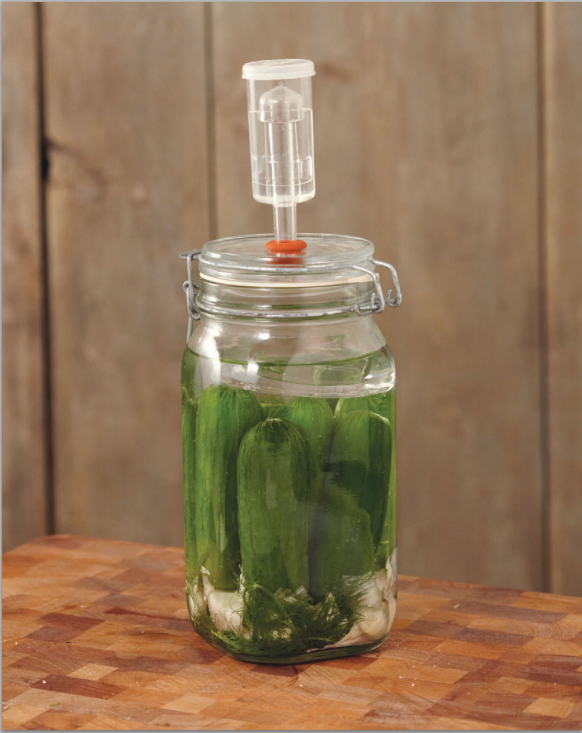
Cucumber Pickles


Cucumber Pickles


Pickled cucumbers, or simply “pickles,” are a quintessential fermented food. The first record of pickles comes from ancient Mesopotamia. Such diverse historical figures as Aristotle, Julius Caesar, Shakespeare, Amerigo Vespucci, and Thomas Jefferson are reported to have been fond of pickles. Indeed, Amerigo Vespucci, after whom America was named, was a pickle vendor before he became a world explorer. Pickles play a significant role in the food culture of many countries, from North America through Europe and into the Middle East.
Preparation:


1. ) If your cucumbers are at all soft, if you bought them at the store, and/or if you suspect that they might have been picked a while ago, you can perk them up by soaking them in ice water. 2. ) Trim the blossom ends off your cucumbers. These ends contain enzymes that can contribute to “hollow pickle syndrome. ” 3. ) Combine the chlorine-free water and salt in the pitcher, and add any starter or vinegar, if using. 4. ) Place the seasonings and tannin providers at the bottom of the jar or crock, followed by the cucumbers. 5. ) Pour the brine into the crock. 6. ) Weight everything down in such a way that it stays submerged. 7. ) If needed, cover the top of the jar or crock with the cloth, and affix the cloth with the rubber band. 8. ) Store at cool room temperature. Every day after the second or third, pull out a pickle, cut off a piece with a clean knife, and taste it. When the pickles are pleasantly sour but still crunchy, they are done. Move them to a cool place (like the refrigerator) immediately. Yield: 3–4 pounds (1.5–2 kg), Prep time: 10 minutes, Total time: 3 days–2 weeks

Equipment:


Knife; Cutting board (wood is ideal); 1-gallon (4-L) pitcher; ½-gallon (2-L) mason jar, a Pickl-It, a Harsch crock, or a plain glazed (lead-free) ceramic crock; Something to hold the cucumbers under the brine, like a small clean plate or saucer that fits inside the jar or crock (if needed); Clean dishtowel or cloth to cover the top of the jar or crock along with a rubber band (if needed).


Ingredients:

3 or 4 pounds (1.5 or 2 kg) small, thick-skinned cucumbers
2 quarts (2 L) chlorine-free water
1⁄2 cup (115 g) sea salt
Up to 1 cup (250 ml) whey or 1 pint (475 ml) sauerkraut juice, or starter powder from an envelope (optional)
Seasonings: generous amounts of whole garlic, bay leaf, etc. (optional)
A few fresh grape or oak leaves, or a couple of black tea bags, for their tannins (optional)
Red wine vinegar or apple cider vinegar, boiled and cooled to replace up to half of the water (optional)

Saturday, March 24, 2018

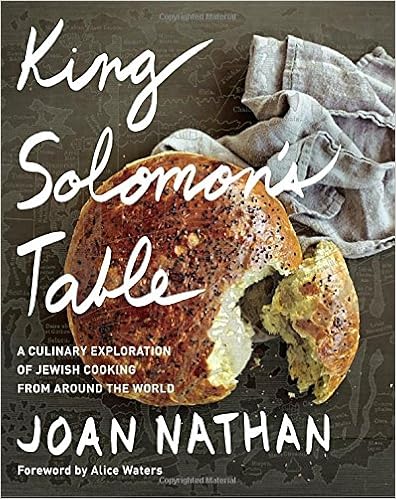
King Solomon's Table: A Culinary Exploration of Jewish Cooking from Around the World Hardcover – April 4, 2017 by Joan Nathan (Knopf) (IBRCookBooks) , a review by the Bard Of Bat Yam (#BardOfBatYam) ,(PoetLaureate Of Zion(#PoetLaureateOf Zion) and Stephen Darori (#Stephendarori, @stephendarori)


The cover tells the story: a variation of a challah roll lying atop an embossed map of the nations of the world. Joan Nathan, a tireless, curious, multilingual cookbook goddess, was in the Paradesi Synagogue in Kochi, Kerala, India, researching a book when she noted a sign that said Jewish people had been in India since the time of King Solomon. Whether it is myth, legend, or fact, she pondered how so many Jewish merchant seamen and traders traveled from the Middle East to other ports for business, spices, and spouses; and they created relationships and families, and “mashed-up” their Jewish food traditions with local customs, foodways and ingredients. She changed her plans and wrote this cookbook, her eleventh, instead.

In it, Ms. Nathan travels – like these ancient mariners - from country to country, and finds she Jewish mash-ups, whether it is Jewish foods from Europe that ended up in Dayton, or Turkish staples in Cuba, or the foods of Babylonia in FSU Georgia. As she once said, “When I lived in Israel, I saw not a clash but a coming together of civilizations. You know, for me, Jewish food was my mother’s matzoh ball soup. Then I went there and I saw stuffed vegetables and all kinds of salads that were different… I realized then that food was culture, and it was not restaurant culture. It was ethnic culture.”

The title? It is said that Solomon had 700 wives and half as many girlfriends, and they had many food traditions. He learned from them, they learned from him, and there was a sharing of recipes and other things. It was "tabletop Judaism." In this spirit, Nathan shares over 170 uniquely Jewish recipes from El Salvador to Israel, from Morocco to Cuba, Siberia to Canada, and Sri Lanka (you know the Rambam’s brother lived there...) to Romania.

The book opens with a quote from Genesis: When woman ate of the tree of wisdom, she took of its fruit and ate, and shared some with her husband, and he ate. This is followed by a 16 page introduction to Solomon, Babylon, Judea, and the roots of Jewish foods; and 11 pages on pantry spices. There are sections for Morning (16 recipes); Starters (21 recipes), Salads (16 recipes), Soups and Their Dumplings (13 recipes), Breads (7 Sabbath breads, 4 Weekday breads), Grains and Such (10 recipes), Vegetables (15), Fish (15), Poultry (10), Meat (14), and Sweets (23).

The aleph recipe is an Azerbaijani Kukusa with Swiss Chard and Herbs, which is easy and herb-infused and a living vestige of Jewish life in Babylonia and Persia and an example of how a Jewish dish traveled from southern France to North Africa and back to France, morphed to Azerbaijan and then to Brooklyn. The Tof "closing recipe" is a Libyan Saefra, King Solomon Cake (how often have you used Cream of Wheat and Orange zest in a recipe?).

One of the fascinating aspects of this book is that each recipe has a priceless shared story and an amazing photo. To me, it is a keepsake. Smoky Shakshuka with Tomatoes, Peppers, and Eggplant comes with a story of colonial Williamsburg and its first Jewish resident, Dr. de Sequeyra, who introduced tomato-eating to his neighbors and patients. A Matzo Brei recipe comes with a cook-off story than ranges from Zamosc Poland to DC to the residence of the late Sheila Lukins (author of Silver Palate Cookbook). A recipe for Chilaquiles (Mexican Matzo Brei) is delivered with a story from LA's Jonathan Gold. Her “New Old Fashioned Bagel” recipe is akin to Montreal style ones of Mark Furstenberg’s "Bread Furst." Speaking of Canada, there is a recipe for Toronto-style Shtritzlach, as well as Siberian Chremsel. The Socca (chickpea pancake) recipe may change your life, as will Caponata Siciliana di Melanzane alla Giudia (many say that the Jews introduced eggplants to Sicily). Her Hummus with Preserved Lemon and Cumin recipe is matched with a Hebrew translation story on whether it was ‘vinegar’ or ‘hummus’ that Boaz served his workers in The Book of Ruth.

Other highlights (just mentioning a few) include: Corfu/Italian Huevos Haminados con Spinaci (Long-Cooked Eggs with Spinach) from Daisy Dente Modigliani; Halleq (Persian Haroset); Ferrara Haroset (using banana, pear, and apple); Bene Israel Fish Curry with Fresh Ginger, Tamarind, and Cilantro (from Babu of Ernakulam, India); Matbucha; Curried Beet Borscht with Apples and Ginger; Yemenite Chicken Soup with Dill, Cilantro and Parsley, Persian Cucumber and Radish Salad with Hungarian Paprika; Salonikan MelitzanoSalata; Tchav; Honduran/CrownHeights mashup Winter Squash Soup with Hot Pepper and Coconut Milk; Perugia-style Cod with Tomatoes, Dried Plums, Onions, and Pine Nuts; Abgoosht with Gundi; Suellen Lazarus’ Vegetarian Matzo Ball Soup with Ghee; Concia; T’beet (Baghdadi Sabbath Overight Spiced Chicken with Rice and Coconut Chutney); Karaite-style Spiced Fried Matzo with Celery Seed and Tumeric; Kosher-Brined Roast Turkey with Challah-Chestnut-Cranberry Stuffing; Bulgarian Pashtida (from Spain Greece, the Balkans); Kubbanah, Ka’ak; Pletzel; Parpikas Krumpli (Hungarian Roasted Potatoes with Onions); Fideos Tostados with Cinnamon-Spiked Tomato Sauce (coupled with an essay on Rabbi Mussana and his concordance to the 1140 CE HeAruch); Slightly Sweet and Sour Cabbage (via Cuba by way of Ladino speakers of Turkey); Hand Cured Corned Beef; Indian Chicken with Cardamom, Cumin and Cilantro; David Tanis’ Dayton, Ohio-inspired Poached Salmon with Ginger-Cilantro Butter and Spinach; Macedonian Leek and Meat Patties; Roman Ricotta Cheese Crostata with Cherries or Chocolate; and El Salvador Schokoladenwurst.