Showing posts with label Stephen Darori.. Show all posts

Tuesday, March 20, 2018

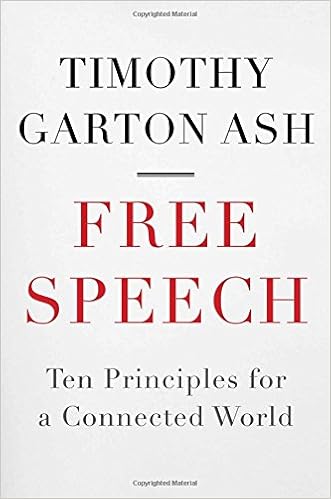
Free Speech: Ten Principles for a Connected World by Timothy Garton Ash Yale University Press, 491 pp., $30.00 ... a book review by the Bard of Bat Yam (#BArdOfBatYam) , Poet Laureate of Zion (#Poet:areateOfZion) Stephen Darori


A recent cover story in The Economist warns that free speech is under attack in much of the world, through government repression, assassinations of journalists by nonstate actors, and the rising insistence by minority groups that they have a right not to be offended.1 China’s Great Firewall polices websites and censors an estimated 13 percent of social media posts; Chinese advocates of free speech risk being jailed, and many have been prosecuted for what they say.
Meanwhile, the Committee to Protect Journalists reports that fifty journalists, in eighteen countries, were murdered in 2015, and at year’s end nearly two hundred were imprisoned. Since 2010, more than 450 journalists have been driven into exile. These figures don’t include nonfatal assaults or threats; undoubtedly many journalists have been frightened into silence by the fate of their colleagues.

Universities, like the press and the Internet, are supposed to be bastions of free speech. But a Chinese government directive forbids university teachers from discussing the “Seven Don’t-Mentions,” among which are universal values, Western constitutional democracy, and press freedom. On a lesser scale, commentators warn that on US campuses hypersensitive students are stifling free speech with complaints about “microaggressions” and demands for “trigger warnings” and safe spaces.

At the same time, vile, violent, and deceitful speech has never been more prevalent. As Timothy Garton Ash writes in Free Speech: Ten Principles for a Connected World, “the internet is…history’s largest sewer.” Terrorist incitements are frequent; lies and disinformation abound; trolls and haters are everywhere. A 2014 Pew survey found that 73 percent of Internet users have witnessed harassment on online discussion sites, and 40 percent have experienced it themselves; fully one fourth have encountered physical threats addressed to someone on the Internet. Women are particularly frequent targets: the Justice Department reports that three fourths of cyberstalking and cyber harassment victims are women. Recently The Guardian analyzed seventy million comments on its articles, and found that the ten writers who got the most abuse were eight women and two black men.

What principles should govern a connected world where speech is at once imperiled and too easy to use to do harm? That is the question Garton Ash sets out to answer in Free Speech, an informative and bracing defense of free speech liberalism in the Internet age. He reviews the philosophical underpinnings of free speech, analyzes the threats to free speech in today’s environment, and proposes principles we should embrace to foster free speech in the face of novel threats.

The book is part of an ambitious project inaugurated by Garton Ash and his Oxford colleagues: an international, multilingual forum to discuss free speech controversies. By my count the project’s index now contains nearly four thousand entries covering 163 topics. Garton Ash tells us that the principles he proposes in his book have been vetted, reworded, and reordered after vigorous discussion on freespeechdebate.com—the forum’s website, where free speech liberalism is enacted and not merely advocated.

Twenty years ago, John Perry Barlow, an Internet theorist and activist, issued a manifesto on behalf of “Cyberspace, the new home of Mind,” declaring that governments “have no moral right to rule us nor do you possess any methods of enforcement we have true reason to fear.” It’s easy to see why Internet pioneers, with their famously libertarian convictions, saw cyberspace as providing remarkable freedom: the network has communities but no leaders, and every voice has access.

Today, Garton Ash argues, Barlow’s utopian picture is essentially false. The Internet is jointly ruled by governments and giants like Google and Facebook—the “big dogs” and “big cats” of cyberspace. Garton Ash borrows this imagery from Jonathan Zittrain. We, netizens of the world, are the mice. The big dogs and cats decide which websites the mice can access, which content gets removed, and which items appear on the crucial first page of our Google searches.

It was inevitable that the freewheeling Internet would collide with the big dogs—most conspicuously China, but also various European countries, with their laws protecting privacy and the “right to be forgotten,” that is, to have damaging personal information removed from the Internet. For those who favor a more regulated Internet in their own countries, on the other hand, the United States is the biggest and baddest dog. China regards US promotion of First Amendment values globally as an assault on every state’s sovereign right to determine the scope of free speech within its territory. In fact the US does not have any clearly effective ability to challenge repression of free speech in China, although in 2010 Google shut down its search engine there because of the censorship the Chinese government required. The United States, Garton Ash notes, has a “small programme to fund technologies that would help circumvent internet-blocking firewalls built by authoritarian regimes such as Iran and China.” He does not say that such programs have had any success. It’s an important controversy and question. We mice must do what we can in favor of free speech values, although we should have no illusions about what can succeed.

The big cats of the Internet industry regulate more subtly, often invisibly. They mine and store our personal data in staggering quantities, the equivalent of thousands of pages about every user, and use it to customize our searches and choose the ads we see. Big cats including Google, Facebook, and Twitter also regulate directly, making their own judgments about removing hateful or obscene material. Those making the judgments are unaccountable to users, and far from transparent.

Sometimes the big dogs and big cats gang up on the mice, for example when Internet companies cooperate with government in data mining for national security. Garton Ash calls this “power squared,” or P2 for short, and he finds it perilous. Big dogs, big cats, P2—these are facts of life that shape the political economy of free speech today. Internet and telecommunications companies secretly cooperated with US intelligence agencies—sometimes voluntarily, sometimes not—and the Snowden revelations made this cooperation the most notorious example of P2. But Garton Ash also points to less-well-known examples, including Western companies selling surveillance and censorship technologies to oppressive regimes.

Against this backdrop, Garton Ash defends a liberal approach close to that of John Stuart Mill—not completely libertarian, but very close to that side of the free speech debates. The main tenets of free speech liberalism are straightforward: first, all speech is permissible unless it harms someone; second, restrictions on speech essential to avoid harms must be tailored as narrowly as possible; third, the cure for bad speech is more speech. Underlying these principles is a tremendous faith in the value of free speech. What justifies it?

Garton Ash offers four familiar arguments for free speech. First, unless we can express ourselves freely, we will never know ourselves; we’ll barely have selves to know. Selves are formed and found through give and take with others. Second, no-holds-barred discussion is the best way to find the truth, and limiting such discussion may prevent the emergence of truths. Third, free speech is essential to good government, by criticizing the government, by exposing official misconduct, and by enlisting the wisdom of the multitude. Fourth, hearing all voices teaches us to live with diversity in our cosmopolitan world. Self, truth, government, diversity—STGD, as he abbreviates it—are Garton Ash’s case for free speech.


These are powerful arguments, springing from the spirit of the Enlightenment, but none of them justifies free expression across the board. Deliberate lies do nothing to advance the search for truth, and the good government argument offers no case for porn. None of the arguments supports the malice of the troll tweeting “rape her nice ass” in response to a journalist,2 or the circulation of photos of the topless Duchess of Cambridge. Sometimes a sewer is just a sewer.Magnum Photos
Beijing, 1984; photograph by Steve McCurry from his book On Reading, which includes a foreword by Paul Theroux and has just been published by Phaidon

To bolster the case for free speech we need an additional argument—an argument grounded not in the positive case for speech but in the mistrust of censorship. Whoever the regulators may be, we cannot count on their good faith or good judgment when they decree what we must not say or hear. Nor can we trust them to tolerate dissidents and political adversaries. For that matter, even honest regulators will find it nearly impossible to write rules that filter out only the sludge. A policy as seemingly straightforward as “no threats or solicitation of violence” would have blocked advocacy for the American Revolution or the singing of the “Marseillaise” in Rick’s Café.

Yet if free speech has any limits at all, as it surely does, we must trust someone to draw lines. Who? Garton Ash answers: “It is ultimately you, the individual woman or man, who must decide.” That is no answer; leaving the decision to every troll under the bridge would be equivalent to no limits. The Enlightenment maxim “Think for yourself!”—which Garton Ash invokes more than once—must not be warped into “Trust no one else!”

As his argument unfolds, it turns out that Garton Ash doesn’t really reject either public or private regulation of harmful speech. He has no problem with criminalizing child pornography, and “those who threaten violence must be met with the full rigour of the law.” He favors a spectrum of enforcement mechanisms to curtail bad speech. At the harsh end is criminal punishment, to be used sparingly, and only against obvious harms. At the other end is voluntary self-restraint—an individual ethic of civility and respect. For journalists, the individual ethic is one of truthful reporting. Between criminal law and self-enforced ethics we find a variety of formal and informal methods to enforce good behavior, lying on the fuzzy border between “the Kingdom of Laws and the Republic of Norms,” by which Garton Ash means unwritten norms enforced by social pressure:


There is civil law. There is the so-called expressive function of law, with wording that is designed to send a general message about how things should be in a given society. There is “soft law,” a term which well describes the nonbinding character of most international agreements on freedom of expression. There are regulations on nondiscrimination which affect what may or may not be said in hiring someone and at the workplace.

To this list he adds private speech codes in industries, including broadcasting, and universities—the “self-made rules and practices of private powers.” Finally, the mice, acting collectively and aided by the Internet, can sometimes police misbehavior by other mice, and even by the cats and dogs. “We, the mice, vote with our mice.” And we speak with our tweets.

Garton Ash clearly favors informal enforcement over restraint by law. He advocates voluntary self-restraint, reminding us that “a right to say it does not mean that it is right to say it,” and “a right to offend does not mean a duty to offend.” However, this appeal to self-restraint leaves an inconsistency in Garton Ash’s position that he never resolves, between an ethic of self-restraint and an ethic of speaking your mind. He tries to capture both in an ideal of “robust civility,” but the phrase labels the contradiction without resolving it. The “robust” part explains why he opposes self-censorship, and the “civility” part promotes self-restraint—but he doesn’t seem to recognize that self-restraint may lead to more telling and persuasive expression, though it may also be a form of self-censorship.

If selfhood requires self-expression (the “S” argument in STGD), and learning to live with diversity requires exposure to disagreeable opinions (the “D” argument), why restrain yourself? S and D suggest that you owe it to yourself and to others to say what you think, in more or less the words you think appropriate. Since ideas of what is appropriate vary greatly, we are perilously close to the duty to offend that Garton Ash doesn’t believe we have. He counters with an argument for civility, grounded in the need to get along with others in a cosmopolis. But he defends civility more tentatively than STGD, and he offers no real rejoinder to the uninhibited insulter whose attitude is “I’ll tweet whatever I want; let the others get along with me!”

A crucial test case for the free speech liberal is offensive speech, of which the Internet offers plenty: “Vast shit-tides of abuse are waiting to flow out of your box,” Garton Ash writes. Should the spigot be closed, and if so by whom? He believes we should not be forced to view offensive content on the Internet. His sensible proposal is the one-click-away principle: leave the offensive content on the Internet, but make sure the viewer must affirmatively click through to see it.

Obviously, though, we cannot avoid all offensive speech by others. What do we do about it? Here Garton Ash is at his most libertarian. He insists we have no right not to be offended, and his advice is blunt: grow a thicker skin. Recognize, as Nelson Mandela did in the case of racist speech, that “those who are truly demeaned are not the targets of racist abuse but their abusers.” If the targets of abuse choose to regard it as an assault on their dignity, that is their own “sovereign decision on how to view their own situation.”

This argument comes uncomfortably close to Plessy v. Ferguson, the US Supreme Court’s notorious 1896 decision upholding racial segregation. The Court brushed away the argument that segregation demeans black Americans, explaining that “if this be so, it is not by reason of anything found in the act, but solely because the colored race chooses to put that construction upon it.”

Of course segregation was not demeaning solely because the “colored race [chose] to put that construction upon it.” Analytically, the mistake is one Garton Ash makes as well: locating offensiveness in the “purely subjective act of taking offence,” as if offensiveness is all in the eye of the beholder. That isn’t how language works. No doubt people can be too touchy, taking offense when none is intended and none is really there. But to deny the offensiveness of common words of abuse, intended to demean their target, and understood that way by onlookers, seems removed from reality.

That doesn’t mean offensive speech should be banned. Policing offensiveness is a job for the Republic of Norms, not the Kingdom of Laws, and the ethic of self-restraint must be the first line of defense. In that case, though, Garton Ash’s advice to the targets of offensive speech to grow a thicker skin seems misguided in the way the Plessy Court was misguided. It puts the moral burden of good behavior on the target of abuse when it should rightly fall on the abuser.

Hate speech is different from merely offensive speech. Unlike personal insults or mockery of cherished ideas, hate speech as the law understands it is speech that incites hatred of people on the basis of group membership—race, ethnicity, religion, gender, or sexuality. Many countries prohibit hate speech. In the past, that included the United States, although today such prohibitions would probably not survive a First Amendment challenge. The aim of laws against hate speech is to ward off what Garton Ash calls “a constant drip-drip of dehumanising abuse of a particular group of human beings.” Such abuse, he warns, “can eventually incline people to violence against that group.” Although laws against hate speech prohibit defamation of any racial or ethnic group, it is typically minority groups that face the danger of public dehumanization. Jeremy Waldron, a defender of hate speech laws, would limit them to speech “directed at vulnerable minorities, calculated to stir up hatred against them.”3

Garton Ash opposes hate speech laws, on several grounds of varying merit. He fears they will lead to a “taboo ratchet” as ever more identity groups clamor for special protection from hate speech:


If race, why not religion? If religion, why not homosexuality? If sexuality, why not disability, age, obesity? If Christianity…, why not Islam? If Islam, why not Scientology? If homosexuality, why not bisexual, transgender and intersex? If fat, why not thin? If old, why not young?

The answer is not as hard as this cascade of rhetorical questions suggests. Only groups in realistic peril of systematic discrimination or persecution need the protection of hate speech laws, and they aren’t difficult to identify. No one oppresses the thin or the young, and hate speech attacking the thin for their thinness or the young for their youth would be merely weird, not dangerous. The list of protected groups may expand as we come to appreciate hitherto-unrecognized discrimination, and it may contract as old forms die out. But it isn’t as endlessly malleable as Garton Ash fears. For that matter, some countries’ hate speech laws restrict the protected categories to race and ethnicity; the “taboo ratchet” objection would not apply to those laws.

Garton Ash is on firmer ground when he points out that the volume of hate speech on the Internet, much of it anonymous, makes law enforcement a nearly hopeless task. Yet as he elsewhere emphasizes, law serves an expressive function, and even an underenforced law may serve as a deterrent and an expression of public conscience.

The main difficulty with Garton Ash’s blanket rejection of laws against hate speech is that he lumps together hate speech with other forms of offensive speech, like personal insults or mockery of religious doctrines. Free speech rightly demands that the latter not be criminalized. Hate speech is different: as Jeremy Waldron emphasizes in The Harm in Hate Speech, its aim is to reduce the standing of entire groups and assault the human dignity of their members. Garton Ash disagrees that this is reason enough to prohibit hate speech, unless it incites actual violence. Yet even if the “constant drip-drip of dehumanising abuse” doesn’t lead to violence, it can lead to perpetual fearfulness of vulnerable groups, and their exclusion from civic life—which is, after all, the aim of hate speech. These seem like evils that a government can rightly seek to combat.

What about speech that threatens or advocates violence, or deliberately provokes it? These are very different cases, and Garton Ash rightly treats them differently. He would ban advocacy only when the violence is “intended and likely and imminent”—the Supreme Court’s criteria in its 1969 Brandenburg decision. But he is rightly willing to relax the imminence requirement, which makes little sense when incitements can linger for years on the Internet. And he borrows from the scholar-advocate Susan Benesch a useful set of criteria for when public speech makes violence likely: an influential speaker, a susceptible audience with grievances, a recognizable call to violence, a social setting conducive to violence, and an influential medium.

Realistically, the difficulty of proving likelihood probably ensures that inciters will never be prosecuted unless the violence they advocated actually happens. Even threats are hard to prosecute: the Supreme Court threw out the conviction of a man whose Facebook posts contained graphic descriptions (some in verse form) describing how he would kill his ex-wife, bomb the sheriff’s department, shoot up a kindergarten, and slit the throat of the “Little Agent Lady” from the FBI who interviewed him about his kindergarten threat. The Court held that the state hadn’t proven these amounted to threats rather than rap lyrics.

Provocations are neither threats nor advocacy, even when they deliberately aim to stir up a violent response. Garton Ash’s most elaborate case study concerns a “sleazy little video” called Innocence of Muslims that contains scabrous depictions of the Prophet Muhammad. It was produced under a fake name by an Egyptian in Southern California whose prior career included convictions for drug crimes and financial fraud. He uploaded it to YouTube in 2012, and within two months it was dubbed into Arabic and publicized by a blogger. The upshot: violent demonstrations against it by Muslims in several countries, causing hundreds of deaths and injuries.

Should the government or Google censor material that seems likely to provoke violent reactions? Here, Garton Ash takes a firm line. The film may be offensive rubbish, but to ban it because of the violence it provokes would permit an “assassin’s veto” and encourage extremists to censor the Internet by threats of violence. Likewise with the depictions of Muhammad in Charlie Hebdo and the Danish cartoons, and with subsequent death threats against the cartoonists. Perhaps it was a bad idea to publish the images—there is no duty to offend. But once the response was violence or threats of violence, taking them down would be wrong. That would surrender to the assassin’s veto, so the drawings must stay.

The assassin’s veto is a powerful concept, and Garton Ash makes a strong case for not giving in to it. Yet he is rightly loath to criticize editors who fear for the safety of their staff and won’t republish offensive texts or images for that reason. That creates a significant dilemma, though. Shouldn’t editors also fear for the safety of the anonymous innocents who will die in distant riots? Garton Ash offers no answer, and there may be no good advice to give.

Lastly, consider the wave of grievance-mongering supposedly extinguishing free speech on US campuses. How big a problem is it? Big, according to The Economist, which reports that “visiting some American universities these days feels like touring the scene of an earthquake, or a small war.” The article bears the dateline “Princeton and Yale,” and if they are cracked and cratered, their grassy campuses disguise it rather well. News reports focus on a handful of incidents, which are undeniably infuriating, but don’t necessarily represent a trend. Garton Ash rightly notes that “a university without student protests against visiting speakers would be like a forest without birds,” and adds, “if students couldn’t write wild articles in student papers what would the world be coming to?” Yet he too rolls out a short parade of anecdotes to raise concerns about the chilling effect of student grievance culture. These range from absurdities (demands for trigger warnings about The Merchant of Venice and Mrs. Dalloway) to more serious incidents of disinviting conservative speakers. But he offers no evidence that instances like these are common, or even that they reflect widely shared attitudes on campus.

My own sense, as a career academic, is that these instances are rather rare, and the free speech climate at universities has varied only slightly over the years. Responding to faculty anxieties, Yale’s president commissioned a report on freedom of expression on campus after protesters disrupted several controversial speakers—but that report was in 1974.

As for the fear that professors must now monitor what they say, thinking before speaking isn’t such a terrible thing. Law professors would be wise to keep their witticisms to themselves when they teach rape cases, regardless of whether a student in the class may have been raped. Garton Ash remarks that “self-censorship is not a good way to uphold free speech.” Often it is—boorishness can stifle dialogue as surely as a gag order, and that is certainly true in the classroom.

Garton Ash is acutely aware that the lines he draws are not the only defensible ones. At one point, he describes complex, contextual judgments as central to his book, as they surely are. “Anyway,” he comments, “what I argue here is not a dictum, let alone a diktat. It is a proposition put forward for debate and disagreement.” Taken in that spirit, the book succeeds beautifully. Its fundamental faith comes out in the last chapter: “Freedom of speech, like the rule of law, strengthens the arm of the weak against the strong.” That may not always be true: as Citizens United and the Murdoch press illustrate, the strong carry a big megaphone. But in a world where free speech can never be taken for granted, Garton Ash’s free speech liberalism is a good place to start any discussion.

Sunday, March 18, 2018

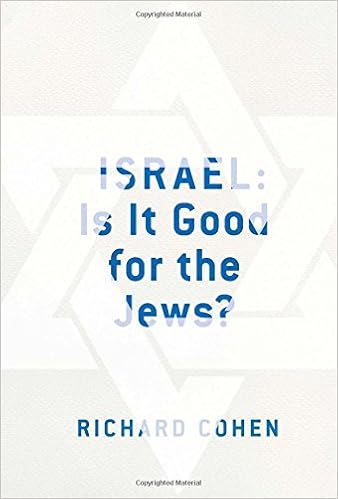
Israel: Is It Good for the Jews? Paperback – July 30, 2016 by Richard Cohen (Simon & Schuster)


Can a reviewer go on strike? Though I am not a member of any union, there were moments while reading Richard Cohen's book when I was tempted to throw up a literary picket line. Mr. Cohen, a longtime Washington Post columnist, originally titled his book "Can Israel Survive?" but renamed it "Israel: Is It Good For the Jews?" for final publication. He fails to answer either question. Yet that's far from the only problem with this well-meaning volume that flirts too often with outright illiteracy.

Consider the following sentences: "Anti-Semitism is a prejudice of the zeitgeist. It is now situated in the Middle East, in the Arab world. It stirs in Europe and elsewhere, but the noxious stink of the Hitlerian abattoir clings to it still, so it is a sotto voce sort of thing."

Reading these lines—the remainder of the paragraph is even worse—you get the sense that Mr. Cohen thinks this is writing of a high order. Does it occur to him that something with a "stink" to it cannot be "sotto voce"? Or that "the zeitgeist" cannot have a prejudice? Or that a prejudice cannot be "situated" in the Arab world, as if it were a pyramid or a mosque? Or that anti-Semitism is hardly a "sotto voce sort of thing" in certain neighborhoods of Paris or London?

Yes, the reader more or less gets the point. But as George Orwell warned in 1946, the English language "becomes ugly and inaccurate because our thoughts are foolish, but the slovenliness of our language makes it easier for us to have foolish thoughts." Mr. Cohen's book is a case study in Orwell's timeless lament.


ISRAEL: IS IT GOOD FOR THE JEWS?

By Richard Cohen
(Simon & Schuster, 273 pages, $26)

Indeed, it was slovenly language that accounts for this book in the first place. In 2006, during Israel's summer war with Hezbollah, he wrote a column called "Hunker Down With History" that began with the line: "The greatest mistake Israel could make at the moment is to forget that Israel itself is a mistake." The column sparked the usual rebukes from Israel's supporters. But it also elicited congratulations from many of Mr. Cohen's colleagues and friends, which he found disquieting. "What oozed out," he writes in the book, was that "they had finally met a Jew who acknowledged the truth about Israel."

Mr. Cohen should not have been surprised by the reaction. And yet he quickly realized that the line about Israel being a mistake was a mistake. It had been "tossed off under deadline pressure." He couldn't think of another word that expressed his meaning. Perhaps he didn't quite know what he meant at all.


And so Mr. Cohen hunkered down with the very history he claimed to know, but didn't, while he was busy patronizing Israelis with a lecture as they were being shelled by Hezbollah.

Now he disgorges all that he has learned. He writes about Theodor Herzl, the founder of modern Zionism, and about the Dreyfus Affair, the anti-Semitic prosecution of a French Jewish artillery officer that proved to Herzl that Jews faced a dark future in Europe. He describes the grim condition of the Jews in Eastern Europe, particularly the Poland of his grandparents, that prompted people like the young David Grün —later to rename himself David Ben-Gurion —to leave Poland for Palestine. He explains, and defends, the Revisionist Zionism of Ze'ev Jabotinsky, who knew better than Ben-Gurion's Labor Zionists that the Arabs of Palestine would never consent to Jewish rule, however progressive or benign. He reminds readers of how little was done by Western powers (including the Roosevelt administration) to save the Jews before, during or even after the Holocaust. As late as 1946, Jews were being killed in Polish pogroms.

Mr. Cohen also recites the history of the close collaboration of Amin al-Husseini, the Grand Mufti of Jerusalem, with Adolf Hitler. He reminds readers that, while ethnic expulsions and population transfers were common occurrences in Europe and elsewhere in the first half of the 20th century, it was only Israel that refused to follow suit by expelling its own Arab population after its independence in 1948. Today, of course, it is only Israel—with an Arab population of 20%—that is widely denounced for allegedly doing what, in fact, it did not do.

All of this makes for a useful, if derivative, primer on the whence and why of the Jewish state. But then Mr. Cohen makes the leap from his extended book report to his attempt at making his own arguments, and we're back to terrible writing, shallow arguments and mental goo.

"For many of these people," Mr. Cohen writes, referring to young American Jews who are indifferent to their heritage, "history did not end, in the famous (and misunderstood) formulation of Francis Fukuyama, but was consumed in the Holocaust . . . . Two thousand years of anti-Semitism supposedly halted on the spot, stopped right there, and history started something new. Context is gone. The moment is everything. The tweet, the text, the phone call, the cell phone picture, and, if you want to get really fancy, the photojournalist garbed as if for a safari, countless pockets for this and that, but none for what went before." You follow?

Worse than this, however, is Mr. Cohen's undiminished need to patronize Israelis and supporters of the Jewish state. "Who will defend Israel when its national character is no longer that of the European exile, the fighting intellectual, rifle in one hand and a volume of Kierkegaard in the other?" he asks, as if the defense of Israel rests on literary sensibilities. "What will happen when Jews from Islamic lands, already nearly 50% of the population, become a healthy majority and change the face that Israel presents to the world, particularly America?"

So, is Israel good for the Jews? Mr. Cohen has a sentimental affinity for the country. But he also says that the country has "run out of purpose" and, by virtue of its very location, puts its citizens at risk in all kinds of ways, not least by putting them in range of an Iranian nuclear missile. For all that, Mr. Cohen might have noted that fewer Israelis have died in all of its wars than were murdered on any given day of the Holocaust.

Israel has been proving even its sharpest critics wrong for nearly 70 years. Here's betting its light outshines Mr. Cohen's dim bulb.

And Then All Hell Broke Loose: Two Decades in the Middle East Paperback – February 14, 2017 by Richard Engel (Simon & Schuster)

And Then All Hell Broke Loose: Two Decades in the Middle East by [Engel, Richard]

A major New York Times bestseller by NBC’s Chief Foreign Correspondent Richard Engel—this riveting story of the Middle East revolutions, the Arab Spring, war, and terrorism seen close up “should be required reading” (Booklist, starred review).

In 1997, young Richard Engel, working freelance for Arab news sources, got a call that a busload of Italian tourists was massacred at a Cairo museum. This is his first view of the carnage these years would pile on. Over two decades he has been under fire, blown out of hotel beds, and taken hostage. He has watched Mubarak and Morsi in Egypt arrested and condemned, reported from Jerusalem, been through the Lebanese war, covered the shooting match in Iraq and the Libyan rebels who toppled Gaddafi, reported from Syria as Al-Qaeda stepped in, and was kidnapped in the Syrian cross currents of fighting. Engel takes the reader into Afghanistan with the Taliban and to Iraq with ISIS. In the page-turning And Then All Hell Broke Loose, he shares his “quick-paced...thrilling adventure story” (Associated Press).

Engel takes chances, though not reckless ones, keeps a level head and a sense of humor, as well as a grasp of history in the making. Reporting as NBC’s Chief-Foreign Correspondent, he reveals his unparalleled access to the major figures, the gritty soldiers, and the helpless victims in the Middle East during this watershed time. His vivid story is “a nerve-racking...and informative portrait of a troubled region” (Kansas City Star) that shows the splintering of the nation states previously cobbled together by the victors of World War I. “Engel’s harrowing adventures make for gripping reading” (The New York Times) and his unforgettable view of the suffering and despair of the local populations offers a succinct and authoritative account of our ever-changing world.

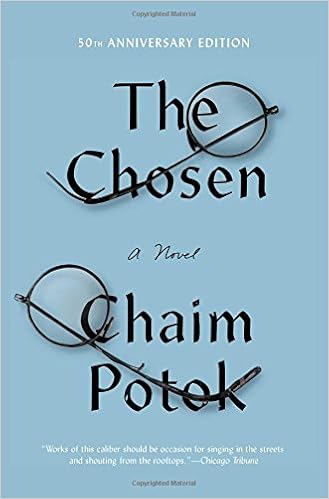
The Chosen Hardcover – November 1, 2016 by Chaim Potok (Simon & Schuster)


A Cruel and Dangerous Treatment that May Have Worked--This Time

This is the story of two boys in the Williamsburg section of Brooklyn, and their fathers, during the 1940s. Danny's father is a Hasidic rabbi, and Reuven and his father are orthodox Jews, but not Hasidic. The story begins with a (softball/baseball) game--the author seems to confuse the two games--in which a ball hit by Danny strikes Reuven, the pitcher, breaking his glasses and putting him in the hospital. Danny comes to the hospital to apologize to Reuven, but Reuven angrily rejects Danny's apology. Reuven's father counsels him to apologize for his rude rejection of Danny, which he does, and they become best friends.

I suspect that many of the one-star reviews were written by folks who read no farther than this; I must admit I came close to quitting at this point and giving it one star, but fortunately I persisted, and soon thereafter the boredom ceased, and I could hardly put the book down after that.

Several reviewers have commented on Rabbi Saunders' silent treatment of Danny, which may, in this case, have accomplished its purpose of developing compassion. However, most children develop compassion as they grow up, without the silent treatment, which was cruel, and was uncomfortably close to the parenting style that, according to what I have read*, has been found to be common to most serial killers such as Ted Bundy. The ending could easily have been tragic, and it is not exactly happy, but life will go on, and will probably be bearable. Reuven will probably get married eventually, and maybe Danny will, too.

There are some surprises which I won't spoil. This is not a book for children; you need the life experience of growing up to adulthood to fully understand and appreciate it. I doubt that I was ready for it before age 35. But at 77, I am very glad that I read it.

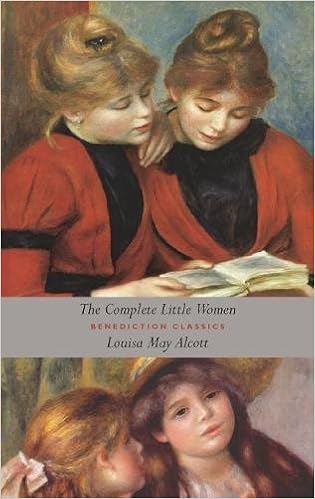
The Complete Little Women: Little Women, Good Wives, Little Men, Jo's Boys (Unabridged) Hardcover – February 18, 2017 by Louisa May Alcott


There is, in short, no separate standard of taste by which to determine the value of books written for children. To be of permanent use, they must possess literary quality; that is, they must be whole-souled, broad, mature in temper, however simple they may need to be in theme or manner. This truth is not always observed by the fond adult buyer. The given book seems, he admits, rather silly, but he supposes that to be a part of its character as a "juvenile." A theory seems to be building up that the attribute of ripe humor which is wisdom is rather wasted upon a book for children; that a boy knows a parson and recognizes a clown, but is only puzzled by the betwixts and betweens of the class to which most of humanity belongs. It is often asserted that a child's sense of humor is mainly confined to a sense of the ridiculous. That is true of his sense of a joke; but children have never been proved insusceptible to the warmth of true humor, though they may have been quite unconscious of susceptibility. In the meantime, they are ready enough to put up with its absence; and they find at hand a type of fiction built upon an artificial code of sentiment and morals. Children's magazines and libraries are full of stories written according to this code, the beginning and the end of which is the prescription of certain things to do and not to do: never to cheat in examination, always to be grateful to your parents, never to pretend to have money when you haven't, and always to knock under to authority. By way of making up for all these deprivations, you are (if you are a genuine school hero or heroine) allowed to make precocious love to the prettiest girl or the handsomest boy in school. It cannot be denied that there is something of this in Miss Alcott, though her successors and imitators have, according to the habit of imitators, exaggerated the defects of her method and her work. Her books are, in the main, not only interesting to girls, but wholesome, and deserve to be handsomely reprinted, as two of them have just been, for the benefit of the rising generation of Beths and Megs and Pollies

Friday, March 16, 2018

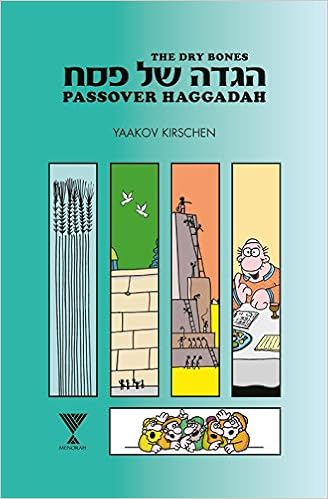
The Dry Bones Passover Haggadah (Hebrew and English Edition)Dec 10, 2017 by Yaakov Kirschen Hardcover (Menorah Books


The Passover meal called Seder, meaning “order” and referring to the sequence of fifteen practices during the meal, is designed to remind Jews of the ancient slavery of their ancestors in Egypt, the exodus from that slavery, the many ways that we are physically, emotionally, and psychologically enslaved today, and to work to free ourselves and others from the current enslavements.
Interestingly, the Seder is one of several non-biblical practices that even generally non-observant Jews obey on Passover. Another two, for example, are observed on Passover and on other occasions, are not like the Seder a happy occasion, but involve mourning practices, and are arguably based on superstition. One is the saying of the kaddish and yizkor for the dead. Many Jews feel that unless they say the kaddish for eleven months for parents and on the anniversary of their death, the yahrzeit, harm will come to their dead parents. Recently, this notion was elaborated upon with the concept of illui neshamah, the belief that certain acts by live people can cause the dead to go to a higher level (higher to where is unstated). Many Jews also think that wishing a mourner “may your father/mother have an illui neshamah” increases the chances for the rising. Still another non-biblical practice observed even by non-observant Jews is that people whose parents are alive leave the synagogue when yizkor is said because they are convinced that if they are present in the synagogue when the yizkor is recited their currently alive parents will die during the upcoming year. In contrast to these acts, the Seder is rational.
The fifteen customs of the Seder are designed to capture the interest of adults and children and encourage them to think of the message of Passover. Many different gimmicks are used to capture the interest of children; the most well-known is giving them four questions to ask, hoping that they will become interested in the answers to their questions and even ask some questions of their own.
The Dry Bones Haggadah is perfect for helping both adults and children reflect upon the exodus from ancient slavery and its meaning today. It is fun to look at, both the Hebrew and its modern English translation are printed in an easy to read almost poetic-like structure. The book is by the same cartoonist who published the very popular Dry Bones cartoons for forty years. Many of the pages have clever funny cartoon strips. On other pages there are interesting drawings.
For example: One cartoon strip shows Moses speaking to God.
“Israel will become a light unto the nations?”
“Yes, but the nations will get really good at looking the other way.”
Another portrays a man complaining.
“Every year I seem to put on a few pounds, and I’ve finally figured out why: Yom Kippur is one day of no food, and Passover is one week of overeating!”

[1] By Yaakov Kirschen, Menorah Books, 2017.

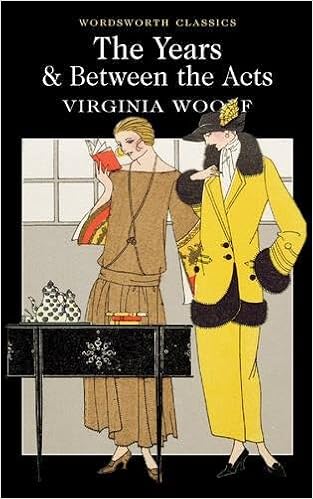
The Years / Between the Acts (Wordsworth Classics) UK ed. Edition by Virginia Woolf (Wordsworth Editions) (IBRClassicsReview)


The Genius of Virginia Woolf
In Her Last Book the English Novelist Again Says the Unsayable

When Virginia Woolf quietly wrote a farewell note to her husband, took her stick--so fixed is habit--and went on her favorite walk across the summery meadows down to the Ouse to slip under the water, it was a sad hour for English letters. Why did she do it? No one knows precisely. It may well have been a combination of four factors--sorrow over the war with its breeding hatreds; the demolishment of her Bloomsbury apartment ("They are destroying all the beautiful things!" she cried); the revising of her book, which always caused her pain; and the fear of "an old madness" coming over her.

"Between the Acts" had been completed before her death, but she was still working on the final revisions when the compulsion for the ultimate escape seized her. It is with curiosity, profound regret, and a cool sort of reverence that one takes up the last work of the sole indisputable genius among contemporary British women-of-letters.

Virginia Woolf has left to posterity a shelf of sixteen volumes that enrich our literature in a very special way. Two are books of criticism of extraordinary perception, and ten are novels, in which she has achieved inimitable distinction. And though her fiction has been predominantly caviar to the general, yet in two of her novels she achieved best sellers--one, "The Years," held the top place on best seller lists for months in 1937. With "Jacob’s Room" in 1922 Mrs. Woolf was recognized by the discriminating as a novelist of first rank. From "Mrs. Dalloway" on, she was widely regarded as the foremost woman writing in English.

As the bulk of the iceberg lies beneath the water’s surface, so the greater opulence of Mrs. Woolf’s prose fiction may be said to lie above the clouds. In rarefied strata of pure sensation, ephemeral beauty, celestial imaginings, she flies with skill and daring. Without eager wings and sympathetic vision, even the practiced reader may fail to realize how she has pierced the screen ‘twixt thing and word, "where language is lit straight from soul."

"Between the Acts" is one of Mrs. Woolf’s most seemingly simple books: the plot well integrated, the fancy under deft control. There is even a new calmness, a new clarity. She is not lost in webs of speculation, thin-drawn to incommunicability as in "The Waves," where she wrote, "I desire always to stretch the night and fill it fuller and fuller with dreams."

Yet in her "easier" last book, ingeniously the story is played out on three levels--a pageant within a pageant and all within the vaster pageant of creation and infinity. The animal plane, the human and the spiritual, each has function and counterpointal significance. As to actual plot, despite the disciplined guidance, what does it amount to, and who seriously cares?

Did the plot matter? She shifted and looked over her right shoulder. The plot was only there to beget emotion. Don’t bother about the plot: the plot’s nothing.

So says Miss La Trobe, the enigmatic author and producer of the pageant, who seems to represent the creative mind in relation to an audience and actuality.

On a single day of June, 1939--with the war imminent but virtually unperceived--the action takes place at Pointz Hill, an English country house. It revolves about a pageant played upon the lawns by the local villagers. In its unity of time "Between the Acts" recalls "Mrs. Dalloway." Through implications of the scenes touching on the whole history of England and the mutations of English literature it suggests "Orlando."

Despite her necessity, the solitary, thick-legged, masculine Miss La Trobe, who knew how "vanity made all human beings malleable," is not one of the principal characters. The chief actors are the members of the Oliver household. The head of the house is old Bartholomew Oliver, who like so many retired English soldiers has only his India to cling to. He marvels at his widowed sister’s orthodoxy. ("Deity," as he supposed, "was more of a force or a radiance, controlling the thrush and the worm, the tulip and the hound; and himself too, an old man with swollen veins.") This aging sister, Mrs. Swithin, who would have become a clever woman is she could ever have fixed her gaze, is the most sympathetic figure in the book. Living with the older Olivers are Isa, the poetry-quoting daughter-in-law, temporarily attracted to a gentleman farmer, and Giles, the stock broker son, handsome, hirsute, virile and surly.

To this special group are added buoyant, big-hearted Mrs. Manresa, "a wild child of nature" for all that her hands are bespattered with emeralds and rubies, dug up by her thin husband himself in his ragamuffin days in Africa. Uninvited she drops in at luncheon, bringing along with the picnic champagne a maladjusted, putty-colored young man named William Dodge, whom Giles contemptuously sizes up as "a toady, a lickspittle, not a downright plain man of his senses, but a teaser and a twitcher, a fingerer of sensations; picking and choosing; dillying and dallying; not a man to have a straightforward love for a woman."

William tries dallying with Isa, and Giles, partly to annoy his wife, pays court to the full-blown charms of sparkling Mrs. Manresa, who confesses she loves to take off her stays and roll in the grass.

Outstanding among the villagers in pageant and audience and the gentry from neighboring estates, is the minister.

The Reverend G. W. Streatfield looked at the audience, then up at the sky. The whole lot of them, gentles and simples, felt embarrassed, for him, for themselves--there he stood, their representative spokesman, their symbol, themselves, a butt, a clod, laughed at by looking glasses, ignored by the cows, condemned by the clouds which continued their majestic rearrangement of the celestial landscape, an irrelevant forked stake in the flow and majesty of the Summer silent world.

There is explanation, but no development of character in "Between the Acts." Mrs. Woolf seems to be saying that for all the transcendental beauties of nature and the high-breeding processes of civilization, human beings haven’t changed much from the time when "prehistoric man, half- human, half-ape, roused himself from his semi-crouching position and raised great stones." Fashions change, days are wet or fine, but the essential heart of man remains much the same. Mrs. Woolf is as poignantly aware of the durability of land and sky as she is of the impermanence of man’s relationships. "That’s what makes a view so sad," says Mrs. Manresa nodding at the strip of gauze laid upon the distant fields. "And so beautiful. It’ll be there when we’re not."

As in most of her novels, the cream of "Between the Acts" lies between the lines--in the haunting overtones. And the best of the show--the part one really cares about--happens between the acts and immediately before the pageant begins and just after it is over. So the play is not really the thing at all. It is merely the focal point, the hub of the wheel, the peg on which to hang the bright ribbons and dark cords of the author’s supersensitive perceptions and illuminated knowledge. It is in her imagery, in her felicitous gift for metaphor, for cadence, for exciting association, in her "powers of absorption and distillation" that her special genius lies. She culls exotic flowers in the half-light of her private mysticism along with common earthgrown varieties and distills them into new essences. Her most interesting characters move in an ambienteof intuition. With half a glance they regard their fellow-mortals and know their hidden failures. They care less for the tangible, the wrought stone, than for fleeting thought or quick desire.

In ten novels Mrs. Woolf lifted veil after veil to reveal what she perceived as the secret meaning of life. When one finishes a book of hers it is not characters he remembers but their spiritual emanations, which are in reality manifestations or facets of Virginia’s Woolf supervision. Her peculiar interest not in surfaces but in mysterious motivations and subterfuges that do not meet the eye. And no other English novelist has ever written more dazzling passages of poetry undefiled than Virginia Woolf. Like the great poets--Shakespeare, Donne, Shelley, Blake--Mrs. Woolf could say the unsayable, and it is there in her books for those who have ears attuned to unheard melodies, even if they can never recommunicate it in any language except Mrs. Woolf’s own precisely.

At once a woman of profound erudition and intuitive intelligence, she is also the most poignantly sensitive of English novelists. Yet there was a leaven of zest and humor in her make-up, and her wit was akin to that slyly malicious kind that ran in the veins of Prince Hamlet. Steeped in the classical tradition, she was an audacious experimentalist. She looked upon existence as a maze of paradoxes, but she was continually uplifted and renewed by the transient beauty of the world. One passage from "Between the Acts" seems to epitomize the attitude of mind, the prose style, the whole art of Virginia Woolf:

"Here came the sun, an illimitable rapture of joy, embracing every flower, every leaf. Then in compassion it withdrew, covering its face, as if it forebore to look on human suffering."

"Between the Acts" has no more ending, no more conclusion than English history. The pageant is played out, the guests depart, night falls. The old folks retire and Isa and Giles are alone for the first time that day.

"Alone, enmity was bared; also love. Before they slept, they must fight; after they had fought, they would embrace. From that embrace another life might be born. But first they must fight, as the dog fox fights with the vixen, in the heart of darkness, in the fields of night.

Isa let her sewing drop. The great hooded chairs had become enormous. And Giles too. And Isa too against the window. The window was all sky without color. The house had lost its shelter. It was night before roads were made or houses. It was the night that dwellers in caves had watched from some high place among rocks.

Then the curtain rose. They spoke."

The physical embodiment of Virginia Woolf is no more, but her inimitable voice remains to speak to generations yet unborn. The first line of her last book begins, "It was a Summer’s night and they were talking"--The last paragraph ends: "Then the curtain rose. They spoke."

As long as English is read the voice may go on--if without new delight, also without fresh pain. For Virginia Woolf, the woman, "Peace, Let her pass!" as the author says of a person just dead in the pageant. "She to whom all’s one now, Summer and Winter."

Tuesday, March 13, 2018

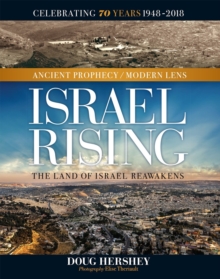
Israel Rising: Ancient Prophecy/Modern Lens Hardcover – February 27, 2018 by Doug Hershey (Citadel)

Israel Rising : Ancient Prophecy/ Modern Lens, Hardback Book

A unique visual story of Israel's miraculous journey from unforgiving desert land to thriving nation.

Thousands of years ago, the prophet Ezekiel foretold a future time in which the arid land of Israel would come alive for its people. Now this breathtaking book documents the fulfillment of this vision, from the hills of Shiloh where shepherds once roamed, to the booming city of Tel Aviv, founded on sand dunes, to the stellar beaches of Caesarea, transformed from a small village into one of Israel's most stunning coastal cities and finally Jerusalem, the Eternal City of Peace, where in ancient times the power of worship resounded from the Temple. Here, rarely seen photographs taken between the 1880s and the 1940s juxtaposed with contemporary images of the same locations illustrate the region's biblical history as a place of monumental battle, celebration, worship, and awesome resilience.
Whether by helicopter or on foot, on their own or with the aid of locals, author Doug Hershey and photographer Elise Monique Theriault negotiate the terrain to access the vantage points required to match the original photos, from the rooftop of Israel's National Museum of Science, Technology and Space in Haifa, to Jaffa Port's breakwater, and much more. Their quest creates a collection that will inspire and captivate as it illuminates Israel's foretold awakening in a new and unforgettable way.
To help facilitate this dramatic view of history, Israel Rising will start at the beginning. It will look at what exactly Ezekiel prophesied. It will explore the historical accounts from Jewish, Christian, and Muslim eyewitnesses of what the land and region has experience and endured. And photos from the 1880s-1940s will be compared to new photos of the same locations. With more than 175 photos, Israel Rising will depict the transformation of Israel as it celebrates its 70th anniversary.

BETWEEN THE WORLD AND ME Notes on the First 150 Years in America by Ta-Nehisi Coates (Spiegel & Grau)


The powerful story of a father’s past and a son’s future.

Atlantic senior writer Coates (The Beautiful Struggle: A Father, Two Sons, and an Unlikely Road to Manhood, 2008) offers this eloquent memoir as a letter to his teenage son, bearing witness to his own experiences and conveying passionate hopes for his son’s life. “I am wounded,” he writes. “I am marked by old codes, which shielded me in one world and then chained me in the next.” Coates grew up in the tough neighborhood of West Baltimore, beaten into obedience by his father. “I was a capable boy, intelligent and well-liked,” he remembers, “but powerfully afraid.” His life changed dramatically at Howard University, where his father taught and from which several siblings graduated. Howard, he writes, “had always been one of the most critical gathering posts for black people.” He calls it The Mecca, and its faculty and his fellow students expanded his horizons, helping him to understand “that the black world was its own thing, more than a photo-negative of the people who believe they are white.” Coates refers repeatedly to whites’ insistence on their exclusive racial identity; he realizes now “that nothing so essentialist as race” divides people, but rather “the actual injury done by people intent on naming us, intent on believing that what they have named matters more than anything we could ever actually do.” After he married, the author’s world widened again in New York, and later in Paris, where he finally felt extricated from white America’s exploitative, consumerist dreams. He came to understand that “race” does not fully explain “the breach between the world and me,” yet race exerts a crucial force, and young blacks like his son are vulnerable and endangered by “majoritarian bandits.” Coates desperately wants his son to be able to live “apart from fear—even apart from me.”

This moving, potent testament might have been titled “Black Lives Matter.” Or: “An American Tragedy.”

Friday, March 9, 2018

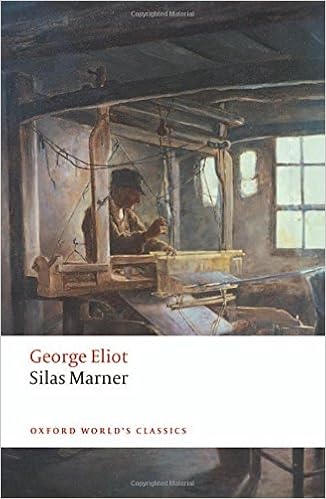
Silas Marner: The Weaver of Raveloe (Oxford World's Classics) 2nd Edition by George Eliot (Author),‎ Juliette Atkinson (Editor) (ISBClassicsReview)


Silas Marner: The Weaver of Raveloe is the third novel by George Eliot, published in 1861. An outwardly simple tale of a linen weaver, it is notable for its strong realism and its sophisticated treatment of a variety of issues ranging from religion to industrialisation to community.

Summary 
The novel is set in the early years of the 19th century. Silas Marner, a weaver, is a member of a small Calvinist congregation in Lantern Yard, a slum street in Northern England. He is falsely accused of stealing the congregation's funds while watching over the very ill deacon. Two clues are given against Silas: a pocket knife, and the discovery in his own house of the bag formerly containing the money. There is the strong suggestion that Silas' best friend, William Dane, has framed him, since Silas had lent his pocket knife to William shortly before the crime was committed. Silas is proclaimed guilty, however, after a drawing of lots. The woman Silas was to marry breaks their engagement and instead marries William. With his life shattered and his heart broken, Silas leaves Lantern Yard and the city for a rural area where he is unknown.

Marner travels south to the Midlands and settles near the rural village of Raveloe in Warwickshire, where he lives isolated and alone, choosing to have only minimal contact with the residents. He throws himself into his craft and comes to adore the gold coins he earns and hoards from his weaving.

One foggy night, the two bags of gold are stolen by Dunstan ("Dunsey") Cass, a dissolute younger son of Squire Cass, the town's leading landowner. Silas then sinks into a deep gloom, despite the villagers' attempts to aid him. Dunsey immediately disappears, but little is made of this by the community because it coincides with the death of the horse he was meant to be selling for his brother.

Godfrey Cass, Dunsey's elder brother, also harbours a secret past. He is married to, but estranged from, Molly Farren, an opium-addicted woman of low birth living in another town. This secret prevents Godfrey from marrying Nancy Lammeter, a young woman of high social and moral standing. On a winter's night, Molly tries to make her way to Squire Cass's New Year's Eve party with her two-year-old girl to announce that she is Godfrey's wife. On the way, she lies down in the snow and passes out. The child wanders away and into Silas' house. Silas follows her tracks in the snow and discovers the woman dead. When he goes to the party for help, Godfrey heads outdoors to the scene of the accident, but resolves to tell no one that Molly was his wife. Molly's death, conveniently for Godfrey and Nancy, puts an end to the marriage.

Silas keeps the child and names her Eppie, after his deceased mother and sister, both named Hephzibah. Eppie changes Silas' life completely. Silas has been robbed of his material gold, but thinks that he has it returned to him symbolically in the form of the golden-haired child. Godfrey Cass is now free to marry Nancy, but continues to conceal the fact of his previous marriage—and child—from her. However, he aids Marner in caring for Eppie with occasional financial gifts. More practical help and support in bringing up the child is provided by Dolly Winthrop, a kindly neighbour of Marner's. Dolly's help and advice assist Marner not only in bringing up Eppie, but also in integrating them into village society.

Sixteen years pass, and Eppie grows up to be the pride of the village. She has a strong bond with Silas, who through her has found a place in the rural society and a purpose in life. Meanwhile, Godfrey and Nancy mourn their own childless state, after the death of their baby. Eventually, the skeleton of Dunstan Cass—still clutching Silas' gold—is found at the bottom of the stone quarry near Silas' home, and the money is duly returned to Silas. Shocked by this revelation, and coming to the realisation of his own conscience, Godfrey confesses to Nancy that Molly was his first wife and that Eppie is his child. They offer to raise her as a gentleman's daughter, but this would mean Eppie would have to forsake living with Silas. Eppie politely but firmly refuses, saying, "I can't think o' no happiness without him."

Silas revisits Lantern Yard, but his old neighbourhood has been "swept away" in the intervening years and replaced by a large factory. No one seems to know what happened to Lantern Yard's inhabitants. However, Silas contentedly resigns himself to the fact that he will never know and now leads a happy existence among his self-made family and friends. In the end, Eppie marries a local boy she has grown up with, Dolly's son Aaron. Aaron and Eppie marry and move into Silas' house, which has been newly improved courtesy of Godfrey. Silas' actions through the years in caring for Eppie have apparently provided joy for everyone, and the extended family celebrates its happiness.

Characters

Silas Marner: lower class by birth, a weaver who is betrayed at Lantern Yard (site of a dissenting sect) by his treacherous friend William Dane, moves away to Raveloe (where the community is Church of England), becomes taken for a miser, as he accumulates a small fortune, only to have it stolen by Dunstan Cass. After these misfortunes, he gradually finds his happiness and virtue by the arrival of young Eppie (biological daughter of Godfrey Cass) who he raises as his adopted child.

Squire Cass, Lord of the Manor of Raveloe and host of the party on the night when Eppie comes into Silas's life so unexpectedly.

Godfrey Cass: upper class by birth but troubled by money, eldest son of the local squire, who is blackmailed by his dissolute brother Dunstan over his secret first marriage to Molly. When Molly dies, he feels relief, and escapes punishment for his betrayal and deceit, instead marrying Nancy.

Dunstan Cass: second son of the local squire. He blackmails his older brother, until he disappears. He steals Silas' gold after accidentally killing his older brother's horse Wildfire. Many years pass before his corpse is found in a newly drained pit.

Molly Farren: Godfrey's first (and secret) wife, who has a child by him; an opium addict; lower class, impoverished. She dies in the attempt to reveal to the community her relationship with Godfrey, leaving the child, Eppie, to wander into Silas' life.

Eppie (Hephizibah): daughter of Molly and Godfrey, who is named by and cared for by Silas after the death of her mother. Mischievous in her early years, she grows into a radiant and beautiful young girl, devoted to her adoptive father.

Nancy Cass (née Lammeter): Godfrey Cass' second wife, a morally and socially respectable young woman, admired by her husband but deceived by him as regards his past.

Priscilla Lammeter, Nancy's plain, unwed sister, who supports Nancy and their father.

Aaron Winthrop: son of Dolly, who marries Eppie at the end of the novel and is considered a happy match for her.

Dolly Winthrop: mother to Aaron, wife of Ben; godmother to Eppie. Sympathetic to Silas and offers him practical support in raising the child.

Ben Winthrop, wheelwright, largely invisible in the novel.

Mr Snell, landlord of the Rainbow Inn, Raveloe.

William Dane: William Dane is Silas' former best friend at Lantern Yard. At the start of the novel, William betrays Silas by framing him for theft and marrying Silas' fiancée Sarah.

Sarah: Silas' fiancée in Lantern Yard, who subsequently marries his treacherous friend William Dane.

Mr. Macey: the clerk at the local church, a tailor, very elderly by the end of the novel.

Solomon Macey, Mr Macey's brother, a talented violinist.

Mr Crackenthorpe, rector of Raveloe and a Justice of the Peace.

Bob Lundy, the butcher of Raveloe.

John Dowlas, the farrier of Raveloe.

Jem Rodney, a local poacher, initially suspected by Silas of stealing his money.

Mrs. Kimble, the sister of Squire Cass, and the doctor's wife, thus considered a double dignitary.

Dr. Kimble, the doctor of Raveloe, who attends when Molly is found dead.

Analysis

Lawrence Jay Dessner has drawn connections between the biographical circumstances of Eliot's life in relation to events in the novel.[1] Bruce K Martin has discussed Eliot's use of Godfrey Cass as "both parallel and foil" to Silas Marner in the structure of the novel.[2] Fred C Thomson has examined the multiple levels of the idea of alienation in the novel.[3] Joseph Wiesenfarth has noted undercurrents of myth and legend, incorporated into a 'realistic' context, along with contrasts of responsible and irresponsible behaviour in the contrasting fates of Silas Marner and the Cass brothers.[4] David Sonstroem has studied ideas of chance and Darwinian thinking in the context of the plot and character fates in the novel.[5] Susan Stewart has looked at the influence of folktales and ideology related to 'work' vs 'labour' in the novel.[6] Ian Milner has examined two overarching themes of Silas Marner's 'loss and recovery of his humanity', and of a conflict between stated moral values and the social realities juxataposed with them.[7] Robert H Dunham has analysed the influence of the ideas and philosophy of William Wordsworth on the novel.[8] Brian Swann has examined mythic and religious undertones in the novel.[9] Jeff Nunokawa analyses ideas about physical touch, with respect to Silas Marner's handling of his gold compared to his raising of Eppie, and connects them to sexual and sensual themes.[10] Kate E Brown has discussed overarching themes of time and temporality, with respect to the interlocked stories of Godfrey Cass and Silas Marner.[11]

References

[1] Dessner, Lawrence Jay (Fall 1979). "The Autobiographical Matrix of Silas Marner". Studies in the Novel. 11 (3): 251–282. Retrieved 2017-08-21.


[2] Martin, Bruce K (Fall 1972). "Similarity Within Dissimilarity: The Dual Structure of Silas Marner". Texas Studies in Literature and Language. 14 (3): 479–489. Retrieved 2017-08-21.


[3] Thomson, Fred C (June 1965). "The Theme of Alienation in Silas Marner". Nineteenth-Century Fiction. 20 (1): 69–84. Retrieved 2017-08-21.


[4]Wiesenfarth, Joseph (June 1970). "Demythologizing Silas Marner". ELH. 37 (2): 226–244. Retrieved 2017-08-21.


[5] Sonstroem, David (October 1998). "The Breaks in Silas Marner". The Journal of English and Germanic Philology. 97 (4): 545–567. Retrieved 2017-08-21.


[6] Stewart, Susan (Summer 2003). "Genres of Work: The Folktale and Silas Marner". New Literary History. 34 (3): 513–533. Retrieved 2017-08-21.


[7] Milner, Ian (Autumn 1966). "Structure and Quality in Silas Marner". Studies in English Literature, 1500-1900. 6 (4): 717–729. Retrieved 2017-08-21.


.[8] Dunham, Robert H (Autumn 1976). "Silas Marner and the Wordsworthian Child". Studies in English Literature, 1500-1900. 16 (4): 645–659. Retrieved 2017-08-21.


[9] Swann, Brian (Spring 1976). "Silas Marner and the New Mythus". Criticism. 18 (2): 101–121. Retrieved 2017-08-21.


.[10] Nunokawa, Jeff (Spring 1993). "The Miser's Two Bodies: Silas Marner and the Sexual Possibilities of the Commodity". Victorian Studies. 36 (3): 273–292. Retrieved 2017-08-21.


[11]Brown, Kate E (Spring 1999). "Loss, Revelry, and the Temporal Measures of Silas Marner: Performance, Regret, Recollection". NOVEL: A Forum on Fiction. 32 (2): 222–249. Retrieved 2017-08-21.

Tuesday, March 6, 2018

The Digital Academic: Critical Perspectives on Digital Technologies in Higher Education. Deborah Lupton, Inger Mewburn and Pat Thomson (eds). Routledge. 2018.


In 2016 a contributor to The Guardian’s ‘Academics Anonymous’ section wrote a post entitled: ‘I’m a serious academic, not a professional Instagrammer’. In it, the anonymous author criticised and bemoaned the increasing expectation that academics should use social media, whether to promote themselves or to be seen to appear enthusiastic. Within a week of hitting the web, the article had garnered over 300 comments, 3,000 shares, one jocular counter piece and a small storm on Twitter whose apex took the form of a parody account replete with a meme of a cat wearing a lab coat (@SeriousAcademic).

Amongst the outrage, cats and memes was a debate on what new technologies mean for academic work and the university. For universities, digital technologies bring major changes to the way that teaching, research and communication can occur. Blogs, tweets, automatically generated citation measures, learning analytics, Massive Open Online Courses (MOOCs), flipped classrooms, open access research – all of these impact on academic work and academic workers.

In trying to make sense of this new world, discourse around digital technology in the academe can often result in polarising categories. On the one hand, we find the glorified hype of the Web 2.0. version of the university: the digital classrooms of the future where education is free and democratised for all. On the other, one-dimensional stereotypes of ‘digital natives’ glued to iPhones and academics forced into yet more content production in the form of blogs, tweets and videos, all of which will be used to reward and penalise the neoliberal worker. Inadvertently, by assuming either utopic or dystopic futures, discussions of the digital are prone to mirroring the very binary structures of the machines and systems they seek to explore.

In a context saturated with hype and hope, there is a need for more varied insight. The provision of this is one of the key achievements of The Digital Academic: Critical Perspectives on Digital Technologies in Higher Education. Edited by Deborah Lupton, Inger Mewburn (of Thesis Whisperer fame) and Pat Thomson, this scholarly edited work curates multiple critical perspectives from contributors, many of whom are themselves active digital users of social networking sites and digital technologies. This collaboration has resulted in a text whose academic prose remains lively, accessible and at times joyful to read. The inherent readability also attests to earlier commentary that blogging may serve to help academic writing.


By focusing a critical lens on academic life, this collection contributes to an increasing body of research interested in universities and the realities for the academics who exist within them. If Burton Clark’s 1987 book The Academic Life began the conversation around the effects of changes such as massification and marketisation, then The Digital Academic takes this conversation in a specifically digital direction.

While the digital landscape may be the context for this work, the focus remains a human one. Technical functionality and specifications give way to more socio-technical philosophies. This shows in methods that consistently explore the digital by turning towards the human, with interviews, surveys and ethnographies taking the place of more quantitative tech-centric approaches. This decision to focus on the voice of the academic is moreover an important one, particularly at a time when the academic self is so frequently quantified, measured and commodified.

Instead of presenting technology as something all-determining, each chapter invites the reader to explore how new technologies are actually used within faculties and institutions. By taking a critical perspective, the authors deliberately situate this usage within the various power structures that exist within and across the contemporary academe. These chapters navigate away from visions of the utopic or dystopic university of the future to explore what is happening in the here and now, in what Neil Selwyn (2014) has referred to as the messy and mundane everyday realities of university life.

One of the main vehicles for thinking about this is the academic self. As observed by the editors, ‘an academic in a cloister is a very different creature from one on a stage’ (6). Though blogs, Twitter and Facebook are performative spaces, academic use and appropriation of these stages are diverse. Chapter Two’s study of PhD students found blogging to be a way for students to create a scholarly identity, think out loud, receive feedback and engage with a community. Likewise, Charlotte Frost’s chapter on her work around PhD2Published demonstrates a way of publicly self-teaching and how this manifest as part of her own career trajectory – countering claims that no-one ever gets tenure from a blog post.

As a set of critical perspectives, this book would not be complete without a deep dive into power structures and hidden labour. In Chapters Eight and Nine, the respective authors’ turn their attention to academic experiences of two oft-endorsed innovations: ‘flipped classrooms’ and MOOCs. Though an abundance of research already exists on these, most has so far focused on their implications for learning and teaching. Instead, these chapters contribute insight from a wider academic perspective. Martin Forsey and Sara Page’s chapter on flipped classrooms demonstrates that, while ‘flipping’ lecture content to online delivery to allow for more interactive classes can be very positive, students and staff have to invest considerable time and energy to make them work. Likewise, Katharina Freud et al’s chapter on MOOCs draws attention to the ‘labour iceberg’ of MOOC delivery and the way the MOOC marketplace may lead to some voices, content and forms of knowledge being privileged over others. These perspectives draw further attention to the complexities of work within the neoliberal university context.

Taken together, the overall direction of The Digital Academic is to encourage further critical exploration of the role that digital media plays for the academy. Aside from this shared goal, the book’s chapters eschew taking one united position or advancing a single argument. Instead, illumination comes from different voices. In edited scholarly works this approach can run the risk of lacking coherence, however well justified or theorised by the editorial team. Yet, in this instance, the approach is not only appropriate but well-executed. Though there can always be a case made for further diversity, there remains value in the specifics of the qualitative even, or especially because, it is always partial, never universal and seldom fully representative.

For the academe ‘there is no escaping the digital – no outside to which we can retreat’ (15). As such, this volume is a vital contribution for anyone who cares about academic work and labour. While a number of the theoretically denser chapters will elude some, as a collection The Digital Academicoffers a sufficient range to engage a wide variety of readers. This is important since one of the barriers to broader uptake of research of this nature has been its impermeability to academics working outside the arts and social sciences. Those who are curious will find Chapter One to be an accessible and highly enjoyable overview of the key issues, while interview transcripts in Chapters Eleven and Twelve embrace a conversational messiness that provides an alternative to the research studies. In summary, this thoughtful volume invites us to go beneath the surface of hypes and hopes to critically explore the wonders and problems of the digital university. This invitation is one that anyone who cares about the modern university should most definitely accept.

This review is by Dr Jessica Frawley and originally appreaed in the LSEReview of Books 

Monday, March 5, 2018

Mirror Sydneyby Vanessa Berry,Giramondo 2017 PB 320pp $39.95

A series of delightful anecdotes about Sydney
Vanessa Berry sets out her brief in Mirror Sydney early. This book is a description of Sydney that doesn’t seek to describe its ‘natural beauty’ but instead focuses on the ‘marginalia, the overlooked and the odd’. To appreciate the ‘weird places, suburban mythologies and unusual details’. To find a ‘shadow Sydney’. It’s an interesting idea, which Berry pursues through a series of journeys traversing the Cumberland Plain up into the Blue Mountains, from pre-history to the present. These journeys are often personal, so that the ‘histories and the memories’ of Sydney, and also of Berry, are woven together.
Berry punctuates her writing with a series of hand-drawn maps. Maps are always abstract, and Berry is not looking for precision or scale. Her maps serve as illustrations of what is in the text. Often there are only a few cursory lines to mark roads or coast, and then they are filled with buildings or events or animals. They’re tea-towel maps, the sort of thing you get at amusement parks. Perhaps they’re kitsch, but there is tenderness and warmth in the careful blue etchings.
The connection with amusement parks is no coincidence. Berry loves them, or rather she loves their ruins. The now defunct Magic Kingdom in Lansvale, for one:
At the foot of the slide is a pile of plastic bread delivery trays, used in place of mats to ride down the slide by those who come to visit the park after dark. The Kingdom has never ceased to be a playground for some […] and to climb to the top of it at night and look out across the darkness below is to become the Magic Kingdom’s royalty.
Showing ruins as places of contemplation and artistic merit is not a new idea, but the convention is one of stone. It takes a certain amount of style to demonstrate the romantic power of crumbling fibro and Besser brick.
Berry has a kind eye for the ugly. This extends beyond the merely scruffy to buildings that, through a combination of geometry, material and location, create something arrestingly unattractive:
The mystery of ugly places is in their making us contemplate how they came into being, what kind of ideals they represent, or what kind of processes might have caused them to be the way they are. Sydney’s ugliest buildings are enigmas, around which dreams and desires for the city swirl.
There is something endearing about Berry weighing up the merits of one unsightly place over another. This is a particularly interesting idea for Sydney, because the backdrop for all this ugliness is just so beautiful. One of the most astonishing things about Sydney is that it is still gorgeous, even after all we have done to it.
This book is an enjoyable read, in part, due to Berry’s humour. The tone is light and she doesn’t take herself too seriously. There are some wonderfully funny details throughout the text, including a memorial built in 1870 at Kurnell to mark Captain Cook’s landing:
It has a funereal look to it, surrounded by a low sandstone fence like a family plot in a graveyard. Set into the path leading to the obelisk are the words Warra warra wai – go away – documented as the first words spoken by the Gweagal People to Cook and his crew.
This is one of the little details of Sydney Berry presents that need to be more widely known. It tells us something real about who we are and where we have come from. Apart from anything else, it’s as darkly humorous as honouring Harold Holt with a swimming pool.
Berry makes no curatorial claim beyond searching for the ‘overlooked and the odd’, and seeks no understanding beyond describing the ‘imprints of past times and future dreams’. The product of this dreaming is a book of delightful anecdotes,but what is lacking is an analysis of why these places have come to be what they are. It’s a pity, because it makes the stories a little disjointed. By not grappling with questions of cause and effect, Berry misses the opportunity for narrative drive. But the big criticism of this book can also be levelled at most history and travel writing: that it describes places well but not people. And it is people that make places, and make Sydney, come alive.
Mirror Sydney starts with an explanation, but it finishes with an image. The final scene is of Berry riding the train over the Harbour Bridge on New Year’s Eve. There is almost no one in the carriage, and as the train leaves the tunnel north of Wynyard, ‘The smoke and sparks of the fireworks surround us. They explode and sizzle in clusters of colour.’ It’s an exhilarating Sydney moment, one that reminds us, amid the beauty, the heat, the forgotten places, the ugliness and the madness, why we love it.

Alphonse Mucha Edited by Tomoko Sato. (Skira) IBRArtBooks


Mucha as mystic, bohemian and philosopher

Spanning the entirety of Alphonse Mucha’s prolific career, this handsome, affordable and concise overview examines the beloved artist’s oeuvre—from posters, jewelry, interior decoration, theater and product design to painting, book illustration, sculpture and photography—across six themed sections that highlight the artist’s personality: “A Bohemian in Paris”; “A Picture-Maker for People”; “A Cosmopolitan”; “The Mystic”; “The Patriot”; and “The Artist-Philosopher.”

Mucha rose to fame in fin-de-siècle Paris with his elegant theater posters for Sarah Bernhardt, the most famous French actress of the time, and his decorative panels featuring gracefully posed women. For these posters, Mucha created a distinctive style characterized by harmonious compositions, sinuous forms and a muted palette, which became synonymous with the newly emerging decorative style of the time—Art Nouveau. By the time of the Paris Exposition Universelle of 1900, Mucha had become a leading figure in this decorative-art movement, and he defined the look of the era. The catalog explores the development of Mucha’s career and overall achievements as a multifaceted and visionary artist.

Czech painter Alphonse Mucha (1860–1939) leapt to fame in 1895, in Paris, when his poster “Gismonda,” created for the superstar Sarah Bernhardt, heralded the birth of “Le Style Mucha.” Between 1903 and 1922 Mucha made four trips to the United States, where he attracted the patronage of Charles Richard Crane, a Chicago industrialist and Slavophile, who subsidized Mucha’s epic series of 20 large historical paintings illustrating the “Epic of the Slavic People” (1912–30). After 1922 Mucha lived in Czechoslovakia, where he died in 1939.