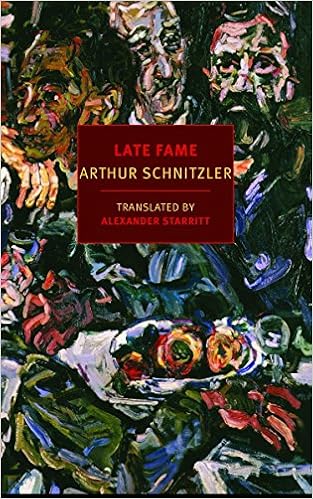
If you don't know Arthur Schnitzler's work, and I confess I didn't, this novella offers an excellent starting point, even though it may not be especially representative of his larger body of work. The romantic story behind the novella's publication is that while it was written in the 30's it was lost among his collected papers, (because he wouldn't serialize it and its existence was forgotten after his death), and only recently discovered and published.
Be that as it may, we have the story now. The broad outline of the story is that Eduard Saxberger, an "unremarkable civil servant", returns home one night to be met by a young poet who enthusiastically exclaims that a book of poems that Saxberger wrote as a young man has been rediscovered by the artistic youth of Vienna, who celebrate his artistic genius. So, rescued from a life of boredom, routine and obscurity, Saxberger finds himself surrounded by a circle of self-proclaimed young intellectuals and artists who treat him as a venerable poet. How divine.
The joke here is that in his youth Schnitzler was a member of "Young Vienna", a circle of avant-garde artists, and the book is in many ways an affectionate, gentle, and partly melancholy send up of that crowd. (I imagine that if you really know your German literary history from that period you could play some guessing games about who might be who in the book. The excellent afterword to this volume does a bit of that). For mere mortals like myself, though, the fictional young artists were quite entertaining enough.
The book, thus, proceeds on two levels. On one hand we observe the rise and fall and reconciliation with life and fate that is Saxberger's tale. On the other hand, we witness the excitement, pretentiousness, certainty, and self-delusion of the young artists. As I say, this is all done with a fair amount of affection - there is no figurative blood left on the floor and only a few bruises.
The translation is excellent. The narrative, and especially dialogue, is crisp with just the right color, darkness, and wistfulness. The conflict between Saxberger, who is surprisingly self-aware once the flattery wears off, and his young admirers, who are delusional and oblivious, is penetrating, if gentle. This struck me as a kind but clear-eyed summing up by an accomplished writer, and was a delightful find.
About the Author
Arthur Schnitzler (1862–1931) was born in Vienna to a well-to-do Austrian Jewish family. His father was a prominent laryngologist, and Arthur followed him into the profession, obtaining his doctorate of medicine and working at Vienna’s General Hospital until he stopped practicing to pursue writing full time. His first play, Anatol (1893), was a success. Other early works include Reigen (1897), which was adapted into Max Ophüls’s 1950 film, La Ronde; and Lieutenant Gustl (1900), a military satire denounced by anti-Semites who successfully lobbied for Schnitzler to be discharged from his position as a reserve officer in the medical corps of the Austro-Hungarian army. In 1903, he married Olga Gussmann, and the couple had a son and a daughter. Schnitzler wrote dozens of novels, novellas, and plays, including The Road into the Open (1908); Fräulein Else (1924); and Traumnovelle (1926), which Stanley Kubrick adapted into Eyes Wide Shut. Schnitzler and Gussmann were divorced in 1921. In 1928, their daughter, Lili, committed suicide; Schnitzler died following a stroke three years later.
Alexander Starritt is a writer, translator, and journalist who lives in London. His writing has been shortlisted for the Paris Literary Prize and he has contributed articles to The Times Literary Supplement, The Spectator, and The Mail on Sunday.
Wilhelm Hemecker teaches in the Department of European and Comparative Literature and Language Studies at the University of Vienna.
David Österle is a researcher and assistant to the director at the Ludwig Boltzmann Institute for the History and Theory of Biography in Vienna.

No comments:
Post a Comment