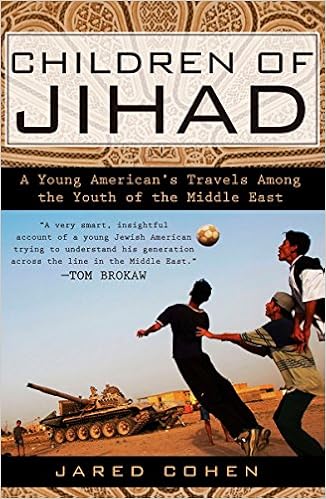
I expected Jared Cohen's "Children of Jihad" to read either like a travel journal (author in foreign land feels foreign, learns Lessons), or a collection of Friedman-style essays/episodic dispatches from the Arab street.
Instead, COJ succeeds on a whole other level--part page-turning adventure, part history/social study, part conversational reporting--truly unlike anything I've read on the subject. Cohen draws heavily on personal interviews and daily interactions from his months abroad to paint a surprisingly vibrant portrait of young people across the Middle East (most strikingly, Iran); one that is more dynamic, perceptive and pro-American than most of us think.
His interviews and anecdotes compellingly remind us that the campaign for "hearts and minds" is a two-way effort. In public diplomacy, it's not enough for us to get our message out to "them"; we must also actively listen to what "they" have to say to us--about their hopes and aspirations; about the US role and how our policies affect their daily lives--if we are ever to acheive the diplomatic goals we seek. In this respect, the book is an excellent source for public diplomacy scholars and practitioners.
Organized by destination (Iran, Lebanon, Syria and Iraq), COJ reads like an exciting and informative ride across Cohen's death wish of a map. Thematically, the book focuses on what Cohen calls the "Youth Party," which serves as a purposefully broad demographic marker (two-thirds of the ME is under 30), as well as a metonym for an ineluctable, generational thirst for change.
Cohen and the majority of his subjects--ranging from students to taxi drivers to members of Hezbollah--were all under 25 at the time of writing. It makes for a fresh and novel approach, and Cohen is a truly gifted storyteller. He strikes a narrative balance between observation and empathy that feels right, and reads well. Brief historical backgrounders are included where needed for readers new to the subject.
Above all, Cohen allows himself (and the reader) to be surprised and touched by the people he meets because his encounters are rooted in mutual respect. Fluent in Arabic and Farsi, and an area scholar, he is candid about his identity as an American Jew, while remaining sensitive to the repressive political contexts in which he and his new friends must operate.
Whoever said, "Youth is wasted on the young" must not have read this book--energetic and bold, it is a highly accessible, ambitious, and clear-eyed account that I would recommend to anyone with an interest in the region. Cohen used his youth and insouciance to his remarkable advantage, and even area experts likely will be surprised by his findings.

No comments:
Post a Comment