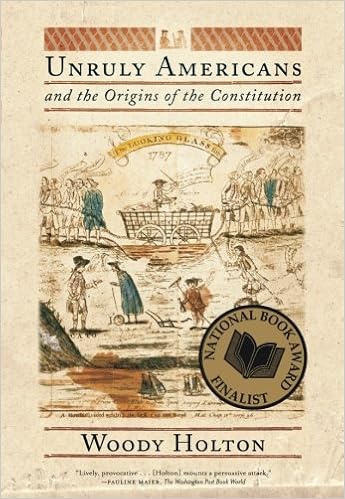
Why did the Founders create the Constitution? This has been an argument that stretches back to the days when the ink was still drying on the document. Even the men who created it differed as to why they had done so which should surprise no one. They had created a new national government out of compromises and it was quite natural for them to disagree as each saw different reasons and opportunities arise from this governmental framework. In today’s culture wars the argument has often been over whether it was a conservative or liberal document, but often that is a debate influenced by modern terms and interpretations, not necessarily the same the men of 1787 would have understood.
Woody Holton was an associate professor of history at the University of Richmond. He has since moved to become the Peter and Bonnie McCausland Professor of History at the University of South Carolina. This is his second book. His first was the award winning Forced Founders: Indian, Debtors, Slaves, and the Making of the American Revolution in Virginia. This latest literary work of his, Unruly Americans, continues in the vein of his earlier work in looking at the development of the United States. Other works have since followed and they too continue in the same vein. This also reflects a recent trend in the historiography of the American Revolution.
Instead of looking at the events from the top down perspective, Holton and other historians look at it from the bottom up approach much like Howard Zinn advocated. In examining the creation of the Constitution, Holton looked at it with both lenses, that of the Founders and what it meant through the eyes of the lower classes. In this work, Holton proposes that the Founders were men of means who were terrified of the “excess of democracy” then going on in the various states. This is a view that has been expressed by many historians over the last fifty years including Gordon Wood.
Yet, Holton goes deeper than Wood did in stating that the Constitution was made to create a strong central government and would have gone farther than it did, but stopped short because the delegates were concerned that it would not be ratified if they did. In short, they wanted to limit democracy but could not. It is ironic that their attempt to rein in democracy turned out to actually encourage it albeit in different ways. In many ways, the Constitution was created for economic reasons according to Holton which echoes Charles and Mary Beard.
Holton demonstrates that the compromises in the Constitution were there because the delegates felt they could not eliminate the ability of the people to participate in the political process. They wanted to limit that participation and at no point did they think that what Wood called “the middling sort” should be representing the people. Yet, that is exactly what did happen. The personal liberties and freedoms that so many people today look at were not part of the Constitution nor were they ever meant to be by those delegates. Those points were added later through the Bill of Rights only because of the stringent objections of the people which threatened ratification causing the Federalist to promise to add a list of rights to the document.
Holton’s scholarship is outstanding throughout the book. I disliked the use of endnotes, but that it of course a publishing decision not left to the author. I thoroughly enjoyed reading the book as it made me do some investigation of my own on some points. Holton’s thesis is correct in my opinion. Economic issues were indeed a major discussion point and the evidence of it is in the Constitution itself. It is plainly obvious that financial matters were prevalent from the published letters and notes of the delegates as well. Yet, they still had to deal with the issue of democracy and that could not be so easily removed which I think Holton points out clearly.
All in all, this is a very good exploration of the Constitution from multiple perspectives. Some readers may be disappointed at the lack of patriotism in the Constitution’s creation, but the reality of the past shows the pragmatism of the delegates at the convention. It also reflects the larger picture of this time period as the principles of the Revolution clashed radically with all kinds of realities. The creation of the Constitution reflected that clash which I think Holton illustrates vividly.

No comments:
Post a Comment