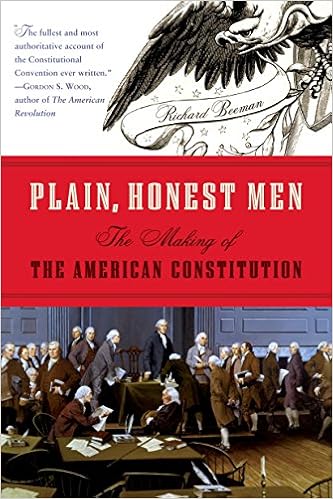
The most momentous event in the history of the early American republic is the drafting of the United States Constitution in Philadelphia from May to September 17, 1787. Dr. Richard Beeman a distinguished professor of history at the University of Pennsylvania and an expert on the Constitution has written the best popular account of the event in this generation of scholars.
The president of the Constitutional drafting meeting was General George Washington who would later become the first POTUS.
Delegates from twelve of the thirteen states (Rhode Island did not send delegates) met in the Pennsylvania State House for long hours during the spring, summer and fall of that distant year. Philadelphia had a population of 40,000 in 1787. The fifty-five delegates were housed in private homes, inns and boardinghouses.
Among the distinguished members of the constitution drafting convention were James Madison the writer of the best of the future Federalist Papers and fourth POTUS: Benjamin Franklin of Philadelphia, the Pickneys of South Carolina, Elbridge Gerry of Massachusetts and Luther Martin of Maryland. Delegate G. Morris of Pennsylvania came up with the idea of dividing the federal government into three branches: legislative, judicial and executive. Slavery was the elephant in the room! Twenty-five of the fifty five delegates were slave owners George Mason of Virginia owned over three hundred African-American slaves.
Many of the battles raged over the large states wanting proportional representation in Congress. It was decided that one member would represent 30,000 persons in congressional districts in the United States House of Representatives while two senators would represent each of the states. One of the most interesting parts of the book concerns the executive branch. Many compromises were required and the state conventions between the Federalist and Anti-Federalists supports was fierce. In 1789 The US Constitution at last became operable. The document ended the weak continental congress governed by the Articles of Confederation. Shays rebellion and the inability of the continental congress to tax or wield military power evinced a dire need for a Constitution.
Beeman writes with fluidity and interest on the complex topic of the Constitution. His descriptions of the leading participants and the major issues facing the delegates makes for fascinating reading. This book could be used with efficacy in a college course on the US Constitution. Excellent and essential for students of American government!

No comments:
Post a Comment