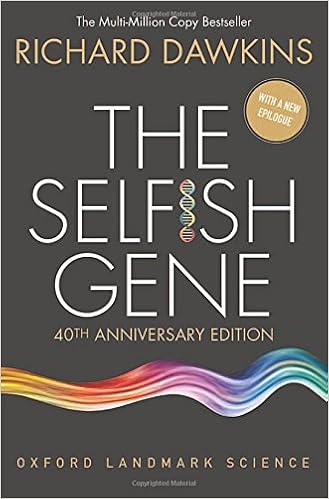
There is much more to "The Selfish Gene" than is advertised, even in the most glowing of its reviews. In fact, I (not a biologist, but fascinated by evolution ever since "dinosaurs" and the first high school biology course) have been vaguely aware of this book since its initial wave of rave reviews many years ago, but never bothered to read it because as it was advertised its theme(s) always seemed pretty obvious. But something recently piqued my curiosity again, not sure what that was now, and after reading the prefatory material online I finally decided to take a look.
After reading quickly through the first 3 chapters, it became apparent that there was a great deal more underlying the book than was overtly presented, that it was not just an over-extended, over-simplified, over-popularized, metaphorical presentation .... but rather that its metaphorical treatment is painstakingly faithful to an elaborate, closely-reasoned, even rigorous, scientific underpinning. At which point, I stopped reading and began again from the beginning, first the prefatory material, then from page 1, this time more slowly and more carefully, taking care to appreciate and reflect on all the markers of the underlying basis and their implications.
This is a wonderful book, even beautiful in many respects, from its initial beginning (at the "beginning") with the purely chemical/physics "evolution" of the primordial soup (cast suggestively in the form of biological evolution); to the consequent continuity with the creation of "replicators", elementary "survival" cells, genes, and the beginnings of life forms; to the important distinction between genes and individuals, as genes and their "survival vehicles" (the first cells and "us", for example); to the nicely extended notion of "gene" itself, required by underlying scientific reality; to a clear presentation of the conflict between Darwinian and "group" selection and evolution; to the nature of evolution, operating (in distinct ways) in terms of both genes and individuals, aka both genes and "their" survival vehicles, aka both chemical/physics and biological evolution; to genetic kinship and its very special selective and social implications; ... ; to the delicious End Notes to the 1st eleven chapters, which provide much supporting and fascinating material.
"The Selfish Gene" goes on to clarify not only its expressed subject, the nature and genesis of Selfishness and Altruism, but to make clear the error, scope, and source of various (idealistic, and often political) arguments and ideas centered around group selection fallacies, including the genesis of (ill-conceived) "group-beneficial", cooperative "functions" vs. (individual) evolutionarily stable strategies (ESS) and kinship. It also sheds light on many other commonly-posed questions, among them: the fundamental "reason" for the 50:50 sex ratio (despite the number of different breeding strategies observed for male competitors); the driving source of the natural variability upon which (continuing) evolution depends; the variety and shadings of competing "strategies", which can be both conceived and advantageous, clustered around a given regard (partly on account of environmental inconstancy), one incidental, unintended but important, implication of which is that this is itself an evolutionary driving source of the natural variability upon which (continuing) evolution operates; .... and NOT so commonly posed: that "In its long journey down the generations therefore, an [ANY] average gene will spend approximately half its time sitting in male bodies, and the other half sitting in female bodies", and thus genes will generally contribute positively to both sexes, sometimes in very different ways, and that, indeed, many "purely male / purely female" effects pass (unexpressed) through many bodies of the opposite sex; and much, much more.
Beautifully written and packed with wonderful insights, "The Selfish Gene" is not only well-worth the read, but will amply reward the reader in proportion to the thoughtfulness and reflection with which they read it. In fact, there is so much food for thought in the story-lines and examples (e.g., the fig, "lichenization", and organelle endosymbiosis) provided in "The Selfish Gene", that one must often stop and consider, at length and at leisure, the questions which it provokes or which Dawkins rhetorically poses.
I will, however, amend Dawkins' wonderful characterization of "us" (Preface to the First Edition, p. xxi): “We are survival machines --- robot vehicles blindly programmed to preserve the selfish molecules known as genes. This is a truth which still fills me with astonishment. Though I have known it for years, I never seem to get fully used to it.” ...... by grafting it to my own previous synopsis, with the result:
"We are Conditioned-Reaction Engines [built on Basic Senses + Unconditioned Reflexes (among them innate Kantian "Categories", instincts, emotions, etc.)] built as Gene-Survival "Machines" [genetically "programmed" to serve the "interests" of our genes] = Pavlo-Kantian Conditioned-Reaction, Darwin-Dawkins Gene-Survival Automatons.

No comments:
Post a Comment