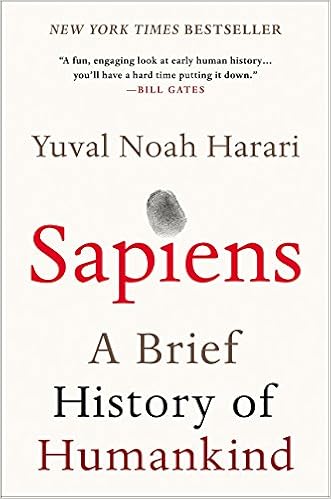
Harari focusses on the three great revolutions of human history: Cognitive, Agricultural, and Scientific. He asks how "An Animal of No Significance" managed to become the dominant life form, and whether that animal's learning to produce his own food and then to further harness the natural world to his will through science were boons or setbacks, both for that animal and for the rest of the biosphere. In 20 brilliant chapters Harari asks his readers to consider not only what did happen, but what might have occurred had things turned out slightly differently (the roles of chance and accident are given a lot of attention.) He reveals the mutually agreed upon "stories" that helped shape human societies and questions their validity, not to disillusion but to challenge his readers. At times the tone is unavoidably cynical, but at others there's a real optimistic air (leavened by some cautions here and there). I found Harari's ideas fascinating, especially those in his final chapter "The End of Homo Sapiens" and in his brief but important "Afterword: The Animal That Became a God."
Readers who are looking for detailed chronicles listing, for example, the Emperors of China, Kings and Queens of England, or Presidents of the United States should look elsewhere. But readers who want to be challenged and enlightened will find Sapiens a most enjoyable work. I'm a retired AP World History teacher, and while I was reading there were many moments which made me wish I was back in the classroom so I could share Harari's ideas with my high school students. That's high praise indeed, but Sapiens deserves it and much more.

No comments:
Post a Comment