Wednesday, August 1, 2018

Harry Potter And The Sorcerer’s Stone Written by J.K. Rowling Age Range: 8 and up Paperback: 336 pages Publisher: Arthur A. Levine Books; Reissue edition (June 26, 2018)


What to Expect: Fantasy and Magic

It is July 31. That means that it is Harry Potter’s birthday and the the perfect opportunity to celebrate the 20th anniversary of Harry Potter and the Sorcerer’s Stone.

Get your tickets ready. The grand, shiny red Hogwarts Express is ready to depart from platform 9 3/4, and you won’t want to miss the enchanting ride into the spellbinding wizarding world of Harry Potter.

Harry is an orphan who has been living with Aunt Petunia, Uncle Vernon, and cousin Dudley Dursley since he was a baby. The Dursleys are plain despicable and make Harry sleep in a cupboard under the stairs. On Harry’s eleventh birthday, mysterious letters addressed to Harry Potter begin arriving at the house, and his aunt and uncle try everything they can to keep them from Harry. That’s when a very large looking man, Hagrid, shows up to deliver the letter in person, along with a very important message: “You’re a wizard, Harry!” Unknown to Harry, he isn’t just any wizard, he is a very famous wizard with a destiny waiting to be fulfilled; a destiny that explains the peculiar lightning bolt scar he has on his forehead. Harry’s whole world will be turned upside down as he embarks on a new and exciting journey to Hogwarts School of Witchcraft and Wizardry.

J.K Rowling’s writing is as magical as the story itself. The settings and locations provide rich backdrops for the page-turning drama that unfolds—Hogwarts is located in a remote location in a majestic castle nestled against the Forbidden Forest. Feel-good moments soften, and also propel, the ever-growing tension—amidst the flurry of new magical activities (flying broomsticks and playing the wizarding sport of choice, Quidditch) and lessons (‘Care of Magical Creatures’ and ‘Defense Against the Dark Arts’), it becomes apparent that a dark power is growing stronger … the kind of power that could only come from the most feared wizard … He Who Shall Not Be Named. Could Harry and his lightning bolt scar be somehow connected to this dark wizard? This question and more make it near impossible to stop at just one or two chapters a night!

Harry Potter and the Sorcerer’s Stone is not to be missed by any reader, young or old. To celebrate the 20th anniversary of this story, Scholastic has released new covers for the series, illustrated by Caldecott Medal-winning artist Brian Selznick. The covers are a kind of magic in their own right: when placed side by side, the seven covers make one spectacular picture that highlights the arc of the seven book series. Selznick’s artwork is fantastical and the cover design concept is genius!


Artwork by Brian Selznick © 2018 by Scholastic

Of course, there’s only one thing to do: Grab your invisibility cloak, and jump headfirst into this adventurous, mysterious, perilous, and highly entertaining book about muggles (non-magical) and magical folk.

About The Author

J.K. Rowling is the author of the record-breaking, multi-award-winning Harry Potter novels. Loved by fans around the world, the series has sold over 450 million copies, been translated into 80 languages, and made into eight blockbuster films. She has written three companion volumes in aid of charity: Quidditch Through the Ages and Fantastic Beasts and Where to Find Them (in aid of Comic Relief and Lumos), and The Tales of Beedle the Bard (in aid of Lumos), as well as a screenplay inspired by Fantastic Beasts and Where to Find Them, which marked the start of a five-film series to be written by the author. She has also collaborated on a stage play, Harry Potter and the Cursed Child Parts One and Two, which opened in London’s West End in the summer of 2016. In 2012 J.K. Rowling’s digital company Pottermore was launched, where fans can enjoy news, features, and articles, as well as original content from J.K. Rowling. J.K. Rowling is also the author of The Casual Vacancy, a novel for adult readers, and the Strike crime series, written under the pseudonym Robert Galbraith. She has received many awards and honors, including an OBE and Companion of Honour, France’s Légion d’honneur, and the Hans Christian Andersen Award.

About The Illustrator

Brian Selznick’s books have garnered countless accolades worldwide, and have been translated into more than 35 languages. He is the Caldecott Medal-winning creator of the #1 New York Times bestsellers The Invention of Hugo Cabret, adapted into Martin Scorsese’s Oscar-winning movie Hugo; and Wonderstruck, adapted by celebrated filmmaker Todd Haynes, with a screenplay by Selznick; as well as The Marvels and Baby Monkey, Private Eye (co-written with Dr. David Serlin). Selznick divides his time between Brooklyn, New York, and San Diego, California.

At the Strangers' Gate: Arrivals in New York Hardcover – Deckle Edge, September 5, 2017 by Adam Gopnik (Knopf / Penguin Random House Canada)


A riveting and incandescent chronicle of personal evolution vividly set within the ever-morphing, cocaine-stoked crucible of ferocious ambition that was 1980s Manhattan. [Gopnik] tells tales of the forging of a marriage; of nightmares apartment battles with verminous hordes; of fortuitous jobs at museums, men’s fashion magazines, and a book publisher; and of bonds developed with critic Robert Hughes, artist Jeff Koons, and, most profoundly, photographer Richard Avedon. Arabesque, captivating, self-deprecating, and affecting, Gopnik’s cultural and intimate reflections, in league with those of Alfred Kazin and Joan Didion, are rich in surprising moments and delving perceptions into chance, creativity, character, style, conviction, hard work, and love.

When Adam Gopnik and his soon-to-be-wife, Martha, left the comforts of home in Montreal for New York, the city then, much like today, was a pilgrimage site for the young, the arty, and the ambitious. But it was also becoming a city of greed, where both life's consolations and its necessities were increasingly going to the highest bidder. At the Strangers' Gate builds a portrait of this particular moment in New York through the story of this couple's journey--from their excited arrival as aspiring artists to their eventual growth into a New York family. Gopnik transports us to his tiny basement room on the Upper East Side, and later to SoHo, where he captures a unicorn: an affordable New York loft. He takes us through his professional meanderings, from graduate student-cum-library-clerk to the corridors of Condé Nast and the galleries of MoMA. Between tender and humorous reminiscences, including affectionate portraits of Richard Avedon, Robert Hughes, and Jeff Koons, among many others, Gopnik discusses the ethics of ambition, the economy of creative capital, and the peculiar anthropology of art and aspiration in New York, then and now

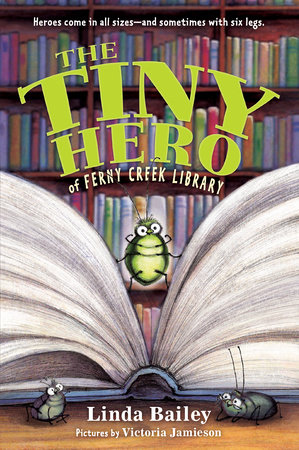
Tiny Hero of Ferny Creek Library, The Hardcover – June 20, 2017 by Linda Bailey (Author), Victoria Jamieson (Illustrator) (Greenwillow Books / Penguin Random House Canada)

The Tiny Hero of Ferny Creek Library

The Tiny Hero contains well-done black and white illustrations for each chapter.  There are 324 pages but the type is large and well spaced. This book is immediately engaging. Even though it is written for children ages seven to twelve, I was completely hooked.

The reader can't help but love the little hero, Eddie, a tiny bug who braves the huge halls of the school, dodging a spider, a mouse, and lots of squishers (humans who stomp on bugs), in order to find his missing aunt.

Aunt Min is special. She has taught Eddie to read and told him many stories she overheard in the school library. These are books every child should experience from the works of Dr. Seuss to E.B. White. Avid readers will nod their heads with understanding whenever these books are mentioned. You may want to find those you haven't read.

The novel supports reading and libraries at a time when many are shrinking or disappearing. Little Eddie reminds us of all the reasons we love a children's library and why it cannot be replaced by a computer terminal.

The first quest for Eddie is to save his aunt and then protect his foolish little cousin who has followed him. The second one is to save the library from a substitute librarian (sister of a powerful administrator) who wants to board up its beautiful windows, remove all the books, and turn it into something less expensive. It seems an impossible task for a little bug to stop the demise of the beloved library when even the principal has trouble asserting himself but Eddie is committed and clever.

This endearing, suspenseful, and thoughtful book will connect with children and parents alike. There are acts of courage and sacrifice, a great deal of humor, subtle ethical topics, and tributes to our most cherished children's books. I love how we see the world through the eyes of a small, defenseless creature who only wants to survive with his family. (A good discussion could follow about how some humans are "squishers" of small insects and how this contrasts with the compassion other people show to the small and defenseless.)

This book doesn't touch on the topic of bullying but I believe if children are taught to show kindness to the smallest and most helpless, they are less likely to bully others or to be speciest. Little Eddie and his family are adorable ambassadors for compassion.

Stones for My Father Written by Trilby Kent (Penguin Random House Canada / Tundra Books)

Stones for My Father

As you may or may not know, "The Stone Book" is the first in a quartet of stories following a family throughout several generations. For my own part, I learned about the series through a hoity-toity British literary periodical entitled, "Children's Literature In Education". The article I read mentioned that these were great lost classics and that anyone who knows ANYTHING about kiddie lit (as I like to call it) should be familiar with these books. The fact that this book won a coveted Phoenix Award years ago cemented the deal for me. The Phoenix Awards are given to children's books that, some believe, haven't gotten the attention they so richly deserve. So the real question becomes, is "The Stone Book" worthy of attention? Should children everywhere have to read it? And the answer is yes and no.

This tale takes place in Victorian England and is all of sixty pages. Really, it's not much more than a short story in book form. In this tale, young Mary goes to a nearby church that her father is building. Her dad's a stonemason and is exceedingly good with rocks of all kinds. Mary cannot read, though her father can, and one night she asks him for a book as a present. In answer, he takes the girl with him to a cavern between the rocks. Leading her to a tight passage, he gives her strict instructions that she must follow. He tells her that once she reaches the end of the cavern she must come back and let him know if she still wants that book. Mary goes and discovers ancient cave paintings as well as footprints from hundreds of people before her. On returning to her father she is told that it has been a tradition in their family for the father to bring his eldest child (usually a son) down to that cavern and that it has been done for hundreds of generations. That night, Mary receives a book like no other and that, in a way, tells the tale of that day's adventures.

There's a great deal going on in this tiny creation. Discussions about rocks come up frequently, often touching on the fossils and ancient (one might even venture, prehistoric) footprints that are found in the region. This leads, inevitably, to religion, the unspoken possibility of evolution, and the nature of literacy itself. One of the many debates in this book happens between Mary's father and her uncle Old William. Old William contends that books are a waste of time and only make people discontented with life. Mary's father is of the opinion that true wasted time is doing work every day and never showing anything for it. There's even a suggestion that Mary's father is discontented with his life, a fact that comes out when he gives in to the urge to drink once in a while.

And all this happens in a scant sixty pages. Reading it, I found myself (for a long time) wondering if kids would like to read it. Seems to me that this book is a real contender for the books-adults-love-and-kids-ignore category of the library. Sure, there are deep rich meanings just waiting to be dug up throughout the text. Sure, this book tackles big subjects in a small clear way. But how many children are going to pick this puppy up voluntarily and enjoy it? Until Mary found herself alone in the deep dark cavern, I doubted that much of anything in this story would hold their interest. Perhaps that's why this book has been as forgotten as it is until now. If the kiddies don't dig it, what's the point?

In short, "The Stone Book" succeeds and fails. It succeeds because it truly is a wonderfully written tale. It's a great look at daily life in a far distant time. It fails because I can't see many kids today successfully sinking their claws into the text. If you want something with a modicum of intelligence for yourself, enjoy. Just don't go handing it out to any five year olds you know.

In the French Kitchen with Kids: Easy, Everyday Dishes for the Whole Family to Make and Enjoy Paperback – July 31, 2018 by Mardi Michels (Author), Dorie Greenspan (Foreword)(Penguin Random House Canada / Appetite by Random House)


I have always marveled at the French talent for educating their children in matters of taste. No age is considered too young to start learning to recognize quality food and to appreciate the pleasures of a shared table. Mardi Michels’ inviting new book creates the kind of allure that will excite children about cooking and leave them feeling empowered and proud of their results. A perfect place to set off on a lifetime adventure of good eating

One of the best ways to have fun and bond with young people is to cook with them as partners. Kids are inherently creative; the smell and taste of the dishes produced will stay with them permanently. In the French Kitchen with Kids, a thorough, well-organized, approachable and friendly cookbook, will take your child on a delectable culinary voyage leading to a lifetime of lasting memories.”

Mardi brings the flavors of France into your home, and makes them fun for the family to prepare together. From Quick Croissants to silky Crème Caramel, In the French Kitchen with Kids brings everyone to the table, in the true French spirit. Mardi Michels’s knowledge and dedication to teaching the next generation about the joys of cooking the French classics is obvious, and her fun, thoughtful approach is not only inspiring, it’s totally infectious!

I applaud Mardi’s French-inspired approach to inviting kids into the kitchen. Her extensive teaching experience shines through the entire book, and encourages parents everywhere to share their love of simple, homemade foods with their children

About the Author
MARDI MICHELS is a full-time French teacher to elementary school-aged boys and the author of eat. live. travel. write--a blog focusing on culinary adventures near and far. As part of her job, she runs cooking classes for boys aged 7 to 14, called Les Petits Chefs and Cooking Basics. Mardi grew up in Australia, lived and taught in Paris for over five years and now calls Toronto home. In 2014, Mardi and her husband purchased a historic home in southwest France, which they operate as a vacation rental property. Mardi is also a Food Revolution Ambassador and in her spare time teaches French cooking and baking classes.

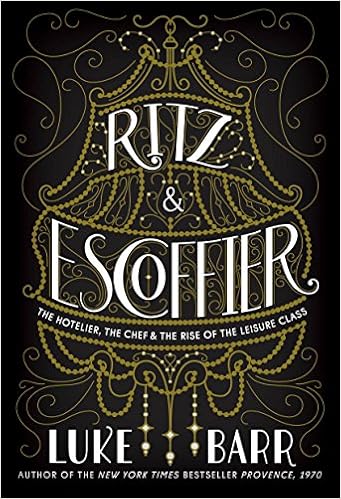
Ritz and Escoffier: The Hotelier, the Chef, and the Rise of the Leisure Class by Luke Barr Clarkson Potter, 312 pp., $26.00


César Ritz (1850–1918) gave his name to some of the world’s most luxurious hotels—in Paris, Madrid, and London—as well as to the ninety-one hotels in the Ritz-Carlton chain and, posthumously, to a cracker. His surname even became an adjective, “ritzy.” The success of his original hotel enterprises owed much to his partner, Auguste Escoffier (1846–1935), history’s most celebrated cook and still the secular patron saint of most professional chefs.

They were both crooks. (So was Ritz’s deputy, Louis Echenard.) On March 7, 1898, their employers, the Savoy Hotel in London, where Ritz was the general manager, sacked them for larceny, embezzlement, and fraud. The Savoy managed to recoup £19,137, “a significant amount,” writes the food historian Luke Barr in his new book about the rascally pair. But he does not convert the figure to today’s money to show us how significant: £19,137 in 1898 is equivalent to £2,412,123 (about $3.2 million) in 2018. For comparison, Barr says, “the hotel’s total profits” that year were £20,276, equal to £2,555,688 (about $3.4 million) today.

They’d been thieving since Escoffier joined the hotel on April 6, 1890; even so, it’s no mean feat of pilfering to have, in only eight years, stuffed their pockets with nearly the entire profits of a good year. While Ritz, who went on to open the Carlton and then the hotels that bear his name, paid back an enormous sum to the Savoy, Escoffier, who had no head for money, only managed to return £500 of the £8,000 he owed.

Ritz had risen impressively above his background. He was the last of thirteen children from a poor peasant family in Niederwald, Switzerland; Barr says he was ashamed of his “large, peasant-size hands and feet.” At twelve he had the good fortune to go a Jesuit college as a boarder. When he reached fifteen and needed to prepare for a career, he apprenticed for the summer as a wine waiter at a hotel; but the proprietor told him, according to the unreliable memoir by Ritz’s wife, Marie, “You’ll never make anything of yourself in the hotel business. It takes a special knack, a special flair, and…you haven’t got it.” Ritz went back to the Jesuit college, where he worked as a sacristan, then made his optimistic way to Paris in time for the 1867 Universal Exhibition.

Escoffier, also from humble origins, was the son of the village blacksmith in Villeneuve-Loubet near Nice. At thirteen, he was apprenticed to his uncle, who had opened a restaurant in Nice that catered to the well-off winter visitors; as he showed promise as a cook, Escoffier found a job in Paris in 1865, when he was nineteen. Called up for military service shortly afterward, he spent almost seven years in the army, going to Metz as chef de cuisine of the Rhine Army when the Franco-Prussian War began in 1870. His army experience led to his interest in preservation, especially canning food; he would later bottle and sell sauces labeled with his name.


H. Bedford Lemere/English Heritage/Arcaid/Corbis/Getty Images
The dining room of the Savoy Hotel, London, circa 1898


The two met in 1884. Ritz was managing a hotel in Monte Carlo that belonged to his wife’s aunt and uncle, but lost his chef to the new Hôtel de Paris at the casino. Ritz had heard great things about Escoffier, and finally located him. “Temperamentally,” writes Barr, “they were opposites.” Whereas “Ritz was outgoing, debonair, and excitable…Escoffier was cerebral and methodical. Ritz was extravagant, ambitious, and prone to self-doubt, while Escoffier was self-assured and precise.” Both married up socially—Ritz in 1888 to Marie-Louise Beck, and Escoffier in 1880 (some sources say 1878) to Delphine Pauline Daffis, a poet and the daughter of a publisher; both were always in businesses that depended on wealthy, often aristocratic patrons. Social climbing was part of their careers.

Barr refers to Ritz’s mental illness and mentions that he had a final “nervous breakdown” in 1902, but he does not mention the often-cited possibility that Ritz suffered from what was then called manic depression. Though mania might provide a clue to why Ritz was drawn to larceny, there is no comparable explanation for Escoffier’s crimes. His sole excuse was that, in taking kickbacks and a 5 percent commission in cash from his suppliers (who made up their losses by shorting their deliveries to the Savoy), he was only following the long-standing customs and practices of his trade.

The land on which the Savoy Hotel stands was bought in 1880 by the impresario Richard D’Oyly Carte to build the Savoy Theatre, dedicated to presenting the Gilbert and Sullivan operas, which he produced. Impressed by the opulence of the American hotels in which he’d stayed while touring, D’Oyly Carte decided to build, on the same site as the theater, London’s first luxury hotel, with electric lighting, elevators serving the 268 rooms, and marble bathrooms with constant hot water. These were all novel in London in 1889, when the hotel opened, but it lost money in its first year of operation. The board of directors (which included the composer Sir Arthur Sullivan, the impresario Carl Rosa, and George Grossmith, co-author of Diary of a Nobody) decided that the general manager, W. Hardwicke, was responsible for the hotel’s poor performance and dismissed him.


D’Oyly Carte had been courting Ritz for some time, and now made him the irresistible offer of an annual salary of £1,200 (about $200,000 today), with equally generous wages for Echenard, his deputy and wine buyer, and Escoffier, who was by now the first celebrity chef de cuisine. The chef became the chum of Émile Zola and the friend (some say lover) of Sarah Bernhardt; he attracted the favors of the famous, for a few of whom he named dishes—pêche Melba (after the Australian soprano), poularde Adelina Patti (after another soprano), filets de sole Walewska (after the mistress of Napoleon III). Soon their most important client was the Prince of Wales, who probably used other parts of the Savoy to entertain at least some of his mistresses (rumored to have numbered fifty-five).

Ritz and D’Oyly Carte’s business plan, says Barr, “was for the Savoy to occupy the very heart of cosmopolitan London, to bring together in spectacular fashion socialites and celebrities, royalty and bohemian artists, and newly minted millionaires, night after night—all the energy and drama of the city in one place.” They also wanted to attract a female clientele, as women then seldom ate or entertained outside their homes, so they paid special attention to features of the dining room, such as flattering lighting. But it was Escoffier’s cooking “that was of utmost importance to the Savoy’s success,” Barr tells us. “It was the cooking that would entice new visitors, and bring them back.”

What was Escoffier’s cooking like? There’s a clue in the fact that it was the target of the culinary rebellion by the nouvelle cuisine chefs that began in the 1970s. In his day, Barr writes, Escoffier’s cuisine was novel,


less complicated than [that of his famous predecessor Carême] had been, shorn of unnecessary ornamentation, inedible decoration, and too many sauces. Food should be food, said Escoffier. Surtout, faites simple was his motto—“above all, make it simple.”…Ultimately, he wanted the ingredients to shine through.

Escoffier, of course, made genuine changes to the haute cuisine of his predecessors, but for the nouvelle cuisine chefs, who sought even more lightness, freshness, and simplicity, his cooking was fussy, overelaborate, and oversauced. One sixteen-course banquet—including bird’s nest soup, borscht, crayfish, chicken, lamb, ortolan, quail, and braised turtle fins—had four sweet courses, but only one of vegetables or salad. At a dinner put on by the Prince of Wales, the quail was “stuffed with large-dice foie gras and then wrapped in bacon and lined up in large terrines.”

Escoffier is revered, even by today’s chefs, for his kitchen reforms and for elevating the social status of the profession. Kitchens were hot, sweaty places, even after coal-fired ranges were replaced with gas burners. Cooks rehydrated themselves with beer, which meant a good deal of drunkenness by the time dinner was served. Escoffier banned alcohol consumption (and smoking and shouting) in the kitchen and insisted that no one ever appear in public with dirty chefs’ whites or wear their whites on the street.

Even better for the chefs, waiters, diners, and profits, he restructured the kitchen, introducing the idea of brigades under his overall command. Now, instead of being responsible for cooking dishes from beginning to end, the cooks were divided into parallel teams, each dealing with a single aspect of a dish as assigned by the appropriate chef de partie, or station chef, who oversaw each brigade. This organization greatly sped up the time needed for preparation, reduced waste, and increased the chances of customers getting their food while it was hot. Escoffier also solved the problems, Barr writes, of English clients not understanding menu French and not knowing “how to arrange a pleasing series of courses” by developing the prix fixe meal: “For any party of at least four people, Escoffier would create a personalized seven-course menu for a set price.”

Ritz, for his part, saw that their business depended on the Savoy’s attracting “respectable” society women of the sort who formerly did not dine in restaurants. He had somehow to rid the hotel of the many high-class prostitutes who frequented it. Ritz’s solution was to require formal evening dress. “No unaccompanied women,” Barr writes, “would be admitted, nor any woman wearing a hat. (An extravagant hat worn in the evening, Ritz had discovered, was a sign of trouble.)” He was not so worried by the teenaged male prostitutes Oscar Wilde brought to the hotel—despite “the stains on his sheets” during his and Lord Alfred Douglas’s stay in March 1893—or by Wilde’s taking more than a year to pay the bill.

Notwithstanding the glitz, glamor, and high turnover of Ritz and Escoffier’s first year at the Savoy, there was not enough profit to pay a dividend to the ordinary shareholders. But revenues and profits increased—until September 1897, when profits suddenly went down 40 percent. That month, D’Oyly Carte’s wife and partner, Helen, who had long had doubts about Ritz, received a letter of nine foolscap pages. Signed only “One Who Knows,” it alleged wholesale corruption. The best-attested charge was the complaint of the managers at Bellamy’s, one of the Savoy’s chief grocery suppliers, that they were finding it hard to “allow 5% off the Savoy account, give 5% to the chef and supply Ritz and Echenard’s private homes for nothing.” Kickbacks were almost the least of it—Ritz was charging his taxis and even his family’s laundry to the hotel. Escoffier collected his bribes in cash, paid for, writes Barr, by “a stunning 30 to 40 percent shortfall in the deliveries to the Savoy.”

The directors had no option but to fire Ritz, Escoffier, and Echenard, telling them to leave the premises immediately. Ritz responded by persuading his coconspirators to join him in suing for wrongful dismissal and breach of contract, and the hotel then had to investigate their crimes even more carefully. The result was the Savoy’s countersuit, and on January 3, 1900, all three culprits signed confessions. Ritz’s describes his looting wine worth £3,476 ($555,539 today), some of which he had used to entertain potential investors in his new schemes outside the Savoy; he had also had the gall to charge these lunches and dinners to the Savoy and allow his friends to run up colossal unpaid bills. His personal stockbroker owed £281 ($44,910 today) for meals, which he never paid; his doctor never paid either.

The scandal emerged only in 1983. I was food and wine editor of the Observernewspaper, and a friend, the late Sarah Howell, a commissioning editor for the Observer magazine, handed me an envelope that contained copies of the signed confessions and supporting documents that had obviously come from the Savoy’s archives. Sarah said she was merely an intermediary, giving these to me to use on the condition that I didn’t inquire into their sources. The late Ann Barr (no relation to Luke) and I first published the Ritz-Escoffier saga in The Official Foodie Handbook in 1984. In print (and in the several TV documentaries that followed), I called my benefactor “Deep Palate,” and he has only now given me permission to reveal his identity: it was Ian Bostridge, the opera and lieder singer (and contributor to The New York Review) with a doctorate in history, who gained access to the Savoy’s archives when working for a major accounting firm during his year off between secondary school and university.

Luke Barr almost makes good on the promise of his subtitle to describe “the rise of the leisure class.” He does give the reader a glimpse of how mobile (and slippery) Edwardian social life was, so that anybody with money could dine at the Savoy. Barr is especially sensitive to, and frequently mentions, the anti-Semites who resented the part wealthy Jews had in the creation of this new, democratic leisure class; he bridles at an anti-Semitic remark about a party host in a gossip column: “A very large specimen of the Hebrew fraternity, and if his manners are not quite as polished as the Earl of Beaconsfield, it is not to be wondered at.”

Not every reader, perhaps, will get the punch line. “The Earl of Beaconsfield” was the title created for Disraeli, and the columnist is nastily saying that you would not expect an uncouth Jew to have the good manners of a prime minister, even one of Jewish origin.

In general, Barr has trouble with British titles (which are important to telling the story of a pair of rogues whose livelihood depended on snobbery), listing “lords, barons, and earls” even though barons and earls are ipso facto lords. He also writes that to be made a peer is to be “given the title of ‘Lord,’” apparently without realizing that, in the late nineteenth century, a peerage was primarily a seat in the second chamber of Parliament, which, of course, came with a title. Barr is excellent on food except when he gives the ingredients of ratatouille but calls the dish “cassoulet.” He understands the history and culinary properties of ingredients and recipes, however—even of Escoffier’s bizarrely beloved birds’ nest soup. He knows what chefs actually do, as when he explains the division of labor in the professional kitchen and the preparation of the quail described above.

The real failing of this entertaining book, though, is the novelization of the narrative: Barr constantly tells us, with no source cited, what is going on in his characters’ heads. And he does not address the issue of why the D’Oyly Cartes and their directors never made public the confessions of Ritz and Escoffier. After all, from 1896 to 1899, Ritz was building the Carlton Hotel in Haymarket, designed to be the sole competitor to the Savoy. Why didn’t the Savoy reveal the dirty secret and run him out of town? The answer, I believe, is that though the Prince of Wales exacerbated the situation by remaining loyal to Ritz, even to the extent of planning to use the Carlton for his eventual coronation events (“Where Ritz goes, I go”), the gentlemen of the Savoy did not wish to distress the ailing, elderly Queen Victoria by making royal trouble—and perhaps they were also a little nervous, lest it come out that Ritz and the Savoy had facilitated the frolics of the future king.


Mort Ziff Is Not Dead by Cary Fagan Puffin Penguin Random House Canada 2018 176 Pages $7.99 ISBN: 978-0143198482


It’s the winter of 1965 in Toronto, and Norman, the youngest of three, feels he doesn’t quite fit in with his older brothers. His parents call him "Normy," which his brothers—who seem to do all they can to make his life miserable—change to "Wormy."

Things look up a bit when Norman wins a contest with a prize of $1,000. Since money is tight, his parents hope he will contribute his winnings to the purchase of a new roof, a new car, or possibly put the money toward his college fund—but they leave the decision up to him. Instead, he suggests a family vacation to Miami Beach. His parents slowly come around to the idea, and his brothers are delighted.

The family has never traveled before and are elated to stay at the fanciest hotel on the beach. Upon arriving, the three brothers meet three sisters from New Jersey and the fun begins. The two older brothers are competitive with the two older sisters, while Norman and the youngest sister, Amy, join forces to stand up to their siblings.

The first night’s entertainment is a comedian named Mort Ziff, an old-timer who looks like he has seen better days. When Norman and Amy find out Mort is about to lose his job, they decide to make a project of keeping him employed. Their kindness, concern, and ingenuity send the message to readers that even young people can make a difference.

This entertaining book contains one heavy-handed moment, when the cab driver who takes the family from the hotel to the airport explains the problem of discrimination against minority entertainers. While it’s a worthy message, it seems thrown in as an afterthought.

Overall, this is a humorous and easy read. Fagan has a knack for perfectly capturing the dialogue of this age group.

Recommended for ages 9 to 13.