Saturday, February 24, 2018

Strange Weather byJoe Hill,( Orion, )


Alzheimer's, guns, fantasy and hard rain are the subjects of the four novellas in Joe Hill's great collection.


Joe Hill’s new collection of four novellas, Strange Weather, is a great one – and not only if you’re a Capetonian staring down Day Zero with its poverty porn, blame and bad neighbourliness.

The first novella, Snapshot, is a reverse Alzheimer’s metaphor.

Butterball teen Michael Figlione finds himself taking care of his childhood nanny, Shelly Beukes. He realises that it’s not just her dementia talking: there really is a creepy stranger, Polaroid Man, with a special camera like a gun that takes photos of people to steal their souls. In a parallel process, as the Polaroids famously develop – and Shelly’s memory gets patchier – Michael finally understands how much she really loved him.

Shelly’s worried husband is a Schwarzenegger-esque South African expat cheekily named Lawrence Beukes. While that’s not incredibly significant, it illustrates how much Hill actively enjoys writing.

Named Joseph Hillstrom King (after the activist and songwriter) by his famous parents, Stephen and Tabitha King, Joe Hill writes under his own name. In-jokes, thought experimentation and sarky political commentary aside, writing is also a serious commemorative act – for the dead, and for our own dead selves. That goes double for horror, and triple for horror as beautifully rendered as Joe Hill’s.

Look here: “There is no system of measurement that can adequately quantify how much resentment I carried in my heart when I was young and lonely. My sense of personal grievance ate at me like cancer, hollowed me out, left me gaunt and wasted. When I set off for MIT at 18, I weighed 330 pounds. Six years later I was a buck-70. It wasn’t exercise. It was fury. Resentment is a form of starvation. Resentment is the hunger strike of the soul.”

We see it particularly in the second novella, Loaded – a didactic, heavily sexual exploration of America’s “national hard-on for The Gun”. Hill says that he “had that one in my head ever since the massacre of 20 children in Newtown, Connecticut”. The story is incredibly powerful: a young woman’s affair with her jerk-off boss ends in tears and bloodshed for everyone in the mall, including a Muslim mother with her baby strapped to her chest, the carrier conveniently mistaken for a suicide bomb.

The weakest – most deliberately fluffy – novella is Aloft, set mostly on a cloud. A one-sided crush on his fey bandmate, Harriet, makes Aubrey Griffin determined to skydive with her. At the last minute Aubrey tries to back out, but there are technical difficulties with the plane and everyone is forced to jump.

Aubrey lands on a cloud (cold, and a bit like mashed potato) and must confront his sad realisation that he can touch either terra firma or Harriet’s boobs again, but not both. The novella is a palate cleanser and a spot of stylistic showing off, but it’s no great shakes other than as a continuation of the real theme of all the novellas – how to let go.

The brilliant Rain completes the quartet. Boulder, Colorado, suffers a rain of fatal and needle-sharp shards of space-age rocks. Hill has fun with our beliefs and what we need to tell ourselves in order to survive. The histrionic president blames cloud-seeding religious fanatics, while the crazed comet cult next door accepts all comers. We follow Honeysuckle Speck, whose angelic girlfriend Yolanda was one of the first to die, impaled by the celestial spikes.

Honeysuckle must deliver the news to Yolanda’s minister-father, travelling a highway of murderous shards.


The Last Hours Minette Walters Allen & Unwin


Minette Walters, better known as an author of psychological crime novels, has moved into new territory here – back to the 14th Century and the arrival of the Black Death in southern England.

The results, the loss of around half the country’s population and with that, a mortal blow to the old feudal system of serfdom, are well documented historically and form an important backdrop to what is planned to be a two novel saga.

In the manor of Develish, the brutal Sir Richard of Develish is planning to ride to a neighbouring estate to arrange a marriage for his deeply unpleasant 14 year old daughter, Eleanor. He leaves his wife Lady Anne in charge, and while he is away, news of the rapidly spreading plague arrives.

As the bodies mount up, Lady Anne bars the estate to all comers, including her dying and unlamented husband and his entourage. Only when the survivors are out of quarantine (she has considerable medical knowledge, considering her era) does she let them return. But besides the plague stalking the countryside there are other dangers: starvation and marauding bands of dispossessed and chancers.

Walters creates a sense of claustrophobia and fear which is compelling – her work as a writer of psychological drama standing her in good stead here. She also draws a hierarchical and patriarchal society, ruled by an often corrupt church.

Tensions rise within the barricaded estate as serfs begin to realise there will be advantages for them once they can sell their labour. Their loyalty to their mistress keeps things on a more or less even keel – she has protected them against her horrible husband, and, maybe a trifle anachronistically, taught many of them to read and write.

Once a group of lads, led by the bastard Thaddeus, heads out to see what is happening beyond their boundary and to look for desperately needed food, the story divides into two parts, and loses a little of its tension. But it still rollicks along, and should delight fans of Ken Follett’s Pillars of the Earth and the like.

My main criticism would be that the goodies are so good and the baddies so bad that there is little room for nuance. But Walters produces a suitably cliffhanging ending so that there will be plenty of readers keen to find out the further fortunes of Lady Anne and Thaddeus, and even nasty little Eleanor

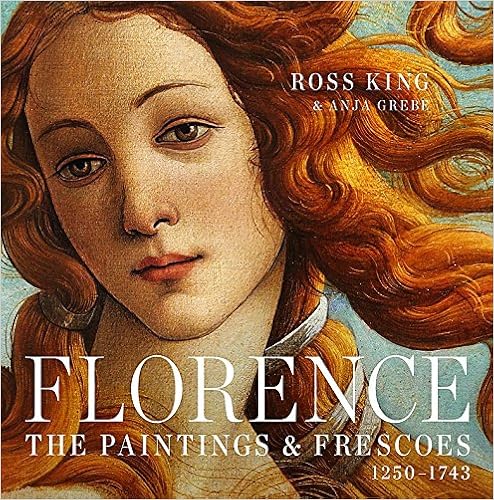
Florence: The Paintings and Frescoes (1250-1743) By Ross King and Anja Grebe. (Black Dog & Leventhal/Hachette, 708 pages, 2,000 color illus. $75.) (IBRArtBooks)

itemprop

HOLY FAMILY” by Paolo Veronese

For 800 years Florence, Italy, has been a sacred city whose very walls breathe beauty. In vivid essays and more than 2,000 lush images, this glorious book covers the great collections of the Uffizi, the Pitti Palace, the Accademia and the Duomo, plus key works in 28 of the city’s additional museums and churches. The lively text explains Florentine politics, patronage, street life, banking, international trade and the effect of its wars, plagues and religious squabbles. Fascinating book.

This is the most comprehensive book on the paintings and frescoes of Florence ever undertaken, with nearly 2,000 beautifully reproduced artworks from the city's great museums and churches-produced in the same manner as BD&L's The Louvre and The Vatican.

Every painted work that is on display in the Uffizi Gallery, The Pitti Palace, the Accademia, and the Duomo is included in the book, plus many or most of the works from 28 of the city's other magnificent museums and churches. The research and text are by Ross King (best-selling author), Anja Grebe (author or The Louvre and The Vatican), Cristina Acidini (former Superintendent of the public museums of Florence) and Msgr. Timothy Verdon (Director of the artworks for the Archdiocese of Florence).


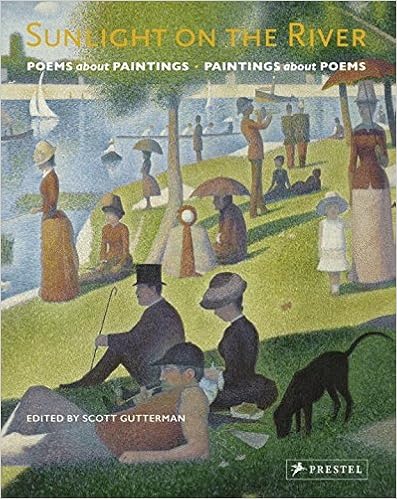
Sunlight on the River: Poems about Paintings, Paintings about Poems By Scott Gutterman. (Prestel, 144 pages, 60 illus., $34.95.) (IBRArtBooks) Bo


This novel book would make a charming gift for a literary sort with an eye for art, or vice versa. Art ranges from Vermeer to Edward Hopper, Mark Rothko and Larry Rivers. The poets flow from Shakespeare to William Carlos Williams and Rainer Maria Rilke. Could it have been a Minnesota winter that prompted John Berryman to pen a few lines about Pieter Bruegel’s “Hunters in the Snow”?

The world’s great poets interpret the world’s great art in this exquisite book that investigates the connection between art and words, deepening our understanding of both. The poet and the artist share a special kind of vision—an ability to see and penetrate the very essence of their subjects. This volume features poems by writers who turned to paintings for their inspiration, as well as paintings by artists who based their works on poems. Stretching across centuries and styles,this collection includes Rossetti’s haunting sonnet based on Botticelli’s Primavera; Wallace Stevens’s "The Man with the Blue Guitar," a masterful meditation on an iconic painting by Picasso; William Carlos Williams’s joyous interpretations of scenes by Breughel; and Adrienne Rich lending a compassionate voice to the subject of Edwin Romanzo Elmer’s The Mourning Chair.These and other pairings appear as elegant texts facing full page, glowing illustrations of the paintings. An introduction to some of the greatest poets and painters in history, this remarkable book makes a perfect gift, offering compelling insights into the worlds of art and literature, and the relationship between the two.

BOOKS! BOOKS! BOOKS! Explore the Amazing Collection of the British Library by Mick Manning & Brita Granström ; illustrated by Mick Manning & Brita Granström Age Range: 8 - 12 ( Candlewick)


As the subtitle indicates, young bookworms are invited to “Explore the Amazing Collection of the British Library.”

“Explore” is the key word here, as the table of contents lists 21 potential discoveries among the library’s holdings. In its tour, the text capitalizes on the human-interest aspects of the collection, such as the facts that Shakespeare’s First Folio is kept in a bombproof, underground room and that the oldest surviving book produced in Europe, St. Cuthbert’s Gospel, was found in a coffin. Other monuments to the (mostly) English masterworks surveyed include Darwin’s On the Origin of the Species, Handel’s handwritten sheet music, and the original manuscript of Alice’s Adventures in Wonderland. Questions to readers provide segues from one entry to the next; “Are you hungry after all that drama?” leads them from Shakespeare to the section on cookbooks. The watercolor-and-digital illustrations lend a fanciful, hodgepodge effect to the collection of literary tidbits. Varying typefaces play to the topics, as with the use of a Gothic type for The Canterbury Tales and a delicate scriptlike type for Jane Austen. The book effectively demonstrates the role of the British Library as custodian to a broad swath of British literary history. The question here is, who is the audience on this side of the Atlantic, particularly at a time when concerted efforts are being made to create a more diverse and inclusive canon? The Inside-Outside Book of Libraries, by Julie Cummins and illustrated by Roxie Munro (1996), is a little old but still provides a better introduction to the concept of libraries.

Beautiful and reverent but perhaps not particularly relevant. (thumbnail bios, glossary) (Nonfiction. 8-12)


CHAGALL by Gianni Pozzi & illustrated by Claudia Saraceni& L.R. Galante Age Range: 9 - 13 (Peter Bedrick) (IBRChildrensBooks) (IBRArtBooks)


Marc Chagall remains one of the most popular and influential artists of the 20th century. His work is part of permanent collections of major museums all over the world. Chagall’s journey as an artist led him from a small village in pre-revolutionary Russia to Paris, Israel, and New York. Influenced by Russian folklore and the Jewish tradition, Chagall introduced a new set of symbols and images in the world of painting. Fantastic images met religious symbolism in a whole new way. This book chronicles Chagall’s life story and art with high quality reproductions of his paintings, analysis of the work, and illustrations and photographs of the era.
 
A remarkable biography of Chagall, exploring both his tremendous lifelong output of art, and the lush artistic world in which he lived. Pozzi strives to make the biography accessible right from the outset, introducing major ``characters''-- Chagall's wife, art dealers, and his friends--in pictures and caption biographies. Text and illustrations play equal roles throughout, recounting the artist's childhood in the small Russian town of Vitebsk, through his adult life in Paris, his marriage, and old age. Pozzi is careful to point out facets of the art (the Eiffel Tower, symbols of Judaism) that are also symbols of Chagall's experiences. Along with the many full-color reproductions (which, typical of the Masters of Art series, are often too small to do the paintings justice) of his work, there are numerous reproductions of art by his contemporaries, enveloping readers in the ideas of the times and introducing them to artists they may not yet know. (chronology, index) (Biography. 9-13)

Sunburn By: Laura Lippman. ( William Morrow, )292 pages, $26.99.


It doesn’t get much more noir than James M. Cain. Or at least it didn’t until Laura Lippman’s “Sunburn” came along.

Back in the 1930s, Cain wrote a couple of novels that pretty much established — and perfected — the noir subset of hard-boiled crime fiction: “Double Indemnity” and “The Postman Always Rings Twice.” Savage little sonatas of lust and lies, betrayal and revenge, they can still keep readers guessing, appalled by the characters’ behavior but unable to resist what comes next.

Lippman has plenty of first-class crime fiction on her résumé: a dozen books in the Tess Monaghan detective series, set in Lippman’s hometown of Baltimore, and nine stand-alone psychological thrillers.

“Sunburn” takes a different tack. It’s slimmer and quicker, pared down but equipped with more twists than a bag of snakes. It’s an explicit salute to Cain — at one point one of its main characters takes certain inspiration from the classic film versions of “Postman” and “Indemnity” — and a more than worthy one.

“Sunburn” is set in 1995, but it feels as if it has slipped halfway into the 1930s of Cain’s books. As it opens, a sexy redhead named Polly has left her husband, Gregg, and their 3-year-old daughter in the middle of a beach vacation and landed in a frayed little town inland.

Adam, “a Ken doll kind of guy, if Ken had a great year-round tan,” spots her sitting on a bar stool, the title’s sunburn across her shoulders all but glowing in the dark. They meet with a wisecrack:

Extract ( with permission of the publisher)

“He looks at his own drink and says out loud, as if to himself: ‘What kind of [a jerk] orders red wine in a tavern in Belleville, Delaware?’

“ ‘I don’t know,’ she says, not looking at him. ‘What kind of [a jerk] are you?’ ”

For Polly, Belleville is a way station to gather herself and make a plan for escaping her marriage for good. Why Adam is there is not immediately apparent. It’s certainly not a garden spot. Polly is staying in a motel “named the Valley View, although there’s no valley and no view. The High-Ho, the Valley View, Main Street — it’s like this whole town was put together from some other town’s leftovers.”

But Polly isn’t all that transparent herself. When Adam asks her name, she thinks, “What is her name? Which one should she use?”

Both of them stay on in Belleville, getting jobs in the same diner where they met, her waiting tables, him displaying impressive skills as the cook — so much so that the dive starts turning into a real restaurant.


And, of course, they end up in bed together, although by then the reader knows that there are all sorts of reasons why they shouldn’t.

It’s tough to say very much about “Sunburn” without risking spoilers, and this book deserves not to be spoiled. It’s a virtuoso performance of crafting plot, point of view and voice to reveal some things to the reader while withholding others to create a decadent, delicious tension.

There are dark secrets and blackmail and deaths that might or might not be murder and, of course, money at the root of all that evil. There’s even an insurance guy tangled up in it all.

As Polly reflects, “She can’t afford love. No matter how much money she ends up with, it won’t be enough to have love, too.”

Or will it?