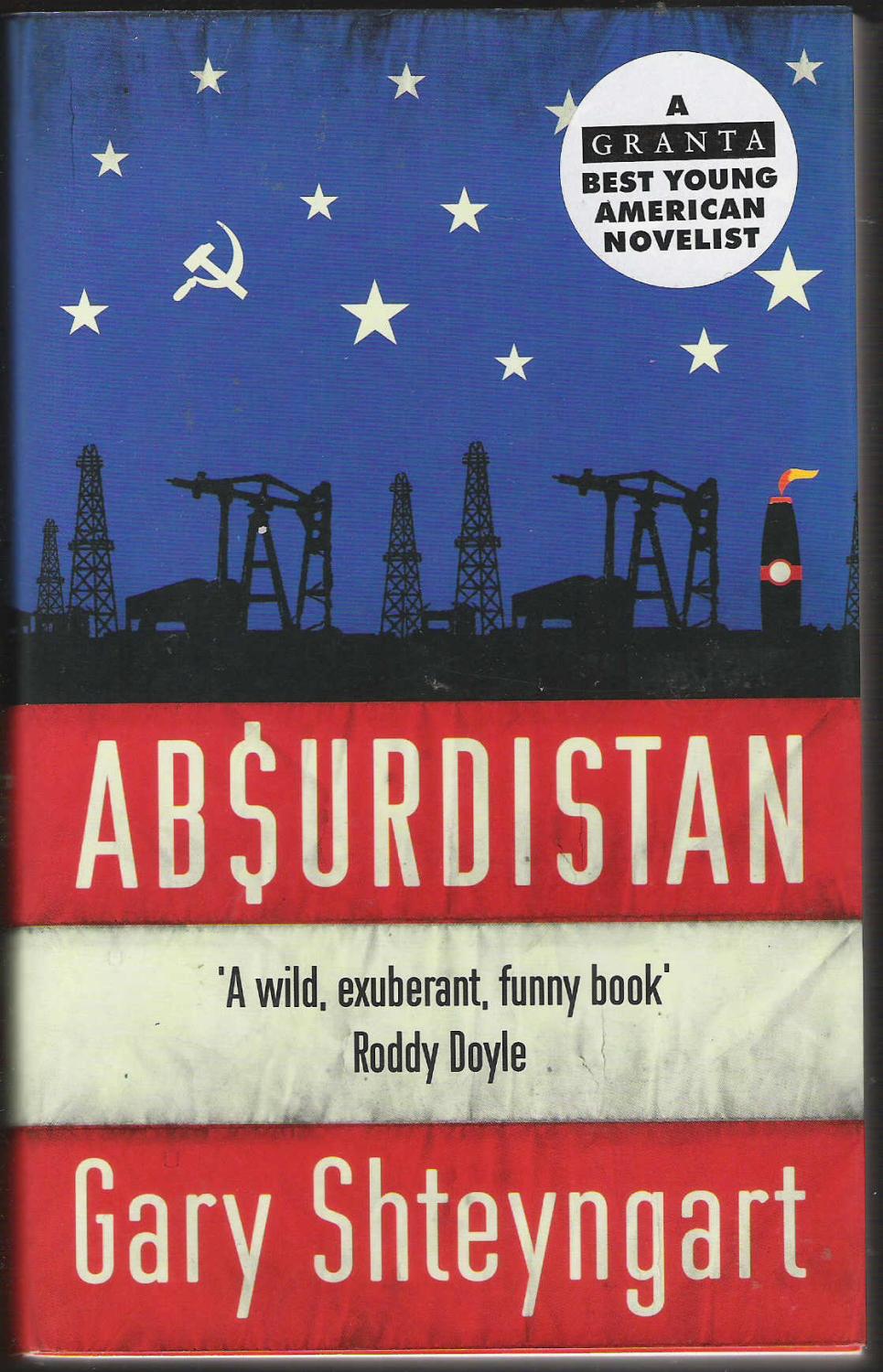
Russian Unorthodox .Why praise it first? Just quote from it -- at random. Just unbutton its shirt and let it bare its chest. Like a victorious wrestler, this novel is so immodestly vigorous, so burstingly sure of its barbaric excellence, that simply by breathing, sweating and standing upright it exalts itself.
"I stood there listening to my father's killers. Oleg and Zhora were of Papa's generation. All three had been made fatherless by the Great Patriotic War. All three had been raised by the men who had managed to avoid battle, the violent, dour, second-tier men their mothers had brought home with them out of brutal loneliness. Standing before the menfolk of my father's generation, I could do nothing. Before their rough hands and stale cigarette-vodka smells, I could only shudder and feel, along with fright and disgust, appeasement and complicity. These miscreants were our country's rulers. To survive in their world, one has to wear many hats -- perpetrator, victim, silent bystander. I could do a little of each."
The young writer supplying the lines is Gary Shteyngart, who moved to the United States from Russia when he was 7, while the young bereaved oligarch he's speaking through is Misha Vainberg, who attended college here but ended up marooned back in St. Petersburg. Misha is extraordinarily fat, ambivalently Jewish, unapologetically rich and -- as his homeland's best comic heroes often are -- infinitely thwarted. During his collegiate heyday, he gorged at the American buffet, slurping up rap music, psychotherapy and the sky's-the-limit complacent optimism that we take for granted as a birthright but that Misha sees for what it is: a glorious geo-historical accident.
All he needs to return to the party (and to Rouenna, his beloved trash-talking black girlfriend from the Bronx who asks him, while touring his native city, the grand imperial center of Czarist tradition, "Where the niggaz at?") is a visa from our consulate. Tough luck. As the heir to an ill-gotten bloody fortune in mobbed-up post-Soviet Russia, Misha can have anything he lusts for -- top-shelf liquor, pharmaceutical sedatives, human pyramids of prostitutes and multiple alcoholic servants -- but because of his murdered father's global misdeeds he can't have that stamp on his passport.Continue reading the main story
AdvertisementContinue reading the main story
He sulks and schemes. And Russia, in its wretched boom, sulks with him. "Let us be certain: the cold war was won by one side and lost by another." This epic collapse is continuing, we sense, inside the circus tent of smutty new money that Misha has. Shteyngart is a master panoramist who paints in just three tones: exhausted grays, despairing browns and superficial golds. When he mixes them, he gets moments like this one, which deserves to be reproduced at its full scale:
"The windswept Fontanka River, its crooked 19th-century skyline interrupted by the postapocalyptic wedge of the Sovietskaya Hotel, the hotel surrounded by symmetrical rows of yellowing, waterlogged apartment houses; the apartment houses, in turn, surrounded by corrugated shacks featuring, in no particular order, a bootleg CD emporium, the ad hoc Mississippi Casino ('America Is Far, but Mississippi Is Near'), a kiosk selling industrial-sized containers of crab salad, and the usual Syrian shawarma hut smelling invariably of spilled vodka, spoiled cabbage and some kind of vague, free-floating inhumanity."
Shteyngart and Misha, exuberant depressives, don't stint on the syntax or the verbiage when objects huge and rotten hulk into view. Their thick, overloaded style is what happens, though, when socialist realism decays into black comedy. This is the prose of heroic disappointment, faintly labored at moments but fitted to the task of shoveling up mountains of cultural debris. Hemingway's clean sentences wouldn't do here. A man needs commas, semicolons, adjectives. He requires linguistic heavy machinery.
Which Shteyngart operates with a light touch as his story gains speed, leaving behind the rubble of the past for the about-to-be rubble of the near-future. After being foiled in dull St. Petersburg, Misha lights out for flashy Absurdsvanï, an oil-blessed former Soviet republic where he hopes to finesse his visa problem. He flies there, accompanied by the only servant he hasn't pensioned off with petty cash and by an American college buddy who now runs a DVD business in Russia called ExcessHollywood (a name that, in another novel, would indicate a playful author but which, in this one, suggests a playful author and a numb society).
Quartered in a gleaming Hyatt, Misha is just days from freedom when Shteyngart starts turning back the hands on Absurdsvanï's political clock. Dictatorship looms like a thug in a cheap suit. The spirit of democracy strikes back with its hand-lettered cardboard sign. There are billions of petro-dollars at stake, which liquefy and ooze corruption on everyone. Misha is mired. As a Russian, that's his lot. Borders can be crossed, regimes replaced, economic systems re-engineered, but -- for Shteyngart -- identity persists. It's that frustrating last 10 pounds of history that folks can't seem to shed, no matter how much they modernize their diets.
Book Review
Be the first to see reviews, news and features in The New York Times Book Review.
Sign Up
Receive occasional updates and special offers for The New York Times's products and services.
SEE SAMPLE
PRIVACY POLICY
And it's a weight people cling to, the novel hints, to keep their souls from floating off into the bewildering thin air of purely notional internationalism. Misha is stuck with his inborn inertia as surely as if he'd sat down in wet cement. He's no match for the nimble, more Asiatic locals who can outfox him in their sleep. Meanwhile, over in the land of progress, his plucky ghetto girl is moving on up -- and into the clutches of her lecherous writing teacher. Misha's Nabokovian nemesis is an émigré poseur with a name resembling Shteyngart's and a novel on his résumé whose title pornographically alludes to Shteyngart's first effort, "The Russian Debutante's Handbook." He's a naturalized monster who trades on his own foreignness (or the aura of what's left of it) to scoop up chicks and critical attention.
There are a lot of stereotypes here and plenty of intellectually incorrect exercises in racial and group determinism. Shteyngart, via Misha, thinks in peoples, not just individuals. He jokes in peoples, too, and not only about Jews and Russians, as his heritage entitles him to, but about Muslims, Germans, Brooklynites and every other in-group he can outrage. One envies his sense of entitlement to biases, and his frank understanding of the fact that such crude distinctions make the world go round. Especially these days, when they're not supposed to. When, ostensibly, we're all United Nations blue.
It's self-consciousness that defines our species, though, and Shteyngart is hilariously aware that the selves we invent in order to be conscious of them can be based on almost any difference. Ours is the species that insists it's not one. How else could we justify warring for common resources? Absurdsvanï, for example, is divided between two ancient Christian traditions. The schismatic distinction is the tiny line that the sects draw through the bottoms of their crosses. One party's line slants up from left to right, the other's is angled in reverse. Sometimes the Absurdis laugh off the split, sometimes they fight about it. Almost always, though, some ambitious profiteer or maniac is plotting new ways to use it to his advantage.
Despite being jammed with charged references to Halliburton, Bechtel and other big-name players in the latest round of the great game, "Absurdistan" isn't a book of social issues or geopolitical controversies. It rides on top of them much as Huckleberry Finn rode atop his raft. Not surprisingly, considering the times, it rides them straight downstream, tugged by a bubbling current of worldly pessimism. Misha can't make much headway against such suction. He's sluggish. Obese. He's consumed his way into a corner. Shteyngart has built an apt hero in this respect: a self-defeating fatso globalist. His appetites drive the strife and fuel the tensions that provoke him to keep eating.
Compared with most young novelists his age, who tend toward cutesy involution, Shteyngart is a giant mounted on horseback. He ranges more widely, sees more sweepingly and gets where he's going with far more aplomb. His Absurdistan, to Americans, may seem amusingly far away at first, but the longer one spends there, hunkered down with Misha in a hotel room high above the rocket fire, the closer and more recognizable it gets. Absurdsvanï is far, but Absurdistan is near.
'Absurdistan,' by Gary Shteyngart Walter Kirn is a regular contributor to the Book Review. His most recent novel is "Mission to America."Continue reading the main story

