Showing posts with label #CameoFromZion. Show all posts

Friday, June 9, 2017

The New Abortion Battlefield...... Women Against Abortion: Inside the Largest Moral Reform Movement of the Twentieth Century by Karissa Haugeberg University of Illinois Press, 220 pp., $95.00; $24.95 (paper); About Abortion: Terminating Pregnancy in Twenty-First-Century America by Carol Sanger Belknap Press/Harvard University Press, 304 pp., $29.95

Ken Light/Contact Press Images
The Women’s March, Washington, D.C., January 2017

If anyone thought that Donald Trump’s manifold inconsistencies might more or less randomly offer women some protection from the Mike Pence wing of the Republican Party—after all, Trump once said of himself, “I’m very pro-choice”—they were wrong. Trump, who was once in thrall to his resident misogynist Steve Bannon, remains dependent on Pence, his omnipresent minder, and women’s reproductive rights are in his sights.

Women have always been subject to male domination, sometimes almost completely. Even in as enlightened a country as the United States, men created the laws under which women lived well into the twentieth century, and they ensured that women had an inferior status. Shirley Chisholm, the African-American congresswoman who ran for president in 1972, famously said that of her two handicaps—being black and being a woman—“I have certainly met much more discrimination in terms of being a woman than being black, in the field of politics.”

Women couldn’t vote in the United States until 1920 (fifty years after African-American men), and until 1936 they could lose their citizenship if they married a foreigner and lived abroad. As for their children, citizenship was conferred by the father, not the mother. Until 1968, job ads could specify whether men or women would be hired, and that year women were paid on average 58 cents for every dollar earned by men. Remarkably, women could be denied credit without a man’s signature until 1974, and until 1978 they could be fired from their jobs if they became pregnant.

Not surprisingly, controlling sexuality and reproduction was central to keeping women in their place. For most of the country’s history, motherhood was considered women’s highest calling. They were expected to submit to their husbands sexually, and marital rape did not become a crime in all states until 1993. Abortion was illegal in most of the country for most of its history. Desperate women would take various folk remedies to end a pregnancy, try to end it themselves with some contrived implement, or find an illegal abortionist—all risky. There are no reliable figures for how many women died from illegal abortions but almost certainly there were many.

Until 1960, abstinence was expected for single women, and if that didn’t suit them, they were pretty much on their own. Getting fitted for a diaphragm was a ritual mainly for women engaged to be married. The only other forms of contraception were withdrawal, abstinence during the likely time of ovulation, and condoms; late menstrual periods could be terrifying. If a single woman did become pregnant, then what? Single motherhood was seldom contemplated, at least for a middle-class woman. Instead she might hope that her partner would marry her quickly, or she might try to get an illegal abortion. (The language of those days was appropriately evocative—“back-alley abortions” and “shotgun marriages.”) Often, she would be sent to a “home for unwed mothers,” where she would stay until her baby was born, maybe under cover of some story about going away for a few months to care for a sick relative in a distant town. After the baby was born, it would usually be given up for adoption. (Many of these places ran lucrative adoption businesses.)

Everything changed in 1960 when the first birth control pill, Enovid, came on the market. The impact can hardly be overstated. Despite the fact that a prescription was required, which could be embarrassing and even difficult for single women to get from paternalistic doctors, within a few years millions of women were “on the pill.” For the first time, they had access to a reliable means of contraception that they controlled, and so were free to plan their own lives to an extent not possible earlier. Later, implantable contraceptives, intrauterine devices, and the “morning after” pill, known as Plan B (now available without a prescription), added new ways to prevent pregnancy. Nevertheless, many pregnancies continued to be unplanned, and still are.

In 1973 the Supreme Court, in the case of Roe v. Wade, took the next step. It found by a 7–2 majority that women had a constitutional right to end a pregnancy. The right was close to absolute in the first trimester, could be regulated by the states in the second trimester only to protect the woman’s health, and in the third trimester could be further regulated or even banned to protect “potential life,” unless the woman’s health or life were at stake. Legal abortions rapidly became common. According to the Guttmacher Institute (a research institution that gathers data on reproductive health in the US), about 3 percent of women in the United States had legal abortions in 1980 (one of the peak years), and it was later estimated that roughly a third of American women would obtain an abortion at some time in their lives.

Almost immediately, Roe v. Wade became a moral and political—and sometimes a literal—battlefield, and it remains so. Two excellent books, Women Against Abortion: Inside the Largest Moral Reform Movement of the Twentieth Century, by Karissa Haugeberg, and About Abortion: Terminating Pregnancy in Twenty-First-Century America, by Carol Sanger, tell the story. Both authors support abortion rights, but they also present the opposition to abortion fairly and, in the case of Haugeberg, sometimes sympathetically.


Some of the most vociferous and effective opponents of abortion have been women, and Haugeberg focuses on them. Through their eyes we see what moved them, and through their activities, the increasing violence of the movement. Sanger’s book is broader and more philosophical. She is interested in the whole panoply of issues around abortion—its history and the laws regulating it, who has abortions and why, how state legislatures and the courts are eroding its availability, the rights (if any) of pregnant minors and of fathers, and, perhaps most interesting, why a perfectly legal procedure is still in the shadows. Her observations are nearly always insightful and often nicely trenchant. She writes, for example, that a prohibition against abortion that makes exceptions for rape or incest “produces a rather sharp inequality among fetuses.”

According to Haugeberg, the initial public opposition to abortion, which began even before Roe v. Wade, came from priests and bishops in the Catholic Church, as well as Catholic women, often nuns, whose opposition frequently grew out of their general reverence for life (many had been involved in antiwar activities in the 1960s). It was only later that the term “pro-life” became more a political label than a statement of purpose, since it tended no longer to encompass the loss of life from wars or executions.

In addition, antiabortion organizations were formed, such as the National Right to Life Committee (NRLC), which had millions of members and chapters in every state by the late 1970s. Like the Catholic Church, their focus was on protecting the embryo (defined as less than eight weeks’ gestation) or fetus—both usually referred to as the “unborn child”—through legal and legislative strategies.

But beginning in the late 1970s, there was an ideological shift. Instead of emphasizing only the protection of the fetus, the focus changed to include the protection of pregnant women. In essence, they were seen as potential victims of heartless abortionists, as much at risk as their fetuses. A new psychological illness, called the postabortion syndrome, was invented, marked by lifelong guilt and remorse after an abortion. (According to Sanger, the most commonly reported feeling after an abortion is actually relief.) Justice Anthony Kennedy’s majority decision, when the Supreme Court upheld a law against certain late-term abortions in 2007, echoed that notion:


While we find no reliable data to measure the phenomenon, it seems unexceptionable to conclude that some women come to regret their choice to abort…. Severe depression and loss of self-esteem can follow.

He offered no evidence, nor did he address the possibility of severe depression or loss of self-esteem from having to continue an unwanted pregnancy.

This shift gave new importance to facilities that had emerged in the 1960s called crisis pregnancy centers (CPCs). According to Haugeberg, these “were a uniquely woman-dominated sector of the antiabortion movement.” Often located near abortion clinics, they were designed to look like them. But instead of providing abortions, CPCs offered free pregnancy tests, then tried to dissuade pregnant women from obtaining abortions. They rapidly became the major form of activism, writes Haugeberg, and by 2009, there were 3,200 of these facilities, with a combined staff of 40,000, and they saw about one million pregnant women each year. After 1995, CPCs became partially federally funded.

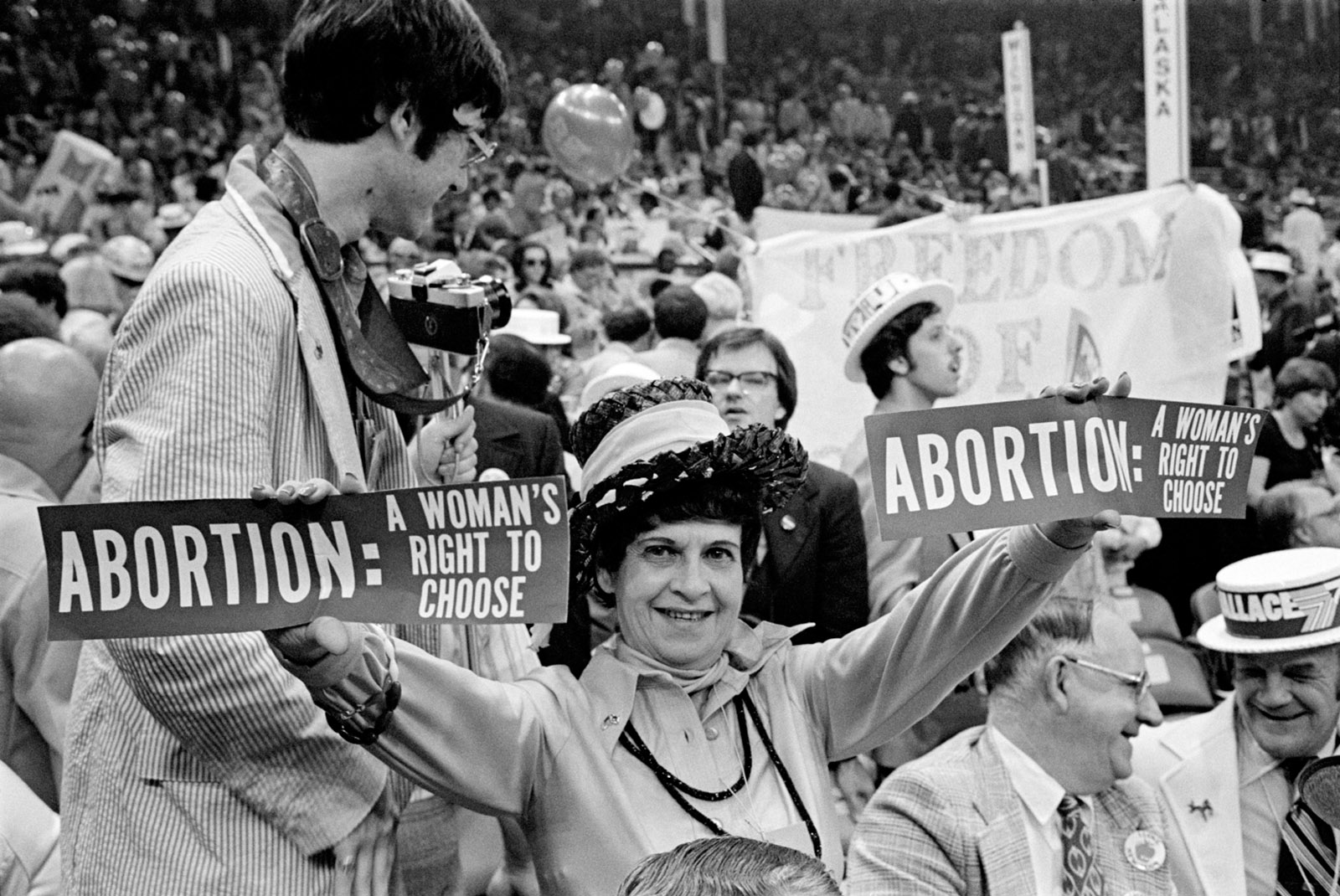
By the 1980s, the antiabortion movement had undergone another major shift. It became dominated not by Catholics but, over time, by evangelical Protestants, and its methods increasingly included direct confrontations at abortion clinics to block access. The movement also became increasingly associated with the right wing of the Republican Party, which as far back as the Eisenhower administration had set out to win over religious and social conservatives. The 1980 Republican platform called for a constitutional amendment to protect the life of the unborn, and the new president, Ronald Reagan, who, like Trump, had once favored abortion, now, like Trump, opposed it.Richard Kalvar/Magnum Photos
A supporter of abortion rights at the Democratic National Convention, New York City, July 1976

In 1986 an evangelical Protestant minister, Randall Terry, started an organization called Operation Rescue, which advocated stopping abortions by nearly any means possible, including firebombing clinics and harassing and threatening clinic doctors and staff and their families. There were more than 60,000 arrests at Operation Rescue actions, according to Haugeberg, and the organization went bankrupt within a few years because of the mounting number of lawsuits. But the turn toward violence continued. There were “Wanted” leaflets posted for Dr. David Gunn, for example, describing him as a “circuit riding abortionist,” and giving his address, car make, and license number, other personal details, and the address of his clinic—where he “kills children.” Gunn was murdered in 1993 by an antiabortion activist named Michael Griffin. One of Griffin’s apologists said, “Defending Michael Griffin’s action came naturally to me. Babies were not murdered on the day David Gunn was shot and a serial killer would never kill again.”

One problem was the lax attitude toward law enforcement at abortion clinics. Firebombing and arson were treated as isolated incidents, and the perpetrators were lightly punished, sometimes again and again. One repeat offender was Shelley Shannon, who was eventually sentenced to eleven years in prison for the attempted first-degree murder of Dr. George Tiller, an abortion provider, but in the five years before that, according to Haugeberg, she had been “arrested nearly fifty times and charged with a crime thirty-five times, usually trespassing. When she was found guilty, she was typically sentenced to perform community service or serve up to thirty days in jail and to pay nominal fines.”

The murder of Dr. Gunn prompted Congress to pass the Freedom of Access to Clinic Entrances (FACE) Act in 1994. President Clinton, the first president to support abortion rights unambivalently, directed his cabinet to investigate and prosecute activists who interfered with the provision of abortion services. His attorney general, Janet Reno, authorized the FBI to investigate whether Shannon had assistance when she firebombed clinics, and directed federal marshals to protect endangered clinics after two more abortion providers were murdered in 1994.

Haugeberg devotes most of a chapter in her book to Shannon—a sobering account of how an unexceptional young woman became an increasingly violent fanatic. Her motivation, as she said repeatedly, was to save the lives of “unborn children.” In her trial for attempted murder, she explained it this way:


I believe there are occasions when a person becomes so evil and perhaps to stop the crimes they’re causing or to stop them from murdering all kinds of other people, such as in the case of Hitler…it may take something like their death to stop what they’re doing.

But there was also a grisly aspect to her. Haugeberg writes:


Shannon and her comrades encouraged pro-lifers to exact physical pain and suffering on abortion providers “by removing their hands, or at least their thumbs below the second digit.”

Shannon, still in prison and a heroine to the extreme wing of the pro-life movement, was intensely devoted to her network of fellow zealots, which seems to have been dominated by men.

When it became more difficult to confront doctors at their clinics because of better protection, antiabortion extremists found them at their homes and churches. After Shannon’s attempt on his life, George Tiller was later murdered in his church by a friend of Shannon’s. Another doctor, Barnett Slepian, wrote about the intimidation he experienced:


The members of the local non-violent pro-life community may continue to picket my home wearing large “Slepian Kills Children” buttons, which they did on July 25. They may also display the six-foot banner…. They may continue to scream that I am a murderer and a killer when I enter the clinics at which they “peacefully” exercise their First Amendment Right of freedom of speech…. But please don’t feign surprise, dismay and certainly not innocence when a more volatile and less restrained member of the group decides to react to their inflammatory rhetoric by shooting an abortion provider. They all share the blame.

Four years later, Slepian was murdered at his home. The total count between 1978 and 2015, writes Haugeberg, was eleven murders (nine of them physicians), twenty-six attempted murders, 185 arsons, forty-two bombings, and 1,534 vandalizations of clinics.

The attention of antiabortion advocates also turned to legislative efforts to restrict the right to abortion, with the hope of regulating it out of existence. Many states, particularly Republican strongholds, began to pass legislation that put onerous and often humiliating conditions on women seeking abortions and on the doctors providing them. In the 1992 case of Planned Parenthood v. Casey, the Supreme Court considered a challenge to the Pennsylvania Abortion Control Act, which set a twenty-four-hour waiting period for women seeking abortions, and required doctors to provide them with information designed to dissuade them from their decision. Although the Court affirmed a constitutional right to abortion, which could not face an “undue burden,” it eroded that right substantially. As Sanger writes:


The Court announced that Roe had undervalued the state’s interest in potential unborn life, an interest which Casey now fixed at the moment of conception. States were now within their rights to persuade pregnant women against abortion from the start.

The trimester system of Roe v. Wade, in which fetal interests came into play only in the third trimester, was gone.

Since then, and particularly since Republicans have gained control of most state governments, states have rushed to pass new laws that treat pregnant women like errant children. According to Haugeberg, “Between the 2010 midterm elections and 2015, states adopted 231 new restrictions on abortion.”

Consider Alabama’s Women’s Right to Know Act. It requires a twenty-four-hour waiting period prior to an abortion. Before the procedure, the physician must first perform an ultrasound examination of the fetus, and must ask the woman if she would like to see the image. After the procedure, she must complete a form acknowledging either that she looked at the image of her fetus or that she was “offered the opportunity and rejected it.” Ten states have enacted similar legislation. Some include a requirement that the physician describe the fetus in detail to the woman.

Texas went even further. It added two more requirements to its already daunting restrictions. The first required all abortion providers to have admitting privileges at a local hospital, and the second required all abortion clinics to be licensed as “ambulatory surgical centers,” essentially mini-hospitals. These requirements would put many abortion clinics out of business, as the legislators well knew—and intended. The case eventually reached the Supreme Court, which held in Whole Women’s Health v. Hellerstedt (2016) that these additional requirements put an “undue burden” on the exercise of a constitutional right—one of the few pieces of good news in recent years for defenders of abortion rights.

Still, about half the abortion clinics in Texas have had to close, as have many in other states. According to the Guttmacher Institute, 95 percent of abortions are performed in freestanding clinics, not in hospitals or doctors’ offices, so widespread closures have an enormous impact. Sanger is strong in her denunciation of the state restrictions. She points out that life-changing decisions are made every day without the requirement for waiting periods, and that to require them here implies that pregnant women are impulsive and don’t know their own minds. She also opposes the requirement for ultrasound examinations—“should women be made to offer up the content of their bodies in the form of an image for inspection before the law permits them to end a pregnancy?”—and for doctors to impart state-specified information to their patients.

Most telling, Sanger highlights the failure of those who favor the restrictions, ostensibly because of the harms abortion causes, to consider the harms of not being able to obtain one. For many women, an unwanted pregnancy can be disastrous—emotionally, financially, or even physically (the mortality rate from childbirth is about ten times that of an abortion), and there are now concerns about a resurgence of self-induced abortions in regions where abortion clinics have closed. Moreover, there has been almost no consideration of the possible harms to children whose mothers didn’t want them.

The latest figures from the Guttmacher Institute are for 2014. They show a rapid drop in abortions to the lowest level since Roe v. Wade, about half the frequency from the peak in 1980. The decline probably reflects better methods of contraception, but it is likely that it also reflects the growing difficulties in obtaining abortions.

The reasons most women gave the researchers for choosing an abortion were concern for someone else, inability to afford raising a child, and the belief that having a baby would interfere with work, school, or the ability to care for dependents. The great majority had incomes of less than 200 percent of the federal poverty level, and nearly 60 percent already had given birth to at least one child. About half were single. In 1977, Congress barred Medicaid from using federal funds to pay for abortion services, but fifteen states permit state funds to be used. Still, most women in 2014 paid for the procedure out-of-pocket.

As for the ages of women who had abortions, 61 percent were in their twenties, 8 percent were eighteen or nineteen, 3 percent were fifteen to seventeen, and 0.2 percent were younger than fifteen. Depending on the state, girls under age eighteen must either notify or get consent from their parents for an abortion, or, alternatively, petition a judge to get permission. The judge’s task in these hearings is to determine if the minor is sufficiently mature and well informed to make her own decision. If so, she may get an abortion without her parents’ consent or knowledge. But if not, then what? Presumably, as Sanger writes, this immature and uninformed girl “marches on to motherhood,” depending on the judge.

An important new development is the growing use of medical abortions performed using two drugs, mifepristone (Mifeprex) and misoprostal, given two days apart, that induce a miscarriage. Although mifepristone was approved by the FDA in 2000 for early abortions, the agency attached a number of restrictions to its dispensation, ostensibly for safety reasons. For example, it can be dispensed only by a specially certified prescriber in clinics, medical offices, or hospitals. Nevertheless, about 30 percent of abortions are no longer surgical, but medical—that is, performed using these drugs. Medical abortions will almost certainly become more important as surgical procedures continue to decline. Moreover, a recent article in The New England Journal of Medicine by experts in the field—the Mifeprex REMS Study Group—argues convincingly that the restrictions on the dispensation of the drugs are unnecessary and should be lifted.1

Sanger is at her best and most original in discussing the secrecy surrounding abortions, which she sees as the biggest obstacle to public acceptance. Her argument is that even though abortion is legal, women who have an abortion tend to behave as though it weren’t. They keep it a secret even from their friends in a way that goes beyond privacy, and suggests fear of recrimination. The fact that clinics are isolated from the medical facilities that provide most other health care adds to the furtiveness, as does the fact that courts use pseudonyms (as in Roe2) in abortion cases, which Sanger, quoting one court decision, notes is permitted only when there is “some social stigma or the threat of physical harm to the plaintiffs….”

She believes women should talk openly about having had an abortion, in the same way that other once-closeted subjects, such as depression, being gay, getting divorced, miscarriage and stillbirth, even breast cancer, were normalized through both private and public disclosure. “The absence of private discussion distorts the nature of public debate, which in turn distorts the political discourse that informs legislative processes,” Sanger writes, and further, “secrecy hides potential solidarity or resolution.”

A Pew poll in October 2016 showed that 59 percent of Americans think abortion should be legal in all or most cases, while 37 percent think it should be illegal in all or most cases. (This is one of a number of contentious issues about which the public is very far removed from its Republican-dominated government.) It seems to me that much of the argumentation about abortion hinges on the use of loaded words, in particular the word “life.” If life is defined as beginning at conception, then it is often assumed that abortion should therefore be illegal. But that doesn’t necessarily follow. Most abortions occur before eight weeks of pregnancy, before the embryo is even mature enough to be called a fetus, and although it is technically alive, it is a very primitive form of life. Whether the argument for its preservation outweighs the concerns of the pregnant woman may be a reasonable question, but the moral argument would go better without the notion that the answer follows from the word.

The Trump administration has made it clear that it, along with the Republican Congress, will do everything possible to bring an end to abortion. Consider the omens: one of Trump’s first executive orders was to stop funding for overseas medical facilities that even mention abortion as an option. His attorney general, Jeff Sessions, referred to Roe v. Wade as “one of the worst, colossally erroneous Supreme Court decisions of all time.” The new Congress is poised to eliminate federal funding for Planned Parenthood, the largest provider of reproductive health care services in the United States—which includes cancer screening and contraception as well as abortions. As governor of Indiana, Vice President Pence signed one of the most restrictive of the state abortion laws. “I long for the day,” he has said, “that Roe v. Wade is sent to the ash heap of history.” If Neil Gorsuch, Trump’s addition to the Supreme Court, is in agreement, which is likely, Roe v. Wade could be overturned or further eroded if a relevant case comes before the Court.

In the past half-century, women have made giant strides toward equality, and there is no question that a major reason is the availability of reliable contraception and safe and legal abortions. Women now earn more undergraduate and graduate degrees than men and are closing the income gap (from 58 cents to a man’s dollar in 1968 to 78 cents in 2013). But they have not reached parity, and there is still a glass ceiling. Moreover, further progress is not inevitable, and change does not move in only one direction. We can go backward as well as forward—something Iranian women experienced in 1979, and Afghan women in the 1990s. It will take awareness of the fragility of progress, as well as political action, to stop the Trump administration from turning back the clock.


1

“Sixteen Years of Overregulation: Time to Unburden Mifeprex,” The New England Journal of Medicine, February 23, 2017. ↩
2

The plaintiff in Roe v. Wade was Norma McCorvey, who, after becoming a born-again Christian and later a Catholic, turned against the abortion rights she had won in 1973. She died on February 18, 2017. ↩

Central Asia in Art: From Soviet Orientalism to the New Republics. Aliya Abykayeva-Tiesenhausen. IB Tauris. 2016.


Often a historian’s role is to act as a voice for the unheard or silenced, undoing the folded lies of propaganda and bias. Kazakh art historian Aliya Abykayeva-Tiesenhausen performs a rendition of this role, not so much in speaking out for the silenced but in dismantling the layered stereotypes and distorted images of Central Asia. Central Asia in Art: From Soviet Orientalism to the New Republics focuses primarily on Soviet approaches to portraying Kazakhstan, Uzbekistan and Kyrgyzstan in art. Abykayeva-Tiesenhausen’s book blends accessible art analysis and detailed historical context to create a thought-provoking exegesis of identity and the control of perceptions not just in Central Asia but in Russia too. The reader learns that the Central Asian countries’ inability to control the discourse surrounding them did not collapse with the Berlin Wall, but lives on in new guises such as Sacha Baron Cohen’s Borat; interestingly though, where the USSR used selected images of Central Asia to buttress empire, Cohen’s Borat is used as an Other to critique the Western Self.

Much of Central Asia in Art concentrates on Socialist Realist art produced during Stalin’s stranglehold over the USSR. Socialist Realism was a homogenous supranational style developed to lionise Soviet values through realistic imagery, and was deployed in the Central Asian peripheries of the USSR to foster greater unity between Central Asian nations and Moscow. Paradoxically, this was done whilst trying to celebrate different national identities, albeit within tight constraints; indeed, as Abykayeva-Tiesenhausen asks: ‘why would a union of nations be celebrated through the persistent accentuation of difference?’ The USSR empire was a bizarre construction, as the author pithily notes, exerting a ‘constant demonstration of dominance and simultaneous denial of it’.

The book is comprised of large, beautifully detailed plates accompanied by Abykayeva-Tiesenhausen’s probing commentary, which, combined, give the reader a comprehensive, empathetic and encyclopaedic understanding of the featured artworks. This brings to life interesting leitmotifs, such as the Russian declaration of a civilising mission in Central Asia. For Russian audiences, artists would infantilise Central Asian nations by depicting young central Asian females ‘ready to be emancipated and which have been educated and pacified’. Frequently, whenever a painting shows Russians interacting with Central Asians, the former are often shown undertaking paternal activities, such as teaching chess or demonstrating their artistic skills. Interactions between Russian and Central Asian artistic subjects can be even more dynamic, such as in David Flekman’s Recovery of Sight (the very first image the reader sees on opening the book), in which a Russian nurse and doctor inspect a Kyrgyz woman after she has regained her vision. The painting bludgeons home Soviet messages of female and Kyrgyz national emancipation as well as Soviet modernisation.
Image Credit: Landscape as Art Exhibition 2009, Olivia Garnett’s 3-D model of Alexander Volkov, Caravan (University of Michigan School of Natural Resources and Environment CC BY 2.0)

Modernisation is a recurrent theme of Soviet Realism: the open steppes and virginal lands are portrayed as awaiting Soviet development. In Abylkhan Kasteev’s 1930s paintings, Haymaking and Collective Dairy Farm, lush verdant landscapes exude abundance and high yield whilst Kazakhs harmoniously working together on the collective farm. Equally, depictions of urban spaces are used to press home Soviet modernisation, where a point is made by Soviet artists of electricity, culture and permanent infrastructure to nations of more nomadic historical leanings. Yuri Zaitsev’s 1935 nighttime scene, Building Site in Balkhash, represents this economic rejuvenation well, glorifying a building site not only in depiction but also in medium. Abykayeva-Tiesenhausen points out that this medium brings the worksite to the plateau of high art, a ‘sacrifice for the creation of the new world’, destined to remain ‘eternal’ on a museum wall as opposed to transient press photographs.

The reader learns that the creation of art was not a one-way street for Russian artists and audiences, but rather an exercise to reconcile Russian identity too. Russian Orientalism portraying Central Asians through stereotypes, such as with watermelons and attached to the land, helped Russians situate themselves in their limbo position between the East and the West. An interesting medley of the Russian Self and Asian Other is Alexander Volkov: born in Turkestan (the former name of the Central Asian territories) and educated in St Petersburg and Kiev, he immersed himself in Central Asian culture for many decades far from the reach of Moscow. His work stands out as not being concerned with a unity of nations or modernisation, but rather for that rare thing other Soviet artists were unprepared to show: the effort and associated stresses incurred by Central Asian labour to propel modernisation. The works do not ‘openly talk about the Soviet nature’ of the exertion; but even acknowledging such toil sets him apart from many other Soviet artists. As the author points out, in art history a special mindset is required for judging artists in a totalitarian environment: usually an artist is judged by what they did, but in totalitarian states it is about what they did not do.

Despite the title implying a longer time span, the book is focused mostly on art developments during Stalin’s leadership. Few pages are devoted to art post-Khrushchev and the interesting times of independence. This is a shame as the few pages the author devotes to the 1990s and 2000s are filled with astute analysis of Central Asia grappling with identity in the midst of Borat and a globalised world. Given the author’s forensic analysis of Soviet history throughout the twentieth century, it is surprising that she has little to say about the effects of present political control by autocratic regimes in Uzbekistan and Kazakhstan on contemporary art (the current ‘strongman’ leader of Kazakhstan has wielded power since 1991, whilst his Uzbek equivalent who ruled for the same time died in September of this year).

The book, however, is a visual feast and cerebral stimulant recommended to art historians, USSR specialists and dilettantes alike. It is at the forefront of an increasing historical art focus on the relationship between Central Asia and Russia, whilst building on major critiques of Socialist Realism by the likes of Boris Groys (Gesamtkunstwerk Stalin and Art Power) and Gleb Prokhorov (Art under Socialist Realism: Soviet Painting, 1930-1950). Abykayeva-Tiesenhausen’s work is profound and empathetic; combined with a scholar’s comprehensiveness, this is most aptly displayed in her poignant analysis of one of the most famous pieces of Soviet art: A Daughter of Soviet Kyrgyzia by Semion Chuikov. Abykayeva-Tiesenhausen dissects the painting in great detail, showing the forward motion of the girl in the painting striding proudly towards the future and away from an imperialist past. With allusions to the present and Central Asia, Abykayeva-Tiesenhausen notes sagaciously:


The girl in Chuikov’s painting is forever young. The model for his painting has, however, aged. It seems that her schooling, if it took place at all, brought the Communist utopia into the village, rather than the young girl into the future [the girl never left the village]. The girl was allowed to look ahead but never managed to walk out of the village she was born in.

The Conversational Firm: Rethinking Bureaucracy in the Age of Social Media. Catherine J. Turco. Columbia University Press. 2016.


‘

Empowered workforce’, ‘flat organisation structures’: we’ve all heard the empty buzzwords and latest fads to improve office productivity. When new initiatives are implemented there is often little change at the coalface for employees and minimal rewards to a company’s bottom line. Refreshingly, Catherine J. Turco’s study of a US social marketing company (which retains anonymity throughout the book as ‘TechCo’) reveals a business operating in a radical manner through its use of social media to discuss decisions and plan work. Building on ten months of fieldwork diligently interviewing and observing workers both in and out the workplace, Turco vividly writes in The Conversational Firm: Rethinking Bureaucracy in the Age of Social Media about the unique problems of pursuing radical openness, such as not having a Human Resources (HR) department and publishing details of executive pay packages.

What does it mean to be a ‘conversational firm’? TechCo uses multiple communication channels (chat forums, a wiki, large open meetings) to leverage collective wisdom from its hundreds of employees to confront market and internal challenges. A vocal culture pervades TechCo, in which employees feel emboldened to speak out. This is most notably demonstrated in employees posting ideas and critiquing others’ thoughts on the company’s collaborative web-based forum (the wiki). There, the lowest-rung employees comment on executives’ posts and proposals, whilst high echelon employees reciprocate.

It is critical to understand nonetheless that in a conversational firm such as TechCo, communication rights do not correlate to decision-making rights, and employees at TechCo in general understand and are happy with this arrangement. As one employee states: ‘Ideally, I want a decision to come from the top down but with input having been encouraged and elicited from throughout the chain.’ Interestingly, Turco proposes that this could be a quirk of middle-class millennials brought up to be vocal on instant messengers, but with a ‘highly structured upbringing designed to advance their personal and professional development’.
Image Credit: (verlaciudad CC BY SA 2.0)

Desire for structure is also the backdrop to an engrossing chapter in Turco’s study: the pursuit of operating without a HR department. When Turco met Eric and Anil (TechCo’s founders) for the first time, Anil declared, ‘I have a visceral hatred of HR.’ About six months before Turco commenced her fieldwork, TechCo hired a professional HR manager to build much-needed HR functionality. Eric and Anil did not compromise on their post-bureaucratic vision easily: TechCo operated until it was five years old with nearly 400 employees without a HR manager, department or formal processes. This meant employees were plagued by issues such as a lack of standardisation in performance reviews and no consistent maternity leave policy. TechCo’s open culture of surveys, meetings and wiki discussions eventually won the day in persuading Eric and Anil of the need for HR.

Although not fully acknowledged by Turco, there are areas where communication and decision-making rights can significantly overlap. This passage is particularly powerful as Turco explores different perspectives of TechCo’s growing pains. While ethnographies of workplaces can become hamstrung by focusing on one segment of a workforce (frequently either upper management or workers) in a bid to not appear as a ‘double-agent’, Turco avoids this false dilemma well in giving understanding to the hopes and fears of TechCo’s founders, management and general employees.

A particularly intriguing mode of distributing decision-making rights is the policy of ‘use good judgment’. Shortened to ‘UGJ’, this means the distribution of broad freedoms and avoidance of micro-management. UGJ has become applicable to many areas of employees’ work, whether it be answering calls from clients (usually a receiver of a call in a normal company would be given a script; instead, at TechCo, it is UGJ that is the defining mantra), taking as much holiday time off as desired or smaller (but delectable) liberties, such as free (and always available) beer in the office for employees to drink whenever they want.

However, two novel problems occur with this policy – the first being a disparity in decision-making between different employees over work matters (one person’s UGJ may well be the opposite of another’s UGJ), with managers using UGJ to pass off difficult decision-making to other employees. As one manager candidly admits: ‘UGJ is a way for people at my level to avoid making decisions.’ The second quandary is that some employees are able to live more UGJ than others: for example, engineers with prior technical experience were able to exercise UGJ to greater levels.

TechCo’s idiosyncratic environment also requires a very specific type of person to succeed (millennial, extrovert, thick-skinned, obsessive), making hiring a critical process. It is perhaps churlish, but I am fascinated to hear more insights on recruitment and integration from the TechCo hiring manager who explains: ‘We rarely hire people from other places, and when we do, their experience is discounted. I have to coach people not to talk about their experience.’ The frequently cult-like atmosphere of TechCo could potentially make transition from the wider world to TechCo life difficult, or perhaps not if young recruits have little experience and are therefore more malleable. This transition is certainly ripe for further exploration; equally, more questions could be asked of how work-life balance is managed, if at all, at TechCo. The reader sees hints at potential failure in achieving this balance with the failing maternity leave standardisation as well as the relegation of some employees to ‘second-class citizens’ – a term used directly by several TechCo employees – when it came to control over time and schedules. The latter phenomenon has occurred because some roles in TechCo allow for more flexibility over work schedules than others: customer support and entry-level sales reps cannot by the nature of their work get the same level of flexibility in vacations as engineers. The openness of the conversational firm makes this inequality hard to ignore as vacation requests are available for all TechCo personnel to see on the company wiki and employees discuss their vacation plans in TechCo chat rooms.

The book is an excellent addition to the field of publications like Talk, Inc.: How Trusted Leaders Use Conversation to Power their Organizations, gaining an empathetic understanding of how grand communication ideas like a conversational firm can affect employees in the smallest ways. Turco accompanies this emotional analysis with rigorous academic context, but this does not impede accessibility for more lay readers. A particular gem of the book is the methodological appendix at the end: here, the reader learns about the dilemmas of writing – for example, should TechCo ever be de-anonymised post-publishing? – and Turco brings to life her experience, whilst also briefly scraping away at the problem of integration for newcomers: ‘I am an introvert who craves structure and routine, and I was operating inside a company that privileged communication over control and had a unique tolerance for disorder and chaos.’

One of the great strengths of Turco’s book is emphasising the understated power of having a voice. One may not always have demands respected, but to have a voice, be listened to and consulted before a decision is made is important to people. Social media has given the opportunity to do this in the workplace, and in the wider world if used correctly. On the other hand, it can be a tool to buttress power and not engage, a prime example being Donald Trump’s use of Twitter as a broadcasting tool instead of engaging in conversational democracy. TechCo’s iconoclasts give some hope that conversation does not need to fizzle out, and that now more than ever there are more opportunities for it to occur – all that is required is the will to speak and listen.

Wednesday, June 7, 2017

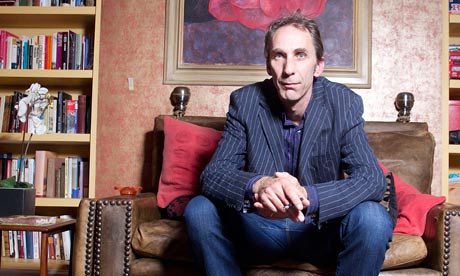
Phone by Will Self is published by Viking (£18.99)

Phone by [Self, Will]
Phone by Will Self review – a triumph of joined-up thinking

Self’s modernist trilogy concludes with typical panache and wit

Who remembers the Mutoscope? What about the Poulsen Telegraphone? Technologies that seemed for a brief moment to be the only games in town are now as obsolete as Betamax. Some media die, but others go on haunting the culture. Think of the icon of the floppy disk that adorns your taskbar, symbolising “save”, even though no one born after about 1990 will remember the object it represents.

For a long time now Will Self has been interested in the ways we have come to be constrained by the technologies that once promised to free us. His last three novels – Umbrella (2012), Shark (2014) and now Phone – form a Kittlerian trilogy, telling a story about the interplay between minds, madness and technology across the 20th century. As Zack Busner (the Leopold Bloom-like psychiatrist everyman who has been our guide through much of Self’s fiction) thinks in Phone, the problem with modernity is that we are all “attempting to make our way across this new wasteland using the same old ways”.


Will Self: 'I don't write for readers'

Phone is the final instalment in what has shown itself to be one of the most ambitious and important literary projects of the 21st century. Its style, as well as many of its characters, will be familiar to Selfians. The novel opens with Busner (now 78, and faintly baffled by a world “where there could be such a procedure as anal bleaching”) mid-breakdown in a hotel restaurant. He’s suffering from the early stages of dementia, but doesn’t think himself unwell: “Whatever they say, there’s not much wrong with my memory – its only that I have to … sort of … download things,” he thinks. Besides “Alzheimer’s itself may be a form of good mental heath – after all, what could be saner in a world in which every last particle of trivia is retained on some computer than to … forget everything.”

In Umbrella we learned how Busner had woken comatose encephalitis lethargica sufferers using the drug L-Dopa. In Shark we followed him into the “Concept House”, an anti-psychiatric commune he founded in Willesden in the 1970s, where he joined the patients on liberatory LSD trips. Phone presents us with late-style Busner: a wandering Brahmin armed with a staff and the dream of spiritual enlightenment (he considers buying an artisanal begging bowl from Heals, but is shocked at the price). His children and grandchildren, of which he has many, argue about his care, inheritance, and parental legacy. In despair, he goes for a walk amid the cruisers of Parliament Hill – a Lear on the blasted wastes of Hampstead Heath – accompanied by his clown, Simon, a mentally ill waif he’s adopted. “You’re like all the others,” Simon says, “Jimmy and Rolf, Max and the It’s-a-Knockout geezer – ’stead of growing older and wiser, you’ve stayed stupidly the same while yer knackers’ve gone … south!”

We are also reintroduced to Jonathan “The Butcher” De’Ath, a savant – like his grandfather Sir Albert De’ath, whom we met in Umbrella – with an “enormous Mycroftian mind”. The Butcher is a spook and a dandyish, though closeted, homosexual. Both are activities which, he thinks “depended on good tradecraft”. Jonathan’s father, Peter “Kins” De’Ath, also familiar to readers of Shark, was a disappointed academic and bullying homophobe. (It doesn’t take a Freudian to detect some father-slaying going on here: Self’s brother is named Jonathan and, like Kins, his dad was an academic.)

Jonathan is having an affair with Gawain Thomas, an unhappily married soldier who, during the second Iraq war, is put in charge of a regiment whose members commit an atrocity. Things come together when Busner’s autistic grandson Ben, a conspiracy-minded hacker, uncovers some of Jonathan’s secrets.
Shark review – Will Self's latest has sharp teeth and a warm heart

Will Self deals bitingly with miscellaneous modern horrors – but there's true feeling in this stream of consciousness, writes Sam Leith


There’s been a revival of interest in literary modernism in recent years. With their psychological fragmentation and determined subjectivity, Eimear McBride’s A Girl Is a Half-Formed Thing and Mike McCormack’s The Solar Bones showed one way of engaging with the legacies of modernism. But over his last three novels it’s become apparent that Self’s method is different. Phone isn’t an attempt to inhabit the language of modernism but an attempt to exhaust a style. There’s still plenty of fun to be had spotting references to Self’s lodestars, Joyce and Eliot, in Phone: Molly Bloom’s “met him pike hoses” becomes Busner’s “metempcuntosis”; Kins, like John Henry Menton in Ulysses, has “oyster eyes”; commuters cross Vauxhall Bridge “Ready to undo so many deaths”; Busner shores some “eggshell fragments” against his ruin. But these moments aren’t mere allusions. Instead, they show how we live in modernism’s wake, how we’ve internalised its languages and styles so that we can’t think outside of it even if, like Busner, we’ve never read a line of Joyce. Phone will be a challenge to those whose minds have been eroded by the permanent present of the smartphone. It’ll take you a couple of weeks to read all three novels properly. But I can’t think of a better way to spend your time. Self’s message is a perennially important one, brilliantly expressed: only connect.

Cyclogeography: Journeys of a London Bicycle Courier by Jon Day is published by Notting Hill Editions (£8.99).

Sunday, June 4, 2017

Terror in Argentina ...Once@9:53am: Terror in Buenos Aires (Dimyonot)Oct 14, 2016 by Marcelo Brodsky and Ilan Stavans Paperback(Penn State University Press)


March 17, 1992 was the date of the bombing of the Israeli Embassy in Buenos Aires that destroyed not only the embassy, but also a Catholic church and a nearby school. Twenty-five people were killed of which the vast majority were Argentine civilians—only four of the victims were Israelis and 242 people were injured. It was the deadliest terrorist attack in Argentina’s history until two years later a similar attack on the AMIA, the Jewish Federation building, killed 85 and injured over 300 people.

The latter attack occurred in the neighborhood of Once at 9:53 AM (the title of this novella in photos or fotonovela, written by Ilan Stavans with photographs by Marcelo Brodsky). The Spanish term “fotonovela” describes a comic book with photographs instead of illustrations. In English, the it has a bit of a different meaning as you will see when you read this.

It is surprising that the Mexican-born academic Stavans and Argentine photographer and artist Brodsky use this format to tackle such a traumatic historical event such as the terrorist attack on the AMIA building but it works and works well. “Once@9:53am” is a fictionalized account of the hours prior to the bombing. It is an intimate homage to the Buenos Aires’ historic immigrant neighborhood which is something like New York’s Lower East Side, and its communities. The story we get here is a countdown to the moment when the catastrophe changed the face of the area forever.

The original Spanish edition of the book was published in Argentina in 2011. Penn State University Press now brings us this fascinating book. The expanded edition contains a new essay by Stavans that looks at not only Argentina’s complicated history of attempts at coming to terms with the terrorist attacks, but also puts the narrative in the wider context of Latin American Jewish identity. This essay alone makes it an excellent and important read. This is a must-read for those interested in the Jewish culture of Latin America and an excellent for those who just want to read a fascinating book.

Saturday, June 3, 2017

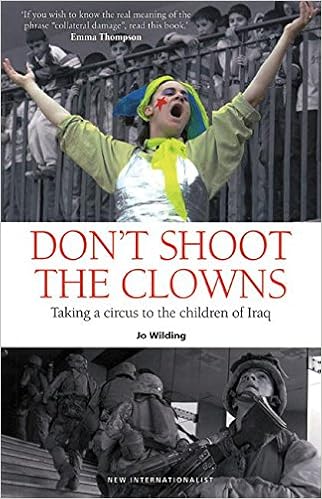
Don't Shoot the Clowns: Taking a Circus to the Children of Iraq Paperback – October 1, 2006 by Jo Wilding(New Internationalist)


Don’t Shoot the Clowns is Jo Wilding’s account of living with Iraqi people during the war and its aftermath. She tells what daily life is really like in a country coping with invasion and occupation, and how she and a hastily recruited troupe of circus performers brought clowns, laughter and some moments of respite to the children of Iraq.

As an independent observer, Jo Wilding witnessed and recorded in her blog some of the worst atrocities committed against ordinary people. Out of the trauma grew the circus, travelling round the squatter camps, schools and orphanages, putting light and hope back into people’s lives. ‘I want to thank you for coming,’ said one observer. ‘This is the first time since the war that I have seen the children laugh this way, from their insides.’

Jo Wilding isn’t a journalist looking for stories. In simply playing with children, helping where possible and instinctively recording events, she provides a unique and independent perspective. Her daily accounts have an immediacy and accuracy that bring the scenes sharply into focus. From the shocking, painful stories of the siege of Falluja – where, for a terrifying day and night, she was taken prisoner – to the crowds of mesmerized children, every episode vividly describes life in occupied Iraq.

About the Author: Jo Wilding is a human rights lawyer working in London. In the last few years she has been an activist blogger and clown. Her weblog from Iraq (see www.jowilding.net) was read all over the world during the war and the ensuing occupation. She was one of one thousand women jointly nominated for the 2005 Nobel Peace Prize.

Wednesday, May 24, 2017

Thinking Like a Political Scientist: A Practical Guide to Research Methods. Christopher Howard. University of Chicago Press. 2017.


In Thinking like a Political Scientist: A Practical Guide to Research Methods, Christopher Howard makes a compelling case for transforming how research methods are taught to undergraduate students of political science. Through its accessible, easy-to-follow approach, this new guide equips and encourages the next generation of political scientists to undertake research that has the potential to directly impact pressing political issues, writes Iván Farías Pelcastre.


There is an often overlooked fact at the heart of political science: the study of politics has been the realm of moral philosophers, legal thinkers and public administrators for longer than it has been that of scientists. Despite their late arrival, political scientists confidently argued that the use of the scientific method in their analyses of political phenomena enabled them to understand corresponding causes and effects in a better way than previously. They claimed they could study and explain the emergence, functioning and development of former and modern polities in an objective, rigorous and value-free way. This allowed them to rapidly appropriate a field that is nearly 2,500 years old. Ever since, the discipline of political science has been built upon the conviction that there is only one way to study politics objectively: through empirical, measurable and evidence-based research.

To become effective political scientists, then, contemporary students of political science (and by extension, international relations) are expected not just to learn about, but also conduct valued and insightful research on domestic and international political structures and phenomena. They are also expected to publish written work that provides suitable and innovative causal explanations about the origins, functioning and development of these same phenomena. Despite these high expectations, few books, and even fewer academics, ever manage to help students truly understand and think critically and systematically about the domestic and international political issues taking place around them. At times, teachers of political science introduce students to multiple theories, issues and debates, but fail in helping them to develop the critical judgement to analyse them. Moreover, many research methods textbooks (and teachers) nowadays are mainly, or only, concerned with teaching how to use statistical software packages in lieu of a comprehensive course on how to gain effective research skills. To address these gaps and contradictions, it is therefore necessary to change our collective approach to the teaching of research methods.

In Thinking Like a Political Scientist, Christopher D. Howard contributes to such a change. In this short but excellently written book, he makes a compelling case for transforming how research methods are taught to undergraduate students. Howard rightly argues that students of political science ‘are better off learning a handful of skills, and learning them well, rather than being overwhelmed by a multitude of concepts and formulas’ that is currently the subject of numerous research methods courses (4). The book’s main aim is to enable students to develop their own skills as researchers, so they can generate and advance our common knowledge about domestic and global politics. The book achieves this objective by introducing its readers, step-by-step, to political research design, while maintaining an excellent balance between substance and humour that is hardly ever seen in other research methods textbooks. Its accessible language and easy-to-follow structure and examples prompt students to move away from the mere memorisation of facts, formulas and theories towards a more critical evaluation of their own ideas and works – both inside and outside the classroom.
Image Credit: (Simone Smith CC BY 2.0)

The book is divided into two main parts: ‘Asking Good Questions’ and ‘Generating Good Answers’. In Part One, the author introduces readers to the significance and value of asking – and confidently answering – the three main questions underlying any worthy political research: ‘who cares?’; ‘what happened?’; and ‘why?’ Some of the skills discussed in this section include: how to ask (and successfully answer) causal questions featuring independent, dependent and intervening variables; how to pick good cases for testing a hypothesis; and how to distinguish causation from correlation. Answering these questions serves as the basis for teaching students other valuable research skills, including, for instance, how to work with ‘big’ concepts, such as democracy, peace and security. These lessons will prove relevant to students of any sub-discipline of political science and international relations, including comparative politics, political economy and political theory.

In Part Two, meanwhile, the author provides a short guide to some of the most common and essential tasks of political scientists, including how to choose an appropriate research design; how to choose and conduct experiments to test a given hypothesis; how to select suitable cases; and how to use evidence to adequately support one’s arguments and hypotheses. Throughout these sections, the author also discusses how to gain and strengthen other valuable research skills, such as writing strong literature reviews, recognising authoritative research and addressing common hurdles, such as the lack of sufficient data on a given issue or phenomenon.

Just as importantly, the book helps students to understand what political scientists – including their own research methods teachers – expect from them and their research. For instance, the book dispels the widespread myth that undergraduate papers should always offer a truly original argument. Howard reassures students that they do not need to search for (least find!) the ‘holy grail’ of politics when writing research papers. Instead, he clarifies that the main point of political research is simply ‘to figure out a way to move the conversation forward, even if only a little bit’ (23). It is this kind of valuable insight that makes Thinking Like a Political Scientist truly stand out from other research methods textbooks.

The book’s most important contribution to the literature, however, was probably unintended. It hints at the possibility of further change in our collective understanding of the main aim of political research. At first, Howard explicitly states that political scientists prize causal knowledge highly, following the longstanding convention that research should be simply devoted to explaining political phenomena – not changing material realities. Afterwards, however, he challenges the notion that political scientists should always conduct empirical, as opposed to normative, research in the pursuit of knowledge. He concedes that, at times, the most persuasive political research is when researchers ask normative questions, moving deliberately and decisively from abstract ideas and theories towards concrete proposals for addressing domestic and global political issues.

Finally, Howard acknowledges that political scientists will, and often do, try and engage in conversations that extend beyond academia. Hence, he encourages students to conduct research that goes beyond simple essay-writing, number-crunching and chart-making. Instead, he advises students to stop, reflect and ask themselves: ‘what makes a political puzzle so important that readers will devote some of their scarce time and attention to understanding it better?’ (25). He argues that students should aim to produce research that truly connects with its readers, that persuades them to stop, listen and engage with it. Perhaps then, in the future, the aim of political research will not only be to extend, refine and challenge our knowledge of domestic and global politics, but also to propose solutions to actual political problems affecting people around the world (25). Thinking Like a Political Scientist contributes to move the debate in this direction. And, most importantly, it does so in the most effective way: talking directly to the next generations of political scientists (and their teacher


Saturday, May 20, 2017

The Legacies of President Bill Clinton ,,,,,Inside the Clinton White House: An Oral History (Oxford Oral History Series) 1st Edition by Russell L. Riley(Oxford University Press);Bill Clinton: New Gilded Age President Hardcover – January 28, 2016 by Patrick J. Maney (University of Kansas Press);Bill Clinton: The American Presidents Series: The 42nd President, 1993-2001 Hardcover – January 24, 2017 by Michael Tomasky (Author), Arthur M. Schlesinger Jr. (Editor), Sean Wilentz (Editor) (Times Books),Crisis of Character: A White House Secret Service Officer Discloses His Firsthand Experience with Hillary, Bill, and How They Operate Paperback – May 16, 2017 by Gary J. Byrne (Center Street Press);Man of the World: The Further Endeavors of Bill Clinton Paperback – September 19, 2017 by Joe Conason (Simon & Schuster)


With the election of 2016 it would appear that Bill and Hillary Clinton are now finished as active politicians. They are in the process of moving into the realm of history. So what are we to make of the Bill Clinton presidency? Was he a significant president who shaped his era and left a strong, lasting legacy in policy and legislation? Or was he a political minority elected because of fissures in the dominant coalition, who, because of his weak political base, found it easier to dominate foreign policy rather than center his agenda on domestic issues? And how badly did reckless behavior in his personal life damage his political legacy? Less than two decades removed from a Clinton presidency, Russell L. Riley’s “Inside the Clinton White House: An Oral History” (Oxford, 2016) and Patrick J. Maney’s “Bill Clinton: New Gilded Age President” (Kansas Press, 2016) suggest that the dust is still settling on the reputation of our 42nd president.

It is clear that the subjects of the various oral histories in Russell L. Riley’s book have a positive opinion of Clinton. Housing and Urban Development Secretary Henry Cisneros argues that Clinton’s decision to reduce the deficit made economic growth and any number of social developments that stemmed from it possible. Deputy National Security Advisor Nancy Soderberg lauded his decision-making abilities, commenting that she “literally never saw Clinton make a foreign policy decision for anything but policy reasons.” The view that emerges from these and many other interviews is of a principled and able politician, advancing an agenda he believed in and developing a foreign policy for the post-Cold War era that would endure.


Riley has also done an impressive job of taking dozens and dozens of interviews and sewing them into an engaging, entertaining read. The chapters are organized in a roughly chronological manner. The book is rife with great quotes. Stanley Greenberg on gays in the military: “Our poll numbers crashed.” Roger Altman on internal debates within the administration on what to prioritize in 1993: “Were there different views? Sure. But was it a battle? No. I’ve seen Washington battles and that wasn’t one of them.”

With that said, many times the interviewees dodge important issues. Commerce Secretary Mickey Kantor on the impeachment: “Well, it is a Clinton pattern to get in trouble when he is doing better.” On why Clinton had so many critics, Secretary of State Warren Christopher argued: “One thing I think has to do with his ‘Southern-ness’ and the fact that he came from a state that’s not very highly regarded nationally.”

In contrast, Patrick J. Maney’s book is more realistic than negative. Clinton had a weak political base, but managed to get several major pieces of legislation passed because of his political flexibility. With that point made, many of the major changes taking place in the 1990s had little to do with who was in the White House, and reflected major developments in technology and commerce. While the economy grew, so did income inequality, and many jobs were lost as new industries came to replace older ones. In many ways the 1990s were a repeat of the 1890s. Clinton failed to exert that much influence on the nation, because “the flywheel of contemporary history was powered in the private, not the public, realm.” This “new Gilded Age” argument is interesting, but it disappears for large chunks of the book.

While the oral history interviewees argue that Clinton was ideologically committed to a middle course, Maney sees him as far more opportunistic. He supports that position in convincing fashion. Clinton went left in his first year, only changing course after health care reform and lifting the ban of gays in the military failed. Clinton supported deregulation (with mixed results), pushed his party to a more centrist position and reformed welfare, which neutralized crime and welfare as issues the Republicans could use against Democrats. Even then, Maney argues Clinton’s reelection owes more to Republican ineptitude than his own skill.

In foreign policy, he got better with time. Under Clinton, the North Atlantic Treaty Organization intervened in Bosnia, but ignored the mass killing in Rwanda. During its first term, the Clinton Administration spent time trying to develop a strategy, which Clinton began to believe was a fool’s errand. Historians and “the chattering class” gave foreign policy more coherence after the fact. Maybe, maybe not, but Maney argues cogently that Clinton had real influence in his second term. His foreign policy team was more cohesive and he expanded the war-making authority over Congress. A U.S. intervention in Kosovo brought peace to the region, while ignoring the War Powers Act. Clinton took anti-terrorism efforts seriously and was targeting al-Qaeda long before he left office. He also notes that Clinton and a large, bipartisan majority in Congress changed U.S. policy towards Iraq in 1998, calling for regime change rather than containment. There were limits, though. Maney makes a good argument that the effort to negotiate a peace settlement between Israel and Palestine was never as close as Clinton and his staff believed.

Part of the problem in assessing any president so quickly after he leaves office is that subsequent events can quickly change a legacy. Maney argues that Clinton’s most significant action was to make the Democrats more centrist, but Barack Obama appears to have pushed the party back to the left again. Clinton took the terrorism threat seriously and changed foreign policy on Iraq, but in many ways that seems to have made him just a prologue for George W. Bush. Getting to the White House is no small thing, but there are legends like Lincoln and the Roosevelt’s, and then there are those with more modest reputations like Harding and the Harrisons. It is still too early to tell where Clinton will finish or, rather, how his reputation will change over time. These books set a good standard for the studies to come.

The Age of Noise in Britain: Hearing Modernity. James G. Mansell. (University of Illinois Press). 2017.


The twentieth century in Britain saw the arrival of gramophones, motor traffic, aeroplanes and the mechanisation of labour – all ‘the clash and clatter of urban and industrial life’ (1) that, in all its chaos, seemed only to signal meaninglessness. James Mansell’s historiographical approach in The Age of Noise in Britain: Hearing Modernity is to consider sound not as a product or representative of the modern age to be analysed like visual culture or the moving image, but as ‘modernity manifested in audible form’ (1).

Mansell has written extensively and curated exhibitions on the cultural history of sound and hearing and on spiritualist movements such as Theosophy. At the time of writing, there is a programme available on BBC iPlayer in which he discusses his latest work. In this book, Mansell argues for an ‘age of noise’ in Britain, bookended by the two World Wars, during which noise was variously associated with nervousness, the constitution or disruption of subjectivity and selfhood, spiritualism, the power of the state and nationhood. In an echo of John Berger’s famous ‘ways of seeing’ (1972), Mansell posits ‘ways of hearing’ (183), arguing that hearing and listening are far from passive experiences or immune to ideology. The attempts to order and manipulate hearing in the first half of the twentieth century form the subject of this study.

In the first decades of the twentieth century, many figures railed against the intrusion of noise in public life, including Dan McKenzie (City of Din: A Tirade against Noise) and agitators of the anti-noise campaigns. The Cambridge psychologist F. C. Bartlett wrote in The Problem of Noise (1934) that ‘sound, like love, laughs at locksmiths’ (118), identifying the threat it poses to the separation of the public and private spheres. Kant had also observed this in his Critique of Judgement (1790): music ‘extends its influence further than desired (in the neighbourhood), and so as it were obtrudes itself, and does violence to the freedom of others who are not of the musical company’. For this reason, he held music to be the lowest art form; it is, incidentally, one of the most popular (‘vulgar’, in the original sense) cultural products today.
Image Credit: (Rhonda CC BY SA 2.0)

The critique of noise was largely due to its association with nervousness and disturbance. Modernity itself was taken as synonymous with nervousness, and indeed the discourse of shock and distraction in modern (specifically urban) life is familiar from the writings of Georg Simmel and Walter Benjamin. But even Simmel, in his famous essay ‘The Metropolis and Mental Life’, contrasted city life with the ‘slower, more habitual, more smoothly flowing rhythm of the sensory-mental phase of small town and rural existence’. In the crisis of nerves, metaphors of rhythm, vibration and harmony were especially prominent. The US neurologist George M. Beard theorised that the noise of modernity was unrhythmical and disturbed the body, unlike natural sounds (34). Terms of expenditure were also common, and fitted Beard’s idea that each individual had a fixed amount of nerve energy which could be spent or reserved (30). This chimed with Simmel’s notion of the Geldwirtschaft (money economy) of the modern city.

Mansell’s introduction and first chapter focus on the activities of the Anti-Noise League and other noise abatement movements, which figured noise as a disease: a pathologisation of modernity. As he writes, ‘neurasthenia [nervous exhaustion] was a critique of modernity as much as it was a medical diagnosis’ (32): cause and effect were conflated. The condition’s threat to workers’ capacity for labour and the idea that nervous energy should be preserved as a patriotic duty were the first manifestations of the destructive potential of noise for the modern capitalist nation. This national rhetoric was only strengthened in the ‘total warfare’ of the Second World War.

The second chapter, ‘Re-Enchanting Modernity’, yields the most surprising conclusions for the non-specialist reader who might associate the age of noise with the rise of mechanised labour and the concomitant disenchantment of the world, as Max Weber argued. ‘Sound matters in modern history,’ wrote Jonathan Sterne in The Audible Past, pointing to the material elements of sound that were recorded, amplified and distributed over the course of the nineteenth and twentieth centuries. In early twentieth-century Britain, however, mainstream science was attacked as too materialist by movements of occult spiritualism, such as the Theosophists. Unlike the anti-noise agitators, these practitioners advocated the harnessing of ‘vibratory influences’ (71) to attain a self in harmony with the world. Mechanical noise was still problematic be

cause it threatened self-realisation, but certain forms of music and abstract art were held to have a good effect on the nerves. Kandinsky’s treatise Concerning the Spiritual in Art (1911) was influenced by Theosophy, which was founded in New York in 1875. Annie Besant led the movement from Madras, India, after she became president in 1908. In Britain, its figurehead was Maud MacCarthy, the ethnomusicologist, expert on Indian music and occultist who had studied with Besant. MacCarthy set up devotional concerts on Sunday mornings and a Brotherhood of Arts, Crafts and Industries, based on medieval guilds and intended to be ‘temples of magical sound’. Chapter Two is especially successful in exposing the tension and slippage between the spiritual and the secular in this period of cultural transition.

Mansell then turns to the political aspects of sound in early-twentieth-century Britain. The state intervened in two everyday soundscapes – the workplace and the home – and state filmmakers searched for the most adequate ways of representing and promoting these. One key priority was to bring the human body into harmony with the machine to counter the negative image of mechanisation. Thus, industrial psychologists began to figure ‘nervousness’ as a mental rather than physical condition, and claimed that industrial work shared a rhythm with the collective, social self which manual workers entered into. ‘Brain workers’, however, retained a personal, interior selfhood with its own rhythm, which could easily be disturbed by the pulse of industry. This led to a gendering of the noise-sufferer (female secretaries at the typewriter vs. male ‘brain workers’ who needed peace and quiet).

Sound was also increasingly co-opted into ‘the ideological work of nation building’ (149) during World War Two. In the face of Hitler’s ‘psychological war’ (172), it was imperative to stay calm in loud conditions and resist the fear of noisy aerial bombardment. It was, perhaps, a stereotypically British response: in the face of ‘a crisis of nervousness on the home front[,] stoical adaptation instead became the order of the day and the age-of-noise narrative faded as a consequence’ (182).

Mansell’s work is a welcome attempt to redress the visual and textual biases of modern historiography, and covers an area of past experience that is often assumed to be inaccessible. As a student of Modern Languages, I missed some reference to continental philosophy (Peter Szendy, for instance, who has written an excellent history of listening) and to German studies of vibration and rhythm (Michael Cowan is a figure to consult here). However, Mansell’s study usefully highlights the overlap between cultures of rationality and spirituality, and references some fascinating investigations, especially into the relationship between sound and power, if one wishes to pursue a Foucauldian line. Carolyn Birdsall’s Nazi Soundscapes and Susan Cusick’s work on isolation and the role of sound in the constitution of prisoner selfhoods (see her ‘Towards an Acoustemology of Detention in the “Global War on Terror”’ here) are two such examples. We would do well to remember that the aural sense is not free from ideology and coercion, and that studies of listening can yield conclusions that trouble the ideas suggested by visual and textual investigation.

Friday, May 19, 2017

The Art of Philosophy: Visual Thinking in Europe from the Late Renaissance to the Early EnlightenmentFeb 28, 2017 by Susanna Berger Hardcover (Princeton University Press)


The following us a guest post* by Susanna Berger, assistant professor of art history at the University of Southern California. It is an excerpt adapted from her fascinating book, The Art of Philosophy: Visual Thinking in Europe from the Late Renaissance to the Early Enlightenment (Princeton University Press, 2017).

I am grateful to her for taking the time to put together such an interesting and image-rich post for Daily Nous. Enjoy! (And don’t miss the video preview of her book at the bottom of the post.)


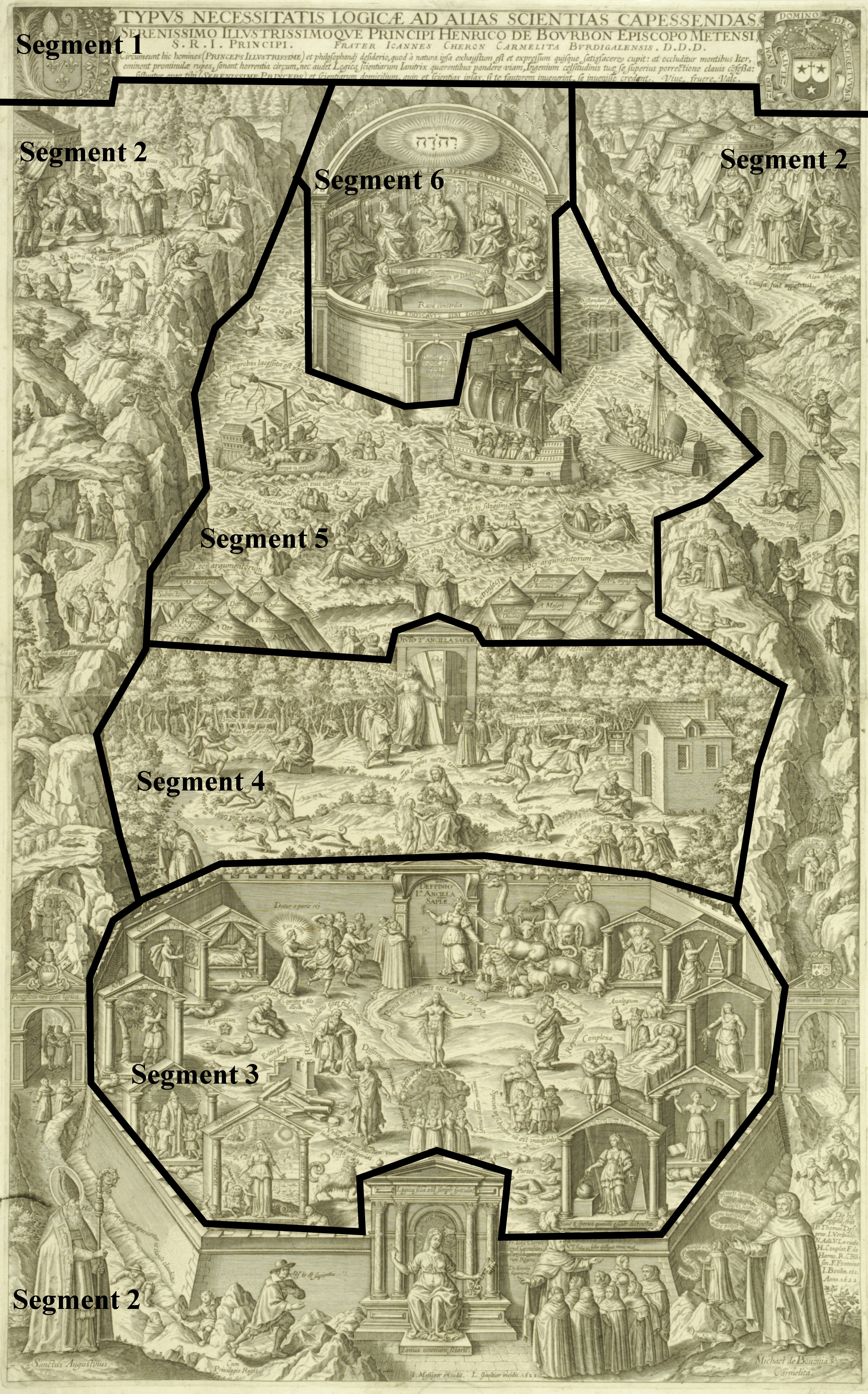
Fig. 1. Chéron and Gaultier, Typus, 1622. Engraving on paper, 29.1 x 18.5 in. (74 x 47 cm). Rare Book Division, Department of Rare Books and Special Collections, Princeton University Library.

The Art of Philosophy
by Susanna Berger

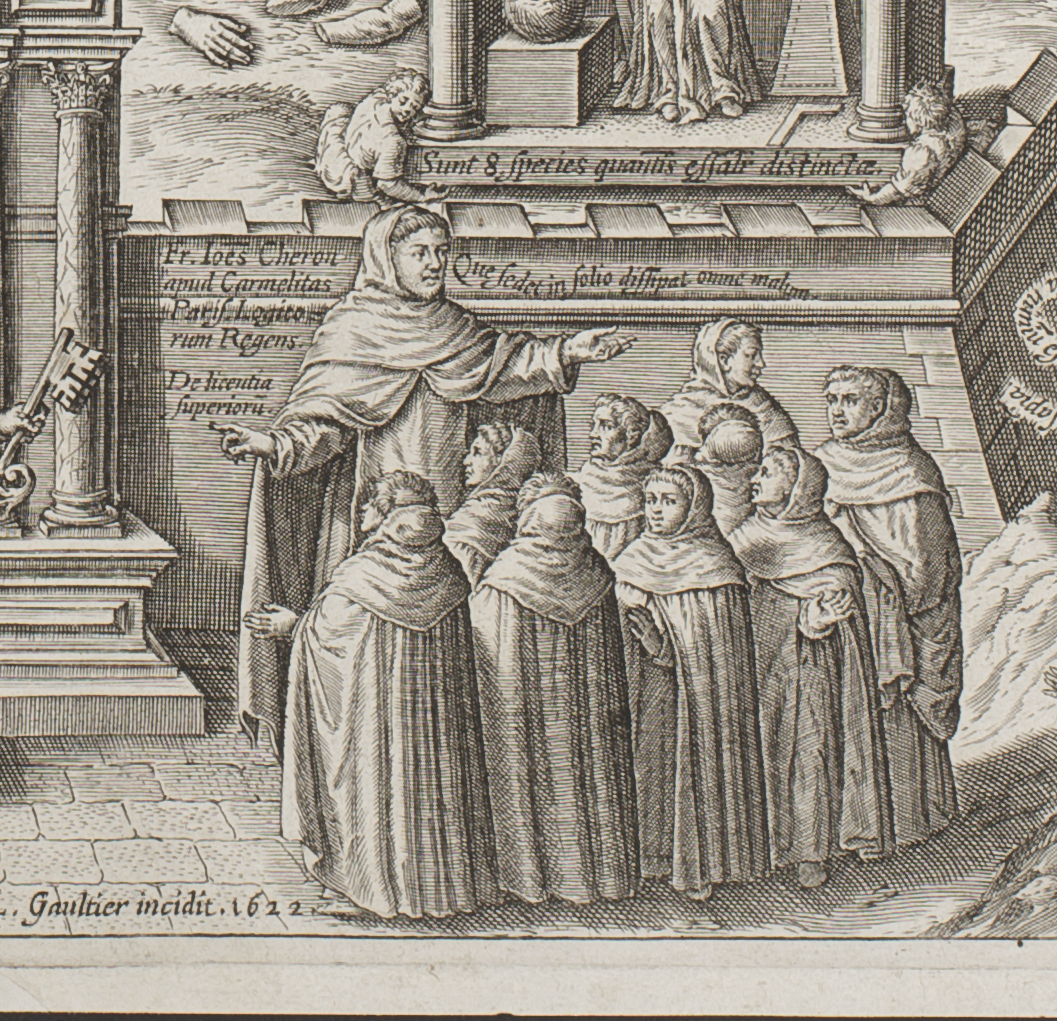
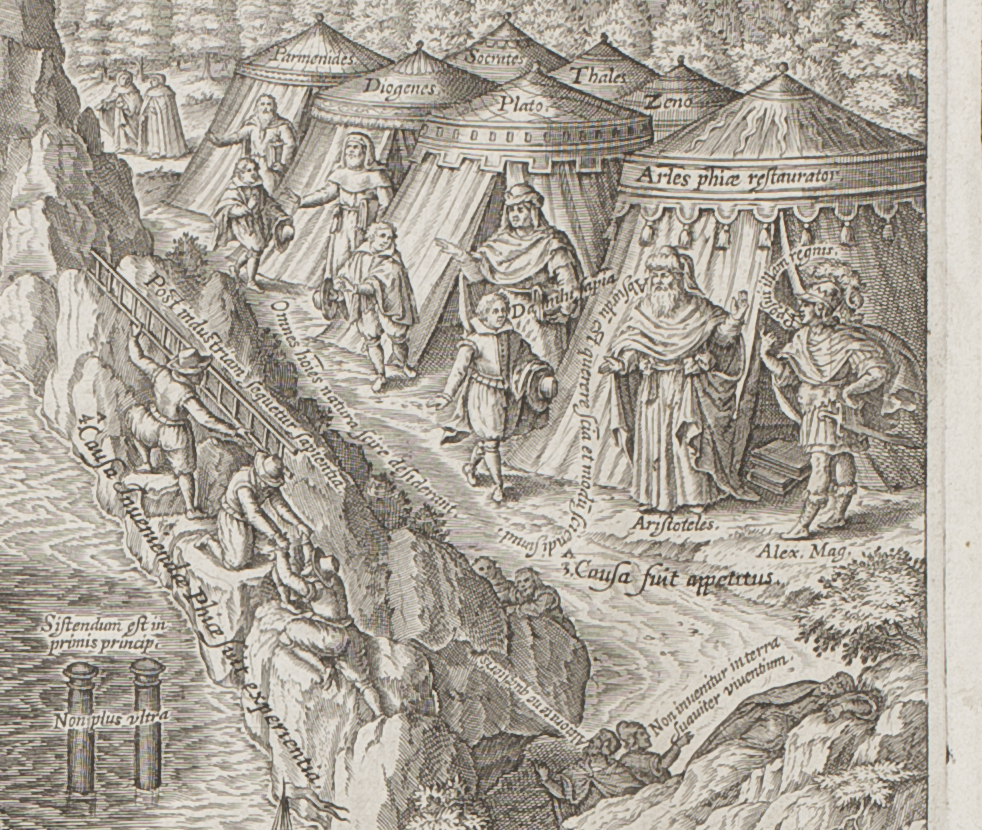
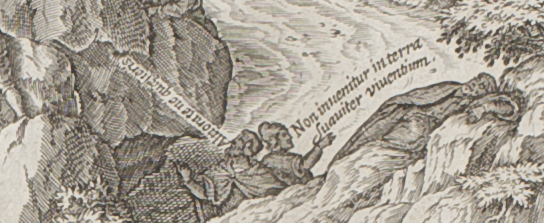
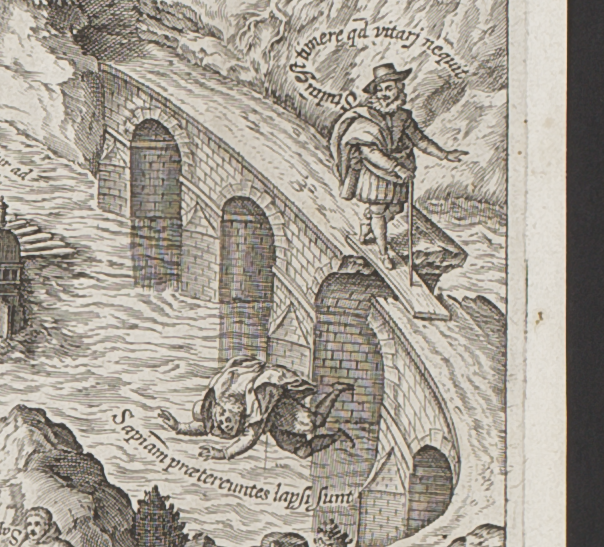
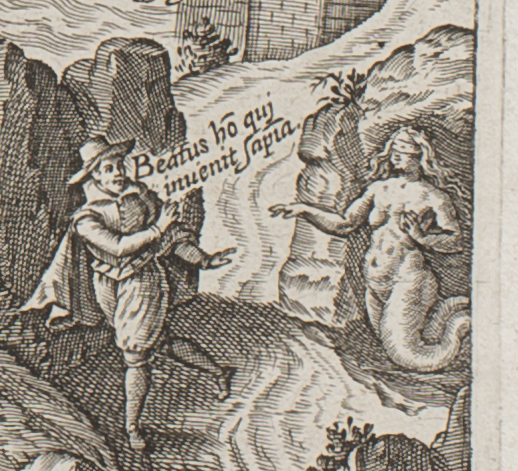
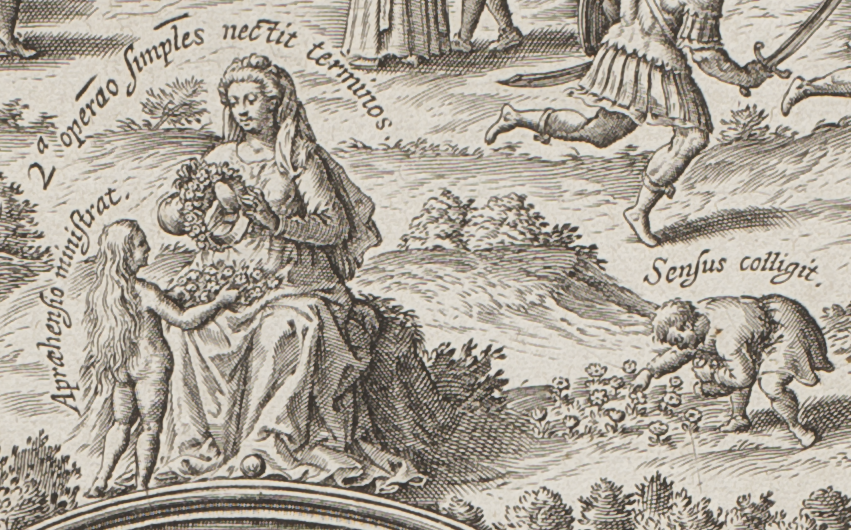
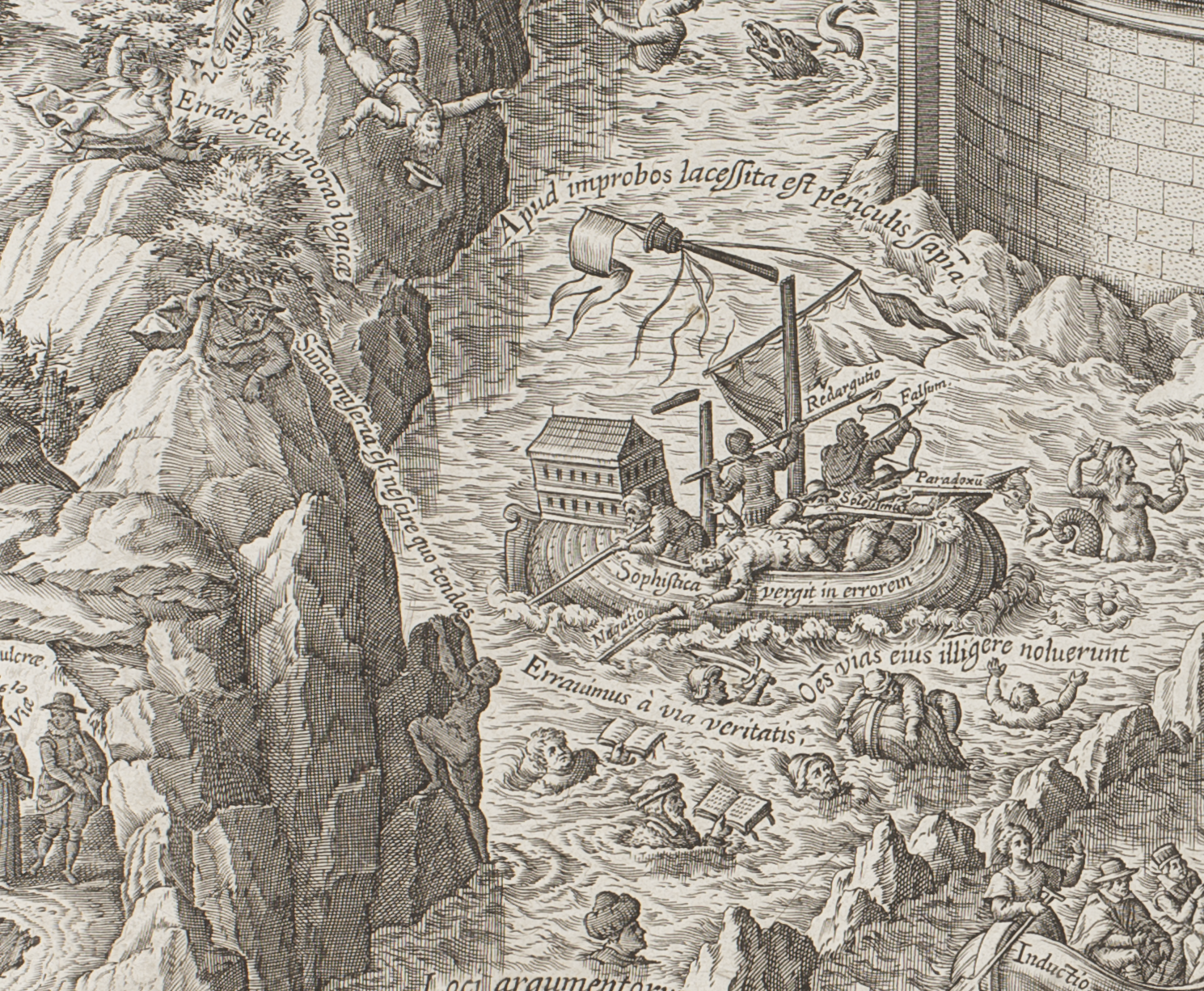
In 1622 the Carmelite professor of logic Jean Chéron (1596–1673) designed an engraving, titled Scheme of the Necessity of Logic for Grasping the Other Branches of Knowledge (Typus necessitatis logicae ad alias scientias capessendas), hereafter Typus, that depicts the human quest to reach wisdom (Fig. 1, above). Throughout this broadside, nearly a hundred small figures stumble along treacherous pathways, scale craggy cliffs, cross wild hunting grounds, and sail through a roiling sea in pursuit of wisdom, represented by a domed temple rising above the waters near top of the page. At the bottom of the scene, Chéron himself stands in his Carmelite habit, surrounded by his students (Fig. 2).


Fig. 2. Chéron and Gaultier, detail showing Chéron and his students from the Typus, 1622. Rare Book Division, Department of Rare Books and Special Collections, Princeton University Library.

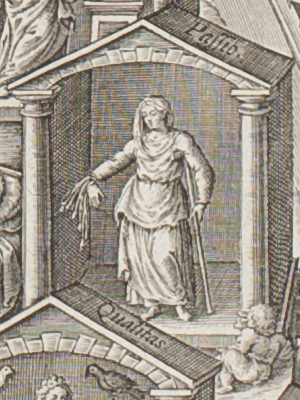
He gestures toward the gates of this landscape, which are guarded by Logic, and invites his students to embark on the journey through this portal, because, he advises them, a mastery of logic is needed for the discovery of wisdom (Fig. 3).


Fig. 3. Detail showing Logic from the Typus, 1622. Rare Book Division, Department of Rare Books and Special Collections, Princeton University Library.

For Chéron’s students at his Carmelite monastery in Paris, this detailed chorographic map depicted the fictional region they would have to cross through as they followed the road of intellectual discovery in pursuit of knowledge. The smaller images within this realm are juxtaposed with fragments of biblical and philosophical texts to depict and to interpret the tools students required in their attempt to master logic and thus to find wisdom.

Produced in collaboration with the engraver Léonard Gaultier (1560/61–1635) and published by Jean Messager (1572–1649), the document was employed by Chéron and his students as a thesis print, a genre of broadside that featured the theses or propositions to be discussed at oral examinations called disputations. The Typus and a collection of other wonderfully intricate philosophical broadsides are at the center of my book, The Art of Philosophy: Visual Thinking in Europe from the Late Renaissance to the Early Enlightenment.

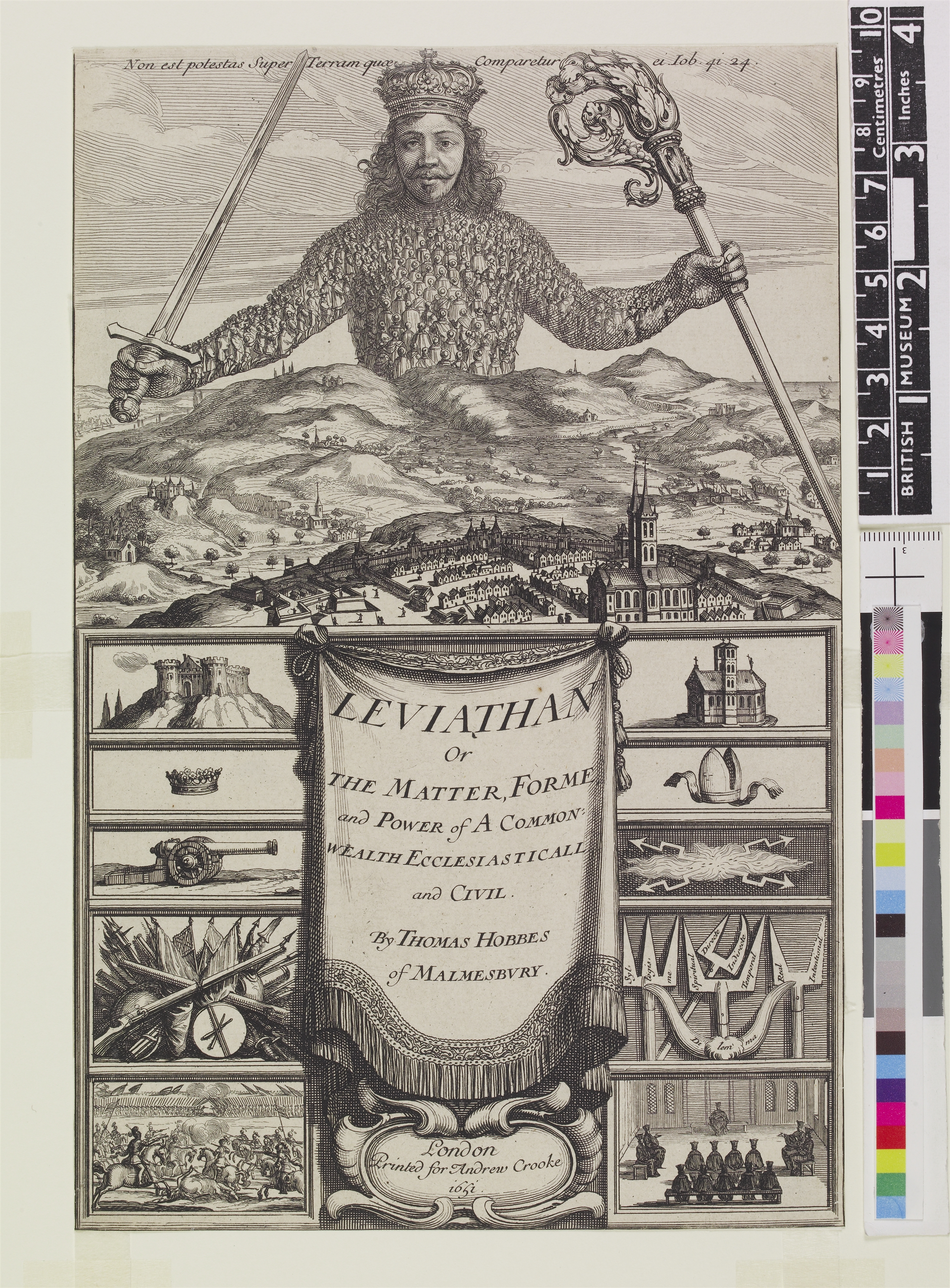
I show how their inventive iconography inspired new visualizations of thought in a range of drawn and printed sources, including student lecture notebooks, printed books, and alba amicorum (friendship albums). The book culminates with a new study of the celebrated frontispiece to Hobbes’s Leviathan (Fig. 4). I argue that previous accounts of the print have failed to capture the full complexity of this etching and offer a new, if complex, account of this famous image—one which emphasizes the process of the state’s generation. Artists and philosophers invested significant amounts of time and money in the creation of philosophical visual representations and we must take these contributions to their thought seriously if we wish to understand their ideas in all their complexity and richness.


Fig. 4. Bosse and Hobbes, frontispiece to Leviathan (London: Andrew Crooke, 1651). Etching on paper, 9.5 (trimmed) x 6.1 in. (24.1 x 15.5 cm). British Museum, London.

In representing the field of logic through a map of diverse terrains, the Typus offers both a visual commentary on the tenets of Aristotelian scholastic philosophy as they were taught in early modern France, and an allegorical depiction of the strenuous intellectual process of the search for understanding, as well as the perils of laziness and the incorrect applications of philosophy. The print unequivocally promotes the philosophy of Aristotle, who stands at the top of the pathway on the right before a military tent that is inscribed, “Aristotle restorer of philosophy” (Aristoteles philosophiae restaurator) (Fig. 5).


Fig. 5. Detail showing Aristotle from the Typus, 1622. Rare Book Division, Department of Rare Books and Special Collections, Princeton University Library.

Logic instruction in early seventeenth-century Paris was based primarily on the compendium of Aristotle’s texts called the Organon and the philosopher Porphyry’s treatise known as the Isagoge. This material was organised according to three principle intellectual processes known as the operations of the mind. The Typus is similarly arranged in three main sections that correspond to these operations. Through apprehension, the first operation of the mind, the conception of an object or term is brought to the mind. It is through judgment, the second operation of the mind, that simple concepts are divided or combined to form propositions. By way of the third operation, the mind organizes the propositions to produce syllogisms or arguments. So, for instance, the first operation of the mind could apprehend the concepts of “Chéron” and of “Carmelite,” and then the second operation could combine those two concepts into the proposition “Chéron is a Carmelite,” and then finally the third operation of the mind could combine this proposition with another to produce the following syllogism: Chéron is a Carmelite/ All Carmelites are Catholic/ Therefore, Chéron is a Catholic.

To clarify this analysis I have divided the image into numbered segments (Fig. 6).


Fig. 6. The six segments of the Typus, 1622. Rare Book Division, Department of Rare Books and Special Collections, Princeton University Library.

The viewer was expected to begin contemplating the broadside in segment one by reading its title and then its dedication to Henri de Bourbon (1601–1682), the illegitimate son of Henri IV.

The figures descending the pathways in segment two head towards the gate guarded by Logic. These pathways act as a framing device that directs the spectator’s gaze from the top of the broadside to the entrance to the courtyard at the bottom. The figures on the pathways remind students of the importance of learning Aristotelian logic. For instance, a little below Aristotle, two men stand beside a third who sleeps on a rock (Fig. 7).


Fig. 7. Detail on the dangers of laziness from the Typus, 1622. Rare Book Division, Department of Rare Books and Special Collections, Princeton University Library.

The figure nearest the sleeping man says, “It [i.e. wisdom] is not found in the land of them that live in delights.” (Non invenitur in terra suaviter viventium.)[1] Further down the pathway, a man falls off a bridge into the water (Fig. 8).


Fig. 8. Detail on the dangers of disregarding wisdom from the Typus, 1622. Rare Book Division, Department of Rare Books and Special Collections, Princeton University Library.

Near the falling man Chéron includes an annotation explaining the cause of his demise: “For regarding not wisdom, they have slipped” (Sapientiam praetereuntes lapsi sunt).[2] In these images, Chéron admonishes his students to remain actively engaged in their studies and not to act foolishly or lazily.

Chéron also warns his students about the dangers of distractions of the flesh. Below a man runs from a blindfolded siren, declaring, “Blessed is the man that findeth wisdom” (Beatus homo qui invenit sapientiam) (Fig. 9).[3]


Fig. 9. Detail on the dangers of distractions of the flesh from the Typus, 1622. Rare Book Division, Department of Rare Books and Special Collections, Princeton University Library.

Those scholars who have not yet fallen asleep, lost their footing, or given into temptation along their journey will pass through the gates of Logic, where they enter what we can identify as the third segment of the broadside, a courtyard that illustrates the first operation of the mind. Inside ten porticoes along the inner walls of the enclosure, Chéron stages scenes interpreting the meanings of each of Aristotle’s ten categories, which are the different types of concepts apprehended through the first operation of the mind. For instance, the category of “being affected” (Passio) is represented by a woman whose arm has been severed (Fig. 10).


Fig. 10. Detail on the category of “being affected” from the Typus, 1622. Rare Book Division, Department of Rare Books and Special Collections, Princeton University Library.

Having made their way through this courtyard, the studious scholar reaches segment four, a valley that encapsulates the workings of the second operation of the mind. A woman, boy, and girl at the bottom center of the field illustrate how the intellect obtains, processes, and organizes sensory data (Fig. 11).


Fig. 11. Detail on how the intellect obtains, processes, and organizes sensory data from the Typus, 1622. Rare Book Division, Department of Rare Books and Special Collections, Princeton University Library.

Scholastic Aristotelian philosophers held that the intellect does not receive information from the five external senses directly. Once the senses have gathered information from the outside world, it must be processed or apprehended, through the first operation of the mind, before it can be divided and combined into propositions, through the second operation of the mind. A woman, boy, and girl at the center of the field show this process. The young boy personifies the five external Senses; he picks flowers, beside the words, “The senses collect” (Sensus colligit). The flowers symbolize things that humans become aware of through the senses. The naked young girl, who stands at the knee of the seated woman, is identified as Apprehension with the words, “Apprehension acts as assistant” (Ap[p]rehensio ministrat.). Apprehension “assists” with processing sensory information. The seated woman personifies the Second Operation of the mind. Above her is the inscription, “The second operation binds simple terms” (2A operatio simplices nectit terminos.) The boy gives his flowers to Apprehension, who in turn hands them over to the Second Operation, who binds the flowers together to create a wreath, a metaphor for the combining of concepts into propositions.

Beyond this valley, in the fifth segment of the broadside, is an interpretation of the third operation of the mind, or the mind’s ability to combine propositions into syllogisms, depicted across a seascape that incorporates imagery of seafaring and military battle. Chéron and Gaultier show a female with three faces who personifies the three kinds of Syllogism (Fig. 12): syllogisms that result in knowledge, opinions, and errors. The syllogisms that result in knowledge are summarized on a galleon, a large multi-decked sailing ship that could withstand a major ocean crossing.


Fig. 12. Detail showing the personification of the three kinds of Syllogism from the Typus, 1622. Rare Book Division, Department of Rare Books and Special Collections, Princeton University Library.

Sophistic methods of argumentation are represented by the sailboat furthest to the left (Fig. 13).


Fig. 13. Detail on sophistic methods of argumentation from the Typus, 1622. Rare Book Division, Department of Rare Books and Special Collections, Princeton University Library.

An inscription marks Sophists as steering the boat: “Sophistry tends into error” (Sophistica vergit in errorem). Above the Sophists’ boat is an annotation stressing, “Among the wicked is a wisdom attacked by dangers” (Apud improbos lacessita est periculis sapientia).[4] Seven men drown beside the boat; an inscription reveals that they know they are suffering the consequences of Sophistry: “We have erred from the way of truth” (Erravimus a via veritatis),[5] Another inscription stresses their ignorance: “They did not want to understand all her [i.e. Wisdom’s] ways” (Omnes vias eius intelligere noluerunt.)[6] An inscription next to the mouth of a man who peeks down at the drowning Sophists from the rocky cliff above betrays his awareness that the Sophists have lost their way to wisdom: “The greatest misery is not knowing to where you are heading.” (Summa miseria est nescire quo tendas,) Another figure on the cliff observes a man falling into the water; an inscription next to the observer warns students of the dangers of living without a knowledge of logic: “Ignorance of logic made [him] wander astray” (Errare fecit ignoratio logicae.)

Those who survive the waters travel onwards to the edifice in segment six (Fig. 14).


Fig. 14. Detail showing the home of Wisdom from the Typus, 1622. Rare Book Division, Department of Rare Books and Special Collections, Princeton University Library.

This building, shown in cross-section to reveal its interior, is marked as the home of Wisdom. In the front of the temple, two monks debate whether voluntary action is an act of the will or the intellect. Five women, seated in a row, observe the debate. In the center sits Philosophy, holding a book and a cornucopia of flowers. The text near her mouth stresses both her positioning at the top of the Typus and her close ties to wisdom: “I inhabit wisdom in the highest places” (Ego sap[ient]iam in altissimis habito). The wall above Philosophy and her companions bears the words, “Philosophy is divided into four general species, namely into” (PHILOSOPHIA DIVIDITVR IN 4 SPECIES GENERALES SCILICET IN) introducing the disciplines personified to Philosophy’s left and right. The left-most figure is Mathematics, who draws on a tablet with a compass. Next to Mathematics sits Theology with a book—almost certainly the Bible—in her lap and a dove above her that symbolizes inspiration. Theology points upwards to refer to the dove and higher powers. To the right of Philosophy is Physics with an opened book on her lap, holding a sun with a face in her right hand. The right-most woman personifies Ethics; she holds a burning heart and has a book resting on her lap. With this representation of the home of wisdom Chéron places great emphasis on the value of studying logic in order to gain wisdom in other disciplines.

Chéron and Gaultier’s strict pedagogical perspective is confirmed by a detail in the upper right region of the broadside, where the words “Non plus ultra” (or “Nothing further beyond”) appear across a pair of columns emerging from the water (see Fig. 14). These are the columns that Hercules was thought to have erected at the Straits of Gibraltar, or the end of the known world, as a warning to sailors not to venture into uncharted waters. The columns also figure in at the end of the lecture notes of seventeenth-century philosophy students from the University of Leuven (Fig. 15).


Fig. 15. Drawing of the columns of Hercules in the notebook of van Cantelbeke. 7.8 x 6.3 in. (19.8 x 16 cm) KU Leuven [Ms. 205, fol. 147r].

Chéron and Gaultier designed their philosophical image to be read in a generally linear progression that concludes at the top of the page; the columns, at the upper right of the broadside, are depicted at the end of the students’ philosophical journey. Chéron and Gaultier present the columns as markers of the ending of studies of logic. Perhaps even more is implied by these columns: that the doctrine of logic is completed and nothing can be added to it; that whosoever ventures beyond Aristotle will drown.


* * *notes* * *

[1] Book of Job 28:13.

[2] Book of Wisdom 10:8.

[3] Book of Proverbs 3:13.

[4] This quotation is a paraphrase of Boethius, Consolatio philosophiae, I.3.

[5] Book of Wisdom 5:6.

[6] Book of Job 34:27.


Based on THE ART OF PHILOSOPHY: Visual Thinking in Europe from the Late Renaissance to the Early Enlightenment by Susanna Berger. Copyright © 2017 by Princeton University Press.