Not long ago, a relative called us for advice about a hospital bill. A public interest lawyer in New York, he had developed chest pain when exercising and consulted his internist, who ordered a stress test with an echocardiogram. To his relief, no abnormalities were found. Distress came later, when he saw that the hospital had charged some $8,000 for this test. Despite having excellent insurance, he was informed that he was responsible for $2,000 of the total. Donald Trump; drawing by John Springs
The bill seemed exorbitant to us, and we suggested that he contact other medical centers in the city to find out what they would charge for the same examination. To his surprise, he discovered that prices ranged from about $1,200 to $6,000. When he called the billing office at the hospital where his test was performed and asked why the echocardiogram was priced at such a high level, he did not receive a clear answer. Frustrated, he informed the hospital that he declined to pay. This resulted in several veiled threats, but he countered that he would contact the attorney general of New York about what he believed was abusive pricing without justification. After much back-and-forth, his internist intervened on his behalf, and the hospital dropped the demand for the $2,000 difference.
This story points to the extraordinary predicament of our current health care system. Since the implementation of President Obama’s Affordable Care Act (ACA)—and the mandatory coverage it brought—most patients needing a procedure such as an echocardiogram can count on some form of insurance. But Obamacare put no controls on the pricing of drugs or clinical care, leaving the profit-driven health industry mostly intact.1 As a result, patients are too often required to pay large out-of-pocket costs while insurance premiums have continued to rise. Most patients navigating the financial shoals of our health care system do not have relatives who are doctors to advise them, nor are they lawyers; and many do not have insurance policies as generous as our relative’s.
Now, if the Trump administration and a Republican-led Congress are successful in their efforts to replace the ACA with “a free market solution,” largely stripped of regulatory restraints, the situation could get much worse. In May, the House of Representatives passed its version of a bill (called the American Health Care Act or “Trumpcare”) aimed at dismantling Obamacare, and the Senate has been crafting its own bill. The Congressional Budget Office has estimated that the House bill, if enacted, would leave 14 million people uninsured as soon as next year, and 23 million by 2026. Furthermore, this plan would make it even more costly for the neediest patients to access care.
At the center of both our flawed current system and its disastrous proposed replacement is a more fundamental reality: health care in the United States is enormously costly, often in ways that are baffling not only to patients but to doctors themselves. In An American Sickness, Elisabeth Rosenthal, a physician turned journalist, first at The New York Times and now at Kaiser Health News, sets out to explain how we got here. The book takes its structure from the way doctors record clinical notes, delineating a “chief complaint,” the “history of the present illness,” then a diagnosis, and finally a treatment. But here the sick patient is our health care system. With health care reform becoming one of the main issues of the current administration, An American Sicknesscould not be more timely or alarming.
Rosenthal identifies the “chief complaint” as an American medical system that “has stopped focusing on health or even science. Instead it attends more or less single-mindedly to its own profits.”
Who among us hasn’t opened a medical bill or an explanation of benefits statement and stared in disbelief at terrifying numbers? Who hasn’t puzzled over an insurance policy’s rules of copayments, deductibles, “in-network” and “out-of-network” payments—only to surrender in frustration and write a check, perhaps under threat of collection?
Rosenthal contends that the behavior of the health care market does not match that of other commodities. Instead, she points out, it defies economic logic:
More competitors vying for business doesn’t mean better prices; it can drive prices up, not down…. Economies of scale don’t translate to lower prices. With their market power, big providers can simply demand more…. Prices will rise to whatever the market will bear.
The American system was not always like this. Rosenthal gives a lucid and revealing history of American health care beginning with religious institutions ministering to the sick and dying in the nineteenth century. Absent effective treatments like antibiotics and anesthetics, therapy was not very costly, and recovery largely depended upon the body’s natural systems of resistance and repair. In the early 1900s, as clinical knowledge and treatment advanced, medications and surgeries were developed, and costs increased.
The question for hospitals at the time was how to cover expenses, not how to make money. The archetype for today’s insurance plans, developed at the Baylor University Medical Center in Dallas in the 1920s, was never intended to generate profit. It began when the hospital accumulated large numbers of unpaid bills for its services and decided to offer the local teachers’ union a deal: for six dollars a year, members “who subscribed were entitled to a twenty-one-day stay in the hospital, all costs included.” But there was a deductible: the insurance took effect only after a week of hospital costs pegged at $5 daily.
Baylor’s plan spread across the country and was given the name “Blue Cross.” The aim of this insurance was to protect patients from bankruptcy and to sustain hospitals and the charitable religious groups that supported them. Employer-based health insurance arose as a “quirk of history.” The federal government ruled in 1943 that no taxes would be levied on the money paid for employee health benefits. “When the National War Labor Board froze salaries during and after World War II,” Rosenthal writes, “companies facing severe labor shortages discovered that they could attract workers by offering health insurance.” After the war, in many other countries, a national health care system came to be regarded as a public good. But in the US, many viewed government-based health insurance as a form of socialism, and despite several attempts, proposals for such a system never could pass Congress.
As more Americans gained coverage, for-profit insurance companies sprang up to compete with the nonprofits Blue Cross and Blue Shield. The “Blues”—which coordinated their efforts starting in the 1940s and formally merged in 1982—accepted everyone, and all members paid the same rate no matter how old or how sick they were. (By the 1960s, more than fifty million Americans had hospital coverage from Blue Cross.) “Unencumbered by the Blues’ charitable mission,” Rosenthal writes, the private insurers “accepted only younger, healthier patients on whom they could make a profit.”
In the 1970s and 1980s, the rise of for-profit insurance companies like Aetna and Cigna made it difficult for the Blues to compete. In 1994, “hemorrhaging money,” Blue Cross and Blue Shield became for-profit as well. “This was the final nail in the coffin of old-fashioned noble-minded health insurance,” Rosenthal writes. The for-profit California Blues “gobbl[ed] up” their fellows in a dozen other states and, renamed WellPoint, emerged as the second-largest insurer in the country. Premiums rose rapidly. “WellPoint’s first priority appeared no longer to be its patient/members or even the companies and unions that used it as an insurer, but instead its shareholders and investors,” Rosenthal writes. This truth is often obscured; insurance companies market themselves in the media as caregivers, confusing the public, but they are not. The companies are fundamentally investment vehicles, maximizing profits to boost shareholder value.
Before the Blues turned into for-profit companies, they spent 95 percent of premiums on medical care. To increase profits, the Blues, along with other insurers, now spend as much as 20 percent of their premiums on marketing, lobbying, and administration. In contrast, Medicare, the federal program for seniors that enjoys widespread popularity, devotes nearly all of its funding to health care and only 1 to 2 percent to administration.2
Rosenthal’s indictment extends well beyond insurance companies. She looks carefully at hospitals, and the reader learns how they have been transformed by marketing consultants and administrators with business degrees to generate large profits, though many still enjoy a tax-exempt status as “nonprofit institutions”—meaning that they pay “almost no US property or payroll taxes.” Instead of profit, tax-exempt hospitals call it “operating surplus.” In 2011, the US government calculated that hospitals were getting an annual tax advantage of $24.6 billion. Steven Brill, who highlighted the predatory pricing that occurs in calculating costs of care in America’s Bitter Pill (2015), recently listed the yearly pay of the CEOs of large hospital systems, which often amounts to many millions of dollars. Rosenthal points out that “total cash compensation for hospital CEOs grew an average of 24 percent from 2011 to 2012 alone.”
Rosenthal’s case study is Providence Portland Medical Center in Portland, Oregon, founded by nuns in the 1850s. A century later, Providence, as other hospitals did, began charging patients for each service rendered. The hospitals hired administrators to “up-code” physician examinations and diagnoses in such a way as to maximize revenue. Providence then decided to stop paying salaries to physicians and treated them instead as independent contractors, turning each doctor into a “business.” A series of mergers and acquisitions followed, creating a giant hospital-based network that dominated geographic regions and had revenues in the billions. Rosenthal notes that Providence still presents itself as a “not-for-profit Catholic health care ministry,” invoking the tradition of its founding nuns. But it
comprises a weird mix of Mother Teresa and Goldman Sachs: one day it is donating $250,000 to help build a new teaching hospital in Haiti to replace one destroyed by the 2010 earthquake, and the next its new offshoot, Providence Ventures, is announcing the launch of a $150 million venture capital fund, led by a former Amazon executive.
As Rosenthal highlights, when doctors are turned primarily into businessmen, there can be egregious abuses of the system. Medicare tightly regulates reimbursement for cataract surgery, and in 2013 it reduced payments to ophthalmologists by 13 percent for simple procedures and 23 percent for complex operations as the technique became more efficient and required less time:
Many eye surgeons made up for Medicare’s increasingly stingy cataract payments by charging commercially insured patients more, leading to some staggering prices. Wendy Brezin, a Web designer in Jacksonville, Florida, had cataract surgery billed at $17,406. John Aravosis, a political blogger, was stunned to be billed over $10,000 for each eye.
Rosenthal also writes of a plastic surgeon who closed a cut on a girl’s face with three stitches and sent a bill to the family for $50,000. This kind of abuse is a betrayal of the profession and should not be tolerated.
But Rosenthal detracts from her story by repeatedly invoking unfounded stereotypes of physicians. She describes pathologists as “quiet, antisocial types.” The training of anesthesiologists is “not terribly difficult.” Rosenthal quotes a remark from an anonymous source regarding anesthesiologists overseeing the care of multiple patients and billing for this work “while sitting in the lounge monitoring their portfolios.” She asserts:
When I left medicine in the 1990s doctors commonly complained that they made less per hour than plumbers. Today, they seem more inclined to compare (negatively) their compensation to that of sports stars like LeBron James or titans of commerce like Lloyd Blankfein, the CEO of Goldman Sachs.
In an otherwise serious and well-researched work, these hyperbolic characterizations are gratuitous and disappointing.
Some of Rosenthal’s medical advice is inaccurate. She incorrectly claims that “neurosurgery to remove a brain tumor is never an emergency.” Tumors can press on the brain (sometimes due to bleeding) and cause a herniation, a life-threatening event in which the brain is squeezed on top of the spinal cord. This is an emergency that necessitates urgent neurosurgical intervention.
In the prescriptive section of the book, Rosenthal offers some useful pointers on contesting medical bills. As we suggested to our relative, she recommends contacting the hospital armed with comparable test charges and alerting a medical society or state agencies to possible abuse. (A surgical specialty society got the plastic surgeon to reduce his bill from $50,000 to $5,000 for the three stitches.)
However, she stumbles in the advice she gives on interacting with your physician. In a section called “In Your Doctor’s Office,” Rosenthal writes:
Here are some questions every doctor or healthcare provider should be able to answer for you at a doctor’s appointment:
1. How much will this test/surgery/exam cost? “I don’t know” or “It depends on your insurance” is not an answer. The doctor should give you a ballpark range with the cash price at the center where he or she refers.
When a patient seeks medical care, the doctor must listen and examine to formulate a diagnosis and recommend treatment options. In many clinics, appointments have been shaved down to some twenty minutes. Time is precious and should be spent on clinical care, rather than searching and quoting price lists. To be sure, information on cost is important, but accurate estimates can be difficult for both patients and doctors to obtain. The “cash price” often bears little relationship to what the patient’s actual cost will be because of the wide variation in deductibles and other specifics of each insurance plan. However, an administrator in the clinic, or a website, could appropriately provide assistance.
Importantly, there may also be unintended consequences of focusing the doctor–patient interaction on money. As Paul Krugman, the Nobel economist, has emphasized, patients should not be understood as “customers.” Doctoring, he avers, is not the same as selling cars. Indeed, we value our health differently than objects we purchase for utilitarian or luxury reasons.3 Research in cognitive psychology indicates that repeatedly cueing the physician to view patient care as a market exchange risks promoting selfish behavior and eroding essential aspects of our profession that contribute to high-quality health care, including pride in work, sense of duty, altruism, and collegiality.4
A recent national survey from the Mayo Clinic of some 6,800 physicians revealed that more than half, many of whom are salaried, reported feeling “burned out.”5Commenting on this finding, a leading cognitive psychologist, Dan Ariely, and his coauthor, Dr. William Lanier, point out that this feeling is largely attributed to the transformation of the health system into “a sort of ‘fixing-people production line.’” This industrial approach has caused loss of physicians’ autonomy as well as micromanagement of their use of time and how they make decisions. The result is a change in the nature of the relationship of doctors and their patients, veering toward a “market” transaction rather than a communal relationship. The time to discuss not only the patient’s physical malady but its effects on other important aspects of his life—time that allows doctors and patients to forge personal bonds—has been all but eliminated.
In his book Getting Risk Right, Geoffrey Kabat offers insight into why the health care debate is so fraught and why it is so difficult to reach consensus:
Different groups—scientists (who themselves fall into different disciplines with different points of view), regulators, health officials, lay advocates, journalists, businessmen, lawyers—are shaped by different backgrounds and motivated by different beliefs and agendas. Depending on the issue at hand, the interests of these parties may conflict or may align and reinforce one another.
In the case of the Affordable Care Act, each group forcefully lobbied Congress and the Obama White House to protect its own share of the pie. In order to craft a bill that would pass Congress in the face of such potent lobbying, the Obama administration caved in to the pharmaceutical industry, omitting provisions that would constrain drug prices. Similarly, the insurance industry was given considerable leeway in setting premiums and deductibles in exchange for agreeing to offer policies that required essential benefits like maternity and preventative care, and that did not discriminate against patients with preexisting medical conditions. And to satisfy lawyers the administration did not pursue any serious tort reform in malpractice cases.
A painful compromise narrowly passed by a Democratic Congress, Obamacare achieved several laudable goals: providing coverage for tens of millions of previously uninsured Americans; ensuring care of preexisting conditions; allowing young adults to stay on their families’ policies until age twenty-six; subsidizing premiums for those of moderate incomes; and expanding Medicaid coverage for the poor, disabled, and elderly in many states. But it failed in one crucial respect, as Rosenthal observes: “The ACA did little…to control runaway spending.”
In the final section of her book, Rosenthal sets out a series of possible reforms to reduce the cost and chaos we now encounter. She rightly argues for greater transparency in the pricing of tests, like the echocardiogram our relative received. Patients should have easy access to websites that show comparative charges among different hospitals.
Rosenthal also proposes creating a national body of experts to assess the “cost effectiveness” and “value” of tests and treatments, like that in the United Kingdom, which sets access to these elements of care. We find this idea misguided. Paul Dolan and Daniel Kahneman have observed that the methodology used to calculate cost effectiveness is deeply flawed. And as Ashish Jha, a widely respected health policy researcher, recently noted, empirical data largely fail to support the notion that paying for “value” improves outcomes for patients.6
Further, much of the practice of medicine exists in a gray zone where there is no one right answer for everyone. Instead, there is continued disagreement among different groups of experts about what is best. Kabat explains in Getting Risk Right that experts have their own biases, often ideological rather than financial. He debunks
the simplistic notion that the “consensus among scientists” is always correct. This is a widely invoked criterion or shortcut for determining who is “right” in a scientific controversy. However, the results of a scientific study should not be expected to line up on one side or the other of a neat yes/no dichotomy. Unfortunately, the science is not always clear-cut, and the consensus on a particular question at any given moment may not be correct.
The American Health Care Act (Trumpcare) has been framed as “freedom of choice,” with minimally regulated competition in the health care market. As a result, patients of limited financial means will be at the mercy of unshackled insurance companies. Some people with preexisting medical conditions may be unable to get affordable insurance, while an estimated 14 million low-income Americans who now depend on Medicaid for health insurance will no longer qualify. Perhaps unsurprisingly, recent polls have consistently shown that, however dissatisfied they are with the current system, a wide majority of Americans are against repeal of Obamacare.
Republican senators have been working behind closed doors on their version of Trumpcare and may try to rush it to a vote as soon as the CBO can analyze its effects on health care costs and coverage. In early June, Senator Claire McCaskill, Democrat of Missouri, decried the lack of open debate about “a bill that impacts one-sixth of the economy.” Even if it doesn’t pass the Senate, the Trump health reform has led to new uncertainty in the health insurance market, with some insurers withdrawing from the exchanges set up under Obamacare.
What is a feasible step to begin to remedy our costly and chaotic health care system? Many industrialized nations, including Germany, Japan, Belgium, and others, have uniform negotiated national fee schedules for hospital admissions and clinical encounters with doctors. Medicare also does this. Furthermore, Medicare markedly decreases administrative costs for both doctors and hospitals, compared to private insurance.
A public option like Medicare that provides vital services and devotes nearly all of its funds to patient care, actively competing in the marketplace with private insurance, would be a welcome step in the right direction.7 This could achieve a goal unmet by either Obamacare or the Trumpcare plan: to remove money as the centerpiece of our health care system and restore the essential communal relationship that sustains patients and physicians alike.
—June 15, 2017
1
“Bending the cost curve” was proposed to occur through increased “efficiency” and reduced “waste.” It was projected that some $80 billion would be saved by mandating the use of electronic medical records, but these savings did not materialize. See Pamela Hartzband and Jerome Groopman, “Obama’s $80 Billion Exaggeration,” The Wall Street Journal, March 12, 2009. ↩
2
See “Setting the Record Straight on Medicare’s Overhead Costs,” Physicians for a National Health Program, February 20, 2013. ↩
3
See Paul Krugman, “Patients Are Not Consumers,” The New York Times, April 22, 2011; and Pamela Hartzband and Jerome Groopman, “The New Language of Medicine,” The New England Journal of Medicine, October 13, 2011. ↩
4
See Pamela Hartzband and Jerome Groopman, “Money and the Changing Culture of Medicine,” The New England Journal of Medicine, January 8, 2009. ↩
5
See Tait D. Shanafelt et al., “Changes in Burnout and Satisfaction with Work-Life Balance in Physicians and the General US Working Population Between 2011 and 2014,” Mayo Clinic Proceedings, February 2015; Dan Ariely and William L. Lanier, “Disturbing Trends in Physician Burnout and Satisfaction with Work-Life Balance: Dealing with Malady Among the Nation’s Healers,” Mayo Clinic Proceedings, December 2015; see also Pamela Hartzband and Jerome Groopman, “Medical Taylorism,” The New England Journal of Medicine, January 14, 2016. ↩
6
This truth is largely ignored in both Democratic and Republican reform plans, which seek to implement rigid top-down standards for care. See Pamela Hartzband and Jerome Groopman, “Rise of the Medical Expertocracy,” The Wall Street Journal, March 31, 2012; Pamela Hartzband and Jerome Groopman, “There Is More to Life Than Death,” The New England Journal of Medicine, September 13, 2012; Paul Dolan, “Developing Methods That Really Do Value the ‘Q’ in the QALY,” Health Economics, Policy and Law, January 1, 2008; Paul Dolan and Daniel Kahneman, “Interpretations of Utility and Their Implications for the Valuation of Health,” The Economic Journal, December 20, 2008; Ashish K. Jha, “Value-Based Purchasing: Time for Reboot or Time to Move On?,” The Journal of the American Medical Association, March 21, 2017. ↩
7
Care should be understood not only as an individual right, but as a social responsibility. Other Western nations have such a blend of private and public options. See Anu Partanen, “The Fake Freedom of American Health Care,” The New York Times, March 18, 2017. ↩

It’s strange to think that where once explorers hauled their equipment stoically through the Polar landscapes, now David Cameron easily poses for ‘Hug a Husky’ photo-ops and tourists flock in comfort. As Polar Regions: An Environmental History shows, tourism is just one of the many peculiarities of the changing Polar regions. Adrian Howkins explains to readers how the Poles’ bareness and mystery of untapped potential have shown humanity at its best, worst and most odd, including, respectively, exploratory exploits, devastating oil spills and the transportation of a heavily pregnant woman to create the first child born on Antarctica. Although substantially different, each of these events displays the traits and priorities of their respective human generations on a global scale. Howkins astutely navigates the changing generational priorities and quirky contradictions of the Poles to present a concise but thoughtful history.
Studies of the Arctic and the Antarctic cannot fail to acknowledge the contrasts and similarities between the two areas. The Northern Pole has an indigenous population, whilst its southern counterpart does not. Both are the coldest regions on Earth characterised predominantly by ice and snow to most. However, this similarity conjures an interesting contradiction: whilst in human minds the Poles are associated with the cold, they are simultaneously connected with warming – more specifically, global warming. The book is heavily framed around these contradictions, which are reflected in Howkins’s grand chapter titles including ‘Exploitation and Preservation’, ‘War and Peace’ and ‘Dreams and Realities’ amongst others. Howkins effectively describes how these contradictions are the threads that both divide and unify the attributes of the Poles, and bind them to shared fates. One of the starkest examples is the Exxon Valdez oil spill of 1989, which obliterated wildlife in the Arctic but also acted as a political spur to protect the Antarctic in the form of the 1991 Madrid Protocol, which has shielded the entire Antarctic from industrial exploitation.
In the shadow of the aforementioned manmade risks, Inuit peoples often have a very different relationship with the Polar environment. Howkins shows how Inuits can achieve high levels of harmony with their surroundings, for example, by integrating the animals they hunt into shamanistic practices: ‘Rather than understanding the successful hunting of an animal as chance or the result of skill, a shamanic view would see the animal offering itself to be killed. If the rituals are followed correctly, the animal is reborn and abundance is maintained.’ This contract of interdependency is affirmed in Howkins’s example: ‘hunted seals […] are assumed to be thirsty from living in the salty sea, and the dead carcass is given fresh water’. Although ostensibly there is a natural equilibrium, Howkins is quick to quell romanticising viewpoints which overlook both the hardships suffered from subsistence living as well as how designating these societies as ‘static’ or ‘without history’ can make them suffer in the long run, as it is these sorts of ‘noble savage’ classifications that give rise to the justification of colonialism.
 Image Credit: Arctic Ocean Sea Ice, 9 September 2009 (Patrick Kelley, US Coast Guard)
Not all external perceptions of indigenous Arctic populations are positive. Some environmentalists in Alaska have viewed them as an obstacle to achieving an Edenic paradise of unhindered wilderness. Meanwhile, during the 1970s, when nations were working towards a zero-catch quota of whales (a complete ban on commercial whaling), the question arose of Inupiat (native Alaskan) whaling: if Inupiat whalers use modern equipment and techniques, does this count as traditional whaling? Heavy with the burden of history given the maltreatment of north indigenous communities by previous US policy, US policymakers achieved the concession of some continued indigenous whaling. Shelley Wright’s Our Ice is Vanishing/Sikuvut Nunguliqtuq: A History of Inuit, Newcomers, and Climate Change (2014) is a good complementary read for understanding Arctic perspectives from an indigenous vantage point and in more depth.
Human ingenuity in the face of dangerous conditions is another leitmotif throughout the book. The early chapters of The Polar Regions vividly record the breakdown of the human body due to afflictions like scurvy. The Polar regions were originally the domain of intrepid heroes forged out of the freezing temperatures. However, after the first wave of explorers came the advent of the belief that the Polar regions could not just be conquered, but also inhabited. Canadian explorer Vilijhalmur Steffanson believed a ‘Friendly Arctic’ had the potential to be a flourishing bastion of humanity. This viewpoint was anathema to Roald Amundsen, the leader of the first successful expedition to the South Pole, who in 1927 fulminated: ‘some adventurous spirits, seeking a fresh thrill in the North, may be misled by this talk about the “friendliness” of the Arctic […] certain death awaits them.’
Both explorers, with vested interests, were at loggerheads over the image of the Poles and the optimum means for mankind to assert its grip over them, if possible. Later in the twentieth century though, it was not how the human body conquered the Polar environments that was integral to global perceptions, but the mode of technology through which this was undertaken. Howkins recalls how the USA and USSR constructed their inland South Pole stations using very different methods: the USA used airplanes to effortlessly airlift their materials, whilst the USSR deployed convoys of large ice tractors with ‘brute force mentality’. The Antarctic therefore served as a canvas to show very different sides of humanity.
With the book standing at 251 pages, Howkins has created an easily digestible history, but readers will be tantalised by where more detail could have been included – such as the 1930s Soviet scientists drifting for months on stations based on floating sea ice. It would also have been good to see greater inclusion of how the Polar environments have captured the imagination of writers and artists: for example, Mary Shelley’s novel Frankenstein (1818), which opens in dangerous arctic waters, or the sublime painting of Caspar David Friedrich, The Sea of Ice (1823-24). These cultural outputs inspired explorers and framed perceptions of the Poles among policymakers and populations.
Nonetheless, Howkins is able to capture the changing identities and interconnected destinies of the Poles, and uses history to offer hope – whether through the restoration of seal populations in the aftermath of overfishing or the ban on CFCs leading to the slowing of the expansion (and even a decrease) of the ozone hole. In the characteristic fashion of the author, on the final page of the book this optimism is pointedly laced with an admission of human vulnerability and respect in the face of what cannot be completely understood: despite human interventions, ‘Polar environments retain a visceral hostility that reminds us that nature can never be fully conquered.’

How do we make sense of the rise of platform-based businesses that are increasingly monopolising the global economy? How did they grow and morph so rapidly? What are the consequences of this business trend? And are there any alternative possibilities as we contemplate a post-capitalist future?
Platform Capitalism addresses these questions through a matter-of-fact narration of the growth of platform-based businesses in the broader history of capitalist development – or what Mark Carrigan calls ‘the historicisation of the platform’ in his review of the book. As Nick Srnicek argues: ‘phenomena that appear to be radical novelties may, in historical light, reveal themselves to be simple continuities’ (9). Through this broadened historical perspective, the book takes readers through an enlightening journey that seeks to understanding the past, present and future trajectories of capitalism and digital technology.
As a reader who is generally interested in financialisation and big data, I found the book’s matter-of-fact narrative useful in two ways. First, it connects the dots between events that may initially appear to be disparate. This helps readers to understand that the current state of the global economy is an inevitable part of capitalist processes. Specifically, by positioning major tech companies as ‘economic actors within a capitalist mode of production’ (3) – instead of cultural or political actors who are informed by cultural values or motivated by the pursuit of power – readers come to understand, with economic clarity, that these companies’ actions are merely reactions to business needs. Secondly, by removing emotions from the narrative style, it allows readers to think logically (and therefore less subjectively) about possible solutions for the future.
In terms of organisation, this short and concise book consists of an introduction and three chapters. The first chapter presents an economic history of the global economy. It focuses specifically on three milestones in the twentieth and twenty-first centuries: ‘the response to the 1970s downturn; the boom and bust of the 1990s; and the response to the 2008 crisis’ (9). The second chapter explains the rise of business models capitalising on big data and the development of their monopolising platforms. In this characterisation, data is synonymous with oil, i.e. a resource ‘to be extracted, refined, and used in a variety of ways’ (40). The third chapter analyses the present state of the platforms – specifically their tendencies as they contend with intracapitalist competition and the challenges they face in the current global economy milieu characterised by stagnant wages, declining productivity and rising inequality – before ending with some concluding thoughts about the future.
 Image Credit: (Esther Vargas CC by SA 2.0)
According to Srnicek, platforms embody four characteristics. Firstly, they are intermediary digital infrastructures that enable different user groups – ‘customers, advertisers, service providers, producers, suppliers, and even physical objects’ – to interact (43). Some platforms further empower users ‘with a series of tools that enable [them] to build their own products, services, and marketplaces’ (43). Secondly, platforms rely and thrive on network effects. The more users a platform accumulates, the more potential it has to milk and generate value from its users and their activities on the platform. This explains why platform businesses enjoy rapid, exponential growth and unprecedented capital accumulation over a relatively short period of time.
Thirdly, platforms use cross-subsidisation. By offering free products and services, a particular platform could accumulate more users and, therefore, more activities on its network. Economic gains and losses are balanced out as the platform corporation taps on its multiple arms of business. Finally, platforms deploy the strategy of constant user engagement through attractive presentations of themselves and their offerings. This is done with the end purpose of extracting (more) data from its users.
Through the interplay of these four characteristics, platform businesses can thus enjoy massive and almost perpetual returns on their initial infrastructural investments. This is because once the platforms are built and established, these businesses can enjoy the monopolistic ability to continually exploit and benefit from their users and their activities, with relatively little productive input on their part. Put differently, in John Hermann’s words: ‘if successful, a platform creates its own marketplace; if extremely successful, it ends up controlling something closer to an entire economy.’
Srnicek goes on to identify five types of platforms, which may exist in various combinations (or in full) within a particular platform corporation. These are advertising platforms (e.g. Google, Facebook), which extract user data and capitalise on ad space; cloud platforms (e.g. Salesforce), which own and rent out hardware and software; industrial platforms (e.g. GE, Siemens), which build the necessary infrastructures ‘to transform traditional manufacturing into internet-connected processes’ (49); product platforms (e.g. Rolls Royce, Spotify), which make use of other platforms ‘to transform a traditional good into service’ (49); and lean platforms (e.g. Uber, Airbnb), which operate on a business model of minimal asset ownership.
Although some large platform businesses have enjoyed economic success, the sector as a whole is facing four interrelated tendencies. These are the ‘expansion of extraction, position as a gatekeeper, convergence of markets, and the enclosure of ecosystems’ (98). On the one hand, the inherent push towards expanding the reach and technologies of data extraction is counterintuitive to the business logic of keeping platform businesses lean. On the other hand, the competitive need to dominate a certain niche becomes increasingly difficult as markets and user groups converge, therefore presenting pressures for common or shared interfaces. One reaction to this is for platform businesses to enclose their proprietary ecosystems (e.g. developing closed apps and privatised internet infrastructure) in order to maintain competitive advantage over their rivals. This, however, will lead to the fragmentation of the internet, which stands counter to the digital economy.
Looking at the current and near-future state of platform capitalism, Srnicek predicts that platform businesses ‘will be forced either to develop novel means of extracting a surplus from the general economic pie or to fold their expansive cross-subsidising monopolies into much more traditional business forms’ (125). In other words, platform businesses will have to conjure up complete reinventions of their business model to ensure sustainability or face an eventual apocalypse.
Although I applaud this book for its rational and easy-to-understand portrayal of the evolution of platform capitalism, I am somewhat disappointed by the concluding section on ‘futures’ (126-29). While Srnicek does offer a possible solution to counter the expansion of platform businesses, which is to create public platforms ‘owned and controlled by the people’ (128), this section pales in comparison to the rest of the book in terms of its depth of analysis and extent of elaboration. Perhaps only time will tell if, and how, the story of platform capitalism and our collective contestations against it will unfold in the economic history of capitalism.
 On 10 June 2014, in the Iraqi city of Mosul, leader of so-called Islamic State Abu Bakr al-Baghdadi officially declared the ‘first’ caliphate in the Muslim world since the dissolving of the last one, with the demise of the Ottoman Empire, in 1924.But what exactly does the concept of a caliphate mean? And who gets to decide its rules?In The Caliphate Hugh Kennedy says the term itself means ‘successor to the prophet of God’.While Islamic State’s narrow fundamentalist use of the term is one that goes back to what is known as the orthodox period of caliphs, the idea itself has a rich and varied tradition. It was once, for example, the most advanced polity in the whole of Western Eurasia.Since the death of the Prophet Muhammad in 632 to the present day, the idea of the caliphate has been expounded, developed, adopted, discussed and rejected, in countries stretching as far as Southeast Asia to Portugal.What this comprehensive historical analysis shows is that, while the idea of a caliphate is today used to promote hatred, violence, brutality and sectarianism across the most unstable region in the Middle East, it can, and has, at certain periods over the past 14 centuries, been used progressively too: in the world of statecraft, government, empire, art, literature, music and culture.The group that calls itself Islamic State does not have ownership of the idea, partly because it’s one that has never had one single, fixed, permanent meaning but is constantly open to reinterpretation.
 First published in 1996, James Shapiro's pathbreaking analysis of the portrayal of Jews in Elizabethan England challenged readers to recognize the significance of Jewish questions in Shakespeare's day. From accounts of Christians masquerading as Jews to fantasies of settling foreign Jews in Ireland, Shapiro's work delves deeply into the cultural insecurities of Elizabethans while illuminating Shakespeare's portrayal of Shylock in The Merchant of Venice. In a new preface, Shapiro reflects upon what he has learned about intolerance since the first publication of Shakespeare and the Jews.
A groundbreaking study of Elizabethan anti-Semitism that offers a shockingly long pedigree for Shakespeare's Shylock. Shapiro (English and Comparative Literature/Columbia Univ.) takes on the accepted opinion that there were no English Jews and few resources in Shakespeare's era from which to draw the leading Jewish villain in The Merchant of Venice, arguing that even after their expulsion from England in 1290, Jews remained in sufficient numbers to ``represent the threat of both cultural and personal miscegenation.'' Testimony from the Spanish Inquisition offers references to postexpulsion Jews in British records, if only when they converted to Christianity or broke the law. Shapiro cites diaries, sermons, and political tracts documenting the British obsession with secret Jews, marranos from Iberia and ``false Christians,'' who somehow threatened a coalescing sense of Britishness. In the prevailing paranoia, Queen Elizabeth Tudor herself was accused of being a secret Jew. While no actual legislation has survived to confirm official government policy toward Jews, archival evidence proves that Tudor kings allowed small groups of Jews, who served as merchants, Hebrew teachers, and physicians, to remain in the country. Shapiro's case is solidified with an array of 16th- and 17th-century allusions to Jews (none positive or neutral) in Tudor and Stuart drama, backed up with gleanings from diaries, travel literature, and political, religious, and commercial tracts. All the vicious accusations, from desecration of the host to well poisonings and ritual murder, ``serve[d] both as threat and a confirmation of Christianity.'' Shapiro explores the pathology of these charges, but outside of his view of the ``pound of flesh'' as a reference to forced circumcision (or emasculation), there is little meat here for the Shakespeare scholar. Although not the Shakespearean study it professes to be, Shapiro's exhaustively researched work adds much to the history of anti-Semitism and to our understanding of xenophobia's role in the creation of the British psyche.
The following us a guest post* by Susanna Berger, assistant professor of art history at the University of Southern California. It is an excerpt adapted from her fascinating book, The Art of Philosophy: Visual Thinking in Europe from the Late Renaissance to the Early Enlightenment (Princeton University Press, 2017).
I am grateful to her for taking the time to put together such an interesting and image-rich post for Daily Nous. Enjoy! (And don’t miss the video preview of her book at the bottom of the post.)

Fig. 1. Chéron and Gaultier, Typus, 1622. Engraving on paper, 29.1 x 18.5 in. (74 x 47 cm). Rare Book Division, Department of Rare Books and Special Collections, Princeton University Library.
The Art of Philosophy
by Susanna Berger
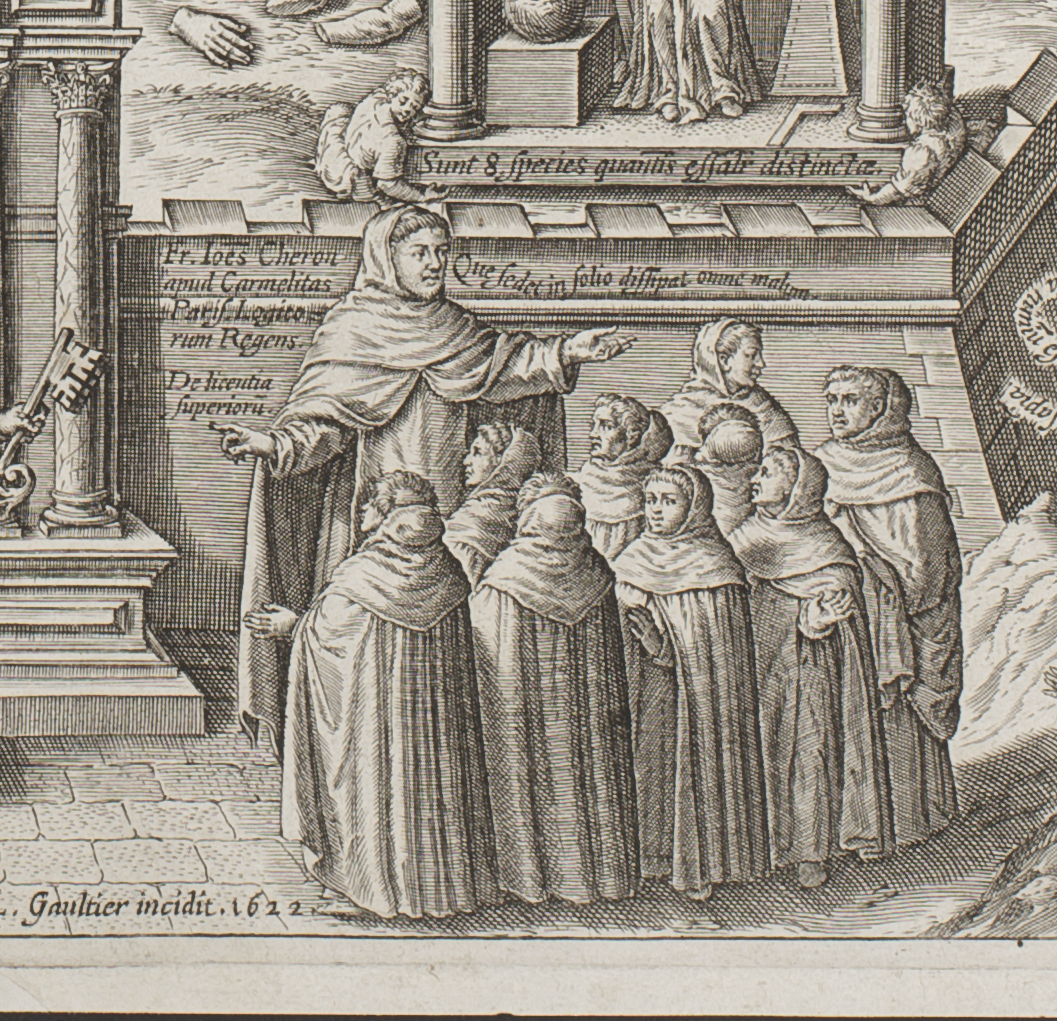
In 1622 the Carmelite professor of logic Jean Chéron (1596–1673) designed an engraving, titled Scheme of the Necessity of Logic for Grasping the Other Branches of Knowledge (Typus necessitatis logicae ad alias scientias capessendas), hereafter Typus, that depicts the human quest to reach wisdom (Fig. 1, above). Throughout this broadside, nearly a hundred small figures stumble along treacherous pathways, scale craggy cliffs, cross wild hunting grounds, and sail through a roiling sea in pursuit of wisdom, represented by a domed temple rising above the waters near top of the page. At the bottom of the scene, Chéron himself stands in his Carmelite habit, surrounded by his students (Fig. 2).

Fig. 2. Chéron and Gaultier, detail showing Chéron and his students from the Typus, 1622. Rare Book Division, Department of Rare Books and Special Collections, Princeton University Library.
He gestures toward the gates of this landscape, which are guarded by Logic, and invites his students to embark on the journey through this portal, because, he advises them, a mastery of logic is needed for the discovery of wisdom (Fig. 3).

Fig. 3. Detail showing Logic from the Typus, 1622. Rare Book Division, Department of Rare Books and Special Collections, Princeton University Library.
For Chéron’s students at his Carmelite monastery in Paris, this detailed chorographic map depicted the fictional region they would have to cross through as they followed the road of intellectual discovery in pursuit of knowledge. The smaller images within this realm are juxtaposed with fragments of biblical and philosophical texts to depict and to interpret the tools students required in their attempt to master logic and thus to find wisdom.
Produced in collaboration with the engraver Léonard Gaultier (1560/61–1635) and published by Jean Messager (1572–1649), the document was employed by Chéron and his students as a thesis print, a genre of broadside that featured the theses or propositions to be discussed at oral examinations called disputations. The Typus and a collection of other wonderfully intricate philosophical broadsides are at the center of my book, The Art of Philosophy: Visual Thinking in Europe from the Late Renaissance to the Early Enlightenment.
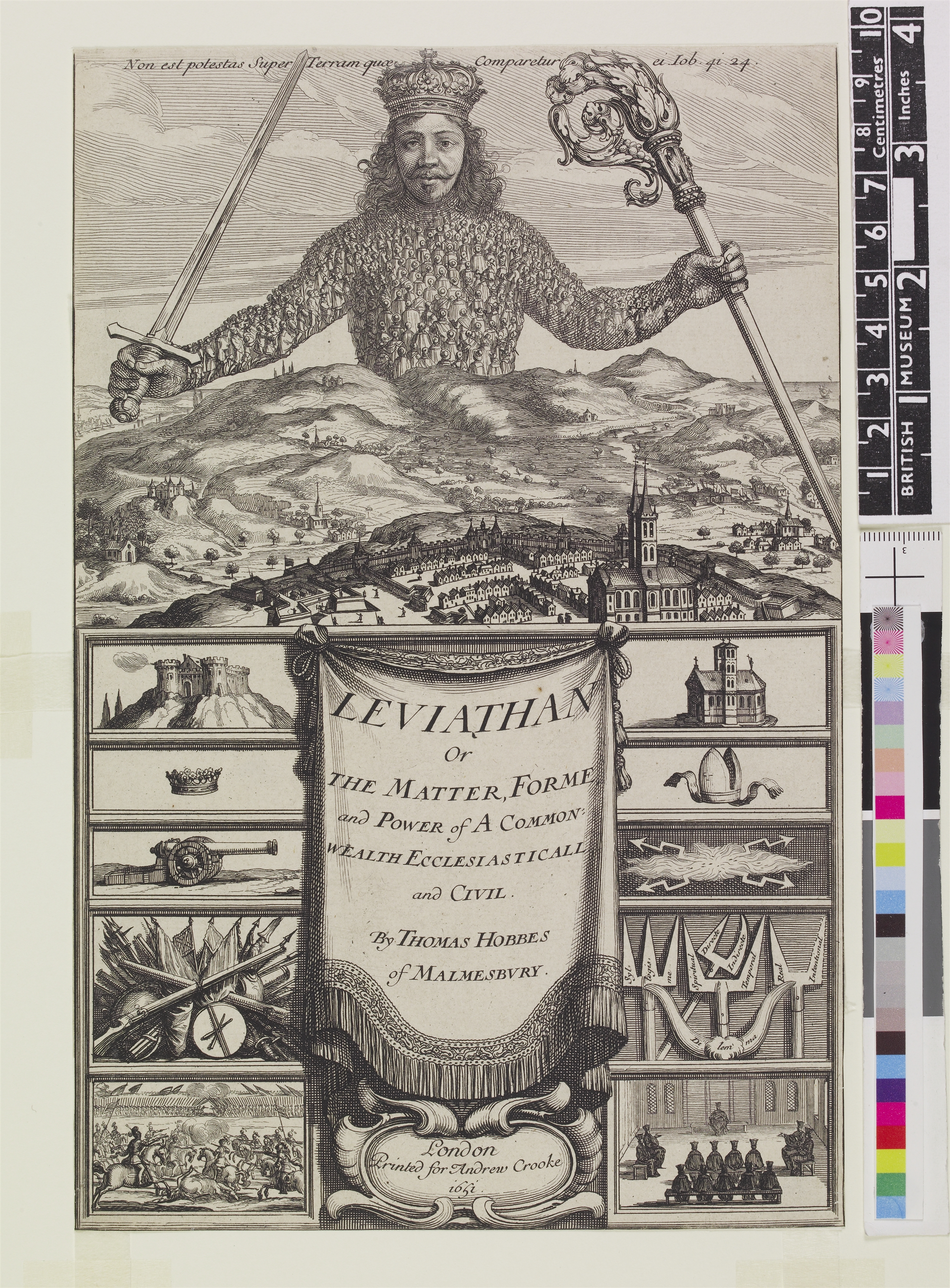
I show how their inventive iconography inspired new visualizations of thought in a range of drawn and printed sources, including student lecture notebooks, printed books, and alba amicorum (friendship albums). The book culminates with a new study of the celebrated frontispiece to Hobbes’s Leviathan (Fig. 4). I argue that previous accounts of the print have failed to capture the full complexity of this etching and offer a new, if complex, account of this famous image—one which emphasizes the process of the state’s generation. Artists and philosophers invested significant amounts of time and money in the creation of philosophical visual representations and we must take these contributions to their thought seriously if we wish to understand their ideas in all their complexity and richness.

Fig. 4. Bosse and Hobbes, frontispiece to Leviathan (London: Andrew Crooke, 1651). Etching on paper, 9.5 (trimmed) x 6.1 in. (24.1 x 15.5 cm). British Museum, London.
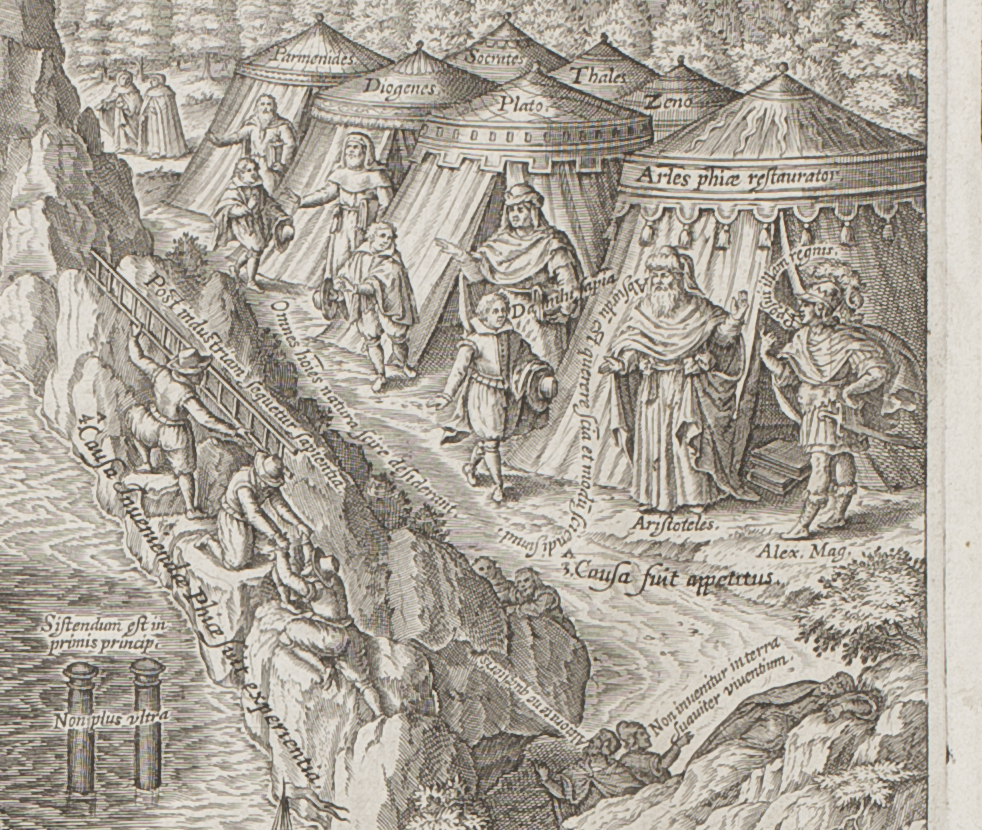
In representing the field of logic through a map of diverse terrains, the Typus offers both a visual commentary on the tenets of Aristotelian scholastic philosophy as they were taught in early modern France, and an allegorical depiction of the strenuous intellectual process of the search for understanding, as well as the perils of laziness and the incorrect applications of philosophy. The print unequivocally promotes the philosophy of Aristotle, who stands at the top of the pathway on the right before a military tent that is inscribed, “Aristotle restorer of philosophy” (Aristoteles philosophiae restaurator) (Fig. 5).

Fig. 5. Detail showing Aristotle from the Typus, 1622. Rare Book Division, Department of Rare Books and Special Collections, Princeton University Library.
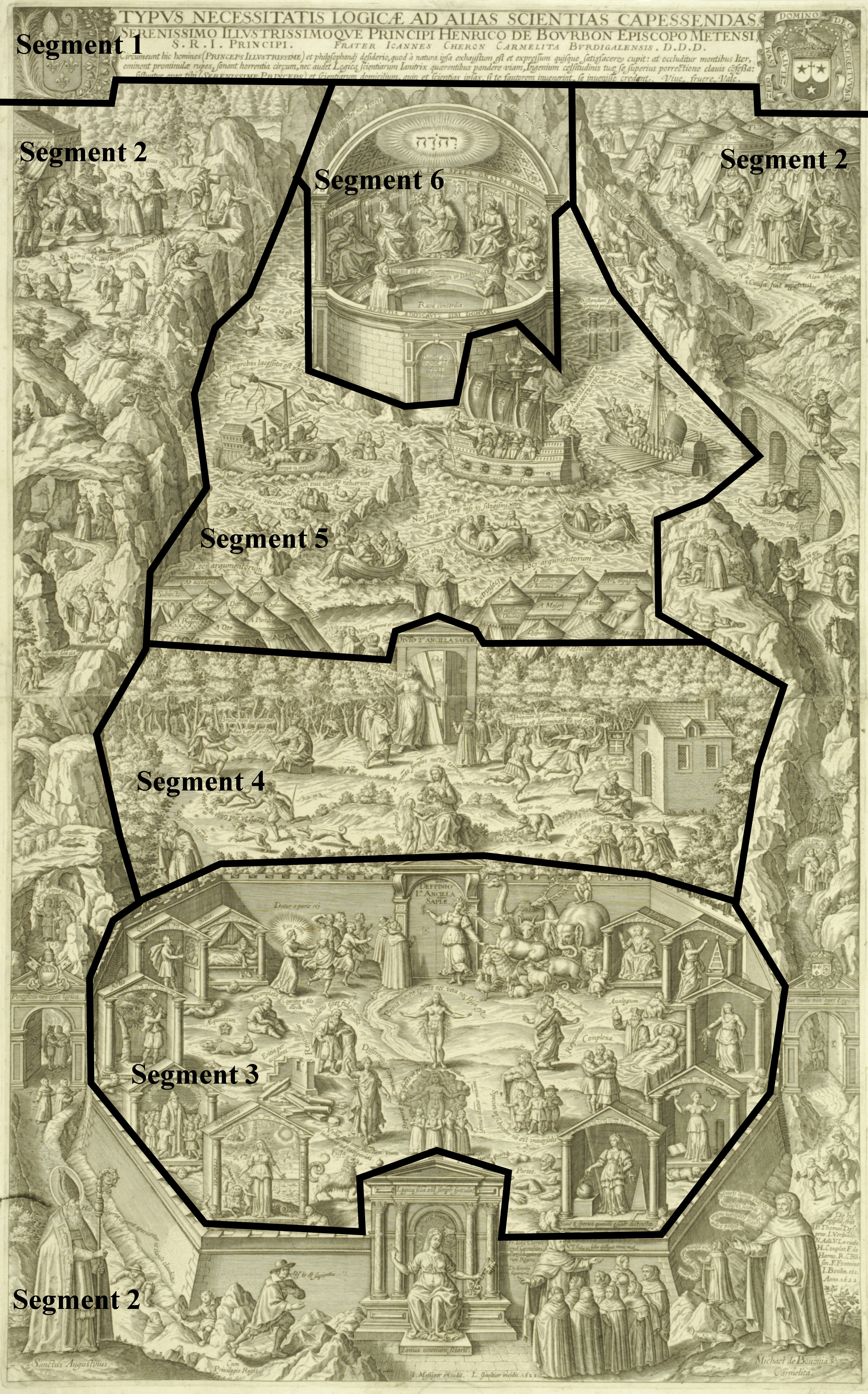
Logic instruction in early seventeenth-century Paris was based primarily on the compendium of Aristotle’s texts called the Organon and the philosopher Porphyry’s treatise known as the Isagoge. This material was organised according to three principle intellectual processes known as the operations of the mind. The Typus is similarly arranged in three main sections that correspond to these operations. Through apprehension, the first operation of the mind, the conception of an object or term is brought to the mind. It is through judgment, the second operation of the mind, that simple concepts are divided or combined to form propositions. By way of the third operation, the mind organizes the propositions to produce syllogisms or arguments. So, for instance, the first operation of the mind could apprehend the concepts of “Chéron” and of “Carmelite,” and then the second operation could combine those two concepts into the proposition “Chéron is a Carmelite,” and then finally the third operation of the mind could combine this proposition with another to produce the following syllogism: Chéron is a Carmelite/ All Carmelites are Catholic/ Therefore, Chéron is a Catholic.
To clarify this analysis I have divided the image into numbered segments (Fig. 6).

Fig. 6. The six segments of the Typus, 1622. Rare Book Division, Department of Rare Books and Special Collections, Princeton University Library.
The viewer was expected to begin contemplating the broadside in segment one by reading its title and then its dedication to Henri de Bourbon (1601–1682), the illegitimate son of Henri IV.
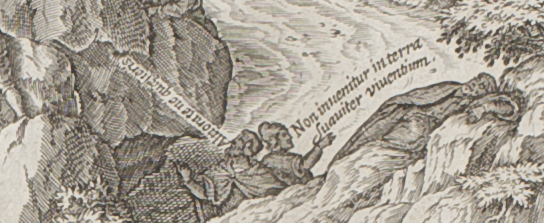
The figures descending the pathways in segment two head towards the gate guarded by Logic. These pathways act as a framing device that directs the spectator’s gaze from the top of the broadside to the entrance to the courtyard at the bottom. The figures on the pathways remind students of the importance of learning Aristotelian logic. For instance, a little below Aristotle, two men stand beside a third who sleeps on a rock (Fig. 7).

Fig. 7. Detail on the dangers of laziness from the Typus, 1622. Rare Book Division, Department of Rare Books and Special Collections, Princeton University Library.
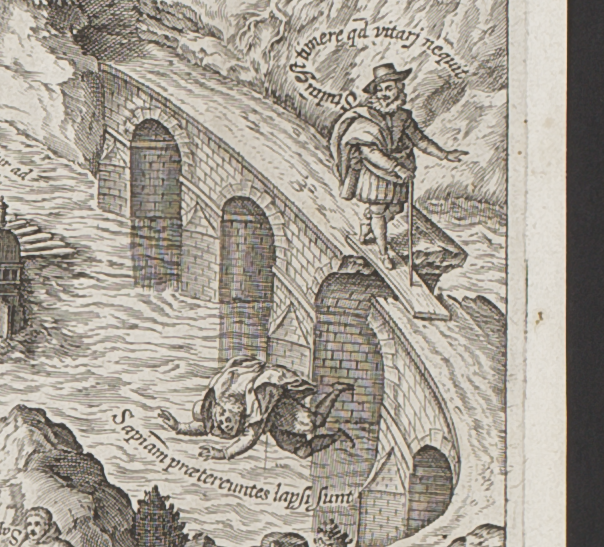
The figure nearest the sleeping man says, “It [i.e. wisdom] is not found in the land of them that live in delights.” (Non invenitur in terra suaviter viventium.)[1] Further down the pathway, a man falls off a bridge into the water (Fig. 8).

Fig. 8. Detail on the dangers of disregarding wisdom from the Typus, 1622. Rare Book Division, Department of Rare Books and Special Collections, Princeton University Library.
Near the falling man Chéron includes an annotation explaining the cause of his demise: “For regarding not wisdom, they have slipped” (Sapientiam praetereuntes lapsi sunt).[2] In these images, Chéron admonishes his students to remain actively engaged in their studies and not to act foolishly or lazily.
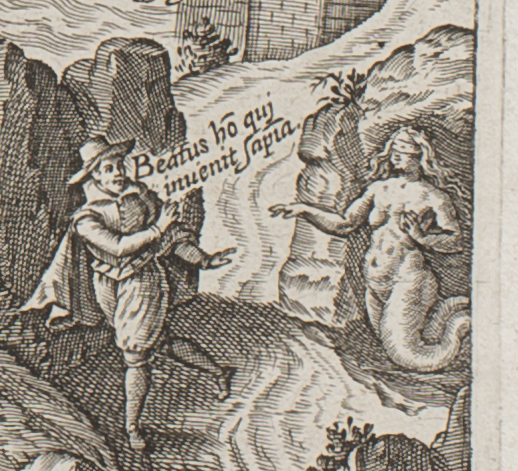
Chéron also warns his students about the dangers of distractions of the flesh. Below a man runs from a blindfolded siren, declaring, “Blessed is the man that findeth wisdom” (Beatus homo qui invenit sapientiam) (Fig. 9).[3]

Fig. 9. Detail on the dangers of distractions of the flesh from the Typus, 1622. Rare Book Division, Department of Rare Books and Special Collections, Princeton University Library.
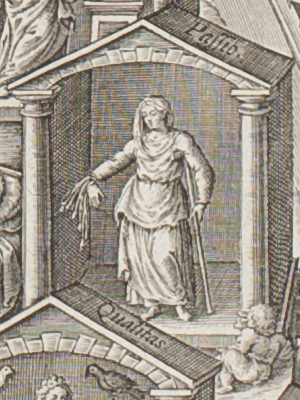
Those scholars who have not yet fallen asleep, lost their footing, or given into temptation along their journey will pass through the gates of Logic, where they enter what we can identify as the third segment of the broadside, a courtyard that illustrates the first operation of the mind. Inside ten porticoes along the inner walls of the enclosure, Chéron stages scenes interpreting the meanings of each of Aristotle’s ten categories, which are the different types of concepts apprehended through the first operation of the mind. For instance, the category of “being affected” (Passio) is represented by a woman whose arm has been severed (Fig. 10).

Fig. 10. Detail on the category of “being affected” from the Typus, 1622. Rare Book Division, Department of Rare Books and Special Collections, Princeton University Library.
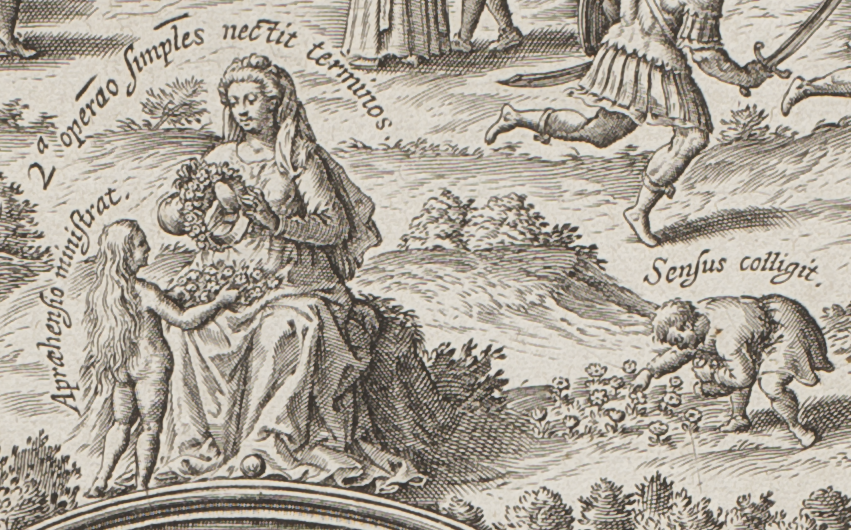
Having made their way through this courtyard, the studious scholar reaches segment four, a valley that encapsulates the workings of the second operation of the mind. A woman, boy, and girl at the bottom center of the field illustrate how the intellect obtains, processes, and organizes sensory data (Fig. 11).

Fig. 11. Detail on how the intellect obtains, processes, and organizes sensory data from the Typus, 1622. Rare Book Division, Department of Rare Books and Special Collections, Princeton University Library.
Scholastic Aristotelian philosophers held that the intellect does not receive information from the five external senses directly. Once the senses have gathered information from the outside world, it must be processed or apprehended, through the first operation of the mind, before it can be divided and combined into propositions, through the second operation of the mind. A woman, boy, and girl at the center of the field show this process. The young boy personifies the five external Senses; he picks flowers, beside the words, “The senses collect” (Sensus colligit). The flowers symbolize things that humans become aware of through the senses. The naked young girl, who stands at the knee of the seated woman, is identified as Apprehension with the words, “Apprehension acts as assistant” (Ap[p]rehensio ministrat.). Apprehension “assists” with processing sensory information. The seated woman personifies the Second Operation of the mind. Above her is the inscription, “The second operation binds simple terms” (2A operatio simplices nectit terminos.) The boy gives his flowers to Apprehension, who in turn hands them over to the Second Operation, who binds the flowers together to create a wreath, a metaphor for the combining of concepts into propositions.
Beyond this valley, in the fifth segment of the broadside, is an interpretation of the third operation of the mind, or the mind’s ability to combine propositions into syllogisms, depicted across a seascape that incorporates imagery of seafaring and military battle. Chéron and Gaultier show a female with three faces who personifies the three kinds of Syllogism (Fig. 12): syllogisms that result in knowledge, opinions, and errors. The syllogisms that result in knowledge are summarized on a galleon, a large multi-decked sailing ship that could withstand a major ocean crossing.

Fig. 12. Detail showing the personification of the three kinds of Syllogism from the Typus, 1622. Rare Book Division, Department of Rare Books and Special Collections, Princeton University Library.
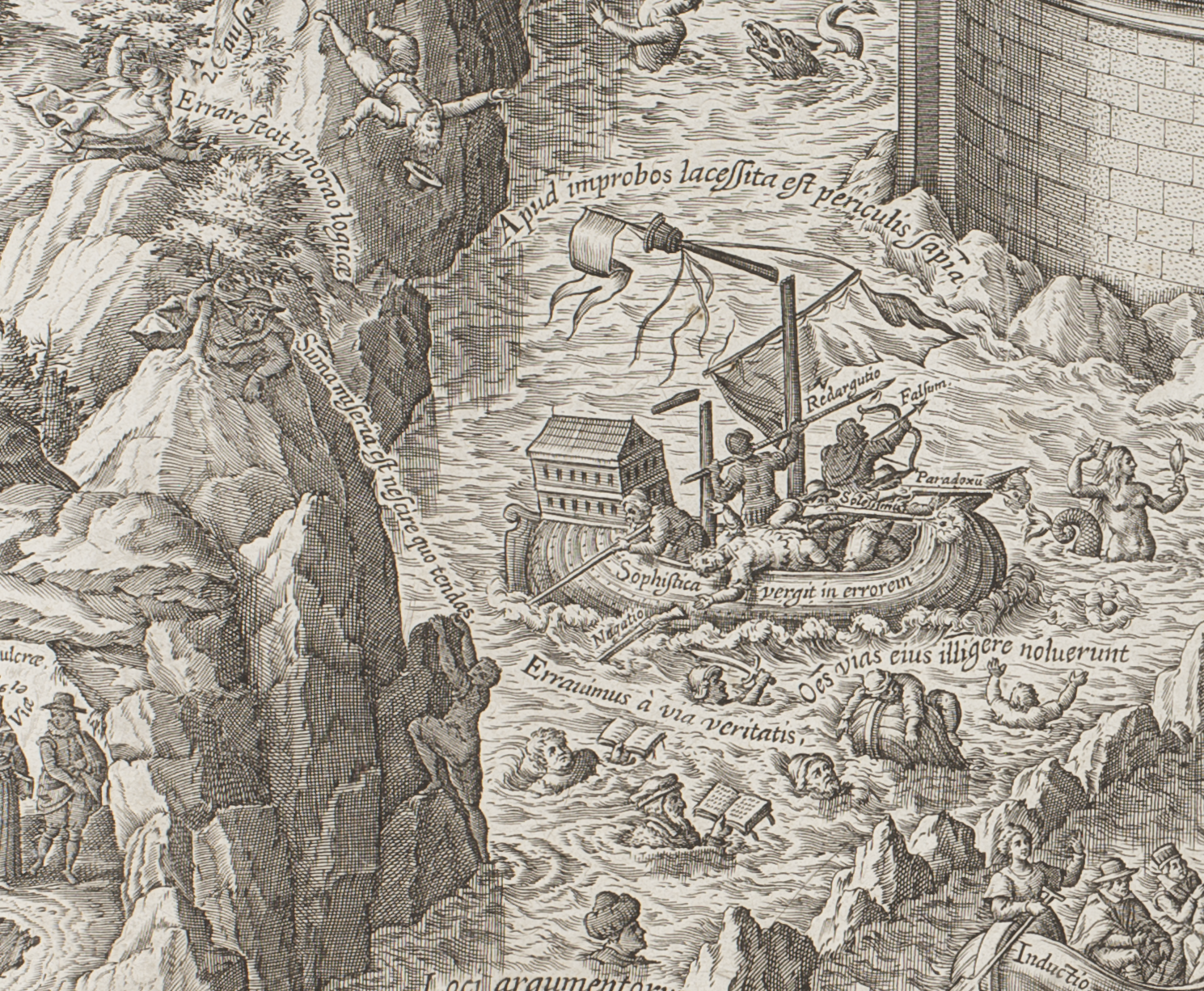
Sophistic methods of argumentation are represented by the sailboat furthest to the left (Fig. 13).

Fig. 13. Detail on sophistic methods of argumentation from the Typus, 1622. Rare Book Division, Department of Rare Books and Special Collections, Princeton University Library.
An inscription marks Sophists as steering the boat: “Sophistry tends into error” (Sophistica vergit in errorem). Above the Sophists’ boat is an annotation stressing, “Among the wicked is a wisdom attacked by dangers” (Apud improbos lacessita est periculis sapientia).[4] Seven men drown beside the boat; an inscription reveals that they know they are suffering the consequences of Sophistry: “We have erred from the way of truth” (Erravimus a via veritatis),[5] Another inscription stresses their ignorance: “They did not want to understand all her [i.e. Wisdom’s] ways” (Omnes vias eius intelligere noluerunt.)[6] An inscription next to the mouth of a man who peeks down at the drowning Sophists from the rocky cliff above betrays his awareness that the Sophists have lost their way to wisdom: “The greatest misery is not knowing to where you are heading.” (Summa miseria est nescire quo tendas,) Another figure on the cliff observes a man falling into the water; an inscription next to the observer warns students of the dangers of living without a knowledge of logic: “Ignorance of logic made [him] wander astray” (Errare fecit ignoratio logicae.)
Those who survive the waters travel onwards to the edifice in segment six (Fig. 14).

Fig. 14. Detail showing the home of Wisdom from the Typus, 1622. Rare Book Division, Department of Rare Books and Special Collections, Princeton University Library.
This building, shown in cross-section to reveal its interior, is marked as the home of Wisdom. In the front of the temple, two monks debate whether voluntary action is an act of the will or the intellect. Five women, seated in a row, observe the debate. In the center sits Philosophy, holding a book and a cornucopia of flowers. The text near her mouth stresses both her positioning at the top of the Typus and her close ties to wisdom: “I inhabit wisdom in the highest places” (Ego sap[ient]iam in altissimis habito). The wall above Philosophy and her companions bears the words, “Philosophy is divided into four general species, namely into” (PHILOSOPHIA DIVIDITVR IN 4 SPECIES GENERALES SCILICET IN) introducing the disciplines personified to Philosophy’s left and right. The left-most figure is Mathematics, who draws on a tablet with a compass. Next to Mathematics sits Theology with a book—almost certainly the Bible—in her lap and a dove above her that symbolizes inspiration. Theology points upwards to refer to the dove and higher powers. To the right of Philosophy is Physics with an opened book on her lap, holding a sun with a face in her right hand. The right-most woman personifies Ethics; she holds a burning heart and has a book resting on her lap. With this representation of the home of wisdom Chéron places great emphasis on the value of studying logic in order to gain wisdom in other disciplines.
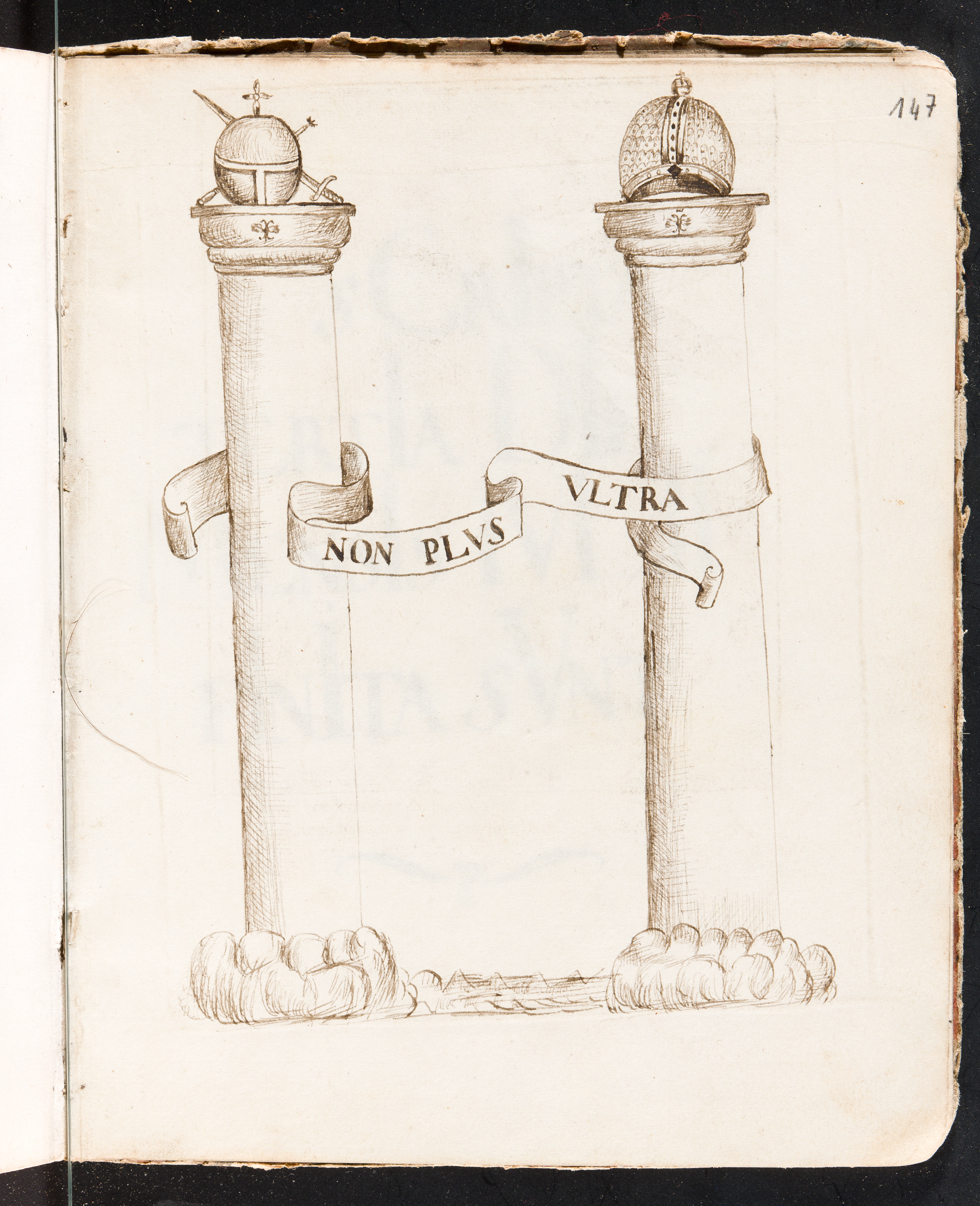
Chéron and Gaultier’s strict pedagogical perspective is confirmed by a detail in the upper right region of the broadside, where the words “Non plus ultra” (or “Nothing further beyond”) appear across a pair of columns emerging from the water (see Fig. 14). These are the columns that Hercules was thought to have erected at the Straits of Gibraltar, or the end of the known world, as a warning to sailors not to venture into uncharted waters. The columns also figure in at the end of the lecture notes of seventeenth-century philosophy students from the University of Leuven (Fig. 15).

Fig. 15. Drawing of the columns of Hercules in the notebook of van Cantelbeke. 7.8 x 6.3 in. (19.8 x 16 cm) KU Leuven [Ms. 205, fol. 147r].
Chéron and Gaultier designed their philosophical image to be read in a generally linear progression that concludes at the top of the page; the columns, at the upper right of the broadside, are depicted at the end of the students’ philosophical journey. Chéron and Gaultier present the columns as markers of the ending of studies of logic. Perhaps even more is implied by these columns: that the doctrine of logic is completed and nothing can be added to it; that whosoever ventures beyond Aristotle will drown.
* * *notes* * *
[1] Book of Job 28:13.
[2] Book of Wisdom 10:8.
[3] Book of Proverbs 3:13.
[4] This quotation is a paraphrase of Boethius, Consolatio philosophiae, I.3.
[5] Book of Wisdom 5:6.
[6] Book of Job 34:27.
Based on THE ART OF PHILOSOPHY: Visual Thinking in Europe from the Late Renaissance to the Early Enlightenment by Susanna Berger. Copyright © 2017 by Princeton University Press.

The Six-Day War: An Inevitable Conflict
Defense Minister Moshe Dayan, Chief of staff Yitzhak Rabin, Gen. Rehavam Zeevi (R) And Gen. Narkis in the old city of Jerusalem, June 7 1967, photo by Ilan Bruner, GPO
It has long been conventional wisdom to view the June 1967 war as an accidental conflagration that neither Arabs nor Israelis desired, yet none were able to prevent. This could not be further from the truth. Its specific timing resulted of course from the convergence of a number of particular causes at a particular juncture. But its general cause—the total Arab rejection of Jewish statehood—made another all-out Arab-Israeli war a foregone conclusion.
The standard narrative regarding the Six-Day War runs as follows: Had Egyptian president Gamal Abdel Nasser not fallen for a false Soviet warning of Israeli troop concentrations along the Syrian border and deployed his forces in the Sinai Peninsula, the slippery slope to war would have been averted altogether. Had Israel not misconstrued Egyptian grandstanding for a mortal threat to its national security, if not its very survival, it would have foregone the preemptive strike that started the war. In short, it was a largely accidental and unnecessary war born of mutual miscalculations and misunderstandings.
This view could not be further from the truth. If wars are much like road accidents, as the British historian A.J.P. Taylor famously quipped, having a general cause and particular causes at the same time, then the June 1967 war was anything but accidental. Its specific timing resulted of course from the convergence of a number of particular causes at a particular juncture. But its general cause—the total Arab rejection of Jewish statehood, starkly demonstrated by the concerted attempt to destroy the state of Israel at birth and the unwavering determination to rectify this “unfinished business”—made another all-out Arab-Israeli war a foregone conclusion.
Pan-Arabism’s Politics of Violence
No sooner had the doctrine of pan-Arabism, postulating the existence of “a single nation bound by the common ties of language, religion and history…. behind the facade of a multiplicity of sovereign states” come to dominate inter-Arab politics at the end of World War I than anti-Zionism became its most effective rallying cry: not from concern for the wellbeing of the Palestinian Arabs but from the desire to fend off a supposed foreign encroachment on the perceived pan-Arab patrimony. As Abdel Rahman Azzam, secretary-general of the Arab League, told Zionist officials in September 1947:
For me, you may be a fact, but for [the Arab masses], you are not a fact at all—you are a temporary phenomenon. Centuries ago, the Crusaders established themselves in our midst against our will, and in 200 years, we ejected them. This was because we never made the mistake of accepting them as a fact.
On rare occasions, this outright rejectionism was manifested in quiet attempts to persuade the Zionist leaders to forego their quest for statehood and acquiesce in subject status within a regional pan-Arab empire. Nuri Said, a long-time Iraqi prime minister, made this suggestion at a 1936 meeting with Chaim Weizmann while Transjordan’s King Abdullah of the Hashemite family secretly extended an offer to Golda Meir (in November 1947 and May 1948) to incorporate Palestine’s Jewish community into the “Greater Syrian” empire he was striving to create at the time. For most of the time, however, the Arabs’ primary instrument for opposing Jewish national aspirations was violence, and what determined their politics and diplomacy was the relative success or failure of that instrument in any given period. As early as April 1920, pan-Arab nationalists sought to rally support for incorporating Palestine into the short-lived Syrian kingdom headed by Abdullah’s brother, Faisal, by carrying out a pogrom in Jerusalem in which five Jews were murdered and 211 wounded. The following year, Arab riots claimed a far higher toll: some 90 dead and hundreds wounded. In the summer of 1929, another wave of violence resulted in the death of 133 Jews and the wounding of hundreds more.
For quite some time, this violent approach seemed to work. It was especially effective in influencing the British, who had been appointed the mandatory power in Palestine by the League of Nations. Though their explicit purpose was to facilitate the establishment of a Jewish national home in Palestine, the British authorities repeatedly gave in to Arab violence aimed at averting that purpose and to the demands that followed upon it. In two White Papers, issued in 1922 and 1930 respectively, London severely compromised the prospective Jewish national home by imposing harsh restrictions on immigration and land sales to Jews.
In July 1937, Arab violence reaped its greatest reward when a British commission of inquiry, headed by Lord Peel, recommended repudiating the terms of the mandate altogether in favor of partitioning Palestine into two states: a large Arab state, united with Transjordan, that would occupy some 90 percent of the mandate territory, and a Jewish state in what was left. This was followed in May 1939 by another White Paper that imposed even more draconian restrictions on Jewish immigration and land purchases, closing the door to Palestine for Jews desperate to flee Nazi Europe and threatening the survival of the Jewish national project. Agitating for more, the Arabs dismissed both plans as insufficient.
They did the same in November 1947 when, in the face of the imminent expiration of the British mandate, the U.N. General Assembly voted to partition Palestine. Rejecting this solution, the Arab nations resolved instead to destroy the state of Israel at birth and gain the whole for themselves. This time, however, Arab violence backfired spectacularly. In the 1948-49 war, not only did Israel confirm its sovereign independence and assert control over somewhat wider territories than those assigned to it by the U.N. partition resolution, but the Palestinian Arab community was profoundly shattered with about half of its population fleeing to other parts of Palestine and to neighboring Arab states.
Preparing for the “Second Round”
For the next two decades, inter-Arab politics would be driven by the determination to undo the consequences of the 1948 defeat, duly dubbed “al-Nakba,” the catastrophe, and to bring about Israel’s demise. Only now, it was Cairo rather than the two Hashemite kings that spearheaded the pan-Arab campaign following Nasser’s rise to power in 1954 and his embarkation on an aggressive pan-Arab policy.
The Egyptian president had nothing but contempt for most members of the “Arab Nation” he sought to unify: “Iraqis are savage, the Lebanese venal and morally degenerate, the Saudis dirty, the Yemenis hopelessly backward and stupid, and the Syrians irresponsible, unreliable and treacherous,” he told one of his confidants. Neither did he have a genuine interest in the Palestinian problem—pan-Arabism’s most celebrated cause: “The Palestinians are useful to the Arab states as they are,” he told a Western journalist in 1956. “We will always see that they do not become too powerful. Can you imagine yet another nation on the shores of the eastern Mediterranean!” Yet having recognized the immense value of this cause for his grandiose ambitions, he endorsed it with a vengeance, especially after the early 1960s when his pan-Arab dreams were in tatters as Syria acrimoniously seceded from its bilateral union with Egypt (1958-61) and the Egyptian army bogged down in an unwinnable civil war in Yemen. “Arab unity or the unity of the Arab action or the unity of the Arab goal is our way to the restoration of Palestine and the restoration of the rights of the people of Palestine,” Nasser argued. “Our path to Palestine will not be covered with a red carpet or with yellow sand. Our path to Palestine will be covered with blood.”
By way of transforming this militant rhetoric into concrete plans, in January 1964, the Egyptian president convened the first all-Arab summit in Cairo to discuss ways and means to confront the “Israeli threat.” A prominent item on the agenda was the adoption of a joint strategy to prevent Israel from using the Jordan River waters to irrigate the barren Negev desert in the south of the country. A no less important decision was to “lay the proper foundations for organizing the Palestinian people and enabling it to fulfill its role in the liberation of its homeland and its self-determination.” Four months later, a gathering of 422 Palestinian activists in East Jerusalem, then under Jordanian rule, established the Palestine Liberation Organization (PLO) and approved its two founding documents: the organization’s basic constitution and the Palestinian National Covenant.
These events made Nasser yet again the undisputed leader of the Arab world, the only person capable of making the Arabs transcend, however temporarily, their self-serving interests for the sake of the collective good. He was nowhere near his cherished goal of promoting the actual unification of the Arab world under his leadership as he had seemingly been in 1958 when Syria agreed to merge with Egypt. Yet he had successfully hijacked pan-Arabism’s most celebrated cause and established a working relationship with his erstwhile enemies in Amman and Riyadh. In a second summit meeting in Alexandria in October 1964, the heads of the Arab states accepted Nasser’s long-term, anti-Israel strategy. This envisaged the laying of the groundwork for the decisive confrontation through the patient buildup of Arab might in all areas—military, economic, social, and political—and the simultaneous weakening of Israel through concrete actions such as the diversion of the Jordan River estuaries. The PLO was authorized to create an army of Palestinian volunteers, to which the Arab governments pledged to give support, and a special fund was established for the reorganization of the Lebanese, Syrian, and Jordanian armies under a united Arab command.
The Slide to War
Before long, this organized pan-Arab drive for Israel’s destruction was disrupted by an unexpected sequence of events that led, within a few weeks, to the third Arab-Israeli war since 1948; and the event that triggered this escalation was a Soviet warning (in early May 1967) of large-scale Israeli troop concentrations along the border with Syria aimed at launching an immediate attack. As pan-Arabism’s standard-bearer, Nasser had no choice but to come to the rescue of a (supposedly) threatened ally tied to Egypt in a bilateral defense treaty since November 1966, especially when the pro-Western regimes in Jordan and Saudi Arabia were openly ridiculing his failure to live up to his high pan-Arab rhetoric. On May 14, the Egyptian armed forces were placed on the highest alert, and two armored divisions began moving into the Sinai Peninsula, formally demilitarized since the 1956 Suez war. That same day, the Egyptian chief of staff, Lt.-Gen. Muhammad Fawzi, arrived in Damascus to get a first-hand impression of the military situation and to coordinate a joint response in the event of an Israeli attack. To his surprise, Fawzi found no trace of Israeli concentrations along the Syrian border or troop movements in northern Israel. He reported these findings to his superiors, but this had no impact on the Egyptian move into Sinai, which continued apace. Fawzi was to recall in his memoirs,
From that point onward, I began to believe that the issue of Israeli concentrations along the Syrian border was not … the only or the main cause of the military deployments which Egypt was undertaking with such haste.
Within less than twenty-four hours, Nasser’s objective had been transformed from the deterrence of an Israeli attack against Syria into an outright challenge to the status quo established after the 1956 war. With Fawzi’s reassuring findings corroborated both by Egyptian military intelligence and by a special U.N. inspection, and the Israelis going out of their way to reassure the Soviets that they had not deployed militarily along their northern border, Nasser must have realized that there was no imminent threat to Syria. He could have halted his troops at that point and claimed a political victory, having deterred an (alleged) Israeli attack against Syria.
But it is precisely here that the Arab-Israeli conflict’s general cause—rejection of Israel’s very existence—combined with the particular causes to make war inevitable as Nasser’s resolute move catapulted him yet again to a position of regional preeminence that he was loath to relinquish. At a stroke, he had managed to undo one of Israel’s foremost gains in the 1956 war—the de facto demilitarization of the Sinai Peninsula—without drawing a serious response from Jerusalem. Now that the Egyptian troops were massing in Sinai, Nasser decided to raise the ante and eliminate another humiliating remnant of that war for which he had repeatedly been castigated by his rivals in the Arab world: the presence of a U.N. Emergency Force (UNEF) on Egyptian (but not on Israeli) territory as a buffer between the two states.
As the U.N. observers were quickly withdrawn and replaced by Egyptian forces, Nasser escalated his activities still further. Addressing Egyptian pilots in Sinai on May 22, he announced the closure of the Strait of Tiran, at the southern mouth of the Gulf of Aqaba, to Israeli and Israel-bound shipping. “The Gulf of Aqaba constitutes our Egyptian territorial waters,” he announced to the cheers of an ecstatic audience. “Under no circumstances will we allow the Israeli flag to pass through the Aqaba Gulf.” The following day the Egyptian mass media broke the news to the entire world.
Did Nasser consider the possibility that his actions might lead to war? All the available evidence suggests that he did. Initially, when he briefly believed in the imminence of an Israeli attack against Syria, he could not have taken for granted that the Egyptian deployment in Sinai would have deterred such an action, in which case he would have been forced to come to Syria’s defense. Moreover, the demilitarization of Sinai was seen by Israel as vital to its national security, which made its violation a legitimate casus belli. But then, Nasser was being rapidly entrapped by his imperialist ambitions. He began deploying his troops in Sinai out of fear that failure to do so would damage his pan-Arab position beyond repair. He continued to escalate his activities, knowing full well that there was no threat of an Israeli attack against Syria, because of his conviction that the continuation of the crisis boosted his pan-Arab standing.
It is true that the lack of a prompt and decisive Israeli response to the Egyptian challenge, together with the quick realization that there were no Israeli concentrations along the Syrian border, might have convinced Nasser that the risks were not so great and that war was not inevitable. Yet, when he decided to remove UNEF and to close the Strait of Tiran, Nasser undoubtedly knew that he was crossing the threshold from peace to war. “Now with our concentrations in Sinai, the chances of war are fifty-fifty,” he told his cabinet on May 21, during a discussion on the possible consequences of a naval blockade. “But if we close the Strait, war will be a 100 percent certainty.” “We all knew that our armaments were adequate—indeed, infinitely better than in the October 1973 War,” recalled Anwar Sadat, who participated in that crucial meeting:
When Nasser asked us our opinion, we were all agreed that the Strait should be closed—except for [Prime Minister] Sidqi Sulayman, who pleaded with Nasser to show more patience … [But] Nasser paid no attention to Sulayman’s objections. He was eager to close the Strait so as to put an end to the Arab maneuverings and maintain his great prestige within the Arab world.
The die was cast. Having maneuvered himself yet again into the driver’s seat of inter-Arab politics, Nasser could not climb down without risking a tremendous loss of face. He was approaching the brink with open eyes, and if there was no way out of the crisis other than war, so be it: Egypt was prepared. Daily consultations between the political and the military leaderships were held. The Egyptian forces in Sinai were assigned their operational tasks. In a widely publicized article in al-Ahram on May 26, the newspaper’s editor-in-chief, Nasser’s mouthpiece, Muhammad Hassanein Heikal, explained why war between Egypt and Israel was inevitable. A week later, at a meeting with the armed forces’ supreme command, Nasser predicted an Israeli strike against Egypt within forty-eight to seventy-two hours at the latest.
The coming of war is seldom a happy occasion. It is often fraught with misgivings and apprehensions. But if doubts assailed Nasser’s peace of mind, he gave them no public expression. The Egyptian war preparations were carried out in a confident and ever-extravagant fashion, in front of the watching eyes of the world media. The closer Nasser came to the brink, the more aggressive he became. “The Jews have threatened war,” he gloated in his May 22 speech, “We tell them: You are welcome; we are ready for war.” Four days later, he took a big step forward, announcing that if hostilities were to break out, “our main objective will be the destruction of Israel.” “Now that we have the situation as it was before 1956,” Nasser proclaimed on another occasion, “Allah will certainly help us to restore the status quo of before 1948.”
Once again imperialist pan-Arab winds were blowing. “This is the real rising of the Arab nation,” Nasser boasted while the few skeptics within the Egyptian leadership were being rapidly converted to belief in victory over Israel. In the representative words of Naguib Mahfouz, Egypt’s foremost writer and winner of the 1988 Nobel Prize:
When Nasser held his famous press conference, before the June 1967 war, and spoke with confident pomp, I took our victory over Israel for granted. I envisaged it as a simple journey to Tel Aviv, of hours or days at the most, since I was convinced we were the greatest military power in the Middle East.
By this time, the conflict was no longer about the presence of U.N. forces on Egyptian soil or freedom of navigation in the Gulf of Aqaba, let alone the alleged Israeli threat to Syria. It had been transformed into a jihad to eradicate the foremost “remnant of Western imperialism” in the Middle East. “During the crusaders’ occupation, the Arabs waited seventy years before a suitable opportunity arose, and they drove away the crusaders,” Nasser echoed Azzam’s 1947 rhetoric, styling himself as the new Saladin: “[R]ecently we felt that we are strong enough, that if we were to enter a battle with Israel, with God’s help, we could triumph.”
Nasser’s militancy was contagious. The irritating chorus of criticism had fallen silent. His former Arab rivals were standing in line to rally behind his banner. On the morning of May 30, Jordan’s King Hussein, who at the beginning of the crisis still mocked Nasser for “hiding behind UNEF’s apron,” arrived in Cairo where he immediately signed a defense pact with Egypt. He returned to Amman later that day accompanied by Ahmad Shuqeiri, head of the PLO and hitherto one of the king’s archenemies. The following day, an Egyptian general arrived in Amman to command the eastern front in the event of war. On June 4, Iraq followed suit by entering into a defense agreement with Egypt, and Nasser informed King Hussein that their pact now included Iraq as well. By this time, Arab expeditionary forces—including an Iraqi armored division, a Saudi and a Syrian brigade, and two Egyptian commando battalions—were making their way to Jordan. The balance of forces, so it seemed to the Arabs, had irreversibly shifted in their favor. The moment of reckoning with the “Zionist entity,” as they pejoratively called Israel, had come. “Have your authorities considered all the factors involved and the consequences of the withdrawal of UNEF?” the commander of the U.N. force, Gen. Indar Jit Rikhye, asked the Egyptian officers bearing the official demand. “Oh yes sir! We have arrived at this decision after much deliberation, and we are prepared for anything. If there is war, we shall next meet at Tel Aviv.” The Iraqi president Abdel Rahman Aref was no less forthright. “This is the day of the battle,” he told the Iraqi forces leaving for Jordan. “We are determined and united to achieve our clear aim—to remove Israel from the map. We shall, Allah willing, meet in Tel Aviv and Haifa.”
The Non-Accidental War
Yet for all his militant zeal, Nasser had weighty reasons to forgo a first strike at this particular time. His war preparations had not been completed: The Egyptian forces in Sinai were still digging in; the Arab expeditionary forces to Jordan had not yet been fully deployed, and coordination of the operational plans of the Arab military coalition required more time. Nasser also feared that an Egyptian attack would trigger a U.S. military response that might neutralize the new Arab political and military superiority over Israel, which had been gained by the most remarkable demonstration of pan-Arab unity since the 1948 war.
Nasser’s fears of U.S. intervention were compounded by the nature of the Egyptian operational plan, which envisaged deep thrusts into Israel’s territory. An armored division was to break out of the Gaza Strip and capture border villages inside Israel while another armored division was to cut off the southern Negev from the rest of Israel, thereby achieving the long-standing Egyptian objective of establishing a land bridge with Jordan. Given Nasser’s belief in the U.S. commitment to Israel’s territorial integrity, such plans could hardly be implemented if Egypt were to take the military initiative. Their execution as an act of self-defense in response to an Israeli attack was a completely different matter, however.
This explains Nasser’s readiness to play the political card, such as his decision to send Vice-President Zakaria Muhieddin to Washington on June 7. He had no intention whatever to give ground, and the move was aimed at cornering Israel and making it more vulnerable to Arab pressure and, eventually, war. Robert Anderson, a special U.S. envoy sent to Egypt to defuse the crisis, reported to President Lyndon Johnson that Nasser showed no sign of backing down and spoke confidently of the outcome of a conflict with Israel.
Anderson was not the only person to have heard this upbeat assessment. Nasser’s belief in Egypt’s ability to absorb an Israeli strike and still win the war was widely shared by the Egyptian military and was readily expressed to the other members of the Arab military coalition. In his May 30 visit to Cairo, King Hussein was assured by Nasser of Egypt’s full preparedness against an Israeli air strike: No more than 15-20 percent losses would be incurred before the Egyptian air force dealt a devastating blow to Israel. The other members of the Jordanian delegation heard equally confident words from Abdel Hakim Amer, Nasser’s deputy and commander of the Egyptian armed forces. When the Egyptian foreign minister Mahmoud Riad asked Amer about the armed forces’ state of readiness, he was told that “if Israel actually carried out any military action against us, I could, with only one third of our forces, reach Beersheba.”
The most eloquent public exposition of this euphoric state of mind was provided by Heikal’s May 26 al-Ahram article on the inevitability of war. “Egypt has exercised its power and achieved the objectives of this stage without resorting to arms so far,” he wrote:
Israel has no alternative but to use arms if it wants to exercise power. This means that the logic of the fearful confrontation now taking place between Egypt, fortified by the might of the masses of the Arab nation, and Israel, bolstered by the illusion of American might, dictates that Egypt, after all it has now succeeded in achieving, must wait, even though it has to wait for a blow. This is necessitated also by the sound conduct of the battle, particularly from an international point of view. Let Israel begin. Let our second blow then be ready. Let it be a knockout.
As it were, the war that broke out on June 5 was not quite the knockout that Heikal had in mind. Instead of dealing Israel a mortal blow, the Egyptians saw their air force destroyed on the ground within three hours of the outbreak of hostilities and their army crushed and expelled from Sinai over the next three days. As Syria, Jordan, and Iraq attacked Israel, their armies were similarly routed. By the time the war was over, after merely six days of fighting, Israel had extended its control over vast Arab territories about five times its own size, from the Suez Canal, to the Jordan River, to the Golan Heights.
Small wonder that Nasser would doggedly shrug off responsibility for the defeat by feigning victimhood and emphatically denying any intention to attack Israel. This claim was quickly endorsed by numerous Western apologists eager to absolve him of any culpability for the war, in what was to become the standard Arab and Western historiography of the conflict. Some went so far in the attempt to exculpate Nasser as to portray him as a mindless creature thriving on hollow rhetoric and malleable in the extreme:
… retired members of the old Revolutionary Command Council wander in and out of meetings and give their opinions; Nasser butts in and nobody pays much attention to him; he takes journalists seriously and revises his intelligence estimate on the basis of their remarks; he is influenced by the casual conversation of diplomats.
Aside from doing a great injustice to Nasser—the charismatic dictator who had heavy-handedly ruled Egypt for over a decade and mesmerized tens of millions throughout the Arabic-speaking world—this description has little basis in reality. As evidenced both by Nasser’s escalatory behavior during the crisis and by captured military documents revealing elaborate plans for an invasion of Israel, the Egyptian president did not stumble into war but orchestrated it with open eyes. He steadily raised his sights in accordance with the vicissitudes in the crisis until he set them on the ultimate pan-Arab objective: the decisive defeat of Israel and, if possible, its destruction.
Conclusion
The June 1967 war was a direct corollary of pan-Arabism’s delusions of grandeur, triggered by the foremost champion of this ideology and directed against its foremost nemesis. It was the second all-out attempt in a generation to abort the Jewish national revival, and it ended in an even greater ignominy than its 1948 precursor. Then, only half of Palestine had been lost. Now the land was lost in its entirety, together with Egyptian and Syrian territories. In 1948, the dividing line between victor and vanquished was often blurred as the war dragged on intermittently for over a year. In 1967, owing to the war’s swift and decisive nature, there was no doubt as to which side was the victor.
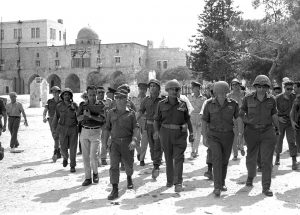
The magnitude of the defeat thus punctured the pan-Arab bubble of denial and suggested to the Arabs that military force had its limits. If the 1967 war was fought with a view to destroying Israel, the next war, in October 1973, launched by Nasser’s successor Anwar Sadat, had the far narrower objective of triggering a political process that would allow Egypt to regain the territories lost in 1967. Israel’s remarkable military recovery in October 1973 after having been caught off-guard further reinforced Sadat’s determination to abandon pan-Arabism’s most celebrated cause and culminated in the Egyptian-Israeli peace treaty of March 1979.
While one can only speculate about Sadat’s ultimate intentions (he was assassinated in October 1981 by an Islamist zealot), there is little doubt that his successor, Hosni Mubarak, viewed peace not as a value in and of itself but as the price Egypt had to pay for such substantial benefits as increased U.S. economic and military aid. So did the Palestine Liberation Organization (PLO), which perceived its 1990s peace agreements with Israel as a pathway not to a two-state solution—Israel alongside a Palestinian state in the West Bank and Gaza living side-by-side in peace—but to the subversion of the state of Israel.
In Arab eyes, then, with the partial exception perhaps of Jordan’s King Hussein, contractual peace with Israel has represented not a recognition of legitimacy but a tacit admission that, at least for the time being, the Jewish state cannot be defeated by force of arms. And while militant pan-Arabism is unlikely to regain its pre-1967 dominance in the foreseeable future due to the ravages of the recent Arab upheavals, the advent of a new generation of Palestinians and Arabs for whom the 1967 defeat is but a dim memory, one more historical injustice that has to be redressed by any means necessary, makes the prospects of Arab-Israeli reconciliation as remote as ever.