Showing posts with label #stephendrus. Show all posts

Sunday, July 8, 2018

Shoah: The Complete Text Of The Acclaimed Holocaust Film Paperback – August 22, 1995 by Claude Lanzmann (Author), Simone de Beauvoir (Introduction) (Da Capo Press)


A nine-and-a-half-hour documentary on the Nazi extermination camps, Shoah (the Hebrew word for "Holocaust") was internationally hailed as a masterpiece upon its release in 1985. Shunning any re-creation, archival footage, or visual documentation of the events, filmmaker Claude Lanzmann relied on the words of witnesses—Jewish, Polish, and German—to describe in ruthless detail the bureaucratic machinery of the Final Solution, so that the remote experiences of the Holocaust became fresh and immediate. This book presents in an accessible and vivid format the testimony of survivors, participants, witnesses, and scholars. This tenth anniversary edition, published on the fiftieth anniversary of the liberation of the camps, is newly revised and corrected in order to more accurately present the actual testimony of those interviewed. Shoah is an unparalleled oral history of the Holocaust, an intensely readable journey through the twentieth century's greatest horror.

Thursday, January 25, 2018

Understanding Fundamentalism: Christian, Islamic and Jewish Movements by Richard T. Antoun Walnut Creek, CA: Alta Mira Press / Rowman & Littlefield Publishers


The Fundamentals of Fundamentalism

The term “fundamentalism” comes from a series of pamphlets entitled The Fundamentals: A Testimony to the Truth published between 1910 and 1915. The point of the pamphlets was to counter the advance of modernism and liberal theology that were seen by conservatives as overtaking American Christianity at the turn of the century. By now, nearly 100 years later, the term has moved beyond its historical meaning and has become a generalized term with a much broader, and much less clearly defined, meaning. It is used, almost promiscuously, as a general description of movements of any type, Western or Eastern, that use religious language, rhetoric and imagery as part of their protest against the prevailing political and/or social reality of their situation. So we talk of Christian fundamentalists in North America in connection with advocating, say, prayer in the public schools; Jewish fundamentalists in Israel in connection with demands that major thoroughfares be closed on the Sabbath; Islamic fundamentalists in connection with sending suicide bombers into Israel; and even Hindu fundamentalists in connection with battling Muslims in India regarding who controls certain sacred ground. It seems to me that it is still an open question as to whether or not all these diverse events really share some common feature that legitimates their all being gathered under the label of “fundamentalism.” But the unquestioned assumption of the book before us is that all of these are indeed instances of “fundamentalism” and that they do share some feature, or rather set of features, in common. The book sets out to identify what that shared set of features might be.

The book, to my mind, fails at some foundational level. The reason is that the author, an anthropologist who did some field work in a Jordanian village, too often lets description, even some fairly thick description, substitute for explanation. This is not to diminish the importance of his descriptive work. Antoun has a good anthropological eye and he does help us see the inner dynamics of many of his encounters, whether with a village preacher in Jordan, a teacher at Bethany Baptist Academy in America, Afrikaner celebrants of the Day of the Covenant in South Africa or the life of a Haredi (ultra-Orthodox) community in Israel. What is lacking is any deeper analysis as to what these diverse descriptions might be pointing to at a more rudimentary level and any discussion of what deeper structural or semiotic features they share under the surface.

This is not to say the book is without any methodological foundation. In his Introduction, Antoun, in good anthropological practice, tells us a good bit about himself and so his possible biases and innate perspectives. He also introduces us briefly to five different theories or postulates about the nature of “fundamentalism” that will serve as the scaffold for his own study. These five approaches are: (1) Henry Munson’s claim that fundamentalism is a world view of being on God’s side, a conclusion based on Munson’s archaeological fieldwork in Morocco; (2) Bruce Lawrence’s observation that Muslim fundamentalist movements tend to be dominated by frustrated, often middleclass educated males; (3) A qualification on this through the sociological analysis of American Protestantism and Iranian Shiite revolutionaries done by Martin Riesebrodt, who argues for shared experiences that cross class and social lines; (4) A linkage to political activism as noted by Ian Lustick in his study of the Israel right-wing group Gush Emunim; and (5) A complex reaction to change, urbanization and modernization as noted by Daniel Levine and David Stoll in their study of the spread of Protestantism in Latin American. Antoun is not in the least interested in choosing among these alternatives. Quite the opposite, he tells us that all contain some truth and that every instance of fundamentalism includes one, and usually several, of these characteristics.

Before moving on, it needs to be noted that even to bring these five views together in conversation is to make two big assumptions. One is, as we have already noted, that they are all talking about the same “thing,” namely “fundamentalism.” The other assumption is that these five views are on the same methodological plane; that is, that by juxtaposing them we are comparing apples to apples and not apples to oranges or even to bicycles. These assumptions are never stated, let alone argued for. In fact, no case is made for why just these five approaches and not, say, only three of them or why others are left out. Instead, the book proceeds simply to assume these five and, in each of the next five chapters, takes one as its central motif. In each case, the approach is not examined or analyzed but is taken pretty much at face value. The chapter fleshes it out through anecdotal illustrations. As noted above, many of the descriptions and cross religious comparisons are interesting, even compelling, but there is no methodological depth to their application, no investigation as to how, or to what extent or in what way, each illustrates, qualifies or reshapes the paradigm under consideration. The facts, as they are presented, are allowed to speak for themselves. Nor is there any attempt at the end of each chapter to draw conclusions about either the paradigm or its application in the real world. The end result is a book of thematic anthropological descriptions and little else. We learn nothing new about the five models, how they apply or how Antoun’s observations give them new form, quality or depth.

The book does serve another, more modest yet still important, function, insofar as it gets us to think of diverse religious actions and modes of rhetoric as somehow related to this general post-modern phenomenon we have come to label “fundamentalism.” It does point in the direction of a conclusion that what appear to be diverse sorts of religious conflicts may in fact share some features that legitimately can be understood, or partially understood, in terms of the other. (Whether “fundamentalism” is an apt term for this commonality is another question entirely.) For students, the book can well serve as a launching pad for a discussion of what fundamentalism might or might not be. And it helps place some of the religious violence in Israel, Ireland and India into a more understandable common framework, showing that they all bear some structural, or at least anthropological, similarities to religious patterns closer to home with which we are more familiar, say in Indianapolis. With its readable style and wealth of real-life descriptions, this book can be a good tool for students. It is just that for scholars looking to understand fundamentalism on a more theoretical level, this is not the book.

Friday, January 5, 2018

Building Better Societies: Promoting Social Justice in a World Falling Apart. Rowland Atkinson, Lisa Mckenzie and Simon Winlow (eds). Policy Press. 2017.


In Building Better Societies: Promoting Social Justice in a World Falling Apart, editors Rowland Atkinson, Lisa Mckenzie and Simon Winlow make a compelling moral case for the social sciences to challenge the prevailing neoliberal climate based around profit-making and individualism. The book’s central message — that the notion of the social needs to be reclaimed and restored for a better society — makes this a relevant and timely addition to the literature on social justice, .


This new book from a collection of social scientists, edited by Rowland Atkinson, Lisa Mckenzie and Simon Winlow, presents critical arguments for what is needed to make society better. Building Better Societies: Promoting Social Justice in a World Falling Apart has a simple message—being in favour of the social (‘prosocial’) means valuing communal bonds not as mere connections, but rather as mechanisms through which we can attain development and fulfil our potential together. No doubt, the perspective of the book will be intriguing to anyone that is for society, but it also begs the question: do we need another book on social justice? The answer seems to be yes. The text largely makes a compelling case for the betterment of society and charts a credible way forward for how we might best achieve this.

In setting the context, the accounts in this book paint a rather depressing picture of inequality in contemporary British society: low-income households have been hardest hit by government cuts to services and the social welfare structures associated with the fabric of a tolerant Britain will become a thing of the past—indeed, the introductory section of the book appears to suggest that they already have.

Building Better Societies takes an unapologetic stance against neoliberalism—in short, neoliberalism is largely to blame for all our troubles. But the book also makes a moral case for social scientists to care again: to be bold and courageous in our ideas that may often be at odds with a climate of profit-making, individualism and careerism. It positions itself as the sociologist’s conscience in a world of social science that has become more commercialised and less in touch with proposing solutions for those who are marginalised.

The book is divided into three parts—problems, ideas and futures—with the three editors writing the first and last chapters to underpin the main purpose of the book and to conclude it, respectively. The book includes a brief historic account of how contemporary British society has descended to its current depths. It traces a journey from a post-war social-democratic era (where collaboration and community were celebrated in the development of a welfare state that saw a generation enjoying security, stability and togetherness) to a period of marketisation that has led to the erosion of a caring welfare system.


In my view, the strongest chapters are Chapter One by the three editors, which makes a splendid case for the prosocial movement, and Chapter Two, authored by Iain Wilkinson, which critiques C. Wright Mills’s ‘The Sociological Imagination’ and makes a case for Jane Addams’s ‘Doing Sociology’. Here, Wilkinson asks ‘how should sociology hold public relevance?’ and sets the scene by presenting statistics on inequalities. He further argues that sociology has lost sight of ‘social’ questions and has become ‘morally neutralised’. As a result, the impact and sway that sociology holds, particularly in caregiving settings, have been limited. In Wilkinson’s mind, political activism ought to be better entrenched within public sociology.

The prosocial argument is further contextualised in Chapter Four authored by Mckenzie. The author makes a compelling argument that social goods, such as education, social housing, state pensions and child benefits, have always been important to working-class people. But with neoliberalism, gains from the post-war consensus have been rolled back and these social goods are no longer guaranteed for those at the bottom of society.

Chapter Seven by Deborah Warr, Gretel Taylor and Richard Williams is a pleasure to read in its discussion of creative practice as a way of examining issues prosocially and embedding them within research designs. Drawing on their research on arts-based activities in low-income neighbourhoods, the authors demonstrate an innovative way of doing social research that combines sociology with creative practice. Similarly, Chapter Eight by Kate Pahl and Paul Ward further builds on the prosocial ethics agenda by exploring ways in which co-producing research with local communities ensures that community knowledge is embedded within social research designs: this can help foster social inclusion and a greater understanding of the diversity within communities.

The book does not present itself as an objective critique but rather as a useful reminder that we need not separate our passionate selves from doing good public sociology and that adhering solely to strict academic conventions stifles our voices as social researchers. By doing so, the narratives in the book are largely inclusive and accessible.

To conclude, the book’s prosocial arguments are primarily built on moral grounds. To the converted, this book is a balm to the moral soul of sociology. And to the sceptics, dare I say hard-core neoliberals, the book’s dependence on morality to drive home its points could be misunderstood. The extent to which the ideas in this book can gain traction is greatly dependent on how quickly our society recalibrates itself to reconnect with values that foster collaborative human behaviour. When one takes a cursory view of recent political events that are dangerously shaping how we treat each other and social values, this book is relevant because it offers a different way of thinking and a simple message—that the notion of the social needs to be reclaimed and restored if we are to have a better society. This book is a well-timed addition to the social justice discourse and should be read by everyone.

Sunday, December 31, 2017

First Time Ever: A MemoirOct 24, 2017 by Peggy Seeger Hardcover (Faber & Faber)


First Time Ever by Peggy Seeger  – a memoir of folk royalty,She was from the American music establishment, he was born of Scottish socialism, and their love led to the 20th century’s most beautiful ballad


Peggy Seeger with Ewan MacColl at home in Beckenham, south-east London, in 1965. Photograph: Brian Shuel/Redferns

The song “The First Time Ever I Saw Your Face”, written in 1957 by Ewan MacColl, son of working-class Scottish socialists, for Peggy Seeger, an American 20 years younger than him and a self-proclaimed “spoiled middle-class girl”, is one of the most beautiful love ballads of the 20th century.

Seeger’s description of how they fell in love is far from starry or sweet. He had, she recalls, a “hairy, fat, naked belly poking out, and was clad in ill-fitting trousers, suspenders, no shirt, a ragged jacket and a filthy lid of stovepipe hat aslant like a garbage can.” On their first night together he couldn’t get it up. The second time round there was time for a quickie. “I was discomfited but compliant.”

MacColl’s father was an iron-moulder with crippling asthma. His psoriatic mother worked 16 hours a day as a charlady. She had two late miscarriages and opened a penny-a-week burial insurance policy for her other children. Seeger, by contrast, came from folk royalty. Her mother, Ruth, was the first woman to win a Guggenheim fellowship for composition; her father, Charles, was a pioneering musicologist. Regular house guests included Woody Guthrie, who once brought with him, fresh out of jail, blues singer Lead Belly. Songwriter Elizabeth Cotten, who discovered a young Peggy lost in a department store, became a housekeeper, was befriended by her brother Mike, and was lured back on to the stage after a gap of 25 years.


Though she kept a diary, her most vivid memories owe less to notetaking than they do to her eye for telling details

Though Seeger has kept a diary for much of her life, her most vivid memories owe less to notetaking than they do to her eye for telling and exuberantly recalled details. In the Vermont of her youth, she writes of “moonlight caught in the xylophone of icicles on the cabin’s overhang”. Her mother “wore a stiff girdle which creaked if you hugged her”. Her overly traditional music teacher at school played the piano with theatrical flourishes she found embarrassing: “Slow has got to be soupy; fast has got to be like little mice gone mad on a wedge of cheese.” Most striking is her description of how MacColl devoured books “much as a whale sieves krill through its baleen comb”.


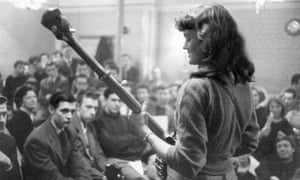
Peggy Seeger performing at the Enterprise pub in Covent Garden, London, in the late 1950s-early 1960s. Photograph: Alamy

Seeger rarely goes easy on herself. She tells of how she was a “lolloping, spontaneous loner” as a teenager, and would flirt with houseguests such as folklorist Alan Lomax or the radical German composer Hanns Eisler. The latter, by then a balding 50-year-old, rebuked her: “You’re doing that on purpose, aren’t you? Don’t.” Of Charles Parker, the BBC producer with whom she and MacColl created the landmark Radio Ballads series from 1958 to 1964, she says:“His ascetic face bore such a look of longing that I nearly invited him into the bed for comfort.” It’s painful to read of her later days with the sick and ailing MacColl, whom she loves, while also arranging trysts with her female lover.

Their times together were rarely smooth. Her social milieu had been assaulted by McCarthyism. MacColl had previous wives and children. Until the royalties started coming in from soul singer Roberta Flack’s cover version of “The First Time Ever I Saw Your Face”, they barely scraped by. Life on the road – popping Dexedrine pills to stay awake, having disgruntled patrons pour beer over her head – is both arduous and addictive.

Seeger and MacColl held fastidious, almost spartist beliefs about what was or wasn’t real folk music. You don’t have to be an anything-goes postmodernist to discern a trace of passport control in her boast that she can “easily spot a decayed version, a rogue word or an ill-fitting melody in print or performance”. This kind of sectarianism inspired one Lancashire folk club to forbid the singing of Yorkshire songs.

These days she readily admits to having doctored, pruned and tinkered around with traditional tunes, and even calls out her “vociferous and hypocritical purisms”, but claims that “we believed we were sticking as faithfully as possible to the style and intent of the original makers and carriers of the songs”.

Equally, in an age when anyone wielding an acoustic guitar or sporting a long weekend’s facial topiary is said to belong to some new-folk movement, it’s moving to hear Seeger evoke, in profound and felt fashion, her relationship to history: “On stage, I become as the narrow neck of an hourglass, bringing stories and singers from the past to the present; a relay runner hoping that someone will take the song from me and carry it into the future.” These songs she likens to “human nutrition”, to “a community”.

At a time when digital hustlers burble forth about disruption and accelerated obsolescence, it’s all the more wonderful to read Seeger write about tenderness and tenacity, value and vitality, culture and continuity, about folk music being “like a cardiograph: the form being the graph paper and the content the heartbeat”.

Saturday, December 16, 2017

200th anniversary of the birth of Henry David Thoreau.....Henry David Thoreau: A LifeJul 7, 2017 by Laura Dassow Walls Hardcover (University of Chicago Press) ;


Image result for Thoreau at 200


This year, the bicentennial of Henry David Thoreau’s birth, has occasioned publication of the first Thoreau biography in 50 years—Laura Dassow Walls’s Henry David Thoreau: A Life. Despite being frequently quoted, little read, and often misunderstood, Thoreau is one of America’s greatest writers. His works resist being shoehorned into contemporary academic environmentalist, naturalist, or liberal ideologies, despite his agenda-driven interpreters’ best efforts. His most famous work, Walden, is a flawless artistic composition of gracious prose, a masterpiece on its literary merits, but it is also spiritual work that illuminates reality’s divine dimension.

A Concord, Massachusetts native, Thoreau was steeped in his mentor Ralph Waldo Emerson's Transcendentalist movement. The movement resists definition, but “transcendental” has roots in Kant and describes a movement of mind rather than soul. In Emerson’s case, this was especially true. Flannery O'Connor claimed that he never transcended the “borders of his own skull,” and added that “when Emerson said he could no longer celebrate the Lord's supper unless the bread and wine were removed, an important step in the vaporization of religion in America had taken place.”

Emerson held sacred only his mind’s abstractions and his shifting feelings. He secularized the pulpit, exalting a new, radically individualistic spirit to take the place of religious doctrine. Emerson’s proto-hippie followers flocked to Concord to learn at their preacher’s feet, just as their descendants would flock to nearby Woodstock 100 years later. But recently married Nathaniel Hawthorne, who was renting an old manse on Emerson's property, was disgusted. In the leading essay to his short story collection, Mosses from an old Manse, Hawthorne noted, “Never was a poor country village infested with such a variety of queer, strangely dressed, oddly behaved mortals.”

Emerson’s transcendentalism led him to reject objective truth, but Thoreau discerned truth in the world’s material reality and in mystery-infused nature. Emerson dismissed experiential theories, and hermetically sealed himself off from the complications and mysteries of human experience that Thoreau confronted.

Thoreau willingly faced experience’s complications while living on Emerson’s land in a small house he built on July 4, 1845. His two years there were not an escape from reality but a more complete encounter with it. He challenged the emerging modern philosophies that fed man's desires while starving his spiritual and eternal needs. For Walls, Thoreau was “a pioneer, not a western one but an inward one.”

Rather than pursuing happiness, physical comfort, and money, Thoreau turned to nature’s wildness to find a deeper joy, since “superficial wealth can buy superfluities only.” He was suspicious of liberal reformers—“the greatest bores of all”—and advocated that a man should reform himself first. In the woods he could avoid the newly-formed and rapidly proliferating humane societies and philanthropists. For Thoreau, their secular philanthropy was not Christian charity, but shallow and self-interested. His ridicule—“a man is not a good man to me because he will feed me or pulls me out of a ditch...I can find you a Newfoundland dog that will do as much”—uncovered the reformers’ selfishness: “their sympathy lies not with their fellow man but in some private ailment in themselves.”

Neither would he make common cause with today’s environmentalists, despite Walls’s reviewers’ claims in The New York Times and The Wall Street Journal. “Read not the Times,” Thoreau cautioned, “Read the Eternities.” Thoreau was against the “ists” and “isms” of ideology and scorned those who, “no longer camp for a night, but have camped down on earth and forgotten heaven.”

In Walden, Thoreau refers to himself as a poet. Deep immersion in Greco-Roman classics and 17th-century English poetry prepared him to think in terms more broadly and open-mindedly than do the ideological straitjackets imposed on thinking today. Thoreau possessed poetic knowledge disregarded in the age of Enlightenment and science.

He was also a contemplative philosopher. In his 1948 Thoreau biography, Joseph Wood Krutch rightly discerned that “official science continued to represent in his mind the antithesis both of any genuine familiarity with even the living facts of nature and of any emotional participation in her mysteries.” In an entry about snowflakes in his journal, Thoreau records that “A divinity must have stirred within them before the crystals did thus shoot and set.” Aquinas argued that the philosopher was like the poet because both are concerned with the marvelous. Our age of “scientism”— an ideology of science which is unconcerned with discerning truth—has replaced wonder with technical expertise.

Laura Dassow Wells’s book is less biography and more an interesting, well written narrative history of Thoreau and his times, filled with many fine anecdotes. We learn, for example, that Hawthorne's fictional faun character in the Marble Faun, may have been based on Thoreau. Her narrative follows Thoreau from childhood to Harvard, through his travels, friends, and writings, and ends at his early death from tuberculosis at age 45.

Thoreau's message is as refreshing today as when it first appeared. He foresaw a modernity where labor banished leisure and changed human existence’s meaning. Before Max Weber, Thoreau knew that, “one does not work to live; one lives to work.” It’s only through leisure and contemplation that man escapes the consumer world’s tyranny. Thoreau recognized that the human soul needs to break the everyday life’s barriers to be lifted beyond. Heraclitus called it, “listening to the essence of things.”

Thoreau asked the ever-present but never answered question: “What is the purpose of human existence?” Knowing absolute justice was impossible, he was no social justice warrior but a reluctant crusader, and late abolitionist. Any politically possible justice results from the soul’s inner state commanded by will, which then rebounds to society at large.

Thoreau was also one of the earliest writers to question material progress and technology. The sounds of a locomotive near Walden woods prompted Thoreau’s reflection on technology’s power over us. It is not always clear if we’re riding technical progress’s rails or if it’s riding on us. Thoreau refused to glorify technical efficiency. He sought ends, not means: “Our inventions are wont to be pretty toys, which detract our attention from serious things.” When newly constructed telegraph cables connected Maine instantaneously to Texas for the first time, Thoreau wondered if “Maine and Texas, it may be, have nothing important to communicate.” For him, the things of the spirit may be the world’s salvation if our civilization is suffocated by material forces.

Had Thoreau lived another twenty years, he may have joined with several other Transcendentalists, including his close friend Orestes Brownson, in converting to Catholicism. Thoreau intuits a mysticism and harmony that envelopes life but which cannot be possessed. His life was one of constant expectation. I visited his grave once, made a cross on it with acorns, and said a prayer. I later realized that such a gesture was perfect for a man like Thoreau who was always searching for an intersection between nature and the timeless.

Thursday, December 14, 2017

The Politics of Islamic Law: Local Elites, Colonial Authority and the Making of the Muslim State. Iza R. Hussin. University of Chicago Press. 2016.


The field of Islamic studies has been of late in a state of renaissance. Not only have remarkable young scholars emerged in virtually all of its subfields, including that of Islamic law, bringing a much-needed breadth of new ideas about Muslim lifeworlds past and present, but one can also discern a palpable tendency to bring Islamic studies into meaningful and mutually enriching conversation with major contemporary critical discourses in law, politics, anthropology, art history and, of course, history itself. The great beauty of Iza Hussin’s intellectual enterprise is that it achieves all that in a single book — the newly-published The Politics of Islamic Law: Local Elites, Colonial Authority and the Making of the Muslim State.

While the unifying thread of this remarkable work is British colonialism proper in Malaya, Egypt and India, and its aftermath in a postcolony (Malaysia), it can also be read as a study in a new type of ‘comparativism’ — one that is no longer shackled in narrow disciplinary ambits such as ‘comparative politics and historical institutionalism’ (213), but which thrives instead on critical imcomparisons of ideas about law, politics and the state akin to, and inspired by, such trans-disciplinary intellectual traditions as postcolonial studies and the jurisprudence of violence. It is, therefore, no surprise that Hussin finds Islamic law after the colonial encounter to be both ‘jurispathic and jurisgenerative’ (i.e. capable of both destroying the ‘old’ and creating ‘new’ meanings of law; 29, in reference to Robert Cover) in its incurable postcolonial condition. What is, however, remarkable is her great gift to tell the story of such law (and the polities and human subjectivities it shaped) in an erudite and deeply engaging manner that is, at the same time, accessible to non-specialist readers.

Primarily, The Politics of Islamic Law mines ‘state archives, libraries, universities, and museums in the United Kingdom, Malaysia, Singapore, and the United States’ (21) for sources in Malay, English and Arabic that relate to the colonial un-making and re-making of Islamic law in the lands of the Middle East, South Asia and Southeast Asia under direct or ‘indirect’ British rule, especially Malaya, Egypt and India. These sources, which Hussin aptly names ‘artifacts’, are then divvied up and analysed in three thematic sets — treaties, trials and representations — each comprising a separate chapter in the book. Thus, Chapter Three zooms in on colonial treaties that facilitated the all-important division of jurisdiction in the state between British colonial authorities and local Muslim elites; Chapter Four turns to colonial Islamic law in practice by means of peculiar formal trials; while Chapter Five analyses an eclectic mix of Muslim colonial portraiture, constitutions and publications to illustrate an existential crisis embedded in the very way that colonised Muslim populations, and especially their elites, saw themselves in this period.


Sultan Ibrahim Building, Johor, Malaysia

These three artefactual formations provide for Hussin a springboard for ‘the paradox of Islamic law’ — a thesis elaborated with respect to British Malaya, British India and Egypt under British occupation in Chapter Six, and with a reference to post-independence Malaysia in Chapter Seven. The paradox, for Hussin, lays in the fact that the institutional marginalisation of Islamic law at the hands of the colonial state was readily, and cunningly, accompanied by its symbolic centralisation. The result was a near-demise of whatever was known as pre-colonial Islamic law (which, in a way, is a restatement of the Hallaq thesis on the death of post-classical sharīʿa) and the concomitant rise of local Muslim elites as the custodians of hybrid colonial and postcolonial Islamic legal regimes, which resembled little, if at all, the Islamic law of the past.

The paradox of colonial Islamic law relied, in turn, on an equally paradoxical ‘statecraft’. ‘By the end of the nineteenth century’, writes Hussin, ‘the Muslim state was two things — one, an administrative state that upheld Islamic law in matters of personal status’ and ‘two, an individual condition of an Islam that was marked increasingly by adherence to a textualized [sharīʿa] organized around the marital family’ (203). And it is in this particular statecraft — captured in the ambiguity of the Perso-Arabic term-of-art siyāsa that simultaneously denotes ‘statecraft’, ‘governance’ and (just) ‘punishment’ — that Hussin locates the politics of Islamic law (171), a politics of paradox par excellence:
The institutionalized politics of paradox, borne out of the colonial encounter, produced through ongoing jurisdictional politics, and maintained through continuing local investments in the Muslim state as an individual and collective good, guarantee the continuity of the politics of Islamic law. Further, the hybrid nature of this law, and these states, indicates a trajectory for the future in which paradox will continue to play a productive political role — an Islamic legal politics that is a matter of elite negotiation locally, but tightly interwoven into religious, economic, and political networks worldwide; an Islamic legal politics that is highly ambivalent, taking on the language and power of the state in order to contest its values, its conduct, and its actors; an Islamic legal politics active at multiple levels — in the education and culture of its professionals, in the language and institutions of the state, in the strategies of activists and opponents, as well as never limited to, the text of the law (265).

While The Politics of Islamic Law is a fine example of the idea, explicitly endorsed by Hussin, that ‘[l]aw makes politics, and politics makes law’ (13), it is also a work of rare ethnographic sensitivity, akin to that of Brinkley Messick (whose oeuvre the author repeatedly praises in the book), in that it pays due respect to transformations in law’s textual forms (i.e. ‘processes of textualization, codification, and officialization that were the hallmark of colonial state formation’ (13)) as well as in law’s elite socialities. Therefore, one can only hope that Hussin’s future work will also relate to what, by her own admission, is missing in this book — a ‘study of how the law worked in everyday life in India, Egypt, and Malaya’ (23). Still, as a crossroads of disciplines, discourses, colonial and postcolonial practices, The Politics of Islamic Law is a remarkable book, and one that is destined to become a seminal reading for new directions in postcolonial theory of Islamic law.

Sunday, December 3, 2017

The Story: A Reporter’s Journey By Judith Miller Published 2015-04-07 Simon & Schuster 400 Pages


In the epiloque of her memoir, The Story: A Reporter’s Journey, Judith Miller declares that she has “tried to review [her] mistakes, to correct errors, add new facts, and update them in the fullness of time.” This final manifesto, delivered in the concluding paragraphs of her weighty book, is essentially its mission statement. By writing about, closely scrutinizing, and heavily commentating on the drama surrounding her departure from The New York Times, Miller attempts to set the record straight and prove why her version of events is the accurate one — the one that readers should accept as the truth. She attributes writing this memoir to a higher journalistic principle, asserting that “[c]orrecting and completing the record are part of the pact that journalists make with readers.”

Miller’s intentions for writing this memoir aren’t in question: readers recognize that Miller strives to redeem herself from rumors, refashion the narrative in her favor. What has been, and what continues to be, questionable is the accuracy of her writing. This — even supported by the purest of intentions — cannot be redeemed by writing a memoir.

Throughout most of the memoir, Miller examines her failure as a reporter. She explains why she reported on weapons of mass destruction in Iraq, and confronts the consequences of that reporting for her, personally and professionally. Her primary defense is that she merely reported what her sources told her. She asserts, “The earlier stories were wrong because the initial intelligence assessments we reported were themselves mistaken — not lies or exaggerations.” When discovering that her sources were wrong, and therefore her heavy reporting on the subject was also, Miller paints herself as a scapegoat. She states that “[b]loggers and other media critics” portrayed her as “either a closet neocon bent of taking the country to war, or a credulous dupe spoon-fed by Ahmad Chalabi [her source] and the White House ‘shillsters’ — a ‘useful idiot’ with ‘blood on [her] hands.’” Miller is certainly correct in asserting that her reporting did not cause the war. To place the blame for an executive decision by the commander in chief on a single woman who is not an elected official, appointed spokesperson, political pundit, or supernatural force endows her with a power she does not and cannot possess. Journalists do not create news — they report news.

Despite this, Miller is blamed. According to her, the leadership at The New York Times “tried to blame the paper’s alleged reporting failures on [her].” In May 2004, The New York Times, under the leadership of Bill Keller, ran a note that implied that Miller “had written only stories that supported President Bush’s assertion that war was justified because the intelligence community had concluded that Saddam was hiding unconventional weapons.” Though she is never explicitly named, this note, among others, “scars her reputation.” Miller claims that this note — one that blatantly exposes the flaws in her reporting — implied that she “had written [her stories] to build a case for the war” and that “that [her] stories had a political agenda.” She claims that she “had never taken a public position, a mortal sin for a Times reporter.” But political agendas and public positions, however subtle or nuanced, pulsate beneath any story. Telling a story without a slant is impossible, regardless of whether her agenda involved a position on the war itself, or just a blind desire to get a scoop on a story that was clearly being peddled to the American public through journalists like her who were too eager to see the red flags, in the story itself, or the sources selling it.

Miller argues that her inaccurate reporting “spark[ed] a sustained campaign against [her] and [her] reporting.” While that may be how she experienced what happened, another way to look at it is this: the journalistic profession is built upon a clearly defined set of parameters, beaded links. A journalist is only as good as her reputation. Her reputation is only as good as her reporting. Her reporting is only as good as her sources. Break a link along the chain and the pretty beads tumble forth, away, beyond your grasp.

The second struggle that Miller writes about is the time she spent in federal prison for protecting her sources. This account is less defensive than the first half of her memoir and certainly more intriguing. For me — an ardent fan of the First Amendment — this is where Miller’s fame resides. As a college student, nearly a decade ago now, the journalist who went to jail fascinated me. The notion was startling, provocative, glamorous even. Miller’s story is still fresh. The drama surrounding her refusal to divulge her sources — conversations with attorneys, contempt of court, and a goodbye to her husband — all feel palpably relevant still. This is probably because although Miller’s imprisonment raised a heightened awareness for the need for a federal shield law that would protect journalists, her imprisonment did not actually achieve obtaining this federal shield law. Journalists can still be sent to federal prison for refusing to share their sources.

Placing Judith Miller — and imprisonment for her refusal to divulge her sources to a grand jury — within a historical legal context here provides a richer understanding of Miller’s efforts. Miller knew that her refusal to provide a source was not protected by the First Amendment. The legal precedent for this — which is still good law today — is the Supreme Court’s decision in Branzburg v. Hayes, 408 U.S. 665 (1972). In that case, the split Court, led by Justice White, held that requiring a journalist to appear and testify before state or federal grand juries does not abridge the freedom of speech and press guaranteed by the First Amendment. Unlike attorney-client privileges, spousal privilege, and psychotherapist-patient privilege, no privilege protects agreements, conversations, discussions between journalists and their sources. Quite simply, the Court held, that the First Amendment does not relieve journalists “of the obligation that all citizens have to respond to a grand jury subpoena and answer questions relevant to a criminal investigation.”

The journalists in Branzburg argued that if reporters were forced to respond to subpoenas, identify sensitive sources, and divulge confidential information, then the sources would refuse to furnish newsworthy information in the future. In essence, journalists argued that a federal shield law was necessary because without this protection sources would be less willing to share news. The Court in Branzburg disagreed with this notion, stating that “[r]eliance by the press on confidential informants does not mean that all such sources will in fact dry up because of the later possible appearance of the newsman before a grand jury.” The Court characterized the relationship between the press and its sources as a “symbiotic one.” Sources need journalists as much as journalists need sources.

Miller — and her team at The New York Times — hoped to change the law in Branzburg. This was not the first time that The New York Times challenged the government. In the early 1970s, Daniel Ellsberg leaked classified information to The New York Times from the United States Department of Defense regarding the Vietnam War. Although the Times was aware it could possibly face repercussions under §793 of The Espionage Act of 1917, the paper nonetheless published the information. Soon after publishing a portion of it, the government sought a restraining order that would stop The New York Times from publishing anything further. In the highly celebrated Pentagon Papers case (New York Times Co. v. United States, 403 U.S. 713 (1971)), the Supreme Court held in a per curium opinion for The New York Times. The Court declared that “any system of prior restraints” bears “a heavy presumption against its constitutional validity.” The Court further explained that to justify the necessity of a prior restraint on publication, the government would have to prove that publication would cause “grave and irreparable damage,” “a heavy burden.” In refusing to reveal her sources, Miller and The New York Times hoped to herald a new law in favor of journalists.

When Miller became aware she could be subpoenaed to testify regarding her sources in the Valerie Plame affair, she immediately consulted the then New York Times assistant general counsel George Freeman (full disclosure: I worked briefly with Freeman at the Media Law Resource Center) and told him she “could not answer questions from a grand jury about [her] discussions of top-secret information without violating a pledge [she] had given [her source].” She said she could not risk an open-ended prosecutorial fishing expedition into her sources and “comply with the subpoena, even if it meant going to jail.”

Miller is never naive, and so her imprisonment is not an unforeseen consequence, but a calculated decision. This does not detract at all from her bravery. In her memoir, she writes that although “some critics wrote [she] was eager to go to jail as a First Amendment martyr, nothing was further from the truth.” Eagerness to be imprisoned aside, Miller is still, in some sense, a First Amendment heroine. Although she describes herself as “the only inmate with a key to the jail,” and although she states that she was “being incarcerated not for a crime but for a matter of conscience and principle,” she still was an inmate and still was incarcerated. No one can say Miller does not push herself to the limits. This requires courage.

Once in prison, however, the situation changes. Her source gives her a waiver, allows her to testify, and Miller is eager to oblige. If her source no longer demands protection, why should she remain in prison? She misses her husband, misses her life, and wants, understandably, out. However, despite this, her attorneys at The New York Times urge her not to testify because testifying would mean that she “had gone to jail for nothing,” would make them “look weak.” Testifying meant that another grand victory for journalism would be abandoned. While Miller wanted to testify, the paper wanted her to remain in prison so that they might achieve more than Branzburg. Miller testifies anyway, and is forced to resign from The New York Times soon thereafter.

Her relationship with the publisher and her old friend, Arthur Sulzberger Jr. was irreparably scarred by her decision, Miller writes. When she questions Sulzberger, asks him what she has done to “offend him or betray the paper” (after he allows an editorial by Maureen Dowd to be published, where she colorfully exclaims that should Miller be allowed to report, “the institution most in danger would be the newspaper in your hands”) he “mumbles” that she “hadn’t stayed in jail as [she] had promised.”

Ultimately, this is a memoir about failed relationships within one of the most prestigious institutions in the United States. Throughout the book, Miller paints herself as a determined journalist. This determination is intriguing and even inspiring when reading about her adventures as a young reporter in the Middle East at the beginning of her memoir (possibly the most fascinating part of her book — I wished for more details here, of Miller in her heyday). However, it quickly becomes clear that this determination does not translate into collegiality, congeniality, or genteelness. Aggression gets the scoop. She admits that she “did not appreciate the importance of building a network of friends inside the Times.” She “tended to regard time spent at the coffee cart with colleagues as goofing off since [she] was not reporting.” While her single focus is admirable, her prioritization of the story is laudable (“the story would always come first”), her relationship with other reporters, her editors, her newspaper, and the public withers.

The problem with The Story exists in its form: the memoir. Miller writes under the impression that her account provides probing examination of her personal story; however, because of the memoir’s highly intimate and volatile nature, Miller cannot separate herself from her subject. Although she repeatedly references notes that she took following controversial incidents, these notes — her own records — do not detract from the bias intrinsic to her work. The Story is not a ruthless journalistic venture as Miller wishes to believe, and wishes to persuade her readers into believing.

Friday, December 1, 2017

A Photographer's Life: 1990-2005 Paperback – November 3, 2009 by Annie Leibovitz(Random House Trade Paperbacks)


Photographs are an “inventory of mortality,” Susan Sontag wrote in “On Photography.” They “state the innocence, the vulnerability of lives heading toward their own destruction, and this link between photography and death haunts all photographs of people.” It is Sontag’s own mortality that haunts the new book by Annie Leibovitz, her friend and companion of some 15 years. A PHOTOGRAPHER’S LIFE, 1990-2005 (Random House, $75), which contains more than 300 photographs, is also about a writer’s death. The many pictures of Sontag — living and dying — are arresting, the kind of pictures that make you want to ask the photographer what she was thinking, what she was feeling, why she took out her camera. “I forced myself to take pictures of Susan’s last days,” Leibovitz says in an introduction, as if by way of answer. “I didn’t analyze it then. I just knew I had to do it.”


Susan Sontag in Paris, December 2003. CreditBook Photograph by Tony Cenicola/The New York Times

These photographs are intensely personal in other ways, too. They chronicle the death of Leibovitz’s father early in 2005, six weeks after Sontag’s, and include images of the photographer herself (among them, the cover shots taken by Sontag) naked, and pregnant with her first child; in a series of seemingly impromptu self-portraits; and with her extended family for Thanksgiving. These, along with shots of birthdays, burials and days at the beach, are scattered among the trademark celebrity portraits that have made Leibovitz, 57, a celebrity in her own right and that dominated her much less personal first retrospective collection, covering 1970-90.


William S. Burroughs in 1995. CreditBook Photograph by Tony Cenicola/The New York Times

Perhaps the most striking figure here besides Sontag is Leibovitz’s mother, who leaps from the pages like the dancer she might have been had she not raised six children. She is so vital, at least in the first three-quarters of the book, she almost seems to belong among the photographs of athletes like Gwen Torrence, Carl Lewis and Charles Austin, as she dances at the ocean’s edge with a grandchild or works in the kitchen on her 75th birthday wearing only her swimsuit. But then she grows frail before our eyes, as Sontag grows ill, as Leibovitz’s father declines, as her first daughter is born and grows older, as the current crop of movie stars — among them Leonardo DiCaprio, Cate Blanchett, Jamie Foxx, Scarlett Johansson — appear, for now, ageless.

Yet a look at Leibovitz’s earlier retrospective belies the apparent immortality of the celebrity: many of her subjects from that book are gone — Jerry Garcia, Louis Armstrong, Hunter S. Thompson, Sammy Davis Jr., Ella Fitzgerald and most memorably John Lennon, pictured with his naked body curled around Yoko Ono. She revisits still others in the new book, where they seem to be aging with grace (or, in a few cases, barely at all): Arnold Schwarzenegger, then (1976 and 1988) with muscles bursting out all over his body, and now (1997) an Adonis on skis, not quite as bulging, but almost as smooth-faced; Bruce Springsteen, then (1984) guitar in hand as if in midflight in front of the American flag for his “Born in the U.S.A.” poster, and now (1999), guitar on his knee, looking less the boy and more the Boss; and the Rolling Stones, to whom the conventions of aging apparently do not apply.

There is an unsettling effect in mixing the public figure with the personal, the flattering and posed with the unadorned, the grainy with the piercing sharpness of the studio (“a photograph changes according to the context in which it is seen,” Sontag wrote). The family members become celebrities, but the celebrities seem emotionally empty after the charged images of the people Leibovitz loves in happy times, images that portend later illnesses and grief. “I considered doing a book made up completely of personal work,” Leibovitz says, “and concluded that the personal work on its own wasn’t a true view of the last 15 years. I don’t have two lives. This is one life.”

Sunday, November 19, 2017

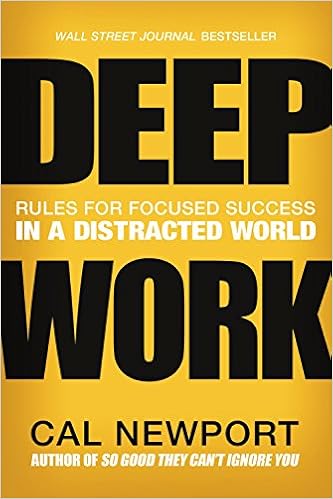
Deep Work: Rules for Focused Success in a Distracted World Hardcover – January 5, 2016 by Cal Newport (Grand Central Publishing)


One of the most valuable skills in our economy is becoming increasingly rare. If you master this skill, you'll achieve extraordinary results.

Deep work is the ability to focus without distraction on a cognitively demanding task. It's a skill that allows you to quickly master complicated information and produce better results in less time. Deep work will make you better at what you do and provide the sense of true fulfillment that comes from craftsmanship. In short, deep work is like a super power in our increasingly competitive twenty-first century economy. And yet, most people have lost the ability to go deep-spending their days instead in a frantic blur of e-mail and social media, not even realizing there's a better way.

In DEEP WORK, author and professor Cal Newport flips the narrative on impact in a connected age. Instead of arguing distraction is bad, he instead celebrates the power of its opposite. Dividing this book into two parts, he first makes the case that in almost any profession, cultivating a deep work ethic will produce massive benefits. He then presents a rigorous training regimen, presented as a series of four "rules," for transforming your mind and habits to support this skill.

A mix of cultural criticism and actionable advice, DEEP WORK takes the reader on a journey through memorable stories -- from Carl Jung building a stone tower in the woods to focus his mind, to a social media pioneer buying a round-trip business class ticket to Tokyo to write a book free from distraction in the air -- and no-nonsense advice, such as the claim that most serious professionals should quit social media and that you should practice being bored. DEEP WORK is an indispensable guide to anyone seeking focused success in a distracted world.

Saturday, November 18, 2017

Literary St. Petersburg A Guide to the City and Its Writers By Elaine Blair (The Little Bookroom) (IBRChildrensbooks)

Literary St. Petersburg

Much of Russian literature is St. Petersburg literature: set in the city, about the city, or written by writers living there. This unique guide profiles fifteen authors whose works and lives were intimately connected to this magnificent setting. Biographical sketches focus on the city as the writers knew it, a sense of their work, the literary and social circles in which they moved, and the sites associated with them.
Travelers can wander through the museum where the teenage Vladimir Nabokov romanced his girlfriend and see the prison where Anna Akhmatova was inspired to write her epic poem about the Great Terror. They can find the statue that comes to life in Pushkin's poem The Bronze Horseman and visit the square where Crime and Punishment's murderer/hero kneels on the ground to ask God's forgiveness. Literary St. Petersburg opens the door to one of the most beautiful cities on earth and a body of literature that is as rich, subtle, and expressive as any in the world.

Thursday, November 16, 2017

Louise Bourgeois Retrospective : Louise Bourgeois: An Unfolding Portrait an exhibition at the Museum of Modern Art, New York City, September 24, 2017–January 28, 2018 Catalog of the exhibition by Deborah Wye. MoMA, 248 pp., $55.00 Intimate Geometries: The Art and Life of Louise Bourgeois by Robert Storr Monacelli, 828 pp., $150.00,Cloth Lullaby: The Woven Life of Louise Bourgeois Hardcover – March 1, 2016 by Amy Novesky (Author),‎ Isabelle Arsenault (Illustrator) ( Abrams Books for Young Readers);Louise Bourgeois: Life as Art Paperback – July 2, 2003 by Penelope Vinding (Author),‎ Poul Erik Tojner (Author),‎ Louise Bourgeois (Author),‎ Julie Sylvester (Contributor),‎ Anders Kold (Editor),‎ Michael Juul Holm (Editor) (Louisiana Museum of Modern Art)


After we’re done shaking our heads at what they had to endure, we project onto our long-lived women artists a mystique that’s as old as history—that of the sorceress or the good witch. These women have a secret. We want them to tell us everything, but maybe they don’t want to. If we can gain access to their magical workshop, squeezing through a narrow corridor to find the door, we might be privy to some important mysteries. The veils will be unwound, and finally we will look life in the face and weep for all that was lost to get us here.

In her long life, Louise Bourgeois experienced both extremes of the female artist story—marginalization, even invisibility early on, and decades later a fierce and passionate following by younger artists and curators. Her status was based on an independence from fashion, and on calling attention to emotions that most people prefer to keep hidden: shame, disgust, fear of abandonment, jealousy, anger. Occasionally, joy or wonder would surface, like a break in the clouds. But Bourgeois was an artist, not a therapist. Her imagination was tied to forms, and how to make them expressive. Her gift was to represent inchoate and hard-to-grasp feelings in ways that seem direct and unfiltered.

Deborah Wye, the Museum of Modern Art’s chief curator emerita of prints and illustrated books, has put together an elegant and revealing exhibition of Bourgeois’s graphic work, prints, and printed books—some 265 images, made with a wide variety of techniques, all from the museum’s extensive holdings, along with related drawings, early paintings, and a small selection of sculptures that show their reciprocity with the drawn forms. Wye, who organized the first Bourgeois retrospective at MoMA in 1982, as well as a survey of Bourgeois’s drawings in 1994, has devoted much of her professional life to the artist and knew her well, and this show must be something of a victory lap for her.


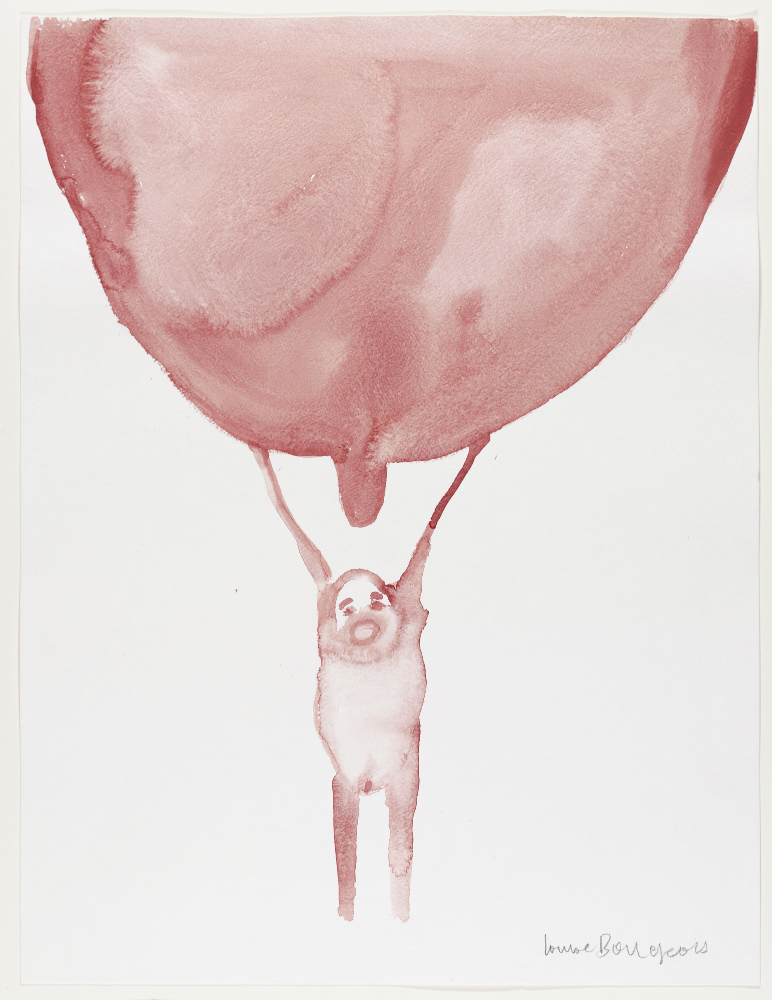
Museum of Modern Art/© 2017 The Easton Foundation/Licensed by VAGA, NY
Louise Bourgeois: Femme, 2006


On first impression, the books and other works on paper seen against the museum’s dove-gray or Venetian red walls are absorbing; they pull you in. But to call it a print show would be a little misleading. Bourgeois was forever altering her work, making additions and adjustments to printing proofs as they occurred to her in the moment, and the majority of the prints in the exhibition exist in several different states, or stages of development. They are often added to, painted, or drawn on—sometimes just a dot of color, other times reimagined completely. What we are really looking at are paintings on paper, which take as their starting point a printed image as a first layer.

Over the course of her marathon career, Bourgeois worked in a wide range of mediums and formats, from engravings just five inches tall to sculptural assemblages sprawling across vast museum spaces. For a long period in the 1950s, she was depressed and creatively blocked, and began long-term psychoanalysis, which seems to have helped. She emerged from her slump as a protean workaholic from whose hand issued warehouses full of materially and emotionally diverse stuff. Even within this focused exhibition we can see the range of Bourgeois’s sensibility, from intimate visual diarist to stage designer manqué, intent on dominating the museum experience with her theatrical mise-en-scènes.

There’s a disarming prelude as you enter the show: a wall of thirty-six smallish images, collectively titled The Fragile (2007), that highlights the playful side of Bourgeois’s graphic art. Most are economical line drawings, one image to a sheet, some augmented with washes of color. There are two motifs: spiders and their webs, and women with greatly enlarged, pendulous breasts. The spiders have human faces, and the heads of the women, all tiny in proportion to their bodies, have a grinning countenance such as a child might draw. One drawing shows the rudimentary profile of a woman’s face, with a high-bridged nose and thin lips, whom we recognize as the artist herself. This head has no eyes, perhaps because they’re no longer needed.

These drawings are like sophisticated cartoons minus the captions; you can imagine some of them printed on cocktail napkins; others would make striking tattoos. In addition to visual humor, the suite shows off Bourgeois’s easy mastery of contour drawing, shape, and placement. She understood the power of white space, how images and marks could be moved around the page for effect, and how sometimes making an image smaller gives it a louder voice. Interestingly, almost all of her images are drawn from a full frontal view, head-on, like specimens pressed onto glass. There are few three-quarter views of anything, perhaps because that would imply a world too local, too real, instead of the symbolic range that is her realm.

Once inside the main galleries, the exhibition begins with several illustrated books and single prints from 1946 to 1949, all of which still look fresh today. Bourgeois was from the start a high-level illustrator and book designer, and the overall tone of these engravings, which feature motifs of buildings—towers or chimneys for the most part—combined with women’s bodies or parts of bodies, is one of earnest modernism; she is already adept at placing her symbolic images in an emotionally suggestive pictorial space. A 1984 variation on her famous Femme Maison series (which originated in 1946) features a nude woman from the waist down, the top half replaced by a multistory building with archways and high windows, with the hand of one thin arm wanly waving to the upper-left corner. Printed on a ground of bright salmon pink, it remains a pungent and incisive logo of feminist art.

The space in these illustrations, together with their small size, gives us a child’s-eye view of life—some of the forms loom above eye level, and the interior spaces are tightly framed and slightly claustrophobic; we see only corners, or rooms crowded with ladders going nowhere. Either there’s no place to stand or one is outside, in a too-open space. The mood is chilly and gray, unsettled and unsettling. In this early phase, the artist whom Bourgeois most closely resembles in terms of tone, touch, and point of view is that other intimate fantasist and chronicler of the doomed family, Edward Gorey. The difference, of course, is that Gorey draws the monster plain, while Bourgeois only implies it.

Dispersed through the first few rooms are examples of Bourgeois’s early carved and painted wood sculptures, and they are all pretty much heartbreaking in the rightness of their forms and colors. Pillar (1949–1950), Figure (1954), and Forêt (Night Garden) (1953) are among her best early works, made some years before she turned to more elaborate and more narrative constructions made with a variety of industrial materials. Had she remained on this earlier path, Bourgeois might have been the three-dimensional equivalent of a deeply inner-directed artist like the painter Forrest Bess. That, however, would have meant renouncing a certain ambition to be heard.

If she wasn’t interested in being that kind of sculptor, Bourgeois continued to elaborate a more intimist sensibility in her drawings. Panic, claustrophobia, frustration, helplessness, and ennui, as well as a strange fatalistic elation, were her subjects, and she went at them with a combination of intuition and design sense.

Bourgeois was a poet of transitions, and of things entering other things. She grasped the malleability of pictorial space—how to shape the warp and woof of it into a visual logic, and how to make that plasticity relate to our bodily and emotional experience. In one untitled watercolor from 2004, swollen tubular or podlike shapes appear to rend the horizontal plane of colored washes, to suggest forms both underwater and in the air. To this graphic sophistication, Bourgeois added an insistence on the specifics—physical, psychological, and social—of female experience.

This aspect of her work is all-pervasive, and manifests itself generally in biomorphism and the attention given to escutcheons and contact points, as well as certain bodily details—nipples, orifices, and other sites of exchange, points of entry and excretion, body cavities, pass-throughs—things that signify “inside-outness” generally. In all of this, Bourgeois is way out in front of the competition. Even Picasso, that cavalier rearranger and morpher of human anatomy, can only really look at the body from the outside. For Bourgeois, the inside, with all its delicacy and power, is the outside. She moves easily from outside to inside and back again.

Born in Paris in 1911, Bourgeois suffered more than the usual number of grievous blows to the psyche, and her inner life stayed tightly wrapped around their memory. War, illness, sexual jealousy, mental instability were all things she witnessed in her first decade, and she never forgot—or forgave—any of them. As a teenager she learned that the attractive young Englishwoman who lived with the family as a tutor was also her father’s mistress, and this betrayal in particular was something she never got over. In addition, or perhaps in response, her mother was fragile and often ill, and young Louise became her companion at various spas and treatment centers; she was released from her caretaker role by her mother’s death when she was twenty-one.


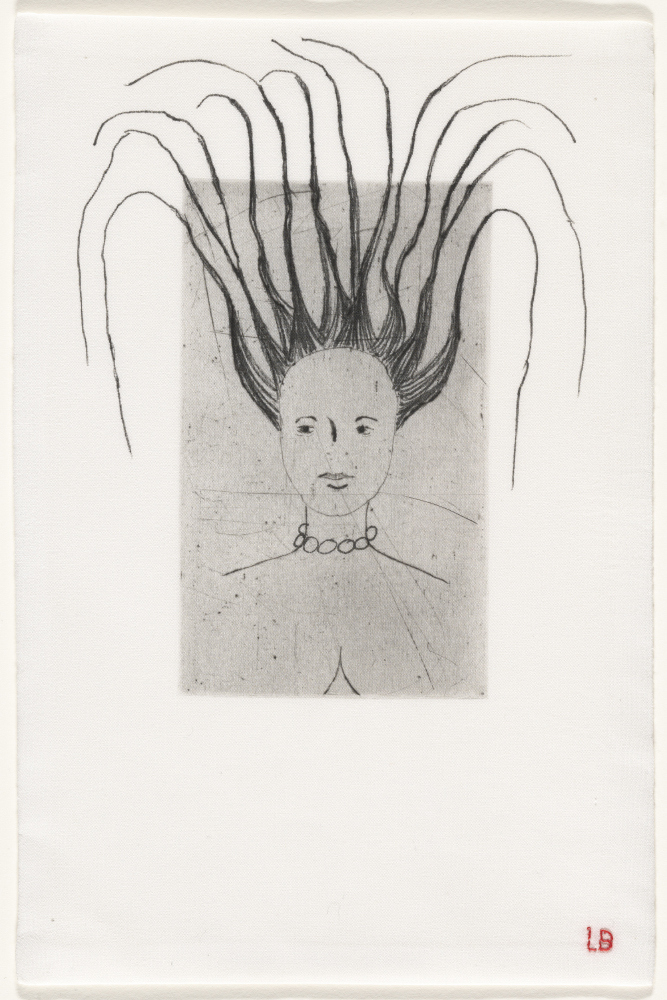
Museum of Modern Art/© 2017 The Easton Foundation/Licensed by VAGA, NY
Louise Bourgeois: Self Portrait, 2007

After the loss of her mother, and encouraged by her charming and tyrannical father, Bourgeois started a small business selling works on paper, prints, and illustrated books out of a corner of the family’s tapestry workshop on the Boulevard Saint-Germain. To acquire her stock, she scoured the auction houses and book dealers, and she seems to have absorbed, almost overnight, the dominant graphic styles of the day. She had a particular affinity for Bonnard and Toulouse-Lautrec, as well as other artists who used the illustrated book form, which was then in vogue. Something about these livres d’artiste, as they were known—the way they combined text and pictures, and the way the image was printed from engraving or etching plates, the whole satisfying feel in the hand of beautifully made paper embossed with rectangles of finely drawn tones of gray—formed the template for how Bourgeois would think about her own art, on and off, for the rest of her life.

At age twenty-six, she met and married the American art historian Robert Goldwater, and from then on made her home in New York. It was at the Art Students League that Bourgeois made her first engravings and woodblock prints on small sheets of paper. These early works are modest but graphically sophisticated. She quickly moved on to making her own illustrated books, which combined story with image, in many ways a natural fit for the precocious beginner, who early on recognized that her own personal history was to be her creative wellspring. She also had the ability to see in a glimpse, and later recall, an image that could carry complex feelings, as in her etching Thompson Street (1946), which depicts a Goreyesque gloomy figure standing in a doorway; it was inspired by seeing a young prostitute in her neighborhood.

Bourgeois’s work of the late 1940s and beyond looks very much like a continuation of the Surrealist sensibility. She herself downplayed any connection to the Surrealists; she did not see herself as their legatee, possibly because she knew all the ones who had fled Europe for New York during the war. (Although there is no record of it, as a French speaker it’s possible she experienced firsthand André Breton’s flagrant misogyny, and that would have been reason enough to take some distance.) In the way that sometimes the full flowering of a movement only happens after everyone has gone home, Bourgeois seems, at this remove, the true heir to Giorgio de Chirico, Max Ernst, André Masson, and Joan Miró. It’s as though she uncorked the genie in their bottle.

Some of her drawings from the late 1940s look like they could have been made by Magritte, had he been able to get beyond his precious subject matter. The Surrealists’ professed belief in the power of the unconscious to guide the hand seems paltry compared to hers. There is as well a strong undercurrent in her work of the shamanistic and totemic forms of Native American and other tribal art, which also greatly interested the Surrealists. One way to think about Bourgeois’s art is to imagine Surrealism, that most adolescent as well as female-objectifying of art movements, retooled by a grown-up woman.

The MoMA show gives us an artist who channeled her Surrealist inclinations into a direct, improvisational way of working. Should anyone miss the more extroverted or public side of her work, the museum’s atrium is home to one of Bourgeois’s crowd-pleasing spiders. This one has legs of steel (all eight of them), the upper joints of which reach twenty-one feet off the floor. Spider (1997) differs from some of its cousins in that the space formed inside the arachnid legs is taken up by a cylindrical enclosure of steel mesh bolted to a thin steel frame, essentially a wire cage roughly fifteen feet tall and ten feet in diameter that one enters through a narrow opening. On the inside, perfume bottles, bits of bone, pendulous shapes of cast rubber, and sections of tapestry have been tied to the wire mesh, like fruit to a sukkah.

What is a graphic sensibility? It begins with a sensitivity to the material, the paper or canvas, and the point of impact, the place where the tool hits the surface, as something that stays continually alive. Think of Cy Twombly and Jean-Michel Basquiat, teacher and student, figuratively speaking. The hand that grips a piece of charcoal as it touches down on the paper is like a phonograph needle skipping lightly across a scratchy LP. With all the skips and floats and the intermittent sinking into the record’s grooves, music starts to fill the air.

What are the hallmarks of Bourgeois’s graphic style? She uses mostly short or medium-length lines made by pencil, engraving tool, or brush, and the marks, all moving more or less in one direction, but not rigidly so, are bundled together in loose, overlapping rows—much like a naive artist’s rendering of hair, or like medical drawings of muscle fibers bunched together in long strings. These bundles accumulate to make forms, but have no mass to speak of. They take up space but don’t weigh much. The repetitive, directional lines call up a number of associations, from the art of the Pacific Northwest Native Americans to Outsider Art. Bourgeois is adept at outlining shapes with a thin, skipping line, a cousin to Andy Warhol’s ink-and-blotter-paper line, which is itself derived from the broken-line illustrations of Ben Shahn.

You feel that Bourgeois wants to dig down to the basic fiber of form itself en route to creating an image; it’s what drawing can do, after all. A subset of the marks that she uses, especially those made with a brush and ink, have the length and start-and-stop quality of a stitch of thread or embroidery: graphic stitches, which are bundled together and become in turn the building blocks for many of her images. These include the skein or hank of hair or yarn, as well as nerve and muscle fibers, including flayed skin and tissue, which cluster, bale up, and twist, and can become in some works undulating curtains of hairlike walls, or take the form of river currents and ocean waves. The equivalency that Bourgeois draws between hair or yarn and muscle fibers or tissue is one of her principal inventions.

Hair, women’s hair, is all over Bourgeois’s art. It is the perfect graphic element; like water, it can go anywhere and take virtually any shape. It can flow like a river, pass through keyholes, or twist around another form, strangling it. It can take the form of a flying carpet, or be made to cover, or smother, another surface. Or it can be parted to reveal what’s underneath. Hair is something to hide behind, or a memento left behind. The eroticism of hair was also a Surrealist staple, and Bourgeois makes good use of it.

One drawing—Hair (1948)—lays out the vocabulary that would remain in place for more than sixty years. Using a brush and ink, Bourgeois draws a female figure as two vertical columns of sacks topped by a featureless oval head, the whole figure enveloped in a cascade of hair that flows down both sides of the body, from the top of the head almost down to the feet. The roughly almond shape of the streaming-out mass of hair that frames the pod shapes, all seamed down the middle and topped off with a little button head, give the image another, labial reading. It’s like going inside Courbet’s The Origin of the World (1866) and coming back out again as a doppelgänger in disguise. The detail contains the whole, like an image out of Nabokov—the world reflected in a soap bubble.

Another of Bourgeois’s recurrent motifs is the protuberance, with its ready associations to bodily forms—breasts, sagging buttocks, scrota, and also tree forms, fungus of all sorts, drops of water; all the swelling, drooping, bagging forms and shapes in nature, anything dangling or hanging, any organic and even inorganic form that is subject to gravity, which is to say just about everything. Sometimes the pendula gather themselves up and reverse direction, rising up from the bottom of the garden or the ocean floor.

I can’t think of anything in the canon by male artists after Leonardo that does much with the body from the inside. The way Bourgeois addressed the basic notion of the body, especially the female body, as having an inside might be her biggest legacy. One modest black-and-white print from a 1989–1990 portfolio simply titled Anatomy has a resonance and a poignancy far bigger than its modest size. It shows what looks like the lower section of a spinal column, with the bladelike lower ribs curving outward from the central core of bone. What makes the image arresting is the slightly up-angled point of view that gives access to a tiny opening within a recess at the bottom in the column’s center, and just above, two rows of three narrow “windows,” similar to those in the Femme Maison drawings. A directional energy leads the eye up, by implication, into and through the interior spaces of the bone, through the core of the core, so to speak, to a new realm of vulnerable body feeling. There’s an intimation of the embalmer’s art to it, the hook with a wad of cotton inserted deep into the body to stop fluids from leaking.

The feeling of “up inside and through the middle” of the body is present in other works such as Torso, Self-Portrait (1963–1964) and Janus Fleurie (1968), as well as some of the large etchings, My Inner Life (2008) and Just Like Me (2007). These depict the body reduced to pods and tubes coiled around a central axis. For once, “gut-wrenching” is not a figure of speech. The artist digs deep within herself, imagines her own anatomy breaking into pieces. She shows us the results of her own autopsy.


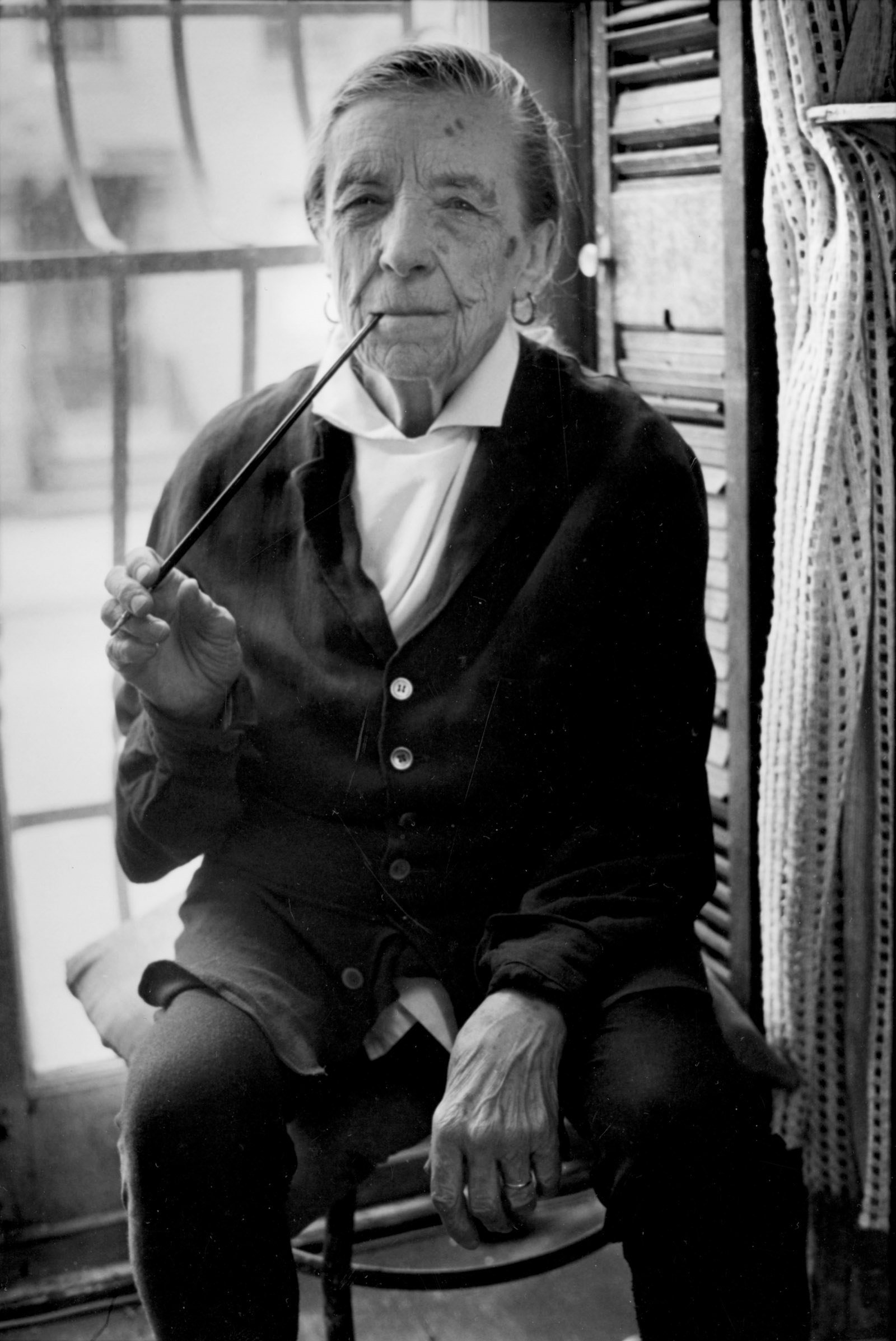
Dominique Nabokov
Louise Bourgeois, New York City, June 1997

Aided by a small team of assistants and printers, Bourgeois produced in her last years two separate suites of large soft-ground etchings, both remarkable in their own way. In the first suite, the sixty-inch-tall vertical sheets allow Bourgeois to play out on a much larger scale the reciprocity between plant forms and those of the body. In one print, titled Swelling(2007–2008), in which three different states, one with added color, are represented, Bourgeois manages to create the impression that a stack of forms—part beanstalk, part vertebrae, part uterus or kidneys—has burst upward, clearing the concentric waves of either water or soil or primordial muck at the bottom half of the image. Inside the trunk of the rising, swollen column are smaller pod shapes, like seeds, rock babies, or jellybeans. “Swelling,” a verb seldom associated with museum art, is a wonderful title, and the kinesthetic feeling of an organism thrusting upward is palpable, and also graphically tight.

The last major prints Bourgeois completed are in a horizontal format sixty inches wide and feature a repeated motif of two loosely braided linear or tubular forms that divide the rectangle diagonally from lower left to upper right. Across fourteen separate sheets, she added additional imagery and marks in pencil, watercolor, and gouache (mostly red) that pulse and spread and course across the length of the paper. Free and loose, with great directional energy, the prints, collectively titled à l’Infini (2008), are possibly Bourgeois’s most ebullient works.

Other late works, like the tapestry- and needlepoint-covered life-size heads from 2002, made when Bourgeois was ninety-one, achieve that sweet spot somewhere between the decorative and the disturbing, but leaning toward the latter. They resemble masks worn by Mexican wrestlers or S&M gear, but with patterns borrowed from rugs that look, at that scale, like Rorschach tests. The first time I saw a group of them in a museum vitrine, in that instant before you recognize the familiar inside the new, I let out an audible What the fuck?

In Robert Storr’s Intimate Geometries: The Art and Life of Louise Bourgeois, scholarship, biography, partisan argument, and subjective interpretation are all intertwined. The book was more than twenty years in the writing, and Storr’s involvement with Bourgeois goes back even further. He was deeply attracted to her as a visionary: as difficult as she could sometimes be, she embodied his ideal of an authentic artist.

A painter himself, as well as a former senior curator in MoMA’s Department of Painting and Sculpture, Storr is well grounded in the physical realities of how works of art are actually made. His descriptions of Bourgeois’s drawing tropes—what they are, how they look, and what they mean—are far and away the best writing on her work that I’ve seen. The book is a major achievement, not just of scholarship, but also as a record of the intersection of two sensibilities, artist and writer, and of personhood as the lens through which all art must inevitably be viewed. It also supports my belief that it takes a very long time to really know anything about an artist, to internalize her ideas and sensibility.

The hundreds of drawings reproduced in Storr’s book flesh out the picture of Bourgeois as a graphic genius that the MoMA show initiates. Storr quotes a line that she wrote in a 1948 diary: “My drawings are an arsenal of forms that I love.” Her choice of words is revealing. Certainly “forms” is the word that points us in the right direction; whatever else she was or has come to stand for, Bourgeois was primarily engaged in finding and inventing forms, and it’s that search, about which she was remarkably clear-eyed and objective, that makes her work so potent. The word “arsenal” is pure Bourgeois. There is no mistaking her intention to lay siege to something.

Bourgeois’s work found common cause with the art world of the 1970s, as attention began to be paid to women artists. It was a seismic shift, and it’s still going on. Although she did not identify with Feminist Art as such, Bourgeois was very active in the movement, and its triumphal tide raised the boat of her career. She was a ready-made example of an artist whose imagery and way of working were seen as specific to her gender. Female experience and identity, especially the parts centered on biological processes like sex, childbirth, and lactation, as well as so-called domestic crafts like rubbings, weaving, embroidery, and sewing: it was no longer necessary to leave them at the door in order to be taken seriously as an artist. Many other artists have also worked with female imagery; in art it’s a matter of what you make out of it. Bourgeois’s art came to prominence more as a result of her singularity than her team spirit.

Opportunities for women denied, an institutional bias toward male artists—it is a familiar narrative. It still goes on, but one hopes less so. Henry Geldzahler, the Metropolitan Museum’s first curator of modern and contemporary art, used to tell a story on himself that illustrates the bias against women artists at midcentury. In 1969, as he was finalizing what would become an epoch-defining exhibition, “New York Painting and Sculpture 1940–1970,” Geldzahler ran into Alice Neel at a party. They were friends; Neel had painted Geldzahler’s portrait, and everyone knew she was a serious artist, albeit somewhat out of the stylistic mainstream. Neel matter-of-factly asked Geldzahler what of hers he wanted for his show. He replied, “Oh Alice, when did you turn pro?” That’s how friends were treated; imagine the condescension if you weren’t known at all.

Louise Bourgeois had to overcome many of the same prejudices. Neel was often on the dole, and made great paintings for decades before fame found her in the mid-1970s, when she had only another ten years to work. Bourgeois, eleven years younger than Neel, was married to an art historian, lived in a townhouse in the West 20s, and knew just about everyone in the art world of the 1940s and 1950s, including her early champion Alfred Barr. Fame finally found her in the early 1980s, when she was nearly seventy, with a long way yet to go. She ran out the clock at age ninety-eight, experimenting with new materials and modes of presentation almost to the end.

The MoMA exhibition gives us an opportunity to find both the young woman and the modernist inventor underneath the slyly imperious grande dame we see on the cover of Storr’s book in the famous Robert Mapplethorpe photograph from 1982. Now that we have some distance, Bourgeois’s art, left to speak for itself, is potent, formally bold, and mysterious. It is sometimes alarming, and often beautiful. Its beauty is the result of a controlled collision of forms that are finely tuned to one another; its effects seem perpetually positioned between a major and a minor key. With apologies to Samuel Beckett, her work might be called pricks and kicks in about equal measure.

Thursday, November 2, 2017

Financial Turmoil in Europe and the US: Essays. George Soros. Public Affairs. 161 pages

Product Details

.
Financial Crisis in Europe and the US: George Soros Essays presents a collection of Soros’ writings from January 2008 until late 2011. Consisting mostly of newspaper and magazine articles, the essays are a curious combination of philosophy, finance and policy advice. The purpose of the book, Soros argues, is to present his views as delivered “in the heat of the moment”. Hence the book tracks events through the collapse of Lehman Brothers, the fierce debate over a bailout package and finally the evolution from financial crisis to euro crisis. Soros is never afraid to offer an opinion, and he confidently asserts that things may have turned out differently had his advice been followed more closely.

The book is structured around four chapters, each corresponding to a different year. Soros seems to have more to say – or at least more success in being published – on more recent events however, and the majority of the book is devoted to the euro crisis. This is no bad thing, as the book only comes to life once the focus moves decisively to events in Europe. The earlier financial crisis – if one can really separate the two – has by now received a good deal of attention in the literature and Soros himself has two other books devoted to the subject. It is not clear that reproducing newspaper articles – some over four years old – is really the best way to spark new life into the controversies. Still, his analysis is extremely authoritative and by pursuing his theory of ‘reflexivity’, his account has a certain uniqueness. It is also re-assuring to find that his argument is sufficiently complex as to be almost contradictory at times. Many accounts of the crisis seem to work the facts around a pre-determined narrative; Soros works his narrative around the facts. In this sense, the book benefits from following events chronologically.

As the financial crisis spreads, Soros lays out the need for both a rescue and stimulus package (as in the article ‘America Needs Stimulus not Virtue’). This is an interesting position to take, having spent much of the introductory chapter arguing that such a strategy had sowed the seeds for the crisis in the first place. Soros contends that public authorities created a ‘super bubble’ – beginning in the early 1980s – by rescuing financial institutions whenever they were in danger. Although the policy created the crisis however, it is now essential to prevent it from developing further. He thus calls for a “two-phase manoeuvre” – first stabilise the system, then undertake the necessary reforms. Although essential, he accepts that the immediate action is “the exact opposite of what was needed in the long term”.

Despite his calls for stimulus, Soros contends that the rescue packages undertaken in Europe ultimately led to the continuing euro crisis. Government support per se was essential however; the mistake was coordinating such support at a national rather than EU level. This meant that financial institutions began to question the credit worthiness of the governments that had come to their rescue. For this mistake, Soros is abundantly clear where the blame lies: Germany and the lack of a common treasury. It was Angela Merkel who insisted that financial support in 2008 should come from individual governments and not the EU. This in turn revealed “a hidden weakness in the construction of the euro” – the lack of a common treasury. Establishing a common treasury is the first point of action in Soros’ ‘Seven Point Plan to Save the Eurozone’ – although he retains his belief that “only Germany can reverse the dynamic of disintegration in Europe”.

Soros’ approach to the problems in Europe – much like his earlier articles on the financial crisis – is clearly borne of pragmatism rather than idealism. He is deeply cynical of how the Coal and Steel Community transitioned “step by step” to the European Union, and yet pushes for one more rather substantial step: the creation of a common treasury. And although the EU may have developed through “piecemeal social engineering”, he argues that “it is no longer a question whether it is worthwhile to have a common currency”. Ultimately, for Soros, the euro must be sustained, however it was created.

Financial Crisis in Europe and the US is therefore an interesting and informed narrative on events since 2008, although many of the earlier articles can now seem a little stale. It is also the case that many articles essentially repeat earlier ones, and to label them all as ‘essays’ may be a touch generous. Nevertheless, the book is a brisk and easy read, which contains such diversity of opinion as to interest anyone with an eye on recent events.

Wednesday, November 1, 2017

Babatha’s Orchard: The Yadin Papyri and an Ancient Jewish Family Tale Retold by Philip F. Esler (Oxford University Press,) 288 pp., $45


Sometime toward the end of the Bar Kokhba Revolt (132–135 C.E.), a Jewish woman named Babatha, daughter of Shimon, fled Ein Gedi with a group of fellow Jews. She had been visiting her stepdaughter and ended up in a remote cave in the Judean desert, accessible only by a narrow ledge carved into sheer cliffs 650 feet above the canyon floor. Like fleeing refugees of other times and places, Babatha carried her most important papers with her, so that she would be able to reclaim her property and re-establish her life when the war was over. However, she and the Jews she was hiding with either died of starvation when Roman soldiers cut off their supply lines or were killed outright when the soldiers penetrated the refuge. Sometime before that happened, she hid her satchel with its 35 documents, including wedding contracts, a property registration, legal petitions and summonses, deeds, and loan notes, in a recess of the cave. These documents were written between 94 C.E. and 132 C.E. in Nabatean Aramaic, Judean Aramaic, and Greek. More than 1,800 years later, in 1961, a research team led by the Israeli general turned archeologist Yigael Yadin discovered Babatha’s archive when a rock wobbled under the feet of a volunteer, revealing the satchel. They also found several other items that likely belonged to Babatha, including a pair of sandals, balls of yarn, two kerchiefs, a key and two key rings, bowls, a clasp knife, and three waterskins.

Yadin’s more famous find in the “Cave of Letters” was the correspondence between Bar Kokhba and his generals Yehonathan and Masabala. What Philip F. Esler demonstrates in Babatha’s Orchard: The Yadin Papyri and an Ancient Jewish Family Tale Retold, an ingenious and meticulous work of reconstruction, is that the documents in Babatha’s satchel shed light on the everyday lives and business practices of Jews and Nabateans who were caught up in the conflict. In contrast to most surviving ancient literature (which was written by and for men), these documents feature women prominently, wheeling and dealing, acting as sellers, buyers, lenders, litigants, and trustees.

Esler’s book focuses on the earliest four documents of Babatha’s archive, all written in Nabatean Aramaic with execution dates ranging from 94 C.E. to 99 C.E., before Babatha was born. One of them records the sale of a date palm orchard to Babatha’s father Shimon in 99 C.E. It is easy to see why Babatha would have held on to this document, since her father had apparently given her the orchard (she registered it as her own in a Roman property census in 127 C.E.). But the other three papyri record transactions among Nabateans who have no apparent relationship to Shimon or Babatha. The question at the center of Esler’s clever microhistory is, simply, why? Why did a Jewish woman living 30 years after these contracts were executed and with no obvious connection to the named parties have them in the first place? And why did she consider them important enough to carry into hiding?