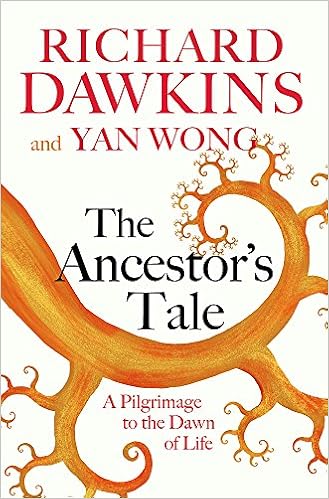
All of Dr. Dawkins's books are seminal in their own right; but, most remarkable is THE ANCESTOR'S TALE: A PILGRIMAGE TO THE DAWN OF EVOLUTION. In this treatise, Richard Dawkins creatively, eloquently utilizes backward chronology to search out ancestors to "sensibly aim towards a single distant target." On opposite ends of a small log, he serves as gentle, factual storyteller, bringing us "back to the universal progenitor of all surviving organisms, probably resembling some kind of bacterium." His lexicon includes "rendezvous," "confluence," and, most notably, "concestor."
"In a backward chronology, the ancestors of any set of species must eventually meet at a particular geological moment. Their point of rendezvous is the last common ancestor that they all share, what I shall call their `Concestor': the focal rodent or the focal mammal or the focal vertebrate, say. The oldest concestor is the grand ancestor of all surviving life."
And the oldest concestor, according to Dawkins, before animals and plants, before multicellularity, is the single cell progenitor bacteria.
"The analogy of insect colony to human body is often made, and it is not a bad one. The majority of our cells subjugate their individuality, devoting themselves to assisting the reproduction of the minority that are capable of it: `germ-line' cells in the testes or ovaries, whose genes are destined to travel, via sperm or eggs, into the distant future. But genetic relatedness is not the only basis for subjugation of individuality in fruitful division of labor. Any sort of mutual assistance, where each side corrects a deficiency in the other, can be favored by natural selection on both."
If I were stranded on an island with access to only one book, ANCESTOR'S TALE would easily be my first choice.

No comments:
Post a Comment