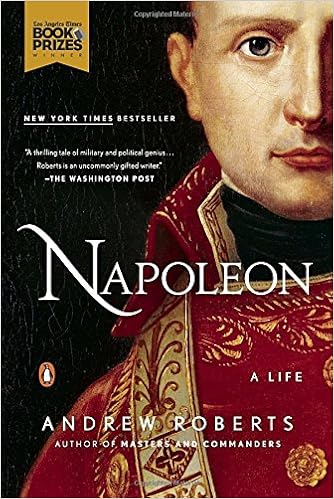
In 1841, Scottish historian Thomas Carlyle penned On Heroes, Hero-Worship, and The Heroic in History. One of the first histories to bring forth the "Great Man" tradition of history--the view that certain individuals are driving forces of history, and simply knowing about such individuals would give one a good command of the history of that era, Andrew Roberts, an English historian, joined this small but notable rank of Anglosphere historians to laud Napoleon as such a figure. What makes this work even more incredible, all things considered, is that an English historian would write and publish a biography of Napoleon that is certainly apologetic and positive on the eve of the bicentennial of the over mythologized Battle of Waterloo where British Nationalists have long wanted to assert that this event, rather than the terrible campaigns of 1813-1814 where Britain played a minimal role, as the Gotterdammerung of Napoleon's life and empire.
Therefore, the biography written by Andrew Roberts stands drastically apart from the majority of scholarship in the last 40 years of Anglosphere scholarship that has undeniable attempted, with vigor, sometimes very eruditely, and at other times poorly--to destroy the "great man" historiographical tradition and with it, any attempt to view Napoleon as "Great" in the same tradition of the other "Great" leaders in world history. From Charles Esdaile (2008) who attempted to destroy the credibility of the Great Man historiographical tradition, to Philip Dwyer (2008 and 2011) whose two-volume work on Napoleon attempted to cast him as a myth-maker and brutal battlefield butcher, to Alan Schom (1997) whose biographical work was described as a "hatchet job" on the French emperor, to Owen Connelly (1987) whose work Blundering to Glory: Napoleon's Military Campaigns cast Napoleon as an otherwise incompetent battle-planner whose real genius was his ability to improvise in the heat of battle that won him fame and glory on the battlefield, the list goes on of Anglo-American historians who apparently have an axe to grind with Napoleon. While Connelly's work is, perhaps, somewhat pro-Napoleon in an awkward way, the majority of Anglosphere scholarship has constantly attempted to tear down Napoleon's status--but Andrew Roberts eruditely attempts to dispel and overturn these constant attacks against one of the modern period's last great rulers and generals. Rather than cast Napoleon as an "Anti-Christ," butcher on the battlefield, or a bloodthirsty ego-maniac, Roberts casts Napoleon in the same vein that Napoleon saw himself as, one of the great individuals of history: a general, husband, emperor, and lawgiver.
Upon the eve of the twin battles of Jena and Auerstedt, in which Napoleon's forces would utterly devastate the Prussian armies and lead to the emperor's swift capture of Berlin, forcing a Russian intervention, the German philosopher George Wilhelm Friedrich Hegel wrote of his encounter with "The World Soul" (speaking of Napoleon) whom sent shockwaves through Hegel's body. As the tradition story goes, Hegel even altered aspects of his great work Phenomenology of Spirit (one of the most important works of modern Western philosophy) after this encounter with the Frenchman who could only ever be admired by his onlookers (pp. 415-418). Napoleon, likewise, as Roberts' shows throughout his work, thought of himself as a great "World Soul" pushing the progress of humanity forward. Rather than an usurper and tyrant, as Anglo-American scholars have often depicted Napoleon for us, Napoleon himself saw himself as the embodiment of French Enlightenment philosophy. Any student of the French political philosophers would naturally agree, the Enlightenment philosophes were extremely elitist and saw institutional absolutism as the only avenue for the progress of humanity since the normal peasant was a brutish animal by their very nature. In this same tradition, Napoleon truly did see himself as the pinnacle of the Enlightened absolutist political tradition, and paradoxically for many, saw himself as the protector of the French republican tradition despite becoming an emperor. Contrary to Anglo-American scholarship, Napoleon isn't a pseudo-republican despot, but the very epitome of Enlightenment republicanism, or better, Enlightened Absolutism. After all, this is why Andrew Roberts says of Napoleon, "[He] was the Enlightenment on horseback."
Roberts', while certainly presenting a positive case for Napoleon, is not short of his criticism of the French emperor. Roberts highlights some of the battlefield brutality that Napoleon was capable of committing. He has no apologetic defense for Napoleon's invasion of Russia and the fallout that ensued, Roberts equally makes clear that many Europeans, but especially Frenchmen, died in Napoleon's gambit to wrangle Europe under his boot.
Yet, at the same time, Roberts doesn't shorthand Napoleon's battlefield brilliance, his ability to inspire friends and foes alike, but more importantly, does not attempt to destroy Napoleon's Legal reforms: the Napoleonic Code. Napoleon, as a Law Giver, is perhaps the most successful legislator or administrator of any figure in Europe in the last 200 years. Napoleon's institutions that embodied meritocracy, religious tolerance and pluralism, and a legal structure that certainly curbed the influence of favoritism in politics due to one's noble birth rank have remained, at least structurally, the mainframe of modern European law ever since Napoleon's ride across Europe. His armies may have failed to conquer Europe, but his legislation, in bitter irony, conquered his conquerors. Roberts' chapter on the Napoleonic Code is where his work shines most brightly, even if it is a short chapter--for Napoleon himself saw his civil code as his greatest accomplishment nearing his deathbed (p. 270).
Upon reading Roberts' book, while it seems impossible that a figure as towering as Napoleon can ever have "the definitive one-volume biography," Andrew Roberts comes as close as it can get. One is left only to awe at Napoleon's meteoric rise to power, his battlefield ability, his own egoism, his political ability as lawgiver and administrator (which is where Napoleon has been most successful, now, almost 200 years after his death, his legal reforms still have more widespread influence than his armies ever died), and at the same time, one can see the propaganda machine and battlefield brutality hard at work. Roberts has written a biography of Napoleon not casting him as "Great" in the sense that Americans view the deified trio of Presidents: Washington, Lincoln, or FDR, but "great" in the historiographical sense--no other figure from 1796-1815 held the world in his hand, and moved almost 20 years of European history with a single breath, or had the rest of a continent trembling in their boots and reacting to his every move.

No comments:
Post a Comment