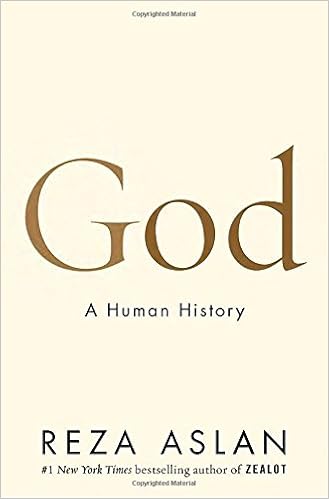
We've seen a goodly number of recent "biographies" of God, and this is an interesting addition to the genre. Those who read the book seeking confirmation or disconfirmation of their own faith won't find either of these here (except in a brief conclusion plugging pantheism): it's simply a history of the concept of God as it has developed over the millennia, all the way from ancient cave paintings to the present.
The book has an enormous section of footnotes, and these should not be skipped, since in many ways they are more interesting than the text is. For each chapter, we get quite a thorough discussion of the various controversies and contradictory views: What was the purpose and meaning of cave art? Was Akhenaten really a monotheist? Etc., etc. Interesting and worth reading. But this is also what had me tearing my hair out! After reading the footnotes, it's clear, for example, that nobody really is sure what was going on with those cave paintings. But in the text, we find Aslan calmly asserting (with no real evidence) that the well-known Breuil drawing often called "The Sorceror" was intended as the earliest known representation of God. It's a case of "The large print giveth but the small print (well, the footnotes anyway) taketh away."
Another example: where and when and why did Judaism become monotheistic and leave behind the henotheistic view that other gods might exist but were subordinate? ("No other gods BEFORE me") In some ways this is the central point of the book, since the origin of monotheism is probably the most significant development in God's biography. Well, we get a good discussion in the text and footnotes, but (spoiler alert!) at the end of this chapter he leaves all this scholarship behind (footnotes suddenly disappear) in favor of a speculative claim that this was due to the Babylonian captivity: Marduk's defeat of Yahweh gave rise to cognitive dissonance and made the Jews decide to go all the way and insist that Marduk didn't even exist. I think few will find this, or many of his other conclusions convincing. The book is worth reading and I learned a lot. But don't believe everything you read.

No comments:
Post a Comment