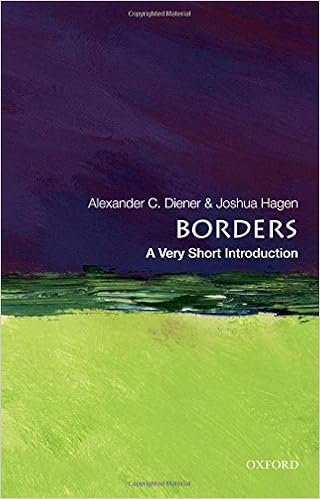
Compelling and accessible, this Very Short Introduction challenges the perception of borders as passive lines on a map, revealing them instead to be integral forces in the economic, social, political, and environmental processes that shape our lives. Highlighting the historical development and continued relevance of borders, Alexander Diener and Joshua Hagen offer a powerful counterpoint to the idea of an imminent borderless world, underscoring the impact borders have on a range of issues, such as economic development, inter- and intra-state conflict, global terrorism, migration, nationalism, international law, environmental sustainability, and natural resource management. Diener and Hagen demonstrate how and why borders have been, are currently, and will undoubtedly remain hot topics across the social sciences and in the global headlines for years to come. This compact volume will appeal to a broad, interdisciplinary audience of scholars and students, including geographers, political scientists, anthropologists, sociologists, historians, international relations and law experts, as well as lay readers interested in understanding current events.
Whilst the opening chapter presents a reasonable account of the history of borders, the descriptions and explanations of borders in more recent periods is a biased consolidation heavy on historical revisionism. As a former student and researcher in academic geography at a time when the emerging paradigm was toward a objective quantitative methodology I am appalled at this reversion to the anecdotal and the ideological pandering in this book. I am well aware that it is at best a compilation for the general reader and reflects the attitudes of its authors. For a work on borders it is light on maps and diagrams but far too heavy on politics and policies and neologisms such as "bordering". Despite defining borders fairly in terms of flows and filters there is no attempt to illustrate or quantify such parameters. Beware of any discipline that appends "studies" to its title (as in border studies). It is the strategy of opportunism.

No comments:
Post a Comment