Red Ellen: The Life of Ellen Wilkinson, Socialist, Feminist, Internationalist, authored by Laura Beers, gives readers a vivid insight into the life of one of the most important figures in the history of the British radical left.
Ellen Wilkinson’s accomplishments speak for themselves: she helped to found the British Communist party; was the tenth woman to earn a seat in parliament; advocated for the poor both in the UK and abroad; was one of the first female delegates to the United Nations; helped lead the Jarrow Crusade; and played a central role in the post-World War Two Labour government. As part of her political career, Wilkinson met Lenin and Trotsky in Moscow and not only befriended the leaders of the Indian Congress Party, but also German anti-fascist groups and the Spanish Republican government.
Wilkinson was a self-made woman, and her exceptionalism highlights the scope of opportunity afforded to women active in politics within the interwar period. The boundaries between the private and public spheres were beginning to blur, and women were no longer forced to conform to the oppressive Victorian ideal of the ‘Angel in the House’: the notion that young women were duty-bound to devote themselves to household chores and raising a family. Ellen’s success, however, was not without controversy: her affairs with colleagues garnered accusations of favouritism, and many of her personal papers were burnt by her brother after her death to avoid further scrutiny. Whilst Red Ellen provides an in-depth insight into Wilkinson’s remarkable life and career, it also raises questions about both the history and the future of the radical left in the UK: where has it been, and perhaps more importantly, where it is going.
This relatively short review cannot possibly give the reader a truly in-depth insight into the life and times of Ellen Wilkinson – that is what the book is for. Instead, I have attempted to give the reader a brief glance into Ellen’s early development as an intellectually curious and vivacious child and teenager before turning to the midst of her political career, a period that saw her travel the world in pursuit of social justice. The looming spectre of fascism over Europe in the interwar years triggered something of a crisis in Ellen’s understanding of impending political events: the outbreak of the Spanish Civil War, in particular, did not see the left coming together to overthrow fascism as she had anticipated, despite men and women from across Europe travelling to Spain to fight in the resistance. Europe did not unite, and was subsequently plunged into darkness.
 Image Credit: ‘The Jarrow March’, Jarrow Metro Station (Andrew Curtis CC BY SA 2.0)
In order to gain an understanding of Ellen’s life, we must start with a look at its foundations. In Chapter One, ‘The Only Girl Who Talks in School Debates’, Beers gives the reader crucial insight into both Ellen’s early life and the Wilkinson family dynamic. Ellen Cicely Wilkinson was born in October 1891 to Methodist parents, Richard and Ellen. The family lived in a house south of the river Medlock, downriver from an area described as ‘Little Ireland’ by Friedrich Engels in The Condition of the Working Class in England (1845), his exposé of the dire living conditions facing working-class families in Manchester and Salford. Regardless of the area’s less-than-favourable associations, the Wilkinson family were considered ‘lower-middle class respectable’ and lived in a community that was relatively socially diverse, getting on well with their neighbours. Despite his lack of formal education, Richard Wilkinson took a strong interest in religious and world affairs, a quality that his daughter shared. Both parents encouraged the passions of their children, but Ellen had more in common with her father, who facilitated her learning.
Ellen was not intellectually stimulated in school, but found ample opportunity to learn about the world through attending Methodist Sunday school classes and by reading voraciously at home. At the age of fourteen, Ellen was reading Ernst Haeckel, Aldous Huxley and Charles Darwin. Her Sunday school classes also afforded Ellen a chance to hone her oratory skills, which would become invaluable to her political pursuits in later life.
Ellen’s formative years saw her develop into a passionate, intellectually curious and politically aware young woman. Instead of going into teaching, as was the norm for young lower-middle-class women at the time, Ellen won a scholarship to study History at the University of Manchester in 1910 with the full support of her family. Yet, Ellen’s political awakening had begun as early as 1908 when she attended meetings of the Independent Labour Party (ILP), and the Church Socialist League (CSL). By 1909, Ellen had not yet ‘found’ feminism, but came into contact with women through the ILP; she would later work alongside them in the women’s movement. Whilst Ellen enjoyed university, she became increasingly distracted by her political activism, but still graduated with a 2:1 in 1913: the highest honour given to a woman that year. Afterwards, Ellen was hired by the Manchester Society for Women’s Suffrage (MSWS) as a paid organiser. Subsequently, Ellen’s lifelong commitment to the women’s movement began; and the rest, as they say, is history.
The Jarrow Crusade of 1936 is seen today as the pinnacle of Wilkinson’s political career. Following the 1935 General Election, Ellen was returned as MP for Jarrow. Ellen was the only woman to participate in the campaign – though she didn’t complete the whole route due to previous commitments – which saw protestors march from their home in north-east England to London to protest the closure of local shipyards and the poverty caused by their subsequent unemployment. However, as Beers notes in Chapter Twelve, ‘Pursuing Social Justice in Britain and Beyond’, it was but a small part in Wilkinson’s transnational quest for justice.
Throughout her career, Ellen’s detractors had argued that her commitment to transnational affairs distracted her from domestic issues. However, there had been less call for her attention at home towards the end of 1934. Despite being the Women’s Organiser for the National Union of Distributive and Allied Workers (NUDAW), there were few strikes to organise. Ellen had argued that the MP salary of £400 was not nearly enough to live on; writing and lecturing therefore became the dominant source of her income. Ellen set sail to the US on the penultimate day of 1934 to investigate Franklin D. Roosevelt’s ‘New Deal’: a series of post-Depression-era programmes that focused on the so-called Three R’s of ‘relief, recovery, and reform’.
Ellen’s own prescription for Britain’s economic woes had been to increase consumer purchase power, in theory similar to Roosevelt’s ‘New Deal’. However, as Ellen observed during her time in the US, industrial control remained the exclusive domain of capitalists. She argued that such moves only increased corporate powers over the state: corporations would be content to give higher wages to workers instead of reorganising inherent structural inequalities. (One can arguably see a parallel in global politics today, particularly in light of President Donald Trump’s cabinet choices.)
Despite her trip to the US, the growing threat of Nazi Germany, the volatile political situation in Spain and Italy’s invasion of Abyssinia, Ellen was nonetheless forced to rethink how best to achieve reform at home and abroad and redefine her political priorities, which ultimately centred on the alleviation of national poverty. Government debates over its stance on the seemingly unwinnable Abyssinian crisis, Ellen argued, detracted from important issues at home, fostering accusations of insincerity and careerism. Beers is careful to point out that whilst Ellen was variously labelled throughout her career, ultimately she was adaptable, and her priorities as a politician shifted with the peaks and troughs of the domestic and international landscapes and reflected the ‘real world’ concerns of her constituents.
On 27 January 1947, Ellen attended her final cabinet meeting as Minister of Education. Unusually, she did not participate in the debate. Her health had become increasingly poor at this point, due to a mix of overwork, addiction to caffeine, asthma and the reputed abuse of both asthma and over-the-counter medication. She died on 6 February 1947 from heart failure resulting from an attack of bronchitis. There was no evidence of foul play, but an autopsy pointed to an overdose of barbituric acid, a key ingredient in sleeping pills.
Today, left-wing activists struggle to find parity in an ever-globalising world. And although Ellen herself could not claim to provide all the answers needed to get by in life, politics and beyond, her career is testament to the importance of questioning the status quo and dismantling the structural inequalities that prevent others from living a life free from the threat of war and socio-economic dissimilitude. Ultimately, if we can learn one thing from Ellen’s example, it is that we must strive to work together for a fairer future for all.

In recent years, we have seen a plethora of books on wealth, inequality, the super-rich and the ‘one percent’ (e.g. Dorling 2014; Forrest et al 2017; Piketty 2014). Research tells us that we are living in an era of ‘extreme inequality’: in 2014, the richest one per cent of the world owned 48 per cent of the global wealth (Oxfam 2015); by 2015, the richest 62 individuals had the same wealth as 3.6 billion people (Oxfam 2016); and in 2016, the eight richest individuals hold the same wealth as the poorest 50 per cent of the world’s population (Oxfam 2017). As a response to rapidly rising inequality, we have seen protests (e.g. Occupy Wall Street) and public criticisms of the wealthy and the super-rich (CNN 2014; Unite 2014).
However, as Brooke Harrington argues in Capital Without Borders: Wealth Managers and the One Percent, little attention has been paid to the people who make the rich rich. While there have been critical accounts of offshore tax havens (Palan et al 2010; Shaxson 2011), these earlier works have not explicitly shone the spotlight on wealth managers per se. As Harrington observes: ‘the offshore system is of course not self-managing: it is manipulated, directly and indirectly, by actors such as elite professionals’ (294). It is only recently – with coverage of the leaked Panama Papers and the 1MDB controversy, for example – that we can begin to understand the intimate relationships between global financial scandals, the intricacies of the offshore system and the creative tactics used by legal and financial professionals to orchestrate these projects. These recent exposés, however, are only the tip of the iceberg.
Riding on this shift towards increasing awareness of the roles played by wealth managers and intermediaries of the super-rich (The Guardian 2016), Capital Without Borders offers an in-depth look into the wealth management profession. Harrington uses what she calls ‘immersion ethnography’ to research an industry that is not easily accessible to outsiders since it shrouds itself under high levels of privacy and confidentiality (see also Karen Ho’s 2009 ethnography of Wall Street). Her methodology involves enrolling in a two-year wealth management training programme, where she immersed herself in the ethos, techniques and vocabularies of her study subjects. Between 2008 and 2015, Harrington ‘follow[ed] the money’ (274), interviewing 65 wealth management professionals in 22 locations, spread across eighteen countries.
The book is very clearly written, avoiding unnecessary and complicated jargon. The simple and clear narrative is effective in unravelling the complex world of wealth managers and their clients for readers who may not be familiar with the world of the one percent. The select and clever use of figures and tables also helps to explain more complex ideas. For example, Figure 4.2 on page 190 clearly illustrates how assets are strategically structured under companies, trusts and foundations in order to protect clients against ‘the many forces of dissipation’ (277), such as economic downturn, political change and divorce.
Overall, the book is also logically organised, explaining the historical evolution of the profession (Chapter Two), relationships with clients (Chapter Three) and wealth management strategies (Chapter Four), before broadening out to socio-political issues of inequality (Chapter Five) and the implications for national borders and states (Chapter Six). The concluding chapter, which I highly recommend, discusses insights on broader socio-political issues such as ‘inequality, the family, globalization, the professionalization process, and state authority’ (272-73), gained from an in-depth understanding of the wealth management industry.
What struck me most in reading this book is the respondents’ understanding of their role and profession on a broader scale. Instead of viewing themselves as expert professionals who preserve and grow their clients’ wealth portfolio, many of them ‘saw themselves as playing a vital and very positive role in the economic development of former colonies’ (257). This is best exemplified in the following quote by a wealth manager based in Hong Kong:
Without our profession, there wouldn’t be the large pools of capital available to fuel economic development. So many of us, if not all, see our work as primarily about helping people – not just our clients, but more generally by helping maintain capital flows for investment and economic growth. But we can’t get this message out effectively. We have, by the nature of our work, cultivated privacy and discretion, so the profession is totally unprepared to respond to the claims being made about us and about the industry […] We cannot win publicly, let’s face it (257-58).
While this discourse sounds convincing and perfectly legitimises the work of wealth managers, it sits uncomfortably with the problematic consequences of the profession. These include capital flight, inequity in resource and wealth distribution, the de facto ‘economic colonisation’ of developing states, the concentration of economic and political powers in the hands of a select group of transnational elites, the undermining of national sovereignty and the increasing erosion of state powers to protect the interests of the masses.
This is a thoroughly researched, carefully thought out and comprehensively indexed book. By tracing the development of the wealth industry ‘from voluntary work undertaken by friends and kinsmen into a thriving form of expert power’ (294) and detailing ‘the workings of agency in producing larger patterns of stratification’ (274), this is an important work for our increasingly unequal world. Instead of uncritically blaming the wealthy and the super-rich or national and state governments, it is high time to focus our attention on the brokers, intermediaries and agents who constitute the ‘middleman economy‘ of global inequality.

Walter Benjamin’s status as one of the greatest philosophers and social theorists of his era is undisputed. During his life (1892-1940), Benjamin was a respected critic of culture and aesthetics, but it is only since his death that his writings on the meaning of art and truth – such as the famous essay ‘The Work of Art in the Age of Mechanical Reproduction’ – have truly been widely appreciated in the English-speaking world, and his influence can still be felt today across fields as diverse as anthropology, art theory, and law. Nonetheless, there is great sadness in acknowledging his posthumous exalted status, given that he died tragically young at the age of 48, committing suicide while attempting to flee the Nazis in 1940. This new biography – Walter Benjamin: A Critical Life – maps his life from beginning to end, tracing the roots of his thought all the way from his early childhood to his seminal work as part of the esteemed ‘Frankfurt School’, and ultimately to his last months in Paris (largely spent writing his final major work – ‘Theses on the Philosophy of History’) before his untimely death in Portbou, Catalonia.
Like most thinkers of his generation, WWI proved to be a formative time for Benjamin – he supported the anti-war stance of the radical leftists Karl Liebknecht and Rosa Luxembourg when war broke out in 1914. Moreover, soon after the opening of hostilities Benjamin was rocked by the suicide of two of his anti-war friends. This personal tragedy seems to have deeply affected him; the authors note that suicidal thoughts began to recur in Benjamin’s private writings in the years that followed.
The authors note that during this formative period the young Benjamin demonstrated a restless intellectual character; he constantly moved around, spending time at universities in Berlin, Freiburg, Heidelberg, Munich and Bern, before eventually gaining a position at Frankfurt. As a philosopher, during these early years he veered between Kant and Nietzsche, but as he matured as a thinker he moved more and more towards Marx, influenced in particular by Georg Lukács’s History and Class Consciousness – perhaps the most important work in early Western Marxism – as well as by his interactions with the communist politician Karl Korsch and the playwright Bertold Brecht.

Sketches of Walter Benjamin. Credit: Renée CC BY-NC-SA 2.0
Early on in the book, the authors – Howard Eiland and Michael W. Jennings – argue that in addition to being a brilliant thinker, he was also a writer of ‘immediately engaging and memorable prose’. However, they further remark: ‘Yet for all the brilliant immediacy of his writing, Benjamin the man remains elusive.’
Indeed, his Frankfurt School colleague Theodor Adorno once remarked that while he was in many ways a generous friend, Benjamin ‘hardly ever showed his cards’. Constructing an appropriate biography for such an elusive character is obviously a great challenge. Thankfully, the writers do not oppress the reader with dubious psychological interpretations of Benjamin’s actions; instead, at the crucial critical junctures that occur in his life – such as his turn towards Marxism – they simply draw attention to his own private and public writings, bringing his thoughts to life, yet allowing him to remain an appropriately ambiguous figure.
For instance, in the chapter on the ‘Metaphysics of Youth’ the authors reflect upon Benjamin’s Jewish upbringing. They note that although he was not a religious man, Benjamin’s Jewish identity lay ‘at the core of his being’. A certain duality is present in his thoughts and actions in this regard; for example, Benjamin opposed political Zionism, yet the prominent Zionist Gersholm Schloen remained one of his closest friends throughout his life (Benjamin even gave a parting gift to his friend, wishing him well, as Scholen emigrated to Palestine in the 1920s). Indeed, Benjamin’s private diaries and letters to friends during his university days illustrate the dialectical conflict he felt between his dual self-identities as a German Jew and as a cosmopolitan European – not to mention the intellectual and physical terror he felt as the Nazis began to march across Europe, eviscerating this pluralist ideal.
As a piece of text, the biography is very well written, featuring sparse, elegant prose – a lot is said, yet a lot is left to the imagination – and it is this characteristic that ultimately makes Walter Benjamin: A Critical Life such a great read. The reader is left with a real understanding of what makes Benjamin such a brilliantly enduring figure in the realm of European thought – yet the man himself remains elusive and enigmatic, as he was in life, even to his closest friends.
————————————————–

A rendering of the new World Trade Center buildings in Lower Manhattan, with the reflecting pools of the National September 11 Memorial in the foreground. Three of the buildings have been completed, including One World Trade Center (far left).
1.
No urban design project in modern American experience has aroused such high expectations and intense scrutiny o the rebuilding of the World Trade Center site in New York City. It has taken fifteen years since the terrorist assault of September 11, 2001, for the principal structures of this sixteen-acre parcel in Lower Manhattan to be completed. In a field where time is money in a very direct sense (because of interest payments on the vast sums borrowed to finance big construction schemes), such a long gestation period usually signifies not judicious deliberation on the part of planners, developers, designers, engineers, and contractors, but rather economic, political, or bureaucratic problems that can impede a speedy and cost-efficient conclusion.
For example, in contrast to this slow-motion rollout, it took less than a decade to erect the Associated Architects’ twenty-two-acre, fourteen-building Rockefeller Center of 1930–1939, accomplished without benefit of the countless technological advances devised since then. That swiftness was owed in part to the project being underwritten by the richest family in America during the Great Depression, when jobs were scarce and both designers and laborers were grateful for work, but it was a logistical triumph nonetheless. With Ground Zero (the popular name for the site that emerged in the attack’s immediate aftermath), the lengthy delay reflected the project’s divided and ambiguous leadership as well as the political tenor of the times.
Who was really in charge of the undertaking remained a persistent and vexing question. As the latest studies make abundantly clear, the transformation of the World Trade Center site was hampered to a shameful degree by the intransigent self-interest of both individuals and institutions. As a result, an effort ostensibly meant to display our country’s unified spirit in response to an unprecedented calamity instead revealed that communal altruism of the sort that helped America to survive the Great Depression and triumph in World War II had largely become a thing of the past. Although all major construction schemes face tremendous problems, the World Trade Center rebuilding encapsulates everything that is wrong with urban development in a period when, as in so many other aspects of our public life, the good of the many is sacrificed to the gain of the few.
The actual and emotional centerpiece of the new grouping is the magnificent National September 11 Memorial, the hypnotic pair of reflecting pools recording the names of victims by the architect Michael Arad, and the surrounding park by the landscape architect Peter Walker, which was dedicated on the tenth anniversary of the disaster.* In May 2014 came the adjacent National September 11 Museum, a much less successful design that resulted from a shotgun marriage between two wholly mismatched firms, the high-style Snøhetta (which designed the trendily off-kilter exterior) and the workaday Davis Brody Bond (responsible for the awkward interiors). This doomed division of labor produced a disjointed building that unintentionally reflects the continuing conflicts over the way the 2001 attacks should be interpreted and responded to.
Three of the five reflective, glass-skinned office towers that will ultimately surround Arad’s pools have thus far been finished: the vapid 7 World Trade Center (2006) by David Childs of SOM; the equally disappointing 4 World Trade Center (2013) by Fumihiko Maki; and the Western Hemisphere’s tallest skyscraper, Childs’s One World Trade Center (2013), a 1,776-foot-tall monolith that supplants Minoru Yamasaki’s Twin Towers of 1966–1977. Not as bad architecturally as it is conceptually, One World Trade Center is faute de mieux the best of the lot.
The chief virtues of this building—which was dubbed the Freedom Tower by New York Governor George Pataki but later “rebranded” to tone down jingoistic associations that might scare off potential tenants—are that it effectively addresses the huge open space to its south, including Arad and Walker’s memorial, and overpowers its lackluster neighbors. Though hardly an intriguing work of architecture, it nonetheless succeeds in anchoring the unruly scrum of contiguous lower structures through the sheer force of its gigantic scale and simple sculptural presence.
The building’s symmetrical, upwardly tapering prismatic contours make it stand out clearly against the Lower Manhattan skyline, especially when slanting sunlight gives its four angled corners a clear contrast against the rest of its mirror-like glass cladding. If not ideally proportioned in its height-to-mass ratio, Childs’s tower comes close enough to being an agreeable composition, and is a notable improvement over the architect’s other conspicuous Manhattan skyscrapers—the bloated Postmodern campanile of his Worldwide Plaza of 1986–1989 in Midtown West (which occupies the entire city block between 49th and 50th Streets and Eighth and Ninth Avenues) and his glitzy twin-towered Time Warner Center of 2000–2003 on Columbus Circle.
Unparalleled security concerns required that the reinforced concrete-and-steel base of One World Trade Center, approximately nineteen stories high, be as impenetrable as a 1950s atomic bomb shelter. In a dubious attempt to prettify this fortification, Childs originally intended to cover it with two thousand clear prismatic glass panels and welded aluminum-and-glass screens. However, after $10 million had been spent on this decorative flourish, it proved technically daunting to execute and more conventional glazing was substituted. In the end, One World Trade Center cost $3.9 billion, more than twice the price of Western Europe’s tallest building, Renzo Piano’s $1.9 billion Shard of 2000–2013, on London’s South Bank; this is the world’s most expensive skyscraper by a wide margin.
The tower’s interior is far stranger than its straightforward exterior, understandably because of urgent protective measures. Visitors to the observatory on the 102nd floor (2.3 million came during its first year) are shepherded through a labyrinthine series of unnervingly lighted and plastic-feeling walkways and holding areas on the ground floor, where security checks are made before they arrive at the Sky Pod Elevators. These lifts propel them to the summit in forty-two seconds, while an animated time-lapse video, brilliantly designed by the California firms Blur Studio and Hettema Group, plays on nine seventy-nine-inch high-definition screens that line the cabs.
This simulation imagines how an eastward outlook from the site appeared during the past five centuries, beginning with lightly forested marshes circa 1500 and, a century later, gabled Dutch houses that pop up and vanish. In due course the skyscrapers that made Manhattan world-famous shoot heavenward and are replaced by ever taller ones. Finally, for a fleeting four seconds, we catch a peripheral glimpse of one of the vertically striped Twin Towers, which swiftly vanishes, happily without any sign of what took place. One exits from this intense ride thankful for the majestic panoramic views that extend peacefully in every direction beyond the glass-walled rooftop gallery.
Without knowledge of Ground Zero’s terrible history, Childs’s design would seem even less exceptional, just another super-colossal, shiny skyscraper made possible by all sorts of advanced engineering marvels but unmistakably a thing of the past because of its fundamental lack of forward-thinking urban planning ideas. It seems impossible to see this as anything other than a place-holder for half of what once stood in its approximate place, a feeling reinforced by the eloquent voids of Arad’s heart-rending memorial right in front of it.
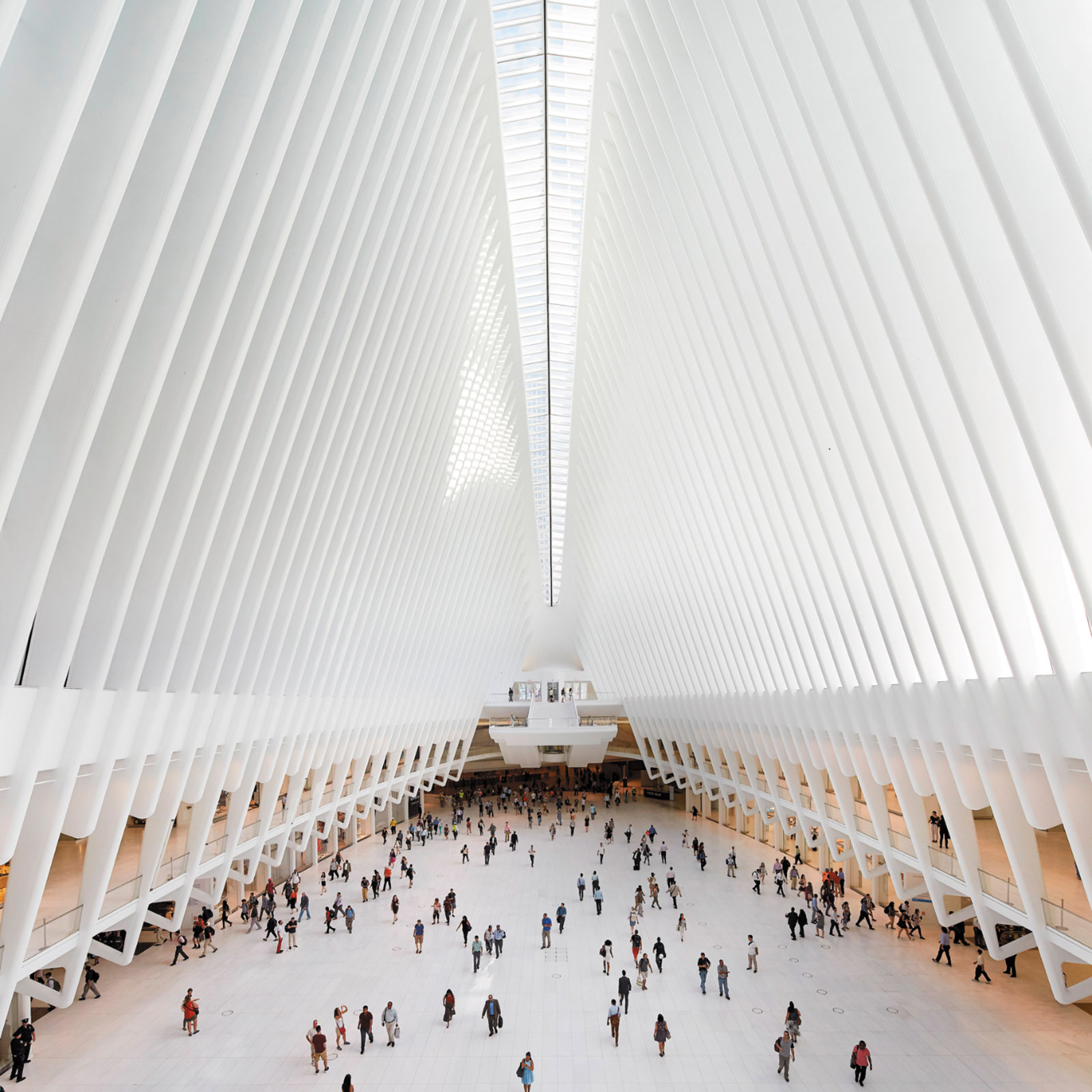
The most architecturally ambitious portion of the ensemble, Santiago Calatrava’s World Trade Center Transportation Hub (commonly called the Oculus), opened to the public in March 2016, though with no fanfare whatever, doubtless to avoid drawing further attention to this stupendous waste of public funds. The job took twelve years to finish instead of the five originally promised, and part of its exorbitant $4 billion price will be paid by commuters in the form of higher transit fares. The fortune spent on this kitschy jeu d’esprit—nearly twice its already unconscionable initial estimate of $2.2 billion—is even more outrageous for a facility that serves only 40,000 commuters on an average weekday, as opposed to the 750,000 who pass through Grand Central Terminal daily. Astoundingly, the Transportation Hub wound up costing more than One World Trade Center itself.
Calatrava’s budgetary excesses were already well known among professionals by the time he received this commission in 2003. But the Lower Manhattan Development Corporation (LMDC)—the joint city-state body established to carry out the reconstruction effort—had just gone through a bruising public struggle to select a master planner for the site, and in its eagerness for an architectural showpiece, it paid insufficient attention to the Spanish architect’s troublesome track record and fell for the maudlin sentimentalism of his design.
What was originally likened by its creator to a fluttering paloma de la paz (dove of peace) because of its white, winglike, upwardly flaring rooflines seems more like a steroidal stegosaurus that wandered onto the set of a sci-fi flick and died there. Instead of an ennobling civic concourse on the order of Grand Central or Charles Follen McKim’s endlessly lamented Pennsylvania Station, what we now have on top of the new transit facilities is an eerily dead-feeling, retro-futuristic, Space Age Gothic shopping mall with acres of highly polished, very slippery white marble flooring like some urban tundra. Formally known as Westfield World Trade Center, it is filled with the same predictable mix of chain retailers one can find in countless airports worldwide: Banana Republic, Hugo Boss, Breitling, Dior, and on through the global label alphabet. (The Westfield Corporation is an Australian-based British-American shopping center company.) Far from this being the “exhilarating nave of a genuine people’s cathedral,” as Paul Goldberger claimed in Vanity Fair, Calatrava’s superfluous shopping shrine is merely what the Germans call a Konsumtempel (temple of consumption), and a generic one at that.
Still to come are 2 World Trade Center by the Bjarke Ingals Group (BIG) and 3 World Trade Center by the office of Richard Rogers. Plans are doubtful for a putative 5 World Trade Center (to replace the former Deutsche Bank Building, which was irreparably damaged by debris from the collapse of the Twin Towers and laboriously dismantled) and no architect has been selected. There will be no 6 World Trade Center to replace that eponymous eight-story component of Yamasaki’s original five-building World Trade Center ensemble, also destroyed on September 11. Hufton+Crow
The interior of the World Trade Center Transportation Hub, designed by Santiago Calatrava
2.
The enormous public interest in the resurrection of Ground Zero quickly prompted three books about the first phases of the effort, all aimed at a general readership and published within four months of each other around the disaster’s third anniversary. Goldberger’s Up From Zero: Politics, Architecture, and the Rebuilding of New York (2004) was one of his typically well-reported but never indiscreet overviews. Philip Nobel’s Sixteen Acres: Architecture and the Outrageous Struggle for the Future of Ground Zero (2005) offered a juicier, more anecdotal account of the same events. Both books suffered from a lack of adequate illustrations, a shortcoming rectified by Suzanne Stephens’s pictorially rich compendium Imagining Ground Zero: Official and Unofficial Proposals for the World Trade Center Site (2004). However, even though the recently issued One World Trade Center: Biography of the Building by Judith Dupré is as glamorously visual as one could imagine, her breathlessly boosterish tone makes it seem more like a promotional event than a serious monograph.
Now, more than a decade after the initial flurry of books, we have what is likely to remain the definitive account of this tortuous and unedifying saga, Lynne B. Sagalyn’s Power at Ground Zero: Politics, Money, and the Remaking of Lower Manhattan. Sagalyn, who retired as a professor of real estate at the Columbia University Business School, insists that there are no heroes or villains in her narrative. However, her meticulous and exceptionally clear exposition of the essential facts provides more than enough evidence for readers to come to their own, and often damning, conclusions, especially about the real estate developer Larry Silverstein, who bought a ninety-nine-year lease on the World Trade Center from the Port Authority of New York and New Jersey just six weeks before the disaster.
Sagalyn’s exhaustive research has revealed some fascinating interrelationships in the upper echelons of the city’s power elite, which will be unsurprising to those who know how the financial and cultural capital of the US really works, and insider glimpses are rarely revealed as directly as she does here. For example, she tells how the well-connected attorney Edward Hayes, a “New York political infighter” and “go-to guy,” urged Pataki, a former Columbia Law School contemporary of his, to pick Daniel Libeskind’s scheme in the competition for the site’s master plan.
Hayes had been introduced to Libeskind and his business-manager wife, Nina, by Victoria Newhouse—an architectural historian and the wife of the publishing magnate Si Newhouse—who was avid to see Libeskind win the commission. Pataki reassured Hayes that he was already in favor of Libeskind’s proposal and indeed intervened at the last moment to ensure that he was chosen. It was a Pyrrhic victory for the architect, however. Libeskind assumed that winning the contest would also entitle him to design the Freedom Tower, but because of his limited experience with such large-scale projects he was forced to collaborate with Childs, who edged him out of the commission with Machiavellian dispatch.
Si Newhouse resurfaces later in the story when the question of who would actually occupy the Freedom Tower becomes an urgent matter. Newhouse’s Condé Nast Publications was identified as the ideal “anchor tenant” by Silverstein’s longtime leasing broker, Mary Ann Tighe of CBRE, the world’s largest commercial real estate services firm, who had known the publisher for decades. Given the perceived danger of another terrorist attack, this would not be an easy sell, but Tighe recalled that Condé Nast had been previously receptive to an undesirable address at the right price when it relocated from its longtime Madison Avenue headquarters to the newly built 4 Times Square in 1999, when that area still had a seedy aura. (The developer of 4 Times Square, the Durst Organization, received tax incentives estimated at more than $280 million, which allowed it to give Condé Nast very favorable terms, a classic example of corporate welfare at taxpayer expense.) Durst partnered with the cash-strapped Silverstein on One World Trade Center once it became an active, risk-free proposition, and Condé Nast agreed to move to Ground Zero when it was offered yet another sweetheart deal on a property widely deemed to be very difficult to rent.
A more visible display of influence was orchestrated by Herbert Muschamp, the New York Times architecture critic from 1992 to 2004. As his friend Frank Gehry told the writer Clay Risen, they dined together in Manhattan the night before the Twin Towers attack, and the catastrophe so traumatized the critic that he felt unable to leave his forty-fourth-floor Tribeca apartment, several blocks north of Ground Zero, for some time afterward. Thus Muschamp deprived the Newspaper of Record of his immediate insights on the biggest architectural news story of modern times for nearly three weeks. Perhaps to compensate for this glaring lapse, he organized a special issue of The New York Times Magazine that presented his notions of how the site ought to be reconfigured, which was published the Sunday before the first anniversary of September 11.
Muschamp had been dismayed that several months earlier the LMDC and the Port Authority (which owns the Trade Center site but leased the now-vanished Trade Center buildings to Silverstein) selected the architectural and planning office Beyer Blinder Belle (BBB) to develop a master plan. Although that partnership had won universal praise for its exemplary restoration of Grand Central, Muschamp deemed BBB insufficiently adventurous for this assignment. Accordingly he invited many of his favorite practitioners—older figures of the New York avant-garde as well as younger trendsetters—to submit their own ideas and assigned parts of the project to them.
The fact that these hypothetical schemes lacked even the most basic information that architects need to draw up design proposals—a budget and a functional program beyond vague designations (school, arts center, and the like)—seemed not to bother either Muschamp or his nominees. As Sagalyn writes in one of her rare overt expressions of disapproval:
This was not city building. Architecture may be art and city building calls for art-like understanding of the fabric of a place, but a city is not a blank canvas to paint at will as Muschamp was advocating with his study project, most unrealistically….
Irresponsibly, Muschamp had preemptively pronounced his personal opinion of what was likely to result before BBB had even drawn a single line. Did this belong in the news section [sic] of the paper? Where does the press cross the line between presenting the news to inform the public and aiming to become a player by advocating a particular vision—other than on the editorial page?
Yet this self-appointed planner was scarcely oblivious to urban design realpolitik. (Nor were the LMDC and the Port Authority, which withdrew the commission from BBB and announced a competition to find a new planning firm.) Immediately after Libeskind’s master plan was chosen over Rafael Viñoly’s proposal—which was centered by a scaffold-like, smaller reiteration of the Twin Towers that the Times critic championed, but that Pataki tactlessly likened to a pair of skeletons—Muschamp made an astonishing volte-face and wrote that the best scheme had won after all.
3.
This aesthetic influence-peddling, whether in the back corridors of government, the salons of the powerful, or the nation’s most prestigious newspaper, was nothing compared to the nonstop machinations of the pivotal figure in this drama, Larry Silverstein, who before September 11 had been considered a fairly minor player and something of a bottom-fisher among the big deal machers of the New York real estate establishment. Although Sagalyn’s portrait of Silverstein accords with the general outlines of previously published reports, here he emerges even more unfavorably as his actions are recounted in greater detail than ever before, thanks to the author’s extensive interviews and her informants’ willingness to speak candidly about him (an indication of how much rancor he aroused).
At the heart of the matter was Silverstein’s unshakable determination that all ten million square feet of office space lost in the Twin Towers’ collapse be replaced, a position driven by his desire to protect the maximum future profitability of his investment. However, this did not accord with the changing economic realities of postmillennial Lower Manhattan, and his sheer stubbornness struck New York City Mayor Michael Bloomberg and the technocratic urbanists around him as fundamentally uninformed and misguided (to put it in the most polite terms).
Sagalyn quotes Daniel Doctoroff, Bloomberg’s deputy mayor for economic development and rebuilding, as pointing out that “Lower Manhattan before 9/11 had a growing residential population, but it had been losing worker population since 1970,” even as the construction of the original World Trade Center was still underway. The changing demographic needs of this part of the city, said Doctoroff, “were swept under the rug in the wake of 9/11 by this kind of nostalgia for the World Trade Center and the tremendous emotion that existed.” The Bloomberg administration favored a varied mix of components with far less emphasis on offices and more housing units, in line with the growing residential character of the Financial District, where many old commercial buildings no longer suitable for today’s high-tech businesses have been converted to apartments, often very costly ones.
But Silverstein’s representatives (including Mary Ann Tighe) aggressively pressed his case for a full ten-million-square-foot build-out, and hammered home the questionable assertion that the boom-or-bust nature of New York City building cycles demanded readiness for the next inevitable upswing (this was before the international market crash of 2008). Conveniently omitted by the developer’s team was the financial history of the World Trade Center. The complex was built during a recessionary period, and it took until the 1980s for it to finally turn a profit; it did so only because of the artificial life support of state government agencies that had been transplanted to the Twin Towers by New York Governor Nelson Rockefeller, brother of that quixotic scheme’s mastermind, David Rockefeller.
Bloomberg and his advisers repeatedly tried to gain control of the project and impose the focused leadership and purposeful direction it lacked. Their most ingenious attempt was a Solomonic solution advanced by Roy Bahat, a twenty-four-year-old aide to Doctoroff, who suggested a swap of the land underneath Kennedy and LaGuardia airports—the city owns that real estate but the Port Authority runs the facilities on it—in return for the Trade Center acreage, which is owned by the Port Authority. This would have allowed the city to invoke eminent domain, cancel Silverstein’s lease, and be done with him. Although the Times praised it as “the most creative idea to arise from the Lower Manhattan redevelopment process so far,” the trade-off foundered not only because of the tangled economics of how evaluations for the respective assets would be calculated, but also because it was stymied by officials who foresaw themselves losing power if the deal went through.
As is typical of such betrayals of the public trust, there was more than enough blame to go around. Sagalyn names names, and they include Port Authority Vice Chairman Charles Gargano, described by the author as “‘a loyal Pataki soldier’…said to be riled by the swap proposal, a threat to his influence; he had already been ‘a loser in a bid to control the [LMDC]’. In the end, it was a political decision—for Governor Pataki.” At that time Pataki harbored presidential ambitions and felt that his continuing involvement in rebuilding Ground Zero would elevate his national reputation. As a result of these and other complications, the swap died in June 2003.
Whatever one might think of Bloomberg’s often high-handed approach to urbanism, which tended to favor corporate interests at the expense of other concerns, there can be little doubt that he did a number of very good things for New York City, and would have been a far better overseer of the World Trade Center redevelopment than any other major figure on the scene at that time. Among the institutions involved in the rebuilding, none is portrayed more critically by Sagalyn than the Port Authority, and rightly so. Its preference for investing in chancy real estate speculations instead of focusing on an overburdened transportation system and crumbling regional infrastructure has been a long-running scandal. A thorough overhaul of that bistate agency would seem to be the only solution to correcting the abuses detailed so appallingly by Sagalyn in her quiet way.
High among other factors that greatly complicated the rebuilding of the Trade Center site are recent advances in DNA verification methods. The conjunction of those new capacities with the 2001 catastrophe is the basis for a thoughtful and solidly informed meditation, Who Owns the Dead?: The Science and Politics of Death at Ground Zero by Jay D. Aronson, a professor at Carnegie Mellon University and director of its Center for Human Rights Science. Because it is now easier than ever to identify human remains found at sites of mass disasters, expectations ran high among many families bereaved by the Twin Towers attack that they might reclaim some corporeal vestige of their dead relatives. It was once expected that those lost at sea would lie forever asleep in the deep, much as soldiers killed in foreign wars would be buried near where they fell. However, modern science has encouraged a broad belief that the retrieval of physical matter, no matter how tiny, is essential to attaining “closure”—that obsessive yet elusive goal of contemporary grieving.
As of last autumn, remains of 1,113 of the disaster’s victims—or some 40 percent of the death toll—continue to be unidentified. At several points during the slow, painstaking, dignified, and respectful recovery process, officials announced that the search had concluded, but family members who had not yet been given definitive physical proof demanded further forensic investigation.
As it turned out, spot checks confirmed that minute amounts of residue from the victims were still discernible in the surrounding area, a finding that prompted an even more microscopic search that in some areas went inch by inch through newly discovered concentrations of possible physical evidence. This late phase was pursued with a vigilance that the participating experts vouchsafed was much more thorough than any they had witnessed before, verging on the exactitude of an archaeological dig. And indeed, additional names were associated with the powdery particulate. But to what end was this increasingly obsessive search? As Aronson writes:
The thought of unidentified remains is unnerving, especially for a society that wants to believe it has the technical capacity to provide some measure of certainty in an uncertain world…. It is ironic, then, that the individualization of the victims of the World Trade Center has made it more politically palatable for the US government to engage in a seemingly perpetual war that has created innumerable casualties in Afghanistan, Iraq, Pakistan, Yemen, and elsewhere.

Heart of Europe: A History of the Holy Roman Empire, the magnum opus of Oxford’s Peter H. Wilson, is almost a thousand pages explaining a thousand-year empire that few contemporary readers know or care about. Yet the long-ago, expired heart of Europe still has a vital message for the United States today.
All any Brit or American can recall about this empire, which lasted longer than Rome’s, is perhaps Voltaire’s leitmotif that it was neither holy, Roman, nor an empire. Probably true—but that would be to list its strengths rather than weaknesses, notwithstanding the French cynic’s intention.
It was not holy since it separated church and state better than other powers did at the time. It was not Roman but Germanic (which is why Frenchmen so loved to promote the Voltaire jibe). It was not an empire but a federation, the most successful one before the United States, and for similar reasons. It was based upon compact and decentralization rather than primarily relying on top-down coercion to force uniformity.
Wilson, the academic historian par excellence, saves that wisdom until the very last paragraph of his many thousands. His is a history of such magnitude it is impossible to do it justice in a review. Just consider the range of different dynasties: Carolinians (119 years), Ottonians (105), Salianians (101), Lothar (12), Staufers (116), little kings (93), Luxembourgs (90), and the incredible (and better-known) Habsburgs (368). At best, Anglo Saxons are familiar with Charlemagne and maybe Charles Martel from the Holy Roman Empire’s beginnings, and with the Habsburgs—although knowledge of them is generally confined to Franz Joseph’s abdication after the First World War, well after the demise of the empire, which expired in 1806 to deny the emperor title to Napoleon.
This book makes the case for continuity for the whole millennium between 800 to 1800 A.D., even though there were sustained periods without an emperor during the above-mentioned dynasties. (Under the Hapsburgs, the interregnum was for only three years.) Wilson’s argument is convincing since it was the inability of the electors to agree upon a replacement emperor, or disputes between them, that caused the vacancies. Both elector and non-elector princes continued operating under the same laws and courts during those interludes.
The scope of the empire’s territory was immense, with the boundaries constantly changing in ways to befuddle moderns who look at the old maps and are unable to fit the duchies and principalities into modern nation-states or regions. Ruling nobles fool us with numerous noncontiguous properties that were the result simply of where they could exercise power or, more often, marry their children. Many units survive but just as many do not, having been effaced by modern place-names. The most local elements do endure, many tracing back to remnants of the “original” Roman Empire (which ended in 476 A.D.), with many still on the castle tours today.
The central structure of the Holy Roman Empire was based upon the only ideal its inhabitants knew: the old Roman Empire from which it devolved. The earlier model was modified substantially by three major countervailing forces: fierce German tribalism, a Christianity with deep roots in much of the population before the fall, and finally, an east-west rather than a north-south trade and communications orientation. The empire’s sinew was a network of vassals who formed links from the very top to the remotest outposts: from the emperor, kings, dukes, princes, and lords down to the lowest knight, with the commoners mostly left to supervision by the lower nobles, the bishops (who might also be secular lords), and the minor clerics and abbots.
The vast hierarchical and interconnected vassal system was a military, family, social, and commercial line of communication between the various parts linking all aspects of empire life. Its vaunted legal system was built around the mutual obligations up and down the hierarchical line. Maintenance of the structure was the main business of the realm, as well as a major cause of disputes, whether charges of disloyalty emanating from above or refusals of support emanating from below. The ultimate power at the top was to unseat vassals, but this was exercised sparingly so as not to threaten the whole system of authority. Charlemagne and his early successors removed dozens rather than hundreds. The ultimate power from below was to switch loyalty from one superior to another.
Governance resided at emperor, prince, and local levels. The emperor had two main functions: to keep the borders safe, especially from various Viking, Slav, Magyar, and Muslim invasions; and, just as important, to travel throughout the realm carrying the flag of office and settling inter-principality disputes with his traveling court, from which lower and disbursed courts emerged. Under the Holy Roman Emperor, the prince pretty much ran his fief as he saw fit as long as the emperor’s interests were respected and he could persuade his vassals. Each lord below operated upon the same principle. Still, by the high Middle Ages, most manor, parish, and village settlements had some degree of self-governance.
The top princes were designated electors who chose the emperor himself and of course ruled their own realms, traveling and dependent upon lower vassals they could likewise remove—but with circumspection because the latter, if they united, could remove him by force or by subterfuge. The local lord supervised the processes of production—mainly agriculture, but later trade and water, and then steam-powered manufacturing. Political power so widely distributed required living with differences and disagreements and negotiating, with war only a last resort where all suffered. Religious beliefs encouraged these same attributes, and Europe in this period enjoyed substantial interludes of “public peace” often binding on the emperor himself, up until the Black Plague of the 14th century, which undermined both religious and civil authority.
The legal structure was a large part of the empire’s success. Law was a mix of Germanic folk custom embedded deep in “barbarian” tribes and cults, old Roman law, and church cannon law, all of which evolved over time both from below and from above. Emperors, princes, and principalities could come and go, but the law and courts survived (although also in various evolving forms). Major reforms began as early as the reforming 9th century Cluny Benedictine monastic movement, which refined practices that had to appeal to a ruling class based upon muscle rather than rationality. With the diocese and monastery’s own large property base and overlap of religious and economic functions, it meant that canon law, and the church as a legal venue, gained appeal as compared to the nobles’ trial by ordeal and fire. This rationalizing of law then spread to higher church venues, the principalities, and the empire itself.
While all of the important regions in the empire were derived from tribal names (Bavaria, Franconia, Frisa, Swabia, Saxony, and Thuringia), the dominant Franks represented only 25 percent even in the early Carolingian period. Tribal practices set the foundations of law, language, and customs but these tended to be compromises as different ones interacted with each other and laws from above provided some commonness. Over time, ethnic group, ancestry, marriage, and custom became less important than formal law, although these persisted in local symbols of flags, coats of arms, badges, and colors throughout the life of the empire.
Property rights emerged from local tribal markings and later fences and walls, which set family boundaries and ultimately individual ones. These were recognized in law mainly in resolving disputes in court, mostly based on custom and possession. The rise of commerce in cities and guild associations sparked further written uniformity for wills, agreements, and contracts. As with all Europe, Latin provided a common language for the rulers developed around the church, whose scribes did most of the writing. But German replaced Latin in the 13th century as the official language of the empire, two centuries before English became dominant across the channel, although Latin, Italian and Czech persisted too.
With the church demanding some separation from Caesar and holding large areas of property, disputes were inevitable at all levels. The most dramatic was the so-called Investiture Dispute between emperor and church lasting between 1073 and 1122. Traditionally, the king or emperor would give the church-selected bishop a staff to recognize his shepherding the church flock and the bishop would give the king a ring to acknowledge his secular rule. Henry IV invested the archbishop of Milan without church approval, whereupon Pope Gregory VII declared it invalid, infuriating Henry since the archbishop had secular power, too. It was not settled until the Concordat of Worms in 1122, with the emperor—after three days’ penance standing in the snow—conceding that the church council and pope must invest bishops with spiritual authority but the emperor would supervise the council proceedings and help resolve disputes, with the bishop then pledging loyalty to the emperor, a compromise that lasted until the time of Napoleon, almost 700 years.
Such agreements between emperor, lords, and church setting rights and obligations became common in the high Middle Ages. Concurrent with Magna Carta, Emperor Frederick II issued similar charters recognizing secular and religious rights in 1220 and 1231, and the Aragonese Privileges were adopted in 1283. A perverse result of the agreements that granted rights to many levels of society, but were actually enforced by the higher lords, was that the top princes actually gained power relative to the lower nobles and widened the class distinctions between them. Henry IV’s weakness led to numerous military threats to the throne, including from his son, ending in the Salianian wars and finally the peacekeeping Staufers after 1138, and a return to the more consensual rule that was more typical of the empire (with Prussia the main continuing exception), while the rest of Europe turned toward Divine Right centralization.
By the 15th century, the empire became more identified with a common German language and a more uniform legal system protecting property and liberties. A major Turkish invasion in 1469, however, created disorder among the princes over strategy and obligation to the states under attack. Victory was followed by relative peace, with France busy with internal dynastic and religious struggles. Ethnic nationalism did not develop within the empire until the 18th century. It even survived the Reformation, for it ended up containing Protestant and Catholic principalities. But it changed again in 1699, after the Hapsburgs won large territories from the Ottomans, giving the dynasty larger plots of land outside the empire than within.
The Hapsburg kings’ interests then began to diverge from those of the empire’s princes, especially Prussia, with the princes divided in the War of the Austrian Succession. The Hapsburg monarchy actually outlasted the empire, only petering out at the conclusion of the First World War.
The empire’s rule was long, with great differences over time but it held together with multiple layers and divisions of power accepting disagreement and contracting with other power centers as a means of avoiding constant war or dissolution. In effect, the empire invented federalism. Johannes Althusius is normally identified as the first philosopher of federalist contracting between center and periphery (contrasted to the centralizing thought of his contemporary, Thomas Hobbes); but Althusius formulated his theory based on the already-existing reality that linked his Catholic emperor, Lutheran prince, and Calvinist city. While some question whether the Baron de Montesquieu read Althusius, he followed him, and did use similar arguments that would come to exert a strong influence on the American Founders.
Unfortunately, federalism, which President Reagan called the secret of America’s success, became weakened when President Wilson convinced our intellectuals that centralized, scientific administration was the better theory, and this error has dominated U.S. politics from Wilson’s day to ours. But the Wilsonian myth is showing ever more and ever deeper cracks, with widespread agreement today that the center does not hold. Indiana University Professor Vincent Ostrom made the intellectual case as early as 1974 that bargaining among equals produced superior results than force. Today a politically centrist professor writing for the Brookings Institution concedes that the center does not work, crushed by its layers of bureaucracy and red tape. Donald Trump understood the dissatisfaction and rode it to the White House.
Heart of Europe does not directly consider modern political implications, but the author does criticize the European Union at the end as too centralized and suggests a more decentralized and consensual union that might look back upon the empire for valuable lessons—especially now, in the wake of Britons’ decision to leave the EU and the Italian rejection of a more centralized constituion.
The memory of the decentralized empire inspired the success of Konrad Adenauer’s federalism in Germany after the Second World War, and it might even inspire a new American administration as its looks to reconnect its alienated rural base to the heart of its own dysfunctional empire.