Showing posts with label Cameos from Zion. Show all posts

Wednesday, August 16, 2017

The Silence of the Archive. David Thomas, Simon Fowler and Valerie Johnson. Facet. 2017.


In the past two to three decades, the archival profession has been caught between two currents of cultural and technological change: simultaneous, largely unrelated, both apparently inexorable. Largely confined to the academy, but resonating beyond it, has been a radical scepticism about the stability of meaning in language resulting from the postmodern turn in historical thinking. Coupled with this epistemological scepticism has been a hermeneutic of suspicion of the power relations that are embedded in the creation, description and accessing of archival records. This has been bound up with the emergence of a wider politics of identity, and the assertion of the experience of marginalised groups as being equally worthy of documentation and study as those more ‘official’ voices that have traditionally dominated archives.


At much the same time, the transition from paper to digital in records management and archiving has presented the profession with challenges of exceptional scale and complexity, as laid out by David Thomas, former Director of Technology at the National Archives of the UK, in Chapter Three of this fascinating book. This transformation has fundamentally changed the ways in which live records are created and managed by organisations, with the significant added risk of mis-description as frontline staff are pressed into becoming their own archivists, and also of discontinuity in working IT systems such that data is lost or rendered uninterpretable. As these records pass to the archive, new and intractable challenges of scale come into play as archivists must select content for archiving and appraise it, presenting the difficulty of finding effective ways of describing these records and designing access systems that meet the needs of users.


For most working historians, much of the ferment of the discussion that these changes have prompted amongst archivists and theorists has been largely obscure; most of the literature that the authors (all three of them present or former TNA staff) synthesise here is to be found in the journals of the archival profession, into which historians rarely look. For those scholars whose only contact with archives is in the search room, this book will likely come as something of a revelation at just how far-ranging and radical some of that thought has been in the last ten years, and should be widely read for that reason alone. One might expect it also to find its way onto reading lists for introductory courses in the methods of archival research. It is therefore a matter for regret that the book, even in paperback form, is priced at a level that makes it unlikely that it will find its way into many private collections.
Image Credit: (Matt Brown CC BY 2.0)


As a whole, the book has two major themes, one of which is acknowledged by both the title and the back cover, and another, equally if not more important, which is everywhere implied but rarely stated (to which this review returns below). Firstly, the theme of the title: the silence of the archive. The authors, along with Anne J. Gilliland in the foreword, identify an image that has formed in the public imaginary of the archive as a comprehensive repository of all known facts about the past. Scholars will differ on how potent and pervasive that image is, but the authors set out to show firstly that archives are neither comprehensive in this sense nor purely objective, even supposing such a state were possible.


Chapter One, by Simon Fowler, deals with ‘enforced silences’, whereby organisations conceal, amend or destroy records before they reach the archive, or where (as an unintended consequence of freedom of information legislation) records are never created as business is transacted informally. All manner of decisions are then made as the archivist selects which records should be preserved, appraises those records that are selected and removes material in the process, and then catalogues records in ways that bring certain aspects to the fore while effectively silencing other voices. In addition, neither the transient quality of everyday life nor the lives of the majority of the population often come under the gaze of the state and so leave few traces (Chapter Six by Valerie Johnson is instructive on the ways in which marginalised communities may be intentionally brought into view and their stories documented as a result.)


Professional historians are of course accustomed to engaging critically with the ways in which their archival sources come into being, but they will benefit nonetheless from this wide-ranging survey of the particular issues. In several places, however, a strangely critical note is struck: a suppressed frustration with the users of archives and their apparent inability to understand the issues. In Chapter Two, ‘Inappropriate Expectations’, Fowler quotes the historian Nicholas Rodger on the distaste of staff of the Public Record Office when asked to provide subject indexes: to do so ‘would imply that the Office had a duty to provide something the public wanted, instead of the public having a duty to shift for itself and leave the archivists in peace’ (54).


While this whole book is a testament to how far those kinds of attitudes have been eclipsed, glimpses occasionally show through. Archivists, we are told on page 45, are familiar with being ‘bombarded’ with questions which cannot be answered, by users who ‘struggle to understand’ the issues (60). Johnson writes (after Lisa Jardine) of the ‘longing of historians and researchers to find that golden key which will unlock the secret they are investigating’, which in some cases leads to false assumptions about evidence that does not in fact exist and (at the extreme) to the sorts of conspiracy theorising, fictionalisation and fabrication that Thomas explores in Chapter Five. Whilst some researchers can and do cross this line, the experience of this reviewer, at least, is that such cases are rare, and are perhaps overstressed here. Most historians are able to control their longing. That said, archive users, for their part, have no doubt been guilty of failing to appreciate the role of the archivist as something more than a mere fetcher and carrier of files as Johnson notes (146): there is work to do perhaps on both sides of the relationship.


To a certain extent, the book is let down by its title and chapter headings, since the focus on what is not possible obscures a more hopeful and arguably more important thread which appears explicitly only on page 141. Johnson asks where the responsibility for the documentation of society lies, and answers: ‘it has been the implicit argument of this book that we are all responsible, whether as creators of records or professional curators of those papers, or as users, researchers, historians and informed citizens.’ At this point, this reviewer must declare an interest, as one working to facilitate precisely this better working between archives and the users of their digital services.


Nonetheless, The Silence of the Archive is throughout a call for a new relationship between archivists, the ‘archival subjects’ (those whose lives are documented) and those who use the archived record. Johnson writes of the process whereby those archival subjects are engaged in the process of creating the archive of their existence, thus becoming co-creators with the archivist (149-53). Thomas points out the acute need in a digital archive for close engagement with end users, both in the selection of material and in the design of the interfaces that make those records first discoverable and then usable (70-72). It is a shame, then, that this call for change – necessary and urgent – is somewhat muted here; indeed, in general, the authors have a tendency to quote and expound the work of others rather than elaborate an argument, and could have been bolder. However, it is a case that should be widely heard. Records managers, archivists, historians and other users of archives should read this timely and important book.

Friday, March 17, 2017

Fallen Glory by James Crawford ,Fallen Glory: The Lives and Deaths of the World's Greatest Lost Buildings Paperback – July 12, 2016 by James Crawford


'Fallen Glory' explores the most famous buildings that no longer exist

Scottish historian James Crawford finds meaning in lost landmarks.


As a new book tells us, the best of buildings are much more than brick and sand, angles and arches, steel and iron. Vivid history lessons lurk in our most stunning landmarks, particularly the ones that have crumbled at the hands of humanity or nature, ground under the present's mastery of the past.

The Library of Alexandria, the Temple of Jerusalem, the Bastille. Hong Kong's Kowloon Walled City, India's Fortress of Golconda, Spain's Madinat Al-Zahra. James Crawford, a young Scottish historian, makes a perceptive virtual visit to each of these lost landmarks and more than dozen more in his hefty Fallen Glory: The Lives and Deaths of History's Greatest Buildings.

The architecture gets plenty of attention, but Crawford pulls back to paint a wider portrait. For each building – and he's happy to stretch the definition of the word – Crawford expands its meaning to those who built it, those who used it and those who preserved its memory.

After all, he writes, "if we let them, buildings have the potential to be the ultimate raconteurs." To put it another way: Oh, the things they've seen.

The book begins with the most famous legendary building in history – the Tower of Babel.

In the Bible, two prophets connect the tower to a leader's epic excesses in Babylon. In fact, something much older – a site called Eridu in Iraq – may have inspired the legend of Babel, Crawford discovers.

Eridu isn't just home to a half-built temple called a ziggurat. Archaeologists looked under walls and found 17 layers of buildings constructed over hundreds of years on top of each other, each bigger, suggesting "seam after seam of architectural evolution that rise up through the centuries" – over a millennium, in fact. At the very bottom: a chapel, possibly "the first temple, in the first ever city."

To Crawford, it reveals the story of an ancient people's "progress and ambition," the same potent combo that the Tower of Babel legend seems to warn against.

Buildings, of course, can also serve to inspire, even if they they're mostly or entirely gone.

The Citadel of Mycenae in Greece, which crumbled hundreds of before the birth of Christ, is thought to be Europe's first war memorial, a celebration of the warrior and "the spiritual home of every 'hawk' who ever took up arms and marched across continents in the footsteps of Agamemnon, the one-time 'lord of men.'"

The ruins of the citadel have drawn a "bizarre roll call of heroes and villains," Crawford writes, from Nazi leaders to philosophers, beat poets, Henry Miller, William Faulkner, and Agatha Christie.

But now, archaeology is painting a different picture of the time and place that produced the memorial, raising doubts about age-old assumptions regarding a warrior race. It appears that the Mycenaeans were "a civilization of traders and farmers rather than warriors, ruled over by diligent but dull bureaucrats." One can almost imagine them toiling in cubicles and gathering around water coolers.

More recently, the ruins of the Roman Forum entranced warlords like Adolf Hitler, who dreamed that the remains of his nation's structures would touch the world many centuries from now, beyond the fall of the "thousand-year" reich. To make this happen, he "ordered that steel and reinforced concrete should no longer be used for Nazi public buildings, and that architects must turn instead to the more durable materials of stone and marble." Ruin, however, came much earlier than Hitler expected.

The newest physical structures to appear in "Fallen Glory" are the towers of the World Trade Center, described by one architect as being "as successful as the pyramids" at the art of symbolism. But Crawford's flexible definition allows one more recent creation to make his list. It's GeoCities.

Wait, what? Yes, GeoCities, the doomed Internet community that once served 38 million people. "The biggest collective cultural endeavor in history," it became obsolete and vanished forever one day in 2009 when Yahoo pulled the plug.

Well, to be more accurate, it sort of vanished. The ruins of GeoCities exist online, a kind of "digital Pompeii" that offers a glimpse into the clunky early days of the Internet, when people embraced a new way of building a community. Then, when GeoCities failed to be useful anymore, it was snuffed out by a company with its eye on the next big thing.

As Crawford's book suggests, the glories of the past often can't compete with the imagined glories of the future: The old must make way for the next.

It all goes back to Babel: "Some fragment of the tower has always been present, every time man has looked to build something new.... It whispers, 'Beware, don't let ambition be your downfall.' And in the same breath it says, 'Build up to the heavens and don't look back. Go to it. And make a name for yourself."

Tuesday, January 17, 2017

The Two State Solution Academic Fantasy : An even greater threat to Palestinians than to Israelis


 Most observers, when debating the pros and cons of a two-state solution, focus exclusively on its potential impact on Israel and its Jewish citizens. Much less attention is paid to the solution’s potential impact on the Palestinians. Leftists, right-wingers, conservatives and liberals all tend to assume that two states would naturally be in the Palestinians’ interest. Think again.

As was apparent at the recent Paris conference, the world refuses to acknowledge that the two-state solution has already failed the Palestinians. The Palestinian Authority (PA), established in 1994, came to rule over all of Gaza in the summer of 2005 after the complete Israeli withdrawal and destruction of Israeli settlements. The PA also had exclusive control over the major cities in Judea and Samaria/the West Bank and their environs, comprising some 95 percent of these territories’ population.

However, that unified Palestinian entity, which was supposed to be the Palestinian side of the two-state equation, proved extremely short-lived. Within two years of Israel’s withdrawal from Gaza, Hamas took over Gaza completely. In the summer of 2007, after several rounds of fighting that began soon after Hamas’s electoral victory in 2006, the Islamist group established its own exclusive government in Gaza.

Thus, the Palestinians partitioned themselves into two bodies: an autocratic entity headed by Mahmoud Abbas in the West Bank, and a Hamas theocracy in Gaza. Almost unnoticed, the two-state solution had given way to a three-state solution.

European states – like France, for example, which convened the Paris conference – will no doubt clam that that was all in the past, and the past can always be corrected.

It is certainly true that the Palestinians are always allowed by the international community to have yet another chance. But a two-state solution is simply no longer feasible.

A relatively bloodless civil war has been raging between the two entities day in and day out since their bloody 2007 confrontation, offering a constant illustration of why there cannot be a single Palestinian state. If the two sides were to attempt to reunite, that war would become very bloody indeed. The Palestinians themselves realize this, which explains the succession of failed attempts to bring the sides together.

As separate entities, the two sides make do by utterly subduing the opposing group. The cost of this suppression has been relatively low so far: several deaths of tortured political prisoners in Hamas and PA prisons, a few extrajudicial killings, and the occasional closing down of professional or charitable organizations linked to the opponent. The PA, the economic clout of which is financed by the international community, has blocked projects like the creation of a new Israeli electric grid line into Gaza and the creation of a modern port that would considerably improve Gazans’ standard of living.

Ironically, Hamas supports the new Israeli grid line, even it means greater dependence on the Israeli enemy it has vowed to destroy. For Hamas, waging civil war with the PA over electricity (in addition to many other areas) is more important than increasing its own dependence on the enemy.

For Abbas’s PA, the three-state solution, or, more precisely, the current status quo, is even more essential for its security. The Hamas network of sympathizers, activists, and terrorists in the PA is huge – far greater than the threat Abbas’s Fatah organization poses to the Hamas government in Gaza. The presence of Hamas in the PA is so substantial that the PA is able to contain it only with significant help from the IDF. For the PA, civil war might lead to the same outcome in Ramallah that it experienced in Gaza in 2007.

Even worse, Hamas as an organization has proven adept at maintaining unity. This is not true of Abbas’s PA and Fatah, its ruling party and militia, which have excelled in their divisiveness. This problem is made only graver by Abbas’s refusal to appoint a deputy and potential successor. In this state of affairs, civil war could give way to several more unresolved and bloody Palestinian partitions.

There is an Israeli angle to Palestinian partition and civil war. Israel’s clear historical right to settle the Land of Israel has been flagrantly challenged, partially on the basis that it would undermine the two-state solution. The argument goes that it would turn the future Palestinian state into a discontinuous state geographically – a Swiss-cheese configuration that is assumed to be inherently dysfunctional. The international community forgets that it was the Palestinians themselves who initiated the process of discontinuity, and they are likely to make it worse as the fight over Abbas’s successor intensifies.

At the end of the day, there are only two available options: 1) A Swiss cheese configuration that remains bloodless due to Israeli state expansion through settlement, which keeps the Palestinian opposing sides at bay; or 2) a prolonged and bloody Palestinian civil war between two or more Palestinian entities.

The Zionist movement, and later the State of Israel, have been waiting a hundred years for the Palestinians to be both sufficiently flexible to live side by side with the Jewish state and sufficiently unified to remain intact as a state. In the face of Palestinian failure to do either, Israel has every right to pursue its legitimate rights in settling Judea and Samaria. This should include annexation of area C, the blocs around Jerusalem and in Samaria where almost no Palestinians live, or anywhere else Israel sees fit.

Sunday, November 6, 2016

The Coalition Effect, 2010-2015. Anthony Seldon & Mike Finn (eds). Cambridge University Press. 2015.


Ahead of the 2015 General Election, Anthony Seldon wrote a clear introduction to this expert volume of essays, setting out the observation that David Cameron’s place in history was already secured: for holding the coalition itself together; significantly improving the economic outlook; overseeing some steady domestic reform; restoring dignity to the PM’s office; and winning the Scottish referendum (25). To those, further cementing Cameron’s place in history, we might now add the 2016 referendum on Britain’s EU membership.

Yet, our judgement of the former PM will rest a great deal on the broader question of how history will judge the Coalition government. For a book that asks much more rigorous and specific questions, this volume, edited by Seldon and Mike Finn, helpfully comes very close to looking at that verdict. The Coalition Effect, 2010-2015 deserves serious recognition for setting out, and in many respects crystallising, the major and contemporary distinctive effects of the Coalition government on British politics. Its Herculean task is carefully pursued through 23 chapters of sober, analytically rigorous and critically evidenced observations which adhere to the final conclusions of Finn – that although Britain’s first peacetime Coalition government since the 1930s came into existence because of political necessity, this neither prevented it from setting high ambitions for itself nor inhibited its capacity to generate legislative, economic, governmental and political effects (601). This account and assessment of the ambitions, the visions and the ‘new politics’, including the Programme for Government, tell us much about the Coalition in terms of its history, its meaning and desirability.

For Finn, the Coalition was successful in some economic ambitions – notably, restoring the economy to growth (in terms of jobs and employment) – but that it failed in other significant areas e.g. eliminating the structural deficit, government borrowing and its position towards the ‘cost of living crisis’. It did not achieve its economic targets. As Paul Johnson and Daniel Chandler’s chapter on the Coalition and the economy expresses, the 2010-2015 government only endured Act One of a two-part process of fiscal consolidation in which Act Two may well have been tougher, albeit only now just unfolding (193).

Finn further concludes that the Big Society ‘failed emphatically as a unifying ideal’. And what is also notable about memorable figures such as Andrew Lansley, who ‘went rogue’, and Michael Gove in ‘carrying forward his personal agenda’, are their solo, independent and real effects – but that means they were not truly ‘Coalition effects’. The Coalition’s huge impact on the NHS and education was divisive. Furthermore, for all the debate, the government did not achieve much on constitutional reform. The relationship with Europe deteriorated significantly. It advocated intervention over Iraq and Libya, but could not carry the Commons or the country over Syria. Some of the most devastating Coalition effects were not on agendas as such, but on the Conservative and Liberal Democrat parties. And England, of course, still does not love coalitions.
Image Credit: (themostinept CC BY SA 2.0)
Finn’s observations also raise issues particularly germane to the 2015 General Election: that an unintended net Coalition effect is the genuine emergence of four-party politics at Westminster (at that stage envisaged as being Conservatives, Labour, Liberal Democrats and UKIP). The real ‘fourth party’ was, of course, the Scottish National Party (SNP), returning 56 MPs at that election. Yet, as a chapter by Neil McGarvey highlights, beyond Westminster, coalition and multi-party politics, fixed term parliaments and referenda were not truly novel since they had already become part of ‘normal’ politics in Northern Ireland, Scotland and Wales (110).

While four-party politics could still potentially have far-reaching implications for Britain at home and abroad, as Finn argues, one is left with the niggling question of whether such an emergence could just as easily be viewed as a consequence arising from, for example, an absence of catch-all, cohesive and strong leadership within mainstream parties in a rapidly changing environment rather than stemming from a peculiar ‘Coalition effect’ as such. Peter Riddell, citing Robert Hazell, describes the essence of the broader problem in his own chapter that all the authors of this volume face: ‘It is important to try to distinguish what is a necessary consequence of coalition government and what is merely contingent’ (130). This volume, then, is a significant move towards identifying those distinctions and features from necessary but seismic fudges and the intricate but often unforeseeable complexities and promises-turned-compromises of coalition government.

Martin Loughlin and Cal Viney’s chapter on the Coalition and the constitution is supremely notable for its consideration of fixed term parliaments, voting and House of Lords reform, sovereignty and the EU, rights protection and Scotland and Wales in the UK. It is well justified in concluding that ‘the experience of the 2010-2015 coalition government highlights the dangers of a minority party [the Liberal Democrats] seeking to use its leverage to bring about basic constitutional reform on matters for which there is no cross party consensus’ (86). There is one proviso, however. The implicit division and tension of parliamentary and popular government, theorised by Vernon Bogdanor and which Loughlin and Viney adopt, does not explain precisely how coalitions preclude democratic government and principles. Most importantly, Parliament as a whole (as well as the electorate) did not endorse by any kind of mandate the Coalition arrangements, which in turn endorsed the Coalition Agreement. Their view, therefore, that the implication of the formation of coalitions between the parties is that Parliament, rather than the electorate, has the decisive role in determining who will form the government (84) is problematic in this case – neither Parliament as a whole nor the electorate directly endorsed the Coalition arrangement preceding the Agreement.

It seems more likely that the Coalition of 2010, as organised by a very small clique of political elites (probable ministers and senior party figures), required the bypassing of Westminster and the Coalition agreements, precluding formal democratic procedure and parliamentary government founded on accountability to the electorate. The Coalition Agreement itself was not a Westminster phenomenon, but a Whitehall one. As Seldon writes in his introductory essay, ‘the advice from Whitehall officials was that the national interest demanded stable government’ (2): thus, the Coalition was born. It is for this reason that Loughlin and Viney’s chapter provides and provokes a stimulating essay and debate on the key principles of coalition government.

There is also sometimes a point of caution, or perhaps reservation, towards supposing multi-party coalition arrangements are themselves a ‘Coalition effect’. Anthony King in The British Constitution (2007), for example, considered a line of argument that briefly came to the fore during the turbulent 1970s when adversarial politics and the extremism of party political rides on the ‘ideological big-dipper’ occurred, alleged to have led to economic stagnation, political chaos and a society at odds with itself (270). As a result, some began to see the solution as Proportional Representation and the essential formation of moderate, anti-extremist, inter-party, coalition governments. It bears some political resonance with the UK’s post-2008 wave of economic recession followed by tighter post-2010, Conservative-led, governmental austerity measures; it is possibly too soon for political analysts and scientists to predict again only a long future of coalition governments.

The wonderful hindsight of the 2015 General Election following the publication of this volume showed us that a wafer-thin majority Conservative government could be capably formed while coalition arrangements are rapidly, but with dignity, consigned to history. Yet, if anything, the indispensability of this text lies with the fact that five years after the first coalition government was formed since the Second World War, a wide variety of esteemed experts from Whitehall, Parliament, academia and think tanks have given their professional and intriguing assessments of the ‘Coalition effect’ across all major policy areas.

Tuesday, October 25, 2016

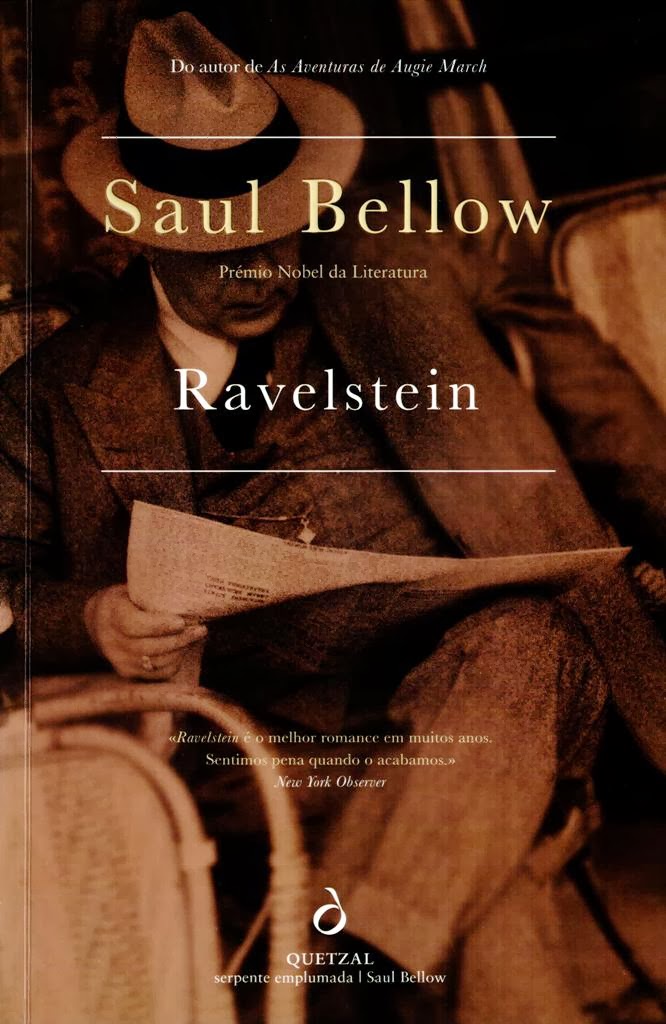
Ravelstein by Saul Bellow Viking, 254 pp, £16.99, April 2000, ISBN 0 670 89131 2

Image result for Ravelstein by Saul Bellow

Ravelstein by Saul Bellow
Viking, 254 pp, £16.99, April 2000, ISBN 0 670 89131 2


Novelists can be lucky in their editors, in their friends, in their mentors and even in their pupils. Sometimes they are generous or sentimental enough to fictionalise the relationship. In Keep the Aspidistra Flying, George Orwell gave his friendless, dowdy and self-pitying protagonist, Comstock, one true pal: the editor and patron Ravelston, proprietor of the small yet reliable magazine Antichrist. This Ravelston – some composite of Sir Richard Rees and John Middleton Murry – was a hedonistic yet guilt-ridden dilettante, good in a pinch, and soft on poets, but too easily embarrassed by brute exigence. Saul Bellow – who has already shown a vulnerability to exigent poets in his wonderful Humboldt’s Gift – now presents us with Ravelstein, a hedonistic kvetch who manifests patience towards none. As is known to all but the meanest citizens of the republic of letters, the novel is an obelisk for the late Allan Bloom, author of the 1987 shocker, The Closing of the American Mind. This book, which was a late product or blooming of the University of Chicago Committee on Social Thought, argued that the American mind was closed because it had become so goddamned open – a nice deployment of paradox and a vivid attack on the relativism that has become so OK on campus these days. Bloom’s polemic swiftly became a primer for the right-wing Zeitgeist; a bookend for the shelf or index sternly marked ‘all downhill since 1967’. And even then, there were those who detected a Bellovian lending, or borrowing as the case might be.


When The Closing of the American Mind first came out, Robert Paul Wolff, then a professor of philosophy at Amherst, wrote a short review in Academe, the journal of the American Association of University Professors. Let me quote from his prescient opening staves:


Aficionados of the modern American novel have learned to look to Philip Roth for complex literary constructions that play wittily with narrative voice and frame. One thinks of such Roth works as My Life as a Man and The Counterlife. Now Saul Bellow has demonstrated that among his other well-recognised literary gifts is an unsuspected bent for daring satire. What Bellow has done, quite simply, is to write an entire coruscatingly funny novel in the form of a pettish, bookish, grumpy, reactionary complaint against the last two decades. The ‘author’ of this tirade, one of Bellow’s most fully-realised literary creations, is a mid-fiftyish Professor at the University of Chicago, to whom Bellow gives the evocative name ‘Bloom’. Bellow appears in the book only as the author of an eight-page ‘Foreword’, in which he introduces us to his principal and only character.

Right away one thought of Herzog, the super-kvetch of all kvetches. But here again, in his foreword to Bloom or ‘Bloom’, Bellow kept us guessing. As he phrased it (teasingly?):


There are times when I enjoy making fun of the educated American. Herzog, for instance, was meant to be a comic novel: a PhD from a good American university falls apart when his wife leaves him for another man. He is taken by an epistolatory fit and writes grieving, biting, ironic and rambunctious letters not only to his friends and acquaintances, but also to the great men, the giants of thought, who formed his mind. What is he to do in this moment of crisis, pull Aristotle or Spinoza from the shelf and storm through the pages looking for consolation and advice?

Rather archly, perhaps, Bellow went on to smile at the simplicity of some of his public:


Certain readers of Herzog complained the book was difficult. Much as they might have sympathised with the unhappy and comical history professor, they were occasionally put off by his long and erudite letters. Some felt that they were being asked to sit for a difficult exam in a survey course in intellectual history and thought it mean of me to mingle sympathy and wit with obscurity and pedantry. But I was making fun of pedantry!

Well, taking things all in all, I think we had better be the judge of that. Because now we have an ostensibly full-out novel, this time under Bellow’s real name, which reveres pedantry and is all about the life and death of Allan Bloom. Indeed, with its many real names and actual locations, it constitutes a novelistic and realistic memoir of him. And it is related, partly in anguish, by a Herzog character – ‘a PhD from a good American university’ whose wife has just left him for another man, or at any rate for other men.


For some reason that I cannot pretend to decode, this Boswell is named ‘Chick’. He it is who proposes that Ravelstein write the egghead bestseller (‘It’s no small matter to become rich and famous by saying exactly what you think’) and who in return accepts Ravelstein’s commission to become his – probably posthumous – biographer. So far, so accurate: Bellow was the egghead’s egger-on, and also his angel in the publishing world, and here we find the second half of the debt redeemed. The story is authentic too, as far as it goes, about Ravelstein/ Bloom’s egghead allegiances. Bloom was an adept or disciple of the Chicago philosopher Leo Strauss, a German-Jewish émigré who was, according to your bias, sinister or arcane. Modelling himself on Aristotelian and Machiavellian theories of the covert formation of princes, Strauss never sought public renown and insisted on close explication of the occult element in classic and classical texts. His American disciples, of whom Francis Fukuyama is probably the most celebrated, achieved a brief nearness to real power during the Reagan and Bush Administrations, one of them (William Kristol, son of Irving) being the Aristotelian mentor of Dan Quayle. The giveaway in Straussian critiques is the employment of the term ‘regime’ to denote styles of rulership. Bellow captures this neo-cultist element quite deftly:


But Ravelstein knew the value of a set. He had a set of his own. Its members were students he had trained in political philosophy and longtime friends. Most of them were trained as Ravelstein himself had been trained, under Professor Davarr, and used his esoteric vocabulary. Some of Ravelstein’s older pupils now held positions of importance on national newspapers. Quite a number served in the State Department. Some lectured in the War College or worked on the staff of the National Security Adviser. One was a protégé of Paul Nitze. Another, a maverick, published a column in the Washington Times. Some were influential, all were well informed; they were a close group, a community. From them Ravelstein had frequent reports, and when he was at home he spent hours on the telephone with his disciples. After a fashion, he kept their secrets. At least he didn’t quote them by name.

That’s the first and almost the last we hear of the crucial and seminal Felix Davarr, who as Leo Strauss is mentioned only once in The Closing of the American Mind, where he makes the oddly trite observation that the moderns ‘built on low but solid ground’. Bloom’s reticence, though, is appropriate: it is that of the close-mouthed and knowing initiate, while Bellow treats Strauss as if he were like Anthony Powell’s Sillery: no more than a don with a number of influential ex-pupils. When Alexandre Kojève is mentioned a few pages later, he is drawn in the same rather lifeless terms as ‘the famous Hegelian and high official who had educated a whole generation of influential thinkers and writers’. Someone who had really done that could once have expected a more lapidary (or do I just mean less tired?) sentence from Bellow’s pen.

The cynicism of Strauss’s theory and practice was summarised in his antithesis between Athens and Jerusalem. I am certain to vulgarise the recondite here, but Straussians believe in religion and not in God. Philosophy is the high calling of the élite: a strenuous and contemplative effort directed at the moulding of a cultural and political leadership. Obviously, superstition and piety are mere encumbrances in the discharging of this elevated task. But the masses, of whom no such effort can be expected, must draw their ethical and disciplinary rations from the commissary of the supernatural. ‘Chick’/ Bellow shows no grasp at all of this dialectic, which he repeatedly expresses as Ravelstein’s fascination with Athens and Jerusalem, as if Plato and the Talmud were equal treasures from the bran tub of antiquity.

That of course was the ad hoc conclusion of the autodidact and omnivore Augie March, Bellow’s most superbly rendered fictional creation. March passes long stretches on the periphery of the University of Chicago, and at one point makes a sort of jackdaw living by stealing ‘great books’ on commission for scholars like the lanky Hooker Frazer. His first major haul is ‘a big Jowett’s Plato’ but he soon diversifies: ‘Two volumes of Nietzsche’s Will to Power I had a hell of a time swiping, for they were in a closed case at the Economy Book Store; I also got him Hegel’s Philosophy of Right, as well as the last volumes of Capital from the Communist bookshop on Division Street, Herzen’sAutobiography, and some de Tocqueville.’ The influence of the University on the city, especially on its outcast or indigent element, can be felt all the time in The Adventures of Augie March. There is Padilla, the impoverished Mexican who gets a scholarship to develop his genius for mathematics, and there’s Clem, amassing erudition in a fly-blown rooming-house.

In Augie March, too, we sense Bellow’s interest in gurus and savants and mentors. Here’s the disabled local fixer and broker William Einhorn:


The first superior man I knew. He had a brain and many enterprises, real directing power, philosophical capacity, and if I were methodical enough to take thought before an important and practical decision and also if I were really his disciple and not what I am, I’d ask myself: ‘What would Caesar suffer in this case? What would Machiavelli advise or Ulysses do? What would Einhorn think?’ I’m not kidding when I enter Einhorn in this eminent list. It was him that I knew, and what I understand of them in him. Unless you want to say that we’re at the dwarf end of all times and mere children whose only share in grandeur is like a boy’s share in fairy-tale kings.

When Einhorn’s father dies, his self-educated and slum-bred son reaches for the ‘deep-water greatness’ of the ancients and strains pathetically but nobly for an elevated note and a high calling. In his dignified filial death-notice for the neighbourhood paper he writes without embarrassment: ‘“My father was not familiar with the observation of Plato that philosophy is the study of death, but he died nevertheless like a philosopher, saying to the ancient man who watched by his bedside in the last moments … “That was the vein of it.’


I can’t resist adding two more themes from Bellow’s triumph in 1953. One is a hatred of workhouse condescension towards the underclass: ‘Something in his person argued what the community that contributed the money wanted us poor bastards to be: sober, dutiful, buttoned, clean, sad, moderate.’ And the other a real demotic admiration for the Greeks, for their ancient willingness to face things as Augie tries to face the humilations of jail and the Stygian gloom of Erie, Pennsylvania and other wasteland spots:

Only some Greeks and admirers of theirs, in their liquid noon, where the friendship of beauty to human things was perfect, thought they were clearly divided from this darkness. And these Greeks too were in it. But still they are the admiration of the rest of the mud-sprung, famine-knifed, street-pounding, war-rattled, difficult, painstaking, kicked in the belly, grief and cartilage mankind, the multitude, some under a coal-sucking Vesuvius of chaos smoke, some inside a heaving Calcutta midnight, who very well know where they are.

By contrast, Ravelstein, and Ravelstein, are shadows on the wall of Augie March’s cave. The great city of Chicago is now represented as a heaving Calcutta midnight, awash in feral delinquency. Ravelstein segregates himself in an apartment building, with the pretentious name of ‘The Alhambra’, where his only contact with the world of the streets is a superannuated black skivvy: ‘As nearly as any honky could, he took into account her problems with her prostitute daughter, her jailed criminal son, and with the other son whose HIV troubles and scrambled wives and children were too complicated to describe.’ Why does one get the impression that Bellow would rather these people were ‘sober, dutiful, buttoned, clean, sad, moderate’? Ravelstein, meanwhile, looks on his students as the raw material of a future conservative hierarchy owing a debt to himself. (In a moment of lucid callousness we are informed that ‘if they weren’t going to make it he didn’t hesitate to throw them out.’) Also, we soon discover that this newmaître, who possesses none of the coarse vigour of Einhorn, has ‘HIV troubles’ of his own.

Chaos, most especially the chaos identified with pissed-off African Americans, was the whole motif of The Closing of the American Mind. Bloom had taught at Cornell during the campus upheaval of 1968, and never recovered from the moment when black students produced guns to amplify their demands. (He also never reconciled himself to the ghastly fondness of the young for rock music. ‘Whether it be Nuremberg or Woodstock,’ he wrote in a passage of extreme dyspepsia comparing everybody to the Brownshirts, ‘the principle is the same.’) However, there was hope. A small group of classics students copied out and xeroxed a passage against ochlocracy from Plato’sRepublic and passed it out as a leaflet. Bloom sounds just like Bellow when he recalls this moment: ‘They had learned from this old book what was going on and had gained real distance on it.’

Actually, Glaucon’s evening with Socrates would have been a poor shadowy guide to an American ‘regime’ which was then engaged in confronting a revolt of the helots, and in fighting a war far more cruel and unjust and irrational than the Peloponnesian. But what Bloom liked was the attachment to form. At least, he liked it most of the time. The worst thing he could think of to say about one of his academic antagonists was that he was ‘an assiduous importer of the latest Paris fashions’. By this of course he meant an interest in Sartre or Althusser or perhaps Foucault; it makes it all the funnier that when we first meet ‘Ravelstein’ he is in Paris on a vulgar spree of consumerism: Lanvin jackets, costly scarves, Lucullan restaurants and hotel suites; if you’ve got it, baby, flaunt it. Before too long there is a fast car with all the fixings being ordered for ‘Nikki’, the travelling companion, and we further learn that Abe (Ravelstein’s seldom used first name) is en rapport with at least some young blacks for his fashion sense alone. By these signs, and a few others, Bellow makes it easy to know what ‘Bloom’ never admitted in his paeans to the Greek style: that for all his contempt for the counter-culture he was a live-dangerously homosexual.

As depicted by Bellow, this is perhaps the most attractive and sympathetic aspect of the man. But, as the novel fails to register, it was also a negation of his whole public stance. Allan Bloom thought, and Abe Ravelstein thinks, that sex – any sex – is a poor expression of Eros, but better than nothing at all. Heavy weather is made of this simple point:


Naturally there was a Greek word for it, and I can’t be expected to remember every Greek word I heard from him. Eros was a daimon, one’s genius or demon provided by Zeus as a compensation for the cruel breaking-up of the original androgynous human whole. I’m sure I’ve got that part of the Aristophanic sex-myth straight. With the help of Eros we go on, each of us, looking for his missing half. Ravelstein was in real earnest about this quest, driven by longing. Not everyone feels that longing, or acknowledges it if he does feel it. In literature Antony and Cleopatra had it, Romeo and Juliet had it. Closer to our own time Anna Karenina and Emma Bovary had it, Stendhal’s Madame de Rênal in her simplicity and innocence had it. And of course others, untaught, untouched by open recognition, have it in some obscure form.

The ‘obscure form’ in which ‘Bloom’ really experienced it was of this kind:

One day he said to me: ‘Chick, I need a cheque drawn. It’s not a lot. Five hundred bucks.’

‘Why can’t you write it yourself?’

‘I want to avoid trouble with Nikki. He’d see it on the cheque stub.’

In the first proof of the novel that I read, Bellow went on to be explicit about the sexual elements that were masked by this accountant version of anonymity. He has since excised that paragraph, perhaps or presumably in deference to the unease produced by his candour about Bloom’s escapades. (Pre-publicity for the book drew some moans of pain from the old-school Chicago hands.) However, the chief point is allowed to survive its euphemisation: Allan Bloom died of Aids, as was finally and reluctantly admitted by his admirers. Nor is this a detail. Bloom never mentioned the gay movement in his series of assaults on promiscuous Modernism. Throughout his posthumously published book Love and Friendship, a rather superior effort to analyse Eros and agape from Alcibiades to Émile, he hoarded his own views on pederasty well on the other side of the closet door. No ordinary reticence was involved here. The philosophical movement associated with Leo Strauss regards ‘sodomy’ as sterile and nihilistic, and as an unmanly betrayal of tribe and family. And the Straussian intellectuals have undergone a schism, every bit as sulphurous and Talmudic as the Trotskyist faction-fights that were known to Augie March and indeed the young Bellow. Professor Harry Jaffa, Strauss’s most ardent disciple and Bloom’s one-time collaborator in a volume on Shakespeare’s politics, has authored a stream of polemics against homosexuality as a violation of ‘natural law’. This very trope currently forms the moral cement of the American Right. There may or may not be a suggestive and contradictory connection between ‘Ravelstein’s’ secretive sex life and his attachment to arcane doctrines – between the erotic and the esoteric – but Bellow can’t seem to be bothered with it.

This is perhaps because his narrator has problems of his own. Domestic traumas – heterosexual and banal ones, to be sure – are eating him up, and like Herzog he finds little release in pulling Aristotle or Spinoza from the shelf. Indeed, when he tries to scan anything at all, this happens:


One day when I was reading a book (my regular diet of words) she wandered into the room entirely nude, came to my bedside and rubbed her pubic hair on my cheekbone. When I responded as she must have known that I would she turned and left with an air of having made her point. She had won hands down without having to speak a word. Her body spoke for her, and very effectively too, saying that the end was near.

Bellow has always had a fierce instinct for the blunt messages that female pudenda can convey, especially in closure. The much younger and tougher Augie March had to endure the following:


In heat like this she preferred to go naked in her room. When I wanted to recall how she was, naked, I found I could do it very well. She saw my eyes on her lower belly and her hand descended to hold the edge of the robe there. Seeing that colourful, round-fingered hand descend, I bitterly felt how my privilege had ended and passed to another man.

The pubis-flaunting female in the present case – enough to drive anyone nuts, if not necessarily queer – is the coldly scientific and dedicated Romanian wife we last met inThe Dean’s December. By degrees, as Ravelstein sickens and dies, ‘Chick’ shuffles forward to become the subject and object of his own novel. He realises that his wife has outpointed him emotionally and also legally. Lamenting his own dullness, and also lapsing into terrible colloquialism, he kvetches: ‘You deaden your critical powers. You stifle your shrewdness. Before you know it you are paying a humongous divorce settlement to a woman who had more than once declared that she was an innocent who had no understanding of money matters.’ The spring-heeled and amoral Ravelstein is probably the near-perfect friend to have in such a fix; he mocks the wife’s robotic ways and her frigidly perfectionist style, and suggests that her Romanian pals are probably Iron Guard fascists anyway. (He punctuates his monologues with the tic phrasing ‘thee-ah, thee-ah’, which Bellow records skilfully without noting that such mannerisms are designed to make the speaker uninterruptible, and are thus an unfailing sign of the closet authoritarian.) Still, Chick’s best-ever pal turns out to be his next wife, who realises that he is not just sick but actually in mortal peril after he eats the wrong fish on a Caribbean holiday, and who exerts herself to pluck him back from the lip of the grave. I’m sorry that the narrative breaks off before the latest big news in Bellow’s life, which is his fathering of a daughter at the age of eighty-plus, with the same staunch and estimable woman who did the plucking.


Thin though this novel may be, and perfunctory in keeping its commitment as the unwritten memoir that Bellow promised to Bloom in a moment of weakness, it does exemplify some of the stoicism of the neo-conservative mentality. ‘Ravelstein’ doesn’t whine as the end approaches. We don’t actually see him die (Bellow’s own near-death experience follows, perhaps, too hard upon) but we witness him in the humiliating shipwreck of his last illness and he remains a wise-cracking atheist and materialist. ‘Chick’ chooses to see this as a pose, and to take literally Ravelstein’s expiring gags about a reunion beyond the grave, which strikes me in the light of a slight but significant breach of faith. Say what you will about the Straussians, they aren’t hypocrites or weaklings and they don’t burble about heavenly rewards to make up for when the mind has gone. Indeed, they have made rather a pointed study of the dignified hemlockian terminus. Bloom should have been allowed this last nobility.

Bellow’s own attitude to Jerusalem is given a mild work-out in these pages. In the past few decades he has had a fluctuating relationship with the neo-conservative movement. He first endorsed the bogus work of the pseudo-demographer Joan Peters, who argued that there had been no Palestinian population to be dispossessed in the first place, and then honourably withdrew his encomium when the facts about the book became known. He signed up with the grandiosely titled Committee for the Free World, run by Midge Decter and Norman Podhoretz, and then let his sponsorship lapse when the same outfit published hysterical slanders against Norman Mailer and Gore Vidal. In the argument about standardised courses in ‘Western Civilisation’, he intervened with the now notorious remark that the Papuans had no Proust and the Zulus had no … was it Zola? He wrote a crabbed and resentful account of a visit to the Holy City, which seemed to some of us to be an Arab v. Jewish allegory of the fears and resentments – about black populism and demagogy in New York and Chicago – which have been more cheaply annexed by Tom Wolfe but which found an outlet also in Mr Sammler’s Planet. InRavelstein he presents the Jewish experience principally and unexceptionably as one of survival. With a tinge of self-pity, though, he also advances it as something that non-Jews can’t be expected to understand. Even great humanists like Maynard Keynes, when you con the list of ‘great books’, disclose their rodent prejudice. ‘I had a Jewish life to lead in the American language, and that’s not a language that’s helpful with dark thoughts.’ There’s a quavering note here which, ironically in its way, contrasts with Abe Ravelstein’s robust and amoral and defiant and very American style; a style redeemed from being merely reactionary by its understanding of the ancients, and the understanding (to which it incidentally or accidentally assists us) that intellectuals never sound more foolish than when posing as the last civilised man.

Saturday, October 22, 2016

Central Asia in Art: From Soviet Orientalism to the New Republics. Aliya Abykayeva-Tiesenhausen. IB Tauris. 2016.

Central Asia in Art: From Soviet Orientalism to the New Republics. Aliya Abykayeva-Tiesenhausen. IB Tauris. 2016.
central-asia-in-art-coverOften a historian’s role is to act as a voice for the unheard or silenced, undoing the folded lies of propaganda and bias. Kazakh art historian Aliya Abykayeva-Tiesenhausen performs a rendition of this role, not so much in speaking out for the silenced but in dismantling the layered stereotypes and distorted images of Central Asia. Central Asia in Art: From Soviet Orientalism to the New Republics focuses primarily on Soviet approaches to portraying Kazakhstan, Uzbekistan and Kyrgyzstan in art. Abykayeva-Tiesenhausen’s book blends accessible art analysis and detailed historical context to create a thought-provoking exegesis of identity and the control of perceptions not just in Central Asia but in Russia too. The reader learns that the Central Asian countries’ inability to control the discourse surrounding them did not collapse with the Berlin Wall, but lives on in new guises such as Sacha Baron Cohen’s Borat; interestingly though, where the USSR used selected images of Central Asia to buttress empire, Cohen’s Borat is used as an Other to critique the Western Self.
Much of Central Asia in Art concentrates on Socialist Realist art produced during Stalin’s stranglehold over the USSR. Socialist Realism was a homogenous supranational style developed to lionise Soviet values through realistic imagery, and was deployed in the Central Asian peripheries of the USSR to foster greater unity between Central Asian nations and Moscow. Paradoxically, this was done whilst trying to celebrate different national identities, albeit within tight constraints; indeed, as Abykayeva-Tiesenhausen asks: ‘why would a union of nations be celebrated through the persistent accentuation of difference?’ The USSR empire was a bizarre construction, as the author pithily notes, exerting a ‘constant demonstration of dominance and simultaneous denial of it’.
The book is comprised of large, beautifully detailed plates accompanied by Abykayeva-Tiesenhausen’s probing commentary, which, combined, give the reader a comprehensive, empathetic and encyclopaedic understanding of the featured artworks. This brings to life interesting leitmotifs, such as the Russian declaration of a civilising mission in Central Asia. For Russian audiences, artists would infantilise Central Asian nations by depicting young central Asian females ‘ready to be emancipated and which have been educated and pacified’. Frequently, whenever a painting shows Russians interacting with Central Asians, the former are often shown undertaking paternal activities, such as teaching chess or demonstrating their artistic skills. Interactions between Russian and Central Asian artistic subjects can be even more dynamic, such as in David Flekman’s Recovery of Sight (the very first image the reader sees on opening the book), in which a Russian nurse and doctor inspect a Kyrgyz woman after she has regained her vision. The painting bludgeons home Soviet messages of female and Kyrgyz national emancipation as well as Soviet modernisation.
central-asia-in-art-imageImage Credit: Landscape as Art Exhibition 2009, Olivia Garnett’s 3-D model of Alexander Volkov, Caravan (University of Michigan School of Natural Resources and Environment CC BY 2.0)
Modernisation is a recurrent theme of Soviet Realism: the open steppes and virginal lands are portrayed as awaiting Soviet development. In Abylkhan Kasteev’s 1930s paintings, Haymakingand Collective Dairy Farm, lush verdant landscapes exude abundance and high yield whilst Kazakhs harmoniously working together on the collective farm. Equally, depictions of urban spaces are used to press home Soviet modernisation, where a point is made by Soviet artists of electricity, culture and permanent infrastructure to nations of more nomadic historical leanings. Yuri Zaitsev’s 1935 nighttime scene, Building Site in Balkhash, represents this economic rejuvenation well, glorifying a building site not only in depiction but also in medium. Abykayeva-Tiesenhausen points out that this medium brings the worksite to the plateau of high art, a ‘sacrifice for the creation of the new world’, destined to remain ‘eternal’ on a museum wall as opposed to transient press photographs.
The reader learns that the creation of art was not a one-way street for Russian artists and audiences, but rather an exercise to reconcile Russian identity too. Russian Orientalism portraying Central Asians through stereotypes, such as with watermelons and attached to the land, helped Russians situate themselves in their limbo position between the East and the West. An interesting medley of the Russian Self and Asian Other is Alexander Volkov: born in Turkestan (the former name of the Central Asian territories) and educated in St Petersburg and Kiev, he immersed himself in Central Asian culture for many decades far from the reach of Moscow. His work stands out as not being concerned with a unity of nations or modernisation, but rather for that rare thing other Soviet artists were unprepared to show: the effort and associated stresses incurred by Central Asian labour to propel modernisation. The works do not ‘openly talk about the Soviet nature’ of the exertion; but even acknowledging such toil sets him apart from many other Soviet artists. As the author points out, in art history a special mindset is required for judging artists in a totalitarian environment: usually an artist is judged by what they did, but in totalitarian states it is about what they did not do.
Despite the title implying a longer time span, the book is focused mostly on art developments during Stalin’s leadership. Few pages are devoted to art post-Khrushchev and the interesting times of independence. This is a shame as the few pages the author devotes to the 1990s and 2000s are filled with astute analysis of Central Asia grappling with identity in the midst of Boratand a globalised world. Given the author’s forensic analysis of Soviet history throughout the twentieth century, it is surprising that she has little to say about the effects of present political control by autocratic regimes in Uzbekistan and Kazakhstan on contemporary art (the current ‘strongman’ leader of Kazakhstan has wielded power since 1991, whilst his Uzbek equivalentwho ruled for the same time died in September of this year).
The book, however, is a visual feast and cerebral stimulant recommended to art historians, USSR specialists and dilettantes alike. It is at the forefront of an increasing historical art focus on the relationship between Central Asia and Russia, whilst building on major critiques of Socialist Realism by the likes of Boris Groys (Gesamtkunstwerk Stalin and Art Power) and Gleb Prokhorov (Art under Socialist Realism: Soviet Painting, 1930-1950). Abykayeva-Tiesenhausen’s work is profound and empathetic; combined with a scholar’s comprehensiveness, this is most aptly displayed in her poignant analysis of one of the most famous pieces of Soviet art: A Daughter of Soviet Kyrgyzia by Semion Chuikov. Abykayeva-Tiesenhausen dissects the painting in great detail, showing the forward motion of the girl in the painting striding proudly towards the future and away from an imperialist past. With allusions to the present and Central Asia, Abykayeva-Tiesenhausen notes sagaciously:
The girl in Chuikov’s painting is forever young. The model for his painting has, however, aged. It seems that her schooling, if it took place at all, brought the Communist utopia into the village, rather than the young girl into the future [the girl never left the village]. The girl was allowed to look ahead but never managed to walk out of the village she was born in.

Friday, October 21, 2016

Citizens in Europe: Essays on Democracy, Constitutionalism and European Integration. Claus Offe and Ulrich K. Preuss. ECPR Press. 2016.

Citizens in Europe: Essays on Democracy, Constitutionalism and European Integration. Claus Offe and Ulrich K. Preuss. ECPR Press. 2016.
citizens-in-europe-coverIn Citizens in Europe: Essays on Democracy, Constitutionalism and European Integration, two prominent German political researchers, Claus Offe and Ulrich K. Preuss, offer a collection of essays dealing with contemporary European issues, the place that European citizens play in building up-to-date political institutions and the ways to solve some of the problems within what journalists, policymakers and academics refer to as the current ‘Euro crisis’. This is not the first time these authors have worked together: English readers will likely be familiar with theirseminal book on institutional design in post-communist societies, published almost twenty years ago.
In Citizens in Europe, Offe and Preuss present 22 essays published since 1983, written by one or by both of them, either in the form of peer-reviewed articles or book chapters. The main goal of this collection is to use the normative and analytical arguments presented in their earlier work to throw light on the issues that the European Union and its citizens must come to terms with if the current turbulences in the European integration process are to be endured (1). Without presenting specific policy recommendations, the authors suggest keeping the old or creating new institutional mechanisms that enforce citizens’ political participation and turn the EU into a supranational welfare state.
The book targets both a general and academic public – not necessarily current university scholars or students but readers interested in recent European developments but with minimum knowledge about many issues. The writing style rarely uses specific social scientific terms. Nevertheless, it is not a collection of journalist writings, even if the subject matter can look quite similar.
For the purpose of this review, I focus on the four most recent essays, published since the beginning of the current Euro crisis. Two were written by Offe and two by Preuss; two were first published as peer-reviewed articles and the others as book chapters. This narrowing down is necessary to provide enough material for further critical assessment, yet these four chapters are not representative as far as the discussed topics are concerned. They are, however, representative regarding the model of demonstration that typically leads the authors from the research question to different institutional solutions.
citizens-in-europe-imageImage Credit: Lights of the Night, Europe (Mapbox CC BY 2.0)
In Chapter Four, ‘Crisis and Innovation of Liberal Democracy: Can Deliberation be Institutionalised?’, Offe discusses institutional designs for democratic innovation to improve the functioning of liberal democracies. Two groups of innovation are currently considered as remedies for some of the observed deficiencies of democracy. The first deals with strengthening the voice of citizens and the expression of their will, such as through changes to the electoral system, making voting mandatory, allowing for direct democratic legislation, increasing the autonomy of local authorities, introducing gender quotas, etc. The second group, which Offe implicitly recommends, deals with improving will-formation through deliberations. Deliberations make citizens better informed on the issues at hand, increase the scope of citizens that are informed and have the potential to widen the social inclusion of participants.
In Chapter Eleven, ‘Constitutionalism in Fragmented Societies: The Integrative Function of Constitutions’, Preuss discusses how to reform corrupt political structures that pervade society, further political apathy and cynicism and encourage the renaissance of nationalist, xenophobic and anti-Semitic tendencies. The solution is to include within constitutional texts several vague principles open to very diverse, even opposing, interpretations. The idea is that such vagueness will invite political actors to fight in the field of constitutional interpretation and will therefore guide antagonists away from the brink of civil war (223).
In Chapter Sixteen, ‘Revisiting the Rationale Behind the European Union’, Preuss considers whether the peoples of the member states of the EU have believed, and still believe, in the dominant narrative about the Union: a narrative that sees ever-closer Union as an embodiment of lasting peace and economic prosperity. Has this story undergone changes in the course of the 60 years since the EU’s foundation? The author concludes that it is the end of the political vision of the European Union as a polity in which many peoples blend into one body whose coercive character requires the homogeneity of the rulers and the ruled. Instead, he offers a new vision in which the idea of solidarity is grounded in the mutual recognition of otherness and the development of modes of cooperation, which requires a reduction of social inequality among Union citizens.
Finally, in Chapter Twenty-Three, ‘Europe Entrapped: Does the EU Have the Political Capacity to Overcome its Current Crisis?’, Offe discusses what should and can be done to overcome the crisis with the common European currency. The solutions, as expected, require reforms within institutional settings. Among them, the author signs up to the idea of an EU-wide tax harmonisation applying to direct taxes; to an increase of taxes on high income and wealth; and to proposals for creating an EU-wide system of unemployment insurance and social assistance, which will have as a side effect a boost to mass identification with Europe as a political entity. Politically, Offe suggests strengthening the European Parliament and transforming the Commission into something like a parliament government (487).
The institutional design school is one of the main approaches within contemporary political science when it comes to suggesting solutions for acute social, economic and political problems. It is strong, especially within comparative analysis, because it can demonstrate how among several cases one significant change within institutional design can lead to different outcomes. However, the major limitation of this approach comes when similar institutional designs still produce different political outcomes, or when unexpected new outcomes emerge without significant changes within institutional designs.
Citizens in Europe is a good example of both the strengths and limitations of the institutional design approach. The essays are not formal discussions detached from empirical foundation; instead, suggested institutional solutions are grounded in comparative political experience. In other words, these solutions are expected to work as planned because they have worked in similar situations elsewhere. The possible critique of these solutions is also rather typical and comes from comparative politics too. For example, empowering citizens through deliberations (Chapter Four) may have unexpected consequences in also empowering charismatic leaders with anti-liberal and anti-democratic political agendas. Shifting the dominant discourse of the EU from liberal ideas to ideas of solidarity (Chapter Sixteen) may unexpectedly backlash; instead of taming the market beast, the result may be an impoverished, greying Europe, and  the same criticism could follow each and any of the suggested economic and financial measures presented in Chapter Twenty-Three. Yet, these theoretical limitations notwithstanding, Citizens in Europe is a very useful read for people curious to find institutional ways for solving the current European crisis.

Thursday, October 20, 2016

Dylan's Visions of Sin by Christopher Ricks Viking, 517 pp,


 Image result for Dylan's Visions of Sin
Dylan's Visions of Sin by Christopher Ricks  Viking, 517 pp,

A scene from a concert: on stage, a young Jewish-American folk singer/ songwriter, accompanied only by his own guitar and the harmonica around his neck, with a forceful, nasal voice and impeccable comic timing, is singing – or half-reciting, half-improvising – a talking blues. The object of his satire is the paranoid and xenophobic response of some of his fellow Americans to the threat posed by a sinister and nebulous enemy from the other side of the world. It could be Bob Dylan performing his ‘Talkin’ John Birch Paranoid Blues’ (‘I discovered there was red stripes on the American flag’); but the year is 2002, and the song is ‘Talkin’ Al Kida Blues’ (‘Cuba’s our enemy, unless we need a prison camp’). Al Kida is the name of a man who lives ‘somewhere in Cleveland’: ‘He’s freaking out.’ The singer’s name is Dan Bern. His parents moved to Mount Vernon, Iowa, where Bern was born, round about the time that Robert Zimmerman started calling himself Bob Dylan and left Hibbing, Minnesota, to head circuitously east for New York City.

Where Bern stands in relation to Dylan isn’t straightforward. He isn’t anything so crude as a tribute act: he performs his own songs, not Dylan’s. He’s too original to be a mere imitator, too irreverent for a disciple. He is a kind of interpreter, if not of Dylan’s songs then of his style, or of some of his styles. Dylan has had many interpreters over the years, musical and otherwise: that his songs have shown themselves to be at once so resilient and so open to meaningful reinterpretation is perhaps the surest sign of their greatness. They have been performed magnificently by, for example, Joan Baez, Jimi Hendrix and the White Stripes. Then there was Donovan, a bit like Dan Bern without the sense of humour, or the critical distance. A.J. Weberman, self-styled Dylanologist, burrowed into the singer’s rubbish bins to try to make sense of him. And countless others have applied themselves to more conventional forms of criticism.

Among the most deep and distinguished of this last kind of interpreter is Christopher Ricks, whose previous books include Milton’s Grand Style, Keats and Embarrassment,T.S. Eliot and Prejudice and Beckett’s Dying Words. Dylan’s Visions of Sin is the culmination of at least three decades’ critical engagement with the songs of Bob Dylan (he first wrote about them in the Listener in June 1972, a decade after Dylan released his first album). Sin is a grand theme, but Ricks doesn’t have a grand argument, or draw any grand conclusions. ‘The claim in this book isn’t that most of Dylan’s songs, or even most of the best ones, are bent on sin. Simply that (for the present venture in criticism) handling sin may be the right way to take hold of the bundle.’ The seven deadly sins and their antitheses, the four cardinal virtues and three heavenly graces, provide the book’s organising principle. A pair of introductions, ‘Sins, Virtues, Heavenly Graces’ and ‘Songs, Poems, Rhymes’, precede 14 chapters, devoted to each of the sins, virtues and graces in turn. It was prudent of Ricks to set himself constraints: the book isn’t short as it is; the combination of Dylan’s creative and Ricks’s critical fecundity could, untempered and unchecked, proliferate indefinitely.

Each chapter consists of close readings of a number of songs. ‘Sloth’, for example, looks at ‘All the Tired Horses in the Sun’, ‘Clothes Line Saga’, ‘Lay Down Your Weary Tune’ and ‘Mr Tambourine Man’; ‘Lust’ at ‘Lay, Lady, Lay’ and ‘On a Night like This’; ‘Justice’ at ‘The Lonesome Death of Hattie Carroll’, ‘Seven Curses’ and ‘Oxford Town’. Ricks aims to demonstrate how the songs under consideration in the first half of his book engage with but avoid the sin in question, and how those in the second half embody the pertinent virtue or grace. According to Ricks, Dylan’s songs are not guilty of lust, for example, but rather express desire (I wonder if the Church Fathers would have recognised the distinction). The anger in ‘Only a Pawn in Their Game’, a song about the murder of Medgar Evers, Mississippi’s first African-American field secretary of the NAACP, in 1963, is ‘forcefully contained’. ‘Only a Pawn in Their Game’ is the only song Ricks writes about in his consideration of ‘Anger’; the chapter is a mere seven and a half pages long – a restrained analysis of restraint. (The longest chapter in the book, not by coincidence, is the one on ‘Fortitude’.)

‘Dylan has always had a way with words,’ Ricks writes, and it is on Dylan’s words that he focuses. He acknowledges the importance of ‘comprehending the way in which the multimedia art of song differs from the page’s poetry’, but the uncharacteristic awkwardness of that phrase hints at Ricks’s discomfort writing about the music. Which isn’t to say he treats the songs as if they were words on a page: he is acutely alert to the differences between reading and listening, and to the ways words sound in Dylan’s mouth; but he doesn’t treat the songs as songs so much as poems spoken aloud. If you don’t know what a song sounds like, you’ll get no sense of it from Ricks. He’s unapologetic about this: ‘It ought to be possible,’ he writes, ‘to attend to Dylan’s words without forgetting that they are one element only, one medium, of his art.’ Some of the effects he attributes to the words, however, owe as much to the music.

The song about which Ricks writes best is probably ‘The Lonesome Death of Hattie Carroll’, the penultimate track on The Times They Are A-Changin’ (1964), partly because he does so with such enthusiasm, such conviction of its greatness: ‘Here is a song that could not be written better.’ His discussion of it, in the chapter on ‘Justice’, is the centrepiece of his book. ‘William Zanzinger killed poor Hattie Carroll,’ the song begins, ‘with a cane that he twirled round his diamond ring finger.’ ‘William Zanzinger had 24 years/Owns a tobacco farm of six hundred acres’; Hattie Carroll ‘was a maid in the kitchen/She was 51 years old and gave birth to ten children.’ Ricks writes brilliantly about every word in the song, and about the words that are missing from it: 
The song never says that she’s black, and it’s his best Civil Rights song because it never says she’s black. Everybody knows she’s black and it has nothing to do with knowing the newspaper story. You just know that she must have been black. But then you know that Zanzinger is white, though it never says this either. It’s a terrible thing that you know this from the story, and from the perfunctory prison sentence, even while the song never says so.

Ricks talks about the ‘feminine endings’ (unstressed final syllables) of the names in the song and of many of the lines: ‘In this cadence, Dylan fashioned his song, which is steeled and steely in support of “the gentle”.’ Now would have been the moment for him to mention that the song is in 3/4 time, like a waltz or a minuet, not the 4/4 of a march and of most pop music, in which every other beat is stressed; in ‘Hattie Carroll’, the accent falls, more gently, on only one of three. The chord progression in the verse can be repeated an indefinite number of times, which allows for the different number of lines in each verse, to which Ricks draws our attention. But an imperfect cadence leaves the listener expecting resolution, which duly comes. The refrain is introduced by a B major chord (following G sharp minor),​1 and it ends with a perfect cadence. But Dylan sings: ‘But you who philosophise disgrace,/And criticise all fears,/Take the rag away from your face./Now ain’t the time for your tears.’ It’s a kind of double bluff; the music reaches a resolution, but the words say: wait. Three times this happens. And then, at the end of the fourth and final verse, after the judge has ‘handed out strongly, for penalty and repentance,/William Zanzinger with a six-month sentence’, the double bluff becomes triple. The music is as before, the words are different: ‘Oh, but you who philosophise disgrace/And criticise all fears,/Bury the rag deep in your face/For now’s the time for your tears’ – just when you’d got used to the repeated deferral of resolution. Ricks’s analysis would have been enriched by some consideration of the music.

There is no discussion in the book of instrumentation, variation in which makes such a huge contribution to the distinctive sound of each album: Desire (1976) may have an ‘inspired title’, but there’s no mention of Scarlet Rivera’s violin playing, her inspired use of the antiphonal fiddle, its jagged sound the perfect partner for a duet with Dylan’s ‘barbed-wire tonsils’ (Ian Hamilton’s words), his ‘voice like sand and glue’ (David Bowie’s). ‘Like a Rolling Stone’, Ricks says in his chapter on ‘Pride’, is saved ‘from being – in all its vituperative exhilaration – even more damnably proud than the person whom it damns and blasts . . . There can be felt in the refrain an exhilaration and a further exultation . . . some exultation that she herself may have come belatedly into possession of and be feeling even now.’ (‘She’ is the woman to whom the song is addressed: ‘Once upon a time you dressed so fine/Threw the bums a dime in your prime, didn’t you?’) A major part of this exultation is the new sound – the song is the first on Highway 61 Revisited – of Dylan’s expanded band: Michael Bloomfield’s taut guitar-playing, the easy-going piano, the optimistic warble of the Hammond organ. But Ricks doesn’t write about any of that: instead, he writes about Larkin (‘Home is so sad’).

This comes as less of a shock than perhaps it should: the first piece of work here to which Ricks applies his critical microscope at full magnification is not a Dylan song but a poem of Larkin’s, ‘Love Songs in Age’, about an elderly widow looking at the music she played on the piano when she was young. It’s an exemplary piece of practical criticism: Ricks teases out Larkin’s dense and careful diction, plots the play of syntax against metre, unweaves the rhymes. He points out that ‘only one rhyme in the poem is inexact, and with good reason: chord/word. That the words of life do not quite fit its music is one of the things that the poem knows.’ The off-rhyme also illustrates one of the differences between poems on the page and poems spoken aloud: looking the same isn’t the same as sounding the same. Ricks makes a lot of fuss about puns, and frequently indulges his own, not always happy, compulsion for them: ‘the Dylai Lama’, he quips, in Tourettic response to the word ‘Tibet’.

Ricks attends to Dylan’s rhymes with great care. Of the refrain of ‘Stuck inside of Mobile with the Memphis Blues Again’ – ‘Oh, Mama, can this really be the end/To be stuck inside of Mobile with the Memphis blues again’ – he says: ‘“End” and “again” are metaphorically a rhyme because every rhyme is both an endness and an againness. That’s what a rhyme is, intrinsically, a form of again (a gain, too), and a form of an ending.’ Ricks sees endings as problematic, for two principal reasons: first, there’s no way of knowing, when listening to a song, unlike when reading a poem, how far you are from the end; second, how can Dylan bring a song to an end and yet indicate that the sentiment expressed in the song continues? These problems are solved in rhyme. The end of ‘Just like Tom Thumb’s Blues’ – ‘I’m going back to New York City/I do believe I’ve had enough’ – ‘feels like a due ending for the perfectly simple reason that, in this final verse (one that, in closing, starts out “I started out”), all the lines (odd and even) rhyme – something that is not true of any previous verses’ (it’s preceded by a harmonica solo, which also helps). And in ‘Song to Woody’, ‘the first time, the only time, then, that a rhyme has returned’ is in the last verse: ‘This is an arc completed, not a feeling vacated.’

‘Rhymes and rhythms and cadences,’ Ricks writes, alluding to the album title Bringing It All Back Home, ‘will be what brings a poem home to us.’ Rhymes and rhythms and cadences, and allusions, too: Ricks is very well read, it’s well known. Dylan is among the (male) English (language) poets here: the translators of the King James Bible, Shakespeare, Donne, Marlowe, Herbert, Milton, Marvell, Pope, Wordsworth, Keats, Tennyson, Browning, Swinburne, Hardy, Kipling, Yeats, Eliot, Larkin, Berryman, Stevens, Frost – all figure prominently. Much of what Ricks has to say on this score, especially in relation to what Dylan owes to the Bible (what ‘Sad-Eyed Lady of the Lowlands’ owes to Ezekiel, for example), is revelatory, or at least elucidatory, though some of his connections are not entirely persuasive. Perhaps because he realises this, he doesn’t always claim that the coincidences of expression to which he draws our attention are deliberate: ‘not a source but an analogue’ is a phrase that crops up more than once. ‘Lay, Lady, Lay’, Ricks says, resembles ‘To His Mistress Going to Bed’: ‘Donne’s poem might be a source but what matters is that it is an analogue. Great minds feel and think alike.’ Making these comparisons is a way of asserting Dylan’s greatness, his place in the canon. In ‘My Life in a Stolen Moment’, Dylan wrote:

I can’t tell you the influences ‘cause there’s
too many to mention an’ I might leave one out
An’ that wouldn’t be fair
Woody Guthrie, sure
Big Joe Williams, yeah
It’s easy to remember those names
But what about the faces you can’t find again
What about the curbs an’ corners an’ cut-offs that drop out a sight an’ fall behind
What about the records you hear but one time
What about the coyote’s call an’ the bulldog’s bark
What about the tomcat’s meow an’ milk cow’s moo
An’ the train whistle’s moan
Open up yer eyes an’ ears an’ yer influenced an’ there’s nothing you can do about it

Before a lengthy comparison of ‘Not Dark Yet’ with ‘Ode to a Nightingale’, Ricks quotes the sleevenotes to Biograph (1985): ‘To the aspiring songwriter and singer I say disregard all the current stuff, forget it, you’re better off, read John Keats, Melville, listen to Robert Johnson and Woody Guthrie.’ Ricks has read Keats all right, but he doesn’t show any evidence of having listened to Robert Johnson. He is less good generally when it comes to extrabibliothecal references. Glossing the second verse of ‘Love Minus Zero/No Limit’ –

In the dime stores and bus stations,
People talk of situations,
Read books, repeat quotations,
Draw conclusions on the wall

– Ricks’s mind turns immediately to the Book of Daniel and Belshazzar’s feast; the thought of graffiti doesn’t occur to him. ‘Love Minus Zero’ (‘My love she speaks like silence,’ it begins) was released in 1965, on Bringing It All Back Home, the same year as Simon and Garfunkel’s ‘Sound of Silence’, which includes the line: ‘The words of the prophets are written on the subway walls.’ I don’t know which was written first, or if they were written quite independently, and it doesn’t matter – after all, it’s not a source but an analogue. Besides which, the songs are making opposing claims for the value of the graffiti. Dylan, pre-emptively or otherwise, undercuts Simon’s sonorous assertion: ‘Some speak of the future,’ Dylan sings, ‘My love she speaks softly’ – these so-called prophets, what do they know? Ricks also misses a trick I wouldn’t have expected him to in the last verse of ‘Love Minus Zero’. The song ends:

The wind howls like a hammer,
The night blows rainy,
My love she’s like a raven
At my window with a broken wing.

Perhaps Poe is too well known to be in Ricks’s arsenal.

‘The song seems to me to turn out to be saying something along these lines,’ he writes:

‘What I like about her is that she is so wonderfully independent of me, she doesn’t really need me, other people do this, that, and the other, and she deliciously doesn’t, she, she, she – actually, come to think of it, far from being what I like about her, it’s why . . .’ – exit, muttering darkly something about going to get a hammer.

The song certainly charts a change in feeling, but the causal link that Ricks infers isn’t proven. Earlier on Bringing It All Back Home is the ironically titled ‘She Belongs to Me’: ‘You will start out standing/Proud to steal her anything she sees./But you will wind up peeking through her keyhole/ Down upon your knees.’ Ricks doesn’t always pay attention to the allusions that Dylan makes to his own songs, never mind the songs of others.


Events don’t interest Ricks much: in fact, he seems to think they’re rather vulgar. At the end of a fascinating discussion of ‘A Hard Rain’s A-Gonna Fall’, in which the song is put in the context of Twelfth Night, The Dunciad, the Scots ballad ‘Lord Randal’, Sidney’sArcadia, Browning’s ‘Childe Roland to the Dark Tower Came’, Paradise Lost, A Shropshire Lad and, to give Ricks his due, several other Dylan songs, he at last gets round to mentioning the Cuban Missile Crisis, with a high-minded justification of why he hasn’t mentioned it before: ‘It might be wondered why my commentary says nothing about the Cuban Crisis of 1962 . . . What precipitated the song was the Cuban Crisis. Agreed. But the song, being a work of art, is always going to be larger and other than what precipitated it.’ ‘Other’, certainly; but ‘larger’ is a comparative too far. It’s also worth remarking that the Cuban Crisis didn’t in fact ‘precipitate’ (a nicely chosen word) the song, which, as Mike Marqusee points out,​2 Dylan performed at Carnegie Hall a month before the Soviet missiles were spotted on Cuba. It was, however, precipitated by the tensions of the Cold War, and it’s no surprise that it should have been hitched so quickly to a dramatic Cold War episode (according to the sleevenotes of The Freewheelin’ Bob Dylan, released in 1963, the song ‘was written during the Cuban Missile Crisis’). And people hearing it at different times and in different performances since then will be put in mind of different crises. I most recently heard Dylan play it in May 2002: he slurred his way almost incomprehensibly through the song he’d first sung forty years earlier with such urgency and clarity; but why should he have bothered to do otherwise, since pretty much everyone in the audience knew the words anyway? The hard rain’s been falling for at least forty years, Dylan seemed to be saying, and it doesn’t show any sign of stopping: what’s coming isn’t ‘a wave that could drown the whole world’, but yet another minor apocalypse.

‘A Hard Rain’s A-Gonna Fall’ is discussed in the chapter on ‘Fortitude’. Next up is ‘I Believe in You’, from Slow Train Coming (1979), the first of Dylan’s Christian albums. As is perhaps inevitable in a book organised around sins, virtues and graces, Ricks devotes a lot of space to the Christian songs, more space than many people would think they warrant. He quotes Michael Goldberg’s NME review of Slow Train Coming: ‘Bob Dylan has left the side of free-thinking, socially aware, sometimes cynical humans trying to make ethical choices in a world ripped apart by war and hate and prejudice. For him, all is solved in one simple act: accepting God.’ Ricks sternly replies: ‘Sorry, I didn’t quite catch that – who is it who’s doing the oversimplification? And who is it who’s colluding with hate and prejudice exactly?’ He makes a forceful case for the Christian songs, which is half persuasive: he effectively demonstrates that the same talent is at work, that Dylan didn’t lose his way with words when he found God; but Ricks’s claim that these songs give us ‘sympathetic access to systems of belief that are not our own’ doesn’t stand up – they are fundamentally and deliberately rebarbative to people who don’t share the belief. In ‘I Believe in You’ Dylan sings:

They show me to the door,
They say don’t come back no more
‘Cause I don’t be like they’d like me to,
And I walk out on my own
A thousand miles from home
But I don’t feel alone
‘Cause I believe in you.

It’s just him and his God, and there’s no way into that relationship for anyone else; you could almost say it’s presumptuous of Ricks, who insists on his own atheism, to think that there is.

Taking hold of Dylan’s songs by the sin handle has another unfortunate consequence, more pervasive and therefore more damaging than the bias the book shows towards the Christian songs. Viewing them through the prism of sin, Ricks co-opts all Dylan’s songs, or at least all those that he writes about, for Christianity. Trying to show that Dylan does not fall into sin, Ricks steers his critical patrol car up a number of dead ends, and has to perform some tricky manoeuvres to extricate it; his quarry, meanwhile, has ducked down an alleyway or jumped down a manhole and is nowhere to be seen. Many of Dylan’s songs are, pace Ricks, guilty of one or other or several of the sins: they are angry, proud, lustful, covetous. This isn’t a problem, however, unless you decide, as Ricks does, to make it one. Take anger. ‘Masters of War’, on Freewheelin’, ends like this:

And I hope that you die
And your death’ll come soon
I will follow your casket
In the pale afternoon
And I’ll watch while you’re lowered
Down to your deathbed
And I’ll stand over your grave
Till I’m sure that you’re dead.

The singer is, unambiguously, implacable: he doesn’t just hope that the masters of war – viz arms manufacturers – will die, he hopes they’ll die soon. And he won’t be satisfied with their apparent death: who’s to say they won’t fake it? Or that they’re even human: ‘I’ll stand over your grave/Till I’m sure that you’re dead’ is a curious formulation. Does he think they might dig their way out? Forget the Dylai Lama, this is Bobby the Vampire Slayer – and he’s furious. It’s not very surprising that Ricks mentions the song only once, in passing. Or what about ‘Idiot Wind’ (on Blood on the Tracks, 1975)?

Idiot wind, blowing every time you move your teeth,
You’re an idiot, babe.
It’s a wonder that you still know how to breathe.

Dylan blasts those vowels through his nose, giving the first syllable of ‘idiot’ and the ‘i’ in ‘wind’ almost the same length and value as the ‘ee’ in ‘teeth’ and ‘breathe’. The storm has blown itself out by the end of the song, as the singer comes to recognise that he’s an idiot, too – ‘We’re idiots, babe./It’s a wonder we can even feed ourselves’ – but you couldn’t say the song doesn’t give in to rage, and Ricks doesn’t try to say so (‘Idiot Wind’ gets three mentions, in passing). This fury of Dylan’s isn’t a problem for the songs, quite the contrary; but it is a problem for Ricks’s thesis.

Ricks has nothing to say about the mortal sin of despair, of which Dylan, in ‘Ballad of Hollis Brown’ (on The Times They Are A-Changin’), gives a searing, stunning portrait:

Hollis Brown he lived on the outside of town
With his wife and five children and his cabin broken down

In the second verse, the perspective shifts, moving from third person to second, into Hollis Brown’s head: ‘He looked for work and money and you walked a ragged mile.’ The song doesn’t overreach itself by presuming to speak in the first person. Hollis Brown’s misfortunes are ruthlessly enumerated. In every verse, the second line repeats the first: a convention of the blues, certainly, but also a confirmation of the situation’s hopelessness. ‘You prayed to the Lord above oh please send you a friend’; again, ‘You prayed to the Lord above oh please send you a friend,’ but ‘Your empty pockets tell you that you ain’t a-got no friend.’ The guitar is equally remorseless: there are no chord changes; it’s E flat minor throughout. There is some variation in the bass, but it never gets very far in either direction, up or down the scale, before returning to the tonic: no escape for Hollis Brown. ‘You spent your last lone dollar on seven shotgun shells.’

Way out in the wilderness a cold coyote calls
Your eyes fix on the shotgun that’s hangin’ on the wall
Your brain is a-bleedin’ and your legs can’t seem to stand
Your eyes fix on the shotgun that you’re holdin’ in your hand

At which point, just as the perspective is at its most compressed, it zooms out to an indifferent God’s-eye view.

There’s seven breezes blowin’ all around the cabin door
Seven shots ring out like the ocean’s pounding roar
There’s seven people dead on a South Dakota farm
Somewhere in the distance there’s seven new people born

From up here, Hollis Brown doesn’t even have a name. Dylan isn’t indifferent, however: Hollis Brown may be a sinner, but he is also a victim of injustice, and the singer is on his side. Dylan forgives him, even if God wouldn’t. Though I wonder whether his wife would have, or should have.

Ricks takes a monolithic view of Dylan’s work. But one of the most remarkable things about Dylan is the way he reinvents himself. Ricks tries to see his changing art in terms of Christianity (sin, virtue, grace), when he might have done better to look at Dylan’s Christianity in terms of his changing art. In his discussion of ‘The Times They Are A-Changin’’, Ricks writes: ‘Temporariness is itself a permanent condition.’ Or as Shelley has it (not a source but an analogue): ‘Naught may endure but mutability.’ Songs can acquire new meanings as time passes.


In ‘Wild Mercury: A Tale of Two Dylans’, an essay written ‘for Dylan’s 60th birthday’, the late Ian MacDonald traces the course of Dylan’s contrarian self-fashioning and refashioning, from the high-school rock’n’roller who called himself Elston Gunn, to the ‘fusion of folk singer, hillbilly wit . . . and Chaplinesque clown’ of his early New York performances and first album, Bob Dylan (1962), on through Freewheelin’ to the deeply serious and deeply political Times They Are A-Changin’, then the more personal and ‘miserable’ Another Side of Bob Dylan.​3 Next came the ‘1965-66 trilogy’,Bringing It All Back Home, Highway 61 Revisited and Blonde on Blonde, the creator of which ‘resembled a souped-up version of the wise-ass Jewish beatnik who’d roomed at Sigma Alpha Mu on the Minneapolis campus in 1959’. MacDonald, like many people, regards those three albums as the apex of Dylan’s career, but the man who made them ‘was no more the real Bob Dylan than any of the other selves he’d rebounded to, or would continue to rebound to for the rest of his life’, including the born-again Christian of the 1980s. These shifts, experimenting with unfamiliar styles and risking alienating fans, have never been especially temperate or prudent. One of the virtues of pop music is that it doesn’t have to be virtuous.

Dylan’s Visions of Sin has been dismissed out of hand by some reviewers, almost as a matter of principle: this is no way to write about Dylan. But partly because there are so many Dylans, or so many sides to Dylan, there isn’t one right way to look at his work; rather, there are many right ways (and many wrong ways, too, foremost among which is the one founded on the idea that the songs are riddles with fixed answers, which will be revealed if only you can find the proper exegetical key). Ricks’s book is far from being the last word on Dylan, but then the last word on Dylan is neither possible nor desirable (perhaps the closest that anyone has come, if you don’t count Dan Bern, is Michael Gray in his awesome and encyclopedic Song and Dance Man, currently in its third, extensively revised edition).

Dylan is always several steps ahead of his interpreters: just when they seem to have him surrounded, he reveals a new side. MacDonald says that with John Wesley Harding, he threw ‘his pursuers off his trail’. ‘The Drifter’s Escape’, a song on that spare, troubling, marvellous album, which, like ‘All Along the Watchtower’, was muscularly reinterpreted by Jimi Hendrix, tells of a drifter who has been put on trial, found guilty (of what isn’t quite clear) and sentenced. ‘Inside the judge was stepping down/ While the jury cried for more.’ Juries don’t, on the whole, cry for more, unless they’re the kind who’ve bought tickets for the trial, and turn up in their thousands.

Just then a bolt of lightning
Struck the courthouse out of shape
And while ev’rybody knelt to pray
The drifter did escape.