Showing posts with label .Israel Book ReviewI. Show all posts

Tuesday, February 6, 2018

The Friend By Sigrid Nunez 212 pages. Riverhead Books. $25.


It would be wrong to suggest that Sigrid Nunez, a crisply philosophical and undervalued novelist, is preoccupied with animals. But when they do appear in her work, they leave an impression.

In her first novel, “A Feather on the Breath of God” (1995), which contains extraordinary writing about ballet, a man emigrates from China to Panama. As his boat leaves the dock, his dog, which has been brought to see him off, releases an unearthly howl.

Nunez’s novel “Mitz” (1998) is the tender biography of a sickly marmoset that was adopted by Leonard Woolf and became a fixture of Bloomsbury society. Nunez described Mitz with her customary élan: “How small she was! A mere scrap of a monkey. You could have balanced her on your palm, like a fur apple. A head no bigger than a walnut, two black pips for eyes, and the tiniest nostrils — mere pinpricks.”

In her apocalyptic novel “Salvation City” (2010), about a plague, a family has a basset hound named Sadie. Its full name, worth repeating because good dog names are as rare in literature as they are in life, is Sad-Eyed Lady of the Lowlands.And in her memoir “Sempre Susan” (2011), about her friendship with Susan Sontag, Nunez reports that the poet Joseph Brodsky loved cats and sometimes, as a greeting, would meow. Perhaps Brodsky said — as did a cat in “Ulysses,” in Joyce’s onomatopoeia — “Mrkgnao!”

These details are prelude to announcing that the unnamed heroine of Nunez’s dry, allusive and charming new novel, “The Friend,” is a writer and a cat person. More specifically, she is a cat person in a 500-square-foot Manhattan apartment who inherits, after the suicide of a friend, his harlequin Great Dane.

The comedy here writes itself. When she walks the enormous dog, which is named Apollo, passers-by ask: “Have you tried riding him?” The dog likes being read to. At one point he brings the heroine a Karl Ove Knausgaard novel from her coffee table. 

This novel’s tone in general, however, is mournful and resonant. It sheds rosin, like the bow of a cello. The woman grieves for her friend, who was her mentor and, if only once, her lover. His dog soothes her; they sleep in the same bed; he is a constant reminder of the man she misses.

“When you’re lying in bed full of night thoughts,” she thinks, “such as why did your friend have to die and how much longer will it be before you lose the roof over your head, having a huge warm body pressed along the length of your spine is an amazing comfort.”

This book brings a set of complicated facts and emotions to our #MeToo moment. The narrator’s dead friend was a beautiful man with a BBC accent, a writer and teacher and womanizer. He frequently slept with his students, of whom, back in the day, she was one.

“The classroom was the most erotic place in the world,” he had argued. “To deny this was puerile. Read George Steiner. Read ‘Lessons of the Masters.’” She falls in love with him. He ends it, but they remain lifelong friends.

As he ages she compares him to David Lurie, the protagonist of J. M. Coetzee’s great novel “Disgrace.” “You were one of several Lurian friends I’ve known: reckless, priapic men risking careers, livelihoods, marriages — everything.”

Lurie considered self-castration because, as Nunez asks, “would that really be any more disgusting than the antics of a dirty old man?” The friend’s answer is suicide. (I wish Nunez had realized that the ideal first sentence of her novel appears on its second page. That sentence is: “There were two errors in your obituary.”)

The narrator’s own students disappoint her, as do the new rules of the faculty lounge, which encourage you to turn in another professor for telling even a mild off-color joke.

Her students are doctrinaire. Reading their papers about books, she thinks: “You got customer reviews full of umbrage, suggesting that if a book didn’t affirm what the reader already felt — what they could identify with, what they could relate to — the author had no business writing the book at all.”

The writing profession, in “The Friend,” is viewed as a series of little murders of the soul. Writers are weird, jealous, greedy, backbiting, warped from the undersea compression of competition in Manhattan. “If reading really does increase empathy, as we are constantly being told that it does,” the narrator says, “it appears that writing takes some away.”

The narrator seems to share with her dead friend a “loss of conviction in the purpose of fiction — today, when no novel, no matter how brilliantly written or full of ideas, was going to have any meaningful impact on society, when it was impossible even to imagine anything like what had led Abraham Lincoln to say, meeting Harriet Beecher Stowe, in 1862, So you’re the little woman who wrote the book that started this great war.”

“The Friend” is thick with quotations and anecdotes from the lives and work of many writers, in a way that can recall the bird’s-nest-made-of-citations novels of David Markson. Nunez deals these out deftly; they do not jam her flow. The snap of her sentences sometimes put me in mind of Rachel Cusk.

There is a bit of drama. The narrator’s apartment does not allow dogs. Still, she decides she cannot part with Apollo. Her friends stage an intervention. Apollo is not worth being cast out of Manhattan, they tell her.

She realizes she has somewhat gone off the deep end. At a book party, a woman she has never met before giggles at her and says, “Aren’t you the one who’s in love with a dog?” It is not worth spoiling how this all turns out.

Writers and dogs. They are alike in the sense that, as Charles Simic put it in “Ax,” one of his early poems:

He who cannot howl
Will not find his pack.

Monday, September 25, 2017

Better Homes and Gardens: New Cook Book, 16th Edition Ring-bound (Better Homes and Gardens);(#IBRCookBooks)


Since 1930, home cooks have turned to Better Homes and Gardens New Cook Book for guidance in the kitchen. This new edition includes more than 1,200 recipes, 1,000 color photos, and more tips and how-to information than ever. The “Secrets to Success” feature in each chapter shows cooks the key ingredients or steps to making each recipe successful. The “8 Ways With” feature enables home cooks to customize recipes by changing up flavors in basic recipes like omelets, shortbread cookies, and more. Along with the best recipes for favorite foods, this indispensable volume offers information on new cooking trends and fresh ideas, a new fruit and vegetable guide with ID photos, and expanded coverage of canning. Because food is at the heart of many family traditions, a new holiday chapter is included, and throughout the book, icons highlight recipes that are fast, low-calorie, and best-loved. From setting up a kitchen to cooking a great meal, this comprehensive book fulfills every cooking need.


A couple of years ago, Better Homes and Gardens published the 16th edition of the New Cook Book. It’s just come out on March 1 in a smaller, spiral bound version and it is again worthwhile considering how the 16th edition varies from the past.

There are over 1200 recipes with a 1000 color photographs. It’s a bright, happy book. There have been changes since the 15th edition. It’s not a total rewrite, but it is a significant one with many of the recipes touched one way or another.

The 16th edition is about evolution.

Of course some things cannot and should not change. That wonderful red and white checkerboard cover of the Better Homes and Gardens New Cook Book is instantly recognizable. It’s a constant reference for me — especially me. My wife Suzen is a talented cook, as good as you can get without going through the CIA. Me? I need help. Lots of help. Hundreds of pages of help. Plenty of pictures help. Plenty of tips help. So, this book is a standby in the kitchen for me, something I often grab off my bookshelf with a sigh and smile of relief. The BH&G tome is one we can all trust. And all use.

The previous edition, the 15th, was published fairly recently, in 2010. So two questions arise: what is different and should I add this book to my shelf. Briefly, there are distinct changes — more shifts really — in the content that make this book really “new.” It’s such an instant classic that I am happy to put the 16th next to the 15th and plan to use both. It’s not a matter of “one for the other” but rather “adding a new child” to the family.

This book is not a rewrite from scratch. Most of the old recipes are there, but there are additions and clarifications. This edition reflects the changes and shifting trends in home cooking:


The inside cover has a new table for substitutions that includes Cajun and Fajita

Smoothies appear with multiple recipes

The pasta recipes are more contemporary and a whole section is devoted to homemade pasta; so Cheese Filled Tortellini and the Meat Filled Ravioli are gone, to be replaced by Potato Gnocchi.

Desserts are updated; for example, the old Sweet Potato Pie is gone, replaced by Bourbon Sweet Potato Pie; here the old ½ cup of white sugar is displaced by a full 1 cup of brown.

One new chapter appears, Holiday Favorites, which is sure to be one you dive into during this year’s holiday season

The Tips appearing each chapter have been greatly expanded to help people like, well, me

This new edition is about the same length as the old one. It’s hard to quantify the content change, something on the order of 10%. If you add something, and want to keep the book length the same, then sadly some recipes must go away. So, we get smoothies, but the mint brownies are gone. That’s a reason to both add the 16th yet keep the 15th.

Old recipes are mostly untouched, but there are some significant boosts. Ever tried to make classic hash brown using grated potatoes? I have and I created one mass of black stuff.

“Don’t blog that,” was Suzen’s comment. I did anyway, but made heavy use of salt, pepper, lighting and Photoshop. The hash browns recipe in the 16th has been greatly expanded with instructions to guide you to perfect, dreamily hash browns. Not hash blacks.

So the 16th is heavily about refinements, clarifications, and reorganizations. The onion rings are still there but shifted from the Appetizers chapter to Vegetables. Many of the recipe titles have been changed to give you an immediate idea of what the flavor will be: the Asparagus Deviled Egg recipe is now titled Asparagus and Ham. The net effect is to make the book more immediately clear and give you an easier path to recipe selection.

An interesting new feature is the “8 Way With …” concept. Here a basic recipe can be changed with some simple changes and additions. It lets you turn chicken breasts into something beyond chicken, an act that may draw applause from your children. Or from you.

The 16th edition makes the BH&G standard a contemporary, very friendly and very wise addition to your kitchen library. Your old copy of BH&G, like my 15th, probably has a collection of dog-eared pages. After you get your copy of the 16th, you’ll find many favorites — both old and new. The 16th is big, helpful, and immensely enjoyable.

And, if you think this book is just "American" food then consider the photo below: Greek Lamb Soup with Cucumber Yogurt Topping. This is a cookbook with international flavors.


Tuesday, September 19, 2017

Capital in the Twenty-First Century. Thomas Piketty. Harvard University Press

Product Details


Thomas Piketty’s book has received enormous attention and lavish praise from academics and policy-makers alike, including Mark Carney and Christine Lagarde. At first, I found this hard to understand. The book has more than 500 pages and is often repetitive, as well as being full of formulas and graphs which for non-economists are off-putting.

However, I soon found that the perseverance required was extremely worthwhile. This is a truly path-breaking book offering a hard-hitting and well-founded critique of capitalism in the twenty-first century. Piketty is concerned with the dynamics of income and wealth since the eighteenth century to draw lessons for the century ahead. The book has an admirably wide scope, offering systematic comparisons not only across advanced and emerging economies, but also across modern history. While mainly focusing on national pictures it does not lack a global scope. Moreover, notwithstanding some of the criticisms that have found faults in his calculations, it is an exceptionally well-researched book. His sources are well documented. Piketty’s overall analysis and conclusions cannot be waved away by those who feel threatened by the book’s analysis and policy recommendations.

Piketty is a somewhat unusual economist who considers his work to be in the tradition of political economy and economics a social science. There is no mathematical modelling in this book. The author is always careful to point to the limits of his quantitative estimates, as well as being cautious in drawing his conclusions. His writing is admirably clear (compliments to his translator Arthur Goldhammer). Additionally, the notion that literature is a mirror of society forms a thread going throughout his book. Jane Austen and Honoré Balzac, as well as Orhan Pamuk and Naguib Nahfouz, do not figure in many economists’ books!

Piketty presents no less than two new fundamental laws of capitalism. He uncovers structural contradictions which, while present in most historical phases of capitalism, are likely to grow to such a degree that they threaten to overwhelm societies and politics in the twenty-first century. The central contradiction of capitalism for Piketty is that return on capital, for long periods of history, tends to be greater than national output or growth and, through inheritance, is bound to create tremendous inequality of wealth. As both the rate of economic and demographic growth are slowing down (with only a little delay in emerging economies), this inequality becomes exacerbated. Whereas the return on capital will increase to around 4-5 per cent in the coming decades, growth will be a mere 1 to 1.3 per cent. (The currently high growth rates of emerging economies will stop once catch-up is accomplished). The resulting divergence in wealth from capital ownership from that of income from labour is occurring on a global scale. Hence the first fundamental law of capitalism is that the share of capital from national income equals the return on capital times the capital/income ratio.

Piketty’s historical comparisons – their length in time depend on data availability – mostly start around the last quarter of the nineteenth century (but much earlier in France). They suggest that inequality in private wealth holding, notwithstanding the radical transformation in the composition of wealth over time, is threatening to return to the extremely high levels of that early period. The decrease in wealth inequality experienced between 1914 and 1970 is held to be exceptional, due to the long-term effects of capital destruction during two world wars, as well as to the high levels of taxation introduced during this period. (These consequences, of course, mainly affected Europe and Japan and had much less effect on the USA). By 2010, despite the 2008 financial crisis, ‘capital was prospering as it had not done since 1913’ (p. 42).

Piketty also investigates the evolution of public wealth and shows that, once national debts are considered, there is almost no public wealth left, since the privatization from the early 1980s onwards.

Concerning the historical capital/labour split in income, he calculates that capital’s share was between 35-40 per cent from the late eighteenth through the nineteenth centuries; it fell to 25-30 per cent in the mid-twentieth century and rose again to 25-30 per cent in the late twentieth and early twenty-first centuries. The income from capital is just as unequal in emerging countries, although there are slight differences in extent between them. He puts Columbia and Argentina at the higher end of the range and China at its lower end.


Thomas Piketty. Credit: Harvard Press.

Piketty’s second fundamental law of capitalism inserts national savings into the equation and shows that in countries which save a lot and have low demographic growth capital inequality will become particularly pronounced.

Piketty also deals with income inequality from labour which, although significant, for him pales in comparison with wealth inequality. Concerning earned income, the 1914-1970 period saw a significant redistribution of income, leading to the growth of a new large middle class. Although the growth of knowledge and technology led to a significant redistribution of income, the resulting inequality is not nearly as large as that of wealth and hence not as destabilising of democracy in the long run as the latter. He considers that the apparent shift towards labour during this period, despite some significant changes, must be considered an exceptional occurrence. ‘The post-war years of social democracy created an illusion that the contradictions of capitalism had been overcome’ (p.19). Capital has enjoyed a real comeback during the recent low-growth period.

But make no mistake, inequality between different classes, based on income from labour, is still large and has been growing since 1980. Piketty points to and substantiates a phenomenon already well-known – the appearance of supermanagers (his term). These have become particularly prominent in the US and the UK, and their income – including stock options and bonuses – puts them now in the top centile of earners, rivalling the income from capital of all but the wealthiest rentiers. Piketty shows convincingly that their obscenely high incomes are not based on any outstanding economic contribution they have made, nor are they necessary for growth. They have been awarded by often incestuous company boards, and encouragement for their award has come from the low level of taxation of such top earners experienced during the period of Neoliberalism. Although Piketty notes the fact that salaries have not risen to the same extent in other advanced societies, he fails to explain this. One explanation surely must be the divergent composition of share ownership, with companies in the Anglo-Saxon countries being exceptionally widely held and thereby mooting shareholder opposition to such disproportionately high salaries. He finally shows that these astronomical incomes of supermanagers in the Anglo-Saxon countries go hand-in-hand with stagnating and exceptionally low incomes from labour for the bottom 50 per cent of their societies, particularly in the US.

In addition to uncovering these fundamental contradictions of capitalism and documenting the ensuing inequality in great detail, Piketty’s book contains a large number of less central, but nevertheless very arresting insights and findings. These range from a review of the world’s wealthiest individuals – the billionaires of the Forbes index; the connection between inequality and the recent financial crisis; a discussion of the social state; over the revelation that inequality in the US has not always been that high, nor progressive taxation that absent; to both methodological critiques of Marx’s work and the finding that the Gini coefficient widely used to measure inequality is very misleading (it lumps together income from wealth and income), to name only a few of his insights.

It seems almost churlish to try and find fault with this monumental work. If there is any weakness in the book it is mainly Piketty’s almost exclusive focus on structural forces and his virtual neglect of agency, as well as the interaction between the two. One could also object that many of his findings are not new for social scientists. However, never before have they been as well substantiated and marshalled towards a policy program.

Finally and very importantly, Piketty goes beyond uncovering the dynamics of capitalism and the ensuing inequalities and goes on to suggest policy measures to arrest/reverse them. These are not merely an afterthought but form a significant and well-reasoned part of the book. His favoured remedy is quite simply a return to progressive taxation, abandoned from the early 1980s onwards. To make such taxation comprehensive and just it requires an exceptionally wide gathering of information of who earns what, and this information base has to be almost global. The nation state is no longer up to gathering such data during a time of extensive foreign capital ownership, nor to implementation of progressive taxation, given the strong tax competition between states. He realises that a global approach may be utopian but believes that it may constitute a bench mark towards which to work. Piketty suggests making a start in large countries such as the US and China, as well as in the EU, suitably transformed to become adequate to the task, . He states specific rates of progressive taxation, to be imposed on various top sections of the wealth and income hierarchies and shows their varying effects. Piketty anticipates the enraged opposition his analysis and policy responses will elicit and points out that his proposals are far less radical than were Marx’s. They are liberal in tenor and will preserve entrepreneurialism, while stopping a further escalation of inequality. Piketty shows himself to be not only a supereconomist but also a skilled politician. No wonder his thoughts have resonated even at the highest political levels. One can only hope that his work will actually influence adoption of his policy recommendations.

Saturday, September 9, 2017

The Martian by Andy Weir Paperback, Broadway Books

Product Details

‘The Martian’ best-seller lands in classrooms minus the F-words

Apart from the four-letter words, “The Martian” is a science teacher’s dream text: a gripping story that hinges on the hero’s ability to solve a series of complex problems, using his knowledge of physics, chemistry, astronomy and math to stay alive on a hostile planet.

There are more than 160 swear words in Andy Weir’s sci-fi thriller “The Martian,” including two memorably deployed F-words in the novel’s first three sentences.

The profanity did not strike Weir as excessive when he wrote the book nearly a decade ago. After all, the story’s narrator, astronaut Mark Watney, is stranded alone on Mars with a dwindling supply of food and a rescue mission that is four years away — circumstances that warrant constant cursing.

But shortly after the book came out, Weir started hearing from a subset of readers who objected to the obscenities.

“I got a lot of emails from science teachers who said, ‘Man I’d love to use your book as a teaching aid, but there’s so much profanity in it that we can’t really do that,’ ” said Weir, 44, who is cheerful, hyperanalytical and casually profane, much like his protagonist. “It’s hard to get that by a school board.”

Apart from the four-letter words, “The Martian” is a science teacher’s dream text. It’s a gripping story that hinges on the hero’s ability to solve a series of complex problems, using his knowledge of physics, chemistry, astronomy and math to stay alive on a hostile planet. (The Washington Post called the novel “an advertisement for the importance of STEM education.”)

After getting dozens of inquiries from teachers, Weir, who describes himself as “a lifelong space nerd,” asked his publisher, Crown, if a cleaned-up edition of the book could be released.

The novel was easy to amend by replacing the foul language with tamer words such as “screwed,” “jerk” and “crap.” (Weir said there were “occasional squabbles” when he tried to lobby the censors to keep some of the less offensive swear words in.) A kid-friendly version came out last year, and it is being used to help teach science in classrooms nationwide.


At Synergy Quantum Academy, a public charter high school in South Los Angeles, students are conducting experiments based on the novel. In physics class, students will build miniature solar-powered cars, and during astronomy next month, they will try to grow potatoes as Watney did, using a chamber modeled on NASA’s Lunar Plant Growth Chamber.

Eighth-graders at Oak Middle School in Los Alamitos, California, are following a yearlong curriculum based on “The Martian,” with lesson plans that use key moments in the narrative to illustrate concepts such as Newton’s laws of motion, chemical reactions and spacecraft engineering. In a science class at Northwestern High School in Mellette, South Dakota, sophomores are using the novel as a jumping-off point for some hands-on experiments, such as splitting water into hydrogen and oxygen.

“It’s really exciting for them to see the connection between the novel and the science they’re learning,” said Denise Clemens, a science teacher at Northwestern. “Hopefully we’re not going to blow anything up.”
New market opens up


For Weir and his publisher, getting the book into schools opens up a lucrative new market that could turn “The Martian,” which was already a blockbuster that sold several million copies, into a perennial best-seller that guarantees a built-in audience every year.

Weir did not set out to write a science textbook. A college dropout and former software engineer who is fascinated by space exploration, Weir started writing “The Martian” in 2009, mainly to entertain himself. The story grew out of a thought experiment, when Weir began imagining what a scientifically feasible manned mission to Mars would look like.

The story took shape as Weir tried to work out what it would take to get to Mars, and how to keep a stranded astronaut alive on the planet (the creative use of duct tape is key).

“Oftentimes, when I was double-checking the math, I would discover problems that I hadn’t thought of that Watney would run into,” he said.

He wrote computer software to work out what the constant thrust trajectories would be for the spaceship’s ion engine, and studied NASA satellite images to map out Watney’s treacherous course across Mars in a rover. He also calculated how many calories Watney would need to stay alive, how much water he would need to grow potatoes, and how he could manufacture water out of oxygen and hydrazine, a compound used for rocket fuel.

Weir had failed to sell an earlier attempt at a novel, so rather than trying to get “The Martian” published, he serialized it for free on his website. Some fans urged him to list it on Amazon, and he began selling it for 99 cents. He quickly sold 35,000 copies, and started getting inquiries from publishers and agents. Crown bought the novel and published it in 2014.


A feature-film adaptation, directed by Ridley Scott and starring Matt Damon as Watney, came out the next year and grossed more than $630 million worldwide. The novel sold more than 3 million copies, and has racked up more than 29,500 reviews on Amazon.

Crown has printed nearly 30,000 copies of the classroom edition, which comes with a teacher’s guide that lists discussion questions and activities and includes an interview with Weir about the science behind the story. Next month, Weir will address science teachers at the National Science Teachers Association’s conference in Los Angeles, and his publisher will give away about 500 copies of the classroom edition of the “The Martian.”
Lobbying for change

David Beck, a science teacher at Oak Middle School in Los Alamitos, California, was one of the teachers who lobbied Weir for a sanitized version of the story. After he first read “The Martian” two years ago, Beck immediately wanted to create a curriculum based on the novel. “I thought, I could teach all of my eighth-grade physical science out of this book,” he said.

He proposed using the novel in his class to the school’s principal, who loved the idea but thought the foul language could be a problem. They approached the district school board to see if they could assign the novel to students, and were turned down. (They even considered buying copies of the novel and redacting the swear words by hand with markers, but decided against it.)

Beck then emailed Weir and later, his publisher, and asked if they had considered releasing a PG edition for students. At that point, similar requests were piling up. Crown wanted to wait until after the movie adaptation came out, to avoid confusing retailers and readers.

When Broadway Books, a Crown imprint, published the school edition in 2016, Beck created a yearlong curriculum for the school’s 380 eighth-graders, who each got a copy of the book. So far, the students have been enthusiastic, and many have finished the novel ahead of schedule.


Some teachers are skeptical that students need to be shielded from the profanity in “The Martian.” Marc Montalbano, an English teacher at Tottenville High School in Staten Island, New York, said he was using the original version of “The Martian” with his seniors, who are also pulling from the text for science projects. Watney’s swearing makes him seem more relatable as a character and helps offset the heavy science, Montalbano said in an email.

Nora Groft, a high-school English teacher at Northwestern, said she taught the classroom edition of “The Martian,” but told students that a version with more adult language was available and that the curse words might be appropriate, given the context.

“Imagine if you were stranded on Mars,” she said. “Do you think you’d say, ‘Goshdarnit’?”

Friday, September 8, 2017

The Ambivalent Internet: Mischief, Oddity, and Antagonism Online. Whitney Phillips and Ryan M. Milner. Polity. 2017.


Whitney Phillips, winner of the Nancy Baym book award for her work on trolling and mainstream culture (2015), and Ryan M. Milner, author of the World Made Meme (2016), turn their sharp focus to the weird world of internet culture. In this highly anticipated book, The Ambivalent Internet: Mischief, Oddity and Antagonism Online, the authors concentrate on the meeting points between memes and trolling through the lens of folklore and communications traditions as well as drawing rich theoretical insights from ‘overlapping social sciences’, especially anthropology and psychology, along with literary studies (14). The authors open up internet culture through a kind of ‘auto-ethnographic approach’ in order to better understand the tensions between the individual and the collective, between the private and the public and between the mainstream and subaltern (25). While this book is clearly rooted in their previous work, there is a lot of value in this conceptually rich collaboration, examining the contradictions, nuances and ambiguity of the internet, and the multiplicities of its use.

Beginning with the tale of the ‘Three Wolf Moon’ t-shirt, a now-legendary internet object that depicted three wolves howling at the moon and inspired funny and satirical Amazon reviews attributing the shirt with magical powers, this book provides a friendly and thorough introduction to what Phillips and Milner refer to as the ‘folkloric expression of vernacular creativity’ (25). The book focuses on in-depth, wide-ranging and thoroughly detailed examples of individual and collective expression on the internet – what the authors refer to as ‘vernacular creativity’ – grouped according to theme and linked with a relevant synthesis of theories and concepts.

Further drawing on wild and weird examples of and from the internet, the book is structured as follows: the rise of Twitter hashtags like #Cosby, #AskThicke, #YesAllWomen (Chapter One); coordinated viral attacks on celebrities like those by racist and anti-feminist trolls on Ghostbusters actress Leslie Jones (Chapter Two); Tommy Wiseau’s cult classic The Room(2003) and ermahgerd memes (Chapter Three); the remediation of urban legends on social media like ‘Slenderman’ and the ‘kidney heist’ (Chapter Four); and the relevance of ‘Boaty McBoatface’ and Donald Trump’s political presence on social media (Chapter Five).
Image Credit: (Iain Heath CCO)

The examples provide an engaging foundation throughout the book, which Phillips and Milner use to argue that the internet is ambivalent. By this, Phillips and Milner aim to understand how these phenomena both build and destroy communities: how viral memes and Twitter hashtags can ‘hijack identities’ causing immense personal distress as well as cement collective and collaborative relationships that are both pro- and anti-social, often at the same time. In this sense, this book is a welcome departure from the ‘good or bad’ binary often dominating popular media coverage and a great deal of academic work on digital and social media and internet studies.

With this often paradoxical ambivalence in place, Phillips and Milner go on to make a number of observations about the nature of internet culture, and in the process provide significant contributions to internet, digital, social and media studies. Among the many rich points within the book, the three most compelling and thought-provoking arguments can be summarised through the folkloric, constitutive and public nature of internet culture.

First, weird internet and user culture is important as folkloric expression with historic and non-digital precedents. This point and its corresponding chapter are indeed one of my favourites, providing deep insights into ‘the everyday expression of everyday people’, which is not:


by and large, house of worship talk. It’s not ivory-tower talk. It’s back-alley talk, around-the-campfire talk. Furtive talk when the boss isn’t listening. Hybrid, unpolished, and unfinished, folklore is where formality goes to rest (25-26).

Although there is no direct mention of Michel de Certeau or studies of media and everyday life (e.g. Bull 2000, Bird 2003, Gerrard 2017), Phillips and Milner look at internet culture as ‘post-modern folklore’, articulating a kind of twenty-first-century framework for understanding the ambivalence of everyday life on the internet. In this sense, Phillips and Milner validate the importance of what might otherwise be seen only as the playful and ridiculous, rather than also being folkloric, expressive and culturally literate.

Second, drawing from studies of humour (e.g. Dundes 1987, Oring 1992, 2003, Kuipers 2015), Phillips and Milner argue that humour on the internet is socially, culturally and politically constitutive, online and offline. All of their examples, such as the rise of ‘internet ugly’, ‘absurdist creativity’, vaguely insulting jokes about ‘your dad’ and ‘Hulk Hogan’, point to the ways humour is used to create a ‘cozy laughing ingroup’: an ‘us’ which can share values and cultural references. However, true to the ambivalent nature of internet culture, every act which constitutes an ‘us’ also creates ‘at least the potential for an outgroup’: a ‘them’ who are unable (or lack the interest) to decode particular cultural vernaculars (96-97). Here, humour is generative of both particular identifications and ‘otherings’ or exclusions (106). As Phillips and Milner suggest, ‘decoding humour […] requires a set of broader cultural literacies’ (112): a critical point for understanding internet phenomena and the importance of user behaviour.

Third, Phillips and Milner argue that public debate is messy, contradictory and shaped by ‘the evil twins’ of ‘conflict and unity, and affect and rationality’, as well as the play frame of internet culture. Focusing on ‘Boaty McBoatface’ – the most popular name chosen by the masses in a public vote for the £200m polar vessel – Phillips and Milner argue that voice on the internet is complex, ambivalent and entails ‘a process that empowers and marginalizes in equal measure’ (169). Linking Boaty’s playful dynamics to Trump’s bombastic populism, Phillips and Milner successfully outline the affective and exclusionary tensions around building an ‘us’ which can simultaneously silence and amplify others (172-73). By addressing the use of humour for political action (e.g. Periods for Pence or #FreeChrisChristie), Phillips and Milner argue that the ‘play frame’ may not be new, but is increasingly visible and increasingly potent within politics and public debate.

All of these arguments and observations build upon and illustrate the overall ambivalence of the internet, as well as providing a thought-provoking and original synthesis of a wide range of theory and examples. Students and those new to internet culture will love the freshness and accessibility of this book. Those with more experience will appreciate the authors’ significant contributions to internet and digital studies, although they may also question the absence of political economy or critical theory as part of the ‘ambivalent internet’, particularly in terms of power and hegemony (e.g. Fuchs 2017, 2016, Van Dijck 2013). In addition, I found myself questioning auto-ethnography as a method. While I plan to use this book in courses on social media and digital culture, auto-ethnography will need further explanation particularly in terms of representativeness and generalisation – points which could be addressed in Phillips and Milner’s notes on method. Finally, it is worth considering how Phillips and Milner’s vision of the ambivalent internet fits within youth culture, particularly as many, if not all, of their examples are arguably youth-oriented. Given the larger global proportion of young people online (70% of 15-24 year olds) compared to 50% of the world’s entire online population, this is especially relevant, if also ambivalent.

Friday, September 1, 2017

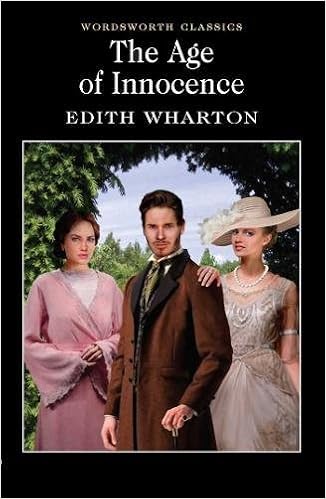
Age of Innocence (Wordsworth Classics) (Wadsworth Collection) by Edith Wharton


One of those books that can be read and enjoyed by readers with a variety of interests and perspectives: family dynamics, women's issues, life in New York's so-called "Golden Age," the lives of the rich and titled, the conflict between individuals and the conventions of society, and so on. It's also a good story, and the more important characters reveal their individual natures gradually, like Salome with her veils.

As in real life, the reader never gets behind the final veil, though. The author seems to respect the idea that we can never know another human being completely, and leaves her audience with a sense of wonder and a longing to know more.This novel reminded me somewhat of themes from The Portrait of a Lady and Anna Karenina. My only complaint about this story was that sometimes the details of family connections, societal expectations, details of dress and dinner parties etc became tedious to read. The author could've painter in broader strokes and the reader would've understood the point without being bogged down in details. Newland Archer faces life with May who is exactly the sort of wife high society expects him to marry. Or he could break with everything he's been taught and run off with her cousin Ellen who represents unconventionality and everything society represses. In a brief afterward we learn what he chooses and I actually liked this ending. It leaves the reader to ponder if he made the right choice, his motives for his decision, and though this is set in a very different era the message is still very real. Do we conform or do we dare? Are we in love with the person/thing or just the idea of it?

Friday, August 25, 2017

The Great Derangement: Climate Change and the Unthinkable. Amitav Ghosh. University of Chicago Press


t is difficult to confront the spectre of climate change without a sense of incipient doom. At times this existential malady seems best personified in Jean-Paul Sartre’s play Huis Clos (No Exit), in which three condemned characters, incarcerated in hell, face an eternity in which to contemplate their sins. Ghastly looms an infinity without purpose. Loathsome indeed are the spiteful goads and self-righteous pontifications of their fellow inmates. But no less intolerable are their self-incriminating recollections of deeds forever done, of opportunities forever lost. Their penitentiary is a space plagued by the anomie of self-disgust and the inescapable evaporation of meaning. All that is left is the anticipation of an endless absence:


GARCIN: How about you? Aren’t you afraid?


INEZ: What would be the use? There was some point in being afraid before, while one still had hope.


GARCIN: There’s no more hope – but it’s still ‘before’. We haven’t yet begun to suffer.


INEZ: That’s so. Well? What’s going to happen?


GARCIN: I don’t know. I’m waiting.


Yet this waiting for something to happen is itself symptomatic of absurdity. Ejected out of temporal schemes that provide coordinates for human existence, they are left teleologically and epistemologically bankrupt. There remains only empty and identical ‘tomorrows’. Trapped in time’s abyss, they are reduced to waiting for nothing.


In The Great Derangement: Climate Change and the Unthinkable, Amitav Ghosh addresses our similarly uncanny predicament under delinquent, ‘deranged’ modes of political and socio-economic organisation. Known as an acclaimed author whose fiction has addressed climatic rupture, Ghosh here takes up the role of analyst and storyteller. Climate change, as his title recognises, only too clearly demonstrates the systemic lunacy inherent in our present world arrangements. As in Huis Clos, we are compelled to become the wardens of our own prison, guardians of an empty future. Devoid of ethical purpose, the future is forfeited to the whims of the market, ceded to the nihilism of economic growth. Instead of exhibiting an unfolding sequence of delimited events that function in the service of a progressive ‘universal history’, the planet is the stage on which the spectacle of human incoherence is playing out.


In Part One, ‘Stories’, Ghosh critiques the limitations of the ‘literary novel’, which aims to exhibit the vagaries of ‘individual moral adventure’. The turn inwards in modern fiction mirrored the turn towards commodity fetishism. As realist literary fiction has explored the complex inflections of human experience, it has assumed the existence of a stable climate and an unlimited flow of resources to fuel the bourgeois regularities inscribed in its narratives. Ghosh contends that the contemporary novel, using narrow scales of time and space that rarely exceed more than a human lifespan, is not only neglectful of climate change but is partly complicit in the dissociation of the mind from the vulnerability of its corporeal situation, since it rarely allows the climate to violently intrude upon the habitual routines and ordinary concerns it prefers to portray. He therefore calls for a heightened imaginary response to climate change, although one can question whether fiction can do much to remedy political and economic intransigence – perhaps if enough people read it?
Image Credit: Sawyer Glacier, Tracy Arm Fjord, Alaska, USA (Ian D. Keating CC BY 2.0)


Part Two, ‘History’, unintentionally exemplifies the historicised mind caught in a world that keeps historicising itself: a situation in which history is constantly made obsolete but remains the faulty technology on which human beings depend to make things make sense. The historicised mind automatically concedes priority to history and stipulates the pre-eminence of historical knowledge and periodisation. Hence, Ghosh’s ample use of terms such as ‘arc’, ‘trajectory’, ‘pattern’ and ‘process’. His attempt to comprehend climate change by necessity aligns with every other effort to do so: one must outline a historical narrative of how we came to be where we are – without history’s categories, remember, the historicised mind couldn’t make sense of anything. Certainly, Ghosh tweaks the emphasis of his narrative, attributing more weight to imperialism than is usual, but the result is much the same – yet another incarcerating historicisation.


Caught in this historicised mentality, Ghosh uncritically employs the term ‘Anthropocene’ (the ‘age of man’) as a colloquialism for climatic crisis and terrestrial destruction. More precisely, this name signifies a new geo-historical epoch pending disciplinary ratification. Using it commits Ghosh to a narrative of incremental human expropriation of the planet. Unfortunately, it also means that he absurdly renders ‘every human being who has ever lived’ culpable in producing climate change, with an undifferentiated ‘humanity’ made universally responsible. More importantly, the Anthropocene is the latest historicisation that makes human existence itself a thing of the past. By definition inescapable, it is a managerial contrivance that both confirms and facilitates planetary incarceration. The horror of the gaol, of being trapped by history, pervades it. Illustrating the condition by which human agency is denied any real potency even while at the centre of planetary affairs, he claims that:


the events of today’s changing climate, in that they represent the totality of human actions over time, represent also the terminus of history. For if the entirety of our past is contained within the present, then temporality itself is drained of significance…


History is terminal, ultimately, because it renders us incapable of exceeding it.


Unsurprisingly, Ghosh is waylaid by history at every turn, ‘entrapped’ by it. His ruminations on ‘the chronology of global warming’ not only evince the redundancy of historical knowledge, but induce paralysis. For, after noting the ‘complexity of the history of the carbon economy’, he leads us to a conclusion in complete conformity with his historicising strategy: ‘our lives and our choices are enframed in a pattern of history that seems to leave us no-where to turn but toward our self-annihilation’. This is precisely the dilemma of the historicised mind ensnared in a self-incriminating historical situation: history always does, in the end, leave one stranded exactly where one already is. Always it comes too late to make any difference. History now cements the antiquation of homo sapiens itself.


In Part Three, ‘Politics’, Ghosh condemns the narrow bandwidth of political concern. Riven by quarrels over identity, squabbling over the sincerity of individual moral performance, holding personal liberty in the highest regard, contemporary politics has little to no capacity to properly address ‘the commonweal’: to engage in collective action for the sake of survival. Bluster, denial and grandstanding obstruct the wrenching political and moral transformations required, and which continue to be delayed. Lurking behind phantasies of untrammelled individual agency, climate change is eroding conceptions of unassailable human dominion over the earth and forcing us to dispense with the possibility of universally achieving the accoutrements of bourgeois life. This conception of human flourishing into which we have been beguiled is consuming itself. Yet the ‘masters of mankind’ (as Adam Smith called them), following their ‘vile maxim’ of self-enrichment, have long abrogated their responsibility to enact real change. Human existence is set up to contribute to the fossil economy, hence to perpetuate ecological malfunction. The horizon of future possibility recedes.


In proffering a vague hope in the ‘sacred’, that ‘religious worldviews’ might inspire mass movements that transcend individualism and the nation-state, one feels that Ghosh is left beseeching a deus absconditus (a hidden God) to bail us out of gaol. Well perhaps, but religious theology frequently considers catastrophe a product of divine will or a sign of impending apocalypse – the latter is itself the means through which the loyalty of the faithful is vindicated. Nor do the religious appear to be much less enveloped in the consumer economy or nationalistic thinking than anyone else: these can complement doctrinal injunctions, as the so-called ‘prosperity gospel’ demonstrates. To his credit, however, Ghosh doesn’t simply advocate a technocratic ‘fix’: a rebooting of the technosphere (e.g. through geoengineering) that would avoid the need for unpleasant ideological and material sacrifice.


This admirable book is the latest testament to the limits of contemporary thought and language, to the frustration of human cognitive power over a world we thought we knew. Deranged indeed, but also incrementally dispossessed, we have become the disinherited of Rainer Maria Rilke’s remark, finding that ‘each blind lurch of the world leaves its disinherited, to whom no longer the past nor yet the future belong’. Yet is this contingency of meaning not our mortal fate? Is not mortality – of ideas, of people, of worlds – itself our only means of renewal? Those who seek a permanent, unchanging ‘end’ should remember that as it is in hell, so it is in heaven. Both outcomes are equally meaningless: not least because you can never leave.

Wednesday, August 16, 2017

Popular Democracy: The Paradox of Participation. Gianpaolo Baiocchi and Ernesto Ganuza. Stanford University Press. 2016.


Popular Democracy: The Paradox of Participation, written by Gianpaolo Baiocchi and Ernesto Ganuza, analyses contemporary forms of participatory governance by tracing the genesis and expansion of the now-famous mechanism of participatory budgeting (PB). Originating in the Southern Brazilian city of Porto Alegre and from the alliance between social movements and leftist political parties that rejected vanguardist strategy, the PB process sought to challenge the influence of clientelist networks over resource allocation, and to realise redistributive justice by devolving decisions over the city budget to a process of direct citizen participation.

Tracing its globalisation from Porto Alegre to the USA and to Europe (the ‘return of the caravels’, as one scholar puts it), Baiocchi and Ganuza cast a hopeful yet critical eye over the potentialities of this democratic institution. Both authors are academic researchers that have had a deep practical involvement in the two main case studies of the book: namely, participatory budgeting in Chicago, USA, and in Cordoba, Spain. Their experience adds depth to their political ethnographies and produces insights into the development of PB that are contextualised with historical analysis of the emergence of PB in Porto Alegre, its globalisation as well as broader developments in the interface of the theory and practice of democracy and public administration.

The central question that the book aims to answer – alluded to in its subtitle as the ‘paradox of participation’ – stems from the fact that these new institutions open up possibilities for democratic participation at a time when the space for democracy is being constrained by encroaching technocracy and the perceived need to appease markets. What opportunities do democratic innovations offer in the context of this paradox? Do they broaden possibilities to advance democracy and social justice, or do they narrow them by foreclosing alternative, more agonistic, forms of action that can challenge neoliberalism? In answering these questions, the authors carve open a space between sanguine advocates who celebrate the mainstreaming of democratic innovation and sceptical critics who identify and condemn their co-option by and perpetuation of neoliberalism.

Popular Democracy explores these issues by telling a series of interrelated stories. First, the book offers an historical account of changes in democratic and public administration theory and practice. Second, it traces the genesis and worldwide dissemination of the Porto Alegre Participatory Budget. This produces insights that the authors then bring their empirical research to bear upon, drawing on ethnographic research in two cases of PB that represent the first attempts to institutionalise it within Europe (Cordoba, Spain) and the USA (Chicago).
The book shows how, in travelling the globe, PB became de-coupled from (a) an explicit focus on social justice through the administration of large budgets; and (b) a set of institutional reforms that were concomitant in Porto Alegre and which reduced other channels for influence that could circumvent the participatory process. The result was that upon the ‘return of the caravels’, what disembarked was a softer engagement tool – a complement for existing administrative systems that handled smaller budgets and lost a focus on social justice. The impressive success of Porto Alegre did not therefore accompany the globalisation of PB. Instead, PB became an ideologically malleable instrument, explaining its present popularity in World Bank reports as well as in World Social Forum ambitions for social justice and emancipation.

So far, the story told is one of co-option and transformation into a neoliberal governance technology. But the story does not stop there. Three points are made in the book that give reason for hope and support of participatory governance. They are here presented in order of the importance I interpret them to have for the argument developed in the book. First, the co-option story can be inverted. The neoliberalisation of participatory governance can be read as a success in introducing logics of political participation into institutions that are tightly focused on capitalist efficiency. This ‘success’ is, however, stinted by the fact that here participation becomes a component of ‘good governance’ conditions for capital accumulation – something that the authors accept.

Second, Popular Democracy shows that institutional design matters. One of the questions that arises from the analysis of the spread of PB is why was the success of Porto Alegre not achieved elsewhere? The answer is two-fold. The design of the process in Porto Alegre combined a ‘communicative dimension’, whereby citizens deliberate to set priorities and investment agendas, with a ‘sovereignty dimension’, where participants shared decision-making power with politicians and officials and used their ownership of the process to inscribe social justice criteria in deliberation and decision-making rules. In the transfer to Europe and the USA, it was mainly the communicative dimension that held, leaving PB a de-politicised, malleable instrument that left participants thinking about trivial issues.

Related to this, PB was also de-coupled from a series of concomitant institutional reforms characterised as ‘political centralisation with administrative decentralisation’ (60-61). Administrative decentralisation through PB made the city administration more porous to citizen demands, and this was coupled with ‘political centralisation’ – a foreclosing of other channels for political influence. This combination of centralised planning and decentralised information gathering made PB the privileged, and perhaps only, channel for influencing the city budget, making it harder for city officials to deflect demands through other channels and for other organised interests to circumvent the PB process.

Ganuza and Baiocchi argue that the main reason for this was that PB travelled a path of least resistance, adopting designs and handling budget scopes that did not present danger to powerful interests. They also argue that rather than a story of neoliberal co-option, this is one of institutional de-linking. The authors accept that this indeed entailed important limits to the democratisation capacity of the process. However, as the ethnographic research in Cordoba and Chicago shows, it kept open spaces for new political subjects to come together – which brings us to the third, most substantive, point of the book.

In the three discrete cases that the authors analyse of the institutionalisation of PB, a common story of political contestation between established and new political subjects is told. All three generated tension between the individual citizens that PB prioritises and social movements supportive of PB on the one hand, and of city technocrats and established associations (‘privileged interlocutors’) on the other. The latter resisted PB by making claims to legitimate authority based on expertise and knowledge of the ‘common good’ versus the political actors that PB sought to bring centre stage, who were seen as inexperienced and self-interested. Established interests also worried that PB would raise civic expectations beyond the limits of what can be delivered within the political authority of the city.

At first sight, these tensions highlight problems in the institutionalisation of PB processes and can be seen as important limits to its potential. Indeed, they led to conflict over the rules and institutional design of the process, the outcomes of which were instrumental in the success of Porto Alegre and relative failure in Cordoba and Chicago. However, the authors argue that they were also generative of new democratic subjects who widened the scope of possibilities by making new demands. As the authors explain in the conclusion:


participants often interacted as if they ran city government, as if they really had power over technical rules, as if they really could control (and not just discuss) the outcomes of decisions that impacted them.

Baiocchi and Ganuza’s wager is that this experience is valuable in itself, because it enables collectivities to form that can imagine new futures and develop new forms of self-regulation and democratic organisation.

Thus, in conclusion, Baiocchi and Ganuza have considerable sympathy for the critical view that institutional innovations are easily co-opted into neoliberal governance instruments. But they argue that this perspective needs qualifying. Innovations also have value because they provide spaces for interactions that open new possibilities by raising questions that they cannot answer within their own parameters. The prominence and influence of PB on the political agendas and imaginaries advanced by social movements such as the ‘indignados’ or the ‘Next Systems Project’, where participatory instruments are afforded massive regulatory powers, are cited as evidence of this (160). The question and challenge that the book leaves for activists, practitioners and engaged scholars is how to make the most of the critical energies they summon.

Friday, July 14, 2017

Europe not so United : Europe Since 1989: A History by Philipp Ther, translated from the German by Charlotte Hughes-Kreutzmüller Princeton University Press, 425 pp., $35.00;The Euro: How a Common Currency Threatens the Future of Europe by Joseph E. Stiglitz Norton, 416 pp., $28.95; Europe Entrapped by Claus Offe Polity, 157 pp., $12.95 (paper); The Euro Trap: On Bursting Bubbles, Budgets, and Beliefs by Hans-Werner Sinn Oxford University Press, 380 pp., $45.00; Der Euro: Von der Friedensidee zum Zankapfel by Hans-Werner Sinn Munich: Hanser, 535 pp., €24.90 (revised and updated version of The Euro Trap); La fin du rêve européen by François Heisbourg Paris: Stock, 200 pp., €18.00; What Is Populism? by Jan-Werner Müller University of Pennsylvania Press, 123 pp., $19.95;

Is Europe Disintegrating?
Image result for Europe Disintegrating


Had I been cryogenically frozen in January 2005, I would have gone to my provisional rest as a happy European. With the enlargement of the European Union to include many post-Communist democracies, the 1989 “return to Europe” dream of my Central European friends was coming true. EU member states had agreed on a constitutional treaty, loosely referred to as the European constitution. The unprecedented project of European monetary union seemed to be confounding the deep skepticism that I and many others had earlier expressed.1 It was amazing to travel without hindrance from one end of the continent to another, with no border controls inside the expanding zone of states adhering to the Schengen Agreement and with a single currency in your pocket for use throughout the eurozone.

Madrid, Warsaw, Athens, Lisbon, and Dublin felt as if they were bathed in sunlight from windows newly opened in ancient dark palaces. The periphery of Europe was apparently converging with the continent’s historic core around Germany, the Benelux countries, France, and northern Italy. Young Spaniards, Greeks, Poles, and Portuguese spoke optimistically about the new chances offered them by “Europe.” Even notoriously euroskeptical Britain was embracing its European future under Prime Minister Tony Blair. And then there was the avowedly pro-European Orange Revolution in Ukraine. As I watched peaceful protesters in Kiev waving the European flag, with its yellow stars on a blue background, I could inwardly intone the European anthem—Beethoven’s music for the “Ode to Joy.”2

Cryogenically reanimated in January 2017, I would immediately have died again from shock. For now there is crisis and disintegration wherever I look: the eurozone is chronically dysfunctional, sunlit Athens is plunged into misery, young Spaniards with doctorates are reduced to serving as waiters in London or Berlin, the children of Portuguese friends seek work in Brazil and Angola, and the periphery of Europe is diverging from its core. There is no European constitution, since that was rejected in referendums in France and the Netherlands later in 2005. The glorious freedom of movement for young Poles and other Central and Eastern Europeans has now contributed substantially to a shocking referendum vote by my own country, Britain, to leave the EU altogether. And Brexit brings with it the prospect of being stripped of my European citizenship on the thirtieth anniversary of 1989.

A young liberal hero of 1989, Viktor Orbán, is now a nationalist populist leading Hungary toward authoritarianism and explicitly praising the “illiberal” example of Xi Jinping’s China and Vladimir Putin’s Russia. Border controls have been reimposed between Schengen countries (“temporarily,” of course), in response to the flood of refugees from Syria, Iraq, and Afghanistan—areas where our so-called European foreign policy has proved little more than waffle. To cap it all, a brave attempt to complete the unfinished business of the Orange Revolution in Ukraine has been rewarded with Russia’s unilateral armed seizure of Crimea and ongoing violent intervention in eastern Ukraine—actions recalling Europe in 1939 rather than 1989. Ichabod! Ichabod! The glory has departed from our common European home.

This spectacular shift from light to dark raises interesting questions about historical periodization and the way historians are influenced by the times in which they write. One of the finest histories of twentieth-century Europe, Mark Mazower’s Dark Continent, first published in 1998, is a partial exception, consciously written against the liberal triumphalism of the 1990s. Yet even Mazower concluded that “compared with other historical epochs and other parts of the world today, the inhabitants of the continent enjoy a remarkable combination of individual liberty, social solidarity and peace.”

Few historians could have been more skeptical about the self-congratulatory platitudes of liberal Europeanism than Tony Judt. He dissected and challenged them in a set of lectures originally published in 1996 as A Grand Illusion? Yet even he concluded the last full chapter of his magisterial history of Europe since 1945, Postwar, published precisely at that 2005 moment of apparent triumph, with these boldly optimistic words: “Few would have predicted it sixty years before, but the twenty-first century might yet belong to Europe.”

I have always had my doubts about the periodization suggested in Tony Judt’s title, implying as it does that the “postwar” period extended from 1945 to 2005. The developments in every epoch have longer-term causes and consequences than implied by any sharp bookend dates, but it seems to me more persuasive to date the postwar period from 1945 to 1989, or at the latest to 1991, with the collapse of the Soviet Union.

The period of European history after the fall of the Berlin Wall in 1989 might be called, in shorthand, “post-wall.” But then we face a further question: Are we still in that period? Or did the post-wall era end during my imagined cryogenic slumber, sometime between the high point of early 2005 and the low of today? Such bookend dates are always contestable, but it seems plausible to suggest that the financial crisis of 2008–2009, which started in the US but rapidly spread to Europe, has initiated a new period characterized by three larger crises: of capitalism, of democracy, and of the project of European integration.


There are always continuities across such caesuras and one is the peaceful rise and rise of Germany. Having unexpectedly received in 1989–1990 what Fritz Stern memorably called its “second chance,” with its rapid and peaceful unification following the fall of the Berlin Wall, Germany has thus far used this chance well. It would surely have been a source of satisfaction to Stern, an incomparable chronicler of modern Germany’s intellectual flowering in the early twentieth century, that in the early twenty-first century Germany’s economic and political strength is accompanied by a certain restoration of intellectual potency. Some of the most incisive analyses of Europe and its discontents now come from German scholars.

Philipp Ther is a German historian at Vienna University. Although the English edition of his book is entitled Europe Since 1989: A History, and he suggests in the preface that he is trying to continue Judt’s Postwar “in terms of time and with a stronger focus on social and economic history,” this is not a history of Europe as a whole. There is only one reference in the index to François Mitterrand and none to Giulio Andreotti. This is a history of post-Communist Central and Eastern Europe, very much including Germany, with one long comparative chapter on Southern Europe. Unlike Judt’s work, it has a central, driving thesis, better captured in the title of the original German edition: “The New Order on the Old Continent: A History of Neoliberal Europe.” At its heart is an argument about what “neoliberal” economic policies did to the societies of post-Communist Europe.

Although dense, Ther’s work is enlivened by personal anecdotes and observations, starting with his first trip to “the East” in 1977, at the age of ten. He has stimulating chapters on what he calls the “cotransformation” of East and West Germany, and on the boom time of capital cities such as Warsaw, so sharply contrasting with the country’s poorer regions, known in Poland as “Polska B.” Unusually for a German scholar, he can sometimes be a bit slapdash, making sweeping judgments on the basis of just one or two sources.3

Nonetheless, his central thesis demands serious consideration. He argues that a “neoliberal train,” put on track in Margaret Thatcher’s Britain and Ronald Reagan’s United States, began “to cross Europe in 1989.” He says he uses neoliberalism “as a neutral, analytical term,” and rightly distinguishes between its intellectual history and the specific social and political circumstances of its implementation. His summary of the main pillars of neoliberal ideology does not feel entirely neutral:


Blind belief in the market as an adjudicator in almost all human affairs, irrationalreliance on the rationality of market participants, disdain for the state as expressed in the myth of “big government,” and the uniform application of the economic recipes of the Washington Consensus. [My italics.]

He maintains that its crucial features, as applied in Eastern Europe, were liberalization, deregulation, and privatization, and that its consequences in social dislocation and growing inequality were very damaging.

Several reservations must be entered about this critique of neoliberalism’s impact on post-Communist Europe. First, as Ther himself carefully notes, the one thing worse than having a neoliberal transformation of your economy was not having a neoliberal transformation. Look at the dismal performance of Ukraine, Russia, and Romania. In 1989, Poland had roughly the same per capita GDP as Ukraine; a quarter-century later, per capita GDP in Poland was roughly three times that in Ukraine. Even more tellingly, he suggests that Poland’s per capita GDP was roughly 10 percent of newly united Germany’s in 1991 but 53 percent just twenty years later.4

Second, his use of the term “neoliberalism” risks overstating the ideological dimension. Yes, there were “Eastern Thatcherites” such as Václav Klaus, the godfather of the Czech Republic’s economic transformation—and Klaus was more Thatcherite than Thatcher. But this was not an ideological mass movement like communism or fascism in the 1920s or 1930s, driven by leaders who believed passionately and dogmatically in their -ism. Most of those who embraced these “neoliberal” policies after 1989 did so pragmatically, for lack of any credible alternative.

Such was the case of Poland’s first post-Communist prime minister, Tadeusz Mazowiecki, who in earlier years had been something close to a Christian socialist. And I remember Bronisław Geremek, a leading Solidarity adviser and subsequently Polish foreign minister, explaining his support for neoliberal “shock therapy” with a metaphor. You see, he told me, the nationalized command economy is like a huge concrete bunker, so it needs a giant bulldozer to take it down. As an endpoint they would have been delighted to have a Scandinavian, social democratic version of capitalism. But first they had to build that capitalism out of the ruins of the Communist bunker.

This leads me to a final reservation. It’s all very well for Ther to wax ironical about Mrs. Thatcher’s TINA (There Is No Alternative) and to note, amusingly, that alternativlos was declared the ugliest German word of 2010. But what exactly was the alternative? How else could they have created a market economy? Historians are not absolutely obliged to explore counterfactuals, but it often enriches their work if they do.

All this being said, I think Ther makes an important point. Post-dissident and reformist elites, including those who came from the democratic left, did go very far in their embrace of a radical (neo)liberal economic transformation. Ther gives the example of the veteran Polish dissident Jacek Kuroń. He might have added that Kuroń in his final years bitterly regretted his vocal support, while a minister in Mazowiecki’s government, for an economic liberalism that had such painful social consequences—not least for many of the workers who had been the backbone of Solidarity. Adam Michnik, for the last quarter-century editor in chief of the influential daily Gazeta Wyborcza, famously observed that “my heart is on the left but my wallet is on the right.”

At the very least, Poland’s urban, liberal intelligentsia could have found a better public language to show that they cared about those who were paying the human price of transition. They could have done more to help the workers who had lost their jobs in large state-owned enterprises to find new, worthwhile employment, and, when the budget permitted, they could have pursued a more active social policy.

For that “heart on the left” was barely visible to those millions of Poles in the small towns and poorer regions of “Polska B,” who felt themselves to be marginalized and left behind by the bulldozer of economic liberalism. They were also, it’s important to add, alienated by the social liberalism, on issues such as abortion, gender, and sexual orientation, which came with the opening to Western Europe. Here was the core electorate on the back of which the populists of the Law and Justice party rose to power in 2015, offering a combination of nationalist, Catholic ideology, typical of the right, and generous promises of welfare benefits and state economic intervention, more historically typical of the left. In short, a reaction against the consequences of economic and social liberalism now threatens the achievements of political liberalism.

Ther suggests that Southern Europe may be supplanting Eastern Europe on some Western Europeans’ mental maps, taking its place as the imagined, backward Other. He points to the acronym PIGS, coined for four crisis-torn, Southern European debtor countries of the eurozone: Portugal, Italy, Greece, Spain. (The insult was originally PIIGS, until Ireland, the second I, lifted itself out by its own efforts.) But Ther’s chapter on Southern Europe feels like King Lear without the king, for he discusses only in passing what is at the heart of the Southern European tragedy: the profound design flaws of the eurozone and inadequate remedies offered by the creditor countries of Northern Europe, meaning mainly Germany.

This is a shared theme of books by Claus Offe, Hans-Werner Sinn, Joseph Stiglitz, and François Heisbourg, to name but four. Coming from very different ideological and national perspectives, all agree that it was a big mistake to create the eurozone with its present design and size—a common currency without a common treasury and shackling together nineteen quite diverse economies. Intended to foster European unity, the “one size fits none” euro is actually dividing Europe. It has revived terrible bitterness between Greece and Germany, and caused widespread resentment in both south and north. Continuing the current policies will at best result in Southern Europe limping along for years to come inside the eurozone, with low growth, high unemployment, and a culture of learned hopelessness.

These writers propose different remedies. With magnificent Cartesian clarity, Heisbourg writes: “The currently existing euro being the cause of the problem, the solution must be to abolish it coolly and by common accord.” This is rational, but is it real? Offe disagrees, asserting that the euro “is a mistake the undoing of which would be an even greater mistake.” Stiglitz and Sinn offer a smorgasbord of more or less radical reforms, which I have neither the space nor the technical competence to assess.

One key to a solution, however, clearly lies in the Germany of Angela Merkel and Wolfgang Schäuble ceasing to treat economics as a branch of theology. Offe makes the sharp observation that the German word for budget is Haushalt, meaning literally household, and evoking a sense of the proverbial Swabian housewife’s good housekeeping, while the German word for debt, Schuld, also means guilt. The German press, he notes, has repeatedly referred to the PI(I)GS as “fiscal sinners.” To adapt the Bible: the wages of sin is debt.

This chronic illness of the eurozone has nourished populists of left and right, in south and north. The German populist party Alternative für Deutschland, for example, started as an anti-euro party, before gaining a much larger following as an anti-immigration party, after last year’s large-scale influx of refugees. And I have not even begun to discuss that refugee crisis, which is still shaking German society; the Brexit crisis; the Ukraine crisis; the frontal challenge posed by Vladimir Putin’s Russia to both European security and European democracies; the terrorism crisis (France, one of the main targets of Islamist terrorism, is still under a state of emergency); the demographic crisis; and the insecurity plaguing many of the continent’s young people, now sometimes known as “the precariat.” All these are distinct but mutually reinforcing parts of an overarching existential crisis that is threatening the entire post-1945 project of European union. And all feed the metastasis of populist politics.

On Sunday, December 4, 2016, Austria decided not to elect a right-wing populist, Norbert Hofer, as president, but he still got some 46 percent of the vote. That same day, amid talk of Trumpismo, Italy voted “no” in a referendum on constitutional reforms proposed by the country’s would-be reformist prime minister Matteo Renzi. Although many voted against the substance of the proposals, this was a boost for the populist Five Star Movement led by the comedian Beppe Grillo and raised the prospect of further instability, especially in the fragile banks of the eurozone’s third-largest economy.

In 2017, we face parliamentary elections in the Netherlands, where Geert Wilder’s populist party is doing well, the presidential election in France, where Marine Le Pen seems almost certain to face the conservative François Fillon in the second round, and then Germany’s general election in the autumn. Of these the most dangerous is the French election, which has been described as “Europe’s Stalingrad.”5

I have used the word “populist” several times without pausing to define it. But isn’t it just a woolly, catch-all term for parties, movements, and presidential candidates we don’t like? What is populism? This is the question addressed in an excellent short book by Jan-Werner Müller, a German scholar who now teaches at Princeton. Müller recalls that Richard Hofstadter once gave a talk titled “Everyone Is Talking about Populism, but No One Can Define It,” yet he makes the best effort I have seen to give the term a coherent contemporary meaning.

Populists speak in the name of “the people,” and claim that their direct legitimation from “the people” trumps (the verb has acquired a new connotation) all other sources of legitimate political authority, be it constitutional court, head of state, parliament, or local and state government. Donald Trump’s “I am your voice” is a classic populist statement. But so is the Turkish prime minister’s riposte to EU assertions that a red line had been crossed by his government’s clampdown on media freedom: “The people draw the red lines.” So is the Daily Mail’s front-page headline denouncing three British High Court judges who ruled that Parliament must have a vote on Brexit as “Enemies of the People.” Meanwhile, Polish right-wing nationalists justify an ongoing attempt to neuter Poland’s constitutional court on the grounds that the people are “the sovereign.”

The other crucial populist move is to identify as “the people” (or Volk) what turns out to be only some of the people. A Trump quotation from the campaign trail captures this perfectly: “The only important thing is the unification of the people,” said the Donald, “because the other people don’t mean anything.” UKIP’s Nigel Farage welcomed the Brexit vote as a victory for “ordinary people,” “decent people,” and “real people.” The 48 percent of us who voted on June 23, 2016, for Britain to remain in the EU are plainly neither ordinary nor decent, nor even real. Everywhere it’s the “other people” who now have to watch out: Mexicans and Muslims in the US, Kurds in Turkey, Poles in Britain, Muslims and Jews all over Europe, as well as Sinti and Roma, refugees, immigrants, black people, women, cosmopolitans, homosexuals, not to mention “experts,” “elites,” and “mainstream media.” Welcome to a world of rampant Trumpismo.

Populism, Müller argues, is inimical to pluralism. Its target is pluralist, liberal democracy, with those vital constitutional and social checks and balances that prevent any “tyranny of the majority” from prevailing over individual human rights, safeguards for minorities, independent courts, a strong civil society, and independent, diverse media.

Müller rejects the term “illiberal democracy,” arguing that it allows people like Viktor Orbán to claim that Hungary just has another kind of democracy, authentically democratic in a different way. What Orbán has done, for example in his takeover of the media, undermines democracy itself. Yet I think we do need a term to describe what happens when a government that emerges from a free and fair election is demolishing the foundations of a liberal democracy but has not yet erected an outright dictatorship—and may not even necessarily intend to. Words like “neoliberalism,” “globalization,” and “populism” are themselves imperfect shorthand for phenomena with significant national, regional, and cultural variations. “Hybrid regime” feels too unspecific, so unless and until someone comes up with a better term, I shall continue to use “illiberal democracy.”

If the post-wall era runs from 1989 to 2009, what epoch are we in now? We almost certainly won’t know for a decade or three. On a bad Europe day, and there were too many of those in 2016, one does feel like going into cryogenic hibernation; but this is no time for freezing. No, we who believe in liberty and liberalism must fight back against the advancing armies of Trumpismo. The starting point for fighting well is to understand exactly what consequences of which aspects of the post-wall era’s economic and social liberalism—and of related developments, such as rapid technological change—have alienated so many people that they now vote for populists, who in turn threaten the foundations of political liberalism at home and abroad. Having made an accurate diagnosis, the liberal left and liberal right need to come up with policies, and accessible, emotionally appealing language around those policies, to win these disaffected voters back. On the outcome of this struggle will depend the character and future name of our currently nameless era.
  1. 1
    See my stark warning about the divisive impact of monetary union in “Europe’s Endangered Liberal Order,” Foreign Affairs, March/April 1998, reprinted in my History of the Present: Essays, Sketches, and Dispatches from Europe in the 1990s (Random House, 2000).  ↩
  2. 2
    See “The Country Summoned Me” and (written jointly with Timothy Snyder) “Orange Revolution in Ukraine” in my Facts Are Subversive: Political Writing from a Decade Without a Name (Yale University Press, 2010). The latter essay was originally published as “The Orange Revolution” in The New York Review, April 28, 2005.  ↩
  3. 3
    One example: he builds a whole argument around a 1990 essay of mine that he found in the German-language journal Transit. On the basis of this solitary document he charges me with ignoring both the democratic groundwork done by the Solidarity movement in Poland and the long tradition of Czech democratic thought, never raising the question “what the West might be able to learn or adopt from Eastern Europe,” consequently condescending to Eastern Europeans in a tradition that (as Larry Wolff has shown) goes back to the Enlightenment, and even of “arguing implicitly from a postmodern Western standpoint.” He seems totally unaware that this was a German translation of an essay published in The New York Review earlier that year, one of an interconnected series of articles and books which, as readers of theReview will know better than anyone, were written with the greatest possible respect for the heritage of Solidarity and the ideas of east Central European dissidents such as Václav Havel.  ↩
  4. 4
    The inclusion of East Germany in the aggregate German figure for 1991 obviously creates a statistical overstatement of Poland’s real degree of catch-up.  ↩
  5. 5
    On the French election prospect, see my “Time to Think the Unthinkable About President Le Pen,” The Guardian, December 9, 2016. ↩