Israel Book Review

Jews Praying In The Synagogue on the Day of Atonement by Maurycy Gottlieb (Tel Aviv Museum of Art) The Israel Book Review has been edited by Stephen Darori since 1985. It actively promotes English Literacy in Israel .#israelbookreview is sponsored by Foundations including the Darori Foundation and Israeli Government Ministries and has won many accolades . Email contact: israelbookreview@gmail.com Office Address: Israel Book Review ,Rechov Chana Senesh 16 Suite 2, Bat Yam 5930838 Israel

Showing posts with label . #CameosFromZion. Show all posts

Wednesday, August 16, 2017

The Coalition Effect, 2010-2015. Anthony Seldon & Mike Finn (eds). Cambridge University Press. 2015.

the-coalition-effect-coverAhead of the 2015 General Election, Anthony Seldon wrote a clear introduction to this expert volume of essays, setting out the observation that David Cameron’s place in history was already secured: for holding the coalition itself together; significantly improving the economic outlook; overseeing some steady domestic reform; restoring dignity to the PM’s office; and winning the Scottish referendum (25). To those, further cementing Cameron’s place in history, we might now add the 2016 referendum on Britain’s EU membership.
Yet, our judgement of the former PM will rest a great deal on the broader question of how history will judge the Coalition government. For a book that asks much more rigorous and specific questions, this volume, edited by Seldon and Mike Finn, helpfully comes very close to looking at that verdict. The Coalition Effect, 2010-2015 deserves serious recognition for setting out, and in many respects crystallising, the major and contemporary distinctive effects of the Coalition government on British politics. Its Herculean task is carefully pursued through 23 chapters of sober, analytically rigorous and critically evidenced observations which adhere to the final conclusions of Finn – that although Britain’s first peacetime Coalition government since the 1930s came into existence because of political necessity, this neither prevented it from setting high ambitions for itself nor inhibited its capacity to generate legislative, economic, governmental and political effects (601). This account and assessment of the ambitions, the visions and the ‘new politics’, including the Programme for Government, tell us much about the Coalition in terms of its history, its meaning and desirability.
For Finn, the Coalition was successful in some economic ambitions – notably, restoring the economy to growth (in terms of jobs and employment) – but that it failed in other significant areas e.g. eliminating the structural deficit, government borrowing and its position towards the ‘cost of living crisis’. It did not achieve its economic targets. As Paul Johnson and Daniel Chandler’s chapter on the Coalition and the economy expresses, the 2010-2015 government only endured Act One of a two-part process of fiscal consolidation in which Act Two may well have been tougher, albeit only now just unfolding (193).
Finn further concludes that the Big Society ‘failed emphatically as a unifying ideal’. And what is also notable about memorable figures such as Andrew Lansley, who ‘went rogue’, and Michael Gove in ‘carrying forward his personal agenda’, are their solo, independent and real effects – but that means they were not truly ‘Coalition effects’.  The Coalition’s huge impact on the NHS and education was divisive. Furthermore, for all the debate, the government did not achieve much on constitutional reform. The relationship with Europe deteriorated significantly. It advocated intervention over Iraq and Libya, but could not carry the Commons or the country over Syria. Some of the most devastating Coalition effects were not on agendas as such, but on the Conservative and Liberal Democrat parties. And England, of course, still does not love coalitions.
the-coalition-effect-image-1Image Credit: (themostinept CC BY SA 2.0)
Finn’s observations also raise issues particularly germane to the 2015 General Election: that an unintended net Coalition effect is the genuine emergence of four-party politics at Westminster (at that stage envisaged as being Conservatives, Labour, Liberal Democrats and UKIP). The real ‘fourth party’ was, of course, the Scottish National Party (SNP), returning 56 MPs at that election. Yet, as a chapter by Neil McGarvey highlights, beyond Westminster, coalition and multi-party politics, fixed term parliaments and referenda were not truly novel since they had already become part of ‘normal’ politics in Northern Ireland, Scotland and Wales (110).
While four-party politics could still potentially have far-reaching implications for Britain at home and abroad, as Finn argues, one is left with the niggling question of whether such an emergence could just as easily be viewed as a consequence arising from, for example, an absence of catch-all, cohesive and strong leadership within mainstream parties in a rapidly changing environment rather than stemming from a peculiar ‘Coalition effect’ as such. Peter Riddell, citing Robert Hazell, describes the essence of the broader problem in his own chapter that all the authors of this volume face: ‘It is important to try to distinguish what is a necessary consequence of coalition government and what is merely contingent’ (130). This volume, then, is a significant move towards identifying those distinctions and features from necessary but seismic fudges and the intricate but often unforeseeable complexities and promises-turned-compromises of coalition government.
Martin Loughlin and Cal Viney’s chapter on the Coalition and the constitution is supremely notable for its consideration of fixed term parliaments, voting and House of Lords reform, sovereignty and the EU, rights protection and Scotland and Wales in the UK. It is well justified in concluding that ‘the experience of the 2010-2015 coalition government highlights the dangers of a minority party [the Liberal Democrats] seeking to use its leverage to bring about basic constitutional reform on matters for which there is no cross party consensus’ (86). There is one proviso, however. The implicit division and tension of parliamentary and popular government, theorised by Vernon Bogdanor and which Loughlin and Viney adopt, does not explain precisely how coalitions preclude democratic government and principles. Most importantly, Parliament as a whole (as well as the electorate) did not endorse by any kind of mandate the Coalition arrangements, which in turn endorsed the Coalition Agreement. Their view, therefore, that the implication of the formation of coalitions between the parties is that Parliament, rather than the electorate, has the decisive role in determining who will form the government (84) is problematic in this case – neither Parliament as a whole nor the electorate directly endorsed the Coalition arrangement preceding the Agreement.
It seems more likely that the Coalition of 2010, as organised by a very small clique of political elites (probable ministers and senior party figures), required the bypassing of Westminster and the Coalition agreements, precluding formal democratic procedure and parliamentary government founded on accountability to the electorate. The Coalition Agreement itself was not a Westminster phenomenon, but a Whitehall one. As Seldon writes in his introductory essay, ‘the advice from Whitehall officials was that the national interest demanded stable government’ (2): thus, the Coalition was born. It is for this reason that Loughlin and Viney’s chapter provides and provokes a stimulating essay and debate on the key principles of coalition government.
There is also sometimes a point of caution, or perhaps reservation, towards supposing multi-party coalition arrangements are themselves a ‘Coalition effect’. Anthony King in The British Constitution (2007), for example, considered a line of argument that briefly came to the fore during the turbulent 1970s when adversarial politics and the extremism of party political rides on the ‘ideological big-dipper’ occurred, alleged to have led to economic stagnation, political chaos and a society at odds with itself (270). As a result, some began to see the solution as Proportional Representation and the essential formation of moderate, anti-extremist, inter-party, coalition governments. It bears some political resonance with the UK’s post-2008 wave of economic recession followed by tighter post-2010, Conservative-led, governmental austerity measures; it is possibly too soon for political analysts and scientists to predict again only a long future of coalition governments.
The wonderful hindsight of the 2015 General Election following the publication of this volume showed us that a wafer-thin majority Conservative government could be capably formed while coalition arrangements are rapidly, but with dignity, consigned to history. Yet, if anything, the indispensability of this text lies with the fact that five years after the first coalition government was formed since the Second World War, a wide variety of esteemed experts from Whitehall, Parliament, academia and think tanks have given their professional and intriguing assessments of the ‘Coalition effect’ across all major policy areas.

Posted by BardofBatYam at 5:21 PM No comments:
Email ThisBlogThis!Share to XShare to FacebookShare to Pinterest
Labels: . @stephendarori, . #CameosFromZion, . #stephendarori, . #stephendrus, . Stephen Darori, . Stephen Drus, . The Darori Foundation, .@israelbookrevs, .Israel Book Review, @#IsraelBookReview, #IsraelBookReview

Friday, July 14, 2017

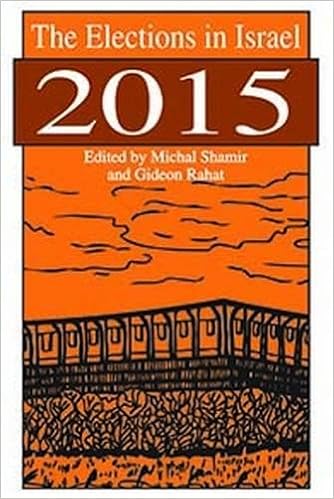
The Elections in Israel 2015 (Elections of Israel) 1st Edition by Michal Shamir (Editor), Gideon Rahat (Editor) (Routledge)


Bibi: The Hidden Consequences of His Victory


Benjamin Netanyahu has won again. He will have no difficulty putting together a solid right-wing coalition. It’s true that his erstwhile ally and present enemy, Moshe Kahlon, a relatively moderate Likudnik who now heads his own party, Kulanu, holds the balance of power between the left and right blocs in his hands; but there’s no reason to think that he’ll refrain from joining the Netanyahu government, probably as finance minister. With Kahlon’s party, the Likud and its hard-core satellites have fifty-four of the 120 Knesset seats. The so-called left, led by the Zionist Union of Isaac Herzog and Tzipi Livni (which is really somewhere in the center-right) and including the one true leftist party, Meretz (five seats) and the Joint List of Arab Parties, can muster forty-two seats. In the center is Yair Lapid’s Yesh Atid—“There Is a Future”—with eleven seats, while the ultra-religious parties hold thirteen seats.

The religious parties have, by now, a very strong affinity with the right, even though historically, not so long ago, large parts of the ultra-religious camp were moderate in their views on making peace with the Palestinians. Compared with the outgoing Knesset—the left with thirty-two seats, “the center” with twenty-seven, the right with forty-three, the religious parties with eighteen—the new one shows a shrinking center and an apparent increase of around ten seats for each of the two largest groupings.

There was a telling shift to the Likud by voters who previously had gone with extreme-right parties such as Naphtali Bennett’s Jewish Home (down from twelve to eight). The lunatic right, embodied by the Yachad party of Eli Yishai—the former coleader of the center-right Shas party, who has now allied with Baruch Marzel, once a leading member of the outlawed and racist Kach movement—did not make it past the threshold of 3.25 percent of the total vote. The Arab Joint List, with thirteen seats, is now the third-largest party in the Knesset. One could say that these results reveal a very slight movement of the electorate toward the center-left, with the two major blocs remaining more or less stable and the right still firmly ahead.

But the naked numbers may be deceptive. What really counts is the fact that the Israeli electorate is still dominated by hypernationalist, in some cases protofascist, figures. It is in no way inclined to make peace. It has given a clear mandate for policies that preclude any possibility of moving toward a settlement and that will further deepen Israel’s colonial venture in the Palestinian territories, probably irreversibly.

These results would not have come as such a surprise were it not for the opinion polls of the last weeks of the campaign, which mostly showed a groundswell of disaffection with Netanyahu and put the Zionist Union ahead of the Likud by a small margin. The polls—including the early exit polls on election day itself—were dramatically wrong; some of them may well have been deliberately distorted by the Likud spin experts in order to get traditional Likud supporters to vote, but the huge margin of error—and the polls’ wholehearted acceptance at face value by the media—also tell us something about the conceptual bubble that the Tel Aviv pollsters and commentators inhabit.

On the other hand, my own observations suggest that there was also some truth in the polls; in a half-century of living in Israel, I have never seen such intense revulsion against a serving prime minister on the part of so many, and from such widely different parts of the social spectrum. Netanyahu’s policies have further impoverished the poor, opened up a growing and dangerous gap between the glittering rich and all the rest, and created an unprecedented crisis in housing. The average selling price of an apartment in Tel Aviv reached 1.75 million shekels—about $430,000—in 2014; it is next to impossible for a young couple lacking huge savings to buy an apartment anywhere in the major cities, though they could, of course, move to one of the West Bank settlements, where housing for settlers is heavily subsidized and no such problem exists.

Despite all this, and the tedious list of Netanyahu’s other egregious failures, his electoral base obviously remains intact. As expected, analyses of the voting patterns show that this base is strongest in the lower middle classes and the geographical and social margins—precisely the population most hurt by his economic policies. The Zionist Union, an all-too-familiar reincarnation of the old Labor Party with its firmly Ashkenazi elite, made no perceptible inroads among Sephardi voters, for whom the nationalist politics of the Likud and of the hard-core right in general are profoundly consonant with their decades-old resentment of the “white” Ashkenazi establishment.

The center-left, which once was the mainstream, has a dwindling constituency; and the fact that it fielded a decent but lackluster candidate, Isaac “Bougie” Herzog, clearly didn’t help matters. In case any voters had forgotten where the lines were drawn, the artist Yair Garboz reminded them at the large leftist rally in Tel Aviv shortly before the election, with his disparaging remarks about Jews who “kiss mezuzas and worship idols.”


I think that deeper currents are also at work in this outcome—for example, the ongoing, ultimately futile effort to squeeze Jewish civilization, in its tremendous variability and imaginative range, into the Procrustean confines of the modern nation-state with its flag and postage stamps and proclivity to violence. Modern nationalism always makes a distorted, very limited selection of the available cultural repertoire, flattening out the potential richness; fanatical atavistic forces tend to take the place of what has been lost. Palestinians suffer from a very similar problem.

Netanyahu’s shrill public statements during the last two or three days before the vote may well account in part for the magnitude of the Likud victory. Mindful of his long record of facile mendacity, commentators on the left have tended to characterize these speeches as more dubious “rhetoric”; but I think that, for once, Netanyahu was actually speaking the truth, a popular truth among his traditional supporters. He explicitly renounced his pro forma acceptance of the notion of a two-state solution (in his famous Bar Ilan speech in June 2009) and swore that no Palestinian state would come into existence if he were elected. He promised vast building projects in the Palestinian territories, including East Jerusalem. He made it clear that Israel would make no further territorial concessions anywhere, since any land that would be relinquished would, in his view, immediately be taken over by Muslim terrorists. I have the strong feeling that he assumes that all Muslims—maybe all non-Jews?—are potential terrorists.

Then there was his truly astonishing, by now notorious statement on election day itself, in which he urged Jewish voters to rush to the polls because “the Arabs are voting in droves.” One might have thought that those Arab voters were members of the body politic he headed as prime minister. Imagine a white American president calling on whites to vote because “blacks are voting in large numbers.” If there’s a choice to be made between democratic values and fierce Jewish tribalism, there’s no doubt what the present and future prime minister of Israel would choose.

What does this mean? On the face of it, things are not all that different today than before the election. But the now seemingly impregnable rule of the right has at least four likely consequences for the near and mid-term future.

First, the notion that there will someday be two states in historical Palestine has been savagely undermined. We have Netanyahu’s word for it, despite his characteristic waffling on Palestinian statehood in post-election interviews directed at a foreign, English-speaking audience and reflecting intense American pressure. If he has his way, Palestinians are destined for the foreseeable future to remain subject to a regime of state terror, including the remorseless loss of their lands and homes and, in many cases, their very lives. They will continue to be, as they are now, disenfranchised, without even minimal legal recourse, hemmed into small discontinuous enclaves, and deprived of elementary human rights.

Take a mild, almost innocuous example, entirely typical of life in the territories. Last weekend I was in the South Hebron hills with Palestinian shepherds at a place called Zanuta, whose historic grazing grounds have been taken over, in large part, by a settlement inhabited by a single Jewish family. Soldiers turned up with the standard order, signed by the brigade commander, declaring the area a Closed Military Zone; the order is illegal, according to a Supreme Court ruling, but the writ of the court hardly impinges on reality on the ground in South Hebron. Within minutes, three of the shepherds and an Israeli activist were arrested.

The people of Zanuta live with such arbitrary decrees on a daily basis, as they live under the constant threat of violent assault by Israeli settlers acting with impunity. In short, these Palestinian villagers are slated for dispossession and expulsion. Activists from the Arab-Jewish Partnership (Ta’ayush) are doing what we can to stop the process, but it isn’t easy. The situation in the northern West Bank is considerably worse.

Second, we may see the emergence in the West Bank of a situation like that in Gaza, with Hamas or other extremist groups assuming power. It seems ridiculous to have to write this, but in case anyone has any doubt: there is no way a privileged collective can sit forever on top of a disenfranchised, systematically victimized minority of millions. We can expect mass violent protests of one sort or another (maybe, with luck, some large-scale nonviolent protest as well). Sooner or later, the territories will probably explode, and the Palestinian Authority may be washed away. At that point Netanyahu will complain loudly that you can never trust the Arabs.

In fact, however, there is an ongoing, intimate, many-layered relationship between Israelis and Palestinians, and what one side chooses to do always has a very direct impact on the other side. More generally, if we Israelis fail to cut a deal with the Palestinian moderates, or at least to strive in earnest for an agreement, we will by our own actions bring their extremists to power. There is no dearth of examples from recent decades.

Third, Palestinians will rightly turn to the International Criminal Court in The Hague (as early as April 1, according to the official announcement) and to international forums such as the UN Security Council, where Israel may soon no longer enjoy the protection of an automatic American veto. The international boycott will intensify to a level far beyond what we have seen. It may in the end force a change, at immense cost to the cohesion of Israeli society and to the state’s claim to legitimacy. In this respect, I think we are approaching the tipping point.

Fourth, and most important, the moral fiber of the country will continue to unravel. Already for years the public space has been contaminated by ugly, violent voices coming from the heart of the right-wing establishment. As Zvi Bar’el has cogently written in Haaretz, “Netanyahu has succeeded in overturning the principle that the state exists for the sake of its citizens and putting in its place the Fascist belief that the citizens exist for the state.”

In accordance with that belief, there will be more hypernationalist, antidemocratic legislation, more deliberate and consistent attempts to undermine the authority of the courts (especially the Supreme Court), more rampant racism, more thugs in high office, more acts of cruelty inflicted on innocents, more attacks on moderates perceived as enemies of the state, more paranoid indoctrination in the schools, more hate propaganda and self-righteous whining by official spokesmen, more discrimination against the Israeli-Arab population, more wanton destruction of the villages of Israeli Bedouins, more warmongering, and quite possibly more needless war.

To my mind, all of this matters more than the straightforward pragmatic consequences, some of which I have mentioned. The danger from within—to who we are and how we live in the world—is infinitely greater than any external threat. The corruption (I am not talking about money) is already far advanced. Israel has, in effect, knowingly moved further toward a full-fledged apartheid system. Those who don’t like the word can suggest another one for what I see each week in the territories and more and more inside the Green Line.

Is there any good news? The Arab Joint List, having won thirteen Knesset seats in the election, is two seats stronger than the combined Arab parties in the outgoing Knesset. A certain tentative awakening was evident in the Arab sector during the campaign. We will have to see if it continues. The great discovery of this period was the eloquent, always unruffled, charismatic leader of the Joint List, Ayman Odeh. They have called for full equality for the Arab-Palestinian minority within Israel and for an end to racist discrimination and to the occupation of the West Bank. A little charisma on the left can’t hurt. But it won’t be enough to challenge the right-wing tide.

Is there a way out of the impasse we’ve constructed? In the long term, yes. We have work to do. Holding on to hope is part of that work. Though he has now won four elections, it is in the nature of Netanyahu that he will eventually destroy himself (and probably many others along the way). In the end, the alliance between moderates and activists on both sides may turn out to be as strong, or stronger, than the unspoken blood alliance of Netanyahu with Hamas, Hezbollah, and ISIS. We will have many opportunities to test this proposition.

Justice, generosity, and empathy are not foreign to the Jewish tradition, though at times they go underground. Perhaps hope lies in a vision of all the territory west of the Jordan River as somehow more than one state but less than two, under conditions of true equality. Already there are groups within what is left of the Israeli left that, together with Palestinian partners, are thinking creatively, and practically, along these lines. One thing is certain. The demand to fully enfranchise the Palestinians now suffering under Israeli rule will eventually prove irresistible. What happens after that, no one can say.
Posted by BardofBatYam at 6:17 AM No comments:
Email ThisBlogThis!Share to XShare to FacebookShare to Pinterest
Labels: ., . @stephendarori, . #CameosFromZion, . #stephendrus, . Stephen Darori, . Stephen Drus, .@israelbookrevs, .Israel Book Review, @israelbookreview, #IsraelBookReview, #JustARipRoaringZionist

International Organizations and Military Affairs. Hylke Dijkstra. Routledge. 2016.


Based on official documents, secondary literature and background papers, as well as 45 in-depth interviews conducted with relevant policymakers in the United Nations, European Union and NATO, International Organizations and Military Affairs, authored by Hylke Dijkstra, explores why and how member states seek to control the expansion of secretariats within these three major international organisations engaging in multinational military operations. It’s noteworthy that Dijkstra adopts the principal–agent theory as the analytic framework of the book.

International Organizations and Military Affairs is divided into four parts. The first section (Introduction and Chapter One) explains why some member states would like to control the secretariats and constrain their expansion. In the following part (Chapters Two to Four), Dijkstra offers an overview of the institutional dynamics of the UN, the EU and NATO, which have swayed precariously between ‘delegating’ and ‘controlling’ their secretariats: namely, the UN Secretariat (e.g. the Department of Peacekeeping Operations and the Department of Field Support), the EU’s European External Action Service and the NATO International Staff.

In the early twenty-first century, international organisations have played essential roles in planning and conducting multinational military operations. In order to reduce the costs of these (e.g. burden sharing and legitimacy), member states of international organisations have delegated some military functions to secretariats. As a result, secretariats have their own budgetary and personnel resources, and even informational advantages over member states. While interests vary across the member states, there has been a clear division between attitudes toward international secretariats. While some member states do not see clear benefits in the expansion of the secretariats, ‘like-minded member states want secretariats to succeed in exerting influence’ (208).
Image Credit: (HimmelrichPR CC BY SA 2.0)

From a cost–benefit perspective, Part Three of the book (Chapters Five to Seven) analyses why and how member states have used three mechanisms to control the expansion of the secretariats within these major international organisations, which ‘each employ 450-650 policy-grade civil servants working on security and military affairs’ (45). For the member states against the secretariats’ expansion, they consider that ‘if states anticipate too high agency costs, they should not delegate at all’ (214). Not surprisingly, these member states have therefore been using three control mechanisms: non-delegation (or incomplete delegation), generic rules and shadow bureaucracies. In the words of Dijkstra, these mechanisms are ‘directly linked to the unilateral interests of member states or groups of member states’ (129). Although the three mechanisms have proved effective, they have considerable administrative and policy costs; Dijkstra therefore identifies the pros and cons of the three mechanisms.

First, some member states have preferred the non-delegation of critical functions. Non-delegation addresses agency costs but has ‘resulted in considerable policy costs’, such as delays in multinational military operations (64). However, there is a notable exception: Operation Atalanta, one of the EU anti-piracy operations off the coast of Somalia, in which the non-delegation of UK command functions did not lead to high policy costs. This was because the national headquarters of the British armed forces are in Northwood, the same location as the EU and NATO’s operations headquarters. This co-location therefore ‘has allowed for contacts and inter-institutional coordination’ (194).

Second, some member states have adopted generic rules (e.g. operating procedures and doctrines), which ‘restricts the flexibility of secretariats’ (43). In the case of the NATO International Staff, Dijkstra identifies several generic rules including, but not limited to, zero budgetary growth and ‘the division of high-level positions among the key member states’ (204). Regarding the UN Secretariat, UN member states also follow a generic rule that ‘the large majority of personnel is appointed on yearly contracts’ (82). In the long run, these would probably lead to negative outcomes: for instance, private military/security contractors being employed by the UN under yearly contracts is still controversial from the point of view of international law.

Third, in order to address informational asymmetries, some member states have used shadow bureaucracies to gather, process and verify information at the cost of significant in-house administrative capability. In fact, some shadow bureaucracies are barely satisfying. In the case of UNMISS (the United Nations Mission in South Sudan), sometimes its function was reportedly limited to ‘protect[ing] the civilians who made their way to the UN bases’ (152).

The final part, Chapter Eight, outlines the issues that need further research in the coming future. Dijkstra shows less concern about the secretariats’ countermeasures to the control mechanisms. For instance, as he confesses, the NATO International Staff used to ‘team up with the United States and other like-minded allies’ (173). At the very least, there is an urgent need to answer the following two questions: how have the international secretariats colluded with like-minded member states? And how have the international secretariats responded to the control mechanisms adopted by some member states? The answers to the aforementioned questions would be helpful for considering the future payoffs of delegation. In addition, this reviewer is highly interested in the extent to which Dijkstra’s findings would be applicable to non-European regional organisations, such as the Association of Southeast Asian Nations and the Shanghai Cooperation Organization.

International Organizations and Military Affairs captures the breadth and depth of the interconnections between member states and international secretariats. Moreover, it offers not only an important scholarly contribution, but also fills a crucial gap for anyone who seeks to gain a better understanding of the politics within international organisations and international military collaborations. This reviewer highly recommends this book to any individuals interested in international security as well as future scholars and analysts.

Posted by BardofBatYam at 4:15 AM No comments:
Email ThisBlogThis!Share to XShare to FacebookShare to Pinterest
Labels: . @stephendarori, . #CameosFromZion, . #stephendarori, . #stephendrus, . Stephen Darori, . Stephen Drus, . The Darori Foundation, .@israelbookrevs, .Israel Book Review, @israelbookreview, #IsraelBookReview

Saturday, July 1, 2017

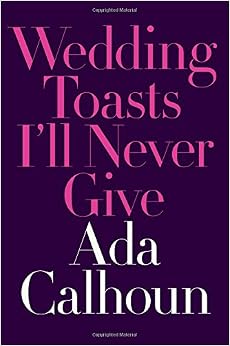
WEDDING TOASTS I’LL NEVER GIVE By Ada Calhoun W.W. Norton and Co. 192 pp. $24.95


Image result for WEDDING TOASTS I’LL NEVER GIVE By Ada Calhoun W.W. Norton and Co. 192 pp. $24.95


It’s peak wedding season, and Ada Calhoun’s “Wedding Toasts I’ll Never Give” is a fine gift to tuck between the negligees and garter belts at the more literary bride’s shower. A breezy, warm-hearted meditation on the nature of matrimony, the book began as a “Modern Love” column in the New York Times. Like many of the essays that appear there, the chapters, with titles such as “The Boring Parts” and “The Truth About Soul Mates,” are designed to encourage readers’ ruminations about their own triumphs and hardships in love.

Calhoun, a journalist, has rich autobiographical material: She’s been married for 12 years to her current husband, has a youthful short-lived marriage behind her, and is mother to one son and a stepson. She uses confessions about her teenage crushes and near-infidelities as a springboard for generalizations about wedded trials or bliss. The book ends with a long bibliography and is peppered with quotes from other writers — Thomas More, James Baldwin, Pope Francis, “modern relationship sage Tyler Perry” and Calhoun’s mother, who delivers perhaps the most pithy advice on the best way to stay married: “You don’t get divorced.”

Calhoun’s marriage, to the oft-admiringly-quoted musician Neal, appears to be a solid one, with plenty of respect and honesty, peppered with in-jokes. Her wry, likable voice is at its Ephronesque best in these passages, which celebrate the joys of the daily. On the frustrating repetitions of rearing a toddler: “With ‘Dora the Explorer’ on, no one can hear you scream.” On spats during home renovation projects: “Because I like to fix broken things quickly and as shoddily as possible (Neal describes my renovation aesthetic as ‘Little Rascals Clubhouse’), I frequently receive the advice ‘Don’t just do something, stand there.’ ” Only occasionally do her glowing reports veer into the territory of the humble-brag or gloat. “Neal denies me nothing. He is great in bed and would just as soon we had sex every day.”

Readers looking for fresh wisdom may be unimpressed to hear that marriage isn’t always thrilling, that it requires compromise or that “the romantic fairy tales we grew up with . . . are not useful for grown-ups.” The book is surprisingly short on insights from psychologists or couples counselors on common marital problems, or on how past family dynamics, endlessly replayed, can doom a marriage. There are few interactions — much less hostility — with parents or in-laws; there are no nasty ex-wives or custody battles; no drunks or swindlers or wife-beaters. Indeed, the basic tenor of the book is Nice — the kind of things you would actually want to voice in a wedding toast.

If I may add two favorite works to Calhoun’s bibliography, I recommend British psychiatrist Adam Phillips’s “Monogamy” (in short: it’s frustrating) and Maggie Scarf’s “Intimate Partners: Patterns in Love and Marriage” (in short: it’s complicated). These are both deeper, darker works. But you can’t really fault Calhoun for having married well or for being stalwartly good-natured. She often advocates a kind of cheerful moderation:

“I’ve noticed that Neal and I need some distance to feel attraction. If we’re too connected, there’s no space to bridge with desire. If we’re too far apart, we become estranged. I’ve begun to suspect that, regardless of what women’s magazines tell us, there might be no way to reach peak sexiness and perfect security simultaneously, that marriage might just involve finding and refinding our own balance between boredom and jealousy, safety and danger.”

A chapter called “Love Is Strong as Death” contains most of the reports from longer-term marriages and older couples, with many partners confessing that they often considered bolting. In fact, one thing that “Wedding Toasts I’ll Never Give” reminds us is that Calhoun’s coordinates on the marital timeline may represent a golden moment. At 12 years, you’re past the seven-year itch. If you’ve had kids, you’ve weathered the most challenging early child-rearing patch but haven’t yet approached the next rough child-rearing patch, adolescence. (The stepson doesn’t get a lot of airtime.)

Calhoun is, in short, the ideal person to deliver a champagne toast before the dancing begins: a little older, a little wiser, but not so old and wise that she has lost her effervescent hopefulness. More jaunty than jaded, she’s still a firm believer in “moments of grace” that transform an ordinary marriage into something consecrated. “These moments are like shooting stars: you see them only if you’re watching, and you see them more clearly when it’s dark.”

Posted by BardofBatYam at 9:53 PM No comments:
Email ThisBlogThis!Share to XShare to FacebookShare to Pinterest
Labels: . #CameosFromZion, . #stephendarori, . The Darori Foundation, .@israelbookrevs, .@stephendarori, .Israel Book Review, @israelbookreview, #IsraelBookReview, #stephendrus, Stephen Darori, Stephen Drus

Saturday, June 24, 2017

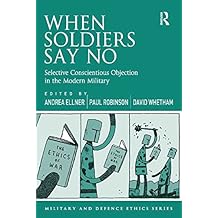
When Soldiers Say No: Selective Conscientious Objection in the Modern Military. Andrea Ellner, Paul Robinson and David Whetham (eds.) Ashgate.

Product Details


This edited collection comprises fourteen contributions from a range of perspectives – military, philosophy, international relations, and law – upon the controversial topic of selective conscientious objection in the military. Put simply, this doctrine concerns the process whereby military personnel object outright opposition to all military action, for example on pacifist grounds. The collection aims to provide a “fresh and thorough evaluation of the topic” and broadly comprises of efforts which evaluate the relative merits of affording recognition of selective conscientious objection and case studies of the doctrine’s treatment in selected countries.

In light of recent controversial military episodes, such as the 2003 US/UK led invasion of Iraq, and instances of selective conscientious objection which they have given rise to, the book is clearly of timely relevance. More generally, the end of conscription in many states and the transition to volunteer armed forces means that the overwhelming number of claims of conscientious objection come from existing military servicemen and are selective in nature.

The first six chapters of the book are concerned with the arguments for and against acceptance of selective conscientious objection. The reasoning employed by the various contributors takes the form of a mixture of perspectives grounded largely in moral philosophy, but also tactical military considerations and political practicalities. A key tension exposed in these contributions is that which exists between permitting individuals to follow the demands of their own consciences with the importance of ensuring obedience to the collective needs of the state as embodied in the manner in which its institutions opt to exercise its sovereign powers.

The argument employed in the first chapter by Imiola is particularly interesting. He describes the traditional perception of soldiers as servants of the state, not best placed to make decisions concerning military operations undertaken by the state. However, as he goes on to demonstrate, soldiers are nonetheless moral agents possessed of an individual responsibility which entails a moral obligation on their part to refuse to perform immoral acts. By contrast, some of the other contributions (for example, those by Bergeron and Fisher) highlight the extent to which recognition of selective conscientious objection undermines sovereign powers, the individual will of soldiers having to be negated to the collective will of the state.


Credit: Brooke Anderson CC BY 2.0

Chapters seven to eleven provide case studies of the approaches taken towards selective conscientious objection in five states: Australia, Britain, Israel, Canada and Germany. The examples of Britain and Israel provide for an interesting contrast. In considering the former in chapter eight, Deakin shows that Britain has encountered very few cases of selective conscientious objection in practice. However, although a low key approach is evident towards their treatment, such claims have been dealt with “through an approach characterized by common sense administrative leniency”. Nehustan surveys Israeli case law in chapter nine. While arguing that there is no justification for only recognising claims of “absolute” conscientious objection, he illustrates that the Israeli Supreme Court has failed to deal with claims of selective conscientious objection fairly. The final three chapters of the collection attempt to draw out some conclusions from the discussion provided in the preceding eleven contributions.

Being an edited collection, and one grounded in varying disciplinary perspectives, there is no singular uniform argument flowing through the work. This is to be expected. The arguments advanced on the merits of selective conscientious objection, however, are nonetheless logical and advanced coherently. The case studies likewise are well researched and presented within the contexts of the dynamics of the relevant states’ military, legal and political structures.

A major strength of the book lies in its plugging a gap within the existing literature on the subject. Discussion of selective conscientious objection has been relatively limited and consists for the most part of shorter pieces and/or treatment of narrow or specific aspects of the doctrine or instances of its invocation. This collection thus adds considerably to the literature by bringing together a range of perspectives on the merits of selective conscientious objection, as well as consideration of its application (or lack thereof) in a number of states. Its interdisciplinary nature is particularly attractive.

The shortcomings of the book are few, but it is unfortunate that the chapters which address the arguments for and against selective conscientious objection appear to be almost exclusively grounded in considerations of a philosophical nature. While clearly at the very core of debates over the merits of selective conscientious objection, there are also various practical considerations applicable to the doctrine – for example, its effects on military discipline, the question of its effective administration, and development of criteria to govern its recognition – which might perhaps have been afforded greater consideration at some point. While the case studies utilised are perfectly reasonable enough, the absence of the US might be questioned given its status as the biggest military power and the instances of selective conscientious objection which its involvement in Vietnam gave rise to. These criticisms should not, however, detract from the book’s general utility and valuable contribution to the literature in this area.

The book will obviously be of great appeal to anyone with an interest in selective conscientious objection in the military, but is also, more broadly, likely to be of interest to those engaged in military ethics, defence studies, international relations, international law, human rights, and moral philosophy.
Posted by BardofBatYam at 6:01 AM No comments:
Email ThisBlogThis!Share to XShare to FacebookShare to Pinterest
Labels: . @stephendarori, . #CameosFromZion, . #stephendarori, . Stephen Darori, . Stephen Drus, . The Darori Foundation, .@israelbookrevs, .Israel Book Review, @israelbookreview, #IsraelBookReview, #stephendrus

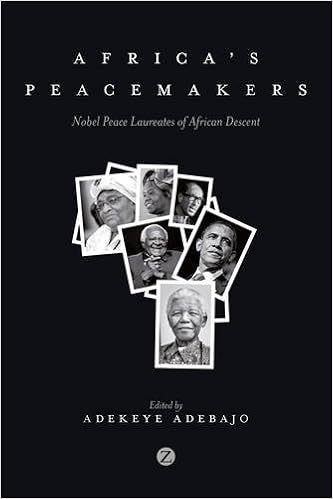
Africa's Peacemakers: Nobel Peace Laureates of African Descent Paperback – February 1, 2014 by Adekeye Adebajo


This book is essentially a “collection of biographical essays provid[ing] profound insight into the thirteen prominent individuals of African descent who have won the Nobel Peace Prize since 1950.” While most of the contributions predominantly focus on an individual recipient of the prize, the earliest chapters attempt to make comparisons and connections between Nobel prize-winners and others who made significant contributions to furthering the agenda of peace. Given Africa’s place at the heart of much post-War conflict and accompanying efforts to promote peace, the major developments of note there – not least among these being the death of apartheid in South Africa – and the number of prominent international figures to have originated from the continent in the last few decades, the book’s focus makes it a worthwhile addition to any library.

A major strength of the book lies in the fact that it covers lesser known winners of the Nobel Peace Prize as well as the universally recognised recipients. The names of Nelson Mandela, Martin Luther King, and Barack Obama are known to everyone, but how many people could identify the likes of Albert Luthuli or Wangari Maathi, among others? The book brings to the fore the stories of such remarkable individuals. An impressive array of prominent contributors has been assembled to write the essays which comprise the book, all of whom are well equipped to comment upon their subjects, sometimes from close personal experience. For example, former UN Secretary-General Boutros Boutros-Ghali is able to offer a personal account of his fellow Egyptian Anwar Sadat’s efforts which secured him the Nobel Peace Prize jointly with Israeli Prime Minister Menachem Begin. Similarly, former UN Under-Secretary-General for Political Affairs James Jonah details Ralph Bunche’s peace-making efforts at the UN, a man he regards as his one-time mentor within the organisation.

The book is split into six parts. In part one, the first chapter introduces the various individuals covered within the book, before the second places Barack Obama’s receipt of the Nobel Peace Prize into a wider historical and political context. The subsequent five parts of the book concern themselves respectively with African-American, South African, Egyptian, Kenyan and Ghanaian, and Liberian recipients of the prize.


Nobel Square, to honuor South Africa’s Nobel Peace Prize Laureates.
Credit: Harvey Barrison CC BY-SA 2.0

The story of Martin Luther King is well known, as is that of Barack Obama, but another African-American, Ralph Bunche, won the prize earlier. In chapter four, James Jonah provides an insightful account of this career UN diplomat, who served within from the time of its creation until his death. A relative unknown to the wider world, Bunche was integral to various early peace initiatives at the UN level and won his prize in 1950 for his peace-making efforts in the Middle East.

Four South Africans have won the Nobel Peace Prize, all for efforts related in some way to ending apartheid. The joint award to Nelson Mandela and FW De Klerk for their roles in the dismantling of the apartheid regime is well documented, and to a lesser extent Desmond Tutu is well known for his leading role in the struggle against the same regime. However, Albert Luthuli, winner of the award in 1961, is far less prominent a figure. Nonetheless, as Chris Saunders’ chapter illustrates, as an early leader of the ANC he gave much inspiration to later generations in the anti-apartheid struggle. Arguably we cannot understand Mandela or Tutu without being aware of the earlier contribution of figures like Luthuli.

The two Egyptians to have won the Nobel Peace Prize did so in remarkably different contexts. Anwar Sadat was acclaimed for his role in brokering a peace between Egypt and Israel, a feat in traditional diplomacy which holds to this day, while more recently Mohammed El Baradei’s efforts to promote nuclear disarmament as head of the IAEA were rewarded in 2005. Further demonstrating the broad understanding of ‘peace’ and efforts to promote it, Wangari Maathi’s receipt of the prize in 2004 was in recognition of her efforts to promote sustainable development through environmental action, as detailed by Janice Golding in chapter twelve.

Kofi Annan is only the second UN secretary-general to have won the Nobel Peace Prize, but as Gwendolyn Mikell shows in chapter thirteen, the ability to take a principled stance on issues of international concern in that post is fraught with difficulty due to the political realities against which the post-holder must operate. Arguably, Annan will be judged by history to have fared better than most in this respect.

The final two studies, Ellen Johnson Sirleaf and Leymah Gbowee, are in many respects polar opposites. As President of Liberia, Johnson Sirleaf was a controversial figure whose receipt of the prize in 2011 was called into question by many unconvinced of her commitment to peace. Gbowee, who shared the prize in that year, was recognised for her campaign for gender equality although arguably overshadowed by her co-recipient.

The perspectives offered upon the various recipients of the Nobel Peace Prize are broadly objective. While it is often easy to overlook the flaws and shortcomings of revered international figures, the contributions within the book do not attempt to portray the individuals concerned as saints, but rather touch upon where appropriate some of the controversies associated with them, such as FW De Klerk’s defence of aspects of apartheid in South Africa and the controversial career of Ellen Johnson Sirleaf.

It is questionable whether the inclusion of African-American recipients of the prize is appropriate, given that the primary focus of the work are individuals who actually come from the continent of Africa. However, the historical stature of Martin Luther King and the relationship between the US civil rights movement and the anti-apartheid movement in South Africa, and the recent controversy over the award to Barack Obama, the first US President of African descent, perhaps make their inclusion relevant.

This clear, concise, and useful bibliographical work will be of special interest to those engaged within international affairs, history or peace studies, although its accessible style also makes it a worthwhile read for the general reader with a passing interest in such matters.
Posted by BardofBatYam at 5:46 AM No comments:
Email ThisBlogThis!Share to XShare to FacebookShare to Pinterest
Labels: . @stephendarori, . #CameosFromZion, . #stephendarori, .@israelbookrevs, #IsraelBookReview, #stephendrus, Stephen Darori, Stephen Drus, The Darori Foundation

Wednesday, May 17, 2017

'Move Fast and Break Things' By Jonathan Taplin,( Little, Brown and Co)., 320 pages, $29

America's major tech companies like to present themselves as cool and countercultural institutions. Their employees and executives wear jeans to work, hold "hackathons" to solve problems and speak in soaring language of how their "disruptive innovations" will positively transform the world. How could these companies not be a force for good?

Jonathan Taplin's excellent new book explains exactly how Google, Facebook and Amazon are undermining democratic institutions, accelerating the rise of oligarchy in America, and destroying both cultural and economic opportunities for millions of people. The book's title is "Move Fast and Break Things," a slogan popular in Silicon Valley that has gradually gained a set of connotations far less flattering than tech oligarchs might realize. As Taplin writes, "a culture and its art are not like an old flip phone — to be thrown in the trash as soon as it has been 'disrupted' by the Next Big Thing."

Many elements of Taplin's case are familiar. Newspaper ad reenue has declined by roughly $40 billion between 2000 and 2014, recorded music revenue has dropped $10 billion in the same period, and over 5,000 independent book and record stores have closed in the last two decades. Facebook's covert experiments in manipulating the emotions of hundreds of thousands of users, Amazon's atrocious treatment of workers at its distribution centers and Google's cavalier disregard for copyright laws are also well-documented.

Taplin, director emeritus of the University of Southern California Annenberg Innovation Lab, argues that the major tech companies are fundamentally monopolistic and parasitic — they exploit positions of market dominance to ignore legal regulations, extract inflated prices from advertisers and rely on content produced by others, often without their consent or knowledge. But his explanation of how these practices arose starts much earlier. Thomas Jefferson wanted a "restriction against monopolies" added to the Bill of Rights, alongside freedom of religion, freedom of the press and protection against standing armies. Alexander Hamilton, founder of the Bank of New York, disagreed and ultimately prevailed.

Though wealthy banking interests prevented the adoption of a clause against monopolies in the Bill of Rights, the Sherman Antitrust Act of 1890 allowed President Theodore Roosevelt to break up John D. Rockefeller's Standard Oil Trust. Taplin quotes Roosevelt, whose words still resonate: "the prime need is to change the conditions which enable these men to accumulate power which it is not for the general welfare that they should hold or exercise."

"Move Fast and Break Things," by Jonathan Taplin, Little, Brown and Co., 320 pages, $29. (Little, Brown and Co.)

Taplin explores how the influential legal theorist and rejected Supreme Court nominee Robert Bork helped shift public and regulatory opinion in the second half of the 20th century. By claiming that the only question regulators should ask is whether monopolies affect consumer welfare, Bork essentially proposed that as long as prices fall, increasing concentrations of corporate power do not matter. Even if Wal-Mart were the only store in America, this would be a problem only if consumer prices rose.

Of course, this myopic thinking ignores the fact that there might be no consumers to shop at Wal-Mart if it were allowed to obliterate every other retail business in the country. Because Wal-Mart would then be the only purchaser of many goods from wholesalers, it could extract ruinous prices. This is precisely the position of Amazon vis-a-vis book publishers. Because Amazon can deny publishers access to its enormous customer base, it can force them to accept artificially deflated prices. Google and Facebook can do something similar with advertisers by threatening to deny them access to billions of users. Taplin cites the Herfindahl-Hirschman Index, a widely used measure of market concentration in antitrust law that allows regulators to determine whether markets are becoming monopolistic. A score of 2,500 is considered highly concentrated. The HHI for internet search markets is 7,402.

The sort of free-market libertarianism that scorns all government regulation is particularly ironic given the origins of the internet. Taplin recounts early research funded by the U.S. Department of Defense that explicitly structured the internet in a decentralized architecture so it could survive a nuclear attack. Not only does the absurdly concentrated power of a few companies contradict this vision, the internet itself might not exist if the anti-government visions of many tech oligarchs had been a reality in the 1960s.


Jonathan Taplin’s latest book explains how Google, Facebook and Amazon are undermining democratic institutions, accelerating the rise of oligarchy in America, and destroying both cultural and economic opportunities for millions of people. (Little, Brown and Co.)

Taplin makes a forceful and persuasive case that companies like Google and Facebook could employ their powerful artificial intelligence programs to prevent the infringement of existing copyright laws. They've demonstrated their capacity to stop pornography and illegal drug markets from surfacing on search results. It would not be difficult for them to enforce copyright infringements more effectively and share some of their enormous profits with the industries they are decimating.

The 2016 presidential election was a dramatic demonstration of the unintended consequences of gutting the once-influential field of journalism. But Taplin believes that his case has implications far beyond the creative industries.

"We need to understand that every one of us will stand in the shoes of the artist before long. Musicians and authors were at the barricades first because their industries were the first to be digitized. ... (S)oon the technologists will be coming for your job, too, just as they will continue to come for more of your personal data," he writes. This is not a prophecy but a warning — without changes to legislation, corporate behavior and consumer values, the oligarchic dreams of a few billionaires could reshape the country even more than they already have.


Posted by BardofBatYam at 10:33 AM No comments:
Email ThisBlogThis!Share to XShare to FacebookShare to Pinterest
Labels: . @stephendarori, . #CameosFromZion, @israelbookreview, #IsraelBookReview, #stephendarori, #stephendrus, Israel Book Review, Stephen Darori, Stephen Drus, The Darori Foundation

"Yummy: Eight Favorite Fairy Tales" By Lucy Cousins Candlewick, $18.99, ages 4-8 ( Candlewick Press) (#ISBRChildrensBooks)


The illustrations are great: large and bright. I read this book to my 2.5 year old twins and it holds their attention.

Some reviews said that the illustrations were "graphic". I disagree - I thought that the illustrations were funny,amusing and very child-friendly. The one in Red Riding Hood where grandma's legs are sticking out of the wolf's mouth (singled out by one reviewer as scary) made my girls giggle and they were not bothered by the "violence" some reviewers alleged was present in the stories one bit.

I was very happy with the size of the book: large, bigger than A4 format. That makes it easy to read to multiple children at the same time at bedtime. The book cover is sturdy and can withstand "toddler love". Pages are easy to turn for the little hands as well.

I realize that, in our society, classic stories (by Brothers Grimm,Perro, etc) are perceived as violent, which is true for some. But the stories in this book are not: evil is punished, and good prevails, there is no blood, gore, or anything that is disturbing to little kids. Yes, the wolf eats the grandma and Red Riding Hood, but they magically appear in the end unscathed.

Lucy Cousins' presentations of 8 familiar fairy tales are "yummy," because food and eating, necessary and communal activities, are central, whether it's in the familiar "Little Red Riding Hood" or the less-known "The Enormous Turnip," where the turnip becomes "an enormous feast" for the family, pets and even the household mouse. The wolf eats Little Red and her grandmother, but after they are rescued by a passing hunter, all three sit down to enjoy the food in the basket Little Red had been carrying. It's also yummy because even the ferocious characters-- the usual bad lot of wolves and trolls-- are so cheerily depicted in the style familiar to children from Cousins' "Maisy" books that they lack the creepy edges of traditional tales for older readers. The various animals all have some part of their costume in brightly colored, spotted, striped or flowered clothing, a sort of Marimekko nation. "The Bremen Town Musicians" might be especially resonant to children because initially the animals each feel "Nobody loves me," a not unfamiliar playground sentiment. Parents who have been wondering about fairy tales for their young children might take a look.


Posted by BardofBatYam at 10:11 AM No comments:
Email ThisBlogThis!Share to XShare to FacebookShare to Pinterest
Labels: . @stephendarori, . #CameosFromZion, .Israel Book Review, @israelbookreview, #IsraelBookReview, #stephendarori, #stephendrus, Stephen Darori, Stephen Drus, The Darori Foundation

HATTIE & HUDSON by Chris Van Dusen, illustrated by Chris Van Dusen Age Range: 4 - 8 ( CAndlewick Press)


A richly illustrated story featuring a courageous little girl and a lake monster. Hattie is a sweet and curious role model for all adventurous children. I love it! Yet again, his illustrations are out of this world. I wish I could see Van Dusen in action! This story reminds me of the time I spend in Maine with my family during the summer! Van Dusen really captures the essence of childhood and the magic of Maine. Hattie and Hudson is a classic!

A lanky, little explorer paddles her canoe on a lake and inadvertently sings up a huge, green beast.

All the other boaters scatter in a panicked frenzy, but later that night, under a moonlit sky, Hattie McFadden returns to the middle of the still lake. Without the distraction of motor boats, the white redhead takes the time to befriend Hudson. The next day, the townsfolk meet to suggest ways to get rid of “the Deadly Beast.” Dismayed, Hattie thinks, “If only they knew him.” The two new friends put together a plan to convince the town of Hudson’s kindness. Hattie bravely finds her voice and makes an announcement to the town: “This lake is his home, and I think he deserves to stay. Once you get to know him, I’m sure you’ll agree.” The glory of lakeshore life is celebrated as idyllic, with lush forests and hills and cool blue water. An undercurrent of environmentalism is present in the symbolic canoe compared to motorboats, and the message of getting to know strangers is a timely one. The gouache illustrations are filled with details that bring light and life to the pages, from each water droplet to every rolled-up sleeve. Hudson, although enormous, is drawn with expressive eyes and a lovely green hue that reflects the stars in the sky, and Van Dusen expertly takes advantage of perspective and composition to make sure readers remember at all times exactly how huge Hudson is.

Outdoor enthusiasts will celebrate this brave young heroine as she schools the town on acceptance. (Picture book. 4-8)
Posted by BardofBatYam at 9:56 AM No comments:
Email ThisBlogThis!Share to XShare to FacebookShare to Pinterest
Labels: . #CameosFromZion, . The Darori Foundation, .Israel Book Review, @israelbookreview, #IsraelBookReview, #stephendarori@stephendarori, #stephendrus, Stephen Darori, Stephen Drus

The States Are Revolting Against the War on Drugs....Pablo Escobar: My Father Paperback – August 29, 2017 by Juan Pablo Escobar (Author), Andrea Rosenberg (Translator) A Thomas Dunne Book for St. Martin's Griffin);(Drugs Are NOT The Devli's Tools - B&W Edition: The History of Drugs: Discrimination, Greed, the War on Drugs and Why Medical Marijuana Can Fuel Change Paperback – April 23, 2017 by David Bearman M.D. (Blue Point Books) ;.Kingpin: Prisoner of the War on Drugs Hardcover – May 2, 2017 by Richard Stratton (Arcade Publishing) ;The War on Drugs: A Failed Experiment Paperback – June 7, 2014 by Paula Mallea (Dundum); Chasing the Scream: The First and Last Days of the War on Drugs Paperback – March 1, 2016 by Johann Hari (Bloomsbury USA); Ending the War on Drugs Paperback – April 26, 2016 by Richard Branson (Virgin Books);The War on Drugs Is a War on Freedom by Laurence M. Vance Paperback (Vance Publications)


On the same day that Attorney General Jeff sessions announced that he would attempt to revamp the war on drugs, it came to my attention that potentially more important events regarding the war on drugs were taking place in Vermont, the "freedom and unity" state.

It would seem that the state legislature in Vermont has voted to eliminate the war on marijuana in the state for recreational use. This is important, critically so, because all of the efforts to legalize recreational marijuana so far have been done by the processes of voter-sponsored ballot initiatives and referendums. In other words, marijuana legalization is now taking place in at least one state legislature, not just the ballot box.

When citizens in a state vote to legalize marijuana it is an act of defiance against federal and international law. When state governments vote to legalize recreational marijuana it raises the level of defiance against federal and international law. While I personally prefer the defiance of citizens, defiance by state legislature could spread to other issues of states versus the federal government and international globalists.

Attorney General Jeff sessions wants federal prosecutors to go after the "most serious crimes with a high likelihood of conviction and long prison sentences." However, this could very easily apply to nonviolent drug offenses, resulting in lengthy minimum mandatory sentences for large numbers of people.

The attorney general argues that this approach is necessary to be tough on crime and to ensure legal justice.

Opponents argue that the tougher approach will result in many ruined lives, targeting and racial profiling, and would greatly reduce legal justice.

Proponents prefer the tough on crime, war on drugs approach, and a roll back of the state legalization measures. Prominently, this group includes such industries as the corporate for-profit prison industry, the alcohol and tobacco industry, and the pharmaceutical industry.

The attorney general's "thinking" seems to be based on the old gateway theory of drugs. This theory argues that smoking marijuana will lead to heroin addiction, insanity, violent crime, and death. From this perspective, a crackdown on drugs and opposing the state legalization of marijuana movement would somehow address the heroin and opioid addiction/overdose epidemic.

The gateway theory of drugs has overwhelmingly been debunked by all of the relevant scientific disciplines which have studied it, including medicine, biology, and psychiatry. Statistically, the only connection between marijuana use and heroin addiction is the war on drugs itself. In other words somebody who obtains marijuana in the black market is statistically more likely to later purchase harder drugs in the black market than they were exposed to because of the war on marijuana.

The only significant connection between marijuana and heroin addiction to my knowledge is that marijuana is considered by many to be a helpful component for overcoming heroin addiction. Marijuana helps addicts deal with the pain, nausea, anxiety, poor appetite, etc. The fact that heroin and opioid overdose deaths have declined in states that have legalized marijuana supports this contention. Legalization states have also seen a decline in the number of prescriptions written for dangerous painkillers and psychiatric drugs.

Attorney General Sessions's announcement can clearly be seen for what it is: a rear guard action in the war on drugs. Such actions take place when circumstances of time and place creates an opportunity to stall an invading force. An example of a rear guard action would be the German military during World War II. Once defeat was obvious the German military retreated out of North Africa and Italy, but occasionally would stop and fight from a defensive position. The purpose of such fighting is not to win a battle or war, but rather to allow more time to evacuate troops and equipment safely.

It is not clear that the Trump administration has the time or even interest in fighting the war on drugs. In fact, the president's budget called for a 90% cut in the White House office of drug policy, that is, the drug czar. As in so many other areas, the Trump administration has created great uncertainty with respect to its policy agenda.

There are two things for which there is a good deal of certainty. The first is that the American people support repealing marijuana prohibition, both for recreational use as well as medical uses. A growing number of Americans support reforming prohibition of harder drugs as well. Given demographic factors the percentage of Americans supporting such reforms will continue to grow in the future.

The second thing that is quite certain is that state legislatures will be necessary to ensure that marijuana legalization goes nationwide. This is because many states do not have voter sponsored ballot initiatives and most of the ones that do have already voted. Otherwise we would need federal action to repeal marijuana prohibition or a federal judicial decision that would uproot marijuana prohibition.

In the meantime, let us thank our friends in Vermont and let us hope that their freedom-and-unity message and their live-free-or-die mentality is an inspiration to Americans across the country.
Posted by BardofBatYam at 5:41 AM No comments:
Email ThisBlogThis!Share to XShare to FacebookShare to Pinterest
Labels: . #CameosFromZion, . The Darori Foundation, .Israel Book Review, @israelbookreview, @stephendarori, #IsraelBookReview, #stephendarori, #stephendrus, Stephen Darori, Stephen Drus

The Ethics and Politics of Immigration: Core Issues and Emerging Trends. Alex Sager (ed.). Rowman and Littlefield. 2016.


Political philosophers have recently started devoting serious attention to the question of immigration. Faced with the fractious, emotionally charged atmosphere that surrounds contemporary debates around immigration in public life and the populist chancers who exploit the issue, one might be tempted to conclude that sustained ethical reflection is ultimately futile. Yet it is precisely because the fog is thick that illumination is called for. At its best, political philosophy throws into question the unexamined assumptions that structure the very terrain of disagreement, such as the assumption that states have a right to exclude people at all. It can also bring to the surface practical commitments that we did not know we had, showing how our agreement in one particular area should inform our thinking on more controversial issues. Why, for example, an official commitment to protecting refugees – defined as those fleeing political persecution – might require us to extend hospitality to groups suffering from other human rights abuses.

In 1987, Joseph Carens wrote a pioneering essay on immigration in which he memorably described citizenship of Western states as a form of feudal privilege: ‘an inherited status that greatly enhances one’s life chances’. His argument aimed to show how the theoretical commitments of utilitarians, libertarians and Rawlsians – the dominant approaches in political philosophy – required them all to support much more open borders. While other noteworthy contributions followed over the decades, most philosophers tended to think about justice under the assumption of a closed-bordered society. Immigration was largely treated as a subsidiary issue within debates between nationalists and cosmopolitans and over the merits of multicultural group rights. In recent years, however, attention to different aspects of immigration policy and practice has gathered pace with a major book by Carens in 2013 summarising a career’s worth of reflections, and significant interventions on the other side of the debate by the likes of David Miller and Christopher Heath Wellman, who have defended immigration controls on the basis of national culture and self-determination. A recent collection of essays edited by Sarah Fine and Lea Ypi brought together many leading theorists in this area to debate rights of entry and exit, the categorisation of migrants and the distribution of citizenship in democratic states.

In to this mix, we can now add The Ethics and Politics of Immigration, edited by Alex Sager. This is an excellent collection of academic essays on some of the key normative issues raised by the laws, policies and practices that govern immigration in liberal states. Nearly all of the contributors work in political theory or philosophy, though the collection distinguishes itself in taking a more self-consciously practical approach to the issues, closely attuned to specific institutional and strategic contexts and the dominant modes of argument in public discourse. The book consists of twelve substantive chapters organised around four key themes: i) admissions; ii) enforcement and its effects; iii) integration and inclusion; and iv) new directions for the philosophy of immigration. I cannot hope to do justice to the full range of contributions, but among the issues covered are the definition of refugee status in international law, the justification of family migration schemes, smuggling and trafficking, citizenship tests, arguments for regularisation, temporary labour migration and migrant care work.


In an illuminating tour de horizon, in Chapter Two, Amy Reed-Sandoval contrasts the ‘classical’ and ‘new’ open borders debate in political philosophy. The former has largely been conducted at the level of ‘ideal’ theory, examining whether there is a universal right to cross borders, the basis on which citizenship is conferred (or denied) and whether states have a general right to exclude whom they wish. While this has the advantage of bringing into clear focus fundamental questions of political morality, it also runs the risk of abstracting too far from the complex historical realities of migration rules and enforcement. The new open borders debate, by contrast, adopts a ‘non-ideal’ approach sensitive to the particularities of existing immigration regimes and drawing on perspectives from critical theory. This approach might examine how relations of race, gender and class condition patterns of exclusion or how historical relations between states influence migration flows and state policies. Reed-Sandoval argues (rightly in my view) that both approaches can usefully inform one another. For example, a state’s history of military intervention in a region – as for example, with the US and UK in the Middle East – might generate a stronger claim against that state for inclusion by those individuals displaced. In this way, the critical perspective of the new open borders debate can usefully supplement abstract discussions of rights and justice, making these debates more ‘user-friendly’ for political activists.

In Chapter Four, Matthew Lister makes a ‘pragmatic’ argument for the moderate expansion of the definition of refugees who are entitled to asylum under international law. The 1951 Refugee Convention extends refugee status to those with a ‘well-founded fear of being persecuted’. While some have argued for a broader ‘humanitarian’ definition of refugees to include those fleeing life-threatening poverty and other human rights deprivations, others have argued that this narrow focus on persecution is justified as a kind of global ‘rebuke’ to oppressive states. Lister departs from the status quo in recommending the expansion of the category of refugee to include those who are fleeing persecution by non-state actors (such as ISIS) in situations where the state is unable or unwilling to offer protection. Against those proposing a broader humanitarian definition, however, Lister argues that a focus on persecution is warranted if we understand asylum as a particularly appropriate kind of remedy for situations where there is an ongoing risk of harm and where alternative solutions, such as aid, temporary protection and military intervention, are not appropriate.

Stephanie J. Silverman’s contribution in Chapter Seven focuses on immigration detention. Prior to the presidency of Donald Trump, the US already had the largest number of immigration detention centres in the world, with over 400,000 people deprived of their liberty for falling foul of immigration law. Immigration debates tend to implicitly assume that removal happens instantly, but in practice the process often takes many years, leaving people in a state of legal limbo. The system officially functions as part of the removal system, but it is also clearly a form of punishment designed to deter would-be migrants in violation of fundamental principles of legality. Silverman notes that while the international human rights regime may blunt some of the harshest elements of immigration detention, it does not adequately define the practice or say how it can be challenged.

One of the most enduring refrains of pro-migrant movements in recent years – found in chants, pamphlets and T-shirts – is that ‘No human being is illegal!’ This is a powerful, life-affirming response to the callous rhetoric of immigration enforcement that also exposes the contingency of legal-bureaucratic statuses. In Chapter Twelve, José Jorge Mendoza offers an incisive analysis of how the term ‘illegal immigrant’ is a xenophobic and racist construction that establishes who is ‘white’ (and privileged) and who is not, protecting insiders and demonising outsiders. Notably, the first naturalisation tests in the US in 1791 stipulated that only whites could become citizens, thus making black people in the country ‘perpetual foreigners’. Whereas the current regime is superficially neutral on race, it nonetheless creates a hostile legal and social environment for non-whites. As Mendoza notes, laws and policies aimed at encouraging the ‘self-deportation’ of undocumented migrants mean that even Mexicans with citizenship in the US are made to feel like permanent suspects and outsiders.

In his own contribution, Sager persuasively articulates many reasons that explain my own instinctive unease at the debate around ‘brain drain’: the phenomenon whereby doctors and other skilled workers move from developing countries to more prosperous states for work. In contemplating this purported problem, a number of philosophers have recommended extensive controls over emigration in developing countries in the name of global equality. As Sager argues, the whole debate operates with the dehumanising assumption that states have a right to control their own populations in the manner of commodities – ‘brains’ – for their own benefit, rather than treating people as individuals with families, lives and futures of their own. Worse, the debate is premised on a shaky set of empirical assumptions that both exaggerate the significance of the phenomenon and the negative impacts it has on developing states (especially in relation to its potential benefits, such as remittances sent home). For Sager, this faulty approach can be explained by the latent tendency of global political theory to ‘methodological nationalism’, which views nation states as the primary unit of concern, downplaying cross-border connections and global economic processes that influence migration flows.

While the quality of the individual contributions is high and the topics are all pertinent, I think this collection would have been improved had the authors engaged with one another’s arguments far more. As it stands, one wonders how the various interventions relate to one another. A dialogue among the different authors would have contributed to the sense of the debate being driven forward in the engaged practical direction that many of the authors seem to desire. The book itself is a handsome object with an attractive cover, though there are a few small copy errors that might be picked up in any future editions. I would have no hesitation recommending the book to those looking for an entry into debates on the philosophy of migration, including scholars from political science, law, anthropology and other disciplines. Given its refreshing lack of unnecessary technical jargon, it should be accessible to the general reader as well as of interest to specialists in the field. Overall, the book does a great job of bringing into normative focus issues that risk being neglected in more abstract discussions of what justice requires. It helpfully maps the broader philosophical and political terrain, deepening the arguments in key areas while also highlighting worthwhile themes for future examination.
Posted by BardofBatYam at 5:13 AM No comments:
Email ThisBlogThis!Share to XShare to FacebookShare to Pinterest
Labels: . #CameosFromZion, . Stephen Darori, @israelbookreview, @stephendarori, #IsraelBookReview, #stephendarori, #stephendrus, Israel Book Review, Stephen Drus, The Darori Foundation

Tuesday, May 16, 2017

In Search of Criminal Responsibility: Ideas, Interests and Institutions. Nicola Lacey. Oxford University Press. 2016.


In this important, engaging and timely book, In Search of Criminal Responsibility: Ideas, Interests and Institutions, Nicola Lacey offers not only an illuminating historical account of the development of the modern concept of criminal responsibility, but also an authoritative and searching ‘socio-theoretic’ inquiry of its current place within a series of broader legal, social, political, economic and cultural frameworks. Building on her prodigious portfolio of research on the concept of responsibility, Lacey adroitly encapsulates the changing social nature of responsibility as a concept grounded in the practice of law in a highly intelligible, accessible and erudite monograph.

The book exhibits Lacey’s move away from the influence of the legal-philosophical tradition of theorists such as H.L.A. Hart, Michael S. Moore and Victor Tadros, who approach criminal responsibility as an abstract phenomenon. Whilst acknowledging continuing scholarly assumptions about the existence of a unitary metaphysical truth to the concept of criminal responsibility, Lacey argues in support of the legal-philosophical pursuit of a ‘socially realistic development of normativism’ (drawing on MacCormick and Weinberger 1986, 6).

The basic premise of Lacey’s argument is that to understand what responsibility actually is, we must first appreciate what it has been for at different times and in different places. Her core proposition is that:


Criminal responsibility, in short, is an idea which is located within a social practice of criminalization, which itself is necessarily located within an institutional framework […] Since that framework conditions and shapes the contours of responsibility as an operational idea in criminal law and criminal justice, that framework must itself be an object of interest to a descriptive or classificatory theory of criminal responsibility (190).

In making her case, Lacey attends to the specific dimensions of criminal law and procedure in England and Wales. While many legal scholars acknowledge that criminal responsibility is ‘crucial to the core modality of criminal justice’ (1) and a touchstone within modern criminal law, there is still significant disagreement regarding the nature of the concept. Hence Lacey’s pilgrimage in search of responsibility.

To assist us in understanding her enterprise, in Chapter One Lacey references the vast and diverse jurisprudential literature on the subject: from treatises focusing solely on conceptual analysis of criminal responsibility to historical accounts of its development and social commentaries relating to criminal justice and procedure. She also identifies a small but burgeoning strand of recent literature that attempts to bring the various genres of legal scholarship on responsibility into dialogue (11). Lacey places her own text in this category in providing the foundational principles that underpin her arguments and drawing upon it in her case studies on responsibility analysis in subsequent chapters.
Image Credit: (Clyde Robinson CC BY 2.0)

Lacey proposes two straightforward assumptions on which to ground her socio-legal account of contemporary criminal responsibility jurisprudence. Firstly, that responsibility is best regarded as an amalgam of concepts that act to both legitimate and coordinate the criminal law per se: the doctrine of individual criminal responsibility legitimates the criminal law as a form of state power; and the state constantly seeks to coordinate the behaviour of the populace in order to achieve social compliance with the law. Secondly, we can identify three main contextualising influences espoused in the book’s subtitle: ‘ideas’, ‘interests’ and ‘institutions’. Each has significant bearing upon the concept of responsibility, forming the focus of the book’s skilfully structured central chapters.

Chapter Two, ‘Ideas’, considers four principal ideational frameworks that have shaped the historical development of criminal responsibility-attribution in England and Wales. Whilst many might consider the idea of ‘capacity’– an individual’s agency, choice and personal autonomy – to be the ‘jewel in the crown’ (175) and the predominant mainstay of modern criminal responsibility, Lacey argues that if one looks to legal history, this assumption is misguided. Of equally longstanding importance, albeit at different points in time, are the sets of ideas concerned with an individual’s ‘character’, as the conception of how criminal responsibility might attach to particular persons and identities as well as ‘outcome’ analysis or the potential social harms that an individual brings about through their actions. To these established ideas, Lacey also adds a more recent conceptualisation of criminal responsibility as ‘risk’: social constructions of liability grounded in appraising the threat posed by an individual.

Chapter Two’s case study concludes by demonstrating that there has been a co-existence of these theories across different historical epochs in England and Wales, despite the continued salience of capacity in criminal theory. So, for example, character, outcome and risk-based theories hold some procedural sway, particularly when it comes to the prosecutorial and sentencing stages of criminal responsibility-attribution. Ultimately, however, the critical focus for Lacey is that:


Legal ideas about responsibility are the product of a much broader set of ideas about self and about relations between the self and society […] Hence they need to be contextualized within intellectual and social history (49).

Chapter Three proceeds to ask: what is it that determines how each of these ideational frames comes to dominate? Lacey draws a conceptual map of the prevailing ‘interests’ underlying societal power structures, asserting that the criminal law is most often shaped by elites, whilst disproportionately enforced against non-elites. The main interests identified are economic, professional, cultural and symbolic, as well as the pivotal position occupied by the modern media. All are crucial to sustaining that particular dynamic vital for the subsistence of the criminal law – political power. Demonstrating how criminal responsibility is invariably shaped by these dominant power structures, Lacey highlights examples such as the nineteenth-century rise and legitimation of corporate power and, more recently, the politicisation of law and the phenomenon of ‘overcriminalization’ in the late twentieth century.

However, as Lacey asserts in Chapter Four, power-based interests cannot exist in a social vacuum. They must rely upon relevant ‘institutions’ for their legitimation and coordination. From the legislature to the police, the judiciary to the prison and probation services, each is implicated in an overarching professional and institutional framework fundamental to the evolution of our current conception of criminal responsibility. Describing a historical trajectory towards a modern epoch of the professionalisation and systematisation of criminal justice procedures, Lacey argues that ‘in both explanatory and normative cases, the history of the institution under scrutiny makes a real difference to the intellectual task of analysis or prescription’ (132).

Lacey’s analysis builds to Chapter Five, where she delineates a historical timeline traversing four identifiable configurations of responsibility-attribution practices from the eighteenth century to the present. Whilst a comprehensive account, the most innovative point is her hypothesis on the contemporary emergence of a hybridised character-risk responsibility-attribution theory. As evidence, Lacey cites the recent resurgence of character-assessment-based ascriptions of criminal liability, such as the much-maligned ASBO as well as the criminal law’s increasing propensity to deal with certain groups, including suspected terrorists, on certain risk-based assumptions.

Lacey recognises that her account will not convince everyone. In particular, she actively pre-empts potential criticism that her move away from moral philosophy might limit the normativity of her analysis. Acknowledging that her account is primarily interpretive and evaluative, Lacey asserts that it was never her primary aim to provide any truly normative answers. Instead she persuasively argues in favour of an interpretive and reflexive methodology, moving between established criminal responsibility theories and social phenomena. In so doing, Lacey provides a compelling proposal for an assimilation of this critical approach into current scholarly understandings and normative visions of criminal responsibility theory.

Without doubt, Lacey’s book is prerequisite reading for those concerned with the most advanced research on modern criminal responsibility and enlightening reading for those interested in criminal law and legal scholarship more generally. Lacey’s analysis may not represent an endpoint in the study of criminal responsibility, but it is an insightful and potentially influential divergence from more traditional scholarship: an important search for a theory of criminal responsibility, down what might still be regarded as something of a jurisprudential rabbit-hole.
Posted by BardofBatYam at 2:12 PM No comments:
Email ThisBlogThis!Share to XShare to FacebookShare to Pinterest
Labels: . @stephendarori, . #CameosFromZion, . The Darori Foundation, @israelbookreview, #IsraelBookReview, #stephendarori, #stephendrus, Israel Book Review, Stephen Darori, Stephen Drus

Monday, May 15, 2017

#OyVeyDonaldTrump's Twisted Twitter Tardiness suggests better dismantle the FBI, and Give its Money Back to the States.....Killers of the Flower Moon: The Osage Murders and the Birth of the FBI Hardcover – April 18, 2017 by David Grann (Doubleday);The Secrets of the FBI Hardcover – August 2, 2011 by Ronald Kessler (Crown Forum) ;Enemies: A History of the FBI Paperback – February 26, 2013 by Tim Weiner (Random House)


With James Comey's firing, we're told the FBI is in turmoil, and Washington DC cocktail parties are all atwitter over the excitement of the scandal. But don't worry about the FBI. If history has proved anything, the Bureau, no matter how much chaos it may endure, can always rely on a fat check from Congress — funded by the American taxpayers. 
But why does the US need a huge national police force at all? Can't state police forces do just as well? The FBI continues to assert never-proven claims that bigger governments are better at law enforcement than smaller onces. This myth is not only untrue, but very expensive for taxpayers. 
The FBI's Gravy Train
The FBI is very well paid. The 2017 budget request for the FBI, for instance, is for $8.7 billion. That's up from 2014's budget of $8.4 billion. That may not seem like a lot compared to say, the Defense Department's typical haul of $500 to $600 billion. But as far as law enforcement agencies in the United States go, the FBI is awash in money.  
It's so much money, in fact, that if the FBI were abolished, and the sum were divided up into 50 even portions for the states, each state would receive $174 million dollars.
That's not chump change. The entire public safety budget for the Illinois State Police in 2016, for example, was $242 million. Even if every state got an equal share of the FBI's budget back, the Illinois state Police could increase their public safety budget by 71 percent. 
Illinois, though, is the sixth largest state (by population) in the Union. Just imagine what smaller states could do with a similar amount were those monies not used to pay for the FBI's latest efforts to raid peaceful political gatherings in Texas, or provide private luxury jets for politicians.  The total budget of the Colorado State Patrol, for instance — including everything from salaries to public relations — is $144 million.
But what a great racket the FBI has going. As an arm of a federal government that prints its own money, the FBI need never worry about any meaningful budget cut. Moreover, it keeps getting bigger budgets regardless of its ineptitude. And ineptitude is easy to find. As James Bovard reported this week in USAToday:
Before the 9/11 attacks, the FBI dismally failed to connect the dots on suspicious foreigners engaged in domestic aviation training. Though Congress had deluged the FBI with $1.7 billion to upgrade its computers, many FBI agents had old machines incapable of searching the Web or emailing photos. One FBI agent observed that the bureau ethos is that "real men don’t type. ... The computer revolution just passed us by."
The FBI’s pre-9/11 blunders "contributed to the United States becoming, in effect, a sanctuary for radical terrorists," according to a 2002 congressional investigation. (The FBI also lost track of a key informant at the heart of the cabal that detonated a truck bomb beneath the World Trade Center in 1993.)
In the late 1990s, the FBI Academy taught agents that subjects of investigations "have forfeited their right to the truth." This doctrine helped fuel pervasive entrapment operations after 9/11. Trevor Aaronson, author of The Terror Factory: Inside the FBI’s Manufactured War on Terrorism, estimated that only about 1% of the 500 people charged with international terrorism offenses in the decade after 9/11 were bona fide threats. Thirty times as many were induced by the FBI to behave in ways that prompted their arrest. The bureau’s informant program extends far beyond Muslims.
It bankrolled an extremist right-wing New Jersey blogger and radio host for five years before his 2009 arrest for threatening federal judges.
And then there are the other scandals — the perpetual false testimony from the FBI crime lab, its use of National Security Letters and other surveillance tools to illegally vacuum up Americans’ personal info, its whitewashing of every shooting by an FBI agent between 1993 and 2011, and its operation of dozens of child porn websites (another entrapment operation gone awry).
But don't worry, the FBI still has plenty of time to spy on ordinary peaceful Americans and antagonize them. Bovard continues:
From 1956 through 1971, the FBI’s COINTELPRO (counterintelligence programs) conducted thousands of covert operations to incite street warfare between violent groups, to get people fired, to smear innocent people by portraying them as government informants, and to cripple or destroy left-wing, black, communist, white racist and anti-war organizations. FBI agents also busied themselves forging "poison pen" letters to wreck activists’ marriages. COINTELPRO was exposed only after a handful of activists burglarized an FBI office in a Philadelphia suburb, seized FBI files, and leaked the damning documents to journalists.
But, the FBI's defenders will surely tell you that every penny of that 8.7 billion is there to keep you "safe." This naive position relies on the decades-old mythology behind a government agency that has long been, as Bovard has called it, a "stasi for America." Last year, I noted: 
Of all federal police forces, the FBI is the most romanticized, and every FBI agent is assumed to be the modern embodiment of a fictionalized version of Eliot Ness: incorruptible, professional, and efficient. Decades of pop culture has driven this home with TV series and movies such as The Untouchables, The FBI Story, and This Is Your FBI have long perpetuated the idea that when local police fail, the FBI will step in to be more effective and simply better than every other law enforcement agency. Corruption cannot touch the FBI, we are told, and they apply the law equally to everyone. 
This mythology was necessary to overcome decades-long opposition to a federal police force which was long properly viewed an an unconstitutional usurpation of state and local prerogatives. 
We Don't Need Vast Government Agencies for Quality Policing
The advocates for national police also often claim that without a national police force, the individual states of the US would be overrun by criminals. The US states are too small and weak, we are told, to mount any effective opposition to sophisticated crime operations. 
So, by this reasoning, small countries should have more criminal activity than larger, more powerful countries. 
But where's the evidence for this? Is Switzerland crime infested while much-larger Mexico is crime free? Nope. Does Poland have sky-high homicide rates while much-more-powerful Russia is serenely peaceful? Wrong again. Indeed, no relationship whatsoever has been demonstrated between the size and scope of a country's regime, and the amount of crime it has. Brazil, after all, is an immense state both in geography and in regulatory vigor. Yet crime there is a major problem. 
Moreover, even if there were some optimum minimum size for countries (which there is not) many US states have more than enough wealth, population, and power to fund immense police operations. 
Texas, for instance, has approximately the same GDP and population size as Australia. If Australia is not ruled by drug runners and terrorists — as we're supposed to believe would happen to Texas without the FBI — why is Texas too small to obtain the same level and quality of law enforcement? With more than 20 million inhabitants, Florida and New York have GDPs similar to those of a mid-sized European country. Pennsylvania has a GDP equal to that of Switzerland. California has both a population and a GDP larger than that of Canada. 
Moreover, without the FBI not even very small US states would be on their own since no FBI is necessary to coordinate information-sharing between states. INTERPOL, of course, has been around for decades as a body that helps police organizations share information and apprehend suspects. INTERPOL itself, however, has no agents who make arrests, and INTERPOL's budget is much, much smaller than that of the FBI.
Not even the European Union has gone so far as to create a police force that resembles the FBI in its vast power. Europol, like INTERPOL, assists in coordination among police agencies, but Europol officers do not conduct independent investigations in member countries as the FBI does in American states. Europol's budget is only a small fraction of the FBI's. 
So why is the FBI necessary? If you're a DC politician, the FBI may be quite useful in terms of settling scores, finding cushy jobs for your friends, and for living out one's control-freak fantasies as appears to be the case with Jeff Sessions' revived drug war. 
For ordinary Americans, though, the FBI doesn't do anything that smaller and more responsive governments can't do on their own.

Posted by BardofBatYam at 11:31 PM No comments:
Email ThisBlogThis!Share to XShare to FacebookShare to Pinterest
Labels: . #CameosFromZion, @israelbookreview, #IsraelBookReview, #stephendarori, #stephendrus, Israel Book Review, Stephen Darori, Stephen Drus
Older Posts Home
View mobile version
Subscribe to: Posts (Atom)

About Me

BardofBatYam
View my complete profile

Blog Archive

  • ▼  2018 (4496)
    • ▼  December (1)
      • Trumped Up: How Criminalization of Political Diffe...
    • ►  November (21)
    • ►  October (324)
    • ►  September (576)
    • ►  August (448)
    • ►  July (430)
    • ►  June (436)
    • ►  May (834)
    • ►  April (823)
    • ►  March (302)
    • ►  February (187)
    • ►  January (114)
  • ►  2017 (1441)
    • ►  December (73)
    • ►  November (67)
    • ►  October (121)
    • ►  September (268)
    • ►  August (83)
    • ►  July (73)
    • ►  June (112)
    • ►  May (249)
    • ►  April (140)
    • ►  March (101)
    • ►  February (94)
    • ►  January (60)
  • ►  2016 (252)
    • ►  December (10)
    • ►  November (10)
    • ►  October (37)
    • ►  September (32)
    • ►  August (31)
    • ►  July (19)
    • ►  June (11)
    • ►  May (35)
    • ►  April (48)
    • ►  March (16)
    • ►  February (3)
  • ►  2014 (1)
    • ►  August (1)
Simple theme. Powered by Blogger.