Showing posts with label @stepehendarori. Show all posts

Tuesday, March 20, 2018

Carson MCCullers a Review. Stories, Plays and Other Writings by Carson McCullers, edited by Carlos L. Dews Library of America, 667 pp., $40.00 Complete Novels by Carson McCullers, edited by Carlos L. Dews Library of America, 827 pp., $35.00 The Lonely Hunter: A Biography of Carson McCullers by Virginia Spencer Carr, with a foreword by Tennessee Williams University of Georgia Press, 600 pp., $39.95 (paper)


Magnum Photos
Carson McCullers, Nyack, New York, 1947; photograph by Henri Cartier-Bresson

Too readily classified, or dismissed, as a Southern Gothicist, Carson McCullers (1917–1967) is one of the most radical writers of the American mid-twentieth century. Among, for instance, her female contemporaries, a remarkable gathering that includes Jean Stafford, Mary McCarthy, Eudora Welty, Harper Lee, Flannery O’Connor, and Shirley Jackson, it is McCullers who dared to take on sexual taboos, violated heterosexual conventions, and refused to punish her characters for their sexual deviancies. (Though her characters might be cruelly punished for other reasons.) A precocious writer, McCullers wrote several of her most moving short stories (“Sucker,” “Wunderkind”) in her late teens, having no idea how daring and subversive she was.

In an era of fiction writing in which the height of sexual transgression might be an adulterous affair between heterosexual adults, as in blockbuster macho novels like James Jones’s From Here to Eternity, McCullers lavished intimate, warmly detailed attention upon what we now call same-sex relationships; with a passionate sympathy unmatched in twentieth-century American literature she explored the bisexual psyche not as seriocomic grotesquerie (as O’Connor might have done) or satirically (as McCarthy might have done), but as an altogether natural bond—“a joint experience between two persons” as McCullers defines love in “The Ballad of the Sad Café.” The increasing attention given to transgender issues in recent years would have been an irresistible subject for her—to explore from the inside. Indeed, McCullers seemed to have identified with whatever is trans- in the human psyche, seeing it as the very fuel of desire:


[Captain Penderton’s] personality differed in some respects from the ordinary. He stood in a somewhat curious relation to the three fundaments of existence—life itself, sex, and death. Sexually the Captain obtained within himself a delicate balance between the male and female elements, with the susceptibilities of both the sexes and the active powers of neither…. He had a sad penchant for becoming enamoured of his wife’s lovers.

McCullers’s rebellion against sexual and gender constrictions, her particular contrariness, seems to have been nourished rather than stifled by the Victorian-era mores of her small-town southern background; she was born in Columbus, Georgia, and returned to her middle-class home, and her doting mother, for solace and comfort intermittently through her life. Unlike her younger contemporary Flannery O’Connor, who grew up in a small Georgia town and lived (as an invalid) with her mother for most of her adult life, McCullers spent as much time in the North as she could, in New York City and the writer’s colonies Yaddo and Bread Loaf; unlike O’Connor, who remained a devout, conservative Catholic with a puritanical distaste for sex, McCullers was inquisitive and open to experimentation, and married romantically young in 1937.

In the posthumously published memoir Illumination and Night Glare, McCullers recalled her naive eighteen-year-old self from the vantage point of her late forties:


When I asked my mother about sex she asked me to come behind the holly tree and said with her sublime simplicity, “Sex, my darling, takes place where you sit down.” I was therefore forced to read sex textbooks, which made it seem so very dull, as well as incredible.

In fact, there are no “sex” scenes in McCullers’s fiction, nor even passages of erotic intensity. There is plenty of passion but there are no characters whose passionate feelings for others are reciprocated. Transcribed with hallucinatory vividness are solitary introspective episodes in which an individual—a “lover”—fantasizes, often with mounting despair, about the “beloved.”

The initial note is struck in The Heart Is a Lonely Hunter, published when McCullers was twenty-three and had been married for several years—indeed, the very title suggests isolation, aloneness. “In the town there were two mutes, and they were always together.” Though McCullers allegedly knew nothing about deaf-mute persons, she spins out of her imagination a parable-like tale conjoined with a more conventional coming-of-age novel centered upon the epicene Mick Kelly. Hunter is an evocative tragedy of adult dissociation linked, at times awkwardly, to a young adult novel that resists a happy ending: “There were these two things [Mick] could never believe. That Mister Singer had killed himself and was dead. And that she was grown and had to work at Woolworth’s.”

The deaf-mute who is the focus of Mick Kelly’s admiration is named John Singer, a jeweler’s assistant who, in his silence, possesses a mysterious charisma; in Singer’s apparent placidity others in the small Georgia town find comfort as they confide in him. (Singer can read lips.) He is a Christ figure, perhaps. (It is even suggested by an observer that “Mr. Singer is a Jew…. I recognized his race the first time I saw him. From his eyes.”) But he is a savior who cannot save himself. It is his fatal obsession with his companion deaf-mute that destroys him—the secret he can’t confide even to his friend Mick Kelly that he is hopelessly in love with the obese, unattractive, seemingly mentally retarded Antonapoulous, who never reciprocates Singer’s feeling for him.


McCullers’s insistence upon portraying Antonapoulous as unworthy of Singer’s friendship, let alone his devotion, gives the novel a willful, perverse quality; if the reader is baffled by Singer’s devotion, it is possible that, like Christ, he loves without qualification and with infinite forgiveness. It is enough to love; one cannot expect to be loved in return. In the colorful clothes Singer has given him, Antonapoulous resembles an icon, a Buddha:


Antonapoulous was more enormous than [Singer] had remembered. The great pulpy folds of his abdomen showed beneath his silk pajamas. His head was immense against the white pillow. The placid composure of his face was so profound that he seemed hardly to be aware that Singer was with him.

When Antonapoulous dies of Bright’s disease Singer is stricken with grief and kills himself with a pistol, to the astonishment and sorrow of the townspeople.

Reflections in a Golden Eye is another tragic tale of obsessive and unrequited love set in a small Georgia town. McCullers’s more willfully grotesque and self-consciously Gothic second novel lacks the luminous voices of Hunter, as well as its verisimilitude; it is related in a curiously Olympian tone that makes little effort to be poetic and is often heavy with the irony of foreboding:


An army post in peacetime is a dull place. Things happen, but then they happen over and over again…. At the same time things do occasionally happen on an army post that are not likely to re-occur. There is a fort in the South where a few years ago a murder was committed. The participants of this tragedy were: two officers, a soldier, two women, a Filipino, and a horse.

The “murder” is rather more an impulsive act of self-defense, when the distraught Captain Penderton discovers an enlisted man crouching by his wife’s bedside in the night; the enlisted man, Private Williams, has been mesmerized by the captain’s voluptuous wife and has stolen into their house numerous times simply to observe her sleeping: “He squatted in the moonlight, his eyes half-closed and a wet smile on his face.” (Of the wife, Lenora, the narrator says bluntly: “Like all very stupid people she had a predilection for the gruesome.”)

But the primary obsession of Reflections in a Golden Eye is that of Penderton himself with the young private, with whom he has had puzzling encounters that leave him frantic with an indefinable emotion. Penderton feels no desire for his wife but rather contempt and revulsion for her female physicality; he cannot acknowledge his desire for the young soldier. Private Williams is a taciturn young man who “did not smoke, drink, fornicate, or gamble,” a tabula rasa that McCullers tries to inscribe with meaning, to account for the deeply repressed homoerotic yearnings he has stirred in his superior officer. The novel’s most striking image is a vision the captain has as he sinks into a sleep induced by Seconal, an anticipation of


a unique and voluptuous sensation; it was as though a great dark bird alighted on his chest, looked at him once with fierce, golden eyes, and stealthily enfolded him in his dark wings.

The “golden eye” would seem to be the all-seeing eye of fate, reflecting an individual’s deepest, unacknowledged desires.

Though it contains strongly written set pieces, including ecstatic descriptions of horseback-riding, Reflections in a Golden Eye is a curiously lifeless work of fiction, populated by zombie-like individuals who, on a US Army base, seem to have nothing to do but interact with one another in shrill melodramatic scenes. Virginia Spencer Carr’s excellent biography of McCullers tracks the young writer’s emotional instability at the time of the composition of this second novel, much of which was written at the Bread Loaf Writers’ Conference, itself a literary hotbed of unstable emotions. McCullers worried, with justification, that her second novel would be a disappointment to the many admirers of The Heart Is a Lonely Hunter; she could not seem to summon the inspiration she’d felt for Hunter, perhaps because Reflections was prompted by an anecdote she’d heard about a voyeur at a southern army base, and McCullers knew (and cared) little about the actual lives of military officers, in contrast to her familiarity with the townsfolk of Hunter.

By this time too McCullers, although still married, had fallen precipitously in love with a Swiss woman named Annmarie Clarac-Schwarzenbach, to whom Reflections is dedicated. Susceptible to sudden, ill-advised infatuations, including one with the coolly disdainful Katherine Ann Porter, McCullers appears to have been gratingly immature and self-absorbed; she was also drinking heavily in her early twenties, and would continue to abuse alcohol for the remainder of her life. It is impossible to determine if McCullers was naturally prone to illnesses (flu, pleurisy, infections, blinding headaches) or whether her drinking shortened her life. She would suffer her first stroke at twenty-four; her final, fatal stroke at fifty.

After the publication of Reflections, which received mixed reviews, McCullers immersed herself in another anecdotal tall tale told in an Olympian voice, perhaps her most idiosyncratic work of fiction—the novella “The Ballad of the Sad Café” (1951). Here, the impossible, obsessive love is that of the moonshiner Miss Amelia, “a powerful blunderbuss of a person more than six feet tall,” for her cousin Lymon, “a weakly little hunchback reaching only to her waist.” If there is something forced and arbitrary about Miss Amelia’s infatuation, which seems less probable even than that of John Singer for his mute, mentally retarded companion, McCullers explains:


Love is a joint experience between two persons—but the fact that it is a joint experience does not mean that it is a similar experience to the two people involved. There are the lover and the beloved, but these two come from different countries. Often the beloved is only a stimulus for all the stored-up love which has lain quiet within the lover for a long time hitherto. And somehow every lover knows this. He feels in his soul that his love is a solitary thing. He comes to know a new strange loneliness and it is this knowledge which makes him suffer. So there is only one thing for the lover to do. He must house his love within himself as best he can; he must create for himself a whole new inward world—a world intense and strange, complete in himself…. It is for this reason that most of us would rather love than be loved…. The beloved fears and hates the lover, and with the best of reasons. For the lover is forever trying to strip bare his beloved.

It’s as if “The Ballad of the Sad Café” is an illustration of McCullers’s notions about love rather than a work of art in itself.

Handicapped by the detached all-knowing voice, the tale strains credulity; we lose our sympathy for Miss Amelia, who’d been at the outset a brave and audacious “freak” in her community but who becomes, in the end, a humbled and ridiculed figure when Lymon cruelly betrays her with her obtuse ex-husband Marvin Marcy. What might have been lyric tragedy becomes a sort of rural slapstick, ending abruptly with an ungenerous summary of life in the small southern town from which the hunchback has fled: “The soul rots with boredom.”

McCullers’s most fully realized and heartrending work of fiction is The Member of the Wedding (1946), published when the author was twenty-nine and at the height of her imaginative powers. This short lyrical novel is a masterpiece of American vernacular prose—a valentine to the loss of innocence and the resolve to survive that loss. Though saturated with the minutiae of small-town southern life in “the summer when Patton was chasing the Germans across France,” The Member of the Wedding is not sentimental but toughly realistic. The opening plunges us into the restive mind of the prepubescent Frankie Addams:


It happened that green and crazy summer when Frankie was twelve years old…. She belonged to no club and was a member of nothing in the world. Frankie had become an unjoined person who hung around in doorways, and she was afraid.

Desperately Frankie wants to be someone—anyone—else: “I wish I was somebody else except me.” Beyond a fear of loneliness she is in terror of her own body:


It was the summer of fear, for Frankie, and there was one fear that could be figured in arithmetic…. This August she was twelve and five-sixths years old. She was five feet five and three quarter inches tall, and she wore a number seven shoe. In the past year she had grown four inches…. If she reached her height on her eighteenth birthday…she would grow to be over nine feet tall…. She would be a Freak.Everett Collection
Ethel Waters, Brandon de Wilde, and Julie Harris in The Member of the Wedding, based on the novel by Carson McCullers, 1952

McCullers is the poet of freakiness—the feeling of being in a body not your own, neither female nor male, but some indefinable, teasing mixture of both that is most keenly felt in adolescence. What more appropriate image of desire than the wedding—the public ritual binding lonely individuals together. Frankie falls helplessly in love with her brother and her brother’s fiancée and with the wedding itself, in this beautifully precise passage:


She stood in the doorway, coming from the hall, and the first sight of her brother and the bride had shocked her heart. Together they made in her this feeling that she could not name. But it was like the feelings of the spring, only more sudden and more sharp.

Like John Singer, Captain Penderton, and Miss Amelia, Frankie Addams has happened upon the object of her romantic yearning seemingly by chance. Though she scarcely knows her older brother Jarvis and doesn’t know his fiancée at all, she projects upon the charismatic young couple her own neediness, not for sexual contact (which, oddly, if not very convincingly, Frankie seems to have had, just one time, with a neighborhood boy, and found repulsive: “The sin made a shriveling sickness in her stomach, and she dreaded the eyes of everyone”) but for an emotional or spiritual redemption. Naively, embarrassingly, Frankie pleads with the astounded couple: “I love the two of you so much and you are the we of me. Please take me with you from the wedding, for we belong to be together.” Titled The Bride during the several years that McCullers was working on it, The Member of the Wedding seems to have shifted its focus from an identification with the bride to an identification with the wedding and the marriage more generally: “The wedding was like a dream outside her power, or like a show unmanaged by her in which she was to have no part.”

Inevitably, Frankie must be disillusioned, humbled by the adult world. She cannot be a “member” of the wedding—she is the freak left behind when the young couple departs. But by the novella’s end Frankie has matured into “Frances”: “Frances was never once to speak about the wedding. Weathers had turned and it was in another season.” There follows the excruciating death of Frankie’s six-year-old cousin John Henry, as if to underscore the irrevocable nature of her experience; Frankie cannot quite believe that the child is dying, that the child dies, of meningitis after ten days of horrific suffering. She hears


in a spell of horror, but a part of her could not believe. John Henry had been screaming for three days and his eyeballs were walled up in a corner, stuck and blind. He lay there finally with his head drawn back in a buckled way, and he had lost the strength to scream. He died the Tuesday after the Fair was gone, a golden morning of the most butterflies, the clearest sky.

That “weathers turn” and life continues after the wedding, and after the death of John Henry, is a fact of life that Frankie, that’s to say, Frances, will learn to accept with a “shock of happiness.”

By this time in her personal life McCullers had become intimately acquainted with grief. Her father had died (in 1944) and her marriage to James Reeves McCullers Jr., allegedly idyllic at the outset, had gradually deteriorated as a result of heavy drinking on the part of both McCullers and Reeves. The two were involved in an intense relationship with the bisexual composer David Diamond that did not end happily. Reeves was jealous of McCullers’s success and of her friends; he pilfered money from their household as early as 1940 (“At that time we’d been married for four years and I could not believe that he would do evil,” she wrote in Illumination and Night Glare) and he forged checks with her name. Susceptible to bouts of delirium tremens, Reeves threatened to commit suicide, and several times tried to coerce McCullers into committing suicide with him. He and McCullers often lived apart; they separated numerous times, were divorced, and (unwisely, as she might have surmised) remarried; their relationship was always stormy, verging upon the psychopathic. Reeves’s alarming and destabilizing presence in McCullers’s life seems certainly to have exacerbated her ill health, as she described in her memoir, referring to a stroke she suffered in Paris in 1946:


In all of his talk of wanting to be a writer, I never saw one single line he’d ever written except his letters. Reeves’ temper became more violent, and one night I felt his hands around my neck and I knew he was going to choke me. I bit him on his thumb with such violence that the blood spurted out and he let me go. The disappointment and the dreadfulness of those days might well have caused the last and final stroke from which I suffered.

In 1953 the unhappy Reeves killed himself by taking an overdose of barbiturates with liquor and Antabuse; as Tennessee Williams observed, “Reeves died, ultimately, out of great love for Carson. His was a desperate loneliness. Without her, he was an empty shell.”

In “The Crack-Up,” Scott Fitzgerald famously acknowledged that he had been “a poor custodian” of his talent. In her emotional and alcoholic excesses, Carson McCullers proved even more reckless with her own: for all of her fame, and the brilliance of her strongest writing, she produced a relatively small body of work, collected here in admirably compact Library of America editions, very capably edited by Carlos L. Dews. An earlier volume includes the five novels, but the more recent volume brings together remaining work, including the outstanding short fiction that brought McCullers to literary prominence in the early 1940s (“Wunderkind,” “The Jockey,” “A Tree. A Rock. A Cloud”) with reprints in The Best American Short Stories and The O. Henry Awards. Here too are essays and poems of varying degrees of quality, as well as McCullers’s stage adaptation of the highly successful The Member of the Wedding, and the plaintively appealing and disjointed memoir-fragment Illumination and Night Glare, which was dictated to an array of different people in the final months of McCullers’s life.

“Illumination” is McCullers’s term for inspiration, epiphany, sudden insight that comes “in a flash, as a religious phenomenon”; “night glare” is her term for her illnesses and bad luck. It was an “illumination” that allowed McCullers to realize, for instance, that John Singer, the symbolic core of The Heart Is a Lonely Hunter, is a deaf-mute; it was an “illumination” that allowed her to see how the work-in-progress titled The Bride was really about an entire wedding. As McCullers humbly acknowledges:


There were so many frightful times when I was totally “un-illuminated,” and feared that I could never write again. This fear is one of the horrors of an author’s life. Where does work come from? What chance, what small episode will start the chain of creation?…


To come back to “non-illuminations,” the soul is flattened out, and one does not even dare to hope. At times like these I’ve tried praying but even prayers do not seem to help me. I remember the fallow times of other authors and try to draw comfort from them.


I want to be able to write whether in sickness or in health, for indeed, my health depends almost completely upon my writing.

Friday, March 9, 2018

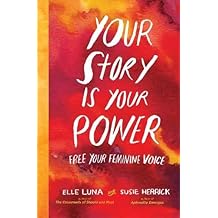
Your Story Is Your Power: Free Your Feminine VoiceMar 6, 2018 by Elle Luna and Susie Herrick Hardcover (Workman Publishing Company_

Your Story Is Your Power: Free Your Feminine Voice

How women can ‘activate their feminine power’ and become effective activists

In their book, “Your Story is Your Power,” authors Elle Luna and Susie Herrick recommend people discover more about themselves and the best role they can play in whichever battle they choose, before taking on an issue with no direction.

Every day it’s something. A tweet or a threat, a school shooting on the other side of the country, or a trio of women standing onstage at the Oscars, emboldened, still pissed, eyes aimed at the culture that ignited the #TimesUp movement.

You watch all this, a constant, slow burn in your gut, and want to do something with your anger and anxiety other than scrolling through, sharing stories and shaking your head.


But before you get out there with great intent and no direction, authors Elle Luna and Susie Herrick recommend you discover a little more about what you can bring to the conversation, the movement — to change.


In their new book, “Your Story is Your Power” — released today in honor of International Women’s Day later this week — Luna and Herrick seek to help women figure out where they come from, the experiences that motivate them to take action and the role they might play in whatever battle they choose: A Reformer? A Challenger? An Investigator?

The book — illustrated with Luna’s watercolors — seeks to help people “look at the story we tell ourselves,” Luna said. “Who we are and where we come from and how we can move forward. The collective change is the result of a lot of individual change, and our hope is to catalyze a lot more individual change.”

With its soft focus and motivational quotes from the likes of Nelson Mandela and the Dalai Lama, the book felt a little mystical to me, like if a doula wrote a book on automotive repair.


But the book packs a surprising punch. Through a series of prompts (“Name eight to 10 beliefs and traits that you inherited from your family”) and some psychological explainers, you start to understand your place in this feminine revolution.

It’s like marching orders tucked into a greeting card.

Herrick, a psychotherapist, and Luna, an artist, are holding events all over the country this month — San Francisco, South by Southwest — to help people “come together and tap into their feminine intelligence.”

They start by dismissing the cultural stories we have been told — Cinderella, Snow White: “Like any good science fiction story,” they write, “roughly half the human race is being manipulated.”

From there, they help people explore their family story and give them “a launchpad” to explore their personal story.

“Our goal is to inspire people at a time when there’s a lot of questions and a lot of fear.”

They hope to build on the power and strength of the #MeToo movement, Luna said: “We’re hoping to add our voices to the story of brave women’s voices coming forward fully.”

Writes Herrick: “The ultimate task is to find love for yourself so you can release your fears of the patriarchy. With this love, you recognize that you are the woman that you long to be. And when you reach your heart, you bring all of us with you.”

The authors conduct exercises that allow women to ask effective questions about their own journeys. How did their parents treat each other? What was each parent’s role? What roles do they play in their own families?

“There no right way to do it,” Luna said. “What we hope to do is give people the space and time to be with two people who have thought about this a great deal.”

This is the second book Herrick and Luna have worked on together. Last year, Herrick wrote a memoir called “Aphrodite Emerges,” about how she changed her strained relationships with the men in her life, starting with her father. Luna did the illustrations.

Not long after, Luna got a call from an editor at Workman Publishing in New York, asking them to write something that would build on the current women’s movement and hopefully impact the upcoming midterm elections.

“It’s beyond words,” Luna said of the actions women are taking to right institutional, cultural, sexual and gender-related wrongs.

“It is so long overdue,” she continued. “I’m 36 and it’s time. No matter how old you are, no matter if you’re a man or a woman, your race or what God you worship, it’s time for this shift to continue to ripple out.

“We want to be part of the choir of voices that says, ‘Enough. This has got to stop. And here’s what you can do.’ ”

Sunday, March 4, 2018

The Square and the Tower: Networks and Power, from the Freemasons to Facebook by Niall Ferguson Penguin Press, 563 pp., $30.00


The Square and the Tower claims to present “a new historical narrative, in which major changes—dating back to the Age of Discovery and the Reformation, if not earlier—can be understood, in essence, as disruptive challenges to established hierarchies by networks.” Social networks “have always been much more important in history than most historians, fixated as they have been on hierarchical organizations such as states, have allowed,” and never more so than in modern times. The first “networked era” followed the introduction of the printing press in Europe in the late fifteenth century. The second such era—our own—dates from the 1970s, and the pace of change has accelerated along with new communication technologies.

The intervening period, from the late 1790s until the late 1960s, saw the opposite trend: hierarchical institutions re-established their control and successfully shut down or co-opted networks. The zenith of hierarchically organized power was in fact the mid-twentieth century—the era of totalitarian regimes and total wars.

Today we live in “the network age.”

Niall Ferguson believes that until recently networks have been neglected by historians, who prefer to study institutions that leave well-preserved and accessible archives. He confesses that he has only recently come to appreciate that his own books “were also books about networks.” For many years the British-born financial historian, chronicler of the Rothschild banks, television broadcaster, and prolific journalist had been “casual” in the way he thought about networks. When writing about the career of Siegmund Warburg, he had in his mind’s eye “a vague diagram that connected Warburg to other members of the German-Jewish business elite through various ties of kinship, business and ‘elective affinity.’” Yet it did not occur to Ferguson to “think in a rigorous way about that network.” He had yet to adopt “formal network analysis.” This book, he writes, “is an attempt to atone for those sins of omission.”


Bibliothèque nationale de France
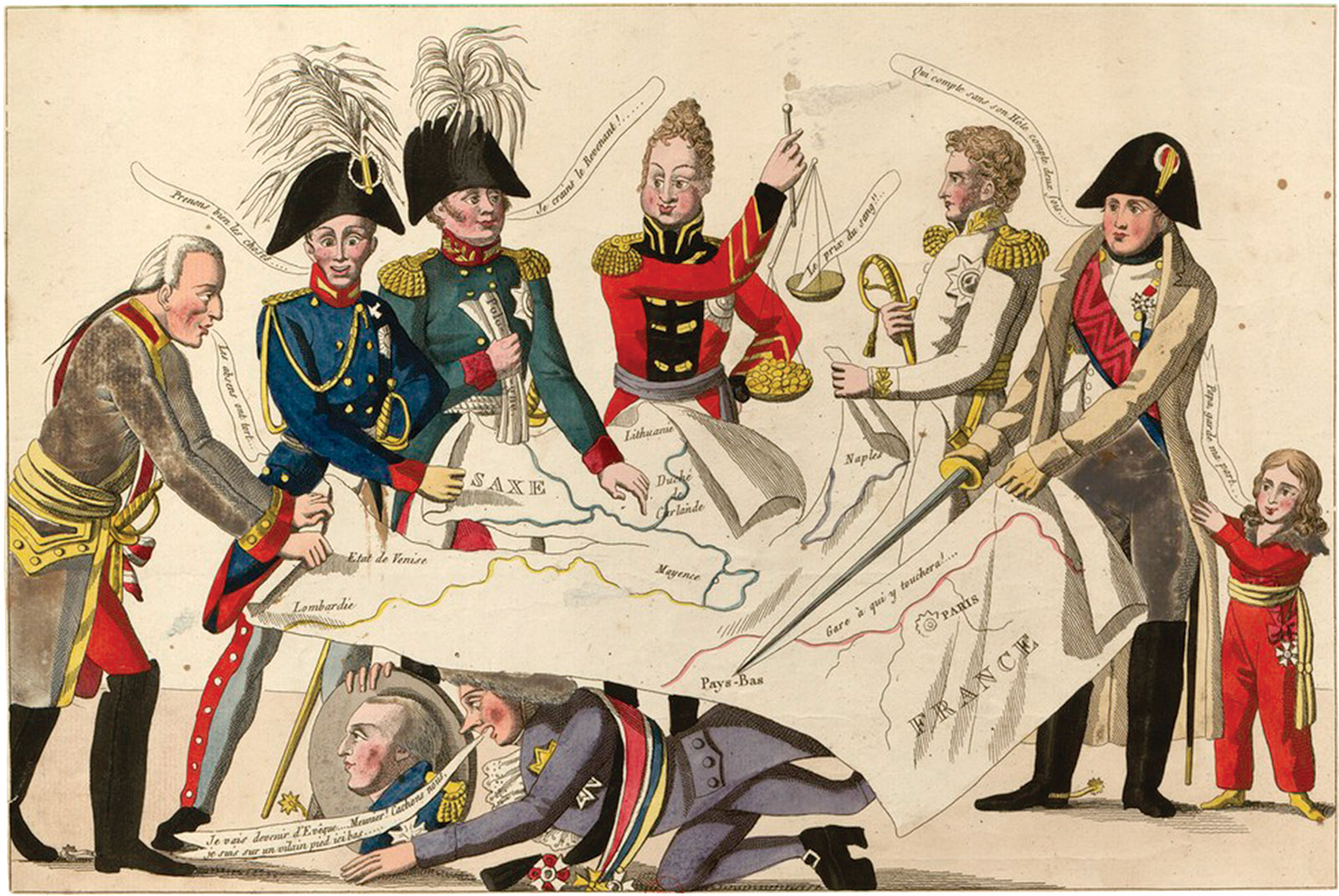
‘The Kings’ Cake, Cut at the Congress of Vienna,’ 1815; from Niall Ferguson’s The Square and the Tower, in which he argues that ‘the “cake of kings” could only be cut up with the help of the Rothschilds’ financial network’

If the study of networks enables a new kind of historical narrative to be written, one might suppose that human history is the chief area in which they operate. But when Ferguson attempts to spell out how they work, he begins with biology: “The animal circulatory, respiratory, renal, neural systems are all natural networks. So are plant vascular systems and the microtubial and mitochondrial networks inside cells…. From worms’ brains to food chains (or ‘food webs’), modern biology finds networks at all levels of life on earth.” A page later, he tells the reader:


Homo sapiens evolved as a cooperative ape, with a unique ability to network…. Indeed, our species should really be known as Homo dictyous (“network man”)…. Man, with his unrivalled neural network, was born to network.

Networks, it seems, are not only pervasive in the natural world but also quintessentially human.

These are large claims, but they are not new. Attempts to explain historical change in terms derived from biology recur throughout modern thought. The Victorian prophet of laissez-faire capitalism Herbert Spencer argued that the free market emerged through a process of evolutionary competition with other economic systems—a claim reiterated in the twentieth century by the Austrian-British economist F.A. Hayek. The early-twentieth-century British sociologist and Fabian Beatrice Webb (who worked as Spencer’s assistant for a time) believed that Soviet collectivism was the next phase in political evolution. Francis Fukuyama used to believe that countries throughout much of the world were evolving in the direction of Western democratic capitalism. The direction of the process may differ, but theories of social evolution form a major strand in modern thinking.

There are many problems with such theories. Darwinian evolution, a process operating through the natural selection of random mutations, has no analogue in history. The underlying unit of natural selection is the gene, a physical structure with definite and specifiable characteristics. No such unit has been identified in society. What exactly are Ferguson’s ubiquitous networks, whose pivotal part in human events he believes has been so badly neglected? Though the book’s central story concerns conflict between networks and hierarchies, he tells us they are not simply opposites: “This dichotomy between hierarchy and networks is an over-simplification.” Indeed, “far from being the opposite of a network, a hierarchy is just a special kind of network.” But if networks and hierarchies are not distinct types of social organization, how can we know how they interact and compete with each other? How can we tell the difference between them in any particular historical situation?

Ferguson never properly answers these questions. Instead he offers a mix of metaphor and what purports to be a new science. The square and the tower that give the book its title are the Torre del Mangia and the Piazza del Campo in Siena, which for six centuries have embodied two types of organization and power: vertical and horizontal. These forms of social organization are exemplified in corporate life today: “When employees from different firms meet for alcoholic refreshments after work, they move from the vertical tower of the corporation to the horizontal square of the social network.” But do employees make this radical transition when they go to the bar together? Or do they remain unequally constrained by the hierarchies of the organization? The metaphor of vertical and horizontal power cannot answer such questions.

Turning from business to politics, Ferguson faces similar difficulties when he discusses how the Bolshevik Party changed after it came to power in Russia: “The Bolsheviks turned their revolutionary network into a new hierarchical system, in many respects much harsher than the old Tsarist regime.” The suggestion is that before the revolution the Bolsheviks were a conspiratorial fraternity not unlike the late-eighteenth-century Bavarian Order of the Illuminati, one of several secret societies Ferguson discusses and to which he devotes the book’s first chapter: “No case better illustrates the historical significance of networks than that of the Illuminati.” But as he acknowledges, the Illuminati network was from the beginning structured on hierarchical lines. There were three grades of membership, and “the lower ranks were to be given only the vaguest insights into the Order’s goals and methods.” The Bolshevik Party was also founded and organized as a hierarchy, with Lenin and his closest comrades at the top. Were these “horizontal” or “vertical” organizations? Both at the same time? Or did they shift at some point from one to the other? A figure of speech cannot tell us.

It may be from an awareness of the limitations of metaphor that Ferguson invokes “network science” repeatedly in The Square and the Tower. The text is embellished with dozens of “network diagrams,” which illustrate “the foundational concepts of network theory,” the Medici network, the sexual network of the Bloomsbury Group circa 1925, the “ego networks” of Richard Nixon and Henry Kissinger, a “network design” of the Arpanet (the proto-version of the Internet), Donald Trump’s 2016 online network, and the Chinese Communist Party Central Committee members’ network, among others.

With the diagrams comes a technical jargon. The importance of individuals in a network can be measured with respect to three kinds of centrality: “degree centrality, betweenness centrality and closeness centrality,” measuring the number of relationships an individual has with others, “the extent to which information passes through a particular node,” and “the average number of ‘steps’ it takes for a node to reach all other nodes.” Using such diagrams, Ferguson suggests, we can better understand historical events. For example, when Protestants suffered persecution in England during the reign of Mary I, the execution of fourteen of the top twenty nodes did not destroy the network because figures with high “betweenness centrality” took over. He illustrates the effect in diagrams of the Protestant network immediately before and after the execution of one of its major “hubs” in July 1555.

Ferguson summarizes network theory in seven ideas: “No man is an island”—individuals can be understood in terms of the “nodes” or “edges” that connect them; “Birds of a feather flock together”—like attracts like; “Weak ties” are strong—a network can be resilient if it is connected with other networks, even if only through weak links; “Structure determines virality”—“some ideas go viral because of structural features of the network through which they spread”; “Networks never sleep”—they are not static but dynamic, and can evolve into complex adaptive systems with emergent properties; “Networks network”—when networks interact, the result may be innovation and invention; seventh and lastly, “The rich get richer. Because of preferential attachment, most social networks are profoundly inegalitarian.” “When we understand these core insights of network science,” Ferguson concludes, “the history of mankind looks quite different.”

Maybe it does. But can network theory explain why significant historical shifts happen? A case cited by Ferguson suggests otherwise. “In the history of networks,” he tells us, “few episodes are more instructive than that of the Cambridge Spies.” Chapter 39, “The Ring of Five,” begins with an expression of puzzlement: “So repulsive were both the totalitarian regimes—Hitler’s and Stalin’s—that it remains difficult to fathom why anyone living in a free society would have been attracted to either of them.”

In chapter 33, Ferguson discusses how members of the Cambridge Apostles, the exclusive “Conversazione Society” founded in 1820, “had become estranged from Victorian values both sexually and politically around 1900.” At Oxford, a network had formed around the imperialist ideas of the former high commissioner of South Africa Alfred Milner, which envisioned “a muscular, martial, imperial and heterosexual future.” Cambridge was quite different. After 1900, Ferguson tells us, “the network that evolved there in and around the Cambridge ‘Apostles’ was effete, pacifist, liberal and homosexual.” Prominent Apostles included Lytton Strachey, John Maynard Keynes, and E.M. Forster. Not all Apostles were gay or bisexual, “but a rising proportion were. And even those (like [Leonard] Woolf) who were not nevertheless subscribed to the somewhat solipsistic ideals of the gay ‘brothers.’”


\
Niall Ferguson, right, with Adrian Pennick at the International Emmy Awards, where their BBC series The Ascent of Money won best documentary, New York City, 2009

In 1939, Ferguson notes, Forster was writing that if he had to choose between betraying his country and betraying his friend, “I hope I should have the guts to betray my country…. Love and loyalty to an individual can run counter to the claims of a State. When they do—down with the State, say I.” By the outbreak of World War I, “a significant proportion of Apostles agreed with E.M. Forster’s position that friendship came before loyalty to King and Country.” A later generation “took this estrangement a step further: from conscientious objection to treason.” Among the Cambridge spies, Antony Blunt joined the Apostles in 1928 and sponsored Guy Burgess as a member four years later. “Both were academically brilliant. And both were gay…. However, the historically significant fact about Blunt and Burgess is that they were Communists who willingly offered their services to Stalin.”

Ferguson reiterates his sense of puzzlement: “Why did they do it?” He rejects as “naive” the idea that they were “all men of principle,…disillusioned by the policy of appeasement, who saw Stalin as the only credible counterweight to Hitler.” Many British spies working for the Soviet Union, he points out, were especially active during the period “when Hitler and Stalin were on the same side—and, of course, the other side from Great Britain.” What then could have motivated them to switch their loyalties from a functioning liberal democracy to one of its enemies, a murderous tyranny?

One reason may have been the appeal of communism as a secular religion, serving the same need to find meaning in history as monotheism had and demanding unthinking obedience from its believers—attractions that, according to Arthur Koestler, moved many intellectuals to convert to communism in interwar Europe. Or perhaps the explanation was more parochially British: most of the spies were members of an elite that realized British power was in decline and aimed to become part of the ruling class in what appeared to them to be the rising power—the Soviet Union. To my mind both accounts have some plausibility, but Ferguson does not discuss either of them. Unless the explanation lies in the “solipsistic” culture that grew up around the Apostles—an implausible view, given that most of the spies recruited in Britain by the Soviets in the period leading up to World War II were not Apostles or gay—he offers no reason for the treasonous behavior of a significant section of the British elite. Network theory seems silent on the subject.

In fact nothing in “network science” can tell us why historical agents—the Illuminati, the Bolsheviks, the Cambridge spies—acted as they did. The scientific credentials of network theory are highly questionable. Ferguson seems confident that


network science offers the best way of understanding why some ideas can spread very rapidly. Ideas…can be transmitted through a social network, not unlike a contagious virus. However, ideas (or “memes,” to use the evolutionist’s neologism) are generally less contagious than viruses.

But what are memes, and how are they “transmitted”? They are supposed to be units of meaning or information that compete in a process of natural selection analogous to that which operates on genes. Discussing Lenin’s rise to power, Ferguson reverts to metaphor again: “The Bolshevik virus travelled by train and telegraph.” Literate soldiers, workers, and sailors were most susceptible to “the Bolshevik plague,” succumbing quickly in the ensuing “epidemic.”

But memes are not observable physical structures like viruses. Is Romanticism a meme, or Christianity? Or the Gothic style in architecture? Like genes, viruses are identified by well-established scientific methods. Memes cannot be distinguished from one another by any objective properties. Like Ferguson’s horizontal and vertical modes of power, they are metaphorical devices. How networks and hierarchies are differentiated from each other depends more on the elasticity of language than on any facts of the matter.

In truth, network theory is not a theory at all. Theories that attempt to explain large-scale historical changes may be crude. Inasmuch as nationalism and religion have continued to act as autonomous forces in politics, Karl Marx’s historical materialism has not been borne out by events. Still, Marx’s account illuminated social conflicts, showing how political struggles are often rooted in economic divisions. If it failed as a general theory, it had at least the merit of being demonstrably false. “Network theory,” on the other hand, is much too nebulous to be either true or false.

The advantage of a discourse of networks, for Ferguson, is that it gives the impression that the story he tells has the authority of science. He takes the reader on a high-speed tour from the Third Dynasty of Ur in southern Mesopotamia circa 2100–2000 BC to the media-assisted political disruptions of the present time. Along the way he offers snapshots of many institutions and episodes, including the Holy Roman Empire, the emergence of modern banking along with the advent of Medici rule in Florence, the impact of the printing press on the spread of Lutheranism, Freemasonry in the French and American Revolutions, the restoration of European order after Napoleon, the significance of steam power and electrical cables in the British Empire, the Taiping rebellion in late-nineteenth-century China, the Arab revolt against the Ottomans in 1916, National Socialism as “a movement” that “can be said to have gone viral between 1930 and 1933,” the “brief encounter” of the British philosopher and historian of ideas Isaiah Berlin with the Russian poet Anna Akhmatova in Leningrad in 1945, “the transition to a more networked world” in the 1970s and “the triumph of Davos man” that supposedly ensued, and George Soros’s part in “breaking the Bank of England” in September 1992, together with vignettes of the use of networks in the September 11 attacks, the ascendancy of Facebook as a distance-conquering social network, the rise of ISIS, Brexit (which Ferguson describes as “a victory for a network—and network science—over the hierarchy of the British establishment”), and Trump’s electoral victory.

Not all of these vignettes serve any discernible purpose. What does an anecdote about Isaiah Berlin and Anna Akhmatova have to do with the book’s central narrative? Perhaps it serves to distract from the fact that Ferguson’s conflict between networks and hierarchies reiterates an old and familiar story. As set out by nineteenth-century writers such as T.B. Macaulay and W.E.H. Lecky, the Whig interpretation of history told the story of humankind as a march from ignorance and tyranny to enlightened liberty. Ferguson echoes this view when he writes:


For most of recorded history, hierarchies dominated networks in their scope and scale. Men and women were mostly organized into hierarchical structures, with power concentrated at the very top in the hands of a chief, lord, king or emperor. By contrast, the average individual’s network was stunted in its scale.

As we approach modern times, the human condition improves with the rise of the free market: “Friedrich Hayek was one of the first to rediscover Adam Smith’s old insight that the spontaneous order of the market was bound to be superior to ‘any that could have been achieved by deliberate organization.’”

It is an oft-told tale. But why should the reader accept it? Other accounts of the origins of market society are available, after all. The political economist Karl Polanyi presented an opposite view in The Great Transformation (1944),1 in which he described free markets as artifacts of state power, constructed by the ruling hierarchies of early Victorian England as a means of breaking up social networks that had been inherited from premodern times in order to promote laissez-faire capitalism. Inverting Ferguson’s account, Polanyi’s is in some ways more convincing. Ferguson does not mention it.

The Square and the Tower may be best read as a presentation of the Whig interpretation of history to an audience of hedge fund investors. Consisting of a series of historical snapshots thinly glossed with large ideas, the format of the book—sixty thumbnail chapters, interspersed with diagrams—is that of a PowerPoint presentation. This is not a study of history but another of the business books that have become familiar sights in airport newsstands in recent decades. While notably more erudite, The Square and The Tower belongs in the same genre as Malcolm Gladwell’s The Tipping Point (2000) and Thomas Friedman’s The World Is Flat (2005).2

Along with nearly all such books, Ferguson’s portrays the present time as one in which the creative energies of entrepreneurs have been unshackled from regulation by an overmighty state. To his credit, his version of this view is more nuanced than most. He cautions against underestimating “both the resilience of the old hierarchies and the vulnerabilities of the new networks—not to mention their capacity to fuse to form even newer power structures, with capabilities potentially greater even than those of the last century’s totalitarian states.” Yet throughout he represents networks, especially those of business, as being inherently more innovative and productive than any government can be. An interpretation of history well suited to triumphal gatherings in Swiss mountain resorts, it may also be one whose time has passed.

The last word on networks and hierarchies may belong to a figure not usually remembered for his intellectual acumen. Toward the end of his life, it has been reported, Stanley Baldwin (1867–1947)—former Conservative British prime minister, astute political operator, and pig breeder—was asked whether he had been influenced by any thinker or book. After a long pause, he replied, “Sir Henry Maine.” In his once-celebrated book Ancient Law (1861), Baldwin continued, the eminent Victorian jurist showed that history was a process of progressive development in which societies governed by status were gradually replaced by ones based on contract. Then Baldwin paused again, seemingly puzzled, and asked: “Or was it the other way around?”3


1

See Robert Kuttner, “The Man from Red Vienna,” The New York Review, December 21, 2017. ↩
2

I discussed Friedman’s book in “The World Is Round,” The New York Review, August 11, 2005. ↩
3

Roy Jenkins, Portraits and Miniatures: Selected Writings (Macmillan, 1993), p. 157. ↩

Thursday, December 14, 2017

We: Reviving Social Hope. Ronald Aronson. University of Chicago Press. 2017


On 4 November 2008, nearly a quarter of a million people flocked to Grant Park in Chicago to watch Barack Obama accept his victory in the presidential election. After more than two centuries of slavery and another 150 years of racial exclusion, many in the audience openly wept with joy at the sight of the first African-American US President. To a worldwide television and radio audience consisting of tens of millions, President-Elect Obama announced:


This is our moment. This is our time […] to reclaim the American Dream and reaffirm that fundamental truth – that while we breathe, we hope, and where we are met with cynicism and doubt, and those who tell us that we can’t, we will respond with that timeless creed that sums up the spirit of a people: Yes, We Can.

After generations of struggle, sacrifice and ‘The Audacity of Hope’ undertaken by countless Americans against ignorance, intolerance and the politics of division, Barack Obama took the presidential oath of office on 20 January 2009. Seven years later, voters in the United States elected Donald Trump – an anti-liberal populist. What explains the abrupt and radical political departure?

In We: Reviving Social Hope, Ronald Aronson utilises the writings of Jean-Paul Sartre (1905-80) to explain the rise of Trump as a consequence of the steep decline of participatory democracy in the United States and offers a blueprint to restore hope to a seemingly enervated body politic.

During the Second World War, Sartre – a Parisian savant – joined several anti-fascist organisations and revamped the concept of existentialism in both a philosophical tome (Being and Nothingness, 1943) and in an accomplished novel (The Age of Reason, 1945). For existentialists, ‘[Humankind] is condemned to be free’ (Sartre), and truly authentic individuals accept that they alone create and re-create meaning in their lives by making self-conscious value judgements and rejecting the fate and inevitability contained in both ideological systems (i.e. fascism and communism) and religious dogma. As Sartrean existentialism provided a formidable methodological tool to sweep away oppressive traditions, delegitimise expedient behaviour and challenge the power of elites, it appealed to coteries of intellectuals under Nazi occupation in France, the Netherlands and elsewhere in Europe.

Only a few paragraphs into the opening essay of this book, ‘Hope in Trouble’, Aronson immediately identifies the expansion of near-unbridled capitalism into the realm of culture as the most corrosive force debilitating the once vaunted idea of ‘the common good’ as expressed by Obama and other politicians. Instead of a nation bound by shared aspirations (i.e. widespread prosperity, equal rights for women and minorities, measures to combat climate change and reasonable restrictions on gun ownership, etc.), the United States, according to the author, has devolved into a disunited assemblage of self-absorbed, acquisitive and career-focused individuals due to the permeation of ‘market logic and metrics […] in government, education, culture, and the law’ (9).


As a result of this ‘privatization of hope’ – or the deterioration of hope in solving the problems of civil society by democratic means – the twenty-first-century temper of American life now pivots on a ‘crude, aggressive, and cynical’ form of individualism. Consequently, a wave of ‘seriality’ – a Sartrean term to describe apathy and disconnectedness among people – now reigns from New York City to Los Angeles (19, 22-23). Although many readers will challenge Aronson’s bleak assessment, the consistency and cogency of the core elements of his case deserve due consideration.

Over the course of the third, fourth and fifth chapters, Aronson also delivers a scathing critique of contemporary notions of ‘progress’ as being antithetical to human flourishing. Despite an impressive thirty-year increase in life expectancy (49 to 79 years from 1900-2016) and an unparallelled record of wealth creation from 1945-75 in the US, the author nevertheless attacks the modern idea of progress as a transmogrified, elitist-driven, capitalist enterprise bent on overdevelopment and maximising profits at the expense of both workers and the environment (80-81, 131-35).

Is Aronson correct? During the Great Recession (2008-12), the US middle class, which had already endured a 35-year drought in wage gains, contracted significantly. While the economy has rebounded to some degree, many workers, who still face working longer hours and paying higher premiums for health insurance than the previous generation, lack the financial means to purchase big ticket items (home and cars) or save for retirement. Partly as a result of corporate influence on politics, the richest one per cent now control ‘more than 20% of all U.S. income’, and the steady transfer of wealth from the middle classes to the upper classes since the 1980s has led to a surge in the numbers of working poor and impoverished. In respect to the environment, the decision of the Trump administration to withdraw from the Paris Climate Agreement in 2017 may prove to be a watershed moment in history. Due to the failure to rein in manufacturers from the excessive production of greenhouse gases and continued denial of the scientifically proven impact of human activity on climate change, warmer temperatures, declining sea levels, decreased crop production, less potable water and more episodes of extreme weather will invariably cause mass dislocations and global distress in the near and long-term future.

How and why, then, can individuals break their seriality and revive a sense of hope? In Chapter Two, ‘What Hope Is’, Aronson employs one of Sartre’s famous anecdotes from his later and somewhat controversial Critique of Dialectical Reason (1960). At a bus stop, commuters sit or stand in silence and remain in their private worlds. What would occur, however, if the bus failed to arrive after a considerable length of time? Most likely, a dialogue would begin among several (if not all) of the previously isolated individuals to determine whether to continue waiting or to locate other means of transportation. In defining hope as a collective group (or a ‘We’) resolving to alter the status quo for the betterment of all, Aronson squarely links hope to a leftist-progressive project to overcome socio-economic inequality through solidarity. Hence, Occupy Wall Street, the Arab Spring as well as campaigns for equal marriage and against sexual harassment all constitute genuine expressions of hope – as hope requires action for the ‘common good’ (48-59).

In Chapter Six, ‘We’, Aronson furthermore lauds the presidential campaign of Democratic Socialist Bernie Sanders as evidence of the resilience of hope. By mobilising the latent idealism of millions of young people around policies anchored in the ‘common good’ (i.e. universal health care, tuition-free college education and the public financing of elections to remove the corrupting influence of corporate donations), the progressive movement behind Senator Sanders stands as a potent, countervailing force to the ‘anti-hope’ political currents of ‘Trumpism’ (176).

If conservative and mainstream critics simply dismiss We: Reviving Social Hope as an outdated, leftist screed, their evaluation will be at least partly mistaken. Through an intellectually rigorous analysis, Aronson has contributed to our understanding of modern America by illuminating how social and economic cynicism generates disillusionment and seriality (passive silence) across the political spectrum. At the same time, his investigation yields tangible insights into the decline of empathy in the United States over the past few decades.

To create a more just and socially responsible country, it will be necessary for Americans to once again embrace the virtues of hope, civility, citizenship and persistence for the benefit of both the United States and the entire world. As such, We: Reviving Social Hope will hopefully be only one of a number of forthcoming critical monographs seeking to stir a robust debate on how America can rediscover its raison d’être as ‘We The People’ and re-establish ‘the common good’ as both a means to and an end of politics.

Sunday, November 26, 2017

Mythos: A Retelling of the Myths of Ancient Greece by Stephen Fry (Michael Joseph)

Product Details

Mythos review – the Greek myths get the Stephen Fry treatment.Fry’s retellings have stiff competition, are limited in selection and sometimes appear to be set in North London. But they have real charm. Engaging, fluent prose .People who enjoy Fry's media personality and particular style of post-Wodehouse English drollery are in for a treat

Ever since William Godwin persuaded Charles Lamb to retell The Odyssey as a novel for younger readers in The Adventures of Ulysses (1808), the myths of ancient Greece have been retold in contemporary prose by every generation. Most of these retellings were originally poetry – the epics of Hesiod, Homer and the philhellene Latin poet Ovid, the Athenian tragedies of Aeschylus, Sophocles and Euripides – in Mythos, Stephen Fry has narrated a selection of them in engaging and fluent prose. But do we need another version of the Greek myths in an already crowded market? Such treasured collections as Nathaniel Hawthorne’s Tanglewood Tales (1853), Edith Hamilton’s Mythology: Timeless Tales of Gods and Heroes (1942) and Robert Graves’s The Greek Myths (1955) are still in print. Countless family car journeys are enlivened by Simon Russell Beale’s audiobook of Atticus the Storyteller’s 100 Greek Myths. So should a reader looking for an initiation into the thrilling world of the ancient Greek imagination choose Fry’s book?

One reason to do so is that Fry is unusually sensitive to the contemporary resonance in myths about gay gods and heroes and the transgender Hermaphroditus. But his subtitle “The Greek Myths Retold” is misleading; it implies a certain comprehensiveness. In fact he has selected a rather small group of stories. They derive mostly from Hesiod’s Theogony (the birth of the gods and the creation of the first few generations of humans), Apuleius’s Latin novel The Golden Ass (Cupid and Psyche), and Ovid’s Metamorphoses (Arachne, Midas, Echo and Narcissus). Disappointment awaits readers expecting the myth cycles centring on Troy and Odysseus, Agamemnon and Clytemnestra, Jason, Medea and the Argonauts, Heracles’ labours, Theseus and the Minotaur, Perseus and Andromeda or the Theban royal house of Oedipus and Antigone. Fry’s collection is the equivalent of a book advertising itself as retelling “the stories from Shakespeare” that leaves out Hamlet, Othello, Lear, Julius Caesar, Romeo, Juliet and Henry V. Since there is no contents page, nor even an index, the eccentricity of his choice of myths would not be immediately apparent to a shopper browsing in a bookstore.

Yet Fry’s ear is finely tuned to the quaint tonality of some of his ancient sources. This is best revealed in his retelling of two Homeric Hymns, to Demeter and Hermes. They deal respectively with the abduction of teenage Persephone and the theft by the newborn Hermes of his big brother Apollo’s cattle. Fry’s distinctive voice undoubtedly adds something lively, humorous and intimate to myth’s psychological dimension. People who enjoy his media personality and particular style of post‑Wodehouse English drollery are in for a treat. He tells us that he imagines Hera, queen of the gods, “hurling china ornaments at feckless minions”. Ares, god of war, “was unintelligent of course, monumentally dense”. Baby Hermes tells Maia: “Get on with your spinning or knitting or whatever it is, there’s a good mother.” Epaphus, child of Zeus and Io, “was always so maddeningly blasé about his pedigree”.

Dialogue is Fry’s great strength, his wit demonstrated in the episode he has invented where an infant Artemis cajoles her “daddy” Zeus into promising her a whole series of presents. This enables Fry to explain her divine attributes: a bow and arrows, a short practical tunic, hunting dogs, choirs of maidens, protection from men and, of course, the moon. Fry’s gods and heroes exchange banter in an endearing style resembling his own posh but colloquial metropolitan argot. Indeed, despite his excellent knowledge of the topography of Greece, especially the Olympus mountains, that informs the narrative, the episodes themselves often feel as if they are set in north London: Cadmus and Harmonia, who Fry tells us today might be called an “iconic power couple”, watch the lethal combat between the Thebans sown from the dragon’s teeth “like a frantic parent on the touchline watching their son being squashed in a scrum”.

Sometimes the charm of Fry’s rather domesticated mythical world comes at a price. He tells stories about love and children and animal metamorphosis with grace, but is less successful dealing with grand elemental or heroic themes such as the emergence of the universe from cosmic chaos, or the philanthropy, heroism and terrible punishment of Prometheus. He tends to play down the horror of the primal power struggles and violence in his sources: Kronos has “an unkind habit of eating anyone prophesied to conquer him”. Perhaps this explains why Fry has kept away from the legends of quest, war, politics and kin-murder that are the stuff of the major mythical cycles.

This leaves the question as to the intended audience. Fry insists eloquently in his foreword that the dazzling Greek myths are for everyone and require no traditional classical education whatsoever. He has a touching mission to inform the public about some relatively arcane issues of classical scholarship: as might be expected in a celebrity who has chaired television quiz shows on etymology and quirky facts, he often explains the meaning of Greek or Latin terms, or appends learned footnotes that provide historical or cultural details to illuminate the meaning of a myth. But he also reveals that he was introduced to them as a child, so does he see children as his primary audience? If so, although the book reproduces 34 famous illustrations of myths from classical art and old masters, he has to compete with some exquisite illustrated children’s versions, notably Marcia Williams’s evergreen Greek Myths (1991), my own children’s runaway favourite. But I have already heard from schoolteachers at both primary and secondary level that the accompanying audiobook, in which he reads his versions himself, is going down well in the classroom. This applies especially to the Ovidian tales in the second half of the collection. Despite my reservation about the book’s limited coverage of the teeming world of Greek mythology, it is commendable to see the well-loved Fry put his fame to such constructive use.

.

Sunday, October 29, 2017

Racial Realignment: The Transformation of American Liberalism, 1932–1965 by Eric Schickler Princeton University Press, 2016, 384 pp. ; Forging Rivals: Race, Class, Law, and the Collapse of Postwar Liberalism by Reuel Schiller Cambridge University Press, 2015, 355 pp.


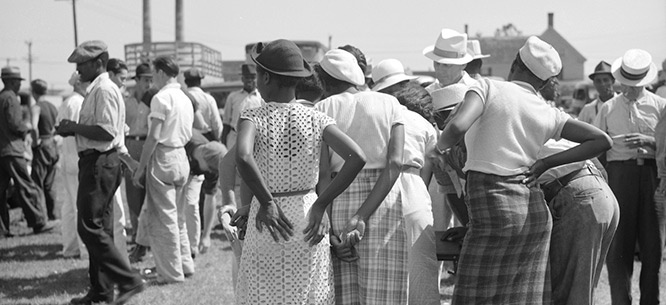
Women workers participate in an interracial strike at the Phillips Packing plant, Cambridge, Maryland, June 1937. The strike was covertly organized by CIO members (Washington Area Spark)

The Rise and Fall of the New Deal Order—memorialized in the classic anthology of that title edited by Gary Gerstle and Steve Fraser in 1989—might be history, but it never gets old. Eighty-plus years after FDR was inaugurated, the New Deal still excites the liberal left imagination even as it, perhaps, stunts it, too. How we got from Roosevelt to Reagan continues to generate conflicting arguments from those who think the New Deal was the “great exception” to American individualism and federalism unlikely to be repeated (Jefferson Cowie); a reluctant capitulation to the white supremacist South which was the best it could do (Ira Katznelson); or, an honorable surrender following the desperate rearguard fight by workers and farmers against the consolidation of corporate capitalism in the late-nineteenth and early-twentieth centuries (Steve Fraser).

Two recent books about the New Deal order, one by political scientist Eric Schickler and the other by legal historian Reuel Schiller, complement each other in their attention to the relationship between unions and the movement for African-American civil rights. But while Schickler writes a story of liberal ascension, driven largely by the Congress of Industrial Organizations (CIO), stopping in 1965 after the monumental legislation of the civil rights era, Schiller chronicles a liberal declension, ending with deindustrialization in the 1970s and tension between labor and civil rights activists. Both books end at roughly the same historical moment. Schickler sees in it labor liberalism’s triumph—the CIO and then the civil rights movement pushing to bring racial justice into the mainstream of the Democratic Party. Schiller, on the other hand, sees the labor movement and those fighting racial injustice, despite their many efforts to work together, as chained to separate legal protocols, doomed to “[talk] past each other.” To paraphrase Bob Dylan, for Schickler, labor liberalism is busy being born at the same time, according to Schiller, it is busy dying.

Schickler’s primary goal is to undermine the dominant narrative about American party realignment that fused African Americans to the Democrats and Southern whites to the GOP: that it took place in the 1960s, following the Goldwater nomination of 1964 and the passage of the Civil Rights Act that year and the Voting Rights Act in 1965. Taking a shot at Ira Katznelson’s influential recent book, Fear Itself: The New Deal and the Origins of Our Time (2013), Schickler insists that “important actors within the Democratic Party were working to undermine the supposed ‘bargain’ between Northern liberals and Southern racists starting in the late 1930s.” In turn, Northern Republicans began to work with those same Southern racists to oppose the racially liberal labor federation, the CIO, and any relationships it might have with civil rights supporters.

Schickler makes two important points. First, at the time of FDR’s inauguration in 1933, Democratic Party liberalism had no anti-racist component (nor did the Republican party, which had been coasting, for many years, on its Reconstruction–era reputation as the “party of Lincoln” without actually supporting policies that would appeal to Northern blacks.) Liberalism was viewed as an economic program of federal assistance to states and localities, and as support for a then slumbering labor movement and impoverished farmers. White liberals attached themselves to business-friendly conservative Democrats like party chairman Jacob Raskob, and, alas, for the last decade or so of his life, former New York governor Al Smith, who worried about increasing the size and influence of the federal government. Second, and central to his theory of causation, is that, even as FDR and other Northern Democrats made compromises on opposing racism to keep the Southern bloc within the New Deal coalition, the CIO played the most important role in shifting the rhetorical meaning of American liberalism to include opposition to racial discrimination. In fact, Schickler argues, it created a movement within the Democratic Party for interracial labor liberalism that percolated upward from the state and local level to finally reach the more cautious leaders of the national party. This movement sustained itself through the civil rights movement and, ultimately, compelled President Johnson and other national party elites to unconditionally embrace the movement for African-American equality and use the power of the federal government to crush Southern apartheid.

The fact that the CIO was a mass organization with mostly white leaders and members provided black activists with an opportunity they had never had before, an institutional lever with which to pry open the doors of the country’s elite white establishment. Schickler argues that the CIO’s motivations were both pragmatically self-interested and ideologically ambitious: it recognized the need to appeal to black workers if it were to succeed in organizing the great industrial and mining sectors of the economy—steel, auto, rubber, dockworkers, coal miners. But the organization, influenced significantly by a cadre of staff and organizers who were members or sympathizers with the Communist Party, also had an expansive ideological vision of industrial democracy and social justice, based upon unifying the working class across racial, ethnic, regional, and skill lines.

Schickler understands that the CIO’s white rank and file was often racist when dealing with its black coworkers. But he asserts that, in contrast with the AFL’s long record of racial discrimination, the leadership of the new federation pushed the organization and the Democratic Party to support civil rights, despite the often antagonistic actions of its own membership toward black union members. In short, the CIO supported the civil and labor rights of black Americans with greater certainty outside of their own workplaces and locals. The CIO financially supported liberal candidates who raised civil rights issues, insisted that labor rights and black civil rights were linked, and supported fair employment and other policies that would benefit African Americans. Its institutional weight amplified the influence of anti-racist liberal and leftist intellectuals. As a result, the Northern Democratic Party, argues Schickler, dominated by the CIO, urban liberals, Jews, and blacks was to the left of the rest of both political parties and the rest of the country as early as the 1940s. These actions and events helped pave the way for the great civil rights victories of the 1960s.

Schickler does a monumental job reconstructing sometimes primitive survey data from Gallup and other polling organizations during the late 1930s that demonstrates that white Democrats in the North, while often still racist in their attitudes, were far less so than Northern Republicans, let alone white Southerners, in their support for anti-racist policies, such as anti-lynching legislation and opposition to the poll tax. Thus, prodded by the CIO and the nascent black civil rights movement in the North, local and state politicians and party officials pushed hard for equality (the 1948 civil rights plank of the Democratic Party is a salient, but not the only example), long before national party elites like LBJ and Adlai Stevenson, who feared the loss of the white Southern bloc.

The Republican Party also had a longer-running evolution that began well before the decisive conflict between Johnson and Goldwater in 1964. It too begins in the late 1930s and is linked to the rise of the industrial labor movement. Southern members of Congress, who had enthusiastically supported the New Deal in its early years, excited by the infusion of federal dollars to their impoverished states, turned sharply against it when the combination of an emboldened unionism and an emerging civil rights movement threatened the labor markets and cultural hegemony of the white supremacist South. Southern congressional reactionaries, enraged by the CIO, launched investigations of the NLRB (with, it must be said, help from leaders of the rival AFL) and opposed the pre-war efforts to extend the New Deal. At the same time, some Republican pols imagined a formal connection between the white conservative Democratic South and the white conservative Republican Midwest as a better electoral calculation than pretending to care about the Northern urban black vote. (Of course, the Southern black vote barely existed at this point.) Eisenhower, who makes his peace with large sections of the New Deal, takes a somewhat different tack, hoping to connect with middle-class white Southern voters without resorting to outright racism. There continued to be something of a debate within the party as to whether to seek to retain a good part of the black vote in the North (and the GOP did keep about one-third of the black vote through the election of 1960, after first losing 70 percent of it to the Democrats in 1936).

Here, Schickler makes a mistake in emphasis. He insists that because “most African Americans had clearly realigned to the Democrats by the late 1940s” that the conflict between the parties for the black vote was over long before the Goldwater opposition to the Civil Rights Act. But still contesting for “most” black votes, as Democrats did during the 1940s and 1950s when the Republicans were still getting as much as a third of the black vote, is much different than the near certainty, post–1964, of Democrats getting more than 85 percent of the black vote and not needing to worry that the GOP would mount even a minimal effort to win black support. So, in this sense, the sixties really were a decisive break—the Party of Lincoln simply conceded the black vote to Democrats thereafter.

Both party trends converge in the sixties and LBJ is indeed pushed by the civil rights movement to achieve its great legislative triumphs. And the white South does, over time, move to the Republicans. Schickler makes a real contribution by underscoring how blasé New Deal and postwar Republican politicians were about their linkage to the Great Emancipator. Basically, smart Republican politicians saw twenty-five years before Goldwater’s nomination that the votes for a reactionary program of limited federal intervention in the operation of businesses could be linked to the desire of white Southerners to have limited federal intervention in their segregated sub-nation. And thus the racial ideology of the modern GOP, like the modern Democratic Party, can be traced to the New Deal era.

Racial Realignment is a genuinely illuminating book. The support of the CIO’s leadership for racial equality is well known, but Schickler deliberately emphasizes its institutional and policy impact, rather than the racism that pervaded its white rank and file. CIO leaders, across a broad ideological spectrum, might not have been able to prevent shop floor “hate strikes,” but they were able, out of pragmatic necessity and genuine moral and ideological conviction, to forcefully advance a vision of liberalism that fought the Southern racists and prodded the cautious national leadership of the Democratic Party toward the cause of racial justice. Then, prodded yet more by the civil rights movement in the sixties, that vision ultimately and decisively transformed the party. By then, the leftist remnants of the original CIO continued to support black civil rights, while the more reactionary AFL-derived section of labor, too often opposed or feared it.

Sometimes, however, Schickler elides developments that would have buttressed his main argument. For example, he rightly discusses the growing strength of the civil rights movement during the Second World War, noting the executive order FDR signed in 1941, under pressure from A. Philip Randolph, to create the Fair Employment Practices Committee (FEPC) and prevent discrimination in the defense industry. But, despite his argument that the CIO was of critical importance to civil rights activism, he fails to mention the UAW’s critical role in getting the order signed. And while emphasizing the importance of the CIO PAC, the first committee to ever raise money to elect political candidates and founded during the war, Schickler ignores the fundamental reason the CIO had the political influence it did: its growing membership in the core manufacturing industries. There is not even a perfunctory stipulation in Racial Realignment about the unique conditions of the wartime political economy that allowed the federal government to leverage companies to recognize union rights in return for workers keeping production running around the clock. CIO membership more than doubled and overall union membership went up 50 percent during the war. African-American workers in the defense industry more than tripled in number, and, while the more conservative, craft-dominated AFL remained larger than the CIO, it was the CIO that advanced the rights of these black workers within the most critical industries of midcentury America.

And then there’s 1946, one of the most portentous years for American labor in the twentieth century—over 14 percent of workers struck in 4,985 work stoppages, which ultimately contributed to the defeat of the Democrats in the midterm elections (particularly left-leaning candidates supported by the CIO). Schickler somehow manages to index an “Operation Dixie” which is not the Operation Dixie, the great failed CIO effort that also began in 1946 to organize both blacks and whites in the South. Instead, he references a mostly failed plan of Eisenhower’s to seed the GOP with moderate middle-class white Southerners. (Ike’s program was effectively taken over by conservative Republicans who, instead, recruited white racists to the GOP.) The omission of the highly touted Operation Dixie is significant because Schickler’s argument is premised on the white Southern elites’ fear of labor and civil rights activists joining forces to break apart its control of the Southern labor market. The CIO pulled its punches and avoided organizing black workers or activating its militant communist-led affiliates. Yet Operation Dixie was, nevertheless, seen by white supremacists as a direct assault on their low-wage system and they ruthlessly red- and race-baited it to death. In 1947, Republicans and Southern Democrats further circumscribed postwar labor by passing the Taft-Hartley Act.

The CIO’s wartime growth—driven by a unique set of conditions never again to be repeated—gave it the necessary political, economic, and cultural authority to promote the cause of black civil rights. And by not grappling with the powerful backlash by the GOP and Southern Democrats to the CIO’s ascent, Schickler ignores some of the conditions that led to the decline of the labor movement, without which the Democratic Party would find it difficult to sustain a multiracial liberalism. Schickler knows how important the CIO was to the cause of racial justice—that’s his central point—but he doesn’t seem interested in why it became so influential and then why it, and the AFL, declined as much as they did. In his telling, labor is like a bee—it stings the Democratic Party on behalf of black Americans, and then it dies.

In Forging Rivals, Reuel Schiller covers some of the same ground as Schickler. They write almost identical sentences regarding the inclusion of racial justice into the meaning of liberalism by the beginning of the Truman administration. They both emphasize the crucial battle, during the 1940s, over the survival of the Committee on Fair Employment Practice (FEPC), a weak effort to fight job discrimination, yet one that Republicans and conservative Southern Dems saw as a threat to both business interests and segregated labor markets. Both authors understand that the CIO had a “bifurcated position on civil rights,” as Schiller puts it—supportive in the political arena, but ambivalent within unions themselves. And they often rely upon the same secondary sources.

But Schiller sets out to answer a different question than Schickler. Schickler wants to know when the split that connected African Americans to the Democratic Party and the white South to the Republican Party originated, and how it evolved. Schiller wants to know why the black civil rights movement and the labor movement—often allies—gradually split apart following the war, and thus were unable to sustain an interracial, liberal, labor movement.

To answer the question of why unions and black civil rights activists came into conflict, Schiller employs a case study of the San Francisco Bay Area’s labor and civil rights movements, from the Second World War through the sixties. This is a shrewd methodological move. Rather than depict a more fraught racial and class dynamic in a Southern city or in the smokestack urban areas of the Midwest or the East, Schiller picks an area of presumed leftist and labor strength, but also interracial cooperation and urban cosmopolitanism. He demonstrates that, over a roughly thirty-year period, the burgeoning movement for black civil rights and even the most supportive unions (meaning: not just the well known structural and episodic racism in the building trades) grew further apart.

Schiller first describes a fictional vignette from the novelist Chester Himes, in which, a black shipyard worker named Jones, fired after confronting a racist colleague, tries to get help from his union. But the union’s grievance process can do little to help Jones, and his shop steward labels his situation a “private gripe.” The union’s procedures were not designed to defend a particular black worker from racist treatment, but rather, to defend workers from general management abuse. From there he narrates several fascinating episodes, moving from racially tense workplaces and union halls to the San Francisco City Council and federal and state courtrooms. Black workers would raise challenges to companies and unions, not as workers primarily with a job grievance, but as black people with a claim of racial discrimination. Civil rights activists obviously did not see a union shop to their advantage in California if the black workers could be arbitrarily fired anyway, and were ambivalent about defeating a right-to-work referendum in 1958. And California’s white union workers in 1964 voted overwhelmingly to repeal a weak housing discrimination law.

Schiller views the relationship between African-American civil rights and the labor movement through the prism of the juridical system. The postwar system of “industrial pluralism” sought to create “mini-democracies,” as Schiller says, in each unionized workplace. This necessitated an unconditional emphasis on “majoritarianism”—that the union would act on behalf of all workers—and an expectation that unions and companies would work out their problems without the interference of the state.

Industrial pluralism was a plausible framework for a then-powerful labor movement to adopt. The logic was to limit government interference in the affairs of unions. For over a century, the state and the courts blocked strikes, fined unions, arrested workers, and, when necessary, killed them. Top union strategists, like the CIO general counsel and future Supreme Court justice, Arthur Goldberg, figured that unions were better off having a minimally refereed arm wrestle with even the largest companies. Thus, as Schiller observes, in the famous 1960 “Steelworker’s trilogy” Supreme Court cases, for example, Justice Douglas, writing for the majority in each case, held that unions had a right, grounded in the unique culture of each workplace, to have disagreements with the company resolved by arbitrators chosen by the parties. Federal courts needn’t intervene to further adjudicate the underlying merits of the dispute.

Ultimately in 1974, the last episode Schiller recounts is of a court challenge from black department-store workers to the exclusive right of a union to bargain with an employer on behalf of all of its members. Schiller points out that in the Emporium Capwell case, Thurgood Marshall upheld the principles of industrial pluralism against the black plaintiffs. Marshall, Schiller observes, believed in a “liberal integrationist vision of the struggle for African American equality, in which black workers would achieve equality by embracing industrial pluralism.”

But there were two problems with industrial pluralism. The first was that the world did not stop in 1960, the apex of union power in the United States. As union density declined, the economy globalized, and growth in productivity decreased employment in union-dominated manufacturing and mining sectors, labor grew too weak to win those arm wrestles with corporate America. It turned out that unions needed the state and the courts to tilt the class struggle its way if they were to have any hope of sustaining their power. The second problem is the crux of Schiller’s book: industrial unionism depended upon, “unalloyed majoritarianism.” The union must have functional and legal precedent over the demands of any given worker or even a significant cohort of workers. Exclusive representation by one union means that, even if a large minority of members wishes to negotiate with the company themselves, they (and the company) must defer to their certified collective bargaining agent, the union. Similarly with the principle of seniority—less experienced workers cannot carve out their own deal with the company—“last hired, first fired” applies to every member because a majority has already agreed to a contract with those stipulations.

Schiller argues that conflict within postwar liberalism between the labor movement and the movement for full, unconditional black citizenship was “built into the structure of the law as it developed in the postwar period.” Industrial pluralism was directed against management adversaries, but, in order for black workers to be equal to their white peers, these workers and their advocates would have to contest and, to some extent, undermine the inflexible majoritarianism of labor. And black workers needed the state and its courts to redraw the rules of collective bargaining—the very state that unions most wished to keep out of their affairs and their relationship with management.

This is a brilliant, airtight synthesis that expresses the entire rise and fall of postwar liberalism through legal fights between unions and civil rights activists in California over several decades. The complicated dance of support and antagonism he depicts between the then large, yet still fragile, labor movement and the nascent black emancipation movement grew increasingly hostile. The legal order, first, undercut anti-discrimination efforts on behalf of black workers, and then later, union majoritarianism.

Schiller’s argument, however, is a bit too airtight: it doesn’t allow for the historical contingency of subsequent developments. After his chronology ends with the Emporium Capwell case in 1974, Schiller wraps up the book by reiterating that the conflict between labor and civil rights brought down postwar liberalism. Reading this, you might think that unions and African Americans, both leadership and rank and file, have had an increasingly hostile relationship from that time up to the present day.

But this isn’t true. Unions and black workers are closer than they have ever been. And unions are, if anything, less ambivalent bulwarks against racism than they were in the immediate postwar period. The AFL-CIO and African-American organizations and politicians work together and, for better or for worse, agree on pretty much every policy issue. Even the building trades, pushed for years by the courts and civil rights activists, have responded by opening up their apprenticeship and training programs to women and minorities. Today, there is a higher percentage of black workers who are union members than there are white workers. Ask any organizer of any color and they will tell you that they stand a better chance of organizing non-white workers, blacks especially, than white workers. And the most successful labor campaign in recent years, the SEIU-led Fight for $15, seeks to organize fast-food workers who are disproportionately non-white. Like the CIO when seeking to organize the industrial sector during the thirties and forties, SEIU today has both pragmatic and ideological reasons to organize workers of color in the growing low-wage service sector. Similarly, service-sector unions have built powerful alliances in California and Nevada with Latinos. As for white unionized workers, despite all of the stories about how pissed off they are at neoliberal Democrats and how they were attracted to Donald Trump’s trade message, the fact remains that white men in unions have still voted for Democrats at a rate of about 20 percent higher than their non-union counterparts. (This pattern likely did not hold this year. Exit polls from the 2016 election indicate that Clinton carried the union vote by 51–43, the lowest margin for a Democrat since 1984.)

So, while Schiller’s expertly depicted legal conflict seems ineluctable, in fact there is more solidarity between unions and African Americans today than there was a half century ago. He insists that the “weak and unstable foundation” of postwar liberalism provided little to “fleeing working-class whites in a time of economic crisis.” But how could a labor movement, grounded in industrial pluralism, win against management as its numbers declined? Conversely, how could this same declining movement succeed in petitioning the state for compensatory protections precisely at the moment when its political impact, along with its membership, grew smaller?

The dueling visions of the law—majoritarian, anti-statist industrial pluralism versus state-assisted redress of individual claims of racial discrimination—as Schiller demonstrates, generated a lot of conflict between unions and civil rights activists. But this conflict didn’t end the labor liberalism driven by the CIO and a few of the AFL unions. The collapse of employment in the key postwar industries and the subsequent decline in union membership is what badly wounded this iteration of labor liberalism. This undermined the Democratic Party’s desire to promulgate full employment and a redistributive economic policy, which meant that the party had an ascendant and growing African-American voting bloc, which simultaneously alarmed white workers at precisely the moment when their economic clout and the unions that provided it were waning.

So the new labor liberalism, built with the support of proportionally more non-white workers (and women), is more progressive than the old pre–civil rights era labor liberalism. If it achieves its powerful new vision, it will be a more humane, cosmopolitan, and egalitarian movement than its predecessor. But as of now, it is a significantly smaller movement and lacks economic and political leverage in key sectors of the political economy. The Fight for $15, however innovative and promising, doesn’t remotely compare to the great CIO victories of the late 1930s and ’40s in terms of its impact on workers, both white and non-white. The unique conditions that engendered labor’s massive growth during this period, barely commented upon by either author, does not necessarily provide a template for contemporary organizing.

As these two sharply argued books demonstrate, postwar liberalism hinged upon how and whether unions maximized and used their power. The books together form an odd complementarity: even as a powerful union movement promoted the cause of equality for African Americans (Schickler), union and civil rights activists began splitting apart from each other (Schiller). Meanwhile, modern conservatism merged its opposition to both worker empowerment and cosmopolitan racial equality, embodied in the figure of Barry Goldwater, the opponent of the 1964 Civil Rights Act who (as neither book notes) also despised and sought to curtail the embodiment of CIO power, Walter Reuther, and the flagship institution of American liberalism that he led, the UAW.

Today, multiracial political activism has returned to the left, but without the support of anything like the economically and politically weighty labor movement of the postwar era. The New Deal order cannot be resurrected. The working class is split along racial, regional, and cultural lines and, by most measures, a significant part of it (even slightly more non-white workers than expected) voted for an authoritarian, racist, misogynist grifter in the last election. Schickler, on the last page of his book, with more hope than evidence, asserts that demographic changes to a “majority-minority” population may in themselves put pressure on Democratic Party elites in the way that the labor and civil rights movements once did. More valuable is his concluding remark regarding the necessity for progressive groups to see themselves not as “isolated claimants on the party system but instead as part of a broader ideological coalition with common aims and shared enemies.” The only good news that resulted from this election is that the need for “shared enemies” has been filled.