Showing posts with label #CameosFrom Zion. Show all posts

Tuesday, May 16, 2017

Where's Waldo Series in the USA ? Where's Walley series in the UK by Martin Handford Where's Waldo? The Totally Essential Travel CollectionMay 16, 2017 by Martin Handford Paperback;Where's Wally? At Sea: Activity Book Sep 1, 2016 by Martin Handford Paperback;Where's Wally? The Totally Essential Travel CollectionJun 1, 2017 by Martin Handford;Where's Wally? In Outer Space: Activity BookJun 2, 2016 by Martin Handford Paperback;Where's Wally? The Colouring BookMar 3, 2016 by Martin Handford Paperback;Where's Wally? The Colouring Collection May 4, 2017 by Martin Handford Paperback;;Where's Waldo Now?Apr 10, 2007 by Martin Handford PaperbackWhere's Waldo? In HollywoodApr 10, 2007 by Martin Handford;;Where's Waldo? The Incredible Paper ChaseFeb 8, 2011 by Martin Handford; Where's Waldo? The Search for the Lost ThingsFeb 14, 2012 by Martin Handford (Candlewick Press and Walker Books) (#IBRChildrensBooks)


When I moved to London for a while , I got  used to things being just a bit different: Sure, there's the whole accent thing and the driving on the other side of the road and the insertion of u's where they hadn't been before, but I mean the much more subtle differences "“ like Waldo.

With his trademark red-and-white striped shirt, his knit cap topped with a pom-pom, glasses and walking stick, Waldo has wended his way through virtually every country on every continent, through time and space and imagination, the sets of Hollywood movies and the pages of beloved books.

And Where's Waldo? you ask? Everywhere. His books have sold more than 50 million copies worldwide and have been translated into over 25 languages, and as a character, Waldo has become an icon, appearing on TV shows such as The Simpsons, Friends and Frasier. Waldo even made it onto the cover of Rolling Stone.

But here in the UK, Waldo is Wally.

And, shockingly enough, Waldo was actually Wally first "“ and he's British. Wally was the brainchild of Martin Handford, an illustrator born in the Greater London neighborhood of Hampstead. Handford said that growing up, his earliest influences were large-scale cinema epics, the kinds of movies with large crowd scenes, which he would then try to recreate with pen and paper.


Already a known illustrator who specialized in crowd scenes, Handford was asked to put together a book of his work "“ and voila! Wally was born, a visual tie-in that kept continuity from scene to scene.

Eventually, after publishers bought the book, Wally evolved into the bespectacled bumbling traveler we now know: In a typical book, Wally/Waldo carries his trademark walking stick, in addition to 11 other items that are designed to help him on his travels: kettle, mallet, cup, backpack, sleeping bag, binoculars, camera, snorkel, belt, bag and a shovel. Waldo, however, isn't particularly good at keeping track of his items and so, on each page, he loses one, requiring the reader to help him find it. To find him and his lost item, readers are tasked with visually sorting through vast scenes, often rife with visual puns and humor (sometimes a bit risqué humor at that).

The book series launched in 1987 in the UK, with Wally as its titular character; later that same year, the series was launched in the US, where Wally was introduced as Waldo. The series took off, becoming a sensation within only a few years and eventually morphing into a TV series in both the US and the UK, a comic strip, several video games (including one due out this September from Ubisoft), and even a few magazines (in the UK and Australia, Wally went on weekly adventures to new countries, which he reported on his children's geographical and cultural magazine, Wally's World).

By 1997, when the publishers of the books came out with Where's Waldo? The Wonder Book, the Waldo world also had several new characters to find: Woof, Waldo/Wally's faithful canine companion; Wenda, Waldo's girlfriend and the "one who takes pictures," according to the introduction to The Wonder Book; Wizard Whitebeard, whose magic allows the apparently jobless Waldo to travel as much as he does; and Odlaw, whose mean disposition, black-and-yellow striped clothing and slick mustache make him the villain in the Waldo-verse.
The intrepid traveler had even by then sparked some controversy "“ Waldo was spotted on the American Library Association's list of 100 most frequently challenged books, after wandering through a beach scene containing a nearly topless sunbather.

But not only has this international man of mystery gotten lost in scenes across the world, but so has his original identity. Continuing the pattern started with its introduction to the US, Wally got a new name and it seems, a new attitude with every country he was introduced. In some countries, Waldo retained the whimsical "˜w' in his name: For example, in Germany, he's Walter ("Wo ist Walter?") and in Norway, he's Willy ("Der hvor er Willy?"). But in France, he became Charlie ("Ou est Charlie?"), in Denmark, Holger and in Israel, Effi. According to Wikipedia (and therefore not entirely to be believed), American Waldo is a hipper, more "tech-savvy" traveler, while British Wally is a bit of a dork.

These days, Waldo and Wally (and Walter, Willy, Charlie, Holger and Effy) have been popping up in some pretty interesting places "“ and in some cases, in incredibly large numbers. This April, students at Rutgers University earned a Guinness Book of World Records distinction for the most number of people dressed as Waldo in one place.


In 2006, Waldo met with a bit of misadventure: According to Internet lore, he appeared in a field of corpses, with an arrow through his head, in a single frame of the theatrical release of the film Apocalypto. And that's not all: Now that Google Streetview has canvassed more of the earth, Waldo/Wally was recently seen at 77 Putney High Street in London; in 2008, Google Earth made a 55-foot tall version of Wally on top of a building visible; he's been found in some pretty atrocious fanfiction on the Internet; and he even made an appearance at this year's ComicCon, flanked by two scantily clad Waldettes.

Word also has it that we might be seeing more of Waldo in the near future "“ Universal has recently acquired the rights to the Where's Waldo? franchise and plans to make the beloved if plot-less books into a live action family film.

Martin Handford with (right-to-left) Wally, Wenda, Odlaw, Woof, and Wizard Whitebeard

Publishers
UK: Walker Books

US: Little Brown & Co then Candlewick Press
Published 1987–present
Media type Print (hardback & paperback)


Where's Wally?, published in the US as Where's Waldo?, is a British series of children's books created by the English illustrator Martin Handford. The books consist of a series of detailed double-page spread illustrations depicting dozens or more people doing a variety of amusing things at a given location. Readers are challenged to find a character named Wally hidden in the group.

Wally's distinctive red-and-white-striped shirt, bobble hat, and glasses make him slightly easier to recognise, but many illustrations contain red herrings involving deceptive use of red-and-white striped objects. Later entries in the long-running book series added other targets for readers to find in each illustration. The books have also inspired a television show (Where's Wally?: The Animated Series), comic strip and a series of video games.


History

In 1986, Handford was asked by his art director at Walker Books to draw a character with peculiar features so that his pictures of crowds had a focal point. After much thinking, he came up with the idea of "Wally", a world traveller and time travel aficionado who always dresses in red and white.[2] Sometimes it would take him up to eight weeks to draw a two-page sketch of the elusive "Wally" and the characters surrounding him.

The first Where's Wally? book was published on Monday 21 September 1987.] The Where's Wally? books were published in the United Kingdom by Walker Books and in the United States under the title Where's Waldo? first by Little, Brown and Company before being taken on by Candlewick Press (Walker Books' American subsidiary publishing company). The first four titles were originally printed in Italy, but later reprinted in China.

The books became extremely popular and were localised for many different territories, with name changes for Wally in certain regions. The franchise also spawned other media in a more storyline-based form, including a television series, a comic strip and a series of video games.

Wally has been made harder to find from book to book, by reducing his size on the page and surrounding him by more other characters. In the first book, Wally was on average 0.99 square centimetres (sq cm) big. This was reduced to 0.80 sq cm in the second book, 0.33 sq cm in the third, and between 0.20 and 0.17 sq cm in the fourth through seventh book. He has also been surrounded by more other characters, from 225 on the first book's first page to about 850 on the last book's first page.

Characters
Wally, whose name was localised for certain international editions, for example Waldo in the United States and Canadian editions. In the first two books, Wally wandered alone and was the only person to be found in every illustration. Over time, more characters were added to find in each scene.
Wilma, Wally's friend first appeared in the Ultimate Fun Book, and was replaced by her identical twin sister Wenda in the Where's Wally: The Magnificent Poster Book.
Wenda, A friend of Wally who replaced her twin sister Wilma for In Hollywood (although she previously appeared in The Magnificent Poster Book).
Odlaw, Wally's nemesis, who made his print debut in The Magnificent Poster Book. He appears nearly the same as Wally, except that his clothes are yellow and black striped instead of red and white; his glasses have a blue tint to them; and he has a moustache. He also has a British accent in the television series. Although we are told "his bad deeds are many", he is not depicted in the books doing anything particularly nasty. However, in the television series, he is frequently seen to be attempting to steal Wally's magical walking stick. Note that the name "Odlaw" is simply a reversal of the spelling of "Waldo", the American name for Wally, although he is called "Odlaw" in the United Kingdom as well.
Woof, Wally's dog, first appeared in The Ultimate Fun Book, where he was identified as Wenda's dog. Only his tail can be found, with the exception of the final page of Where's Wally: The Wonder Book, which depicts all of Woof, and the six activity books released between 1993 and 1995 (the first book of which is titled The Truly Terrific Activity Book), where Woof shows himself to the reader.
Wizard Whitebeard, first seen in The Fantastic Journey. His signature is his exceptionally long beard, which is often the key to finding him. In his first appearance, he was responsible for sending Wally on a quest to discover the truth about himself, and he has tagged along on Wally's travels ever since. His appearance in The Ultimate Fun Book, however, is in just one scene ("Old Friends") and his presence is unmentioned in the book and acts as one of the background characters.

The Wally Watchers are Wally's devoted fan-club that first appeared in Where's Wally? The Ultimate Fun Book (1990). They turn up wherever Wally goes, dressed in the same red-and-white striped outfit. 25 appear in most books, though there are 99 of them in the Ultimate 
Fun Book.
In the earlier books, a character appears in every scene, which the reader must look to find out who it is. This is because no information on the characters is given in the books aside from the task to look for them. The characters appeared as background characters and all had something unique to them (like blonde hair or a ginger beard).
In some cases, characters from previous scenes would also appear.

International editions


In international editions, Wally has often been given a name in the local language:

Afrikaans: Willie
Arabic: فضولي (Fodhouli)
Bulgarian: Уоли (Uoli)
Catalan: Wally
Chinese: 威利
Mandarin pronunciation: Wēilì
Cantonese pronunciation: Wai1lei6
Croatian: Jura
Czech: Valdík
Danish: Holger
Dutch: Wally
Estonian: Volli
Finnish: Vallu
French: Charlie
German: Walter
Greek: Γουόλι (Gouόli)
Hebrew: אפי (Efi)
Hindi: हेट्टी (Hetti)
Hungarian: Vili
Icelandic: Valli
Italian: Ubaldo, Wally
Japanese: ウォーリー (Wōrī)
Korean: 월리 (Wolli)
Lithuanian: Valdas
North American English: Waldo
Norwegian: Willy
Polish: Wally
Portuguese: Wally
Russian: Уолли (Uolli)
Serbian: Гиле (Gile)
Spanish: Wally
Swedish: Valle, Hugo
Turkish: Ali, Gezgin Veli
Vietnamese: Văn Lang
Welsh: Wali

Primary books

As of 2009, there are seven primary Wally books. The books were released both in hard-cover (for the original books) and subsequently in paperback. Each contains around a dozen scenes with Wally hidden in them. Each book has additional hidden objects and/or characters hidden in each scene specific to that book. The books usually reserve telling the reader about some item(s) to find until the end of the book so that the reader will have to go through the book again. The books contain checklists for each scene of interesting things or people to find.

  • Where's Wally? (US title: Where's Waldo?) (1987)
  • Where's Wally Now? (US title: Find Waldo Now, renamed Where's Waldo Now? later) (1988)
  • Where's Wally? The Fantastic Journey (US title: The Great Waldo Search) (1989)
  • Where's Wally in Hollywood? (US title: Where's Waldo in Hollywood?) (1993)
  • Where's Wally? The Wonder Book (US title: Where's Waldo? The Wonder Book) (1997)
  • Where's Wally? The Great Picture Hunt! (US title: Where's Waldo? The Great Picture Hunt!) (2006)
  • Where's Wally? The Incredible Paper Chase (US title: Where's Waldo? The Incredible Paper Chase) (2009)

There have been three rounds of revised editions. In 1993, to coincide with the publication of In Hollywood, the first three books were reprinted with Wenda, Woof and the Wally Watchers added to the original illustrations, and the books were numbered on the cover. A "pocket edition" of the first book was also published, in a tiny A6 format (105 millimetres (4.1 in) × 148 millimetres (5.8 in)). Wally is even harder to spot when shrunk to this degree, and later printings included a free magnifying lens.

In 1997, to coincide with the publication of The Wonder Book, special "Tenth Anniversary Editions" of the first four books were published with a distinct silver border on their front covers, and added later-introduced characters and objects to look for in every scene, and also moved Wally to different locations from the original versions. These special editions appeared in both standard and "pocket" formats.

In 2007, for the 20th anniversary of the first book, the special editions of 1997 (and The Great Picture Hunt) were re-released with a new cover into paperback format. The silver borders on the books were removed and instead, the books were numbered in the top left-hand corner of the cover. Aside from the new numbering system, some of the front covers were also revised otherwise; for example, the "NOW?" on the cover of Where's Wally Now? was given a 2D effect, but it was originally designed to look like a 3D shape.

Other books

In addition to the primary books, other books have also been published in the Wally franchise. The first alternate-format Wally book was the Ultimate Fun Book. In addition to standard Wally scenes, this paperback activity book featured other types of games and activities, as well as cardboard punch-outs and stickers. The Magnificent Poster Book, which was a large-format book of posters including five scenes from past books and six new scenes (later included in The Great Picture Hunt).

  • Where's Wally? The Ultimate Fun Book (1990)
  • Activity book
  • Where's Wally? The Magnificent Poster Book (1991)
  • Larger book containing cut-out posters
  • Where's Wally? The Dazzling Deep-sea Divers Sticker Book (1994)
  • Sticker book and play scene
  • Where's Wally? The Fabulous Flying Carpets Sticker Book (1994)
  • Sticker book and play scene
  • A Where's Wally? Fun Fact Book: Plundering Pirates (2000)
  • Educational Where's Wally? book with new scenes and facts
  • A Where's Wally? Fun Fact Book: Fighting Knights (2000)
  • Educational Where's Wally? book with new scenes and facts
  • Where's Wally? (2008)
  • A £1 World Book Day Book
  • Where's Wally? The Spectacular Poster Book (2010)
  • Larger book containing cut-out posters
  • Where's Wally? The Search for the Lost Things (2012)
  • Where's Wally? 25th Anniversary Annual (2012)

Several other "activity books" have also been published featuring art from the "Where's Wally" comic strip:
  • Where's Wally? The Truly Terrific Activity Book (1993)
  • Where's Wally? The Absolutely Amazing Activity Book (1993)
  • Where's Wally? The Wildly Wonderful Activity Book (1994)
  • Where's Wally? Simply Sensational Activity Book (1994)
  • Where's Wally? The Really Remarkable Activity Book (1995)
  • Where's Wally? The Completely Crazy Activity Book (1995)
  • Where's Wally? Bumper Activity Book (1995)—previous four books in one volume.

Saturday, May 13, 2017

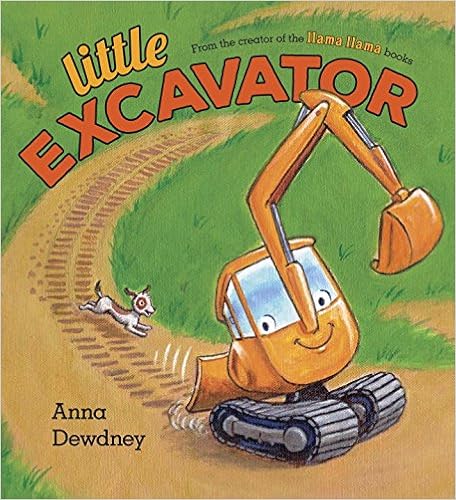
New Picture Books for Young Vehicle Lovers: Little Excavator Jun 6, 2017 by Anna Dewdney Hardcover(Viking Books for Young Readers); Mighty, Mighty Construction Site Hardcover – February 14, 2017 by Sherri Duskey Rinker (Author), Tom Lichtenheld (Illustrator) (Chronicle Books) ,Along the River Hardcover – April 11, 2017 by Vanina Starkoff (Illustrator), Jane Springer (Translator) (Groundwood Books) ;Trains Don’t Sleep byAndria Rosenbaum and Deirdre Gill’ (Houghton Mifflin Harcourt, $16.99; Pedal Power: How One Community Became the Bicycle Capital of the WorldMar 28, 2017 by Allan Drummond Hardcover (Farrar, Straus and Giroux ); Gus’s Garage byLeo Timmers (Gecko) Carl Johanson’s All Kinds of Cars (Flying Eye, $16.95; ages 3 to 7) ,


From “Mighty, Mighty Construction Site.”
There is little doubt as to whether the trucks of Sherri Duskey Rinker and Tom Lichenheld’s Mighty, Mighty Construction Site (Chronicle, $16.99; ages 2 to 5) are up for the job, as Rinker’s vigorous text attests:

Rolling, rumbling, revving hard,
ten big trucks meet in the yard.
A mighty, massive SUPERCREW —


From “Little Excavator.”

In 1930, the Little Engine That Could chugged up a hill to test his metal. Since then, countless books featuring anthropomorphized vehicles have followed in his tracks. One of the latest is Anna Dewdney’s Little Excavator (Viking, $17.99; ages 2 to 5) — which is, sadly, a posthumous title from the beloved creator of the Llama Llama books, who had intended to start a new series. Dewdney excelled at pairing rhyme with heartfelt artwork to convey her character’s emotional journeys. The same skills are on display in “Little Excavator,” as the book’s determined protagonist struggles to help transform a vacant lot into a neighborhood park. Dewdney’s drawings of construction vehicles are as expressive as her llamas, and when Little Excavator beams with pride at the end of the book, the reader will feel the warmth.

Whereas Dewdney’s Little Excavator wastes no time trying to prove his worth, the little bulldozer in Candace Fleming and Eric Rohmann’s Bulldozer Helps Out (Caitlyn Dlouhy/Atheneum, $17.99; ages 3 to 7) has to watch and wait before he can dig in. When the bigger trucks finally assign Bulldozer a job, he quickly realizes it’s more important to stand your ground than move the earth. Whether depicting massive machinery or little kittens, Rohmann’s solidly constructed and deftly colored block print illustrations make every page turn a delight.


From “Mighty, Mighty Construction Site.”
There is little doubt as to whether the trucks of Sherri Duskey Rinker and Tom Lichenheld’s Mighty, Mighty Construction Site (Chronicle, $16.99; ages 2 to 5) are up for the job, as Rinker’s vigorous text attests:


Rolling, rumbling, revving hard,
ten big trucks meet in the yard.
A mighty, massive SUPERCREW —
there is nothing they can’t do!


Briskly paced and stylishly staged, this book’s celebration of teamwork feels like the bombastic opening number of a musical as each truck gets to roll into the spotlight and strut its stuff. Lichenheld’s cartoony oil-pastel illustrations are radiant and capture the grandeur of the construction site as well as the trucks’ determination and pride. These trucks don’t think they can — they know they can. Being on the job site with this can-do team will invigorate old and young readers alike.


Highly literate: From “Little Plane Learns to Write.”

Before we can revel in our mastery, we must first learn the basics. This process can be frustratingly slow, but it can also lead to exhilarating breakthroughs. One such “aha!” moment is writ large in Stephen Savage’s Little Plane Learns to Write (Neal Porter/Roaring Brook, $16.99; ages 3 to 6). Soaring high above city and pastures, Little Plane struggles with his skywriting and gets dizzy when attempting the “loopity-loops” that form the letter O. Perseverance pays off and Little Plane is literally over the moon when he finally learns to write.


As both illustrator and author, Savage seamlessly blends image and word — essential given this book’s subject matter. With its muscular design, saturated colors and crisp language, “Little Plane Learns to Write” is enchanting in its simplicity. The little red plane pops off every full-page spread, and young readers will be frequent fliers for this adventure in writing.

I pause here to note: It’s puzzling that the characters in the above books, with the exception of some of the trucks in “Mighty, Mighty Construction Site,” are all male. The themes of striving and achieving are as gender neutral as the vehicles themselves. If children’s book publishers and authors are ever going to embrace the gender-neutral pronoun “they,” perhaps stories like these would be a good place to start.


From “All Kinds of Cars.”

Dispensing with plot and pronouns, but not personality, Carl Johanson’s All Kinds of Cars (Flying Eye, $16.95; ages 3 to 7) is presented as a pictorial dictionary. Flat colorful shapes playfully combine to depict the carefully observed (small dump truck, small loading shovel, snowmobile) and the completely imagined (castle car, chewing-gum car, crystal car). The simple but cleverly rendered vehicles are likely to inspire children to grab some markers and get in on the fun. Exquisite design and seductive production values make picking this book up a no-brainer. Where to put it down — on your child’s night stand or a living room coffee table — will present the bigger problem.


Recycler: From “Gus’s Garage.”

Gus the pig, the good-natured star of Leo Timmers’s Gus’s Garage (Gecko, $16.99; ages 3 to 8) also knows his cars and, as his ever-present smile attests, delights in inventing new ones. When a penguin overheats or a hare needs a turb charge they turn to Gus, who customizes their vehicles using the pile of “bits and bobs” heaped alongside his shop. Each page spread presents the garage from the same vantage point, and this well-crafted stage set allows the reader to track the refuse pile’s dwindling inventory. By the end of the book only a little tree stands where the pile once stood. The tree provides a home for an odd assortment of birds, proving once again that everything can be made useful. This is an amusing book to reread, since even the smallest details are assigned a narrative purpose. Clearly, one animal’s clutter is another pig’s livelihood in this buoyant, rhyming tale.

From recycling to cycling, Allan Drummond’s Pedal Power (Farrar, Straus & Giroux, $17.99; ages 4 to 8) is a timely political story told with a soft touch. In the 1970s, congested roads in Amsterdam were becoming increasingly dangerous for pedestrians and cyclists. Young moms like Maartje Rutten began to speak out and stage family-friendly demonstrations that included parties held in the middle of the street and hand-holding singalongs. Though these events were catnip to the local news media, it wasn’t until a little girl was killed while cycling that the movement gained traction. As fuel prices skyrocketed amid a global energy crisis, drivers joined the cyclists in demanding change and together they transformed Amsterdam into the “bicycle capital of the world.”


From “Pedal Power.”
Drummond’s line work and coloring is loose and breezy and serves as a fitting counterpoint to the informative text. I especially liked that the police are not depicted as villainous and retain their humanity even as they confront the protesters. This book is a celebration of both cycling and political activism, and in these turbulent times it’s inspiring to know that when the righteously motivated collectively march, shout, sing and pedal, the powers that be eventually yield.

Though social change is usually a story of fits and starts, a more leisurely paced journey awaits readers in the pages of Vanina Starkoff’s Along the River (Groundwood/House of Anansi, $17.95; ages 4 to 8). Open, the book’s long, narrow pages become the river itself. Drifting along, painted in succulent color and loving detail, are all manner of boats abundantly stocked with food, music and celebrations. Born in Argentina and now living in Brazil, Starkoff creates a vivid tapestry of life that reminds us that the spirit in which you travel is more important than where you go.


Steer your own course: From “Along the River.”

In one wry juxtaposition the text gently implores the reader to “search for … your own way” while “continuing to steer your own course.” The accompanying illustration suggests otherwise: A man, eyes closed, is contentedly lying out on a longboat stacked with watermelons, while a dog naps on his chest. A flock of birds hitch a ride and a school of fish swim along. Whereas the construction trucks are all ambition and drive, this stunningly beautiful book presents a refreshingly new sensibility: Willpower alone can only get you so far; sometimes it’s best to go with the flow.


From “Trains Don’t Sleep.”

The murmur of a lazy river may calm one’s nerves, but the distant sound of “wheels on steel” has always been an invitation to wonder. Where has that train been? Where is it going? Moving from dark forest to frozen tundra, from sleepy village to congested metropolis, Andria Rosenbaum and Deirdre Gill’s Trains Don’t Sleep (Houghton Mifflin Harcourt, $16.99; ages 4 to 7) covers a lot of ground. Though never explicitly stated, the book is also a dreamy journey back in time to the golden age of rail travel, when circus trains packed with bears, elephants and tigers would “sweep by sheep,” and interstate highways had yet to be built. The illustrated glossary will help young train enthusiasts learn the difference between a flat car and a stock car, but it’s the book’s painted double-page spreads — at once monumental and ethereal — that are truly transporting.

James Sturm is the author and illustrator of the picture books “Ape and Armadillo Take Over the World” and “Birdsong” and an author of the Adventures in Cartooning series.


Friday, May 12, 2017

The Book of Love: Improvisations on a Crazy Little Thing Paperback – January 19, 2016 by Roger Rosenblatt (Ecco)

Despite the presence of the occasional gem, most of 'The Book of Love' reads like an unfinished manuscript.


Eudora Welty praised the essays of E.B. White as a place where the “transitory more and more becomes one with the beautiful.” That ideal also informs the work of Roger Rosenblatt, whose books often explore the fragile line between what endures and what does not.

In two tenderly exquisite memoirs, “Making Toast” and “Kayak Morning,” Rosenblatt chronicled his grown daughter’s sudden death from a previously undiagnosed heart condition, a tragedy that prompted him to consider what remains in the wake of deep loss. In his 2013 memoir, “The Boy Detective,” Rosenblatt contemplated the nature of the past. Is it an enduring presence, or a mere shadow obscured by the vagaries of memory?

The Book of Love, Rosenblatt’s latest book, tackles equally cosmic questions, offering a roving personal treatise on affection in all its forms – romantic love, friendship, parenthood, love of work and country. The subtitle’s reference to improvisation hints that Rosenblatt’s speculations will liberally indulge caprice – and even free association.

The experimental scheme of “The Book of Love” is a disappointing reminder that experiments don’t always work. Rosenblatt’s book-length essay, which includes everything from extended musical quotations to short fictions, personal recollections to tender valentines to his wife, reads more like a brainstorm for a book than a finished manuscript.

In an opening passage addressed to his wife of many years, Rosenblatt wryly notes how she “turns away at my contrived displays of wit. Embarrassed for me, who lacks the wit to be embarrassed for myself.” It’s a common enough sentiment for any spouse forced to endure a better half’s bad jokes, but the reader, like Ms. Rosenblatt, might also want to turn away at some of the authorial indulgences in “The Book of Love.” In a riff on things he loves, for example, Rosenblatt lists “Bette Davis, and Sammy Davis, Jr., and Harry Connick Jr., and Absorbine Jr.”. A little bit of this verbal horseplay goes an awfully long way, and in “A Book of Love,” that kind of cornball ribbing often flattens Rosenblatt’s typically graceful prose. It’s as if he’s rehearsing a stand-up act that’s not ready for prime time.

The book’s theme of improvisation becomes a label covering all manner of sins. At one point, with no apparent rationale, Rosenblatt throws in an excerpt from “Dogstoevsky,” one of his clever essays for Time magazine in which he comically recalls trying to read “Crime and Punishment” while a nearby canine barks its fool head off. It’s a polished piece of humor – one of the highpoints, in fact, of Rosenblatt’s marvelous 1994 collection of assorted journalism, “The Man in the Water” – but what’s “Dogstoevsky” doing in the middle of “The Book of Love”? The book frequently reads like a filibuster, a procession of bright oddities assembled not so much to say something, but to say anything.

Near the end of “A Book of Love,” Rosenblatt seems to offer a defense for the book’s hodgepodge sensibility. “So I sympathize with people who seek to create a unity of thought and emotion out of disorder,” he tells readers, “but I also believe that trying to fit parts into a whole makes each component smaller, less interesting and inauthentic. There is a life of parts as valid as the life of the whole. Simply noting is often enough. What right have I to give the universe a shape other than the one in which it presents itself without comment?”

Yet earlier in the book, in a passage listing good instructions for loving the world, Rosenblatt offers “’Don Quixote,’” ‘Paradise Lost,’ every Dickens novel, and ‘The Great Gatsby’” – all works of literature that advance just such context.

A mind as magical as Rosenblatt’s is bound to produce some gems, even in a literary project as helter-skelter as “The Book of Love.” He makes an insightful argument about why love at first sight isn’t as reflexive as we think, and there’s a touching account of how his grief for his own daughter connected him with a grieving mother after the school shootings in Sandy Hook, Connecticut. Rosenblatt’s evocation of musical giants, such as Ira Gershwin and Louis Armstrong, points us toward the equally sublime music of his sentences. Listen to these: “The moon is sky-high now, a small pale eye at the top of the dark. A light plane blinks by overhead. A letter from a friend, a photographer, whose child is gravely ill. He includes a picture of the boy. In a corner is the photographer’s shadow, like spilled ink.”

Rosenblatt mentions the ancient Greek belief “that the illuminations of the world derive from the rays our eyes project,” which he initially dismisses as “Hellenistic drivel.” But he essentially argues for love as just this kind of sustained attention. “The Book of Love” is a flawed if heartfelt summons to that way of seeing, a form of vision that compels Rosenblatt to gaze at his wife and conclude that “there was no light in the world but you.”

Party Members by Arthur Meursault Paperback (Camphor Press)


The Middle Kingdom is long overdue being subject to scathing, bilious satire. Few countries can have such a marked contrast between the hospitality and kindness of its people on an individual level and such a total absence of civic feeling. This is, of course, not a historical accident. The destruction of civil society by the Chinese Communist Party and its constant violent repression of any possibility of its reformation mean public-spiritedness and civic virtues can be hard to spot. Of course, one encounters open, friendly, people there; one can also be dazzled by people’s appetite for hard work and self-improvement. Yet, when more than a dozen people idly walk past a dying toddler lying on the road, we sense clearly that there are deep structural problems.


Party Members thus takes savage aim at the incivilities of Chinese society. It is not the work of an insider aiming to destroy the temple from within – the author’s pen name comes from the Camus novel, The Outsider – but rather is by an Englishman who clearly has glimpsed, been disgusted by and catalogued China’s numerous rank vulgarities. The worst features of a large society are laid bare here: public defecation, gluttony, bovine ignorance, officiousness, obsequiousness, label fetishism, inane TV, the arrogant disdain for anything not immediately profitable, and the apartheid-esque contempt for the poor that gives the lie to Communist Party rhetoric of human dignity.


The plot and central metaphor of the book are simple enough. Yang Wei is a low-level official in a nondescript town, Huaishi (“bad thing”) in an unremarkable province. When Yang is provoked by the ostentatious material success of a former classmate in the same ministry, his penis begins to talk to him – instructing him in the arts of succeeding politically, sexually and materially. The penis, once Yang Wei obeys its counsel, begins to grow and take him over. This kind of transgressive metaphor can be traced back to antecedents like the tapeworm in Irvine Welsh’s Filth, the plant in Little Shop of Horrors, and even the original split-personality fiction of them all, Strange Case of Dr. Jekyll and Mr. Hyde. The key to success, it turns out, is to be a huge dick to everyone. Act like some ubermensch, and everyone gets in line. It’s a crude, simple metaphor, but satire doesn’t have to be subtle.


As I said, Meursault is an outsider in the Chinese society he depicts. While this gives him an external moral standard, it also means that his prose is often in explicatory mode. This might help the reader fully understand what is so egregious about the focus of Meursault’s ire, but there is also a frequent sense of authorial intrusion. For instance:


For Director Liang, the evening meant that he only had another four hours to go before he could escape the excruciatingly boring official event he was forced to attend and return to the warm arms of his seventh mistress in a tawdry, pay-by-the-hour love hotel. Until then, he continued to beam his usual empty smile […] while he watched yet another group of well-rehearsed four year-olds perform a special Spring Festival rendition of Lady Gaga’s “Poker Face”, with the words altered to better reflect the city’s latest 8 percent growth in plastic injection exports.


There is perhaps no need to interject that the event is “excruciatingly boring”, once he mentions the length, the performance and the Soviet lauding of production statistics – the reader can probably be trusted to figure that out. The same applies for Liang’s “empty” smile and the “tawdriness” of the love hotel. In a sense, these sardonic asides are like getting to the punchline before the joke is complete. They hold the reader’s hand rather too tightly to the conclusion, and are I think mostly unnecessary.


The key question with such a text, however, is: does the novel’s satire work? I would say without doubt that the answer is yes, it does. For one thing, Party Members is genuinely funny. It can be scabrously funny, it can be situationally funny, and it can be sardonically funny: page by page, the absurd and the dreadful combine, grotesquely, nauseatingly, absurdly, surreally. Yang Wei’s mistress Rainy is a WeChat-addicted narcissistic bubblehead, and when the two are involved in a car accident, she snaps a few selfies as they crawl out the wreckage. Meursault’s observations of Chinese family life are savage yet bristle with home truths that will have the reader chuckling at his insolence. The assaults by Yang’s penis on his rivals are sudden and devastating, and the references to KFC become increasingly grotesque. Some readers may lack the stomach for such dark comedy, but in these bland times, it is refreshing to read someone unafraid to go balls-to-the-wall.


But of course these scenes are not merely comic savageries. For them to work as satire, there has to be a sense of moral trangression, of a better world that should be. Meursault’s indictment is not perhaps complex – the metaphors are all front and centre – but this very obviousness is an asset. The book is not a subtle probing of China’s secrets. It is a full-on, all-guns-blazing, merciless caricature of its everyday social interactions and political culture. It might be easy to mistake its prosecution as a predilection – some might see Meursault as wallowing in what he condemns – but that would be misreading. Party Members is simply and unsparingly scathing about the horrors of Chinese society.

Sunday, May 7, 2017

The Noblest Roman, by Jerry Kelly and Misha Beletsky; David R. Godine, $45.00, 128 pages.


Readers of our spring print issue may recall Allison Meier’s story on book designer and typographer Jerry Kelly, which touched briefly on his recently published chronicle of Centaur type, The Noblest Roman. Co-authored with Abbeville Press art director Misha Beletsky, the book explores Centaur’s origins well as the life of its creator, Bruce Rogers (1870-1957). Originally published by the Book Club of California in 2016, a trade edition appeared this week from David R. Godine, himself a letterpress printer-turned-publisher.
                                                                                                                                                                                           The Noblest Roman is itself physical proof of the enduring beauty and functionality of Centaur type and is set in three digital versions of the typeface; the main text is set in a revival of the original foundry Centaur, a new version is reserved for captions, and monotype Centaur sets off display text. An added treat is the tipped-in type specimen created with Monotype Centaur and Museum Centaur, newly cast from foundry mats that haven’t been employed in one hundred years. Printed in four colors via offset lithography by Kelly, the whole endeavor makes for an immensely readable and elegant production. Just on face value alone, it is a typophile’s delight.
                                                                                                                                                                                    
centt11.JPG
An interior shot of The Noblest Roman. Reproduced with permission from David R. Godine. 

The book traces Centaur’s origins to the year 1470, when French printer and type designer Nicolas Jenson perfected the proportions and spacing of his namesake type. Jenson’s type was hailed as “brilliant” and “more perfect in form than those of any previous printer.” Fast forward five hundred years to William Morris’ revival of Jenson’s type, and subsequently, to Roger’s perfection of the proportions to create the type employed regularly by institutions like Penguin Books and the Metropolitan Museum of Art. Kelly and Beletsky also tackle the near-mythical status of Rogers in the world of book design and how his mercurial personality has made credible biographical treatment challenging. The Noblest Roman draws on new research to create a nuanced portrait of this towering figure and includes sidebar biographies of fellow printers, designers, and punchcutters, rendering this a thorough history of typography and typographers of the twentieth century.

What made this style so groundbreaking in 1470 and so appealing in the
twentieth century? More sculptural than calligraphic, Centaur still appears lively without too much flair that might otherwise distract a reader, while slight irregularities in the ties, terminals, and crossbars keep the typeface from becoming monotonous inkblots splashed across the page. Centaur has gracefully made the leap to digital media as well, where it is regularly employed for its readability.

The Noblest Roman was recently awarded the Mercantile Library Prize in American Bibliography, a cash award announced every three years. Previous winners include the American Antiquarian Society, Joseph Felcone, and Andrea Krupp. This year the award is split between The Noblest Roman and The Mythical Indies and Columbus’ Apocalyptic Letter by Elizabeth Moore Willingham (Sussex Academic Press).

Though named after the title of the first book in which it appeared, Centaur is very much like its mythological namesake; a hybrid of styles that has undergone numerous incarnations, with sublime results. And though editors routinely discourage the use of absolutes, The Noblest Roman makes a most compelling case for this exquisite type.

The Noblest Roman, by Jerry Kelly and Misha Beletsky; David R. Godine, $45.00, 128 pages.

The Lost Book of the Grail, by Charlie Lovett (Viking)

Charlie Lovett launched his fiction writing career with his 2013 debut, The Bookman’s Tale, which became a New York Times bestseller. He followed up with the Austen-inspired First Impressions (2014), and more recently with The Further Adventures of Ebenezer Scrooge (2016). Now Lovett has a new book to offer, The Lost Book of the Grail, to be published by Viking tomorrow, and it is his best work yet.   


9780399562518.jpgSet in Trollope’s fictional cathedral/university town of Barchester, this bibliomystery immediately enchants those with a weakness for old books and church bells. Arthur Prescott is a 40-year-old literature teacher with serious luddite tendencies and a borderline obsession with King Arthur and Holy Grail mythology. He is most suited to days spent in the rare book room of Barchester Cathedral Library, punctuated by drinks with fellow book collectors and cathedral services (morning prayers, Evensong, compline). His favorite volume is a 1634 William Stansby edition of Malory’s Morte d’Arthur, though its “leather binding was badly worn at the joints and corners, and nearly two inches of the lower spine was lacking.”

Enter Bethany Davis, a loquacious American fourteen years his junior, sent to Barchester to digitize pre-Reformation Christian manuscripts, courtesy of some Midwestern billionaire. Obviously these opposites attract, although suspicions abound. While university officials contemplate the sale of the manuscripts once the scanning is completed, Arthur sets off to uncover a secret he believes can save the books.

Lovett layers his narrative with quick dips into Barchester’s history, as Arthur and his clever conspirators unravel a mystery spanning more than a millennium. These characters are lively and relatable, and the novel’s pace is spot-on. The Lost Book of the Grail is truly a page-turner for bibliophiles.

And though we’re told to ‘never judge a book by its cover,’ this one is pretty terrific, with its cut-paper, antique map, and manuscript detailing.


I