Showing posts with label Stephen Darori. Stephen Drus. Show all posts

Monday, April 2, 2018

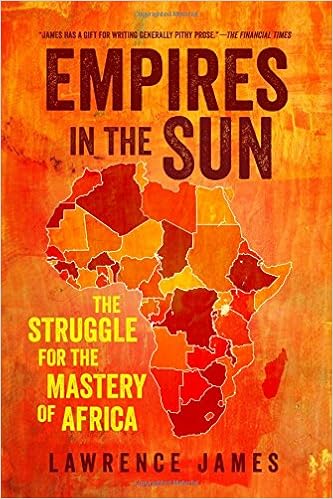
Empires in the Sun: The Struggle for the Mastery of Africa by Lawrence James Pegasus, 391 pp., $28.95


In the year 1415, an unnamed envoy from the East African city-state of Malindi sailed from the Red Sea to China aboard a ship commanded by the great Chinese admiral and explorer Zheng He. Upon his arrival in Beijing, the envoy was escorted to the inner gates of the imperial palace, where he presented a live giraffe to the Ming emperor as a form of tribute. The giraffe so dazzled the imperial audience that its presentation was depicted in paintings, some of which entered the imperial collections and survive to this day. In fact, Chinese curiosity about Africa was piqued to such a degree that during the last two of Zheng’s seven famous voyages, culminating in 1433, his enormous and heavily armed fleet plied the East African coast, establishing relations between the Ming and local rulers in Dar es Salaam, Kilwa, Malindi, Mogadishu, and Mombasa. In one of history’s great coincidences, Zheng’s voyages and the abrupt and fateful inward turn by China that followed them coincided almost exactly with Europe’s “discovery” of western Africa.

Upon his return from the capture of a trading island off the coast of North Africa in 1415, the poor Portuguese prince who came to be known as Henry the Navigator gathered a team of cartographers to begin charting the West African coast. Cut off by Spain from the Mediterranean’s rich trading opportunities, tiny Portugal, with Henry’s encouragement, wagered on southward exploration of the Atlantic. A primary objective seemed to be the discovery of the African source of the trans-Saharan gold supply, but Portugal soon also sought to establish a sea route to the silk and spices of Asia that would allow it to bypass the stranglehold of the formidable Ottoman Empire on the land routes.

The Portuguese explorer Diogo Cão first made contact with the Kingdom of Kongo in west central Africa in 1483. Over the next few years, as diplomatic relations were established, Kongo nobles were brought back to Portugal for conversion to Christianity, then returned to their country. The Portuguese quickly came to depend on the kingdom for a large portion of their slave trade, and the Kongo elite sent envoys to the Vatican and numerous students to European capitals. After an initial period of remarkably equal exchanges, however, conflict arose over Portuguese efforts to undercut rules in Kongo aimed at limiting what was fast becoming a bottomless demand for slaves. In 1526, amid a series of written entreaties to Lisbon to respect these rules, Afonso, the ruler of Kongo, composed a striking complaint to his Portuguese counterpart:


Each day the traders are kidnapping our people—children of this country, sons of our nobles and vassals, even people of our family. This corruption and depravity are so widespread that our land is entirely depopulated. We need in this kingdom only priests and schoolteachers, and no merchandise, unless it is wine and flour for Mass. It is our wish that this kingdom not be a place for the trade or transport of slaves.

The disaster that the unbridled slave trade inflicted on Kongo is emblematic of slavery’s effects on the economic and political development of Africa as a whole. From the earliest times, the scarcest resource of African kingdoms had been people. Population growth in Africa was severely depressed compared to other parts of the world because of the many life-shortening diseases and parasites that were endemic to its tropical climate. Beyond Africa’s historic challenge of underpopulation, its vastness made it difficult for kingdoms to get people to settle in one place, especially against their will. Africans had always practiced slavery among themselves, but slaves were usually war captives and the victors typically sought to absorb them quickly, through marriage, military service, or the manumission of their children. Without such assimilation the risk of flight or rebellion was too great.

By some estimates, the Kongo kingdom and its immediate region lost a third of its population to the European slave trade. Between 1500 and the late 1800s, tropical Africa altogether lost roughly 18 million people to the slave trade, most of them in their prime reproductive years. This impact is better understood if one considers that the population of the continent remained stagnant at 50 million between 1700 and 1850 instead of doubling, as some demographers believe it might have without slavery’s heavy toll.

As the demand for bonded African labor skyrocketed in the early eighteenth century, European traders sold firearms in large numbers to well-organized African states like Dahomey and Oyo, transforming them into single-product economies, i.e., mass slave exporters. These powerful kingdoms, typically situated near the coast, mounted seasonal razzia, or raiding campaigns, initially against weaker neighboring peoples but eventually far inland. This turned much of tropical Africa into what the Yale political scientist James C. Scott has called “shatter zones”—inhospitable places where fragmented groups fled the predations of the more powerful: the remotest swamplands of today’s Central African Republic, the inaccessible buttes of Mali, and many other semidesert and forest zones. Economists like William Easterly and Nathan Nunn have argued that there is a strong correlation, even 150 years later, between areas where razzia were most intense and contemporary African poverty levels, a correlation they attribute in part to the persistence of social mistrust, which limits trade and undermines the development of a business culture.


All too many publications about the history of Europe’s relationship with Africa fail to sufficiently convey the damage that was done to the African economy, peoples, and political development by the slave trade and European colonialism. Perhaps the most striking recent example of this is Empires in the Sun: The Struggle for the Mastery of Africa, by Lawrence James, an English author who has written extensively on the British Empire.

James does not practice outright denialism about European behavior in Africa. But at almost every significant turn in his account, which spans the five centuries from early modern European contacts with the continent to its decolonization beginning in the 1950s, he tends to downplay its ill effects on Africa and wonders aloud why, as he sees it, non-Europeans don’t get held up for comparable scrutiny. Wherever possible, he emphasizes principled motives, particularly as a way of distinguishing the actions of the British from those of their European counterparts. In doing so, he puts the reader in mind of other writers, for instance popularizers of United States history, who likewise emphasize past virtue and decry more critical assessments as unwarranted self-flagellation.

On his very first page, James concedes that “change” driven by European imperialism generated conflict in Africa, but he never returns to dwell upon this at length. Instead, he immediately offers what seems like a pat, exculpatory defense: Europeans “believed [change] would benefit them and their African subjects.” This passage sets the tone for much of what follows. “Strange as it may seem, Charles de Gaulle, Mussolini, Cecil Rhodes and Nikita Khrushchev believed that their countries had something of value to offer Africans.” He calls the slicing up of different parts of the continent by its new colonial masters “a dual partnership of physical and spiritual regeneration [that] was appropriate for Africa, which in the popular imagination was depicted as a ‘dark’ continent.”

In fact, it is not at all strange that Western powers, as they set out to subdue and colonize Africa, would create whatever justifications they needed to defend and promote their objectives. This, indeed, is the general rule, not the exception, with imperial projects throughout history: emphasizing the civilizational virtues that are being shared with less fortunate or explicitly inferior peoples, while minimizing one’s own self-interested objectives and downplaying the violence and dispossession that are usually essential to the subjugation of others.

James’s jarring claims begin early on, in his discussion of the European slave trade in Africa, which began in the fifteenth century. “Slavery and the slave trade were vast but not immovable obstacles to progress in Africa; they skewed economic and social development, and were a constant cause of wars,” he writes in the first chapter, having already told us in the preface that “war had always been endemic in Africa.” What he seems to be saying here is that as traumatic as slavery, and its associated violence, may have been, it should not be considered a major factor in impeding Africa’s subsequent economic and social progress—something that modern scholars widely dispute. A few pages later, James remains neutral as he uncritically describes a European rationale for domination: “So far as it was known there was no African Taj Mahal or Forbidden City. Why this was perplexed Europe’s men of reason during the eighteenth century. The answer seemed to lie in a genetic intellectual deficiency.”

It is certainly true that Western notions about the innate inferiority of Africans were used to justify both enslavement and colonization. But this sort of justification, in addition to being inadequate—deeming a people “inferior” does not provide the grounds for enslaving or murdering them—is based on a false premise, underexplored by James and many other historians. A more curious observer might have also noted that the monumental architecture of the Mayans, the Incas, and the Aztecs gave no pause to Europeans and their designs of conquest. Early on, in any case, European explorers did encounter impressive signs of African achievement, from large and tidy cities to sublime art. They found precolonial African states that dominated entire subregions, controlled lucrative trade routes, and maintained elaborate structures of government. To take but one example, for six hundred years sophisticated kingdoms had succeeded one another astride the Niger River in the region of present-day Mali.

At the beginning of the fourteenth century, nearly two hundred years before Columbus’s voyages, Abubakari II, the ruler of the Malian empire, built a fleet of ships to search for the western shores of the Atlantic. When only one of hundreds of boats returned, Abubakari ordered and personally commanded an even larger expedition, but was never seen again. His more famous successor, Mansa Musa, used Mali’s wealth to recruit Islamic scholars from Egypt and architects from Andalusia, and distributed so many tons of gold while leading an immense pilgrimage to Mecca that he set off a wave of inflation in the Middle East and Europe and crashed the price of the metal for a decade. Musa was so renowned that his image began turning up on the maps of European cartographers.

Evidence of African achievement—from the pyramids of Egypt to the bronzes of Benin, among many other examples—was persistently explained away by Europeans as the possible legacy of mysterious outsiders who came to Africa, left their mark, and then disappeared. To accord local agency in such matters would have undermined a long-standing narrative about the inherent inferiority or even subhuman nature of Africans, which was vital in giving Europeans license for their actions.

James places greater emphasis on intra-African profiteering from the Atlantic slave trade than he does on its economic advantages for the West. “The wealth generated by slavery was a key factor in African politics,” he writes. “Fortunes were amassed by the indigenous entrepreneurs and invested in the soldiers and modern weaponry that were necessary to establish and defend their hunting grounds.” It is of course true that African societies, like Kongo, sold slaves to Europeans in exchange for guns, cloth, and tons of cowrie shells, which were established early on as a form of currency for the trade.

By comparison, however, as recent research by Thomas Piketty, among others, has shown, in the early nineteenth century the value derived from the trade and ownership of slaves in America was greater than the value of all of the country’s factories, railroads, and canals combined. It was also greater than the value of all of its agricultural land. After it abolished slavery, London indemnified three thousand slave-owning families by today’s equivalent of $16.5 billion, or 40 percent of the British treasury’s annual output at the time. Economic historians like Kenneth Pomeranz, meanwhile, have pointed to the “exceptional scale of the New World windfall, the exceptionally coercive aspects of colonization there and the organization of production,” by which he means slavery, to explain the great divergence in wealth between the West and China that began in the nineteenth century, after many centuries with China in the lead.*

In explaining the European “scramble” to take over Africa, James heaps disproportionate blame on France and pins much of its behavior on the purported French obsession with gloire—glory. “Nineteenth-century France was mesmerised by that heady abstraction, La Gloire,” he writes. “Napoleon had been its latest and greatest embodiment: his genius for war had (briefly) made France master of Europe and convinced his own and later generations that winning wars was part of their national birthright.” To emphasize this among the diverse motives behind France’s imperial history in Africa is historically unsatisfying.

When France began its decades-long conquest of Algeria in 1830, as James himself writes, the Congress of Vienna had just confined France to its own borders in Europe. Africa therefore beckoned as a badly needed, unclaimed region where it could compete with Britain and others. The late historian Eric Hobsbawm wrote: “Between 1876 and 1915 about one-quarter of the globe’s land surface was distributed or redistributed as colonies among a half-dozen states. Britain increased its territories by some 4 million miles, France by some 3.5 millions.” Glory and its effects, which are hard to measure, may have been part of that, but Hobsbawm seems persuasive when he writes that “a more convincing general motive for colonial expansion was the search for markets.”

The emphasis on French glory is just one of numerous instances in which James labors to morally elevate his own country over its rivals. France, he says, was the primary driver of the scramble for Africa. British motives in this and in many other matters are far less seriously questioned. “Imperialism was integral to the spirit of the [French] Third Republic,” James writes, without making any comparable observation about the British. “It represented progress and prized what republicans believed to be the unique and superior culture of France.” When speaking of Britain, he is relentless in highlighting supposedly more progressive motives, as in this characteristic passage:


Britain’s businessmen were willing to brace themselves to meet the new conditions of global trade…. The commercial mind was aware that there were advantages in keeping as much of the world’s trade as possible open to Free Trade, even if this meant permanent occupation of areas not yet under foreign control. In the long term, the people of Africa would benefit from competition and an abundance of goods.

Elsewhere, he writes, white and black alike suffered a “torpid” administration under the Dutch in the nineteenth-century Cape Colony, in present-day South Africa. Once London took over, though, “the long-term aim of the rulers of the Cape was the creation of a tranquil colony under humane, British laws, and a passive population that would take advantage of the civil peace to enrich themselves.” “Britain,” in apparent contrast to others, he writes of the 1850s, “was the friend of the weak and the oppressed and a nation deeply aware of its collective Christian duty.” This would be the very moment, of course, that the Chinese were under siege from Britain during the Opium War.

James seems similarly preoccupied with the Arab slave trade in Africa: “The literature on African slavery is selective and imbalanced since it largely ignores the Arab–African slave trade.” Arab and African slavers, he writes, “insisted that they were engaged in a historically legitimate, economically necessary and rewarding enterprise,” though he never delivers such a blunt assessment of Western motives. Amid this discussion, and with no attribution, he claims that the Muslim trade in African slaves was as large or larger than the Atlantic trade. It is true that Islamic markets for African slaves date back to the ninth century. But of the roughly 18 million Africans sold into slavery in the four centuries prior to 1850, roughly 11 million left from the continent’s west coast alone, virtually all of them bound for the New World. During this time, Western agents were active in other regions as well. Numbers aside, James concludes that “the collective moral shame and regret felt by subsequent generations of Europeans and Americans have never been shared by Turks, Egyptians and Arabs,” though many Americans and Europeans would strongly question the scope of this “moral shame and regret.”

Despite its defensiveness and persistent pro-British slant, Empires in the Sun has a number of interesting things to say about intra-European competition and the vicissitudes of migration to and from Africa. One learns, for example, that many European countries in the early twentieth century conceived of emigration to their African colonial holdings as a solution to their own population pressures. In 1905, on the other hand, in response to the lobbying of industrialists in need of workers, France lifted a ban on immigration from Algeria. During World War I, James writes, “huge numbers of Algerians were drafted into French factories, mines and dockyards to release workers for service at the front.” Without African colonies it could tap this way, he writes, Germany resorted to subjecting fellow Europeans to forced labor under military administration. In the decades after the war, French Algerians faced widespread hostility and discrimination. “They were kept under close police surveillance and were disdained by the French, who stigmatised them as a threat to women, carriers of syphilis and child molesters,” he writes.

Late in his book, James situates the sources of Africa’s present problems in the recent decades of independence, variously blaming poor African governance and the legacy of US–Soviet competition during the cold war. There is, of course, plenty of blame to go around. But what are we to make, finally, of the White Man’s Burden and commitment to progress, which James identifies as the predominant rationale for Europe’s actions in Africa? From the eve of World War I, by which time it had achieved its nearly complete takeover of the continent, to the conclusion of World War II, Europe invested little in Africa, especially by comparison with other regions under its colonial control.

By the late 1930s, France had a mere 385 colonial administrators commanding the destinies of 15 million African subjects. British Africa, with 43 million people, had a roughly comparable 1,200. By the late 1950s, the dawn of the independence era for the continent, out of a population of 200 million sub-Saharan Africans, European stewardship had produced only 8,000 secondary school graduates, half of whom were from just two colonies, Britain’s Ghana and Nigeria. In France’s territories only about a third of school-aged children received any primary education at all.

Beyond its problems of emphasis and of selectively used facts, though, James’s biggest missed opportunity is his failure to seriously invoke Africa’s future. Within the last half-century, Africa has finally overcome its long-term population deficit in comparison with other continents, and is now barreling into a globally unprecedented demographic takeoff. According to the United Nations Population Division’s 2017 revision, its population, which stands at 1.25 billion today, will double to 2.5 billion by 2050. By this century’s end, the UN’s median estimate predicts there will be 4.4 billion Africans, slightly fewer, in other words, than twice the combined populations of present-day China and India.

Europe is already in a state of distress about the flow of refugees and migrants from Africa, and in seeming denial about the scale of this pending demographic transformation and the potentially devastating impact of climate change on the continent. The Africa question looms as one of the most momentous human challenges for the remainder of this century. How can the damage of colonial balkanization be remedied and Africa become much more integrated into global economic systems? Despite the scope of the challenge, one hears surprisingly little discussion of this from James or anyone else.

Friday, February 16, 2018

Behind the Spolight ........Keeping On Keeping On by Alan Bennett Farrar, Straus and Giroux, 722 pp., $40.00 Balancing Acts: Behind the Scenes at London’s National Theatre by Nicholas Hytner Knopf, 312 pp., $28.95,Nigel Hawthorne on Stage Paperback – September 28, 2005 by Kathleen Riley (University of Hertfordshire Press)


Hulton-Deutsch Collection/Corbis/Getty Images
Peter Cook, Jonathan Miller, Dudley Moore, and Alan Bennett performing in Beyond the Fringe, 1964

Last summer,there was a fine production of Alan Bennett’s best-known play, The Madness of George III, at the Shaw Festival in Niagara-on-the-Lake, Ontario. I had read the play before but knew it mostly from Nicholas Hytner’s 1994 film version in which, as Hytner puts it in his engaging and illuminating theatrical memoir Balancing Acts, Nigel Hawthorne’s imperious monarch movingly “descends into babbling incontinence.” But I always had a problem with the play. It openly invokes King Lear, but compared to that terrifying journey into the dark heart of a deranged state, it seemed too soft. Bennett’s drama, though full of tender compassion and rueful melancholy, appeared in the end to treat the king’s madness as a colorful historical episode, not as a metaphor for unhinged authority.

Yet watching it a year after Britain voted to leave the European Union and a month after Theresa May lost her authority in a disastrous general election, The Madness of George III seemed precisely that: a perfect theatrical metaphor for a national nervous breakdown that does not rise to the heights of tragedy but rather, in its babbling incontinence, teeters closer to both farcical absurdity and quiet despair. Suddenly, Alan Bennett does not seem so soft after all. In his new collection of diaries and autobiographical essays, it becomes ever clearer that he has long been onto something that eluded other, apparently more politically acute, English writers.

In July 2007, The Guardian published an opinion piece by the distinguished Marxist critic Terry Eagleton in which he lamented the loss of the great tradition of English radical literature and the absence of contemporary heirs to Percy Shelley and William Blake: “For almost the first time in two centuries, there is no eminent British poet, playwright or novelist prepared to question the foundations of the western way of life.”* He made “an honourable exception” of Harold Pinter on the grounds that “being a champagne socialist is better than being no socialist at all,” but made no mention of Bennett.

Bennett records in the diary that forms half of Keeping On Keeping On that if he used e-mail (which as a confirmed Luddite he does not) he would send Eagleton or The Guardian a one-word message: “Ahem.” He has recently returned from a cold, wet, and sparsely attended protest against the US military presence at a Royal Air Force base outside Harrogate: “I’m not sure if this means that in Eagleton’s view I don’t qualify because of my absence of eminence or because such protests as I take part in are too sporadic and low-profile to be noticed.”

It may, at first glance, seem odd that Bennett thinks of himself as a writer in the radical English tradition, even though, while Eagleton scorned David Hare and Salman Rushdie for accepting knighthoods, Bennett had declined the honor when it was offered to him in 1996. (He also refused an honorary doctorate from his alma mater, Oxford University, because it had established a Rupert Murdoch Chair of Language and Communication.) The plays for which he is best known—The Madness of George III, The History Boys, The Lady in the Van—seem rather more inclined to celebrate an English tolerance for individual oddity than to rage against the established order of things. The mental disturbance of King George or of Miss Shepherd, the lady who lived in a dilapidated old van she parked in front of Bennett’s house in London, draws out his lovable qualities of kindness and forbearance. It is not threatening. In his previous volume of diaries and memoirs, Untold Stories, Bennett wrote beautifully of his mother’s struggles with mental illness. Even in a psychotic state, she practiced a restrained kind of madness:


Certainly in all her excursions into unreality Mam remained the shy, unassuming woman she had always been, none of her fantasies extravagant, her claims, however irrational they might be, always modest. She might be ill, disturbed, mad even, but she still knew her place.

Something of the same modesty clings to Bennett’s public persona and in part explains his great popularity in England. Nicholas Hytner describes Bennett the playwright as “a stylist as demanding as Oscar Wilde.” He does indeed have an aphoristic wit, but dazzling Wildean display is not his manner. The polite, understated “Ahem” that he did not utter in protest at Eagleton’s implicit dismissal of his claims to being a writer of political consequence chimes well with the English suspicion of volubility. Bennett’s Englishness is marked by verbal, emotional, and imaginative restraint. “It is not good to talk,” he notes in his diary in October 2006. “Most of the time it’s better to keep quiet.” Hytner, who also directed the original stage production of The Madness of George III at the National Theatre in London in 1991, experienced this aversion to effusion:

“What do you think it’s about, Alan?”
“It’s about the madness of George III.”

When a pretty girl, apparently rather too wrapped up in her own beauty, crosses the road irritatingly slowly in front of Bennett and his partner, Rupert Thomas, the long-serving editor of The World of Interiors, a Condé Nast design magazine based in London, he is tempted to roll down the car window and shout at her, “Listen. We’re nancies. Big tits mean nothing to us.” But of course he doesn’t. His blurting is all interior: part of the pleasure of his diaries is the sense that he tells them things he would never say out loud.

Yet this understatement is still a statement, a mode of privacy transmuted into a very recognizable public persona. The diaries, after all, are published annually in the London Review of Books and collected in hefty volumes. We must remember that Bennett first came to notice in 1960 as a performer in the famous satiric review Beyond the Fringe, albeit as the deadpan foil to the flamboyant Peter Cook, Dudley Moore, and Jonathan Miller. His dryly laconic Yorkshire tones and bespectacled ordinariness have become paradoxically iconic. As Hytner writes, “Most actors can do Alan…not just his voice and mannerisms, but his wry melancholy and boundless empathy.” His very lack of glamour is itself the obverse side of fame, a way of backing into the spotlight.

But being understated also means that, as a political figure, Bennett is greatly undervalued. He can seem almost like a creature from The Wind in the Willows, which, at Hytner’s suggestion, he successfully adapted for the stage—a cute denizen of an imaginary and long-vanished English landscape. In an entry from his diary for September 2006, he records the experience of making supper while idly listening to an arts review program on BBC radio. Out of nowhere,


some Scottish woman in the course of telling off the novelist Mark Haddon accuses him of “Alan Bennettish tweeness.” It’s not a serious injury to my self-esteem but rather as if someone passing me in the street has just turned back to give me a flying kick up the bum and then gone on their way. I hope for some mild objection from one of the other participants but none is forthcoming so perhaps I’m now tweeness’s accepted measure.

If not tweeness, then whimsicality. In March 2013, Bennett is in the post office in the picturesque Suffolk village of Yoxford. There “an ancient customer recognises me and shakes me so firmly by the hand it’s like being caught in a mangle. ‘Say something whimsical’, he commands.” Bennett in his eighties has become a very English kind of national treasure, which is to say a nicely unobtrusive piece of old jewelry that can be taken out of the drawer when the nation wants to be reminded of its more solid, unpretentious self. He possesses a peculiarly unimposing eminence. (“Well,” a woman tells him as she lets him through the barriers at an event, “you’re a celebrity yourself…or on the celebrity side anyway.”) No matter how much he protests or rages, he is all too aware that his compatriots are determined to see him as droll, lovable, and above all unthreatening:


I shall still be thought to be kindly, cosy and essentially harmless. I am in the pigeon-hole marked “no threat” and did I stab Judi Dench with a pitchfork I should still be a teddy bear.

To an extent, Bennett does enjoy playing up the persona of the superannuated remnant of a bygone country, peering myopically and uncomprehendingly at the contemporary world. In June 2005, he sees a woman walking along the street with a handkerchief pressed to her mouth and surmises that she must be on her way home from a painful visit to the dentist. Then he realizes that it’s not a handkerchief that’s pressed to her mouth—it’s her mobile phone. He buys a bottle of organic wine and is pleased by the label’s claim that it is “Suitable for Vegetarians and Vagrants,” glad to see the needs of derelict winos so openly acknowledged. But of course when he looks again, the label says “Vegans,” not “Vagrants.” In 2010, on a visit to Finchale Priory in rustic Durham, he admires the old lichens growing on the path leading to the south door, only to realize that they are, in fact, bits of spat-out chewing gum.

Yet though this self-deprecating humor feeds the cuddly and reassuring image, Bennett is in fact much happier when Rupert tells him, as they watch a movie of Wuthering Heights, “You’re rather like Heathcliff.” “Really?” “Yeah. Difficult, Northern and a cunt.” But he is deemed, and perhaps doomed, to be more teddy bear than Northern cunt, to be liked and even loved but not to be taken quite seriously as a political or public figure.

Unless, that is, Brexit alerts us to the remarkable truth that Bennett’s funny, laconic, apparently quirky, and (yes) whimsical memoirs and diaries have an epic, tragic, and deeply political theme: the unavailing search for an idea of England. Keeping On Keeping On is the third volume of these writings, after Writing Home and Untold Stories. The diary part of it ends with a postscript for June 23, 2016, the day of the Brexit referendum, before the momentous result is known. It says little: “Well, we shall see.” But it acts as a powerful recoil, for it is now difficult not to see, in the crisis of Englishness that Bennett has been recording for thirty years, a personal and intimate charting of the underground fault lines that would eventually create that great earthquake.

In April 2008, when Bennett has just given his notebooks and manuscripts to the Bodleian Library at Oxford University, he is delighted by a phone call from the keeper of special collections: “I thought you would like to know that this evening your MSSare reposing in Bodley’s strongroom on the next shelf to the Anglo-Saxon Chronicle.” Later, at a public reception in Oxford to mark the gift, Bennett tells this story and adds a dryly comic twist: “The only other time in my life when I’d been in such proximity to ancient memories was one evening in New York when I’d found myself sitting next to Bette Davis.”

But he is enough of an Anglo-Saxon to compare the destruction of the industrial heartlands of his beloved North of England by Margaret Thatcher’s monetarist revolution to the harrying of the North by the invading Normans in the eleventh century. Recalling a trip from Hull to Liverpool around 1990, he evokes “a trail of devastation, decay and manufacturing slump that stretched from coast to coast” and adds: “It struck me then that no one had done such systematic damage to the North since William the Conquerer.”
Antony Crolla
Alan Bennett, London

Keeping On Keeping On and its earlier companion volumes do indeed constitute a kind of Anglo-Saxon chronicle. Bennett is English, not British. Scotland is another country: “In Glasgow nobody’s heard of me anyway.” “‘Brits,’” he notes disdainfully in 2010, “—so much of what is hateful about the world since Mrs Thatcher in that gritty hard little word.” But his England is not so much a place, more an obscure object of desire. In Untold Stories, Bennett wrote about his Aunty Myra, who “determined that if her present did not amount to much…then the past could be called in to compensate.”

Bennett would love to be able to make the same determination. When he visits a church in Walpole St Peter, “nothing seems to have been lost, nothing spoilt.” As a medieval historian by training and a traditionalist by instinct, he would be happy to be able to say the same for England as a whole. Bennett describes his politics as a “blend of backward-looking radicalism and conservative socialism.” In another writer, each of these terms might seem an oxymoron, but for him they are accurate evocations of a kind of desolation. For, much as he might wish otherwise, something has been lost, something spoilt, and that something is not just an old man’s youth. It is England itself.

Nations, of course, are never anything but lost. And Bennett’s sense of loss is not recent. His first play, Forty Years On, written when he was thirty-four, was set in an old mansion called Albion House—the state-of-England metaphor being perhaps all too obvious. It is already valedictory: “a lament for an England that has gone.” Bennett’s Englishness, moreover, is best expressed in his rendering of monarchs (George III or the present Queen Elizabeth, who is portrayed in the novella The Uncommon Readerwith a perfect mix of lèse-majesté and affection) or traitors (in The Old Country and An Englishman Abroad)—or ideally by both together, as in A Question of Attribution, which brings the queen together with her perfidious keeper of paintings, Anthony Blunt. It is as if the country can best be seen either from above or from the great beyond of treason, never quite in its day-to-day self.

In his Yorkshire boyhood, as again in middle and old age, Bennett haunted medieval churches, drawn to their odd remnants of a vanished Catholic world, to “the dregs of history,” the accidental survivals of the Reformation and the dissolution of the monasteries. This attraction to poignant survivals is part of what makes so touching what could otherwise be unbearably dull and precious—the many diary entries in which Bennett and Rupert drive to some rustic old church, admire the medieval rood lofts, spy out some obscure tracery, or complain about some botched restoration job, then eat their homemade sandwiches. Bennett is not really an antiquarian. He is well aware that these churches are not some kind of hidden essence of the real England. They are merely, as he suggests at one point, “a metaphor for an ex-England maybe.” Ex-England is Bennett’s country. Or as he fears, “England dismantled.”

Even as he consumes English heritage, Bennett is acutely conscious of, and very funny about, the way this heritage has been repackaged for consumption. The countryside he loves is “now renovated and bijou-d.” For all the accusations of “Alan Bennettish tweeness,” he is in truth hilariously alert to the self-consciously quaint. “The village shop” in Lacock, Wiltshire is, he notes deadpan, “handily named The Village Shop.” He sees in the urban customers drawn to the farmers’ markets and trendy cheese shops that have occupied those villages “the middle class…hugging themselves in self-congratulation at the perfection of their lives.” At one point, while painting a wall in his house, he thinks of images he’s seen on television of IRA men held at the notorious Maze Prison in Northern Ireland during their “dirty protest” in the 1970s and 1980s, smearing excrement on the walls of their cells: “I was invariably struck by what a nice warm and varied shade the protester had achieved. ‘Maze brown’ I suppose Farrow & Ball would tastefully have called it”—Farrow and Ball paints being the wonderfully expensive expressions of an imagined English tradition of exquisitely understated elegance.

On the surface, Bennett’s sense of dislocation is merely aesthetic. He sometimes sounds like Prince Charles in his grumbling about modern architects and “the dismal record of mediocre architecture which has ruined so many English towns.” He bemoans “the nastification of England” as a matter of “bad windows, crude pointing, poor stonework.” But it is really the political architecture that he has fallen out of love with. His lament for England is not a mere tragedy of manners. It is a mourning for “a society systematically broken by Mrs Thatcher” and not adequately rebuilt by Tony Blair’s New Labour project. When Blair, on his retirement as prime minister in May 2007, claims that he leaves behind “a country…at home in its own skin,” Bennett is enraged: “This is virtually the opposite of what the last five years in particular have made me feel.” Bennett is supposed to embody a cozy kind of Englishness, but in fact he comes to represent a country that is not at all at home in its own skin, a nation retreating before the onslaught of a rapacious capitalism: “Less and less are we a nation and more and more just a captive market to be exploited.”

The closer Keeping On Keeping On comes to the present time from its beginnings in 2005, the more evident this becomes. Near the start, in a diary entry of March 2005, Bennett refers to “all one’s complicated feelings about England I hold back,” but that inclination to hold back quickly loses its grip. Four months later he is already broaching the possibility that he might be “ashamed to be English.” This is almost as shocking as if it were uttered in her Christmas message by the queen herself. One cannot but feel a pang of pity for a country whose love for this national treasure is becoming more and more bluntly unrequited.

The drama of Keeping On Keeping On is that the reader begins to realize that the past Bennett is so touchingly and so hopelessly searching for is not actually all that long gone. It is not quaint villages and medieval stained glass. It is social democracy. It is England not as a mystical nation but as a functioning and nurturing state. The fragments to which he is really drawn are the poignant survivors, not of Henry VIII’s dissolution of the Catholic monasteries and the destruction of the old religion’s physical imagery, but of the neoliberal revolution of the 1980s. In a sermon he delivered in Cambridge in 2014, the text of which is published in the book, he comes to the realization that his haunting of old churches is really a personal political metaphor:


In my bleaker moments these shards of history seem to me emblematic obviously of what has happened to England in the past but also a reminder and a warning of what in other respects is continuing to happen in the present, with the fabric of the state and the welfare state in particular stealthily dismantled as once the fabric of churches more rudely was, sold off, farmed out; another Dissolution.

This would be an odd, one might even say a whimsical, conjunction, were it not also a moving and meaningful one. When Bennett is looking at fifteenth-century bench ends or alabaster tomb chests or the fragments of stained glass that were sufficiently inaccessible to escape the Puritan iconoclast’s hammer, he is actually seeing the fragments of social democracy: public libraries, free universities, the national health service. Since his country is the welfare state, it is not surprising that his England is becoming an ex-England, defined by a phony notion of heritage in which, as he puts it, “We glory in Shakespeare yet we close our public libraries.”

Bennett was himself a perfect beneficiary of postwar social democracy, privileged enough to be able to take full advantage of all its opportunities for self-advancement, underprivileged enough to need them. He grew up in a “comparatively genteel” suburb of Leeds. His father’s butcher shop was Bennett’s High Class Meat Purveyors of Otley Road. “We no more made the lower grade than we did a higher one.” But he had free, high-quality secondary education, free or cheap concert halls, libraries, and galleries, the BBC, free university education at Oxford, a theatrical career that took off in an England where to be working- or middle-class and from the previously shunned North was suddenly fashionable. And he does not want to forget any of this.

While Mrs. Thatcher was superbly dismissive of “the Nanny State,” Bennett knows that “I was lucky in my time and I’m grateful to have been nannied.” His old man’s memories are not harmless nostalgia. They are the most subversive of recollections, the recalling of a past in which the state created possibilities for its citizens: “Whereas nowadays the state is a dirty word, for my generation the state was a saviour, delivering us out of poverty and want (and provincial boredom) and putting us on the road to a better life; the state saved my father’s life, my mother’s sanity and my own life too.”

This state was a tangible, practical, collective identity, an England that transcended imperial nostalgia, class prejudice, and the pieties of tradition. Its slow receding has left an empty space to be filled by the confused and incoherent English nationalism whose rise was scarcely noticed until it announced itself so explosively in the Brexit vote. Bennett’s beloved Yorkshire voted heavily to leave. The shock would have been considerably lessened had more attention been paid to his increasingly insistent reflections in his published diaries on an England that was emphatically not at home with itself.

Like the death of the canary in the mineshaft, Bennett’s heartsick inability to maintain his love for his country should have been a warning that something toxic was gathering in the air. Yet Bennett also provides a kind of hope. Being ashamed to be English is, as he is well aware, a way of retaining intense feelings for the country: “There are different ways of being English,” he reflects in 2012, “one of which is not to want to be English at all.”

And Bennett, when we strip away the wrongly imputed coziness, still speaks for other ways of being English: tolerant, kind to strangers, modest, decent, funny, suspicious of all grandiosities, and quietly egalitarian. Even as his book serves as a highly personal chronicle of one kind of national decline, it may also serve, when the country, like King George at the end of the play, is recovering from its great mental breakdown, as a reminder of those admirable possibilities.

Monday, May 15, 2017

Two rotten peas in a pod .The Nixonization of #OYVeyDonaldTrump ......The Plot to Scapegoat Russia: How the CIA and the Deep State Have Conspired to Vilify Putin Paperback – June 6, 2017 by Dan Kovalik ( Sky House Publishing) ;Richard Nixon: The Life Hardcover – March 28, 2017 by John A. Farrell ( Doubleday);The Gatekeepers: How the White House Chiefs of Staff Define Every Presidency Hardcover – April 4, 2017 by Chris Whipple (Crown);Washington Journal: Reporting Watergate and Richard Nixon's Downfall 1st Edition by Elizabeth Drew ( The Overlook Press);All the President's Men Reissue Edition by Bob Woodward (Author), Carl Bernstein (Simon & Schuster); In the Shadow of the White House: A Memoir of the Washington and Watergate Years, 1968-1978 Hardcover – May 16, 2017 by Jo Haldeman (Author), Evan Thomas (Introduction)(Rare Bird Books);Nixon's White House Wars: The Battles That Made and Broke a President and Divided America Forever Hardcover – May 9, 2017 by Patrick J. Buchanan ( Crown);Enemies: A History of the FBI Paperback – February 26, 2013 by Tim Weiner ( Random House)


.


We’re barely into the Trump administration and we’ve had war on the press, electronic eavesdropping, a sacked attorney general, humongous demonstrations, fury over a Democratic National Committee break-in, Cold War­­–style skirmishes, and scandalous intrigues akin to Watergate.

Sound familiar?

“Imagine packing 6 yrs of the Nixon admin into 3 weeks,” tweeted Nicole Hemmer, a scholar from the University of Virginia’s Miller Center (and Vox columnist), in February. “It’s like Nixon speed-dating.”

Veteran hands like Dan Rather, Bill Moyers, John Dean, and William Kristol have joined youngsters like Rachel Maddow in drawing parallels between Richard Nixon and Donald Trump.


As the author of a new biography of Nixon, I get asked — a lot — how I plotted the book’s release to coincide with the surge in discussion, in the press and social media, of similarities between the disgraced 37th president of the United States and his latest successor, Donald Trump.


Having lived the past six years with Nixon in my head (I seek no pity; just buy the book), I approach the idea of comparing the two leaders with caution and restraint, for there are important differences.

As bad as Nixon was, for example, he never embraced white nationalists, much less sat one on his National Security Council. Nixon supported every major civil rights bill in the 1960s, and may have lost the 1962 gubernatorial election in California as a result of his spirited denunciation of the John Birch Society, the alt-right wack jobs of their day. “It was time to take on the lunatic fringe,” he wrote to Dwight Eisenhower.


Which is not to cast Tricky Dick as a saint. Fallacious comparisons cut both ways. When Trump dismissed acting Attorney General Sally Yates, a Justice Department holdover from the previous administration, for declining to defend his executive order on immigration, the episode was immediately compared to Nixon’s “Saturday Night Massacre.” But Trump’s move hardly rates with Nixon’s. The stakes were far higher in 1973, with war in the Middle East, a nuclear alert, and the resignation of a corrupt vice president as a backdrop. Nixon’s own attorney general and his successor resigned over principle after refusing to fire the Watergate special prosecutor, before Solicitor General Robert Bork stepped in to do the deed.

So restraint keeps me from overstating the echoes. But then Trump will produce a performance like his rambling, combative February 16 press conference (“Russia is fake news!”) so rich with “narcissism, thin skin and deeply personal grievances,” as NBC’s Brian Williams put it, that the analogies with Nixon’s piteous “last press conference” of 1962, or his Watergate-era clashes with the media, are insistent and appropriate.

And finally, perhaps inevitably, Trump himself joined the game: He alleged that Barack Obama had bugged Trump Tower in an act worthy of “Nixon/Watergate.” (You want to see your book sales leap on Amazon? Have POTUS tweet your topic.)


Why is Nixon the go-to model for presidential misbehavior? For one thing, he is deeply embedded in our lives and culture. The only president to resign in disgrace was famously polarizing long before Watergate. This red-baiter from Southern California was the point man for McCarthyism, earning the eternal enmity of postwar liberals.

In the swinging ’60s, he was the stodgy self-made man: the square in the age of hip. As such, Nixon was a model for Mad Men’s Don Draper and, after stretching out the Vietnam War for four additional years, his reign helped inspire the evil Galactic Empire in Star Wars (according to George Lucas). He may not be the subject of a hip-hop Broadway musical, but he has served as the central figure in an opera (Nixon in China) and played the villain in the X-Men and Watchmen movies.It took Nixon a while to provoke protests like these. Andrew Caballero-Reynolds / Getty

On the other hand, some two-thirds of the current American population were either not alive or not residents of the United States, when Nixon resigned in 1974. In my Nixon biography, and in what follows, I’ve tried to portray this oft-caricatured scoundrel, in all his glories, for Gen X-ers and millennials who may know him only as the disembodied head on Futurama.

Thinking through the points of similarity between Nixon and Trump, and where they differ, may help us to better understand both men.
Psychobiography — correlation: modest

The differences in their upbringing — Trump came from a wealthy home in New York, Nixon from the California outback and a family wracked by illness, death, and poverty — make any comparison between the two men on this score somewhat strained. Yet both are known for self-centered, narcissistic personalities — and these, perhaps were sired by the emotional austerity of their childhoods. Trump exhibits insecurity, harbors grandiose fantasies, and shows a tetchiness about criticism. So did Nixon.


The Nixon home was known for its physical and emotional severity. Frank Nixon was a crotchety and abusive dad described, by a nephew, as “a highly acquisitive person and a slave driver” who “worked all his children and he worked his wife.” Nixon’s mother, Hannah, a devout Quaker, gave the future president his sense of idealism: He really did want to bring peace to the world. But she was preoccupied with his four brothers, two of whom died as youths, and the demands of the family store. Dick craved her approval, but she never, as Nixon famously confessed, told him that she loved him.

Historians tread lightly when it comes to psychobiography, but Nixon’s career “vindicates one of that maligned genre’s most trustworthy findings: The recipe for a successfully driven politician should include a doting mother to convince the son he can accomplish anything, and an emotionally distant father to convince the son that no accomplishment can ever be enough,” wrote Rick Perlstein in Nixonland.

Much of that may apply to Trump. As biographers Michael Kranish and Marc Fisher describe him in their book, Trump Revealed, the president’s father, Fred Trump, was also a disciplinarian, a workaholic, and a skinflint. At 13, Donald was culled from his family and exiled to military school as a disciplinary remedy. It may not be unreasonable to suggest that, like Nixon, Trump has spent his life seeking to fill an emotional void.
The press — correlation: high

It is no accident that both Nixon and Trump are famous for waging war beyond reason with the press. In men with their backgrounds, criticism may be interpreted as rejection, ripping the scabs from old psychic wounds and inducing emotional pain and hostility.

It’s also no small irony that each was quite successful at courting the press in their early years. Nixon was a protégé of the Chandler family, which owned the then-right-wing Los Angeles Times and promoted Nixon’s career through the simple tactic of imposing news blackouts on his opponents. Trump was a dealmaking playboy in New York’s tabloid jungle. The experiences left both men spoiled by the media’s fawning, cynical about its professed values, and reckless with the truth.Trump surveys the “enemy of the people.” Mark Wilson / Getty

Trump’s well-documented disregard for veracity was well matched by Nixon’s: He lied repeatedly about Vietnam and Watergate as president. When announcing that he was dispatching troops to invade Cambodia, Nixon solemnly assured the nation that the US had been scrupulous, to that point, in observing that poor country’s neutrality. In fact, he had been bombing Cambodia, secretly, for a year.


Nixon was as brash about his lying as Trump. On one occasion, when he thought the camera had stopped filming, Nixon told an interviewer how he had inserted a crude obscenity into a quote from Lyndon Johnson, because it made for a more colorful story — and portrayed Johnson as a vulgar bumpkin. When his aides could not find the chopsticks he used during his famous trip to China, Nixon told them to use any pair for a museum display, as the public would never know the difference.

Striving to maintain control, Trump rages over leaks. Nixon, too, confessed to being “paranoid” about leakers, and famously declared: “The press is the enemy.” Trump has friends in some corners of the media, and his declaration of war may be cynical and manipulative. For Nixon, the hate was real.

Trump, erupting in nocturnal tweets — emissions quite similar to those captured on Nixon’s White House tapes, except that they are instantaneously blasted out to tens of millions of Twitter fans — has taken it further. The press is not just his enemy, he tweeted, but the “enemy of the American people.”
Their politics — correlation: modest

Trump and Nixon both rode the politics of grievance — particularly white grievance — to the White House.


“I am your voice,” Trump told the disaffected electorate of the South, West, and Midwest, who responded by giving him an Electoral College majority. In his speeches, Trump called for the return of “law and order,” just like Nixon in 1968. “The silent majority is back,” Trump said, identifying his voters precisely as Nixon did. “We are going to take the country back.”

The division between coastal elites and the heartland is a hardy theme in American political history — the tension between frontier farmers and the Founding Fathers led to open rebellions in 1787 and 1791. In crises, the country draws together, then the old divisions reemerge in times of peace.

The gulf yawned after World War I, when the carnage of industrial warfare and the doctrines of scientific and moral relativity inspired a fundamentalist response in the midlands. Americans came together during the Second World War, but the rifts reappeared thereafter. In 1946, a young Navy veteran, running as a Republican, unseated a New Deal Congress member in rural California with a campaign that promised, “Richard Nixon Is One of Us” — not one of the pointy-headed pinko elitists running things in Washington.

Arriving in Washington, as a member of the House Committee on Un-American Activities, Rep. Nixon embraced journalist Whittaker Chambers, a reformed communist agent, and went to war with the establishment by identifying one of the New Deal’s golden lads, the former diplomat Alger Hiss, as a Soviet spy.

It was “an epitomizing drama,” Chambers wrote in his memoir Witness, a book that would become a bible for the conservative movement. There was “a jagged fissure” between “the plain men and women of the nation and those who affected to act, think and speak for them … from their roosts in the great cities, and certain collegiate eyries.” The left “controlled the narrows of news and opinion,” Chambers wrote, but “my people, humble people, strong in common sense, in common goodness” were led and inspired by Nixon — “the kind and good.”


Nixon used the Hiss case as a launchpad to the Senate, and then to a spot as Eisenhower’s running mate. He survived a brush with scandal over a campaign slush fund filled by wealthy businessmen with a now-legendary televised address, in which he made memorably mawkish mention of his mortgage, his wife’s cloth coat, and the family cocker spaniel, Checkers.

“The sophisticates … sneer,” wrote columnist Robert Ruark, but Nixon’s speech “came closer to humanizing the Republican Party than anything that has happened in my memory. … Tuesday night the nation saw a little man, squirming his way out of a dilemma, and laying bare his most private hopes, fears and liabilities. This time the common man was a Republican.”

That was 1952. Long before the ’60s, the culture war was raging. The ’50s were “the Nixon years,” columnist Murray Kempton would write, when “the American lower middle class in the person of this man moved to engrave into the history of the United States, as the voice of America, its own faltering spirit, its self-pity and its envy, its continual anxiety about what the wrong people might think, its whole peevish resentful whine.” And so Trump and his legions follow Nixon down a well-worn path in American politics.

However, there is one significant difference in how Nixon and Trump got elected. As circumstances had it, in all three of Nixon’s campaigns for the presidency —against John Kennedy’s “New Frontier” in 1960, amid the chaos of 1968, and against George McGovern in 1972 — he ran as the candidate of moderation, of calm and experience. His speeches were generally soothing.

A young Navy officer named Bob Woodward cast his vote for Nixon, convinced he was the candidate who could end the Vietnam War. Even Hunter S. Thompson bought in.


“For years I’ve regarded his very existence as a monument to all the rancid genes and broken chromosomes that corrupt the possibilities of the American Dream; he was a foul caricature of himself, a man with no soul, no inner convictions, with the integrity of a hyena and the style of a poison toad,” Thompson wrote in 1968. But “the ‘new Nixon’ is more relaxed, wiser, more mellow.” Nixon’s were campaigns, as the political scientists Richard Scammon and Ben Wattenberg put it, of “social stolidity.”

Trump is anything but stolid.
Monkey-wrenched elections — correlation: high?

It is a testament to the efficacy of the Republican cover-up that four months after a foreign power affected — may even have determined — the outcome of an American presidential election, we still don’t know the facts. The timidity of the electorate, permitting Congress to let this pivotal question go unanswered, is stunning.

Anna Chennault was Nixon’s secret liaison with the South Vietnamese government before the 1968 election. The extent of President Trump’s possible contacts with a foreign government before the 2017 election has come under scrutiny. Ira Gay Sealy / Getty

From what we do know, it is safe to say that the Russians sought to influence the outcome of the 2016 election, in favor of Donald Trump. We don’t know how or if he and his advisers, in contacts with Russian officials, acted to further the illegal hacking of Democratic organizations and officials. We know that Trump publicly encouraged the Russians to do so (though whether this was a serious request or a glib comment is debatable). This has been written off, like several such misdeeds, as “Trump being Trump.”

In Nixon’s case, it has taken almost half a century for the truth to come out about the 1968 election — about his own conspiring with a foreign power, and the steps that he tookto affect that year’s outcome.

Nixon feared that Lyndon Johnson’s election year initiative to negotiate an agreement that would bring an end to the Vietnam War was nothing more than an “October Surprise” designed to elect Vice President Hubert Humphrey. (LBJ had pulled such a trick in the off-year elections of 1966.) And so Nixon employed a campaign official, Anna Chennault, to act as a go-between and persuade South Vietnam to drag its feet and scuttle peace talks with North Vietnam. He — and she — promised the South Vietnamese better terms if Nixon won.

Tragically, peace was indeed close at hand in 1968. The Soviet Union, wanting to promote Humphrey, had promised Johnson a “breakthrough” in the talks and vowed to pressure North Vietnam. But Nixon’s attempts to monkey-wrench the talks were successful. In a telephone call to Sen. Everett Dirksen, a bitter LBJ, who had been getting details of Nixon’s machinations from electronic eavesdropping conducted by US intelligence agencies, accused Nixon of “treason.”

(Trump has offered no evidence for his claim that his campaign was “tapped” by President Barack Obama last fall, but there is no doubt that LBJ was eavesdropping on Chennault, a Nixon campaign official, in her discussions with the South Vietnamese Embassy in Washington.)

There is a law — the Logan Act — that makes it illegal for a private citizen to interfere in the foreign affairs and diplomacy of the United States. Nixon appears to have crossed that line; without more facts, we cannot say that Trump did too.
The deep state — correlation: modest

Like Julius Caesar, cut down by Brutus and a gang of conspirators, Richard Nixon fell victim to a coalition of mutinous forces. He had clashed repeatedly with Congress over its power to declare war, to appropriate funds, and to have access to presidential documents and tapes. He declared war on the press. His antipathy for the State Department, the CIA, the military brass, and other power centers was well-known, and his reliance on backchannel diplomacy with China and the USSR spurred the Joint Chiefs of Staff to plant a spy in the White House. Nixon may also have alienated the federal judiciary by pledging to end its lifelong terms and security.


Follow

Donald J. Trump
✔@realDonaldTrump


How low has President Obama gone to tapp my phones during the very sacred election process. This is Nixon/Watergate. Bad (or sick) guy!
2:02 PM - 4 Mar 2017

53,28553,285 Retweets
163,779163,779 likes


The FBI offers an instructive test case on what Nixon’s rash antipathy yielded. Nixon had come to power in Washington with the help of Director J. Edgar Hoover, but after Hoover died, the president provoked the bureau by trying to install a Nixon loyalist as a replacement. “Deep Throat” — the legendary anonymous source for Washington Post reporters Carl Bernstein and Bob Woodward — was Mark Felt, a deputy director that Nixon passed over when choosing Hoover’s successor.

Trump has been tormented by leaks he blames on Obama holdovers in the national security agencies and other entrenched bureaucracies. Trump profited during the campaign from FBI Director James Comey’s eleventh-hour revelation about Hillary Clinton’s emails. But Comey was reportedly outraged by Trump’s allegation that Obama tapped Trump’s headquarters during the campaign and, according to leaks, demanded a public repudiation of the imputation. (And now, of course, Comey has been fired.)
Scandals — correlation: to be determined

There are more than half a million responses to a Google search for Trump and Watergate. But as much as his critics hope to see the 45th president exit the White House like Nixon, we have a long way to go before “Russiagate” is reasonably equated to Watergate.

There are obvious parallels. Both scandals stem from break-ins at the Democratic Party headquarters, whether real or virtual. Both involve electronic eavesdropping. And credit must be given to Roger Stone, a minor figure in the Watergate wars, who managed to survive the decades since and surface once more in the Russiagate stew.

Yet Nixon had years to dig his grave, and the Watergate scandals were, as Woodward and Bernstein famously wrote, “a massive campaign of political spying and sabotage.”

The DNC headquarters at the Watergate were one of a half-dozen targets for burglary and/or bugging, including the campaign headquarters of Sens. Edmund Muskie and George McGovern and the offices of the psychiatrist who treated Daniel Ellsberg, leaker of the Pentagon Papers. By the time Nixon resigned, Watergate was a vast umbrella. The scandal brought to light subsidiary issues — like whether Nixon shortchanged the Treasury on his income taxes, and used taxpayer funds to protect and improve his Florida vacation home — that have obvious correspondence to Trump’s behavior.

But there will have to be some remarkable revelations — proof that Trump and his aides offered inducements to the Russian hackers — before Russiagate can be compared to Watergate. On the other hand, if it is proven that the Trump campaign, in league with a foreign power, stole the White House, it could supplant Watergate as the greatest political scandal of them all.

After President Donald Trump fired FBI Director James Comey on May 9, a historical comparison was invoked with renewed vigor: His actions, many said, were Nixonian. While the letters from Trump’s Deputy Attorney General Rod Rosenstein and Attorney General Jeff Sessions about Comey’s conduct made no mention of the FBI’s ongoing investigation of Russian interference in the 2016 U.S. election, politicians and pundits of all political leanings expressed concern. President Richard Nixon, of course, fired the special prosecutor investigating his Administration’s involvement in the Watergate burglary. Three days later, Congress was flooded with resolutions to impeach him.

***

The comparisons between Trump and Nixon are not new. But beyond that basic and broad similarity, the specific differences and similarities do potentially provide some useful understanding of what is happening.

The People Fired Were Both Accused of Politicking

When Nixon hired Archibald Cox as a special prosecutor, he did so despite Cox’s history serving under Democrats. Cox had been President John Kennedy’s Solicitor General. He also headed the Wage Stabilization Board under President Truman, but resigned on principle after Truman acted against his advice.

“He was viewed as an upright Boston Brahmin,” said Duquense University President Ken Gormley, who wrote a 1997 Cox biography titled Conscience of a Nation. Eliot Richardson, the Attorney General who Nixon hired after the Watergate revelations felled several members of his staff, told Gormley that when Nixon balked at the idea of hiring Cox, he told Nixon something to the effect of: “Archie Cox would just as soon cut off his right arm before he did anything improper or inappropriate,” Gormley said.

But that did not shield Cox. Mere months later, as Nixon advisor Pat Buchanan told TIME, “I recommended that [Nixon] burn the tapes and shut down the prosecutor’s office.” His reason? “It was quite obvious what [the investigation] was: It was a partisan, vindictive effort to get Nixon.”

Trump inherited Comey, whose apolitical bonafides have been questioned for months now — though less by Trump allies than his opponents, who accused Comey of turning the election for Trump by publicly commenting on the investigation into Hillary Clinton’s private email server. The Administration later adopted a similar position that Comey has been irreparably politicized, and the President has touted his opponents’ old complaints about Comey as evidence.
The Justice Department Backed Trump

Nixon could not turn to his Attorneys General for support in firing Cox. Both Richardson and his deputy resigned on October 20, 1973, instead of firing Cox themselves. That evening, known as the “Saturday Night Massacre," still outnumbers the scale of the Comey firing. Third-in-command Solicitor General Robert Bork eventually executed Nixon’s wishes.

Today, current Attorney General Jeff Sessions, who recused himself from the Russia investigation, recommended in a letter to the President that he “remove” Comey “and identify an experienced and qualified individual” to take his place. His deputy Rod Rosenstein concluded in a letter to Sessions that “the decision should not be taken lightly” but that “the FBI is unlikely to regain public and congressional trust until it has a Director who understands the gravity of the mistakes” Comey made in the handling of the investigation of the email inquiry.

The Washington Post has reported, though, that Rosenstein threatened to resign after seeing the White House's narrative largely credit him with the idea of firing Comey.

Trump Did Not Expect the Reaction

Recent reports say that Trump was surprised by the blowback he received for his decision. He now faces a hostile media and a hostile Congress (now distracted from any shared legislative goals) — neither of which were utterly inclined to accept him.

“When I went to dinner that night with my wife and some friends, I walked in and said, ‘There’ll be impeachment resolutions in on the House on Tuesday,’” says Buchanan, who has a chapter on the Saturday Night Massacre in his new book, Nixon’s White House Wars.

“Trump and Nixon faced the same enemies,” Buchanan continued. “Basically, you’ve got a media and a political elite, which were trying to bring them down…. Similar forces are trying to bring down Trump and you’re getting somewhat of the same hysteria. But this to me looks like it’s going to pass very quickly.”

“There’s a whole lot of people who say Trump should have done it sooner, and others who say, ‘Well, it’s just a cover-up,’” Buchanan said. “But it’s a much less grave and less serious matter.”

Investigations Will Continue

The target of the investigation Nixon attempted to skirt was obvious: He did not want the private recordings of a president made public, because he said it would threaten national security. His path to achieving this was straightforward: Shut down the investigation.

By the time he fired Cox and his team, the case was already in the courts — meaning that Nixon had an opportunity to evade the outcome. “Half of the constitutional scholars in the country thought he might win,” says Gormley. “It was a toss-up whether the President did have that kind of absolute executive privilege to keep these kinds of things secret in order to carry out his job.”

Yet even with those much narrower confines, Nixon failed. He was forced into hiring a new special prosecutor, who eventually won out in the courts. Within less than a year, he was no longer president.

The investigation into potential Trump collusion is far younger — in part, as former FBI agent Michael German wrote for TIME, because of Comey. It’s also more diverse, though the FBI’s investigation has long been considered the most viable.

Though this doesn’t mean that the Trump investigation is protected from the President’s influence. “The President is the head of the Executive Branch,” Gormley says Nixon proved. “In the end, he can get a person who will do his bidding.” For Nixon, that was Bork. For Trump, the fear is it will be whomever he puts in Comey’s place. And unlike Nixon, he faces a Congress led by his own political party.

Meanwhile, with Sessions recused, Rosenstein, a relatively new Trump appointee, still maintains a great deal of control over what is to come. (Comey had only days prior requested more resources for the process.) And while Rosenstein entered the post with a commended reputation, so did Archibald Cox.

The Times Have A-Changed

On Jan. 24, 1974, Cox wrote an op-ed in the New York Times that may as well have been about the current atmosphere: “Regardless of the outcome, the value of the proceeding will depend on whether the process is so conducted that the country perceives it as a fair and legitimate measure for restoring integrity to government.”

Yet there are also familiar concerns about whether an entire country will agree on fairness and legitimacy. “The country is irretrievably divided now—culturally, socially, morally, politically, ideologically,” says Buchanan now. “And you’ve got some demonstrations, and some of them are turning violent in places.” But he maintains: “Look, we’re not in the sixties now. We had 250,000 guys on the Monument grounds and buses surrounding the House. We’re not there yet.”

Sunday, July 3, 2016

Elie Wiesel: Scathing Indictment on God and Jewish World


Elie Wiesel.

Newly Unearthed Version of Elie Wiesel's Seminal Work Is a Scathing Indictment of God, Jewish World

In Wiesel’s uncensored Hebrew 'Night' manuscript, unveiled here for the first time, the author expresses desire to take revenge on the Hungarians, lashes out at fellow Jews and describes sexual scenes from the train to Auschwitz.


The 150-page work that historian Dr. Joel Rappel pulls off the shelves of his vast library is a difficult document to read. It’s not the handwriting that makes the task hard – it’s actually quite legible. The content – a searing indictment against God and anyone who believed in him during the Holocaust – is what causes the reader to shudder.

“We believed in miracles and in God! And not in fate … and we [fared] very badly not believing in fate. If we had, we could have prevented many catastrophes,” writes the author. “There is no longer a god in the heavens; he whispered with every step we put on the ground. There is no longer God in heaven, and there is no longer man on the earth below. The universe is divided in two: angels of death and the dead,” he continues.

And then: “I stopped praying and didn’t speak about God. I was angry at him. I told myself, ‘He does not deserve us praying to him.’ And, really, does he hear prayers? … Why sanctify him? For what? For the suffering he rains on our heads? For Auschwitz and Birkenau? … This time we will not stand as the accused in court before the divine judge. This time we are the judges and he the accused. We are ready. There are a huge number of documents in our indictment file. They are living documents that will shake the foundations of justice.”

Who is this man who wants to settle accounts with God and shake faith to its very roots? The author’s name appears at the top of the first page: Eliezer Wiesel.

That is how Elie Wiesel, arguably the most famous Holocaust survivor, wrote his name at the beginning of his journalistic and literary journey. The Nobel Peace Prize laureate has been one of the most significant voices of the Jewish world since the second half of the 20th century. However, the wider public has not been able to read this particular work, which he wrote in the late 1950s.
Wiesel intended to turn it into a special, expanded Hebrew version of his best seller “Night” – one of the most widely sold, read, translated and quoted Holocaust works internationally. However, before he completed his task, he decided to shelve the text, placing it deep in his archive. Even Haim Gouri, who translated “Night” from the French to Hebrew, didn’t know of its existence.

Thus, the archived book was buried for decades, awaiting the moment of its rediscovery.

Dr. Yoel Rappel (left) and Elie Wiesel at the writer's archive in Boston University.Dorit Rappel
The man who finally located the archived work was Dr. Rappel, and it was no easy task when you consider that Wiesel’s archive at Boston University – where he served as a professor for over 35 years – contains about a million documents, stored in 330 boxes. The archive has many of his manuscripts, among them early versions of his articles, drafts and incomplete chapters from books that were never published.

These writings document, among other things, Wiesel’s life in the Transylvanian town of Sighet (then Hungary, now in Romania), where he was born in 1928, and New York, where he has lived since the 1960s; his experiences in Auschwitz and Buchenwald; his career as an Israeli journalist after the Holocaust; his work on behalf of Soviet Jewry and human rights around the world; and his career as a successful writer who rubs shoulders with world leaders.

Wiesel has known Rappel for decades. He was the one in 2009 who asked Rappel to organize and manage his archive, and it took Rappel – a historian and former Israel Radio staffer who specializes in researching the Land of Israel, the Jewish nation and Judaism – seven years to accomplish the complex task of classification and organization. He dedicated two-and-a-half of those years to detective work on locating Wiesel’s lost manuscript.

Rappel’s interest in the archived work was spurred after a document on display in the university library caught his eye. It was a photograph of a page in Hebrew in Wiesel’s handwriting, whose content reminded him of “Night.”

“An alarm bell went off inside of me,” Rappel recalls. “Indeed, Wiesel wrote ‘Night’ in French [also Yiddish] and Gouri translated it into Hebrew, so I asked myself, ‘What is another Hebrew version of this book doing here?’” When he posed the question to Wiesel, the author answered, “There is something like that but I don’t know where it is. I would be very happy if you can find it.”
Rappel realized that he wouldn’t be able to rest until he found the manuscript, but the task proved difficult. “Go find 100-plus pages among a million documents, which are still not organized like a real archive,” he says. He combed through some 500 pages a day, looking for hints as to the location of the missing manuscript. After two-and-a-half years, when he was “completely despondent, but very much stuck with the will to succeed,” he was surprised to find a package of papers in Hebrew among other documents. When he examined it, he realized he had found what he was looking for.
Criticizing God and fellow Jews

“Night” was Wiesel’s first book, written in the 1950s and translated into English in 1960. It describes his experiences as a young Jew in the Holocaust, grappling with harsh existential, identity-related and faith-based questions, and brought him international recognition.

Elie Wiesel's missing 'Night' manuscript. Daniel Tchetchik
The archived version of “Night” is hugely different to the published one. It contains entire sections that don’t appear in the finished book, as well as different versions of pieces that were included.
As well as the sharp criticism of God, the archived version also included harsh criticism of many Jews who either yielded to temptation or were tempted to believe that nothing bad would befall them. Wiesel settles accounts with those among his people who shut their eyes and ears to what was happening, and blames them for paving the Nazis’ way to committing their horrors. He calls them “false prophets.”

“Eternal optimists … it would not be an exaggeration on my part if I were to say that they greatly helped the genocidal nation to prepare the psychological background for the disaster,” he writes, adding, “In fact, the professional optimists meant to make the present easier, but in doing so they buried the future. It is almost certain that if we had known only a little of the truth – dozens of Jews or more would have successfully fled. We would have broken the sword of fate. We would have burned the murderers’ altar. We would have fled and hidden in the mountains with farmers.”

He also reserves criticism for the Jewish leadership, both in Palestine and globally. “We didn’t know a thing [in Europe], while they knew in the Land of Israel, and they knew in London, and they knew in New York. The world was silent and the Jewish world was silent. Why silent? Why did it not find it vital to inform us of what was going on in Germany? Why did they not warn us? Why? I also accuse the Jewish world and its leaders for not warning us, at least about the danger awaiting us in ambush so that we’d seek rescue routes.”

He also describes at length his Christian-Hungarian neighbors, who joyously watched the Jews of his hometown being deported. “All the residents stood at the entrances of their homes, with faces filled with happiness at the misfortune they saw in their friends of yesterday walking and disappearing into the horizon – not for a day or two, but forever. Here I learned the true face of the Hungarian. It is the brutal face of an animal. I wouldn’t be exaggerating if I were to say the Hungarians were more violent toward us than the Germans themselves. The Germans tended to shoot Jews.”
Wiesel also discusses the desire for revenge that arose in 1945. “At the end of the war, I refused to return to my hometown because I didn’t want to see any more the faces they revealed behind their disguises on that day of expulsion,” he writes. “However, from one perspective, I am sorry I didn’t return home, at least for a few days, in order to take revenge – to avenge the experts of hypocrisy, the inhabitants of my town. Then it would have been possible to take revenge!”
It’s fascinating to compare what Wiesel originally wrote with what appears in the final, softened version. Take, for example, the archived version revealing that originally Wiesel wrote an additional passage about sexual relations among those being transported in the cattle cars to Auschwitz.
He wrote in detail in the archived text: “Under the cover of night, there were some young boys and girls who had sexual intercourse. The initial impact of the disaster was sexual. The tension of the final days sparked the desires that now sought release. And the heat also added its own touch, so that the sexual scenes did not provoke protest in the carriage. Eat, drink and be merry, for tomorrow we die.”
Why did Wiesel, now 87, write this text in Hebrew if he decided ultimately to present Israeli readers with the version translated from French? What is the meaning of the differences between the Hebrew version and the one translated into Hebrew from French? Why did he never publish it, but rather store it away among a million documents? And if he wanted to dispose of it, why not simply destroy it – as he did with some of his other manuscripts?
Rappel, who returned to Israel from the United States last summer, has also pondered these same questions. “The first question that arose for me was why this manuscript was not published,” he says. “I wondered if someone wanted to make it disappear and get rid of it.”

Elie Wiesel, highlighted in red, and other inmates in Buchenwald camp, 1945.Private H. Miller, U.S. Defence Visual Information Center

Because of his health, it is now no longer possible to ask Wiesel these questions. But the writer, as is his wont, added a little mystery to the matter when Rappel – one of the people closest to him – asked him about the archived text. “This is the version of ‘Night’ that Wiesel wanted the Israeli reader to see. He didn’t write it for anyone else. Therefore, it was so important,” Rappel explains. “Wiesel knew that many Holocaust survivors from Auschwitz and Buchenwald, as well as many Jews living in Israel, would read this version, and so he put more emphasis on the Jewish aspect.”

If that’s true, why did Wiesel store it away, deep in his archive? “He knew that, someday, someone would find this manuscript and leave it for the following generations,” believes Rappel.
Feverish writing

Whatever the reason, in order to place the writing of this work in the oeuvre of Wiesel’s life, one must return to 1954 – nearly a decade after he was liberated from Buchenwald. He was then a young journalist, filing copy for Yedioth Ahronoth from Paris, and was sent on a journalistic assignment to Brazil. On the way, in a small cabin on a boat, he began writing the book that was destined to transform him from a journalist writing in Hebrew for the Israeli public to a respected, renowned and wealthy author.

In his 1995 memoir “All Rivers Run Into the Sea,” Wiesel described the process of writing “Night”: “I worked in my cabin for most of the journey. I wrote feverishly, with shortness of breath, without rereading … The pages piled up on my bed. I slept fitfully. I didn’t participate in the activities onboard, and I typed incessantly on my little portable typewriter, ignoring my fellow passengers, concerned only that we would get there too soon.”

Wiesel was then 26. A decade before, he was being tossed between life and death in the Nazi camps, where he lost his mother, father and one of his sisters. At this point, he decided to break the vow of silence he had taken upon himself and “to open up the gates of memory,” as he put it.
By the time he had finished writing, he had 862 pages in Yiddish describing what had happened to him during the Holocaust. He published this work in 1956, in an abridged, 254-page version in Yiddish with the title “And the World Remained Silent.” The book was published in Argentina by Mark Turkow, brother of the actor Jonas Turkow. Two years later, an even shorter French version was published.

The person who encouraged Wiesel to publish the book in French was François Mauriac, one of France’s great authors. The men met for the first time in 1954, when the journalist Wiesel interviewed Mauriac, who had won the Nobel Prize in Literature in 1952. When Mauriac told Wiesel about “the image of cattle cars filled with Jewish children at the Austerlitz train station,” Wiesel told him, “I was one of them.” Mauriac immediately understood that Wiesel’s recollections and experiences deserved to be published, and he encouraged him to further edit down the Yiddish version, change the name to “Night,” and introduce other changes that would make it appealing to as wide an audience as possible.

“Please listen to an old man like me: We must talk – we also need to talk,” Mauriac told him, according to Wiesel. And so was born “Night,” the 158-page, abridged version of “And the World Remained Silent.”

Mauriac wrote in the foreword that “Night” is “different, distinct, and unique,” and wished that the number of readers “should be as numerous as those reading ‘The Diary of Anne Frank.’”
The book was translated into 35 languages, among them English and Hebrew, and is mandatory reading on the Holocaust in schools around the world. Indeed, it was many readers’ first encounter with the Holocaust. Another generation was exposed to it after Oprah Winfrey chose it for her book club in 2006.

Rappel estimates that Wiesel wrote the archived Hebrew manuscript in the late 1950s, during the period when he was in talks with Dov Yudkowsky – the then-editor of Yedioth Ahronoth and his closest friend in those days – about translating the French edition into Hebrew. When the talks got serious, he stopped writing the Hebrew version and gave the translation job to Gouri.
Decades later, Gouri himself no longer remembers who asked him to translate “Night” into Hebrew, but stresses that it was the first book he had translated from French. The two met in the early 1950s, when Wiesel was writing for Yedioth in Paris and Gouri was there on a scholarship. The two stayed in touch for many years, despite differences of opinion over Wiesel’s decision to live in the United States.

“As a radical Zionist, I thought that he, as a survivor, would come to be one of us,” recalls Gouri now. “[Then-Mayor] Teddy Kollek also offered him an apartment in Jerusalem, but he said that the United States gave him the home he was lacking. Many didn’t forgive him for this choice. Even after he received the Nobel Prize [in 1986], they wrote some harsh words about him. But over time, a new generation accepted him. When they attacked him, I said, ‘I wasn’t in Auschwitz. He was there.’ It’s impossible to hurt a person who survived Auschwitz. Perhaps if he had moved to Israel, he would have been one of hundreds of thousands of Holocaust survivors.”