Showing posts with label Cameos from. Zion. Show all posts

Sunday, October 23, 2016

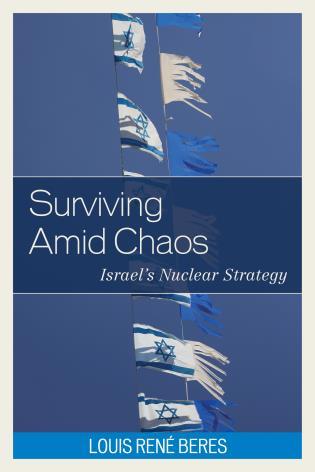
Surviving Amid Chaos: Israel's Nuclear Strategy (Weapons of Mass Destruction)Apr 4, 2016 by Louis René Beres. Hardcover.Rowman & Littlefield Publishers In his new book, Prof. Louis René Beres delves into the complexities of one of the most heated issues in the Middle East and all world politics. As he examines the current nuclear doctrine of the Jewish state, he also suggests that a suitably revised doctrine is in order


Surviving Amid Chaos: Israel's Nuclear Strategy (Weapons of Mass Destruction)Apr 4, 2016
by Louis René Beres. Hardcover.Rowman & Littlefield Publishers

In his new book, Prof. Louis René Beres delves into the complexities of one of the most heated issues in the Middle East and all world politics. As he examines the current nuclear doctrine of the Jewish state, he also suggests that a suitably revised doctrine is in order


This timely and original scholarly book critically examines Israel's rapidly evolving nuclear strategy, a subject with which the author has been authoritatively acquainted for many years. Now facing an unprecedented configuration of existential threats, and, as corollary, a potentially deteriorating "correlation of forces," Israel's leaders must consider such urgent and overlapping survival issues asdeliberate nuclear ambiguity (the "bomb in the basement"); regional nuclear proliferation; Jihadist terror-group intersections with enemy states;rationality or irrationality of state and sub-state adversaries; assassination or "targeted killing;"preemption; and probable effects of "Cold War II" between Russia and the United States. As Professor Beres' new book will explain, these issues underscore the overarching complexity of critical strategic interactions in the Middle East, including more-or-less plausible synergies between Israel's chosen strategic policies, and also the expected reactions of its multiple and often "hybrid" enemies.

Throughout, the author's examination of these issues expressly references pertinent considerations of international law, especially humanitarian international law (the law of armed conflict); terrorist extradition and prosecution; and anticipatory self-defense. Surviving Amid Chaos, therefore, is a book that presents an altogether original synthesis of strategic and jurisprudential factors regarding Israel's nuclear strategy

In the final analysis, as this new book argues convincingly, Israel's nuclear strategy must spring from antecedent nuclear doctrine. What should be the core components of such a doctrine? How has this doctrine actually evolved, from the early days of Prime Minister David Ben-Gurion, to the present moment? What should be the core components of doctrine going forward? To what extent, if any, should these components be made explicit or recognizable? To what extent, if any, should Israel's strategic nuclear doctrine be fashioned on the assumption that there will be endlessly "shifting sands" of friends and foes in the region? To what extent, if any, should Jerusalem construct this doctrine with a view to sharing certain conceptual and operational details with Washington?

Surviving Amid Chaos addresses these distinctly nuanced and interrelated questions.

Israel's emerging strategic nuclear doctrine, we may learn from this book, can never be based upon singular threats. Always, this doctrine must always emerge from a suitably comprehensive consideration of all ascertainable security hazards, a consideration that looks at each particular threat from the much broader and more coherent perspective of vital "correlations" between them. An example would be the Iranian nuclear threat, which is examined here together with the prospect of a Palestinian state. Also discussed by Professor Beres is the role of certain relatively intangible components of enemy force correlations, especially Jihadist belief systems that promise immortality to "martyrs." Here, in the context of examining Israel's nuclear strategy, Surviving Amid Chaos considers a long-neglected source of correlative power in world politics – that is power over death.

Professor Beres' book also looks factually and precisely at different scenarios of regional nuclear proliferation, and at Israel's corresponding obligations and opportunities. Will a newly nuclear Shiite Iran spawn additional nuclear aspirants in Sunni Egypt and/or Saudi Arabia? If so, what would this suggest about possible sub-state nuclear proliferation hazards, to both Shiite (e.g., Hezbollah) and Sunni (e.g., ISIS) terrorist organizations? Should Israel plan to deal with these multiple and intersecting threats with more frequent and more devastating "self-help" resorts to preemption (including assassination and "regime targeting"), or instead by fashioning long-term strategies of deterrence? Moreover, the book inquires, is there a forseeably productive role here for the United Nations and world diplomacy, or do persistently "Westphalian" international relations render moot any such expanded collective security role?

Most importantly, perhaps, Surviving Amid Chaos focuses especially upon the question of "deliberate ambiguity," or the "bomb in the basement." Looking ahead, should Israel's strategy favor a shift to certain potentially useful forms of "disclosure," or should Jerusalem continue with its historic position of "no comment?" As the Chair of Project Daniel (PM Sharon, 2003), and as the editor of Security or Armageddon; Israel's Nuclear Strategy (Lexington Books, 1986) – one of the very first books to consider this question – Professor Beres looks intensely and authoritatively at these particular issues. Among other things, his book will explain why the best argument for ending deliberate nuclear ambiguity has nothing to do with simply re-stating the obvious, but rather with the deterrence-enhancing advantages of undertaking certain limited and incremental disclosures. Iran and other centers of future nuclear threat could be more durably deterred by Israel's nuclear strategy if that strategy suitably expressed the usability, survivability, and penetration-capability of Israel's indispensable nuclear forces.

Surviving Amid Chaos: Israel's Nuclear Strategy (Weapons of Mass Destruction)Apr 4, 2016 by Louis René Beres. Hardcover.Rowman & Littlefield Publishers In his new book, Prof. Louis René Beres delves into the complexities of one of the most heated issues in the Middle East and all world politics. As he examines the current nuclear doctrine of the Jewish state, he also suggests that a suitably revised doctrine is in order


Surviving Amid Chaos: Israel's Nuclear Strategy (Weapons of Mass Destruction)Apr 4, 2016
by Louis René Beres. Hardcover.Rowman & Littlefield Publishers

In his new book, Prof. Louis René Beres delves into the complexities of one of the most heated issues in the Middle East and all world politics. As he examines the current nuclear doctrine of the Jewish state, he also suggests that a suitably revised doctrine is in order


This timely and original scholarly book critically examines Israel's rapidly evolving nuclear strategy, a subject with which the author has been authoritatively acquainted for many years. Now facing an unprecedented configuration of existential threats, and, as corollary, a potentially deteriorating "correlation of forces," Israel's leaders must consider such urgent and overlapping survival issues asdeliberate nuclear ambiguity (the "bomb in the basement"); regional nuclear proliferation; Jihadist terror-group intersections with enemy states;rationality or irrationality of state and sub-state adversaries; assassination or "targeted killing;"preemption; and probable effects of "Cold War II" between Russia and the United States. As Professor Beres' new book will explain, these issues underscore the overarching complexity of critical strategic interactions in the Middle East, including more-or-less plausible synergies between Israel's chosen strategic policies, and also the expected reactions of its multiple and often "hybrid" enemies.

Throughout, the author's examination of these issues expressly references pertinent considerations of international law, especially humanitarian international law (the law of armed conflict); terrorist extradition and prosecution; and anticipatory self-defense. Surviving Amid Chaos, therefore, is a book that presents an altogether original synthesis of strategic and jurisprudential factors regarding Israel's nuclear strategy

In the final analysis, as this new book argues convincingly, Israel's nuclear strategy must spring from antecedent nuclear doctrine. What should be the core components of such a doctrine? How has this doctrine actually evolved, from the early days of Prime Minister David Ben-Gurion, to the present moment? What should be the core components of doctrine going forward? To what extent, if any, should these components be made explicit or recognizable? To what extent, if any, should Israel's strategic nuclear doctrine be fashioned on the assumption that there will be endlessly "shifting sands" of friends and foes in the region? To what extent, if any, should Jerusalem construct this doctrine with a view to sharing certain conceptual and operational details with Washington?

Surviving Amid Chaos addresses these distinctly nuanced and interrelated questions.

Israel's emerging strategic nuclear doctrine, we may learn from this book, can never be based upon singular threats. Always, this doctrine must always emerge from a suitably comprehensive consideration of all ascertainable security hazards, a consideration that looks at each particular threat from the much broader and more coherent perspective of vital "correlations" between them. An example would be the Iranian nuclear threat, which is examined here together with the prospect of a Palestinian state. Also discussed by Professor Beres is the role of certain relatively intangible components of enemy force correlations, especially Jihadist belief systems that promise immortality to "martyrs." Here, in the context of examining Israel's nuclear strategy, Surviving Amid Chaos considers a long-neglected source of correlative power in world politics – that is power over death.

Professor Beres' book also looks factually and precisely at different scenarios of regional nuclear proliferation, and at Israel's corresponding obligations and opportunities. Will a newly nuclear Shiite Iran spawn additional nuclear aspirants in Sunni Egypt and/or Saudi Arabia? If so, what would this suggest about possible sub-state nuclear proliferation hazards, to both Shiite (e.g., Hezbollah) and Sunni (e.g., ISIS) terrorist organizations? Should Israel plan to deal with these multiple and intersecting threats with more frequent and more devastating "self-help" resorts to preemption (including assassination and "regime targeting"), or instead by fashioning long-term strategies of deterrence? Moreover, the book inquires, is there a forseeably productive role here for the United Nations and world diplomacy, or do persistently "Westphalian" international relations render moot any such expanded collective security role?

Most importantly, perhaps, Surviving Amid Chaos focuses especially upon the question of "deliberate ambiguity," or the "bomb in the basement." Looking ahead, should Israel's strategy favor a shift to certain potentially useful forms of "disclosure," or should Jerusalem continue with its historic position of "no comment?" As the Chair of Project Daniel (PM Sharon, 2003), and as the editor of Security or Armageddon; Israel's Nuclear Strategy (Lexington Books, 1986) – one of the very first books to consider this question – Professor Beres looks intensely and authoritatively at these particular issues. Among other things, his book will explain why the best argument for ending deliberate nuclear ambiguity has nothing to do with simply re-stating the obvious, but rather with the deterrence-enhancing advantages of undertaking certain limited and incremental disclosures. Iran and other centers of future nuclear threat could be more durably deterred by Israel's nuclear strategy if that strategy suitably expressed the usability, survivability, and penetration-capability of Israel's indispensable nuclear forces.

Saturday, October 22, 2016

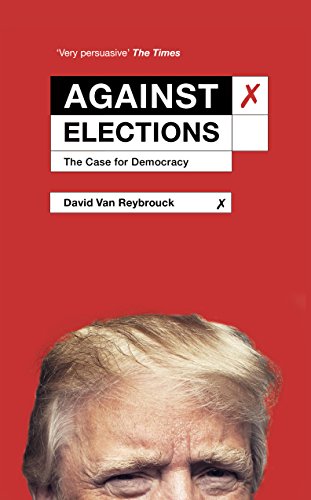
Against Elections: The Case for Democracy. David Van Reybrouck. Bodley Head. 2016.


Against Elections: The Case for Democracy. David Van Reybrouck. Bodley Head. 2016.


Against Sortition


In governance, sortition (also known as allotment or demarchy) selects officers as a random sample from a larger pool of candidates.In ancient Athenian democracy, sortition was the traditional and primary method for appointing political officials and its use was regarded as a principal characteristic of democracy.Sortition is commonly used to select prospective jurors in common law-based legal systems and is sometimes used today in forming citizen groups with political advisory power (citizens' juries orcitizens' assemblies).

The public sphere is full of analyses and lamentations about the inability of Europe’s current political parties and elites to represent their peoples/electorates/nations. Peter Mair’sRuling the Void provides an excellent history of the problem. The end of the Industrial Revolution in the 1960s-70s saw the decline of large class structures, and thus the identities that allowed parties to represent big class or occupational groups; the end of Communism and the triumph of neoliberalism left existing parties with only one ideology to choose from. Parties became state-funded agencies run by media or policy experts as there was no mass base to provide a wider pool of leadership recruits; they became a ‘cartel’ of parties and a ‘caste’ of party leaders. These are despised by an increasingly disengaged, volatile, capricious and angry electorate. The end result is nasty or irresponsible populism.

This review looks at one author’s novel approach to solving our crisis of representation. David Van Reybrouck, a Belgian author and public intellectual, wrote an excellent history of The Democratic Republic of Congo. In his newest book, Against Elections: The Case for Democracy, he reprises some of Mair’s points about the decline of party-electorate linkages. His solution is to bring back sortition – that is, the selection of public officials through the drawing of lots. To Van Reybrouck, the problem isn’t democracy, it is ‘electoral-representative democracy’ and ‘electoral fundamentalists’.

Van Reybrouck argues that the electoral principle has long been understood as undemocratic. The ancient Athenian polis, whose constitution he discusses in great detail, only deployed election to offices requiring specific expertise, such as military positions; otherwise, magistracies were chosen by lot. This system found endorsement by Montesquieu and Rousseau, but was abandoned for the more aristocratic principle of election by the bourgeois meritocrats of the French and American revolutionary eras. It became the election of ‘men who possess the most wisdom to discern, and the most virtue to pursue the common good of society’ (The Federalist Paper #57). This mechanism eventually became embedded in a system of mass parties: a ‘democratisation of elections’ Van Reybrouck condemns as ‘a bogus process’ aided by the redefinition of the word ‘democracy’ and the association of sortition with military conscription.
Image Credit: (Jeff Turner CC BY 2.0)

Key to Van Reybrouck’s diagnosis and proposed solutions is a specific idea of democracy, and an implicit idea of how society is organised and should be represented. Van Reybrouck seems to see elective representation itself as aristocratic, at least for offices not requiring special knowledge. ‘Democracy is not government by the best in our society, because such a thing is called aristocracy, elected or not […] Democracy, by contrast, flourishes precisely by allowing a diversity of voices to be heard’ (152-53). He wants to deal with the problem of the elite-electorate gap by collapsing it completely.

Van Reybrouck certainly makes a valuable contribution to political theory and discussion with his book, and he is a skilled author and researcher. His sketch of how classical Athens worked is one of the best parts of the book, and I would enjoy seeing him put his skills to a history of its democracy. Indeed, the book serves as a very good introduction to the history of sortition in classical, medieval and modern politics, using examples from Europe and North America. Anyone wanting to experiment with Van Reybrouck’s theories will find plenty of practical guidance here.

However, Van Reybrouck’s proposals, however innovative and fresh, only deal with a single aspect of modern disaffection: the alienation of voters from parties and politicians. That’s no small thing, but it is also not a freestanding problem. Politicians may seem like cookie-cutter reproductions of the same neoliberal PR account manager, but that is partly because free-market liberalism has been the only ideology on offer for something like a quarter century, because capital has broken free of national borders and eroded the public sphere. Those global pressures transcend national boundaries, and the ideologies that justify them do as well; simply changing the way states select officials fails to address that larger problem. Greece could pick a new government by drawing lottery balls tomorrow; that government would still have to deal with the bond markets. And Van Reybrouck’s model still relies on experts and officials to help advise the citizens chosen by lot. Nothing suggests that these counsellors would be any more ideologically diverse than the technocrats currently employed by the IMF, the European Union or various finance ministries.

Another problem is Van Reybrouck’s approach to structures other than parties that lie between the citizen and their state. It is perfectly legitimate to complain that ‘lobbies, think tanks and all kinds of interest groups’ have more access to the policymaking process than ordinary citizens (156), but he also seems to assume that those sorted into policymaking or review roles will neither be members of political parties nor engage in ‘tactical voting […] political haggling [or] back-scratching’, instead making decisions ‘according to their conscience, according to what he or she feels best serves the general interest in the long term’ (146).

This implies that there is only one definition of the general interest, which everyone can neutrally work out with enough ratiocination and good will. This ignores questions of class, race, occupation, sub-nationalism and all the other identities, material interests and philosophical concerns we carry into politics. How would this work in a federal system, where you effectively have not just one general national interest, but also the general interests of several states or provinces? From an economic standpoint, how do you come up with a general interest that distributes (or more challengingly, redistributes) resources? For all his condemnation of the first bourgeois republicans of the late-eighteenth century, Van Reybrouck borrows their ideas about a politics without party. That worked for Enlightenment liberals because they could pretend there was only one general interest, since the elected represent only one class of capital owners. He lists several examples of premodern political units that used lot-drawing, but in all of these cases, the ‘citizens’ were a homogenous group of a few thousand or ten thousand men of similar wealth.

In any case, choosing governors by lot does not automatically mean that the public will see those chosen as representing them. Sortition may produce a more representative assemblage of policymakers, but it does not actually empower ordinary citizens unless they are chosen. In Van Reybrouck’s touchstone, Athens, this was not a problem: every citizen was part of the legislature, and there were more than a thousand executive and legislative posts chosen by lot. Every citizen was in some way empowered (a task made easier by excluding most inhabitants from citizenship), and service in an executive role was almost impossible to avoid. In a modern state, this sort of mass participation is not possible, so most citizens will, at most, get to leave comments on the assembly website or vote in occasional referenda. Elections are democratic precisely because they grant choice to citizens, even if it is only a Schumpeterian choice between elites.

Finally, the book’s model for a system run on these ‘aleatory-democratic’ (‘aleatory’ meaning ‘based on chance’) lines, though very thoughtful, is also hugely complex. It involves no fewer than six types of assembly: An assembly to set the overall agenda; ‘interest panels’ to propose specific legislative topics; a review panel to prepare detailed bills; a ‘policy jury’ that would vote on the bills (but not debate them); an oversight council to handle complaints and judicial review; and a rules council to set rules for the other bodies. It is unlikely even the most educated, wonkish voter would find such a Rube Goldberg machine an attractive model. It reminded me of Olivier Bernier’s description of the legislature in Napoleonic France: ‘The Tribunat was composed of one hundred members who discussed the bills brought to it by the executive, but could not vote on them. The Corps Législatif had three hundred members who voted the bills into law, but could not discuss them’ (65).

Van Reybrouck does politics a great service by opening up our discussions of political structure and agency, questioning age-old ideas about elections, representation and the division of powers. That, and his considerable and well-presented historical research, make this book well worth reading. But in an age of such profound citizen dissatisfaction, it is far from clear we can leave something as central as representation to mere chance; leaving things to the supposedly ‘aleatory’ justice of the market is, after all, part of what got us into this mess.

Sunday, October 16, 2016

by Stephen M. Silverman and Raphael D. Silver
Alfred A. Knopf, 464 pp., $45

edited by Holli Levitsky and Phil Brown
Academic Studies Press, 416 pp., $69

by Marisa Scheinfeld, with essays by Stefan Kanfer and Jenna Weissman Joselit
Cornell University Press, 200 pp., $29.95

Image result for Catskills Jewish
The famous Catskills fortresses—Kutsher’s, The Concord, and Grossinger’s heading the list—were, in novelist Mordecai Richler’s words “Disneyland with knishes” and in Damon Runyon’s “Lindy’s with trees,” which meant that they weren’t just fancy resorts in the mountains. They were quintessentially Jewish resorts—of, by, and for Jews. This is the Catskills of Marjorie MorningstarDirty Dancing, and of Stefan Kanfer’s boisterous, bawdy, and ultimately wistful history, A Summer World. It is the Catskills where so much of Jewish entertainment was born and where so much of the American Jewish experience was defined.Mention the Catskills to any Jew of a certain generation and what immediately comes to mind is the “Borscht Belt”—the string of elegant, oversized resorts, basically all-inclusive compounds, in upstate New York where, for decades, Jews from the Eastern Seaboard spent their summers swimming and basting in the sun; playing canasta, shuffleboard, bingo, canasta, mah jongg, and “Simon Sez”; laughing at fresh young comics and some famous older ones (and not laughing too); being tickled by tummlers who roamed the premises to provide mischief and fun lest the guests find themselves bored for an instant; occasionally seeking romance; and three times a day, without fail, eating—above all, eating, lots and lots of eating. “Jews ate like Vikings,” remembered Billy Crystal.
It may come as a surprise, then, that there is an entirely different Catskills, the one described in Stephen Silverman’s and Raphael Silver’s encyclopedic new book simply titled The Catskills. Yes, the Borscht Belt is there, but it is not center stage, just one tableau in a long set of tableaux. The story Silverman and the late Silver (who produced the films Hester Street and Crossing Delancey, both directed by his wife, Joan Micklin Silver) tell is the story of a pristine wilderness, God’s setting, along the river named after its discoverer, Henry Hudson, who aptly enough found it while searching for the Northwest Passage to the Orient, and of man’s attempted conquest of that wilderness.
Jews didn’t play much of a role in this contest until much, much later in the Catskills’ history. In the beginning, a land-speculating Dutchman named Johannes Hardenbergh got a grant from the British in 1708 for two million acres. (The name Catskills means cat creek in Dutch and may have had something to do with the mountain lions that roamed the forests at the time.) Over the following 200 years, the Catskills became America’s “first national landscape,” even as its natural riches were serially plundered. In telling this story, Silverman and Silver introduce a gallery of eccentrics: Zadock Pratt, who, in the 1820s, discovered that the bark of the Catskills’ plentiful hemlock trees was useful for tanning hides and denuded the forests while making the area a capital for tanning; “Bluestone King” John Fletcher Kilgour, who quarried the bluestone for pavement and construction, but wound up penniless; Undersheriff Osman “Bud” Steele, who was murdered trying to put down an anti-rent protest by angry, exploited tenant farmers; multimillionaire Jay Gould, who opened the area to the railroads; and gangsters like “Dutch” Schultz, who, according to a legend sparked by his dying words (“Wonder who owns these woods? . . . he’ll never know what’s hidden in ’em . . . My gilt-edged stuff . . . What did that guy shoot me for?”) allegedly left a fortune buried in the Catskills.
It was Catskills resident Washington Irving who, in stories such as “Rip Van Winkle” and “The Legend of Sleepy Hollow,” imputed to the mountains a magical romance, and America’s first great novelist, James Fenimore Cooper, who, in his Leatherstocking Tales, celebrated the untouched wilderness, invoking a time before the Catskills were corrupted by intruders. For them, the Catskills represented what was best about this young country—its beautiful, awe-inspiring, primeval rawness. And if this gently mountainous land was our first national landscape, it was also, because of that, a place where America first became America—a place that defined us as both rustic and reverential.

The Arcadian or Pastoral State, the second painting in The Course of Empire by Thomas Cole, 1834. Note  the size of the human figures in relation to the landscape. (Courtesy of the New York Historical Society.)
The Arcadian or Pastoral State, the second painting in The Course of Empire by Thomas Cole, 1834. Note the size of the human figures in relation to the landscape. (Courtesy of the New York Historical Society.)
Perhaps nowhere is this more in evidence than in the magnificent and magnificently large Hudson River School paintings of Thomas Cole, Asher Durand, and Frederic Church, men whose canvases functioned in their day the way blockbuster movies do in ours. People actually paid to see these cinemascopic paintings that gave testimony to the verdant lushness of the Catskills and to its providential glory. In these lush landscapes, man was always subordinate, both literally and figuratively. He was a small dot dwarfed by nature. Cole’s great five-painting series from the 1830s,The Course of Empire, which depicts one landscape through history, illustrates what happens when man asserts himself against nature. What happens is destruction and desolation.

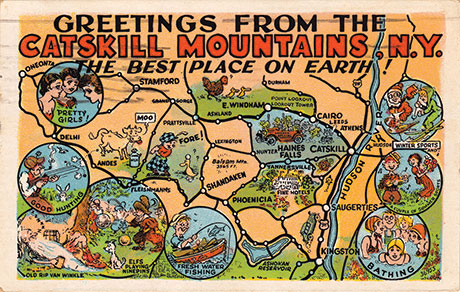
Vintage postcard from “the best place on earth,” ca. 1950s–1960s.
The Jews who came to the Catskills didn’t fit neatly into this schema. They didn’t want to ruin nature, but they didn’t exactly come to commune with it either. There had been Jewish farmers in the Catskills from the 1770s, though it was an improbably difficult place to raise crops.  A Jewish agricultural community in Ulster County in the 1830s lasted only five years. (One feels a Borscht Belt joke coming, but Henny Youngman and his colleagues didn’t do history.) By the last quarter of the century, farming had faded, and the Catskills had become a recreation retreat with monumentally large hotels perched on the mountainsides and a railroad disgorging guests directly from New York City.
But not Jews. The hotels were restricted—so restricted that in 1877 even the prominent Jewish banker Joseph Seligman, a peer of John Jacob Astor and Andrew Carnegie, and a friend of President Grant, was denied a room at the Grand Union Hotel, on the edge of the Catskills in Saratoga Springs. He wrote an indignant letter to the hotel’s owner, and their exchange was picked up by newspapers across the country, triggering a brief national debate on anti-Semitism. It was a debate the Jews lost. If Gentiles were going to God’s country to relax, the last thing they seemed to want was to have communicants with the God of the Old Testament there with them.
When Selig Grossinger, a Galician immigrant with a fourth-grade education who had failed at everything at which he had tried his hand, came to the Catskills in the 1910s, he had no intention of opening a hotel for Jews. Not heeding the warnings of history, he bought a farm in Sullivan County. After failing yet again, he converted his farm into a boarding house catering to Eastern European Jewish immigrants from New York City. Usually they stayed either at boarding houses or at what were called kuchalayn, where one cooked one’s own food in bare rooms with few amenities, aside from the beauty of the outdoors.

Jennie Grossinger with Debbie Reynolds and Eddie Fisher at Grossinger’s Catskill Resort Hotel, mid-1950s.
Grossinger’s evolved into something very different, both from the kuchalayn and from the Gentile resorts. Run by Selig’s daughter, Jennie, who would become the grande dame of the Borscht Belt by recognizing that Jews enjoyed opulence no less than Gentiles, Grossinger’s was somewhat overwrought in the American-Jewish tradition of too-muchness, where more was always more. It had tennis courts, an 18-hole golf course, a 400-seat dining room, and a theater. But, as Silverman and Silver describe it, that didn’t seem sufficient, so Grossinger’s kept growing and adding: a newspaper, a fire department, a shula riding academy, a ski slope, a post office, and, perhaps the pièce de résistance, an airfield.

Belying its Jewish grandiosity, however, was its gemütlich atmosphere, which was also prototypically Jewish. By contrast, Silverman and Silver quote historian Samantha Hope Goldstein on 19th-century Gentile activities in the Catskills: “sketching, writing poetry, strolling . . . and other focused activities which emphasized a refined passivity,” which she attributed to the old Hudson School idea that a visitor there was a “vessel to receive the greatness of God through His landscapes.” The Gentiles came to the Catskills to glory in nature; the Jews came for something else. For them, the Catskills were not nature idealized; it was Jewish family life idealized, which is why it was no coincidence that the two greatest Jewish resorts, Grossinger’s and its rival, The Concord, were run by women, basically Jewish mothers fussing and tut-tutting over their guests. More, for Jews, the Catskills resorts weren’t only an escape from the crowded city; they were also an escape into—into the Jewish community of friends and relatives, many of whom would return year after year after year, underscoring the sense of family on which these resorts were predicated. At Grossinger’s, The Concord, and Kutsher’s, Jews didn’t dissolve their identities into some Whitmanian universal; they asserted it. And for Jews, the last thing they desired was passivity—the Jewish resorts positively buzzed with activity.
As for the God thing, Jews were different from Gentiles there too. For the Gentiles, vacating to the Catskills was all about reverence.  Jews were no less religious; the kitchens were, after all, kosher. But they were less reverent. And maybe that’s where the humor came in. Perhaps, humor was to Jews what gazing upon nature was to Gentiles: a reckoning with God.

As much as anything, the Borscht Belt would become known for the great comedians and comic writers who interned there—among them, Danny Kaye, Phil Silvers, Jerry Lewis, Don Rickles, Red Buttons, Alan King, Sid Caesar, Mel Brooks, and, in later years, Andy Kaufman and Jerry Seinfeld. In short, where Gentiles communed, Jews laughed. Humor was self-protection, negotiation, and balm. You kibitzed with everybody, including God. You had to.
As one old joke goes, a Jew is walking in the forest and, feeling the spirit of God, begins to speak to Him. “God, are you there?” And God says, “Yes my son, I am here.” So the man, in a philosophical mood, says, “God, what is a million years to you?” And God replies, “Well, my son, your million years is like a second to me.” The man lets that sink in. Then he looks to the sky and says, “God, what is a million dollars to you?” And God replies, “My son, your million dollars is less than a penny to me. It means nothing to me.” So the man thinks a moment, then looks up to the sky and says, “God, can I have a million dollars?” And God replies, “In a second.”
Not everyone appreciated this kind of thing. In his novel Enemies: A Love Story, set partly in the Catskills, Isaac Bashevis Singer has his protagonist ask, “Why is it all so painful to me? The vulgarity in this casino denied the sense of creation. It shamed the agony of the Holocaust.” Singer compared the refugees from Nazism who had flocked to the Catskills shortly after the war to moths “attracted by the bright lights, deceived by a false day,” eventually dying by beating themselves against a wall or singeing themselves on light bulbs.

A Hasidic family out for a walk, Woodbourne, NY. (Courtesy of Eli Wohl.)
He wasn’t entirely wrong. It is hard to square the noisy, voluptuary, funny Catskills with the Holocaust, and easy to see it as a kind of willful refutation of Jewish suffering. “It’s so peaceful here at night,” Art Spiegelman says in Mausof the Catskills, “It’s almost impossible to believe Auschwitz ever happened.” To the Singers of the world, it didn’t matter that, in some measure, this was one of the points of the Jewish Catskills: There was no time for reflection there and no desire for it. 

Coffee shop, Grossinger’s Catskill Resort Hotel, Liberty, NY. Bottom: (Courtesy of Marisa Scheinfeld.)E
Coffee shop, Grossinger’s Catskill Resort Hotel, Liberty, NY. Bottom: (Courtesy of Marisa Scheinfeld.)
Phil Brown, in an essay in an anthology he co-edited with Holli Levitsky titledSummer Haven: The Catskills, the Holocaust, and the Literary Imagination, calls the dissonance between American Jews’ summer pleasure and the recent mass extermination of their European cousins a “horrific contradiction,” though it was also, in some ways, cause and effect. Obviously, the great Jewish resorts pre-dated the Holocaust. But the so-called Golden Era of those resorts was the 1950s and 1960s, after the Holocaust. And while the Holocaust made no overt mark on the resorts, it did serve as subtext. As the cliché goes, you laughed so you wouldn’t cry, you played so you didn’t have to contemplate, you gorged to compensate for the European Jews who couldn’t, and you occupied yourself so you wouldn’t have to remember. Brown calls the Catskills a “mini-Jerusalem” where Jews could be Jews. But clearly it was a Jerusalem without grief.
The Borscht Belt wouldn’t last. In part it was a casualty of the very thing that had helped create it. As restricted hotels declined, so did the need for unrestricted ones. At their height, there were some 2,000 hotels in the Catskills. With the rise of assimilation, the need for a mini-Jerusalem, a Jewish refuge, was obviated. Grossinger’s closed in 1982 and was demolished in 1986; The Concord lasted until 1998. Kutsher’s, where Wilt Chamberlain had once been a bellboy, outlasted them all, but it finally closed in 2013 to be converted into a yoga retreat. There was still a Jewish presence in the Catskills after the resorts’ demise. Now, however, it was Hasidim who replaced the secular Jews by buying up some of the old resorts and bungalow colonies, and bringing Yiddish (and a very different kind of Yiddishkeit) to the Catskills.

: Outdoor pool,  Vegetarian Hotel, Woodridge, NY. (Courtesy of Marisa Scheinfeld.)
Outdoor pool, Vegetarian Hotel, Woodridge, NY. (Courtesy of Marisa Scheinfeld.)
But the ghosts remain. Photographer Marisa Scheinfeld has documented the end of the great resorts in The Borscht Belt: Revisiting the Remains of America’s Jewish Vacationland, which features page after page of photos of waterless, cracking pools, dirt-caked floors, weathered and withered wooden cottages, gashed ceilings and gushing insulation, graffiti-bedecked walls, rows of bereft beach chairs, and, perhaps above all, emptiness where there had once been fullness. Scheinfeld’s photos remind one of the old Catskills’ theme of nature despoiled, a contemporary counterpart to the desolate final painting in Cole’s The Course of Empire.
It is hard to imagine a place once so overstuffed with life now so devoid of it. Scheinfeld’s photos are images of desolation, and one feels the urge to mourn the loss of these “mini-Jerusalems,” but perhaps that wouldn’t quite be in the Grossinger’s spirit. As Silver and Silverman inform us, when it finally came time to demolish the great resort’s playhouse, Eddie Fisher, who had debuted there, pushed the plunger—an old relic dynamiting an even older relic. It feels like the kind of black irony his Borscht Belt colleagues and audiences would have appreciated.
Thursday, October 13, 2016

Ghosts of Manhattan: A Novel Paperback ,by Douglas Brunt ,Touchstone

Ghosts of Manhattan: A Novel Paperback ,by Douglas Brunt Touchstone


Successful prose fiction weaves together the fabric of true-to-life experience with the artificial fiber of created characters and synthesized plot lines. The final “quilt” is seamless; you can’t tell which are the real fibers and which are the synthetic ones. This quilt is stronger and more form fitting than the literal truth. It provides us with a lesson, a moral, a path to our own future.

With the American economy still in trouble, and the jobless future still appearing quite bleak, now is the time to look back over the past decade through the probing truth-telling eyes of prose fiction. Douglas Brunt, first time novelist, is a persuasive storyteller, and one story that was important to the collapse of our speculation and deception-ridden economy was failed bailout and ultimate demise of Bear Stearns in 2008. Brunt details a personal world of opulence and excess which the traders and sellers entered when they signed up for duty at Bear Stearns. Whether this rendering is entirely realistic or just one window into a larger reality, it is a compelling read. Our guide to this world is Nick Farmer, a seasoned bond trader who like so many others has sacrificed his youth and his dreams for the million dollar bonuses and the over-specialized non-transferable skills of Wall Street.

But Farmer isn’t just another soulless sellout – he has heart and it turns out he has courage. As we follow him through a Celinesque world of hallucinatory Wall Street decadence and depravity we find ourselves rooting for his final chance for escape. In the process we witness bathroom cocaine, endless alcohol binges, and hookers and strippers who submit to sado-masochistic tryts which tragically border on rape.

Farmer is more or less on the periphery of this brutality, more of a witness than a participant, but it is clear he wasn’t simply signing on to a computer screen when he took the job at Bear, he was agreeing to a mentally and physically corrosive lifestyle that was the ultimate undoing of the individual and may have contributed to the cumulative undoing of our economy. After more than a decade of exposure to this life, Farmer not only feels trapped, but he is in danger of losing both his marriage and his sanity. It is amazing that he is still in a position where he can still save both.

Brunt describes not just the psychological but also the physical effects of years of excess drinking. Jack Wilson is an associate who runs the trading desk at Chappy, a top brokerage shop. “He’s about five seven, average build, but his face and neck are swollen from alchohol. The way cookie dough flattens when baked, his features have melted down to be almost flat and unrecognizable. There is enough left to see that it had once been a good-looking face.”

Jack ends up having a heart attack, probably brought on by alcohol and cocaine, and literally collapses in Nick’s arms, near death.

Jack’s destruction motivates Nick in his struggle to regain his moral compass before its too late, to resist the temptress who is the final threat to his marriage, to quit before he is sucked irretrievably to the center of the vortex.

Reading The Ghosts of Manhattan, it is easy to understand how the worst of Wall Street came apart. But in Nick’s determination to escape his own inevitable destruction we are uplifted and find renewed hope for a cleaned-up world without Bear Stearns.

Unfortunately, plucking out one large weed didn’t mean that others wouldn’t immediately grow in to take its place.

Wednesday, October 5, 2016

Ctrl + Z: The Right to be Forgotten. Meg Leta Jones. NYU Press. 2016.


Ctrl + Z: The Right to be Forgotten. Meg Leta Jones. NYU Press. 2016.
the-right-to-br-forgotten-cover

Can the notion of digital privacy be reframed to resolve policy issues? That is the question at the heart of Meg Leta Jones’ book,Ctrl + Z: The Right to be Forgotten. It offers us alternative ways of thinking about a difficult and taxing matter in the digital era: namely, the right to privacy, and specifically the right to protect one’s own reputation online. We are invited to consider new ways of conceptualising the appropriate policy responses. What, if anything, should the state do, when so much information about our lives resides online and is seemingly there forever, exposing our innermost thoughts and feelings, our peccadilloes and our friendships to ever-wider public scrutiny?

Leta Jones takes a narrow slice of the privacy policy debate in order to tease out the technical and social issues. As the title suggests, the book is inspired by the case of Google Spain in the European Court of Justice. This concerned an individual who wanted news articles about his past debts removed from the Google search engine, and whose claim was upheld by the European Court of Justice.

The book addresses an issue that arises out of that case: namely, that of ‘reputatation management’.  Framed from the perspective of a digital native, it reminds us that ‘your most shameful secret, cringe-inducing incident’ may remain somewhere online. The underlying assumption is that everyone may have an embarrassing moment that has been captured and stored forever, encapsulating the idea that the posting of a drunken image when young can haunt someone throughout their career. Likewise, in the digital era, individuals can never shake off the past, whether previous convictions, deadbeat dads or revenge porn.
However, the right to be forgotten is not exactly what it seems. It is about a right to have information erased; but in the digital era, erasure does not mean total oblivion. This book addresses how we as a society, and in particular our lawmakers, should manage the boundaries of privacy and reputation. It investigates ways in which we might seek to control information about ourselves online, and who should be responsible for managing those procedures. It puts forward the idea that those in charge of storing and processing data could act as information stewards. The right to be forgotten is therefore conceptualised as a way for individuals to have some opportunity to manage information about themselves that is in the public domain, to enable them to have some form of control over it or recourse against possible harm.

the-right-to-be-forgotten-imageImage Credit: Delete Key (Ervins Strauhmanis CC BY 2.0)


The deletion of information is an especially sensitive matter for policymakers as well as for the courts. The book includes a comparative study of the US and the EU, considering the different legal approaches to privacy and erasure of personal data on both sides of the Atlantic. Leta Jones evidently has a US perspective on this issue, but refreshingly she demonstrates a strong interest in the European position, incorporating case law examples from several EU member states as well as the European Court of Justice.

The book also introduces theories of conceptualising privacy. Indeed, the book asks whether privacy is even the appropriate way to consider this issue. Privacy can be considered as ‘personhood’, but it can also be about identity. It may be conceptualised as the absence of information about oneself or about the ability to control that information.

Then there is a consideration of what it means ‘to forget’.  Leta Jones raises notions of redemption and ‘forgiveness’ on the basis that forgiveness may be a long time coming when information remains available online and its currency stays constant. The author builds these concepts into the legal argument further in the book, which from my perspective was interesting in forcing us to think harder about the problem, but I’m not sure it brought us closer to a policy solution.

What I especially liked was the discussion on innovating privacy, and the way the author takes us from theory into practice in the digital environment. The book discusses the idea of  ‘discoverability’. This is about ways in which information can be found and identified, which does vary according to services, applications and uses. Not all information is created equal. Information may be attributed different values depending on certain variables, such as who put it online and how long it has been there.  There is a broad distinction between data that we post and make public ourselves about ourselves versus data posted by others. There is a further difference between a one-off original posting and a click-stream from blogs, tweets, social media and so on. Moreover, we should distinguish between information actively posted and the data that is collected by analytics, which may be an actual record or may be predictive.

Leta Jones uses this analysis to introduce a concept of information stewardship. This is where she gets into the heart of the policy issues in a discussion of where decisions should be taken and by whom. In a scenario-based analysis, she discusses the role of the data controller and the ways in which different types of requests might be approached. Here lies the original thinking of the book, and the kind of analysis that could be helpful in the policy field. The book does not offer any preferred solution, but it does show an array of options and open eyes to new possibilities.

However, this book also leaves open a number of questions for scholars interested in this field. From a European perspective, the public interest issue is critical, the key question being where public interest and freedom of expression may override privacy rights. In many EU member states, the possibility of preventing politicians erasing their past is the most critical aspect of the right to be forgotten. Moreover, how should a ‘right to be forgotten’ differentiate between teenage folly and a person in the public eye knowingly indulging in bad behaviour and then trying to keep it silent? Also, how should it address past criminal behaviour? These questions are hinted at in the book, and will no doubt form the subject of further research.

Ultimately, the book’s strength is its ability to inspire, and that is what makes Ctrl + Z a pleasure to read.  In proposing the idea of information stewardship, it may give us some guidance towards a solution to this complex and controversial policy issue.

Friday, September 30, 2016

Hitler insulted when compared to Trump ....Trump-Hitler comparison seen in New York Times book review


Trump-Hitler comparison seen in New York Times book review


debate trump 3

An "egomaniac" who "rose to power through demagoguery, showmanship and nativist appeals to the masses." A man whose "manic speeches and penchant for taking all-or-nothing risks raised questions about his capacity for self-control." A nation where millions naively embraced "his doctrine of hatred."

This is the subject of a new New York Times book review, by Michiko Kakutani, about the recently published "Hitler: Ascent, 1889-1939" -- but many in the media have interpreted it as a thinly veiled comparison between Adolf Hitler and Donald Trump.
"The beauty of this @michikokakutani review is that it doesn't make the obvious point because it doesn't need to," The Washington Post's Carlos Lozada tweeted.
"Arguably the most compelling case made against Trump by anyone yet," tweeted Edward-Isaac Dovere, the senior White House reporter at Politico.
The review, which was published Wednesday, details (in bullet point format) the various factors that brought Hitler to power, from his own character traits to his use of mass media to the naïveté of his supporters. It does not mention Trump by name.
"Hitler was known, among colleagues, for a 'bottomless mendacity' that would later be magnified by a slick propaganda machine that used the latest technology (radio, gramophone records, film) to spread his message," one bullet point reads.
The review comes as The New York Times takes an increasingly critical stance toward Trump. In recent weeks, the paper has become more confident in calling out the candidate's lies. Wednesday's front-page featured stories about Trump's "disappointing debate," his secrecy about his taxes and his failure to make inroads with undecided female voters.
Kakutani did not respond to a request for comment, but Times executive editor Dean Baquet praised the review. "It was a great review of a big and obviously important book," he told CNNMoney.
Kakutani's apparent effort to highlight Hitler's Trump-like characteristics was not lost on others.
"This New York Times 'Hitler' book review sure looks like a thinly veiled jab at Trump," The Washington Post's Callum Borchers tweeted.
"You read it and think, 'Check. Check. Check,'" Kim Masters, a KCRW host and editor-at-large at The Hollywood Reporter, tweeted.
Many others, like NBC's Chuck Todd, likened it to a "subtweet," a twitter message that refers to someone without directly mentioning them.


 Follow
Chuck Todd 
@chucktodd
Does this book review qualify as a subtweet?http://mobile.nytimes.com/2016/09/28/books/hitler-ascent-volker-ullrich.html?_r=1&referer=https://t.co/hI2dLByHXH 
Photo published for In ‘Hitler,’ an Ascent From ‘Dunderhead’ to Demagogue

In ‘Hitler,’ an Ascent From ‘Dunderhead’ to Demagogue

A new biography portrays Hitler as a clownish, deceitful narcissist who took control of a powerful nation thanks to slick propaganda and a dysfunctional elite that failed to block his rise.
mobile.nytimes.com
Whether the review was actually intended as a comparison between Hitler and Trump, only Kakutani and her editors can say. But if that is the case, her decision not to mention Trump by name has given her the ability to deny any such interpretations.