Showing posts with label Ben Gurion. Show all posts

Monday, April 4, 2016


Israel's Civilian-Military Divide
The generals and politicians have surprisingly different views of the Iranian threat

Have you ever wondered why Iran, after halting (according to Western intelligence reports) its nuclear weapons program in 2003, resumed it (according to more such reports) by 2005? Patrick Tyler, a former New York Times foreign correspondent, thinks he knows. It wasn't because the initial shock of the American invasion of Iraq had worn off. The Iranian nuclear program was probably restarted, Mr. Tyler believes, in reaction to a "clandestine war" waged by Israel against Iran—a war launched, he states in his new book "Fortress Israel: The Inside Story of the Military Elite Who Run the Country—And Why They Can't Make Peace," by the government of Benjamin Netanyahu that came to power following the 2009 Israeli elections.

Come again? Is Mr. Tyler joking when he claims that post-2009 events influenced a decision made by 2005? Not as far as I can tell after several re-readings of his new book's prologue. Among the Mossad's many accomplishments, it would seem, is also time travel.

FORTRESS ISRAEL
By Patrick Tyler 
Farrar, Straus & Giroux, 562 pages, $35

The prologue is "Fortress Israel" at its most hallucinatory. But the book's subsequent 20 chapters deliver an equally unreal message. This is that there has been practically no threat to Israel from its Arab and Muslim neighbors since the Jewish state's establishment in 1948; no denial of its right to exist; no declaration of intent to destroy it; no boycott of its diplomats and businessmen; no killing of its citizens by hostile countries or organizations based in them; and no war it has had to fight for which it doesn't have only itself to blame. Iran is just the latest example.

The Arabs' refusal to come to terms with a Jewish state after 1948? This was only, Mr. Tyler writes, because Israel, a country the size of New Jersey and not as wide at its narrowest point as the length of Manhattan, unreasonably rejected Arab demands for territorial concessions, such as granting Egypt a "corridor through the Negev that would reconnect the two halves of the Arab world," ceding to Jordan the city of Lydda (a 15-minute drive from downtown Tel Aviv) with its international (now Ben-Gurion) airport, and giving Syria half the Sea of Galilee, Israel's main water source. Mr. Tyler backs up his assertion about Egypt with a footnote referring the reader to historian Avi Shlaim's "The Iron Wall." What Mr. Shlaim, an Israeli expatriate with no great love for his native country, actually wrote is that the Egyptians demanded, not a "corridor," but "annexation of a large strip of territory in the Negev." So much for Mr. Tyler's accuracy in quoting from his sources.

The 1956 Sinai Campaign, launched by Israel in response to repeated fedayeen raids from Egyptian-controlled Gaza and large purchases by Egypt of state-of-the-art Soviet arms for which Israel was the only conceivable target? An entirely "unprovoked attack," according to Mr. Tyler.

The 1967 war, triggered by Gamal Abdel Nasser's sending the Egyptian army back into a Sinai that had been demilitarized, declaring a naval blockade of the Israeli port of Eilat and threatening to destroy Israel if it reacted? Israel started it, Mr. Tyler says, because it "was not interested in diplomacy." (In fact, for three long weeks before going to war, Israel frantically sought to muster an international coalition to challenge the blockade. While U.S. and European diplomats dithered, Egypt poured more troops into the Sinai.)

Egypt and Syria's surprise attack on Israel in the Yom Kippur War of 1973, which left more than 2,500 Israelis dead and more than 8,000 wounded? "A catastrophe" that "should have been averted," Mr. Tyler claims, had only Israel not "failed to analyze [Egyptian President Anwar] Sadat in depth and refused to believe that an Arab leader, for the first time since 1949, was honestly talking about long-term peace with Israel." (Sadat had indeed begun to talk about peace, but not about negotiating its terms, which he insisted on his right to dictate.)

Negotiations with the Palestinian Authority? Israel lost all interest in them after the murder of Yitzhak Rabin in 1995. Yes, Israeli prime ministers Ehud Barak in 2000 and Ehud Olmert in 2008-2009 offered the Palestinians almost the entire West Bank and Arab Jerusalem in return for a peace treaty. But the Palestinians, Mr. Tyler writes, were compelled to say no because, psychologically, Mr. Barak was more interested in "forcing a surrender than making peace with his enemy," and Mr. Olmert, under police investigation on corruption charges, wanted only to "somehow overcome the state prosecutors who were pursuing him."

It is a game played with loaded dice. The Egyptians, the Syrians, the Jordanians, the Lebanese, the PLO, even Hamas: Time and again, Mr. Tyler claims, all have reached out a conciliatory hand to Israel, only to have it rudely pushed away or cunningly grasped in order to twist it. And why? The reason, according to the author, is that "six decades after its founding, [Israel] remains a nation in thrall to an original martial impulse, the depth of which has given rise to succeeding generations of leaders who are stunted in their capacity to wield or sustain diplomacy as a rival to military strategy." These leaders "perpetuate a system of governance where national policy is dominated by the military."

In Israel's entire history, Mr. Tyler maintains, only two of its leaders have dared fully resist this "martial impulse," on which generations of Israel's native-born youth, the prickly fruit of Jewish history, have been raised: Moshe Sharett, who spelled David Ben-Gurion as prime minister in 1954-55, and—toward the end of his career—the Yitzhak Rabin of the Oslo Agreement era. Shimon Peres, though he pushed harder for Oslo than did Rabin, is treated by Mr. Tyler as a conniving manipulator. All of Israel's other prime ministers—Ben-Gurion, Golda Meir, Yitzhak Shamir, Ariel Sharon, and Messrs. Barak, Olmert and Netanyahu—are described as having been either in league with or the tools of their generals. And these generals all have harbored an instinctive distrust of, and belligerency toward, the Arab world that is part of the Israeli military ethic.

This is Mr. Tyler's "inside story" about Israel's behavior over the past 60 years—and it is simply wrong. Not that the army, which has always played a large role in Israeli society, hasn't played one in politics, too. But because it is a citizens' army in which most people serve and in which all officers start out as ordinary privates, the Israel Defense Forces (IDF) have always formed the most pluralistic of Israeli institutions. All shades of opinion in Israeli life have been and remain represented in the IDF, from boot camp to the general staff.

True, the conscript in basic training may hate military life whereas the general would not be a general unless he liked it, but historically, it has never been the case that the higher up one goes in the Israeli military hierarchy, the more "militaristic" it automatically becomes. There have been times when the IDF's top echelon has clamored for military action that Israel's political leadership resisted, as in the weeks before the '67 war, and times when it has been reluctant to run the risks the politicians urged on it, as in the final stage of the botched war against Hezbollah in Lebanon in 2006. Generals more cautious than the politicians they are responsible to have never been a rarity in Israel. The list includes such former IDF chiefs of staff as Yigael Yadin (1949-1952), Haim Bar-Lev (1968-1971), Dan Shomron (1987-91), Amnon Lipkin-Shahak (1995-1998), and Gabi Ashkenazi (2007-2011).

Chief of Staff Itzhak Rabin and Generals Moshe Dayan and Mordechai Hod

Nor have all the hawks been consistently hawkish. Moshe Dayan, one of Mr. Tyler's arch-villains, was indeed a military hard-liner throughout the 1950s and pressed for a speedy start to the '67 war. Yet as minister of defense during that war, he unsuccessfully tried to talk the politicians out of attacking the Syrian Golan Heights, and he was one of the main architects of the 1979 peace treaty with Egypt, which called for a total Israeli withdrawal from the Sinai. Ezer Weizman, a commander of the air force and Israel's seventh president, followed a similar trajectory. They were complex figures, far from the bloodthirsty buccaneers that Mr. Tyler caricatures.

The IDF is, moreover, nowhere near being the all-powerful force in Israel that Mr. Tyler makes it out to be. It doesn't, as he asserts, "dominate the national budget." (Military spending, though the 2011 budget's largest item, comprised only a bit more than 15% of it). It doesn't "run a large portion of the economy." (Apart from weapons and military bases, the only significant IDF-owned asset is the popular radio station Galei Tzahal). It doesn't "exert immense influence over communications and news media through censorship." (Nothing is ever censored by the military in Israel that is not genuinely security-related, and very little of that is, too.) And it certainly doesn't make its own decisions on anything but purely internal matters. Israel always has been, and is today more than ever, a fractious, democratic society in which it is the politicians and judges who have the final say.

The current debate over attacking Iranian nuclear installations is an excellent illustration of this, and one all too understandably ignored by Mr. Tyler, who begins his book in Tehran in 2012 but tellingly chooses to end it in Gaza in 2009. It is no secret that the IDF's current leadership is against an immediate attack on Iran. It is not sure how successful such an attack will be. It doesn't know how well it can defend Israel against the missiles that will rain down in retaliation from Iran, Hezbollah and possibly Syria and Hamas-controlled Gaza. It knows the Americans have the means to do the job better, and it doesn't wish to jeopardize a long-standing and crucially important relationship with them by launching a strike they have asked Israel to refrain from.

It is Israel's political leadership, particularly, Prime Minister Netanyahu and Defense Minister Barak, that is most inclined to attack, though not because this will accrue to its political advantage. The accusation that Mr. Netanyahu is looking for a war with Iran to divert attention from his domestic failures is preposterous. He knows that the Israeli public doesn't want a war and will severely punish him at the polls for one that is anything less than the unqualified success that the army can't promise him it will be.

Prime Minister Binyamin Netanyahu, Benny Ganz ( Chief of Staff of the IDF) and Ehud Barak then Defence Minister

Rather, both Messrs. Netanyahu and Barak are genuinely convinced that they can read history better than the generals—and the lesson of history, they believe, is that governments with hegemonic ambitions and genocidal intentions like Iran's must be stopped in their tracks before they have the means to carry out their threats. Both men know that no matter how often Washington reiterates its commitment to keep Iran from going nuclear, the U.S. has broken commitments to Israel in the past and is perfectly capable of doing so again, and that by the time it does, Israel may no longer be in a position to strike.

It is an agonizing and fateful decision, perhaps the most difficult an Israeli government has ever had to make. The politicians say: Strike soon. The generals say: Don't. The politicians will think it over and decide, Mr. Tyler's "inside story" notwithstanding.

Sunday, April 3, 2016

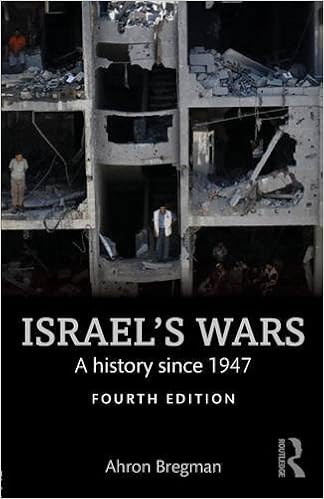
Israel's Wars: A History since 1947 (Warfare and History) by Ahron Bregman Paperback, Routeledge


Israel's Wars: A History since 1947 (Warfare and History) by Ahron Bregman Paperback, Routeledge 

Ben Guirion's notion of an army which was an instrument to build a nation and cement the fragmented Israeli Society can best be illustrated  if the army is seen as a bottleneck through which almost all Israeli citizen's , including women, must pass during a compulsory military service.

In this updated and expanded version of his account of the Arab-Israeli Conflict, Dr Ahron Bregman offers readers an informative and digestible introduction into the origins of some of the wars that have beguiled and shaped the region and pitted Israel, the Palestinians and the Arab states into armed conflict. Dr Bregman offers new insights into some of the more recent conflicts between Israel and Hezbollah and Israel’s operations against Hamas in the Gaza Strip. Israel’s Wars remains essential reading for students of the Middle East and conflict studies as well as anyone interested in Arab and Israeli history.

It's almost impossible to recommend a single book as the concise introduction to post-WWII warfare in the Middle East. This is in large part due to the very complex nature of the IP conflict still plaguing the entire region with its devastating consequences. Nevertheless, Bregman's work is arguably the best modern attempt at providing a brief and impartial overall analysis in the field. It is important to note that this is not a detailed history of the IP Conflict (only the last two chapters are devoted to this subject). If this is what you seek, then I would recommend different authors depending on your predilections - Benny Morris if you lean towards Israel or Avi Shalim and Ilan Pappe if your sympathies lie more with the Palestinians.

Bregman's great strength is that he knows the Israeli political and military establishments inside out. Having served as a tank captain in Israel's 1982 invasion of Lebanon, he understands the IDF officer corps and its mentality very well. His research for the BBC/PBS documentary "The Fifty Years War" allowed him to interview many of the leading political figures of the era he is discussing. Bregman is therefore in a unique position to criticize Israeli decision-making, and is by no means averse to doing so. Well known blunders of the Israeli leadership - such as the USS liberty incident, the intelligence fiasco of the Kippur War, the atrocities in Lebanon or the police campaign to repress the First Intifada - are all correctly described as the dismal failures they really were. This sets Bregman's work a cut above the legion of other Israeli and American historians who prefer to ignore or dismiss the darker episodes of Israel's military history. He also possesses the art of making his readers understand why the political ideologies and vacillations of succeeding Israeli governments resulted in considerable problems for the IDF on the ground.

What I appreciated in Bregman's outlook was the skillful dexterity he displays in keeping his narrative relatively impartial - a considerable achievement given that the subject matter is so controversial. Although Bregman is Jewish, his perception of the Arabs is not biased. He applies the same standards to both Arabs and Israelis, and prefers to judge them by their actions rather than by their personalities. This is particularly apparent in Bregman's examination of the First and Second Intifadas. He also makes extensive use of quotes throughout the book to emphasize facts and support his analysis. The editorial input required for this work must have been considerable. But Bregman succeeds in presenting the reader with a balanced view that mostly steers clear of conjecture and propaganda.

Despite all these advantages, Bregman's book is far from perfect. It's already out of date because it was published before the 2006 Lebanon War and 2008/9 Operation Cast Lead in Gaza and does not cover these events. In my opinion, his treatment of the Suez War is very poor and superficial. For example, he fails to mention what happened in the Gaza Strip during this period; but in Bregman's defense it should be said that good books on the Suez War are hard to come by. I was also disappointed by the lack of proper analysis regarding the atrocities committed by the IDF during the 1982 Lebanon War. Bregman rightly condemns the Sabra and Shatila massacres, but he also seems to dismiss as unlikely claims that IDF troops engaged in war crimes during the first week of the operation (as discussed for example in Noam Chomsky's "Fateful Triangle"). Since Bregman was as an active participant in these events, it is difficult to refute his testimony. But the reader should be aware that other accounts by victims of this cynical episode have related a darker story.

In conclusion, I would suggest that "Israel's Wars" should be hailed as a welcome contribution to the field because it succeeds (where many others have failed) in carrying out its stated objective. It's intended to be an introduction, and it's perfect for those who want an easily accessible reference book detailing the factual course of events and providing a basic cause and effect analysis. Those who are searching for a detailed investigation of a specific conflict in the Middle East should look elsewhere.

Friday, March 18, 2016

Benny Morris on Palestinian Refugees, Arab Infiltation , the Zionist -Arab Conflict and Glubb Pasha

Norman G. Finkelstein photo

The Birth of the Palestinian Refugee Problem, 1947–1949,[1.1]
Israel’s Border Wars, 1949–1956: Arab infiltration, Israeli retaliation, and the countdown to the Suez war,[1.2]
Righteous Victims: A history of the Zionist-Arab conflict, 1881–1999,[1.3]
 The Road to Jerusalem: Glubb Pasha, Palestine and the Jews[1.4]
Israeli historian Benny Morris played a pivotal role in molding the current scholarly consensus on the Israel-Palestine conflict. Until his generation of scholars came along (the so-called new historians), the dominant depiction of the conflict, even in academia, amounted to little more than a footnoted version of Leon Uris’s potboiler,Exodus. The current consensus casts Israel since its founding in a much darker light. During the past 15 years, however, Morris has been given to lashing out at, and defending the old orthodoxy against, critics of Israel.
An unorthodox new historian not too long ago, Benny Morris in effect reinvented himself in recent times as an orthodox old historian. The process has been incremental, the quantitative degeneration becoming at a certain point qualitative. Although disfigured in ways small and large by ideological bias, Morris’s earlier works, such as The Birth of the Palestinian Refugee Problem, 1947–1949,[1.1]Israel’s Border Wars, 1949–1956: Arab infiltration, Israeli retaliation, and the countdown to the Suez war,[1.2]Righteous Victims: A history of the Zionist-Arab conflict, 1881–1999,[1.3] and The Road to Jerusalem: Glubb Pasha, Palestine and the Jews[1.4] brought to light a wealth of novel information. The body of his subsequent major work, 1948: The first Arab-Israeli war,[1.5] preserves a standard of scholarly rigor, but his conclusion crosses the threshold to crude distortion. His last major work, One State, Two States: Resolving the Israel/Palestine conflict[1.6]lacks any redeeming value and reeks of rancid propaganda.
Whereas he did not break new conceptual ground, Morris did roam the archives and cull revealing documents on the Israel-Palestine conflict that he then collated into a fresh, compelling narrative of the past. Once an industrious clerk, Morris has metamorphosed into a raging kook. In all fairness to him, it is of course arguable that Morris has honestly come to reconsider his former conclusions on the basis of new evidence; to discover that, however deficient their scholarship, the conclusions of the old historians were right after all. The problem is that Morris does not adduce new evidence to support his return to the old orthodoxy, but rather whites out the findings of his own pioneering research. This genre might be called doing history not by accretion but by subtraction.

The conclusion of Righteous Victims, Benny Morris’s sweeping “history of the Zionist-Arab conflict,” opened with a quote from Zionist leader (and Israel’s future first prime minister) David Ben-Gurion. The “conflict”with the Arabs, Ben-Gurion said in 1938, “is in its essence a political one. And politically we are the aggressors and they defend themselves.” Morris then observed: “Ben-Gurion, of course, was right. Zionism was a colonizing and expansionist ideology and movement. . . . Zionist ideology and practice were necessarily and elementally expansionist.” Insofar as “from the start its aim was to turn all of Palestine . . . into a Jewish state,” he went on to elaborate, Zionism could not but be “intent on . . . dispossessing and supplanting the Arabs.” Or, as Morris formulated it earlier on in his book, “Jewish colonization meant expropriation and displacement” of the indigenous population.[2.1] These consequences of Zionism, and the Arab resistance they inexorably generated, would figure as signature themes in Morris’s scholarly corpus.
A fundamental challenge for Zionism was how to create a Jewish state, which meant minimally a state whose population was overwhelmingly Jewish, in an area whose population was overwhelmingly not Jewish. One novelty of Morris’s original scholarship was to point up the centrality of “transfer”—a euphemism, as Revisionist Zionist leader Zeev Jabotinsky put it, for “brutal expulsion”[2.2]—to resolving this dilemma. Insofar as orthodox Israeli historians had treated it, they consigned the idea of transfer to a footnote, downplaying it as incidental to the Zionist enterprise.Thus, Shabtai Teveth purported that the Zionist movement only “here and there” and “briefly” contemplated transfer, while, according to Anita Shapira, the Zionist movement conceived transfer merely as a “good thing”that it could just as well “do without.”[2.3] But Morris contended in his groundbreaking study, Birth of the Palestinian Refugee Problem, that, on the contrary, from the mid-1930's “the idea of transferring the Arabs out . . . was seen as the chief means of assuring the stability of the ‘Jewishness’ of the proposed Jewish State,”[2.4] while in Righteous Victims he wrote that “the transfer idea . . . was one of the main currents in Zionist ideology from the movement’s inception.”[5] In another seminal essay, Morris documented that “thinking about the transfer of all or part of Palestine’s Arabs out of the prospective Jewish state was pervasive among Zionist leadership circles long before 1937.”[6]In a greatly expanded version ofBirth, [2.7] Morris gave over fully 25 densely argued pages to documenting the depth and breadth of “the idea of ‘transfer’in Zionist thinking.” His conclusion merits full quotation:
“[T]ransfer was inevitable and inbuilt into Zionism—because it sought to transform a land which was ‘Arab’ into a ‘Jewish’ state and a Jewish state could not have arisen without a major displacement of Arab population; and because this aim automatically produced resistance among the Arabs which, in turn, persuaded the Yishuv’s leaders that a hostile Arab majority or large minority could not remain in place if a Jewish state was to arise or safely endure.”[2.8]   
Thus, in Morris’s temporal-logical sequence of the conflict’s genesis, Zionist transfer was cause and Arab resistance effect in an ever-expanding spiral. He put forth a sequence of succinct and copiously documented formulations on this crucial point in Righteous Victims: “The fear of territorial displacement and dispossession was to be the chief motor of Arab antagonism to Zionism down to 1948 (and indeed after 1967 as well)”; “In the 1880's there were already Arabs who understood that the threat from Zionism was not merely a local matter or a by-product of cultural estrangement.‘The natives are hostile towards us, saying that we have come to drive them out of the country,’ recorded one Zionist settler”; “[T]he major cause of tension and violence . . . was . . . the conflicting interests and goals of the two populations. The Arabs sought instinctively to . . . maintain their position as [Palestine’s] rightful inhabitants; the Zionists sought radically to change the status quo . . . and eventually turn an Arab-populated country into a Jewish homeland. . . . The Arabs, both urban and rural, came to feel anxiety and fear.”[9]In the conclusion of Righteous Victims, Morris reiterated that the Arabs’trepidation and ensuing opposition were “solidly anchored in a perception that [Zionist] expansion . . . would be at the expense of their people, principally and initially those living in Palestine itself.”[2.10] As Morris originally reckoned it, Arab fear was rational—because transfer was “inevitable and inbuilt into Zionism”—and Arab resistance natural—because it sprang“automatically” from the Zionist goal of transfer. He located the root of the conflict in a historical clash between Zionism and the indigenous Arab population of Palestine and the historical (if not moral) onus for engendering the conflict was placed squarely by Morris on the shoulders of the Zionist movement.[2.11]

When Benny Morris was still a historian (the “old” Morris), he anchored the resistance of Palestine’s indigenous population in its rational fear that Zionist settlers intended to “transfer”—i.e., ethnically cleanse—it (see Part 2). The “new” Morris, however, has a very different story to tell. He drastically reduces the salience of transfer in Zionism; locates the genesis of the conflict in “Islamic Judeophobia”; and reckons transfer as a Zionist reaction to this Islamic Judeophobia and the “expulsionist” tendency inherent in it. Cause and effect have magically been reversed: expulsionist Judeophobia—which is inevitable and inbuilt into Islam—is the cause, Zionist transfer—which automatically springs from Islamic Judeophobia—the effect. The onus for engendering the conflict is now placed by Morris squarely on the shoulders of the Arabs, while Zionists are depicted as the innocent victims of a lethal Muslim intolerance towards Jews.
According to this new Morris, transfer initially figured as but a “minor and secondary element” in Zionism; “it had not been part of the original Zionist ideology”; key Zionist leaders only “occasionally” supported transfer “between 1881 and the mid-1940s”; and “its thrust was never adopted by the Zionist movement . . . as ideology or policy” until the late 1940s.[3.1] Whereas the old Morris asserted that “the logic of a transfer solution to the ‘Arab problem’ remained ineluctable” for the Zionist movement, and “without some sort of massive displacement of Arabs from the area of the Jewish state-to-be, there could be no viable ‘Jewish’ state,”[3.2] the new Morris alleges that “the Zionist leaders generally said, and believed, that a Jewish majority would be achieved in Palestine, or in whatever part of it became a Jewish state, by means of massive Jewish immigration, and that this immigration would also materially benefit the Arab population.”3.[3]
If Zionists eventually came to embrace transfer, according to the new Morris, it was only in reaction to “expulsionist or terroristic violence by the Arabs,”[3.4] “expulsionist Arab thinking and murderous Arab behavior,”[3.5] which were “indirectly contributing to the murder of their [the Zionists’] European kinfolk by helping to deny them a safe haven in Palestine and by threatening the lives of the Jews who already lived in the country.”[3.6] Transfer has inexplicably metamorphosed from an “inevitable and inbuilt” component of Zionism—which is what Morris had written when he was still a historian—into a response “triggered”[3.7] by expulsionist Arab threats and assaults, not to mention Arab complicity in the Nazi holocaust. Indeed, in the narrative frame crafted by the new Morris, the indigenous population of a country has metamorphosed into expulsionists. Many cruel and unforgivable things have been said by American historians about our native population, but it took a peculiarly fecund Israeli mind to pin the label “starkly expulsionist”[3.8] on an indigenous population resisting expulsion. To document this “expulsionist mindset,”.[3.9] Morris cites the testimony of a Palestinian delegation before a foreign commission of inquiry: “We will push the Zionists into the sea—or they will send us back into the desert.”[3.10] Insofar as the Zionists were intent on “transferring the Arabs out,” it is unclear how this statement manifests malevolence. Doesn’t an indigenous population have the right to resist expulsion?
The new Morris alleges that “Arab expressions in the early years of the twentieth century of fear of eventual displacement and expulsion by the Zionists were largely propagandistic.”[3.11] He seems to have forgotten that he himself pointed up this fear as the “chief motor of Arab antagonism to Zionism” and that he rationally grounded this fear in Zionist transfer policy. Morris now purports that the Arabs’ resistance to Zionism sprang from their thralldom to the notion of “sacred Islamic soil”; was “anchored in centuries of Islamic Judeophobia”; and reached into “every fiber of their Islamic, exclusivist being.”[3.12] After Israel’s establishment, Prime Minister David Ben-Gurion conceded, “If I was [sic] an Arab leader, I would never make [peace?] terms with Israel. That is natural: We have taken their country.” The new Morris alleges, however, that, because of his ignorance of the Arab world, Ben-Gurion failed to grasp that this rejection of Israel was not “natural” but rather rooted in Islamic “abhorrence” of Jews.[3.13] Insofar as Morris is not known for his expertise on Islam, and insofar as he used to be known for not speculating a hair’s breadth beyond what his sources showed, it might be expected that he would copiously substantiate such gross generalizations. But Morris’s elucidation of 14 centuries of an allegedly hate-filled “Muslim Arab mindset” and “Muslim Arab mentality” consists of all of one half paragraph of boilerplate.[3.14]
[1.1]New York: 1987.
[1.2]New York: 1993.
[1.3]New York: 1999.
[1.4]London: 2003.
[1.5]New York: 2008.
[1.6]New Haven: 2009.
[2.1] Benny Morris, Righteous Victims: A history of the Zionist-Arab conflict, 1881-2001(New York: 2001), pp. 652-54, 61.
[2.2]Shabtai Teveth, The Evolution of “Transfer” in Zionist Thinking (Tel Aviv: 1989), p. 17.
[2.3]Ibid., pp. 2, 6. Anita Shapira, Land and Power: The Zionist resort to force, 1881-1948
(Oxford: 1992), pp. 285-86.
[2.4]Benny Morris, The Birth of the Palestinian Refugee Problem, 1947-1949(Cambridge: 1987), p. 25.
[2.5]Morris, Righteous Victims, p. 139.
[2.6]Benny Morris, “Revisiting the Palestinian Exodus of 1948,” in Eugene L. Rogan and Avi Shlaim, eds.,The War for Palestine: Rewriting the history of 1948(Cambridge: 2001), p. 40. The British proposed in 1937, and the Zionists seconded, transfer alongside partition to resolve the Palestine conflict.
[2.7]Benny Morris, The Birth of the Palestinian Refugee Problem Revisited (Cambridge:
2004).
[2.8] Ibid., p. 60.
[2.9]Morris, Righteous Victims, pp. 37, 46, 49.
[2.10] Ibid., p. 653.
[2.11]It could still be argued, and it is Morris’s contention, that although creating a Jewish state necessarily entailed the ethnic cleansing of Palestine, the establishment of a Jewishstate was nonetheless a greater moral good. Even in his original, liberal phase, Morrisput both moral and historical culpability for the creation of the Palestinian refugeeproblem on the Arabs because, inter alia, they rejected the UN Partition Resolution
[3.1] Benny Morris, 1948: The first Arab-Israeli war (New York: 2008), p. 407; Benny Morris, “Fallible Memory,” New Republic (3 February 2011).
[3.2] Benny Morris, The Birth of the Palestinian Refugee Problem Revisited(Cambridge: 2004), p. 43.
[3.3] Benny Morris, “And Now for Some Facts,” New Republic (28 April 2006).
[3.4] Morris, 1948, p. 407.
3.[5] Morris, “Fallible Memory.”
[3.6] Benny Morris, One State, Two States: Resolving the Israel/Palestine conflict (New Haven: 2009),p. 68.
[3.7] Ibid., p. 67.
[3.8] Ibid., p. 105.
[3.9] Morris, 1948, p. 409.
[3.10] Ibid., p. 408.
[3.11] Morris, One State, p. 179.
[3.12] Morris, 1948, pp. 393, 394; Morris, One State, p. 90. In one place he does grant albeit grudgingly that Arab opposition to Zionist settlers resulted not only from the “threat to the ‘Arab-ness’ of their country” but “perhaps, down the road, to their very presence in the land” (ibid., p. 37).
[3.13] Morris, 1948, p. 393.
[3.14] Morris, One State, pp. 188-89.