Sunday, June 12, 2016

Women Leading Prayer in Judaism.From Medieval Ashkenazi Women Pietists to Women of the Wall


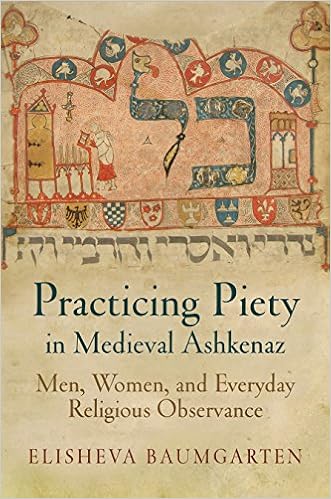
Practicing Piety in Medieval Ashkenazi: Men, Women, and Everyday Religious Observance (Jewish Culture and Contexts)  by Elisheva Baumgarten University pf Pennsylvania Press 

In medieval Germany and northwestern France—an area then known as Ashkenaz—a number of Jewish women began putting on t’fillin, wearing garments with ritual fringes (tsitsit), and performing other religious rituals generally reserved for men. What’s more, they did so with rabbinic approval. This phenomenon, the subject of a new book by Elisheva Baumgarten, was a female version of medieval Jewish pietism, which—for both men and women—often involved adopting practices not required by the letter of Jewish law. Julie Mell writes in her review:


[M]edieval women’s active assumption of “time-bound commandments,” commandments from which they were legally exempt, was not a form of proto-feminism. As Baumgarten never fails to remind her readers, medieval Ashkenaz was a staunchly hierarchical and patriarchal society. Neither the halakhic authorities nor the women about whom they wrote ever questioned the categorical divide between men and women, even when they permitted women’s observance of those commandments reserved for men.


In fact, the same pious impulse that led women to break the gender boundary also led women to impose upon themselves what today would be considered gender exclusion. Particularly pious Jewish women, for instance, began absenting themselves from the synagogue in the late 11th and 12th centuries when their menstrual cycle rendered them impure. By the late 13th and 14th centuries, this became the norm for all Ashkenazi women, [although ceasing to be so in later centuries]. . . .


Baumgarten blazes a trail in the field of medieval Jewish history and law [by arguing that texts] and halakhah do not shape life and practice, but rather it is the other way around. Social custom and contemporary cultural settings led medieval rabbis to discover new things in old texts.

Friday, June 10, 2016

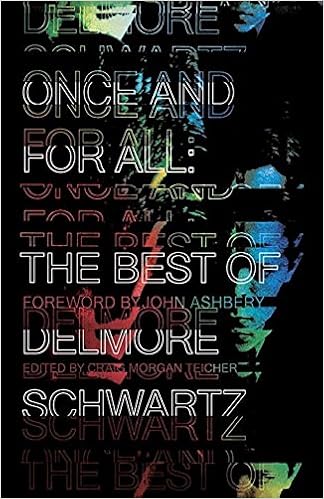
Once and for All: The Best of Delmore Schwartz by Delmore Schwartz and Craig Morgan Teicher,( New Directions )


Once and for All: The Best of Delmore SchwartzMay 3, 2016
by Delmore Schwartz and Craig Morgan TeicherPaperback
New Directions


Reviewing a new volume of selected works by the American poet and short-story writer Delmore Schwartz (1913-1966), Adam Kirschnotes his preoccupation with Jewish sons and their fathers (a preoccupation shared, according to Kirsch, by the contemporary writer Adam Ehrlich Sachs). He writes:

When [his friend and admirer John] Berryman says [in a poem] that Schwartz wrote about “harms and the child,” he is punning on the opening words of the Aeneid, “Of arms and a man I sing.” But it is also a fair summary of Schwartz’s great theme, which is the great theme of early American Jewish literature: the weight of the past, the way the traumas and dysfunctions of the parents are transmitted to the children. For Schwartz, who was an acolyte of both Marx and Freud, this burden was at the same time historical—a product of the long Jewish past, and the recent disruptive emigration to America—and psychological—a product of the guilt and resentment the child feels toward his mother and father.

The two lenses are superimposed in one of Schwartz’s best poems, “The Ballad of the Children of the Czar,” in which he compared himself at two years old, in 1916, with the Romanov princes, who can’t imagine that soon they will be executed. Both the world-historical princes and the insignificant Brooklyn Jewish boy, Schwartz suggests, are doomed by the same forces. . . .

Jewishness, for Schwartz as for more famous contemporaries like Bernard Malamud, is a kind of intensification of the human condition, a way of experiencing more acutely the themes of modern life—alienation, guilt, loneliness, moral striving. Schwartz’s “resignation” from the cult of [the anti-Semitic and pro-Nazi] Ezra Pound—who was, at that time, the idol of all young avant-garde intellectuals—was part of his insistence that English literature had to make room for Jewishness as a subject and a voice. In this sense, Schwartz was a trailblazer for the golden age of American Jewish literature in the 1950s and 1960s—a promised land that, like Moses, he was not permitted to enter.

Thursday, June 9, 2016

Birds of Australia: A Photographic Guide Iain Campbell, Sam Woods & Nick Leseberg


Birds of Australia:
A Photographic Guide
Iain Campbell, Sam Woods & Nick Leseberg
With photography by Geoff Jones


Princetown University Press,Paperback | 2014 | $35.00 | £24.95 | ISBN: 9780691157276

The reviewer is a leading ornithologist at an Israeli University who has thrice taken sabbaticals in Australia to study birds and their preferred foodstuffs. She has published extensive. She prefers not to have a byline for this book review.

I've looked at many field guides whenever I find myself in book stores. This one caught my eye, and I when I learned that a new sixth edition had come out, I got it right away.

While there are many are good bird guides out there, they usually contain pictures and art that don't show the birds from every angle. The information usually isn't that detailed either, or not there at all. I'm sure there are a lot of people who would love to know how to tell the difference between more than one  very similar species like Grey Crowned Babler, Chestnut Crowned Babler, White Browned Babler and Hall's Babbler. Birds of Australia : A Photographic Guide address all these iisues .Where necessary their are more than one picture from different anglesand expert comment about the differences between species,  

This book goes way beyond any guide I've ever seen, the information is in-depth and useful, not to mention that they show the top of the bird's wing and  the bottom of it . For some reason, many guides don't show what the bird looks like from the bottom.Where this is important Birds of Australia does have this additional photograph which is incrediblyuseful since many times they flow overyou and that's all you get to see.
There are supurb migration and location maps maps. Accidental species are also mentioned ( some in great detail),The introduction to Australia's Geography and the location of its bird species with wonderful ( I can't use that word enough) is by itself a reason to by this book..

I could go on forever about how great this book is, it's like a bird-college text book! I wouldn't settle for any other guide!
Australia is home to a spectacular diversity of birdlife, from parrots and penguins to emus and vibrant passerines.Birds of Australia covers all 714 species of resident birds and regularly occurring migrants and features more than 1,100 stunning color photographs, including many photos of subspecies and plumage variations never before seen in a field guide. Detailed facing-page species accounts describe key identification features such as size, plumage, distribution, behavior, and voice. This one-of-a-kind guide also provides extensive habitat descriptions with a large number of accompanying photos. The text relies on the very latest IOC taxonomy and the distribution maps incorporate the most current mapping data, making this the most up-to-date guide to Australian birds.
  • Covers all 714 species of resident birds and regularly occurring migrants
  • Features more than 1,100 stunning color photos
  • Includes facing-page species accounts, habitat descriptions, and distribution maps
  • The ideal photographic guide for beginners and seasoned birders alike
Iain Campbell, a native of Australia, is builder of the Tandayapa Bird Lodge in Ecuador and cofounder of Tropical Birding, which leads bird and wildlife tours around the world. Sam Woods and Nick Leseberg are nature guides for Tropical Birding. Campbell and Woods are the authors of Wildlife of Australia (Princeton University Press).

Wednesday, June 8, 2016

Capitalism: A Short History by Jürgen Kocka Hardcover | 2016 | $26.95 | £19.95 | ISBN: 9780691165226

Capitalism: A Short History Jürgen Kocka

Princeton University Press Hardcover | 2016 | $26.95 | £19.95 | ISBN: 9780691165226


The Breakout of the Soviet Unionand and withit the concept of State Socialism in every walk of life : the once -stagnant economies based on quasi socialism with methodologies best descriped as rip roaring capitalism, and the Great Recession of 2008/2009 have made Capitalism a top of the Agenda subject for both research and book publishing.Professor Jürgen Kocka an expert in Social History has written a wonderful narrative of global capitalism that provides except observations and background to the subject. "Jürgen Kocka is one of the most well known experts in the field of European History and like his previous books this compact book has all of his virtues: it's extremely clear and conceptually tight as well as very succinct.

The idea that it’s harder to write at length than concisely is so familiar that it has become a cliché, but it is surely true that if writing a history of capitalism then number of pages could be a help rather than a hindrance. Historian Jürgen Kocka has written Capitalism: A Short History at 169 pages. What’s more, it spans the centuries from China during the Han Dynasty through the Arab empire and the European Middle Ages to global financial capitalism today.

The point of the book is stated most clearly in the very last paragraph:

“Every era, every region and every civilization gets the capitalism it deserves. Currently, considered alternatives to capitalism are hard to identify. But within capitalism, very different variants and alternatives can be observes and even more of them can be imagined. It is their development that matters. The reform of capitalism is a permanent task. In this the critique of capitalism plays a central role.”

The unstated aim of the book,possible is to address the critics – generally speaking, these are the people who talk about ‘capitalism’, whereas capitalists talk about ‘the economy’, or something else. Kocha seems to be saying that a system of exchange based on markets is deeply embedded in human society and should be regarded as reformable but essential. He argues that capitalism is linked to financial innovation and therefore long pre-dates industrialisation, and one should not conflate the two. Double entry book-keeping, promissory notes, futures trading were all key for the formation of capitalism. And this financial development was closely linked to state formation.

Kocha therefore disagrees with the Marxist line that production and the organization of work are intrinsic to the definition of capitalism – although he accepts that, “Preindustrial commercial traditions of capitalism, wherever they persisted, significantly promoted the breakthrough to industrialization.”

If you’re neither a Marxist not a critic of capitalism in general (as opposed to some of its specifics today), this is a mildly interesting debate but not one to affect the blood pressure in either direction. On the other hand, there are some nice insights, and it is after all a short book, ideal for a train journey or flight. Describing the capitalism we would like to deserve would take rather more pages.

Tuesday, May 31, 2016

A LOADED GUN: EMILY DICKINSON FOR THE 21ST CENTURY by Jerome CharynBellevue Literary Press, 256 pp., $19.95


Todd-Bingham Picture Collection and Family Papers, Yale University Manuscripts / Wikimedia

Emily Dickinson Isn’t You
Biographers try to see themselves in the reclusive poet, and fail to show us who she really was.

“I couldn’t let go,” Jerome Charyn begins his author’s note to A Loaded Gun: Emily Dickinson for the 21st Century, as if remembering a severed romantic relationship. He remained transfixed after writing a fictionalized account of Dickinson’s life, The Secret Life of Emily Dickinson, in which he inhabited, or vampirized, as he says, the nineteenth-century poet’s voice, detailing flings with noted scholars and tattooed handymen—all imagined of course. He spent two years on the book, culling through all the letters, biographies, studies, accounts, and poems he could. “I never believed much in her spinsterhood and shriveled sexuality,” Charyn writes in his new book. “Yet she was a spinster in a way, a spinner of words. Spiders were also known as spinsters, and like a spider, she spun her meticulous web…”
A LOADED GUN: EMILY DICKINSON FOR THE 21ST CENTURY by Jerome CharynBellevue Literary Press, 256 pp., $19.95

Her seduction of Charyn implies her lingering claim on the present, but his inability to “let it go” introduces his attempt to put his mark on her. In the twenty-first century, Emily Dickinson has become very much about our selves, an interpretation that has been allowed to flourish partly because of her anonymity: The bulk of her poems, of course, were published after she died, and she lived with her parents all her life, unmarried and leaving letters that only hint at possible lovers, hardly ever leaving her home. During the last 30 years, it has been many writers’ impulse to try her on, explore the “masks,” as Charyn calls them, that she wore in her poems, and give motive to her writings through more expressive means. Among the better-known works there’s Susan Howe’s My Emily Dickinson, which traces the works that informed Dickinson’s rich interior life; Adrienne Rich’s essay “Vesuvius at Home,” which sees her as feminist forebear; Maureen McLane’s “My Emily Dickinson” from her biblio-memoir My Poets; and Camille Paglia’s essay from Sexual Personae, comparing her to the Marquis de Sade.

Charyn’s book gives a checkered history of the many interpretations of Dickinson, at times attempting to connect them to her actual biography. He starts to trace key disputes in Emily Dickinson scholarship, from the intended recipient for her Master letters—a major clue to a possible hidden romance—to her jumbled publication history. (Her editors Thomas Wentworth Higginson and Mabel Loomis Todd removed her punctuation, then her heirs began to find more unpublished poetry and letters—as did their children.) There was no complete volume of Dickinson’s poetry until 1955. This volume, when it finally appeared, led to a fuller picture of Dickinson by 1976, when “Vesuvius at Home” and the popular one-woman play The Belle of Amherst, which Charyn writes much about, both came out.

The goal of such writings is ostensibly to better know Emily Dickinson, though by means of murky, refracted knowledge—as if making sense out of the same image as projected through a hall of mirrors. But in Charyn’s book, which leans heavily on his own personal web of associations, some sense of who Dickinson might have been ends up feeling more out of reach.

A Loaded Gun progresses with a snaking chronology, imitating the slipperiness of its subject. One chapter, “The Two Emilys—and the Earl,” examines Emily Norcross Dickinson, Emily Sr., in detail, along with Emily’s father, as a portrait of the people who ostensibly best knew her; another chapter is devoted to Dickinson’s very close relationship with her dog, Carlo, her only recorded long-term companion.

Charyn’s book quickly sets up themes that reflect more about his own cultural tastes than Dickinson. He examines, for instance, figures who have been as enchanted as he is with Dickinson as muse. The chapter “Ballerinas in a Box” mostly traces the artist Joseph Cornell’s near-obsession with Dickinson, but Charyn takes such a circuitous path that the portrait becomes muddled. He opens with quotes from male poets and critics who revived Dickinson’s reputation in the early twentieth century. Allen Tate, he tells us, wrote in 1932 that many were mistaken that “no virgin can know enough to write poetry,” but went on to call her “a dominating spinster whose very sweetness must have been formidable.”In the twenty-first century, Emily Dickinson has become very much about our selves.

Charyn finds fault with the group, but limits the argument to two sides, basically between those who called Dickinson a spinster and those who took his own more sensational view. He introduces Rebecca Patterson’s 1951 book, The Riddle of Emily Dickinson,which proposed that Dickinson had a romance with one Kate Scott. Sifting through all of this unrelated material, he attempts to pin Dickinson to his original idea, that she might have intended to seduce him.

This winding path somehow leads to Cornell, whose box construction “Toward the Blue Peninsula: for Emily Dickinson” (c. 1953) is dedicated to the poet. Charyn tries to show how there is a strong link between the two. “If her poems are like his boxes, a place where secrets are kept, his boxes are like her poems, the place of unlikely things to happen,” Charles Simic is quoted as saying. Finding similarities between voices in the crowd surrounding Dickinson can be an interesting exercise, if random; though not as random as when Charyn draws a comparison between Dickinson and the dancing of Allegra Kent. The pair share little besides Charyn’s admiration.

The impulse of writers is to read Dickinson herself like a text—with all the problems of interpretation that follow. Howe has spoken about this before. In her 2012 Paris Review interview, she expressed frustration with those who try to over-decipher the intended of the Master letters: “The constant need of some scholars to decode in these letters a flesh-and-blood lover belittles the ferocity of her poetic calling,” she said.

In his upcoming book The Hatred of Poetry, Ben Lerner writes that Dickinson’s dissonance is exactly her genius: “The status of a Dickinson composition is itself up for grabs: is it a poem or some other kind of object? A work of visual art? What about, for instance, her ‘envelope writings’—gently pried apart envelopes whose physical shapes, some have argued, interact purposefully with Dickinson’s language? Are her letters poems?” She has become such a fascinating figure to write through, in the age of visibility, in part because her art demands no concrete character—exactly why it proves frustrating when this is misread as an invitation to create one.

In one of his chapters, Charyn has a conversation with the Emily Dickinson scholar Christopher Benfey, in which the two men agonize over how unknown Dickinson still is, the way two might commiserate over lost love.

Benfey compares “the cunning and craft” of her letters to Matthew Higginson to performance art, hypothesizing that she meant for him to serve as “a mirror, a conduit, a messenger.” He even goes on to say Higginson and Mabel Loomis Todd were akin to publicists. “She gives them just the amount they need; she withholds access in just the right way.” Charyn’s Dickinson may be a seductress, but in this reading of her, clutching at every clue, she becomes more unreal than usual. In hot pursuit, she becomes dreamlike and open-ended; she could be anything to anyone.

There is very little new learned in A Loaded Gun about Dickinson’s life, save for in the very last chapter. Charyn secured an interview with Sam Carlo, the owner of a daguerreotype of Dickinson—one of only two known pictures of her. He found the image of her at a junk sale in 1995.

If we otherwise know Dickinson only through deceptive fragments, then why save the story of the newest tangible image we have for the book’s last pages? Here, her indecipherability fuels pursuit—the oldest lover’s game, and a cheap one. “She’s already gone by the time we get near,” Charyn writes, with relish. She remains unknowable throughout the chase—leading us back to the Emily Dickinson he made in his image, in the mirror.

Monday, May 30, 2016

How much is a patent worth?True Patent Value: Defining Quality in Patents and Patent Portfolios Larry M. Goldstein

How much is a patent worth?

True Patent Value: Defining Quality in Patents and
Patent Portfolios
Larry M. Goldstein
True Value Press (self published), 2013
ISBN: 978-0989554107, Soft cover, 500 pp (þ 68 pp)
Price: $104.50

The book fills a gap between the ‘how to’ guides, aimed
towards patent attorneys, and the guides to complex valuation
and economics of intellectual property. Goldstein’s
book is thus of interest to the directors of companies, to
investors and non-practising entities. It can also help the
heads of research and development (R&D) by showing how
a patent application fits into a bigger picture.

The book is of interest to patent attorneys as well. In fact,
there are several audiences that the author envisages, and
he spends a couple of chapters giving an overview of the
fundamentals of patent law in terms of each audience’s
requirements.

Goldstein acknowledges that patents may relate to more
or less any field, but goes on to divide the patent world
between biotechnology, chemical and pharmaceutical
(BCP) and information and communication technologies
(ICT). Goldstein’s considerable experience is in telecommunications,
including code division multiple access and
the like. Not surprisingly, his background and personal
history have coloured his perspective. Telecommunications
is a very fast moving area where devices frequently infringe
a large number of patents, and patent pools have developed
to simplify licensing. Non-practising entities (trolls) are
generally active in the computing field. The book focuses
on patents in the ICT field.
* Patent Attorney, IP Factor, Israel’s International Patent and Trademark
Attorney. Email: mfactor@ipfactor.co.il.
168 IP IN REVIEW Journal of Intellectual Property Law & Practice, 2014, Vol. 9, No. 2
 by guest on May 30, 2016 http://jiplp.oxfordjournals.org/ Downloaded from
After acknowledgments that include a quote by Hillel,
the Pharisee Jewish leader in the Second Temple period,
Goldstein provides a preface in which he raises four basic
questions: (i) Why another book about patents?; (ii) Who
will find this book useful?; (iii) What does the book cover?;
and (iv) What bits should each audience read? He provides
a generally useful table showing each segment of his target
audience the sections they should read, and the order in
which they should do so.1
Goldstein associates the value of a patent with being
able to sell it or prevent competitors from practising it.
This has validity in fast-moving fields like telecommunications,
where a product invariably infringes many patents.
The value of a pharmaceutical formulation is very different,
since the value of licensing or sale is almost never considered
and almost all value is in the promise of limited
monopolistic sales conditions that justify the costs of
development.

Goldstein differentiates between the type of automated
evaluation that can be carried out by a non-patent expert
who can count the claims and see whether they are for
methods, devices or systems. He candidly suggests that, in
the very big patent sales, most patents are considered
superficially in such a manner. The more valuable patents
are subjected to a more expert analysis, in which claims are
reviewed in terms of the specification and the file wrapper
is examined. He notes that value may be affected by external
events such as discovery of an earlier citation, or
perhaps a patent-killing disclosure by the inventor.
Nevertheless, Goldstein finds value only in issued
patents, and particularly in issued patents that are infringed
now or will be infringed in the very near future. He does
not consider as value the potential value inherent in
pending applications, or in patents that are not now
infringed. I think this is a little like ignoring potential
energy of a wound spring or of a rock pushed up a hill. I
note that in the Boston Consulting Book on valuing
patents by Mark Blaxill and Ralph Eckardt,2 the analogy of
digital value fluctuations is used, in that worth can fluctuate
widely dependent on external circumstances.
There are some fairly serious analyses of famous
patents that were sold or litigated, and these provide
insight into a patent’s worth. Goldstein’s analysis examines
claims for ambiguities such as non-defined terms, inconsistent
terminology and non-standard phrasing. He is
a believer in claim differentiation and in creating patent
thickets as a strategy to ensure that at least something
survives claim reconstruction, and considers that multiple
claims for the same or closely linked inventions
provide much additional protection, hence value, as compared
to single patents.

Goldstein is correct that many of the litigated patents
and the most valuable patents are in either the pharma or
telecommunications sectors, but there are also mechanical
inventions of value, including some remarkably simple
ideas like the patented concepts behind Tetrapak, Velcro or
the zip fastener whose patents prevented competition and
enabled manufacturing without competition, and thus generated
great wealth.

I suspect that Goldstein’s insights will be helpful in
understanding the huge sums paid out in infringement
cases and the large sums spent in purchasing patents for
telecommunications. I do not think that other sectors of
the patent industry follow similar dynamics. Consequently,
pharmaceutical developers, and developers of methods in
chemistry or biology, may find the book less useful.
Nevertheless, for telecommunications and similar industries,
his insights are highly relevant, and I think this book
is a worthwhile read for anyone in the field, including both
practitioners and their clients. Goldstein has published this
book himself, so the cost is much less than that of similarly
sized volumes from legal publishers. The quality is by no
means inferior, however; so I consider this good value for
money. Sample pages may be reviewed at Goldstein’s
website, www.truepatentvalue.com.
The Fourth Industrial RevolutionJan 12, 2016 by Prof Klaus Schwab Paperback

Performers depict the Industrial Revolution during the opening ceremony of the London 2012 Olympic Games
 Performers depict the Industrial Revolution during the opening ceremony of the London 2012 Olympic Games. Technological change has always been disruptive. 
Until the spasm in the markets interfered, Davos 2016 was supposed to be about how humankind will cope in the new age of the smart machine. While share prices were gyrating, the bigger picture was obscured. There is a fourth industrial revolution happening and it is likely to be as profound in its effects as the previous three.

The first Industrial Revolution was about harnessing steam power so that muscle could be replaced by machines. The second was driven by electricity and a cluster of inventions from the late 19th century onwards – including the internal combustion engine, the aeroplane and moving pictures. A third revolution began in the 1960s and was based on digital technology, personal computing and the development of the internet. Industrial Revolution 4.0 will be shaped by a fresh wave of innovation in areas such as driverless cars, smart robotics, materials that are lighter and tougher, and a manufacturing process built around 3D printing.

A pity then that the World Economic Forum was overshadowed by falling share prices and the cost of oil because the impact of the fourth industrial revolution will be felt long after investors have stopped fretting about a hard landing in China.

Davos was, in some ways, a good forum for the gathering of technology pioneers, business leaders and politicians to consider some of the implications of what will be a very different sort of economy. Just to take one example, smart machines will soon be able to replace all sorts of workers, from accountants to delivery drivers and from estate agents to people handling routine motor insurance claims. On one estimate, 47% of US jobs are at risk from automation. This is Joseph Schumpeter’s “gales of creative destruction” with a vengeance.

There are three myths about Industrial Revolution 4.0. The first is that it won’t really have as big an impact as the previous periods of change, most especially the breakthroughs associated with the second industrial revolution. In the past, it has always taken time to feel the full effects of technological change and many of today’s advances are in their infancy. It is far too early to say that the car or air travel will prove to be less important than the sequencing of the human genome or synthetic biology.

The second myth is that the process will be trouble free provided everything is left to the market. It is a fantasy to believe that the wealth created by the fourth Industrial Revolution will cascade down from rich to poor, and that those displaced will just walk into another job that pays just as well.


Robot revolution: rise of 'thinking' machines could exacerbate inequality

Indeed, all the evidence so far is that the benefits of the coming change will be concentrated among a relatively small elite, thus exacerbating the current trend towards greater levels of inequality.

This was a point stressed by the Swiss bank UBS in a report launched in Davos. It notes that there will be a “polarisation of the labour force as low-skill jobs continue to be automated and this trend increasingly spreads to middle class jobs.”

A similar argument is made by Klaus Schwab, the man who runs Davos, in a book on the Fourth Industrial Revolution handed to each of the delegates at this year’s World Economic Forum.

Schwab compares Detroit in 1990 with Silicon Valley in 2014. In 1990 the three biggest companies in Detroit had a market capitalisation of $36bn (£25bn), revenues of $250bn and 1.2 million employees. In 2014, the three biggest companies in Silicon Valley had a considerably higher market capitalisation ($1.09tn) generated roughly the same revenues ($247bn) but with about 10 times fewer employees (137,000).

It is easier to make money today with fewer workers than it was a quarter of a century ago. Setting up and running a car company was an expensive business and required a lot of workers. A company that makes its money out of a smart app requires less capital, doesn’t have to pay for storage or transport in the way that car companies do and incurs virtually no extra costs as the number of users increases. In the jargon of economics, the marginal costs per unit of output tend towards zero and the returns to scale are high. This explains why tech entrepreneurs can get very rich very young.

Technological change has always been disruptive. There was a polarisation of income and wealth in the first wave of industrialisation at the beginning of the the 19th century, and this gave rise to political and institutional change over the 100 years between 1850 and 1950: the spread of democracy; the emergence of trade unions; progressive taxation and the development of social safety nets. These helped create bigger markets for the consumer goods that were spawned by the second Industrial Revolution: TVs, radios, vacuum cleaners and the like.

But over the past four decades a political model that both facilitated the spread of technology and provided some protection against its disruptive consequences has come under attack. Welfare states have become less generous, levels of long-term unemployment are much higher, taxation has become less progressive, politics has increasingly been dominated by those with the deepest pockets who can lobby the loudest.

Philip Jennings, general secretary of the global UNI union said: “We need some governance to ensure a democratic evolution and that requires public policy discussion. There is the opportunity to shape technology to improve people’s lives; through connectivity, education, health. We shouldn’t be fearful and fatalist about it.”

There is, though, a third and final myth: namely that all will be well provided the fruits of an economy dominated by artificial intelligence and smart robots can be redistributed, perhaps through a citizen’s income so that we can all have more leisure time when machines do all the work.


Schwab said: “The changes are so profound that, from the perspective of human history, there has never been a time of greater promise or potential peril. My concern, however, is that decision makers are too often caught in traditional, linear (and non-disruptive) thinking or too absorbed by immediate concerns to think strategically about the forces of disruption and innovation shaping our future.”But redistribution, even assuming it happens, is only part of the story. Making his first visit to Davos, the Archbishop of Canterbury said the changes likely to be brought about required not just an economic but also a spiritual response. “This is not just about money, it is about what it is to be human”, said Justin Welby.

He’s right, although there is a simpler way of putting it: faced with the challenge of disruptive new technology, the current political framework is no longer fit for purpose and its shortcomings are likely to lead to a backlash that could turn very nasty. That should concern not just Schwab and the Archbishop of Canterbury but also the investment bankers of Wall Street and the tech billionaires of Silicon Valley.