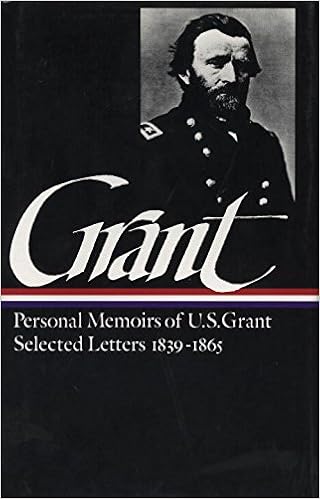
Ulysses S. Grant (1822--1885) was the 18th president of the United States, but he is best known today as General Grant, commander of the Union armies that defeated the armies of the Confederacy, bringing an end to the Civil War and preserving the Union. After two terms as president, Grant and his wife went on a worldwide tour which ate up most of his savings. In an attempt to recover financially, he invested the remainder of his savings in a business founded by his son Ulysses Jr. and an acquaintance named Ferdinand Ward. The business went bankrupt and General Grant was left penniless. In the fall of 1884, he was diagnosed with esophageal cancer. Following the advice of friends, including Mark Twain, Grant undertook a heroic effort through constant pain to write his memoirs.
The Memoirs, unlike most autobiographies, tells us little about Grant's youth or personal life. Perhaps he assumed the public would not be interested in those things. If so, it would be typical of Grant, a humble man, to understimate his own importance. Most of the book (originally published as two volumes) is devoted to his experiences in the Mexican War and the Civil War.
During the Mexican War he was a young junior officer recently graduated from West Point. It was here in Mexico that he learned lessons about warfare and about human beings that would prove of great value during the long trial of the Civil War.
After the Mexican War, Grant left the army, married Julia Dent, and began to raise a family. But he had trouble finding any work that he was good at. He tried farming and gave it up. He went into the real estate business with a partner but gave up on that too. Next, out of desperation, he went to work for his father as a clerk in a leather shop.
About this time, Southern states seceded from the Union and attacked the federal Fort Sumpter at Charleston, South Carolina. The President called for volunteers and young Ulysses S. Grant put on his uniform and answered the call.
The Personal Memoirs is mostly a narration of the battles in which Grant was involved in Mexico and throughout the American south during the Civil War. Maps are included, but they are period maps, much reduced in size. You will need a magnifying glass to read them. Also, scattered throughout are copies of communications with the President and various commanders in the field. The Memoirs ends with the grand review of the Army of the Potomac in Washington at the end of the war. There is nothing here about Grant's post-Civil War life or his two terms as President. Maybe he thought those later years were of lesser importance or interest to readers. Or maybe he just ran out of time. Grant died only a few days after completing the final chapters of Volume 2.
Throughout the text Grant offers his opinions of both enemy and allied commanders and fellow officers. He admires General Lee as a "foe who had fought so long and valiantly, and had suffered so much for a cause, though that cause was, I believe, one of the worst for which a people ever fought, and one for which there was the least excuse." (p. 735) The cause of the war was obvious to him: slavery. And, though the North won the war, its cost was enormous. "But this war was a fearful lesson, and should teach us the necessity of avoiding wars in the future." (p. 774)
This book is a fascinating look into the mind of a man who rose to the occasion to save his country. He is a man of few words, but he wields these words with great precision. There is no attempt to create "literature." You won't find any clever turns of phrase or metaphoric use of language. It is all straightforward and seems very modern compared with the overblown prose of other writers during that Victorian era.
This Library of American edition also contains over 200 pages of Grant's letters to his wife, his children, other generals and officers, administration officials, the President, and others. Although I have not taken the time to read these letters, I am sure they will be of great interest to a student of Civil War history. Finally, there is a 40-page Chronology of Grant's life that will enable the reader to fill in some of the gaps left by Grant himself in the memoir. Two separate indices are provided: one for the memoirs and one for the letters. This edition, 1200 pages in length, is a kind of one-stop shop for anyone interested in learning about America's greatest general.
No comments:
Post a Comment