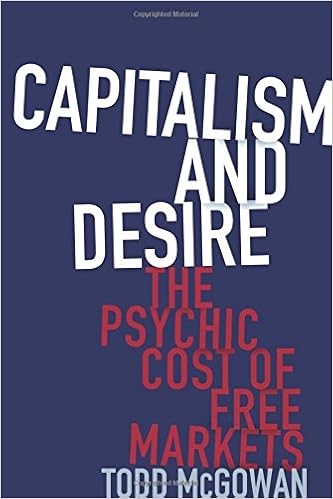
This book is like psychoanalysis itself: it offers hope, but no guarantees, and understanding that it may or may not make one "better" or "improved" or more "conscious." I felt fortunate to have read it within the circumstances of our current life world, given as it is to promises that are not going to be kept and sales techniques overtly intended to deceive. That huge analytic word, desire, and the even larger concept of satisfaction that circulates through advertising and consumer goods messages, are given a common currency in McGowan's estimation of the psychic costs of Capitalism at the personal level of consumption and wish-fulfillment. Because we never get what we believe we are looking for - the sublime - we keep pursuing it - through production and spending. The disappointment keeps us as individuals suspended in a state of disappointment and loss, the actual aim of Capitalism's strategic schemas, and keeps the Capital system expanding, with ever more promise of ever more impossible satisfactions.
We are not left out in the rain in McGowan's thought. Indeed, two primary "solutions" (there may be a better word for what he offers) to the ongoing experience of loss and disappointment are given. The first involves being appreciative of labor, of the actual work of production, in the moment of its embodied fabrication. The means to ends becomes an ever-present means that is a constant end, and is in our hands. The second involves the challenge of finding the sublime in the ordinary, the faraway perfection of fantasy in the mundane and at hand of the human, and the corresponding arrival of ethical accomplishment in our current configuration of concerns, rather than some future fantasy of superior ethical becoming.
We are human, and we do the best we can. That is or should be enough. And that consciousness and practice is the end of Capitalism as an ideology of dominance and signification. The psyche, as such, appropriates the moment and those with whom we share and value it. There is no better love, product, message, image, commodity or fetish over the horizon or just around the corner. You and I are enough, in any context. The de-contextualizations of our moment to moment lives, the disturbance of desire with the seductions of greater value, beauty, wealth, power or knowledge, become the acts of displacement and usurpation that they are; production is assumed by us, in the moment, and that where the story ends because that is where the only real and temporal satisfactions are to be enjoyed.
Wrestling outside this framework of immanent human involvement and concern wounds and frustrates. Capital feeds on the resulting confusion and despair. Capitalism is stimulated by our suffering, frustration and unhappiness. And because Capitalism can reward and enrich, at least temporarily, that potential for wounded and even pathogenic suffering grows, too. McGowan gives us complete responsibility for changing this by inviting us, as would any competent analyst, to take responsibility for our frameworks of living and our orientation toward what is and is not enough. I, for one, found the struggle to read and understand this book amply rewarding. It's payoff involves the recognition that our dissatisfaction, and our apparent preference for it over satisfaction, is not a by-product of a defective nature but the consequence of an internalized ideology that attention and care to what is close, human and immanently at hand can begin to reverse.
We don't overthrow capitalism with resistance and rebellion; we transmute our ongoing dissatisfaction with the ordinary into a renewed apprehension of the sublime, locating it in the seemingly mundane of the human in the moments at hand. This is an inside job. The simplest and most immediate of things and persons turn out to be the greatest gift for achieving this revolutionary aim. In the long run, it probably turns out to be good for business, too.

No comments:
Post a Comment