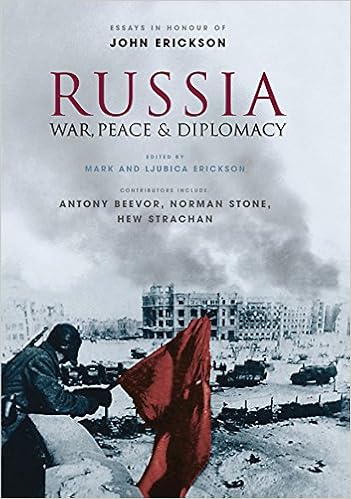
The following festschrift under review was done in honour of the late, great John Erickson, an eminent British historian of Soviet Russia acclaimed as one of the world's leading experts on the Red Army and the Great Patriotic War as the Second World War is known in Russia. In Erickson's honour, this book was commissioned featuring essays from leading British, American, Russian, Israeli and German historians, which despite the title, many of the essays here deal with other nations, especially Germany, but everything here more or less has something to do with Russia. Owning to the nature of such a book, the parts tended to be greater than the sum, but the good essays here are very good indeed. With the exception of the first essay dealing with the 17th century Scots soldier of fortune Patrick Gordon, all of the essays deal with the 19th, 20th or 21st centuries.
Since this is a collection of essays intended to honour Erickson, the reviewer will provide a brief summary of each in order to provide a feel for the book. In "Cock of the East", Dmitry Fedosov gives a brief, but interesting character sketch of the 17th century Scots soldier of fortune General Patrick Gordon who rose to become Russia's leading general and a close friend of Peter the Great, which is marred slightly by Fedosov's hero worship of the subject. During the course of his mercenary career, Gordon fought at various times for Sweden, Poland and Russia and freely changed sides to whoever was offering him the best pay; the fact that there was a bidding war for his services speaks for his ability. Gordon was a devout Catholic who relocated to Eastern Europe to escape anti-Catholic laws in his homeland, but he seemed to have been just as happy fighting for his former enemies against his former employers without troubling his conscience in the slightest. Every other topic in this book deals with the period from the 19th century to the present, so the inclusion of this 17th century mercenary presumably relates to the fact that Erickson was a Scottish military historian of Russia, so what better way to honour him than an essay dealing with a Scots soldier who ended his career as a Russian general. Perhaps most notable were Gordon's constant complaints about the rampant corruption and venality of Russian officials, truly a case of plus ça change, plus c'est la même chose.
In "Jomini versus Clausewitz" A.N. Mertsalov weights out the two leading Western military theorists and finds the former much superior to the latter. Since Clausewitz is normally considered the better thinker today, Mertsalov's essay is worth reading for an alternative point of view, and is especially noteworthy for covering Clausewitz's considerable and often disastrous influence in Russia. Perhaps because Mertsalov is a World War II veteran, there is a real anger about Clausewitz's "inhuman German militarist ideology" and how it influenced how the Red Army fought World War II with the cult of the offensive, mindless authoritarianism, the conviction that willpower alone was sufficient for victory with no thought about such things as logistics, and a savage code of discipline to inspire that willpower. Mertsalov argues that the Red Army only started to become an effective fighting force starting in late 1942 after Red Army commanders finally broke free of the Clausewitz cult. The picture that Mertsalov paints of the Russian military history today is a most dismaying one of hacks beholden to the Ministry of Defence committed to upholding the trinity of three cults, namely those of Clausewitz, Zhukov and Stalin. However, Mertsalov is taking things too far when blames Clausewitz for Stalin's "irrational strategy and diplomacy". Irrational is a perfect term for Stalin's way of doing things, but this reviewer is certain that more than the influence of Clausewitz was at work here.
Christopher Bellamy's "Catastrophes to come..." is a vivid and very fascinating study of Russian/Soviet thinking about future war, and highlights the often overlooked continuities between the Imperial Russian Army and the Soviet Red Army. Contrary to myth, the leadership of the Red Army were not workers and peasants all fired up by Bolshevik fervour, but rather more often than not the same old officers of the Imperial Army. A revealing anecdote concerns a military manual from the World War I, complete with the Romanov double-headed eagle on the cover, which was still the Red Army's basic manual for training officers as late as 1921. Despite the inherent interest of the subject, Bellamy's efforts at gallows humour since as joking about the botched rescue attempt at a Moscow theatre in 2002 are annoying. Moreover, Bellamy, through he shows that there was much forward thinking in the Russian\Soviet armies does not address the question about why these ideas were not put into practice instead of merely being considered? It is one thing to come up with a good idea, another to put it into practice. It is true that in the interwar period, there were a group of highly innovative officers centred around Marshal Mikhail Tukhachevsky who were amongst the world's most forward-looking officers who might had prevented the disasters of 1941 had Stalin not shot them all in 1937, and certainly by 1944 the Red Army had reached a level of operational excellence that made it superior to the Wehrmacht, but there have been other occasions where quite frankly, Russian military leadership has left much to be desired. Indeed, few countries have experienced such vicissitudes between outstanding and dreadful military leadership as Russia, a question that Bellamy does not pose.
In John Chapman's study of Anglo-Japanese intelligence sharing and co-operation during the Russian-Japanese War of 1904-05 is an eye-opener, and is particularly interesting about how German support of Russia in that conflict helped to shape British threat perceptions . In "Britain and Russia" Hew Strachan traces in authoritative detail Anglo-Russian relations in 1914-17, and the intrinsic tensions between two nations widely separated not only geographically, but culturally, economically and politically. Strachan notes the inherent strain in the alliance between British democracy and Russian autocracy, and concludes that British efforts to promote more democracy in Russia, through praiseworthy in the long run tended to be detrimental in the short run. In "Military Policy, International Relations and Soviet Security" Robert Service looks at early Soviet foreign policy, and does an excellent job in highlighting the often distorting extreme Germanophilia of Lenin and the other Bolshevik leaders. As Service wryly concludes, the idea of Germany as the natural ally of Soviet Russia proved to be highly damaging to the latter state, and when the Soviets finally did get to establish a Communist state on German soil after 1945, it did not matter as Germany was no longer a great power. Indeed, one might wonder at the wisdom of the policies of Lenin and his successors who believed that Germany, preferably a Communist one but even one led by the extreme right was a natural ally for Soviet Russia in destroying the international system created by the Treaty of Versaillies. In the sense that Germany was a disruptive force out to challenge and destroy the Versailles system, Lenin was correct that the Reich was a natural ally of the Soviet Union. But given that the military assistance provided by the Soviet Union in helping Germany circumvent the military disarmament clauses of Versailles laid the foundations in the 1920s for Hitler's Wehrmacht of the 1930s, the same Wehrmacht that to go on to attack the Soviet Union in 1941, starting a war that cost the Soviet people at about 20 million dead, one has to wonder if Soviet assistance for Germany's challenge to the Versailles order was really a good idea from their (or anybody's else) viewpoint. If the Part V of Treaty of Versailles, which had disarmed Germany remained in force, then Germany would had no air force, no tanks, no heavy artillery, no conscription, etc, etc, in short would not had the military power to launch Operation Barbarossa, something that surely in the best interests of the Soviet people.
In "Turkey in the Russian Mirror" Norman Stone offers a typically fascinating if rather breezy sketch of Russian-Turkish relations and a comparative study of modernization in the two states. Stone offers much that that is new such as the impact on Muslim refugees from the Crimea and the Caucasus had on modernization in the Ottoman Empire and the idea of the latter empire not only as the destroyer, but also a continuation of the Byzantine Empire. Stone is quite right that most Greeks, far from viewing the Turkish conquest as a disaster in the 15th century, actually welcomed the Turks as preferable to the much hated Latin West. Through Stone assembles some intriguing evidence to the Hellenistic-Roman character of the Ottoman Empire, but to this reviewer seems to downplay the Islamic nature of the Ottoman state too much. As usual, Stone's Turkophila sometimes leads him astray as when writes that the Turks were forced to enter World War I to avoid partition at the hand of the Allies, when in fact the Allies were desperate to keep Turkey out of the war, and the Turkish decision to enter the war on the German side was due to a conscious choice on the part of the Young Turks that this was the best way to reacquire not only recently lost lands, but to win for the Ottoman Empire vast new territories in the Caucasus and Central Asia. Mary Buckley does her best to make a dull subject interesting in "The Ideology and Realities of Soviet "Women's Tractor Driving". Essentially her conclusions are that despite the best efforts of the Soviet regime to get more babas on the tractor, local chauvinism against women driving usually won out.
In "The German Military's Image of Russia", Jürgen Förster offers a devastating look at the prejudices both anti-Slavic and anti-Semitic which characterized the German Army's thinking about Russia before and during World War II. Reading Förster's essay, it is impossible to believe the German fairy tale about highly competent, decent and sane German generals who unfortunately happened be stuck working for an insane Führer. Rather the relationship between Hitler and his generals seems to be a case of like attracting like with both considering the Red Army a joke that would be no match for the German Army and both viewing the Russian people as a mindless mass led by a gang of criminal Jews. Which brings us to the next essay, Omer Bartov's "Celluloid Soldiers", which is a most captivating study of the various apologias offered by German films after 1945. Bartov makes the point that German films tended to show the Wehrmacht as fighting a heroic, noble and clean war fully deserving of praise and admiration which happened to be for a nasty, inhuman regime. In this way, the German soldier of World War II was transmuted from Nazi warrior fighting ruthlessly for his Führer into a heroic victim: a brave, honourable and apolitical soldier caught up in a war that he did not understand. That picture is particulary offensive when one considers the huge role the Wehrmacht played in the Shoah in Russia. Essentially as Bartov shows, German cinema tried to claim that there were two wars going on, the good one waged by the Wehrmacht and the bad one waged by the SS against the Jews. Of course as Bartov points out, the Wehrmacht was as blood-strained as the SS, and that anyhow, everything the Wehrmacht did either by advancing or holding as long as they did helped to facilitate the "Final Solution". Every place the Wehrmacht took in Russia meant death for its Jews; every day the Wehrmacht held out meant death for millions of Jews. Something to think about the next thing one watches a German film dealing the suffering of the 6th Army at Stalingrad. And this is not even considering the role the 6th Army played at Babi Yar and too many other places to be named where they were most helpful with assisting the SS in massacring Jews. As Bartov notes, many a German film has shown the ordeal of the 6th Army at Stalingrad; none has shown the 6th Army at Babi Yar.
Roger Beaumont in "The Devil his Due" looks at the often bizarre views held by Americans about their Soviet allies during World War II. At best, it can be said that in wartime, one should not disparage one's ally. But the idea that Stalin's Russia was a basically liberal state with the same values and interests as the United States is still a very strange one. Antony Beevor's "Stalingrad and Researching the Experience of War" about his research for his Stalingrad battle sounds highly boring, but is more interesting than one might expect as Beevor relates his encounters with German and Russian veterans. Reina Pennington's "Women and the Battle of Stalingrad" offers an exhaustive account of women fighting and dying in the great slaughterhouse on the Volga. Through the fact that women fought in Stalingrad is not as ignored as she makes out, nonetheless she does highlight the extraordinary bravery and self-sacrifice of Russian women. Pennington's essay is a tad too long, but one is left breathless with the amazing courage, fortitude and strength of Russian women during one of history's most hellish battles. Having said that much, just as there must had been men who were afraid to die at Stalingrad, surely they must had been women as while? One is compelled to ask that question given that none of the women Pennington deals with show any of the human emotions in wartime like fear and horror. David Glantz's "Forgotten Battles of the Soviet-German War" is something of a misnomer as many of some battles are in fact not forgotten, but just downplayed. But still, Colonel Glantz does demonstrate the Orwellian nature of Soviet history with entire battles airbrushed out of history in order to protect Stalin's reputation and later that of his leading generals. Stalin's fondness for offensive war at all costs regardless of the circumstances caused a great many needless defeats for the Red Army as Soviet troops were sent into offensive after offensive without proper logistical support and were cut off and destroyed by the Germans. One wonders if the Soviets had an more rational leader, could they had won the war earlier and at less cost?
Sergei Kudryashov's "Ordinary Collaborators" studies the Travniki guards as Red Army POWs, mostly, but not entirely Ukrainian who worked as SS guards at Operation Reinhard death camps were known after the camp that they were trained. The Travniki men were all volunteers, and were either Volksdeutsche (ethnic Germans from Eastern Europe) or Red Army POWs. Leading aside the former, whose willingness to do the SS's most dirty work is beyond doubt, it is true that the Germans treated Soviet POWs extremely badly, and that to escape the life of the POW camps was the most important reason why Red Army POWs volunteered to become Travniki men. Ukrainians and the Volksdeutsche were the largest groups amongst the Travniki guards, but there were also Russians, Poles, Belarussians, Tartars, Georgians, Armenians and Azerbaijanis who were trained at the Travniki camp. Following the lead of Christopher Browning's 1992 book Ordinary Men, Kudryashov offers the chilling, but correct conclusion that almost anybody can become a murderer. Through Kudryashov is right that the Travniki guards were perpetrators who willing chose the course they took and were not victims in any sense, he wastes too much time defending KGB files as a source of evidence. Inevitably given the subject matter of the Travniki guards, the name John Demjanjuk, who is no doubt the best known of the Travniki men, emerges as a major topic. Kudryashov is rather annoyed by the aggressive claims of Demjanjuk's lawyer Yoram Sheftel of a KGB plot to frame Demjanjuk, pointing out that 1) it is not likely that the KGB would go to all the trouble of producing false documents to frame otherwise obscure retired Cleavland autoworker and 2) if there really was a plot to frame Demjanjuk, then Sheftel would never have given access to the files on the Travniki men in the Lubyanka that established that through Demjanjuk was a Travniki man, he was not the sadistic guard known as "Ivan the Terrible" at Treblinka. All of this true, but takes up too much space. Having said that much, if there any Demjanjuk fans who wished to take an issue with this review, please note the following: 1) Demjanjuk was a Travniki guard 2) Demjanjuk was not "Ivan the Terrible" and 3) Demjanjuk was a guard at Sobibor, which makes him guilty of crimes aganist humanity. Even one accepts Demjanjuk's rather implausible claim not to have killed anyone personally, by the sheer virtue of being a guard at Sobibor, Demjanjuk helped in his own small way to facilitate the workings of that death camp.
James Cant's study of the SS-20 missile explores Soviet decision-making with the development of the SS-20 missile in the 1960s-70s. In particular, Cant unveils the interaction between the Soviet military and what can only be called the Soviet industrial-military complex, and argues that it was bureaucratic politics as much military needs that led to the development of the SS-20. Paul Dukes "Cold Wars New and Old" argues in a somewhat muddled fashion that the interaction between the Washington conference of 1921-22 on the Far East and Soviet security policy at the same time was a precursor of the Cold War. Sally Cumming's essay on Central Asia is not really about the past at all, but rather the present deals with the corrupt, authoritarian post-Soviet states of the region, usually run by the same uninspiring apparatchiks who misgoverned Central Asia during the Soviet times. From Communist Party boss to President-for-Life of the various stans is no improvement. Only Kyrgyzstan has attempted, albeit unsuccessfully so far to break from the stifling authoritarian mould that afflicts the region. A major weakness of this essay is the focus on "Eurasian maneuvers", namely the geopolitical competition for influence in this oil-rich region that links together Russia, China, the Middle East and the Indian subcontinent. It is true as Cumming contends that Russia, China, the United States, Turkey, Iran, Pakistan and the European Union are all competing with each other to bring Central Asia in their sphere of influence, but the emphasis on geopolitical competition along the "new Silk Road" is taken too far. It rather makes the Central Asian states sound like the balls in a pinball machine, moving wildly in all sorts of direction based upon whatever external shock they receive at the moment with no real control over their destiny. Barring military intervention, it will always be local politics that will decide the fate of Central Asia. What happens on the streets of Tashkent and Samarkand will always be more important in deciding the fate of Uzbekistan for instance, then what decision-makers in Moscow, Beijing, Washington, Ankara, Tehran, Islamabad and the capitals of Europe may or may not decide to do. Only military intervention can challenge the supremacy of local politics over Great Power politics in Central Asia or anywhere else in the world for that matter. Having said that much, there is no disputing Cumming's conclusion that as long as Central Asian elites still adhere to their present course, the region is doomed to poverty and political instability, and with even more Islamism and terrorism than what currenly afflicts Central Asia. Democracy is still the best way forward.
Donald Cameron Watt's essay "Rumours as Evidence" is a highly interesting study of how rumours were both started and influenced decision-makers before and during World War II with a particular focus on the Soviet Union. One wishes that Watt's essay was longer. It is highly revealing that when the British Foreign Secretary Anthony Eden visited Turkey in January 1941 with the aim of getting Turkey to assist Greece, that Moscow was thrown into a state of panic. Molotov told the Italian Ambassador Augusto Rosso that the Soviet Union would soon be faced with an Anglo-Turkish invasion of the Crimea, and asked for Italian help to resist the British and the Turks. That Stalin and Molotov could so be wrong about the purpose of Eden's visit suggests that they viewed Britain rather than Germany as the main danger in early 1941, something that Stalin's apologists who claim that Stalin only signed the pact with Germany in 1939 to gain time to re-arm for the inevitable clash with the Reich ought to consider (but no doubt won't as there is something about good old Uncle Joe that clouds reason for some people). Finally, Lynn Hansen's "The Edinburgh Conversations" traced the meetings that Erickson sponsored in the 1980s between Soviet, British and American military and diplomatic officials. Hansen tries hard to argue for their importance for helping to end the Cold War, but to this reviewer seems to be greatly overstating his case. All said, a mixed bag of essays, but still much better than normal than books of this kind.
No comments:
Post a Comment