Sheppard is an immensely creative writer, never once needing to 'cry wolf' and settle for the label 'antisemite' as defence for Israel. He looks at a broad range of arguments from journalists, writers, politicians and people when discussing Israel, and builds his case very convincingly for what is fair, and unfair criticism of Israel. He even rejects Bat Ye'or's prolific Eurabia, which has become a source of inspiration to so many writers on this subject. This may ruffle a few feathers among the die-hard Israel lovers...
Quite interestingly, and probably quite indicative of the arguments relating to Israel, is the preface and introduction, both of which are 51 pages long (out of a 310 page book). But this by no means reading 51 pages before getting to the heart of the matter. From the first page Shepherd wastes no time in getting down to business saying 'Arguments relating to this subject very quickly become personal; arguments should be judged on their own merits, not on who's making them.' I had quite forgotten what part of the book I was reading before turning the page and seeing "Chapter 1". It's fair to say this is an engrossing read!
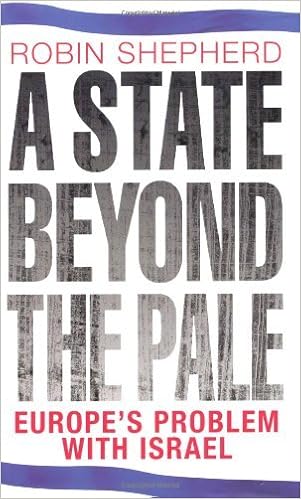
It would be easy to compare this to The Case for Israel by Alan Dershowitz, but this is something very different, and deals with this topic in a very unique way.
One of my favourite 'dissections' was in showing how anti-Zionism is anti-Semitism. For without Zionism, Israel would not exist. And without Israel, as we saw from the Holocaust, the Jews would not exist for very much longer. In his comparison he takes the minority of Jews who are anti-Zionist and compares them to being much like the African village leaders who sold so many millions of their people into bondage.
Another argument I thought brilliant, was the defence of the organisation called MEMRI, which translates Palestinian and other Islamist writings and broadcasting in the Middle East showing how widespread antisemitism and incitement to jihad are etc. Many Israel-haters simply dismiss MEMRI by claiming it is full of former Israeli military personnel. Shepherd argues that it doesn't matter who works there, either the translations from Arabic sources are accurate, or they aren't.
This book has cost Shepherd dearly. Once having worked at Chatham House in the UK, he was summarily expelled from that institution because of his opinions which deviate from the politically correct discourse about Israel in much of Europe. Chatam House, ironically claiming to be a '...world-leading source of independent analysis, informed debate and influential ideas on how to build a prosperous and secure world for all.'
As a Brit myself, the sorry state of affairs is all too evident. In the stories continually appearing in the headlines, from MI6 (the UK's CIA) inadvertently using al-Qaida's top man in Europe for intelligence gathering. Or the Mayor of London, inviting a radical Islamist to give a talk on affairs relating to 'inter-community harmony' in London. It is quite clear, the British establishment doesn't even understand who its friends are, even a decade after 9/11, and after the London bombings of 7/7 2005.
I did want say it would be interesting to see how opponents of Shepherd answer his book, but as with The Case for Israel those same people chose not to answer; instead, simply attempting to deceive and dissuade people from reading it. In the realm of public discourse, Shepherd has raised the bar to a new level, and his work is simply in a category of its own. I'm sure it is destined to become the book by which all others on the subject are judged.
I would defy any open-minded person to read this and not come away with a much better and fairer understanding of what is legitimate - and illegitimate - discourse when discussing Israel.

No comments:
Post a Comment